James Cull, Birkbeck Digital Education Consultant, spoke at the 2026 Media & Learning Association Conference in Belgium. Here, he shares his account of the event and some key learnings and reflections.
Every June, a small Belgian university town becomes the unofficial capital of educational media. This year I was fortunate enough to be invited to speak at the Media & Learning Association Conference 2026 in Leuven, Belgium on the 17th and 18th June, co-hosted with KU Leuven’s Learning Lab, and so got a free ticket to join educators, students, technologists and institutions to explore the theme: “Co-creating the future of learning.”
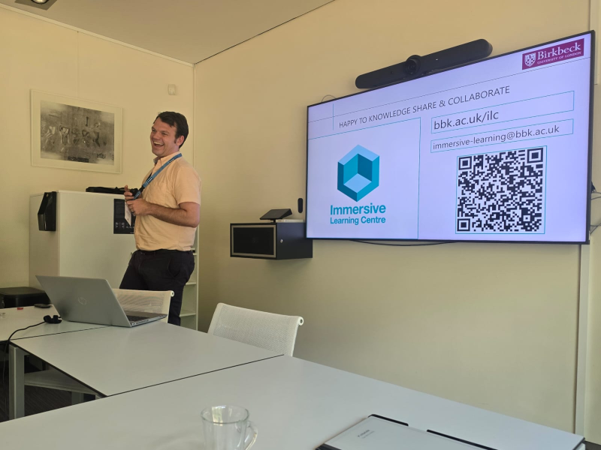
Anyone who has tried to innovate, implement digital tools into teaching or work out how education should respond to an ever-changing technological landscape, knows that “co-creating” is easy to say and hard to operationalise. I was asked to provide a perspective from the Immersive Learning Centre entitled “Building an Immersive Learning Community: Equipping Staff and Students to Lead Across Subject Areas”, to show how we are trying to build up capacity and put the tools in the hands of the users; I was thrilled to discover a shared purpose and that the approach we take in the Birkbeck Immersive Learning Centre is shared across Europe, the US and Australia: there are no better co-creators than those who will be implementing these new ideas.
The conference’s fourteen themes gave a decent map of where higher education’s collective head is at right now: flexible learning pathways, AI-supported co-creation, immersive and narrative-driven learning, new approaches to assessment, accessibility, lifelong learning. As I am only (checks notes) one person, it wasn’t possible to attend all the sessions I wanted, but here are some reflections, learnings and ideas I managed to gain whilst at this two-day conference.
Navigating a fragmenting reality
The conference kicked off with a fascinating talk from Rob Morgan, a visiting fellow at King’s College London, narrative designer, immersive experience designer, and so much more. In this fascinating talk, he proposed that the next big philosophical shift in how we relate to our own reality will be with the further spread of Meta’s smart glasses (already 9-10 million units sold) and their capability to “reskin” reality using AI. How do we prepare our students, and ourselves, to navigate an increasingly fragmented reality? Not only are we all seeing different content online, depending on what the all-powerful algorithm dictates, but with these smart glasses, we can no longer assume we are all seeing the same world around us. He raised some juicy questions: do we have the right to see and be seen however we choose, and do others have the right to see us as they choose?
Some ideas to get you thinking
The University of Adelaide had some interesting research from a student survey about pre-recorded content:
- 61% of respondents always or usually re-watch pre-sessional videos
- 85% of students find a lecturer talking in front of slides to be the most effective form of pre-sessional video
- 56% of students always or usually watch the videos with subtitles enabled, with 67% reporting that subtitles actually improve their understanding of the concepts covered.
They have implemented presentation training for their academics, as they found that presentation quality matters more than production quality. They also found the adoption of new media initiatives is much more effective if there is one person per faculty to act as a champion, so people know who to go to in order to find out more. If you’re interested in finding out about Birkbeck’s facilities, get in touch with Recording-Suite@bbk.ac.uk.
Interestingly, at VU University Amsterdam, students are given paid roles to act as partners with staff and the Centre for Teaching and Learning.
For many universities, a key question is how to get your academics to engage with new tools? Some university staff suggested that reframing this as a solution to a problem, rather than a way to merely enhance delivery, can lead to better uptake.
A personal milestone
I delivered my talk on how we use ThingLink and BodySwaps as tools for staff and students to lead on their own subject areas to a full capacity room. It was my first conference talk! If you’re interested in implementing ThingLink or BodySwaps to create your own interactive media, please get in touch (immersive-learning@bbk.ac.uk).
Further information