Tag Archives: immersive learning centre

How should education respond to an ever-changing technological landscape?

James Cull, Birkbeck Digital Education Consultant, spoke at the 2026 Media & Learning Association Conference in Belgium. Here, he shares his account of the event and some key learnings and reflections.
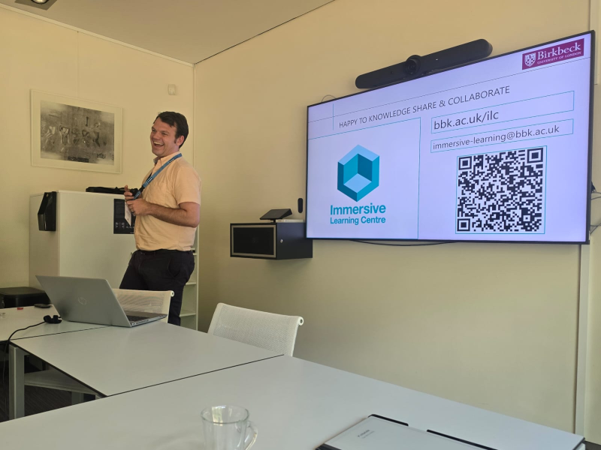
James Cull delivers his presentation at the 2026 Media & Learning Association Conference in Belgium

Every June, a small Belgian university town becomes the unofficial capital of educational media. This year I was fortunate enough to be invited to speak at the Media & Learning Association Conference 2026 in Leuven, Belgium on the 17th and 18th June, co-hosted with KU Leuven’s Learning Lab, and so got a free ticket to join educators, students, technologists and institutions to explore the theme: “Co-creating the future of learning.”

Anyone who has tried to innovate, implement digital tools into teaching or work out how education should respond to an ever-changing technological landscape, knows that “co-creating” is easy to say and hard to operationalise. I was asked to provide a perspective from the Immersive Learning Centre entitled “Building an Immersive Learning Community: Equipping Staff and Students to Lead Across Subject Areas”, to show how we are trying to build up capacity and put the tools in the hands of the users; I was thrilled to discover a shared purpose and that the approach we take in the Birkbeck Immersive Learning Centre is shared across Europe, the US and Australia: there are no better co-creators than those who will be implementing these new ideas.

The conference’s fourteen themes gave a decent map of where higher education’s collective head is at right now: flexible learning pathways, AI-supported co-creation, immersive and narrative-driven learning, new approaches to assessment, accessibility, lifelong learning. As I am only (checks notes) one person, it wasn’t possible to attend all the sessions I wanted, but here are some reflections, learnings and ideas I managed to gain whilst at this two-day conference.

Navigating a fragmenting reality

The conference kicked off with a fascinating talk from Rob Morgan, a visiting fellow at King’s College London, narrative designer, immersive experience designer, and so much more. In this fascinating talk, he proposed that the next big philosophical shift in how we relate to our own reality will be with the further spread of Meta’s smart glasses (already 9-10 million units sold) and their capability to “reskin” reality using AI. How do we prepare our students, and ourselves, to navigate an increasingly fragmented reality? Not only are we all seeing different content online, depending on what the all-powerful algorithm dictates, but with these smart glasses, we can no longer assume we are all seeing the same world around us. He raised some juicy questions: do we have the right to see and be seen however we choose, and do others have the right to see us as they choose?

Some ideas to get you thinking

The University of Adelaide had some interesting research from a student survey about pre-recorded content:

  1. 61% of respondents always or usually re-watch pre-sessional videos
  2. 85% of students find a lecturer talking in front of slides to be the most effective form of pre-sessional video
  3. 56% of students always or usually watch the videos with subtitles enabled, with 67% reporting that subtitles actually improve their understanding of the concepts covered.

They have implemented presentation training for their academics, as they found that presentation quality matters more than production quality. They also found the adoption of new media initiatives is much more effective if there is one person per faculty to act as a champion, so people know who to go to in order to find out more. If you’re interested in finding out about Birkbeck’s facilities, get in touch with Recording-Suite@bbk.ac.uk.

Interestingly, at VU University Amsterdam, students are given paid roles to act as partners with staff and the Centre for Teaching and Learning.

For many universities, a key question is how to get your academics to engage with new tools? Some university staff suggested that reframing this as a solution to a problem, rather than a way to merely enhance delivery, can lead to better uptake.

A personal milestone

I delivered my talk on how we use ThingLink and BodySwaps as tools for staff and students to lead on their own subject areas to a full capacity room. It was my first conference talk! If you’re interested in implementing ThingLink or BodySwaps to create your own interactive media, please get in touch (immersive-learning@bbk.ac.uk).

Further information
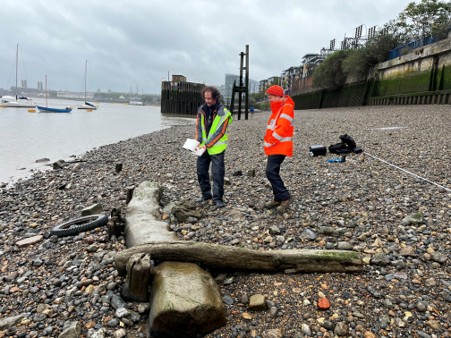
Using immersive technologies to explore archaeological remains on the Thames foreshore

Members of Birkbeck’s Immersive Learning Centre (ILC) visited the Thames foreshore with Birkbeck Archaeology staff and students to investigate maritime artefacts at low tide. What followed was an unforgettable hands-on experience that combined history, technology, and creativity. Birkbeck work placement student, Jorge Bau I Munguira, shares how it went in this blog, after interviewing ILC staff member Luca Battiston.

A race against the tide

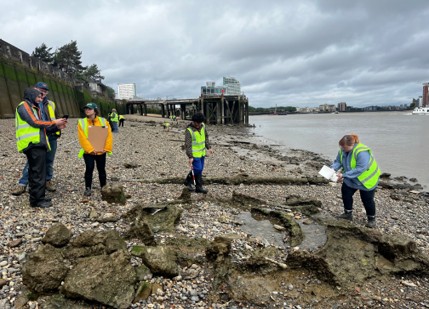
Luca Battiston and Dr Claire Harris using the Leo Artec Scanner

Since the Thames foreshore is only fully exposed at low-tide, we had an early start and a time-limited opportunity to explore archaeological remains between the high and low tide marks. We carried ILC 360° cameras & 3D scanning equipment to create interactive models for students, enabling them to learn and practice the techniques and methodologies used to create 3D models and immersive media in the field.

These models will be made available upon our return to campus. Due to the incoming tide, we had approximately 1.5 hours total time, including carrying the equipment to the shoreline, scanning the items, and collecting images for processing. Even under these tight time restrictions, we still produced some incredible results.

Scanning history

Luca Battiston with one of the student groups of the ‘Thames Through Time’ Birkbeck field school

We used Artec professional scanners and showed alternative scanning techniques to produce highly detailed 3D digital models from a series of photographs. The 3D models taken during the session can be viewed on phones, computers, and even VR headsets. Since much of London’s history lies beneath the water line at high tide, and it is not permitted to remove finds from the beach without a licence, we could capture and preserve these artifacts digitally and later create interactive models of objects found along the riverbank that students would otherwise never get to see.

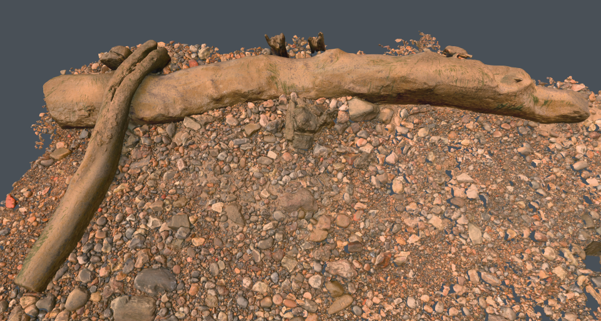
Some of the greatest finds of the day included a large dock structure, measuring over four metres in length, made from reused ship timbers including part of a rudder, which dated back centuries to the days when large ships would dock along the Thames. Archaeologist Dr Lesley McFadyen provided expert knowledge and historical context about the discoveries, and ensured the correct archaeological procedures were followed. Witnessing something so historically important, and often invisible, added another level of excitement to the session.

A screen capture of one of the 3D models created during the Birkbeck Archeology Field School

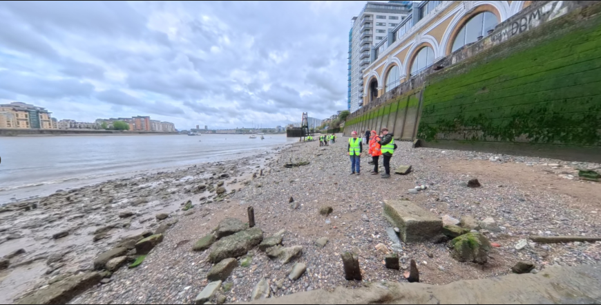
Throughout the session, the ILC team taught student groups how to properly position themselves while scanning, ensure they captured enough images to make a complete model, and described how to recognise potential issues when scanning irregular surfaces. Meanwhile, they also worked with the 360° cameras, providing panoramic views of the area and capturing the energy of the day, generating a complete immersive record of the event. Given the short amount of time, it was amazing to see the outcomes.

A screen capture from one of the 360° images shot during the Birkbeck Archaeology Field School

Students were ‘hooked’

The response from the ‘Thames Through Time’ field school students was incredibly positive. Many students stated they were ‘hooked’ not only because of the technology they were using but due to the unique location where they were utilising it. For many students, this was their first exposure to 3D scanning equipment and experiencing it outside in the open air on the shores of the Thames while discovering pieces of maritime history dating back hundreds of years is an experience they’ll never forget.

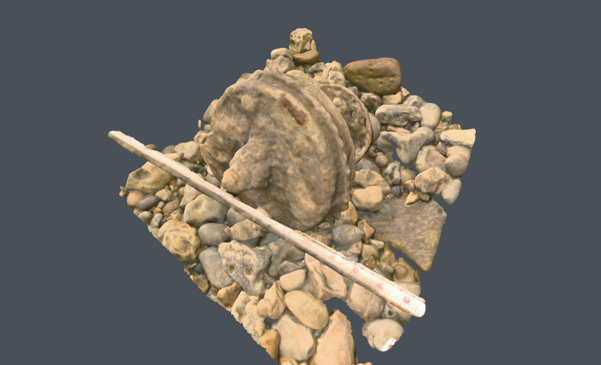
For many students, viewing a portion of London’s riverbed in detail as an interactive 3D model on a computer screen represented a whole new way for them to engage with history and their surroundings. This fusion of physical exploration and digital design created a dynamic that cannot be replicated inside a typical classroom and, as cultural institutions continue to embrace this technology, these skills could provide important employability opportunities.

The ILC and archaeology teams are already planning a second session for students to review and build upon their 3D models and learn more about the photogrammetry process.

A screen capture of one of the 3D models captured by the Birkbeck Archaeology Field School students

Immersive learning beyond campus walls

This trip shows exactly what Immersive Learning Centre’s are all about – immersing your learning beyond the limits of a lecture hall and into the real world. In addition to using cutting edge technologies designed for immersive experiences, we incorporated outdoor exploration and real discoveries from London’s rich history, allowing students to discover their own history rather than only studying it from a book.

In addition, it highlights how easy it is for anyone to take advantage of this type of experience. Immersive technologies (including 360° cameras and digital audio recorders) are available to checkout for free from Birkbeck’s library – all you need is your student or staff ID card. If you’re currently working on a project (research or creative), or if you’d like to try out immersive technologies and what can be achieved with them, then now is the time!

Trips like this Thames Foreshore trip demonstrate that, with some creativity and proper equipment, learning can occur anywhere, even along one of the world’s oldest rivers with tidal waters rising!

Further information