Esther Breithoff is a Senior Lecturer in Contemporary Archaeology and Heritage, and UKRI Future Leaders Fellow based in Birkbeck’s School of Historical Studies. In this blog, her collaborator, Danae Hendrickson shares the story of ‘Bells of Hope’, a creative collaboration that brings attention to the continuing impacts of unexploded ordnance.
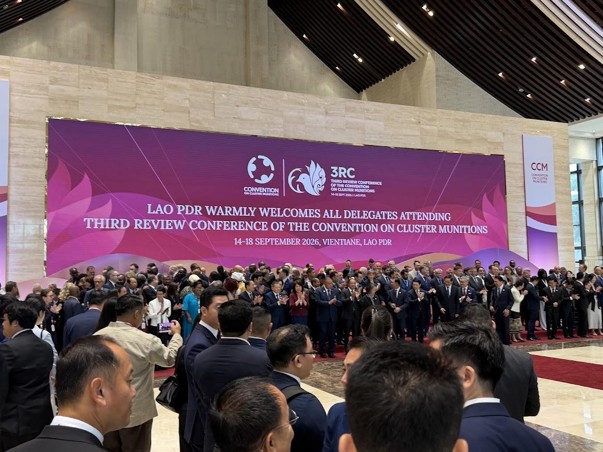
In September 2026, Bells of Hope travelled to Vientiane, Laos, for the Third Review Conference of the Convention on Cluster Munitions. The project comprises a film and a collection of bells made from metal war debris left by the US Secret War in Laos. Together, they brought the ongoing realities of living amidst unexploded ordnance to an international gathering of more than 800 delegates.
Bells of Hope is part of Dr Esther Breithoff’s UKRI Future Leaders Fellowship project, Ecologies of Violence. It was created in collaboration with artisans in Ban Naphia, Xieng Khouang Province, ARTICLE22, Legacies of War, Humanitarian Media Agency, and Birkbeck’s Carena Institute of Sustainable Archaeologies, with creative input from ecological and social artist Antony Lyons. Watch the Bells of Hope film trailer here.
Bells of Hope forms part of Dr Breithoff’s project’s wider exploration of “red zones” – places where violence lingers in landscapes, materials and everyday human and more-than-human lives long after the fighting has stopped.
In France, the project collaborated with the Durand Group, Veterans Affairs Canada and artist Antony Lyons to explore the cordoned-off red zone at the Canadian National Vimy Memorial. The resulting Ecologies of Violence exhibition brought together information panels, a 3D scan of the restricted woodland and the artistic film Zone Rouge / Red Zone: Back Forest Reflections. Together, these offered different ways of encountering a landscape that remains inaccessible to the public because of unexploded ordnance and unstable wartime tunnels.
You can read more about the Vimy exhibition, its later showing at Birkbeck’s Peltz Gallery, and watch the film trailer.
Below, Danae Hendrickson, Chief of Mission Advancement and Communications for Legacies of War, reflects on how Bells of Hope came into being, where the bells and film have already travelled, and where they are going next. All photos by Danae, unless indicated otherwise.
The two films, Zone Rouge / Red Zone: Back Forest Reflections and Bells of Hope, will be shown in full together at Birkbeck Cinema in Spring 2027 for a screening and conversation in collaboration with the Birkbeck Institute for the Moving Image and The Derek Jarman Lab.
A New Future Forged
A connection to the country of Laos gifts you access to a small world of people who understand travel, culture, and war differently than most. It was in this group that we, Legacies of War, connected with Dr Esther Breithoff in 2023, but her journey to Laos began many years before. A Senior Lecturer in Contemporary Archaeology and Heritage, UKRI Future Leaders Fellow, Deputy Director – Carena Institute of Sustainable Archaeologies at the School of Historical Studies Birkbeck, University of London, Dr. Breithoff had long been researching Red Zones and particularly, as she so aptly writes, “how conflict lingers, shaping landscapes and lives as an unwanted inheritance.” This led her to a small village in Northeastern Laos, Ban Naphia, Xieng Khouang, and to the social enterprise, ARTICLE22.
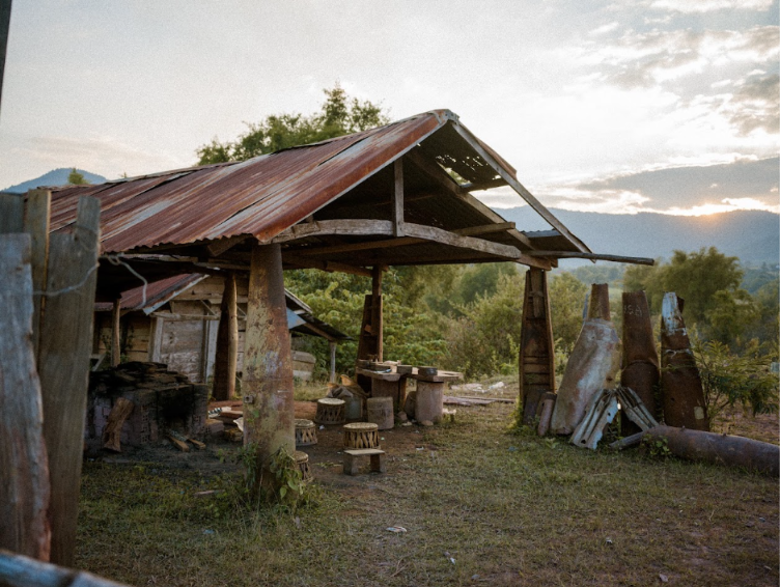
Dr. Breithoff and ARTICLE22’s Founder, Elizabeth Suda, began to explore a new collaboration inspired by both resilience and urgency. Artisans in Ban Naphia have long been creating everyday use items and jewelry made from recycled metals left behind by the U.S. bombings on Laos, which ended more than 50 years ago. What they hoped to create in partnership with these artisans was a collection that invited renewed interest from the global community toward addressing the work of clearing bomb-filled land in Laos. In 2024, Dr. Breithoff returned to Laos, this time with Legacies of War. Her time spent traveling with Lao diaspora and peace activists in Laos, provided deeper insight into how international communities engage on the issue of mine action. Legacies of War were invited to join this collaboration, to ensure that those still impacted by this war are centered.
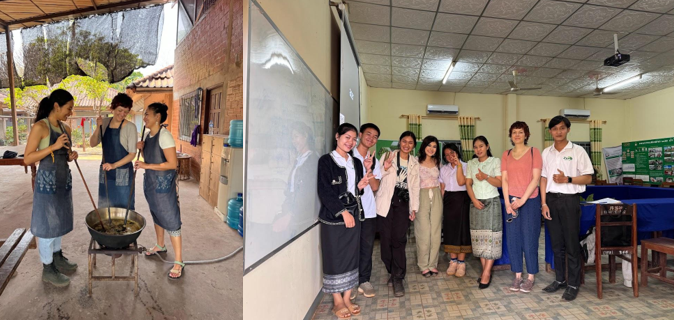
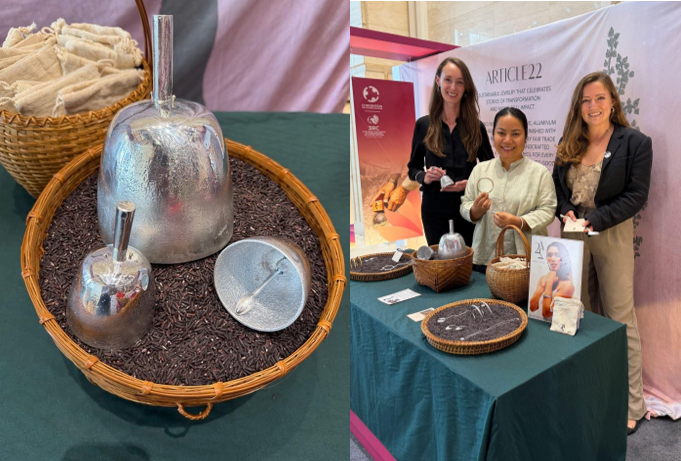
One year later, the collaborative project, The Bells of Hope became a reality in 2025 through Dr. Breithoff’s Ecologies of Violence, Birkbeck and funded through its Carena Institute of Sustainable Archaeologies and UK Research and Innovation (UKRI) Future Leaders Fellowship. Production of The Bells of Hope began – new molds were 3D printed, shipped from the U.S. to Laos, and hand delivered to the remote village in Xieng Khouang Province. Ban Naphia artisans methodically crafted this new collection and after many trials the prototypes were perfected. Dr. Breithoff returned to Ban Naphia together with ARTICLE22 and a local film crew, Humanitarian Media Agency, to capture the process of making the bells and of daily village life – the feeding of the chickens, chopping firewood, steaming sticky rice, and gathering around the fire to eat and also to create. The clappers of these ombré polished bells are designed to pay homage to the very first pieces that these artisans crafted decades ago – spoons.
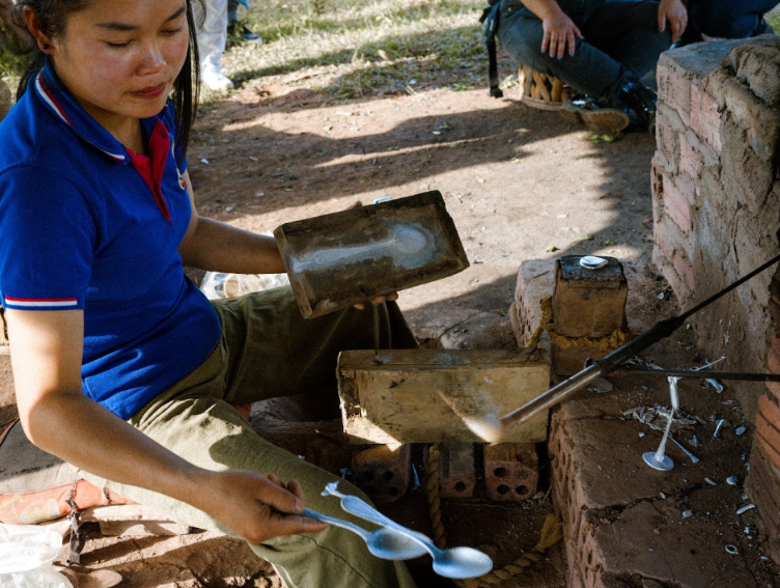
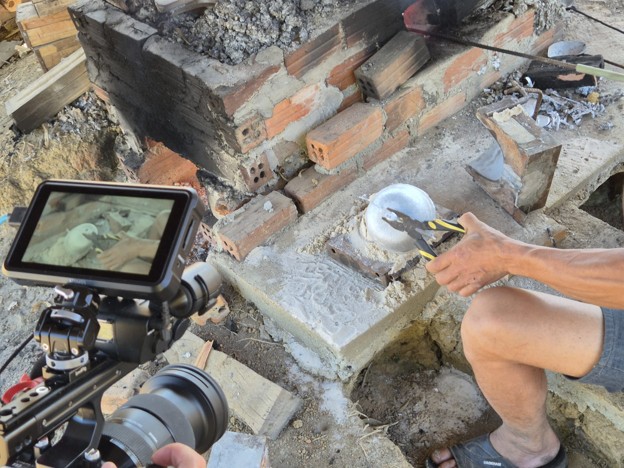
Both The Bells of Hope physical bells and the film were nearing the finish line, with ecological social artist Antony Lyons bringing his creative eye to the fine cut during the film’s post-production. It was time now for this collective to share them with the world.
Ringing The Bells of Hope
The Third Review Conference of the Convention on Cluster Munition as hosted in Vientiane, Lao PDR this September 2026. As Laos hosted the world for this historic event, they called it a homecoming for the CCM as the First Meeting of States Parties was in Laos in 2010. For Legacies of War, attending this convention felt like a homecoming, too. As a Lao American and women led organization, the duality and weight of sharing this history with the world is ever present. We were the only representation from the U.S. at this conference, and we took on the role with honor. We had the opportunity to show representatives from more than 100 countries that this is an issue that the American public cares deeply about. Despite what they may be experiencing directly with the U.S. in their own countries or what they witness in the media, Legacies had the opportunity to share our unique framework of how we have grown American support and attention toward this issue over the last 22 years.
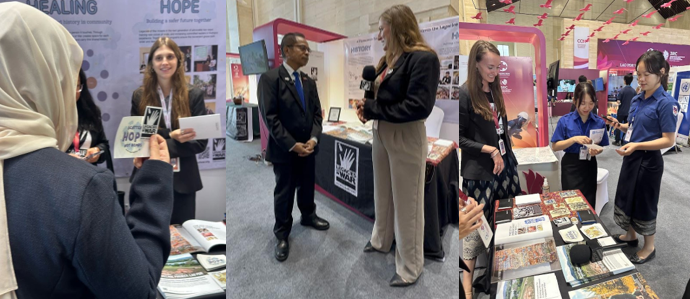
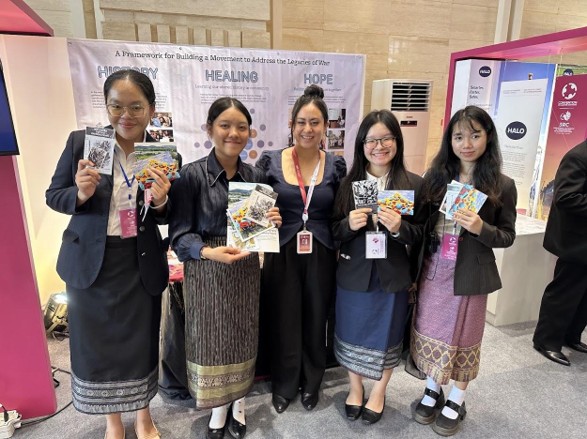
Our exhibit highlighted our three pillars: history, healing, and hope. Our goal was to inspire other countries impacted by war and cluster munitions that healing and change is possible by engaging those with lived experience and centering our stories. For the history of the U.S. bombings on Laos, raising awareness more than 50 years after the war ended is no easy task. It requires constant renewed investment from artists, writers, researchers, diplomats, veterans, youth, and diaspora communities. The collaboration with Dr. Breithoff’s Ecologies of Violence, Birkbeck, Carena Institute of Sustainable Archaeologies, UKRI Future Leaders Fellowship, and ARTICLE22 provides new ways for the public to learn and engage with this history – ways that Legacies of War is not able to access with storytelling alone.
Expanding the conversation through art
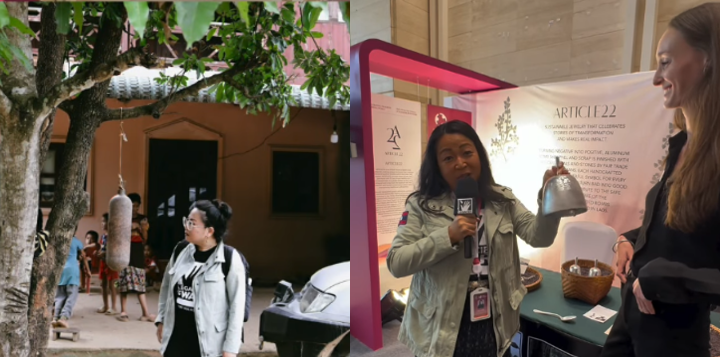
Legacies and ARTICLE22 exhibited directly next to each other at the conference, alongside just 8 other international organizations. Ready to engage with the more than 800 attendees, we centered The Bells of Hope bells and film. From the day before the conference began, you could hear the bells ring throughout the massive corridors of the convention center. During the week as attendees visited our exhibits, the bells seemed to be the first item that would draw people in and as soon as someone playfully rang it, it brought joy and curiosity – “Why a bell?” “What is it made out of” “Where can I buy one?” As soon as we responded with our intent to ring these bells in the halls of Congress, you could immediately see the understanding land so clearly. When our voices are not loud enough or welcomed, when our appearance is itself political, the sound of the bells enter the rooms ahead of us and create common ground.
If attendees were familiar with the concept of the recycled metal jewelry, they would still approach with curiosity about the bell – allowing the opportunity for us to share our story in full and get to know theirs. Sera Koulabdara, CEO Legacies of War, would share her experience of growing up in Laos and bomb shells that would be used as school bells. Her childhood memory was very important to The Bells of Hope project as it helped inspire what object would share the story of the daily impact of UXO in Laos.
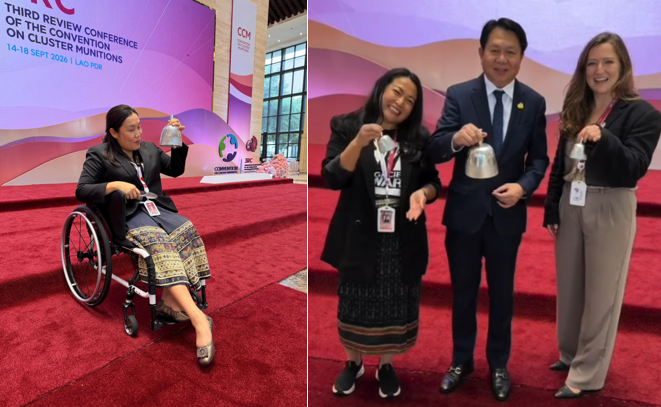
A couple of very special moments with the bell was Metta Thippawong, Director of COPE ringing the bell and Legacies, ARTICLE22, and H.E. Mr. Anouparb Vongnorkeo, Deputy Minister of Foreign Affairs of Laos, and Chair for the Third Review Conference of the Convention on Cluster Munitions (3RC-CCM) ringing the bell at the center of the conference just before the closing ceremony.
The Bells of Hope film did not always match the pace of many of the attendees who were walking around the exhibits, but for those that stopped to watch we noticed that they watched it in full – not just a few seconds but the entire 20 minutes and sometimes even longer if they missed the beginning as we had it looping. This film meets a critical need as the last films and documentaries made on the American Secret War in Laos were released a decade or more ago. This new film will continue to invite greater attention and support to address the legacies of war in Laos.
This conference was a much different audience than we normally reach. Here, each person is well acquainted with what a cluster munition is and yet few knew the details of the immense bombing campaigns on Laos and the risk that remains across all 18 provinces. As viewers watched the slow and seemingly uneventful day of the artisans of Ban Naphia making the bells, it provided a unique opportunity for foreigners to have a real look at village life in Laos; enjoying uneventful and average days while also surrounded by bomb identification posters and repurposed bomb casings into boats, spoons, and tools. The film showcases the haunting reality of the normalization of war in the most bombed country per capita in history.
Legacies of War looks forward to showing this film in more dedicated settings, and sharing The Bells of Hope with The U.S., in the halls of Congress, schools, diaspora community centers, The United Nations, and around the world for decades to come.
Thank you to Dr. Breithoff, Ecologies of Violence, Birkbeck, Carena Institute of Sustainable Archaeologies, UKRI Future Leaders Fellowship, and ARTICLE22, for the generous support and partnership that made this project possible. It is our hope that all Red Zones of the world have access to such beautiful opportunity for collaboration to share their stories and heal their land.
Find out more