Category Archives: Humanities and Social Sciences

Off the agenda: Why press silence speaks volumes about the dangers of concentrated media

This post was contributed by Dr Justin Schlosberg, lecturer in journalism and media. This post first appeared on Open Democracy on Wednesday 13 April
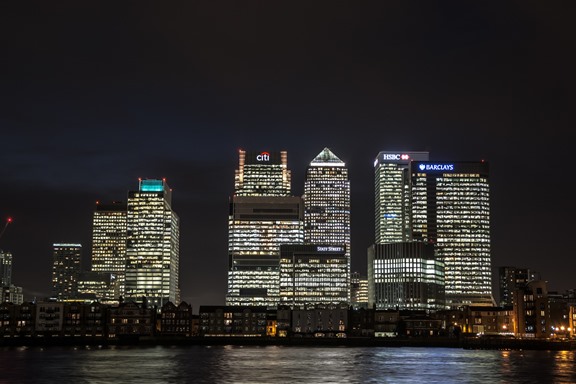
canary-wharf-1145616_1920Real press power resides in the the ability to suppress a scandal, at least as much as the ability to produce one. This is the lesson we learn repeatedly when journalists, facing the combined pressures of austerity, failing business models and an increasingly cautious and interventionist management decide enough is enough.

The latest in this new cadres of whistleblowers from inside the fourth estate is Jim Cusick, former political correspondent for the Independent. Like his former counterpart at the Telegraph Peter Oborne, who resigned amidst the appalling silence of his paper in the face of the tax scandal embroiling HSBC (coincidentally, a major advertising account holder), Cusick has pointed the finger at senior management – and an enduring Fleet Street cabal – for strangling journalism at the Indie.

The merits of the suppressed story itself – which centres on the alleged relationship between the culture secretary, John Whittingdale, and a woman thought to be a sex worker and fetishist – are certainly questionable. But not by Fleet Street standards. And this is the crux of the matter for Cusick who suggests that the story wound its way through successive newspapers with each title deciding against publication not because they thought the allegations were baseless or not much of a story.

On the contrary, it was precisely because of the perceived ‘value’ of the story, that editors and owners decided against publication. This provided the blackmail stick that supposedly made Whittingdale an ‘asset’ for a newspaper lobby hell-bent on destroying the BBC and the new system of press self-regulation recommended by Lord Justice Leveson (and enshrined in Royal Charter and law).

To be clear, Cusick offers little to substantiate this cover up, save a published email from his editor at the Indie calling off the story for reasons undeclared. But his piece does alert us to the wider question of what gets routinely left out of the mainstream media agenda – including stories that are much less ambiguously in the public interest than the not so lurid details of a politician’s private life. From Google’s immersion within the surveillance state to allegations of rampant corruption and criminality within British American Tobacco – real scandals are often very far from the front pages of major newspapers or the headlines of broadcasters.

Stories which play to elite interests

Of course, sometimes a scandal becomes too big for Fleet Street to ignore – even when it does not suit the interests of powerful owners and editors, as when the Guardian revealed in 2011 that murdered school girl Milly Dowler was among the victims of phone hacking by journalists at the former News of the World. It is also true that when the political climate is right, newspapers can go on the front foot in exposing abuses of power at the heart of the political establishment. The backdrop of a deep fracture in the conservative elite caused by the impending EU referendum has certainly provided ripe conditions for the unprecedented onslaught on David Cameron’s personal tax affairs by the right wing press.

But we should also remain vigilant to the way in which the story can be subtly told or retold in ways that ultimately play to elite interests. So, for instance, when the Guardian and other newspapers partnered with Wikileaks in 2010 to publish a series of secret US diplomatic cables, the headlines quickly became dominated by the alleged sexual misdemeanours of Wikileaks founder Julian Assange, rather than communiqués that suggested Britain’s long-running and controversial Iraq War Inquiry had been systematically undermined by government officials from the outset; or that legal loopholes had been cynically exploited by British and American governments in order to maintain a stockpile of US cluster bomb munitions on British territory; or that British military personnel were involved in the training of a Bangladeshi paramilitary group dubbed a ‘death squad’ by human rights groups.

Optimists argue that none of this stuff matters anymore because in the digital environment, one way or another, everything gets published all of the time. But it is precisely because of such information noise that amplification – the ability to be heard­ – has become the major currency of communicative power, and that power is still very much vested in the owners of major news brands. And those who think their agenda or gatekeeping power has been diminished by the rise of digital intermediaries should take one look at Google’s most recent news algorithm patent update, which reveals the degree to which it favours dominant, western media brands like “the BBC and CNN”.

The BBC’s dominance

Others argue that if there is any problem with media concentration in Britain today, then it resides in the BBC’s dominance of news consumption across broadcasting and digital platforms. From this perspective, the mere existence of a national press, however partisan and ideologically driven in its selection of news scandals, is a much needed check on the near monopoly status enjoyed by the BBC. Rather than worrying about the agenda influence of mainstream media in general, commercial media lobbyists argue that we should be concerned exclusively with the overarching reach and influence of the BBC.

But how far does the BBC’s own news selection decisions reflect or align with that of the commercial press? When scholars at Cardiff University set out to investigate this question during the 2015 UK general election, they found a very different picture to that often conjured by critics in the right wing press. Rather than harbouring a liberal or left wing metropolitan bias, the BBC appeared to follow their story priorities which in turn synched with the Conservative Party campaign agenda. Just like the national newspapers, the BBC’s coverage systematically marginalised stories relating to both the NHS and immigration in favour of stories relating to the economy and the threat of Labour-SNP coalition, two issues at the forefront of the Conservative Party campaign. The extent of this agenda alignment was corroborated by other research conducted at Loughborough University and by the Media Standards Trust.

Media ownership
Read the original blog on Open Democracy

Read the original blog on Open Democracy

At a time when many public service broadcasters around the world – including the BBC – are facing varying degrees of existential crises, public debate is all too often reduced to a choice between preservation or market-based reforms; with the latter usually amounting to cutbacks or closures. What’s left off the policy agenda is the possibility of radical democratic reform aimed at reconstituting the independence, accountability and internal plurality of public service media.

This is also an issue that is intimately tied to questions of media ownership. The idea that a substantive section of any democratic media system needs to be in public hands is one that retains a great deal of force, in spite of the digital transition and corresponding end of channel scarcity (which underlined the original rationale for public service media). But the way in which public service broadcasters are structured, regulated and governed can have profound implications for independence in relation to both the state and market.

As for concentration in the wider media – and especially the national and local press – the evidence suggests that ownership still matters, in some ways more than ever. Far from justifying inaction or inattention to media ownership, the complexities, uncertainties and obscurities surrounding concentrated power in a converged media environment make progressive media ownership rules more necessary and more urgent. The rise of grassroots channels of resistance to mainstream media agendas has produced a limited sea-change but not a reason to refrain from tackling the problem – more a basis for doing so.

The need for reform of media plurality rules has been a much talked about issue for some time now, and in many parts of the world. But as digital news markets reach maturity and the political long grass continues to grow, we need a groundswell of pressure from below, along with politicians that have the courage to champion and act on policies that will promote a genuine redistribution of voice and communicative power.

Find out more

When gardens become a nature reserve

Frustrated by a lack of political interest in conservation issues, Dr Adrian Cooper, former Associate Research Fellow in Birkbeck’s Department of Geography, has been developing an innovative and successful approach to community-based conservation in Suffolk.

Felixstowe’s Community Nature Reserve was born out of my frustration with politicians during the 2015 General Election debate. None of them mentioned the catastrophic decline in bee and other wildlife populations. Clearly, local grass roots action was needed.

Dr Adrian Cooper - gardenI started talking and listening to people from local government and the local community about what might be possible, and gathering a small team of volunteers. Most people understood that wildlife populations in Felixstowe were falling, and they wanted to help, but they simply did not know how. It also became clear that getting hold of a single plot of land for any kind of nature reserve project in the Felixstowe area would take too long, and would be too complicated.
Participation in this initiative had to be as simple as possible. First, I re-defined what a nature reserve could be. Instead of it being one area of land, I suggested that local gardeners and allotment owners only had to allocate three square yards of their gardens or allotments for wildlife-friendly plants, ponds and insect lodges, and we could then aim for 1,666 people to take part. That combination would give us a total area of 5,000 square yards – the size of a football pitch.

In this way, we are developing a “community nature reserve” composed of many pieces of private land, but between which insects, birds and other wildlife can fly and develop sustainable biodiversity.

Creating our new nature reserve  

With my partner Dawn Holden, I started a Facebook page, on which we advise local people about appropriate wildlife-friendly plants. I also wrote articles for our local advertiser magazines and gave an interview to our local community TV station and BBC Radio Suffolk. We were thrilled with the early take-up of our ideas, and at the time of writing, we know that 207 people have bought and planted at least one of the plants we have recommended. But the good news hasn’t stopped there.

Where are we now?        

Thanks to Facebook, we’ve had enquiries from people all over the UK, asking about how we set ourselves up, and how the initiative has developed. BBC presenter Chris Packham found out about us, and his tweets to his 145,000 Twitter followers have produced a small avalanche of enquiries about our work and achievements.

In the Leicestershire villages of Cosby and Burbage, people decided to copy our model to develop their own community nature reserves. So now there is the Cosby Community Nature Reserve, and the Burbage Community Nature Reserve. That’s why I wanted to write this blog – to inspire and help other communities to take responsibility for their local conservation in a way that means everyone can get involved. Even window box owners are encouraged to take part – after all, they can grow herbs, crocus, snow drops and much else. So, no one is excluded.

Further action

During the first three months of this year, we’ve recruited lots more volunteers and received some wonderful new ideas, such as the organisation of a plant-swap opportunity, to keep the cost of buying and growing wildlife friendly plants as low as possible.

We’ve also started to work alongside Suffolk Wildlife Trust’s community projects officer to help with their grassroots conservation initiatives and to raise our profile. As a result, this month, April 2016, we hope to help the Trust to raise awareness of falling populations of swifts, and what people can do to help. In September, we plan to help the Trust raise awareness of local hedgehog populations.

Lessons learned

The most important lesson we can offer groups who may wish to start their own community nature reserve is to listen to as many local people as possible. Be patient. Don’t rush on to Facebook until your local community feels comfortable with what you plan to do.

The next lesson is to keep listening, so fresh ideas from the community can be fed into Facebook and other social media as often as possible. We like to use Streetlife.com because it’s a great way to get discussions going among local people who otherwise might not get involved in community engagement.

Finally, we recommend using as many different types of local media as possible to spread the message. We have used Facebook, Streetlife.com, LinkedIn (including multiple LinkedIn posts), local magazines, our community radio and TV station, BBC Radio Suffolk and Twitter. For more information have a look at our Facebook page

Three Reasons Why Boris Doesn’t Matter

This post was contributed by Dr Benjamin Worthy, lecturer in Birkbeck’s Department of Politics. This blog was originally posted on the 10 Gower Street blog on 23 February 2016.

poster,220x200,ffffff-pad,220x200,ffffff.u7

On Sunday evening, Boris Johnson, with the zeal of a convert or the scheming of a Machiavellian, has decided to join the ‘Outers’. Here’s 3 reasons why it doesn’t matter:

Reason 1: Boris isn’t that popular. Remember, Heineken isn’t that strong. I’m intrigued by the poll in the Evening Standard that claimed ‘he could be a game-changer in the historic vote’ as ‘one in three people regard him as “important” to deciding whether they vote In or Out’. Putting aside exactly what ‘important’ means, the statistics are revealing. 32 % of those asked said Boris could be ‘important’ but a full 28 % said Theresa May’s and George Osborne’s views were important-only 4 % points behind Boris (and 23 %, by the way, identified Stuart Rose as ‘important’ too). So if, as the report claimed, Boris could ‘partly’ cancel out Cameron’s influence, presumably May and Osbourne could do the same to Johnson? Boris’ position as ‘the most popular politician’ is often cited though his reach to UKIP voters is probablyrather unnecessary– and it looks like Nicola Sturgeon pipped Boris in the popularity stakes at least once.

Reason 2: Boris doesn’t do arguments. As Janan Ganesh argues in the FT‘voters like Mr Johnson. But they like Judi Dench too. Liking someone and deferring to their judgment on a serious question are different things’. As a number of people have argued, what the Leave campaign needs, above all, is a serious alternative vision, equivalent to the Scottish YES campaign’s positive, mobilising narrative. Boris hangs hilariously from aerial slides but he doesn’t really do ideas or arguments, just quips and ‘mishaps’. Cameron’s speech last night in Parliament was perhaps a taste of the gravitas, clarity and seriousness the Remain campaign will deploy. Judging by his question in Parliament, Boris’ re-joiner will be about ‘soveregnity’ a word not even constitutional lawyers agree on. And there is no nuance or wriggle room in a vote to leave.

Reason 3: Boris doesn’t do teams and messages. Being the Mayor of London is (or was) the perfect job for Boris, where he can be a maverick, a loose cannon and is able to rail against everyone and everything. His record when part of an organised group e.g. in the shadow cabinet, is much less glittering given his tendency to be rather egocentric or, as one unkind review put it, a gold medal egomaniac. How will he fare as part of an organised group with a message and a ‘line to take’?

Boris cites his great hero Winston Churchill. However, for most of the 1930s Churchill, a

Randolph_Churchill

similarly gold medal level egotist, entangled himself in a series of failed and doomed campaigns, from the cross-party ‘arms and the covenant’ rearmament initiative (which he almost wrecked), to supporting Edward the VIII and a bizarre solo effort to stop Indian independence. Churchill was very much, and very often, on the wrong side of history, and only his later struggle against appeasement saved him.

Last night, Michael Crick quoted an unhappy MP who spoke of another Churchill, Winston Churchill’s dad, Randolph (above). He was also a famous politician, gifted, witty and talked about as a future Prime Minister in the 1880s and 1890s. Randolph had, as Winston wrote of his father, ‘the showman’s knack of drawing public attention to everything he said or did’. Why did his career end? Boris take note-he gambled and took sides against his own party and leader on a fundamental debate in British politics. And lost, never to return.

Find out more

Tightening the Grip: Why the web is no haven of media plurality

This post was contributed by Dr Justin Schlosberg, lecturer in Journalism and Media at Birkbeck’s Department of Film, Media and Cultural Studies. This was originally posted on Media Reform Coalition blog on Monday, 15 February 2016.

GoogleLast week a digital market research company reported that “the top 10 publishers make up a huge chunk of the U.K. media market and own more than half of the entire industry”. The statement was based on data that SimilarWeb collected over 2015, specifically the number of page visits to the top 300 news websites. They found that 65 percent of this traffic was concentrated in the websites of the top 10 news publishers, and the top five alone attracted more than half of all traffic across the sample.
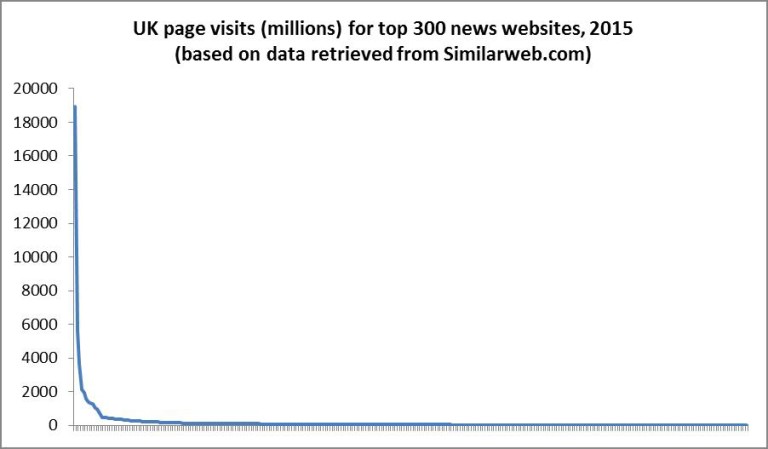
Optimists might consider that the mere existence of 300 news websites (which is itself far from an exhaustive sample of all news on the net), reflects the plurality of the online news sphere, at least compared to conventional platforms like television or print. On closer examination, however, the picture revealed is in fact one of heightened concentration, with not much more than a handful of major publishers able to reach across fragmented audiences, and thus play a potentially defining role in setting the wider news agenda. Previous studies have shown that such concentration can have a cascading or domino effect, with smaller outlets taking agenda cues from the big players. As one scholar put it, “in the age of information plenty, what most consumers get is more of the same”.

Blind Spots

To glimpse this reality we have to peel away a number of veils that make the gatekeeping and agenda setting power of mainstream news organisations not less significant, but rather less visible in the digital environment. Let’s start with the numbers. The lowest ranked news website – Pink News – still attracted some 16 million page views. Which sounds like a lot. But if we compare page views to unique visitors (as measured by the National Readership Survey among others), the average ratio works out to around 250:1. So 16 million page views over the course of the year will probably amount to an audience reach of around 60,000.

That’s still not a tiny amount given that we are at the bottom of the pile here. But it’s important to consider that the list includes many websites that are not really what we would generally think of as news providers. They are much closer to the equivalent of special interest magazines in the print world, focusing on music/film/sport/entertainment etc.

At the heart of plurality concerns is a conviction that healthy democracies depend on the circulation and intersection of diverse voices and perspectives. From this standpoint, it would seem odd to consider the plurality contribution of popularmechanics.com or cylclingweekly.co.uk as equivalent to a daily news provider, especially one that covers political news and current affairs.

One idea that captures the supposed plurality renaissance of the information age is the so-called long tail theory. According to this theory, the ‘personalising’ and tailored recommendations of search, social media and retail algorithms ensure that niche providers flourish and the ‘head’ (representing mainstream culture) dissipates over time. But if we plot Similarweb’s data into such a graph we find the opposite: the curve produces a highly defined ‘head’ followed by a very flat tail…

graph-768x449

A decade after the long tail effect was first explained and predicted, not much seems to be changing. If anything, we may be experiencing a regression back to the kind of mass culture that revolves around superstars, best-sellers and mainstream headlines.

Another problem with the SimilarWeb data is that it does not capture news consumption via aggregators like Yahoo and social media sites like Facebook. Most of this content is produced by mainstream news brands which would make the head look even more concentrated if we were to attribute those page views to the original news sources.

OFCOM – the UK’s media regulator – repeatedly makes the opposite mistake by including these sorts of sites in survey data alongside what it calls ‘content originators’ like the BBC, Sky, Daily Mail, Guardian, etc. This again overestimates plurality by counting aggregators (sites that predominantly host content of other news providers) and intermediaries (sites that predominantly serve as gateways to third party news sites) as news sources in their own right.

Gateway Power

Uncover these blind spots and what we are left with, by any measure, is a highly concentrated picture of media power in Britain today. How has this happened? Given that so much of the traffic to news websites is ‘referred’ by intermediaries, the intricacies of Google’s news algorithm is a good place to start in addressing this question.

For some time now, Google has been weighting and ranking news providers according to a broad spectrum of what it considers to be the most reliable indicators of news quality. But it turns out machines are not much better at assessing news ‘quality’ than human beings. They may be free of subjective bias in one sense, but this means they rely (paradoxically) on quantitative measures of quality, which produces its own bias in favour of large scale and incumbent providers. One look at Google’s most recent patent filing for its news algorithm reveals just how much size matters in the world of digital news: the size of the audience, the size of the newsroom, and the volume of output.

Perhaps the most contentious metric is one that purports to measure what Google calls ‘importance’ by comparing the volume of a site’s output on any given topic to the total output on that topic across the web. In a single measure, this promotes both concentration at the level of provider (by favouring organisations with volume and scale), as well as concentration at the level of output (by favouring organisations that produce more on topics that are widely covered elsewhere). In other words, it is a measure that single-handedly reinforces both an aggregate news ‘agenda’, as well as the agenda setting power of a relatively small number of publishers.

Google engineers may well argue that the variety of volume metrics imbedded in the algorithm ensures that concentration effects are counterbalanced by pluralising effects, and that there is no more legitimate or authoritative way of measuring news quality than relying on a full spectrum of quantitative indicators. Rightly or wrongly, Google believes that ‘real news’ providers are those that can produce the most amounts of original, breaking and general news on a wide range of topics and on a consistent basis.

News plurality reconsidered

At face value, that doesn’t sound like such a bad thing. In a world saturated with hype, rumour and gossip, it’s not surprising that most people are attracted to news brands that signal a degree of professionalism. Part of Google’s corporate and professed social mission is to match users to the content they value most, and if most people prefer the mainstream, then that’s where the traffic will flow.

But there is no getting around the fact that Google favours dominant and incumbent news organisations. The company made its view clear when it stated in its patent filing that “CNN and BBC are widely regarded as high quality sources of accuracy of reporting, professionalism in writing, etc., while local news sources, such as hometown news sources, may be of lower quality”. But when the ‘mainstream’ is held as the ultimate benchmark of good quality news, we start to run into real problems for the future (and present) of media plurality.

Read the original article on Media Reform Coalition

Read the original article on Media Reform Coalition

For one thing, algorithms used by Google, Facebook and (to a lesser extent) Twitter actively discriminate against both prospective new entrants into the news market, as well as those that focus on topics, issues and stories beyond or on the fringes of the mainstream agenda. Yet these are precisely the kind of providers that need to be supported if we want to redress the symptoms of concentrated media power. In the post phone-hacking world, such symptoms continue to manifest in systematic ideological bias, as well as the enduring back door that links Whitehall to the Murdoch media empire.

As print newspapers start to fall by the wayside, news concentration online is of even greater concern. Policymakers, meanwhile, are distracted by dominant narratives that suggest the gatekeeping and agenda power once attributed to media owners has dispersed among ‘the crowd’, or transferred into the hands of intermediaries like Google and Facebook, or that the only plurality ‘problem’ today concerns the so-called filter bubble or echo chamber effects of personalised news.

There is truth in all of these claims but the unseen or overlooked reality is that the gatekeeping power of Google and Facebook works in tandem with that of mainstream news providers, mutually reinforcing each other around what is considered real, legitimate and authoritative news. As Des Freedman urges in his most recent book, “far from diminishing the importance of media moguls and tech giants, announcing the death of gatekeepers or lauding the autonomy of the public, we should be investigating the ways in which their power is being reconstituted inside a digital landscape”.

Find out more

Dickensian delight: Our ‘serial’ fascination with the afterlife of Charles’s characters

This post was contributed by Dr Ben Winyard, digital publications officer at Birkbeck, University of London. Dr Winyard has been a co-organiser of Birkbeck’s Dickens Day event since 2005, and is one of the organisers behind the current Dickens reading project at the College

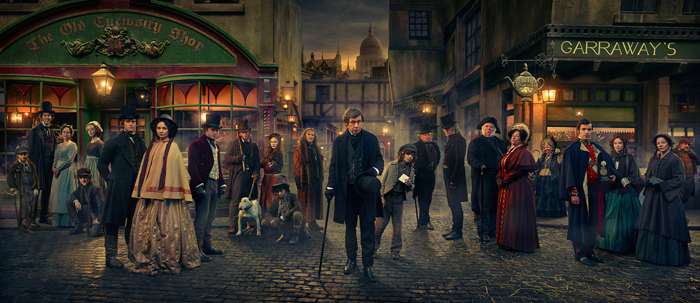
BBC drama Dickensian (image copyright Premier)

BBC drama Dickensian (image copyright Premier)

Is there a word for that familiar feeling of sadness or melancholia that accompanies finishing a novel? Perhaps there is a ferociously lengthy compound noun in German, or an elegant Japanese word with multiple, elusive meanings that can’t be fully encompassed by a solitary English word. A quick, unscientific search on Google reveals fascinating discussions on sites such as reddit about this emotional state and the various words that might describe it: sadness, ennui, nostalgia, regret, catharsis, homesickness, mourning, separation anxiety, and the delightful but somewhat toxic sounding ‘book hangover’.

Another suggestion is the term ‘limerance’, used in psychoanalytic theory to describe an invasive sexual and emotional obsession with a person or object – an infatuation or crush, in more demotic idiom. This feels a little too histrionic for such a quiet, fleeting but pervasive feeling. Imagining a curiously powerful parental bond, Dickens described David Copperfield as his ‘favourite child’, which suggests the intense feelings of attachment readers (and writers) can develop for fictional creations.

Do Dickens’s books deliver more noxious ‘book hangovers’? After all, Dickens was keen throughout his writing career to evoke feeling in his readers, meaning that his forceful use of sentimentality and melodrama, to induce laughter and tears in rapid succession (what Dickens described as his ‘streaky bacon’ approach), might be regarded as a particularly heady and intoxicating form of emotional pummelling. Dickens’s work provokes powerful feelings and his readers are famous for their attachment to the author and to his works. Dickens’s sentimental mode entices, coaxes and even coerces us to be affected by its depictions; it is a form of aesthetic and imaginative self-projection. Indeed, the shared, collective experience of feeling is what often brings us together as a community of Dickens enthusiasts.

It is also worth remembering that Dickens’s original readers would have encountered multiple hiatuses, as they read the novels serially in weekly or monthly instalments, which may have provoked feelings of frustration, anticipation, excitement and longing. A novel’s plot may be thrillingly propulsive, providing a forward momentum that, when halted, generates an exasperated thirst to traverse the ‘empty’ space in-between as quickly as possible. These manifold mini or false endings – which sometimes took the form of cliffhangers, but were more often simply breaks in the narrative – are similar to the final ending of the novel, in that they represent spaces that evoke fantasy and speculation. Just as the serialised instalments represent only temporary cessations that are potentially bridged by longing-filled fantasy, the end of a Dickens novel may similarly rouse imaginative speculation and fancy about the afterlives of the characters.

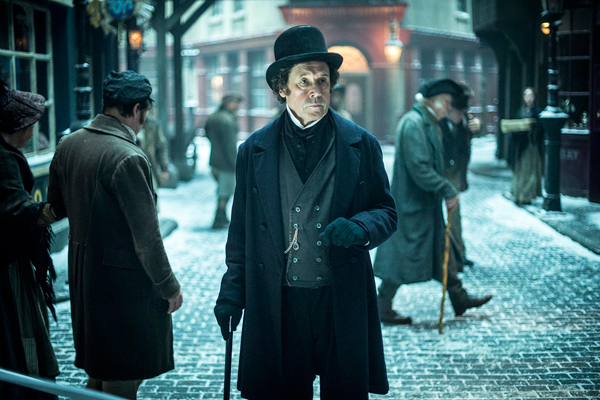
A scene from BBC drama Dickensian, featuring Stephen Rea in the role of Inspector Bucket (image copyright Premier)

A scene from BBC drama Dickensian, featuring Stephen Rea in the role of Inspector Bucket (image copyright Premier)

Adaptation, reimagining, pastiche and outright bootlegging

Dickens was himself no stranger to this phenomenon. The exceptional success of his first novel, The Pickwick Papers, serialised in 1836–37, stimulated a veritable industry of adaptations, pastiches, rip-offs and continuations. One of the most famous was Pickwick Abroad; or, The Tour in France (1837–38) by George W. M. Reynolds, a hugely successful radical journalist Dickens intensely disliked. In this decidedly rough and ready sequel, the Pickwick Club ventures into France, where crass national stereotypes and risqué adventures abound. In an era before copyright law – for which he campaigned vociferously – Dickens witnessed the multiple imaginative afterlives of his stories and characters on stage and in unlicensed prequels and sequels.

There was also a bustling trade in Dickensian souvenirs featuring his characters, including illustrations, porcelain figures, china plates, Toby jugs, keepsake boxes, and miscellaneous other household items and collectibles. Interestingly, in his short-lived journal Master Humphrey’s Clock, which he wrote and edited alone between 1840 and 1841, Dickens acknowledged and indulged readers’ desire for afterlives and new adventures for their favourite characters by reintroducing the hugely popular Mr Pickwick and Samuel Weller. We can also sense in Dickens himself the irresistible urge to resurrect characters he evidently longed to spend time with again – just as many of his readers did.

A digital Dickens afterlife

More recently, Birkbeck’s inventive and successful Twitter retelling of Our Mutual Friend, which saw dozens of people tweet as characters in this multitudinous novel, provided an outlet for Dickens readers to reengage with, and extend the afterlives of, their favourite characters. Many tweeters were unafraid to present their characters in decidedly modern, updated terms, which meant that, while the novel’s plot remained essentially the same, many characters took on new aspects, had new adventures and relationships, and occupied more imaginative space than in the original work.

At the most recent Dickens Day (October 2015), Professor Holly Furneaux, an alumna of Birkbeck who is now based at the University of Cardiff, delivered a fascinating paper on Dickensian fan fiction online, which is forging communities and providing avenues for original, and even erotic, (re)engagements with popular Dickensian characters. Furneaux demonstrated the particular popularity of the triangular relationship between Mortimer Lightwood, Eugene Wrayburn and Lizzie Hexam in Our Mutual Friend, which many online Dickens fan fiction writers reimagined more capaciously, with space within Eugene and Lizzie’s marriage for Mortimer.

Dickensian ­– Goading the stuffy old gatekeepers

Given the powerful attachment of Dickens’s readers to his works and the long history of adaptation, reimagining, pastiche and outright bootlegging of Dickens’s work, Tony Jordan’s Dickensian feels less of an oddity or a provocation than it may first appear. In this twenty-part TV serial, we enter a fantasy Victorian world, in which many of Dickens’s characters, from several of the novels, coexist. Thus, Inspector Bucket (Bleak House, 1852–53) is investigating the demise of Jacob Marley (A Christmas Carol, 1843), with the forensic assistance of Mr Venus (Our Mutual Friend, 1864–65). Accompanying these fantastic mash-ups is Jordan’s reimagining of backstories and subplots in the novels; thus, Honoria Barbary is embarking upon a relationship with Captain James Hawdon that readers of Bleak House know is doomed. And in a delightful nod to the queer affiliations that Professor Furneaux has observed in online fan fiction and other literary and non-literary sources, Arthur Havisham is hopelessly in love with Meriwether Compeyson, the dastardly seducer he has appointed to marry and defraud his sister, Amelia (who will become the bitter, decrepit Miss Havisham of Great Expectations, 1860–61). The first episode of Dickensian thus presented a delightful, uncanny guessing game, as Dickens fan scrambled to identify all of the characters and connect them to their extant stories within the novels.

Jordan himself is keen to present his work as goading the stuffy old gatekeepers of Dickens’s legacy, irreverently insisting in an interview with the Daily Telegraph that ‘he knew the changes risked “p––ing off the Dickens community”’. In actuality, Jordan’s work taps into a rich seam of readerly fantasy about Dickens imaginative worlds that has been amply mined by authors, playwrights, filmmakers and TV executives. Furthermore, the intense relationship between Dickens and his readers, and the love and affection readers have felt, and continue to feel, for Dickens, his fictional world and the people who inhabit it, have all been objects of intense scholarly scrutiny and analysis.

Dickens Gurney head

Charles Dickens – By Jeremiah Gurney (Heritage Auction Gallery) [Public domain], via Wikimedia Commons

It is a truism that all Dickens fans and scholars inevitably encounter that, ‘Were Dickens alive today, he would write for a soap opera’. Jordan, who famously wrote for Eastenders (and less famously, for the slated, 90s camp classic Eldorado), has been keen to emphasise that Dickens’s serialised fiction prefigured the episodic melodrama of the contemporary soap opera. In a recent interview with The Big Issue, Jordan observes that,

“People can be far too reverential. We mustn’t forget that Dickens was a populist writer who wrote for the masses. He wrote episodically, trying to flog magazines every month. He was sensationalist and did cliffhangers way before soap operas. He and Wilkie Collins said their secret was to make them cry, make them laugh and make them wait. That is everything I did in my EastEnders career. It is that deferment of gratification.”

The originality of Dickensian lies in its audacious bringing together of numerous characters at once, but one of the impulses that has powered this – the desire to make characters live again and to imagine them into new aspects, new stories and new worlds – accompanied Dickens’s fiction from its earliest moments. In the spaces in-between and after instalments, we find that readers’ emotional engagement births alternative and new stories, trajectories and lives that all demonstrate the enduring power of Dickens’s fiction.

Find out more

Justice Scalia wasn’t just immoral—he was philosophically confused

This post was contributed by Rob Singh, Professor of Politics at Birkbeck. Prof Singh’s new book, ‘After Obama: Renewing American Leadership, Restoring Global Order’ will be published by Cambridge University Press in May.

This aticle was originally published in Prospect on 16 February.

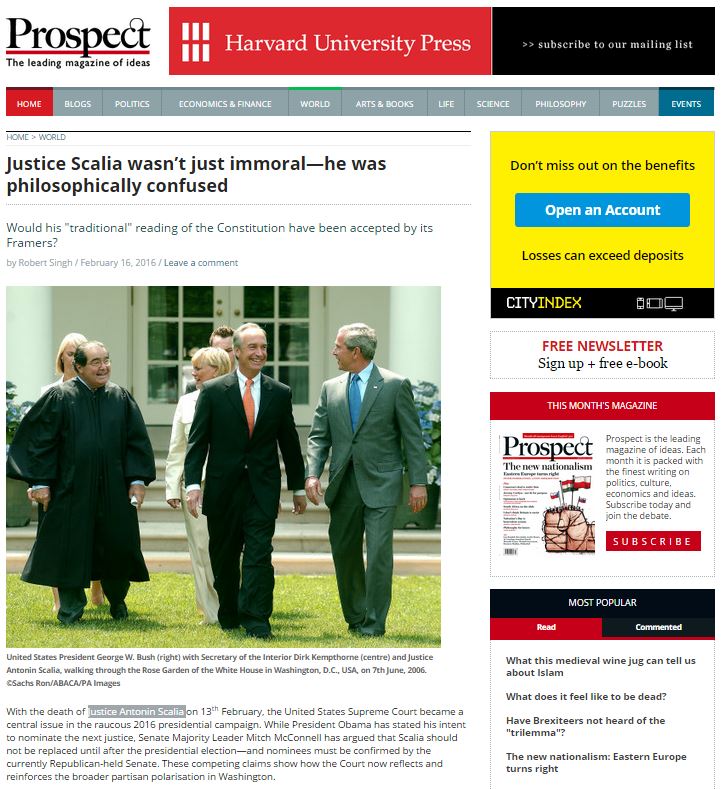
With the death of Justice Antonin Scalia on 13th February, the United States Supreme Court became a central issue in the raucous 2016 presidential campaign. While President Obama has stated his intent to nominate the next justice, Senate Majority Leader Mitch McConnell has argued that Scalia should not be replaced until after the presidential election — and nominees must be confirmed by the currently Republican-held Senate. These competing claims show how the Court now reflects and reinforces the broader partisan polarisation in Washington.

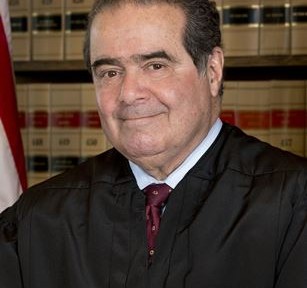
Antonin Scalia Official SCOTUS Portrait crop

Justice Antonin Scalia (By Steve Petteway, photographer, Supreme Court of the United States[1] (See [2]) [Public domain], via Wikimedia Commons)

On decisions from gun control to campaign finance, the court over the last decade has pursued an outspokenly conservative agenda. But other key rulings—such as upholding the Affordable Care Act and the right to same sex marriage—have also grievously disappointed traditionalists. With the remaining eight justices now split between four progressives and four conservatives, Scalia’s replacement could potentially reshape constitutional law for years to come.

A man of acerbic wit and often scathing venom, Scalia developed an approach to constitutional interpretation—originalism—that many found coherent and compelling (a whole book, Scalia Dissents, was even dedicated to his disagreements with prevailing opinion). In a democracy, how can a Court legitimately strike down the laws passed by the Congress and signed by the president? Originalism offered a simple solution: rather than consider what the writers of laws, or of particular constitutional clauses, intended the law to mean, judges should instead interpret these in terms of how the text was commonly understood at the time it was adopted. That adherence to the values of others seemed to limit the dangers of judges writing their own views into law. It had the happily convenient benefit, to Scalia, of also yielding reliably conservative policy outcomes. But three problems plagued the path Scalia paved, which he never convincingly resolved.

First, the practical outcomes of Scalia’s philosophy are widely regarded as repugnant to contemporary moral values. Take Maryland v Craig (1990), where the Court upheld a state law allowing a victim of child sex abuse to testify over CCTV rather than in court, in the presence of her abuser. Scalia dissented, arguing that the Sixth Amendment provides that in “all criminal prosecutions the accused shall enjoy the right… to be confronted with the witnesses against him.”

The only things that had changed since 1791, he argued, were society’s “so-called sensitivity to psychic trauma” and the judgment of where the proper balance lay between assuring conviction of child abusers and acquittal of those falsely accused of abuse. At the same time, in supporting states’ rights to enact statutes rooted in “moral disapproval,” Scalia opposed striking down laws criminalising gay sex in 2003. Relying on “tradition” and popular sentiment to thwart progress, he selectively transformed the Bill of Rights from a safeguard against majoritarianism into another expression of it.

But beyond specific rulings was a second, broader problem. Central to Scalia’s judicial philosophy was an inherent contradiction: would the original framers of the Constitution whom he so venerated have prescribed an originalist approach? Compelling evidence suggests otherwise. Not only is the language of the document notoriously ambiguous and vague, deliberately open to competing and evolving interpretations, but the Framers expressly rejected freezing the fledgling republic in the conditions of 1787. Iconic figures such as Thomas Jefferson even expected new generations to rewrite the Constitution anew.

Thirdly, in decisions such as that made in court case The District of Columbia v. Dick Heller (2008) (which was presided over by the Supreme Court of the United States, and thus Scalia) the Court hardly exemplified a conservative role; for the first time in American history an individualist reading of the Second Amendment was announced. It was ruled that an individual is entitled to carry a firearm for private purposes, such as self-defence, and that the Amendment doesn’t just apply to the rights of groups such as militias. The result of this ruling was a litigation bonanza centred on exactly what gun regulations offend a citizen’s right to own firearms. But if the US survived more than two centuries without the 2nd Amendment ever conferring such a right, when did this change, and why?

Originalists used to criticise the Court’s progressive rulings of the 1960s and 1970s, when the liberal Justices exercised “raw judicial power” by “inventing” new constitutional rights that weren’t explicitly in the Constitution. Now, the same charge can be levelled at the conservatives, whose recent embrace of judicial activism often appears less philosophical rationale than political rationalisation.

Read the original article in Prospect

Read the original article in Prospect

To be fair, Scalia did frequently abide by his own strictures to act as a judge rather than a legislator, not least on First Amendment cases such as flag desecration, where his reading of free expression trumped his affront at unpatriotic acts such as burning the Stars and Stripes. But it is difficult to disassociate his embrace of originalism from his finding in its cold but confused logic a way to oppose every progressive advance from reproductive rights to affirmative action.

George W Bush declined the opportunity to elevate Scalia to the Chief Justiceship in 2005, but Republican presidential candidates have already solemnly avowed to appoint “another Scalia” to the Court, should they be sworn into office in 2017. The chances of that are increasingly slim. With the Court’s future direction now a key issue in the presidential election, several vulnerable Republican Senators facing uphill battles for re-election in swing states such as Wisconsin and Illinois, and the Grand Old Party likely to seem nakedly partisan in obstructing a new Obama judicial nominee from even coming to a vote, Scalia seems likely to remain a magnet for controversy in death as well as life.

It would be mildly ironic if Scalia’s passing, and controversial legacy, hamper the prospect of a more conservative direction in constitutional law by helping to energise the Democratic Party base and costing the GOP the White House and/or the Senate.  And even more ironic that the remainder of this year’s contentious argument over the Court will itself test the proposition of whether a Constitution designed in and for the 18th century is still fit for purpose in the 21st, or more resembles a noble piece of paper housed in the National Archives.

Find out more

The Presidential Apprentice? Taking Trump Seriously

Rob Singh is Professor of Politics at Birkbeck. His new book, ‘After Obama: Renewing American Leadership, Restoring Global Order’ will be published by Cambridge University Press in May. Prof Singh recently appeared on an episode of BBC Radio 4’s The Long View which focused on ‘Donald Trump and the Politics of Celebrity’

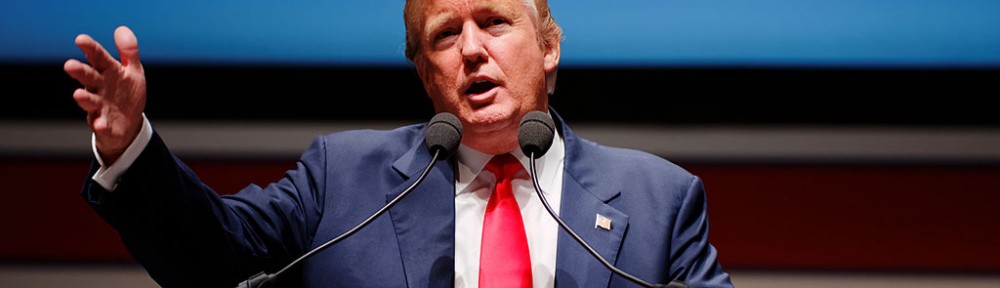
Donald Trump Sr. at Citizens United Freedom Summit in Greenville South Carolina May 2015 by Michael Vadon 13Buffoon. Joke. Jerk. Those are just some of the descriptions of the current front-runner for the Republican Party nomination for president of the United States. From his fellow Republicans, that is. Beyond the party, Donald J. Trump has been lambasted as a bigot, misogynist, and racist. Yet none of this has seemingly hampered the popular appeal of his quixotic quest for the White House.

Should we take the Trump phenomenon seriously? The answer is, emphatically, yes. Laugh at or loathe him, Trump has been the Heineken candidate, reaching parts of the electorate no other candidate can reach. And whilst it remains to be seen whether he can translate his support in the polls into votes, Trump already dominates 2016 in singular fashion. There exists no precedent in the modern era for a political novice setting the agenda so consistently that the media focuses in Pavlovian fashion on whatever subjects Trump raises. From stopping illegal immigration through a ‘beautiful’ great wall with Mexico to a moratorium on all Muslims entering the US, no-one has commanded attention like the New Yorker. Moreover, not only have other Republicans felt compelled to follow his lead but even President Obama’s final State of the Union was essentially an extended rejoinder to the Donald.

So, what underlies the success? Anger, authenticity, media savvy, populism, and timing.

An unapologetically redemptive force

First, most Americans think their country is on the wrong track. Among white working class Americans – the core Trump constituency – stagnant wages, real income decline, and loss of a once-dominant status in a nation transforming economically and culturally underlies disillusion. For Americans regarding ‘their’ country as in need of taking back and among those fearing the US is in terminal decline – polarised and gridlocked at home, discounted and challenged for primacy abroad – Trump represents an unapologetically redemptive force: a visceral, primal scream from the heart of white American nationalism.

Second, Americans broadly view their government as ineffective and political system as corrupt. Running for Washington by running against it, on a platform of incoherent but potently opaque policy positions, no-one – for those wanting to change Washington – embodies the outsider like Trump. Moreover, uniquely, his personal fortune insulates him from charges that he can be ‘bought’ by vested interests. When Trump talks about knowing how to work the system as a businessman, he is credible. Add to that an outspoken willingness to speak directly, bluntly and without fear of causing offence and millions of Americans view the Donald as a truth teller. Like businessmen in politics before him, Trump promises that what he did for himself he can do for America, and that ordinary Americans will once more partake of the increasingly elusive American Dream.

Social media mogul

Third, Trump has exploited his formidable media knowledge with astonishing shrewdness. Outrageous statements, outlandish claims and telling personal insults – seemingly spontaneous but carefully pre-planned and road-tested – compel ratings. Social media abets the creation of an alternative reality and echo chamber from which the distrusted mainstream media are excluded. Disintermediation – cutting out the middle man – compounds Trump’s celebrity status to forge what his 5 million Twitter supporters perceive as a personal link to their politically incorrect champion.

Fourth, Trump – for whom id, not ideology, is all – upends conservative orthodoxy. A New York native who was for most of his life pro-choice on abortion, pro-gun control and a donor to Democrats, Trump is no staid Mitt Romney. In rejecting free trade deals and ‘stoopid’ Middle East wars, pledging to make allies from Saudi Arabia to South Korea pay for US protection, committing to punitive taxes on Wall Street and preserving entitlement programmes for the average Joe, Trump’s anti-elitism is scrambling a party establishment fearful of an anti-government populism it unleashed but cannot control.

Finally, if Obama won the presidency in 2008 as the ‘un-Bush’, what more vivid an antithesis to the current lame duck could be imagined than Trump? After seven years of the most polarising presidency since Richard Nixon, Trump promises to restore the art of the deal – something the US Constitution mandates for successful governing, and AWOL since 2009 – at home and abroad alike.

Can Trump triumph?

Can Trump prevail in the Republican demolition derby? The odds are still against him. After all, most Republicans do not support him and he has been first in national polls in large part because the ‘establishment’ vote has been so fragmented among Marco Rubio, Jeb Bush, John Kasich and Chris Christie. But if Trump can win or come second to Ted Cruz in the Iowa caucus, and then top the New Hampshire and South Carolina polls, the prospects of him securing the nomination are 50-50 at worst. By the time of the Republican Party convention in Cleveland, Ohio in July, if not well in advance, no one may be laughing other than the Donald.

Find out more

The Politics of David Bowie

This post was contributed by Dr Benjamin Worthy, lecturer in Birkbeck’s Department of Politics. This blog was originally posted on the 10 Gower Street blog on 11 January 2016.

david_bowie_by_alexwomersley-d5g9foa

Picture courtesy of Alex Womersley

As with almost everything about David Bowie, no one is sure exactly what his politics were. The Mirror claims he turned down an OBE and a knighthood in the 2000s. In 1977 he is quoted as saying ‘the more I travel and the less sure I am about exactly which political philosophies are commendable’. Nevertheless, many have seen ways in which Bowie’s career could provide lessons for how we do politics.

David Bowie rarely indulged directly in politics or political slogans. His lyrics seemed to deal obliquely with it across his career-from ‘Now the workers have struck for fame’ in‘Life on Mars’, his 1996 song ‘Seven Years in Tibet’ to the album Diamond Dogs, based on George Orwell’s 1984. However, direct ‘interventions’ seemed rare and a little unclear, as with his plea for the union and Scotland to vote No to independence in 2014, sent via Kate Moss, or this rather entertaining acceptance of a Brit award in 1996 from a young Tony Blair. This didn’t, of course, stop his fans who seem, on the whole,left-wing (and also fans of scrabble, Patrick Moore and Monty Python, according to YouGov).

But Bowie was not apolitical. In the 1970s Bowie challenged entrenched gender and sexuality stereotypes at a time when few would. Jarvis Cocker has said how Bowie sent out the message that it was OK to be different while the Mirror speakers of how the singer’s ‘radical, gender-busting personas turned traditional conservative views upside down and widened what was acceptable in society’. He also wrote about the world around him, describing events from the space race to divided Berlin (the German Foreign Ministry today publically thanked him for helping to bring down the Berlin Wall).

At the same time, his championing of different cultures pushed all sorts of new ideas into society-look over his top 100 books, covering everything from a memoir of Stalin’s Gulags to Viz magazine. He popularised of whole kaleidoscope of new sounds and visions to new audiences, from German electronic music to Soul, while also experimenting with what people insist on calling ‘world music’. And his message reached a huge, diverse number of people.

In this way, David Bowie was a very political animal, in the same way that Elvis Presley or the Beatles were. None of them urged ‘revolution’ or told people how to vote. Elvis was rather conservative, John Lennon asked to be counted ‘out’ of the revolution (or maybe ‘in’-he wasn’t sure) and David Bowie was too wide-ranging or elliptical to join any one party. But like these other musical legends, in challenging convention, the Man Who fell to Earth tore down barriers and opened up new worlds. David Bowie made people think differently about the world around them. And that is very political.

Find out more

The State of Europe

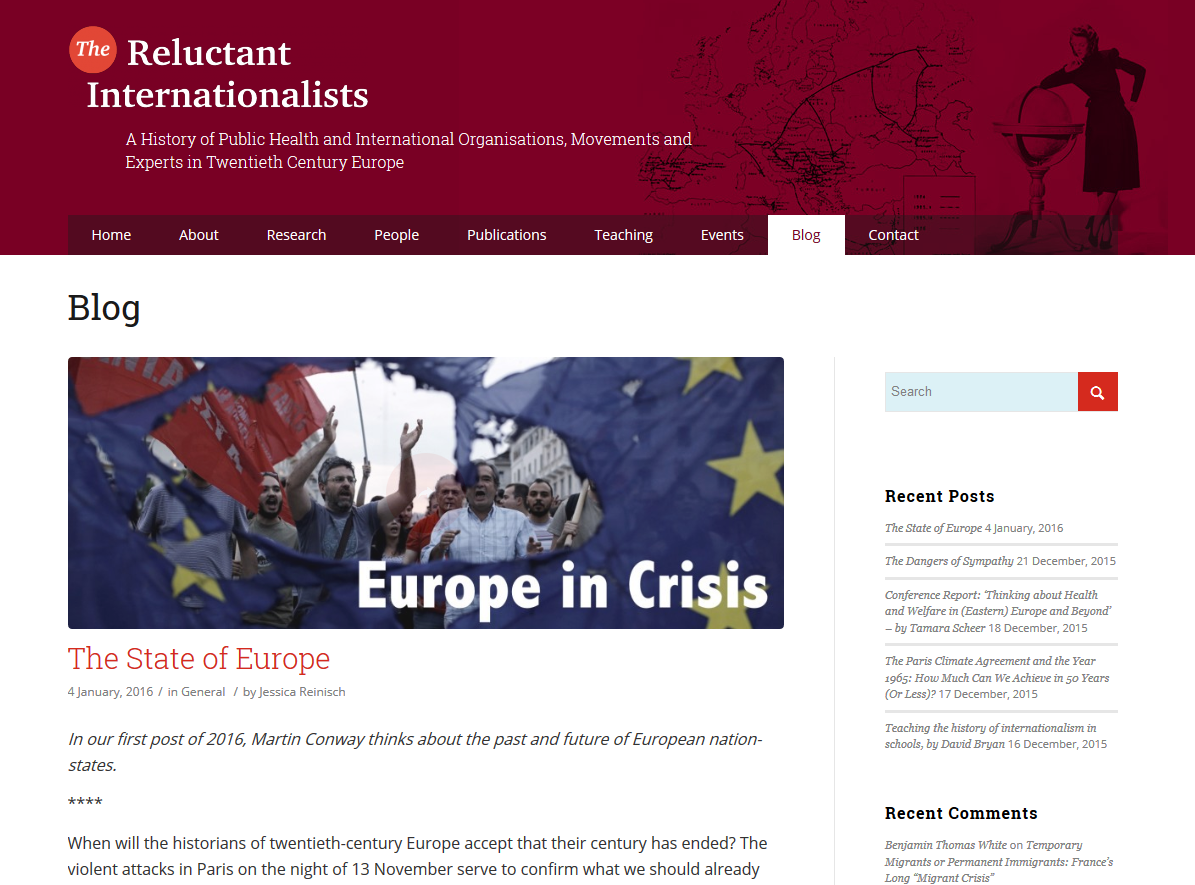
This post was contributed by Professor Martin Conway for the college’s Reluctant Internationalists project. This first appeared on the project’s blog on 4 January 2016

When will the historians of twentieth-century Europe accept that their century has ended? The violent attacks in Paris on the night of 13 November serve to confirm what we should already have known: that the populations of Europe have moved on from the politics of the twentieth century, and it is time for the historians to do so too.

Read the original article on the Reluctant Internationalists

Read the original article on the Reluctant Internationalists blog

Of course, in the aftermath of traumatic events, historians delve rapidly into their store-cupboard of analogies and precedents. And there are many which can be drawn upon for such purposes. Violence by small militant groups composed predominantly of immigrants from specific ethnic backgrounds has, after all, a considerable lineage in twentieth-century Europe. The various revolutionary and counter-revolutionary movements that proliferated in the former territories of the Habsburg and Tsarist empires at the end of the First World War, the militant Jewish Communist groups who played such a role in the anti-fascist movements and the wartime Resistance groups in the 1930s and 1940s, and the FLN militants of Algerian origin who were active in France in the 1950s and 1960s, are all examples of how political violence has often been generated in Europe by marginalized ethnic and religious minorities, who derived their legitimation from the perceived repression by state authorities.

And yet none of these models really has much purchase for understanding the various incidents which, from the train bombings of Madrid in 2004 to the events in Paris, have become part of Europe’s contemporary present. In part, of course, this is because European history is no longer, if it ever was, self-contained: this violence draws its inspiration from elsewhere, and from different histories. But there is also a broader and more disconcerting reality. The radicalized militants who have generated this violence feel no affinity with these precedents. Indeed, one suspects that they know little or nothing (and care even less) about Europe’s past history.

This is a cause for some modesty on the part of historians. We inhabit a present which owes little to “our” past. The twentieth-century history of Europe has come to an end. Everybody can choose their terminus date of preference, be it the reunification of Europe after 1989, the impact of the neo-liberal reforms of the 1990s, or the attacks on the Twin Towers on 9/11 and their subsequent imitators in Europe. But, wherever you choose to stick the frontier post between past and present, it is impossible to ignore the sense that European history has not so much ended as turned into a new configuration. For contemporary historians, to misquote J.P. Hartley, the present is another country, and they do things differently there.

Quite why that should be so is a question which probably demands an answer on a rather grand scale. But the more immediate challenge for historians of Europe is to develop frameworks for understanding the evolutions of the present, which are more relevant than reworkings of our all-too-familiar stories of the crises of the 1930s and 1940s. The history of the twenty-first century has to start somewhere, and the events of the last year have given us plenty of raw material to work from. War in Ukraine, the rise of new populist forces of right and left (or both), the demands for revision of national sovereignty, the arrival of large numbers of migrants fleeing war and economic deprivation, and the impact of new forms of political violence constitute a formidable agenda which demands a response more substantial than the overused language of crisis.

Picture

27 October 2015, Migrants are led by German Fedeal Police to an emergency accommodation centre in Wegscheid, southern Germany (Armin Weigel/ dpa via AP)

Crisis is of course a term that historians conventionally deploy to describe the demise of the old and the difficult birth of the new. The first is certainly highly visible in present events, as manifested by the collapse of a certain way of managing Europe, as well as the retreat of pre-existing political elites in the face of economic pressures and the demands of angry and exasperated voters. Of course, they will not go quietly. The logics of austerity economics and of national security justified by the supposed internal and external threats to European populations provide plenty of means for state authorities to seek to impose their discipline on their populations. But state authority is not what it used to be. One of the more tangible consequences of the last twenty years has been the hollowing out of much of the former trappings of state power and of national politics. In an era when communication has become primarily electronic, and national borders have become largely notional, state authority no longer has the same centrality in the history of twenty-first century Europe.

Part of the challenge of a history of the present is therefore to appreciate, if not fully to understand, the fluidity of boundaries of any kind. We inhabit a new cosmopolitanism, as reflected in the global character of many of Europe’s major cities, but also in the flexibility of identities, be they national, political, ethnic, or indeed religious. Journalists investigating the backgrounds of the authors of the Paris attacks have appeared surprised to discover that they were products of the banlieux of Paris and of Strasbourg, who amidst the chaotic years of their early adulthood travelled without any great sense of purpose to Syria, from where they returned equipped with a cocktail of animus, bravado and perhaps a superficial understanding of some elements of Islam. And yet that surely is what one would expect: militants are made not born, and the manner of their making well illustrates the fluidity of identities among those many Europeans whose lives have been rendered fragile by economic changes, the dislocation of social structures, and the retreat of structures of state provision.

In order to understand this, the most appropriate template is not the twentieth century, with its explosion in state power and totalizing ideological visions, but its predecessor. Looking at Europe’s present-day cities, one cannot but be reminded of the chaotic immigrant cities of Europe in the nineteenth century, and their worlds of neighbourhoods, ethnic self-help structures, and an almost total absence of state authority. Zola, it seems, has never been so topical; but other aspects of Europe’s present-day history seem also to recall the Europe of the mid-nineteenth century. The impact of vast economic forces beyond the control of any public authority, the pressure of migrant masses on a pre-existing population, and sudden surges of political support for charismatic individuals or for rhetorics of national liberation (and of xenophobia) smells much more akin to the Europe of the 1840s and the 1850s, than it does to the Europe of Adenauer, de Gaulle, Thatcher, Kohl and Mitterrand.

However, to replace one set of analogies with another borrowed from the previous century is not sufficient. A history of Europe’s twenty-first century has to identify the building blocks of the new. Some elements of this are incontrovertible: the new precariousness of living standards caused by economic change and untrammelled market forces, and the consequent replacement of the disciplined interaction of socio-economic interest groups by a new and much more volatile politics of economic opportunity and grievance. But other elements appear much less clear-cut. Is Europe moving left or right? Will the migrants of 2015 be integrated into a new and more multi-cultural Central Europe, or will they provoke a descent into forms of ethnic essentialism?

Above all, where, in the end, will state authority be discovered to reside? One of the most striking features of Europe since the final decades of the twentieth century has been the demise of those hierarchical organizational charts of government which used to characterise political-science textbooks. Power is now more dispersed and also more opaque, shared between a plethora of regional, national and supra-national institutions, but also secreted away in institutions such as central banks and security structures that are impervious to democratic control or even public scrutiny. None of that means that we are about to experience new forms of authoritarianism; the populations of Europe have, one suspects, moved beyond the stage when they would submit to the disciplines of states of emergency and military coups. Moreover, for all of the seriousness with which leaders have gathered to consider Europe’s overlapping current crises, one of the most striking features of their discussions has been the relative absence of effective tools of power. Military force – other than the spectacular acts of aerial bombing in Libya, Iraq and Syria – has almost disappeared; national economic policy-making has been transferred to central banks and the power of the markets; and even the routine ability to keep track of the movements of populations appears to have been largely eroded.

From the streets of Molenbeek to the beaches of Lesbos, it is the limits of the capacity of the state which has been more apparent than its strength. Perhaps that presages a new 1848, but more significant is the way that the state has lost, or surrendered, its twentieth-century role as the grand manager of European life. What will replace it forms part of the still uncertain nature of the history of the European present.

The Reluctant Internationalists project inspects the history of international collaboration and ambitions of medical professionals, politicians, generals, diplomats and policy-makers in twentieth century Europe. This four-year project, funded by Birkbeck researcher Dr Jessica Reinisch’s Wellcome Trust Investigator Award, examines the origins of such policies, consequences and lasting legacies.

Find out more

Naming the unspeakable: ‘So-called’ Isis and Harry Potter syndrome

This post was contributed by Professor Penelope Gardner-Chloros, Department of Applied Linguistics and Communication

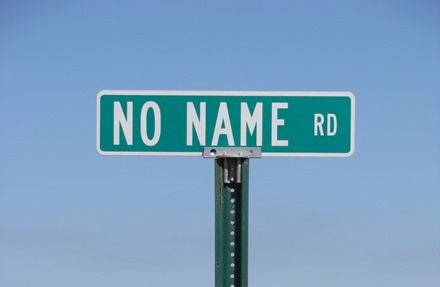
No Name Road (2988366432)It seems that we now have a terrible enemy who cannot be named – or rather whose naming causes a major headache. For many months now, on hearing the term ‘Isis’ we have not thought about a certain Egyptian goddess, or about the river that flows through Oxford. The name is now indelibly associated with one of the most evil organisations of modern times, which adopted the acronym of ‘Islamic State in Iraq and Syria’ (or sometimes ‘Islamic State in Iraq and the Levant’, ISIL).

Because of fears that calling the organisation by this name may legitimise it, some politicians and other public figures in the West have been calling it ‘so-called’ Islamic State, using the verbal equivalent of the two-fingered “scare quotes” gesture which has become part of our gestural vocabulary. There is also a move to call it ‘Daesh’ instead, another acronym which the organisation itself is said not to like.

This is how we in the West shake our tiny fists at the evil monster, even though, to paraphrase Shakespeare, a terrorist by any other name would smell as rank. Ah, the power of names! How can a simple label mean so much? And how do names acquire their symbolic power?

The power of names

The power of names is a recurrent theme in religions, myths and fairy tales. For example the issue of how to name God is an important issue in many religions. In Exodus 3:13-15, Moses asks God who he should say has sent him, and God replies ‘I am who I am’. It is as if God himself did not want to share an actual name with humans, because knowing someone’s name gives you a certain power over them.

In the Odyssey, after Odysseus has got the Cyclops drunk, he tells the monster that his name is ‘Nobody’’ When Odysseus later blinds the Cyclops in order to escape his clutches, his fellow Cyclops come to their brother’s rescue, but when they ask who has hurt him, the Cyclops replies ‘Nobody’ and the other Cyclops understandably lose interest and shuffle off.

Names are important also in traditional fairy tales. Those brought up on Grimm’s tales will remember Rumpelstiltskin, the evil dwarf who loses his power to harm people if they guess his name. And then of course there is Harry Potter, and the villain Voldemort who cannot be named for fear of conjuring him up. He is known throughout as ‘he who cannot be named’.

Marking changes in style, identity and allegiance

But back to ‘so-called’ Islamic State. Radicalised European or American Jihadist fighters change their names from their bland-sounding European ones to Arab ones that make them sound like the holy fighters they profess to be, the change of names marking a clear change in identity. If they return and are deradicalised, their names change back too. Many of us with less sinister motives make minor or greater changes to our names to mark changes in style, identity or allegiance.

We encourage or discourage nicknames and abbreviations at different stages in our life, reflecting how we wish to be seen – remember for example when Kate became Catherine? When we marry, we may change – or resolutely not change – our surnames – if of course this is allowed or encouraged in our culture (in some countries, such as Iceland, the issue does not arise and names are not enmeshed in a patriarchal system).

In Britain we might use our second name rather than our first; but this would not work in a country such as Russia where the second name is invariably a patronymic, i.e. your father’s first name, regardless of your gender. You may even be known by different names in different places – such as Jack in town and Ernest in the country.

Magic? Perhaps not. But certainly another facet of the power of words.

Find out more