Category Archives: Humanities and Social Sciences

Four forgotten medieval books at Birkbeck College

This post was contributed by Prof Anthony Bale, who teaches on the MA Medieval Literature and Culture at Birkbeck’s Department of English and Humanities. This article was originally posted on the Material Texts Network on October 30 2015

When is a book not a book? The destruction of a book – through burning, through recycling, through iconoclasm, for instance – places great emphasis on its materiality, its power as a physical object that must be destroyed. Conversely, when nobody knows about a book’s existence, it simply disappears – both the physical book and the textual lives inside it. When a book is unknown and hidden away it is perhaps reduced to the bare facts of its existence: a piece of matter unread, unloved, unvalued, uncatalogued.

Books disappear easily when they are not catalogued; it is through catalogues and finding aids that medievalists find their sources. When I joined Birkbeck College as a lecturer in 2002, I was excited to find that the College owned one manuscript, which I knew about from Neil R. Ker’s magisterial four-volume catalogue, Medieval Manuscripts in British Libraries. But time passed, I became diverted by other projects, and I never got round to looking at the manuscript. And then I more or less forgot about it.

This year I have been teaching a class on ‘Medieval Material Texts’ for students on Birkbeck’s MA in Medieval Literature & Culture. It struck me that it would be so much easier to talk about medieval books if one had one to show to the students – to talk about the binding, the physical construction of a book, the stains and the damage, the signs of a book’s lived life, as well as the text, the decoration, the illustration. So, somewhere in the back of my mind, I remembered Ker’s description of one manuscript, and looked it up, and sent an email off to my subject-librarian at Birkbeck’s library.

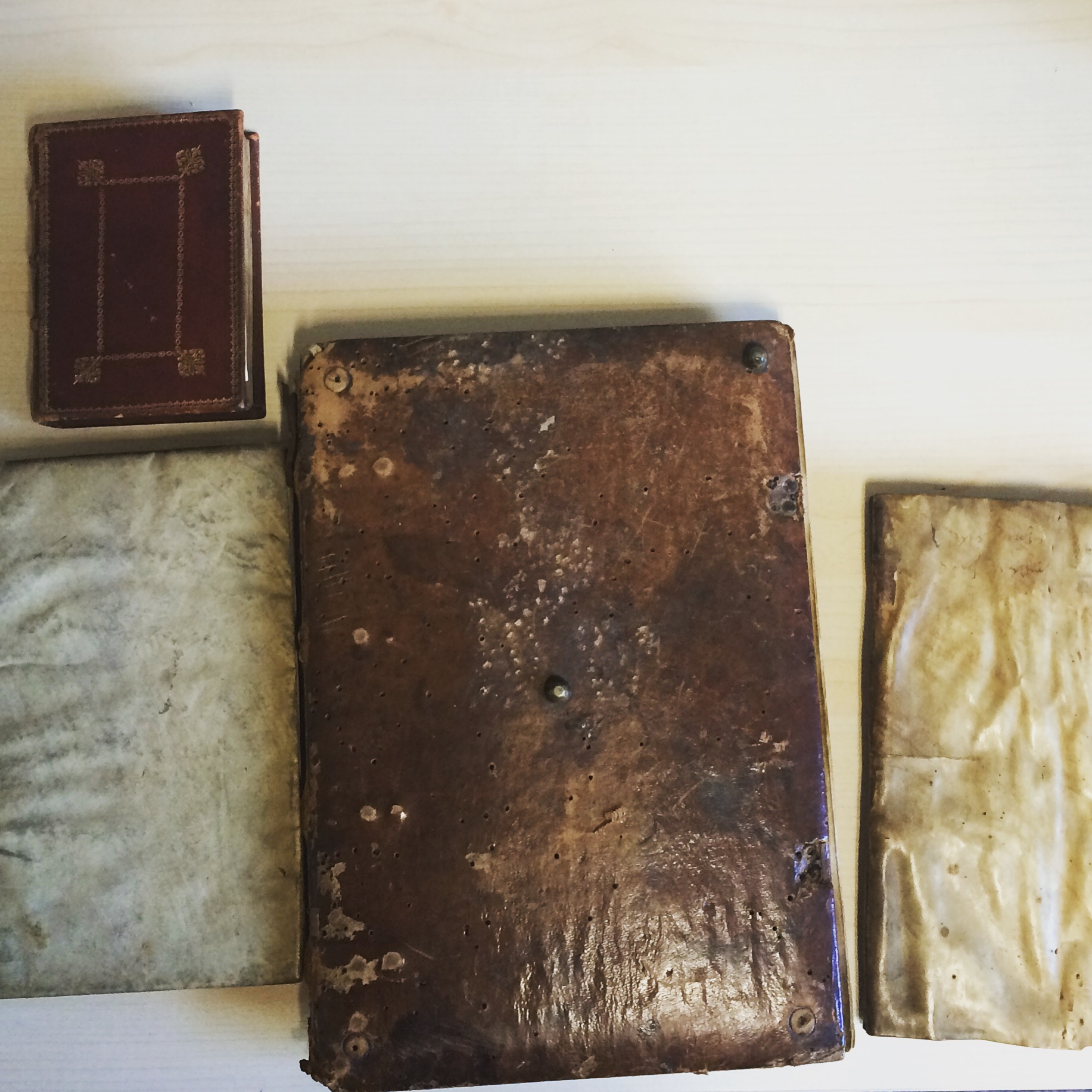
It was as much as a surprise to the College as it was to me to image3discover that Birkbeck houses a small collection of not one but four medieval books (three manuscripts and one incunabulum). I quickly arranged to view the books, three of which have not been catalogued and do not seem to have been viewed since around 1991. The books comprise a sort of ‘capsule collection’: they represent several important developments in European religious culture, in book history, and in literary tastes.

The books are:

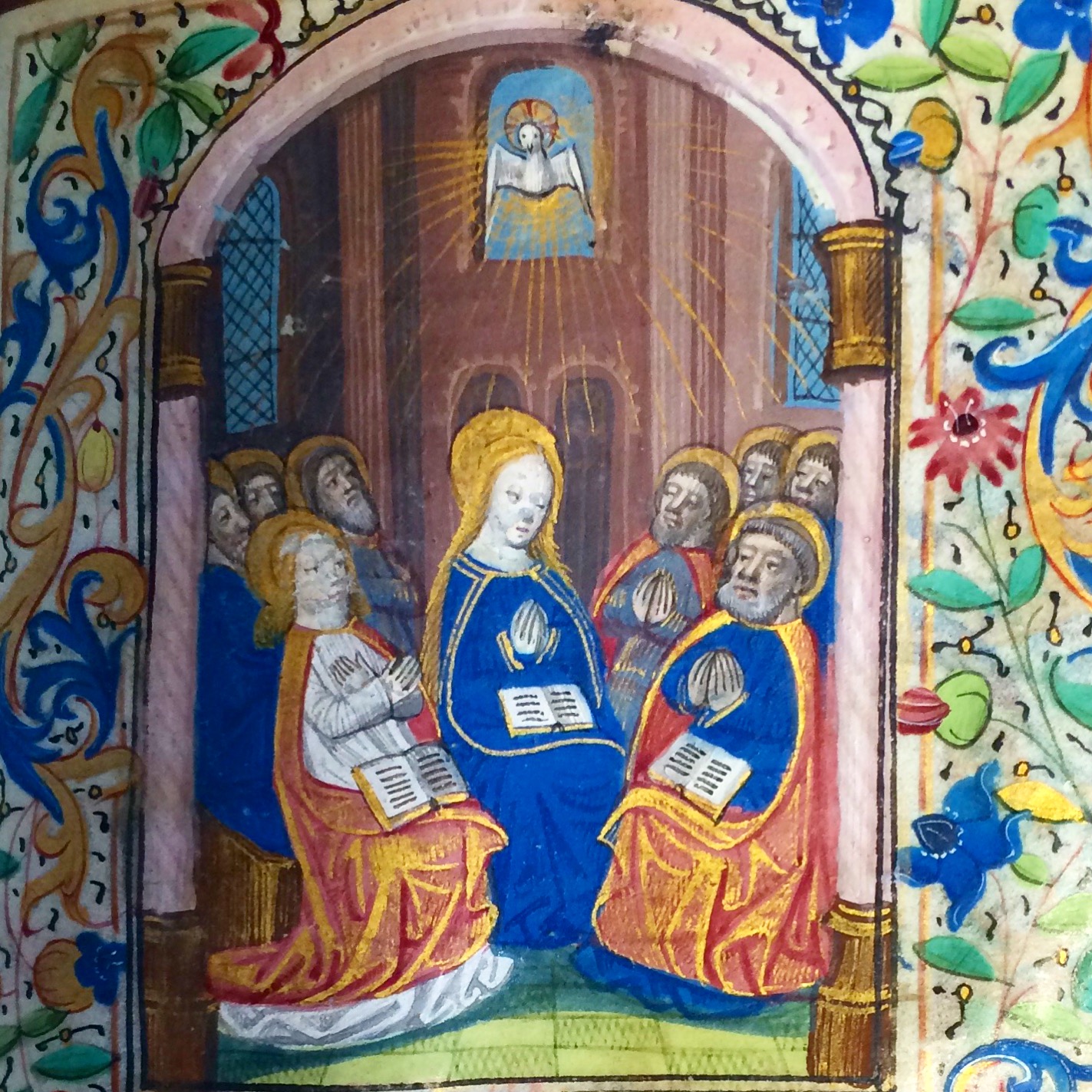
Birkbeck Hours; Pentecost (fol. 105r)

The Birkbeck Hours (sine numero): a beautiful small book of hours, from northern France, dated to c. 1400.

MS L.I: the rules and customs of the Capitoli della Compagnia di S. Girolamo of Siena, dated to the early fifteenth century.

MS 108.C: a manuscript of the Sententaie Sapientiae, attributed to Aristotle, Plato, Socrates, and Seneca, and which once belonged to the Monastery of St Zeno, Verona; dated to c. 1450.

Dictys Cretensis & Dares Phrygius (sine numero): a skin-bound volume, a much-read history of the Trojan War, printed at Venice, 1499.

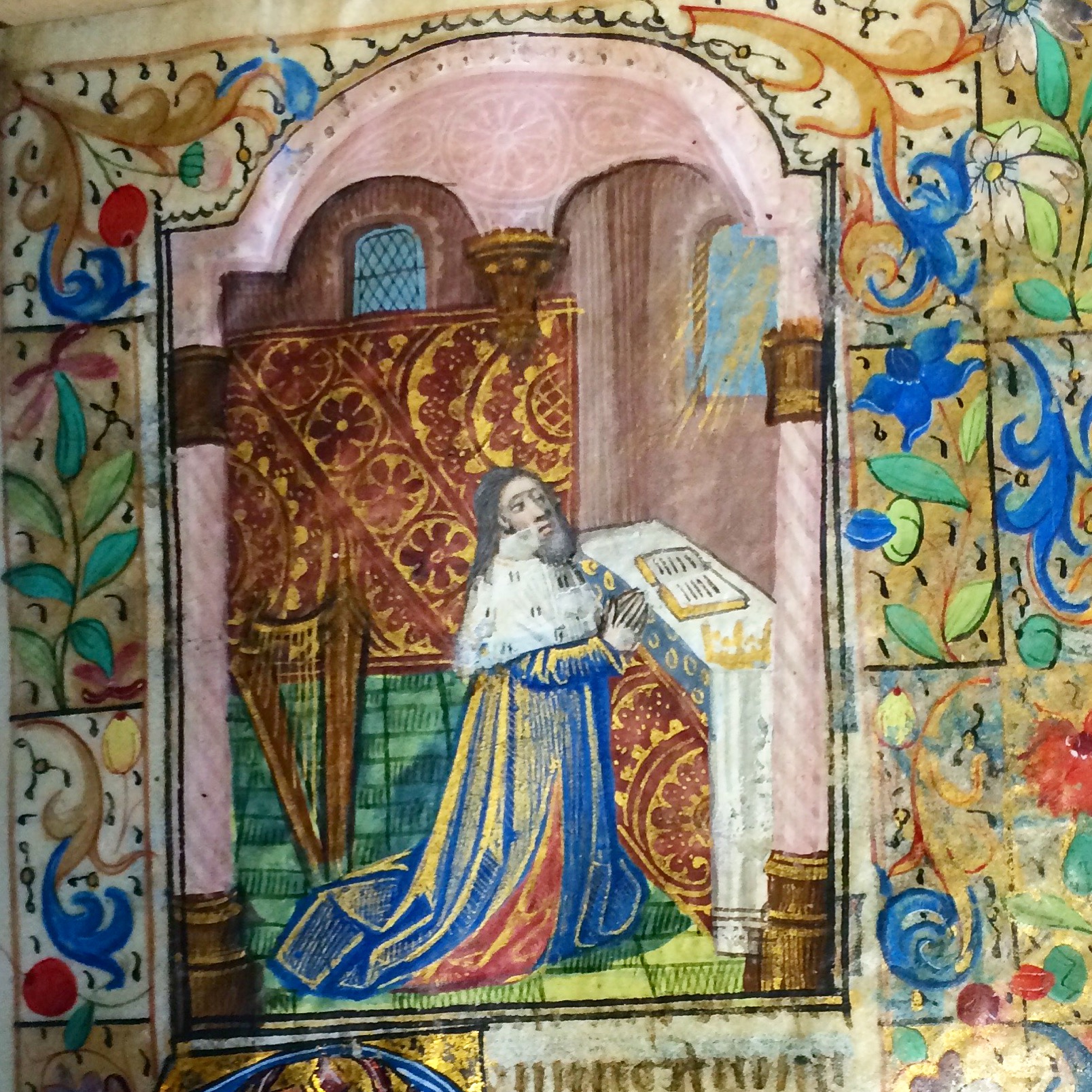
Birkbeck hours; King David at Prayer (fol. 85r)

One of the manuscripts, the Birkbeck Hours, was given to the College in 1977 by the widow of Dr Charles Fox (1897-1977), a lecturer at Birkbeck who later became a distinguished mathematician at Concordia University in Montreal. How the other three manuscripts reached Birkbeck is not known at present, although we do know that MS L.I was purchased by the College in the 1950s, probably to be used as a teaching aid. Ownership inscriptions in MS 108.C show that, in the nineteenth century, it belonged to a Peter John Bruff and, later, the Victorian scholar and antiquarian R. A. H. Bickford-Smith (1859-1916).

The books open a window onto readers and writers from hundreds of years ago; by coming back into public view, they can delight and instruct again. A more detailed examination of the books will, in time, yield much more about the lives these fascinating books have lived, and continue to live.

NB: The books are not currently available for public view, but it is hoped that a digitisation project will make them available online in due course.

Find out more

“You know it’s been a great writing day when it’s 4pm and you haven’t eaten”: Benjamin Wood on writing The Ecliptic

This post was contributed by Andrew Youngson, media and publicity officer for Birkbeck, University of London

The EclipticIn Benjamin Wood’s second novel, The Ecliptic, we delve into the story of Elspeth ‘Knell’ Conroy, a passionate, though somewhat lost, painter. Her desperate pursuit of truth and capturing it in her creations leads her to flee the commercialised 1970s London art scene. Refuge awaits off the coast of Istanbul in the form of Portmantle — the secret retreat on the island of Heybeliada which houses an eclectic group of creatives, from painters to architects and writers.

Will Ellie reconnect with her muse? What exactly was she fleeing from? And is this Turkish haven really everything she thought it would be? All come to light in Benjamin’s book, a fascinating journey into the mind of a passionate artist and her quest for creative authenticity.

The frequently thrilling and consistently moving story was sparked by Benjamin’s own experiences in Istanbul during a three-month artist-in-residence cultural exchange programme which the 34-year-old, Southport-raised writer was selected for by the British Council. Set up with an apartment in Istanbul for the duration, he was handed a simple mission: explore.

Here, the senior lecturer in creative writing at Birkbeck’s Department of English and Humanities, discusses his Turkish adventure, crafting his novel, and the pursuit of authenticity in art.

Hi Benjamin. How was the Istanbul experience?

I was so absorbed by it. There’s something about the city itself­ — it’s a meeting place of continents, and it has an innate sense of history, but equally there’s a certain manner to the people there that I enjoyed. It was quite a levelling experience. I felt that there was a frenetic energy to the city, but also an astounding natural beauty. I could wander alone and feel quite a part of things even though it was a different culture from the one I grew up in. But actually, I don’t know if it was the people or the landscape that I found most inspiring. I think it was going back and forth from the mainland to the islands on the ferry that gave me the strongest connection to the place.

That’s where the idea for the book really came to mind, wasn’t it? What sparked it?

It was visiting the island, Heybeliada, and discovering that a Turkish author Hüseyin Rahmi Gürpınar had lived and worked there. That set my creative head spinning, wondering about the possibilities of how far I could extend this idea of a reclusive artist at work on the island, and how I could use the landscape to hypnotise the reader.

In the book you go into beautiful detail about the process of painting and creating art in general. I believe you went to art college for a while in your youth, but beyond that, what research was involved?

A mix of book learning, extrapolation and some imaginative projection, I suppose. A lot of the stuff about Ellie wandering around Paddington with her sketch book is something I do as a writer. If I’m looking to write about somewhere, I go there and try to memorise the scene and convey that in language — these are things a painter does, it’s just that my medium is different.

How did you come to flesh out the central character, Ellie?

I tend to read a lot of life stories of artists or creative people who I find inspiring. With this, I was reading about Alasdair Gray and Francis Bacon and John Craxton. I tried to find ways to appropriate elements of their lives and create a viable character of my own.

I try to build a character out of found materials and my own personal reflections, to mould them into something that’s believable and authentic — as authentic as fiction can be, anyway.

Ellie goes through some very dark times. Do your characters take you down a dark path personally when you’re writing them?

I tend to be drawn to characters that are solitary and autodidactic, and who feel both compelled towards the world they inhabit, but also repelled by that world too. My characters tend to be only children with few friends who have a very active interior life.

It does make you go to places you wouldn’t wish to go to in your own life, but when you imagine your character in situations like that, it’s one of the most affecting things you can do. You really feel like you’ve been there yourself and, even though you haven’t experienced that particular thing, somewhere you have access to the truth of what it feels like. I’m not saying there aren’t inconsistencies, but when you go into that inner darkness of the character, you realise that it exists in you as well.

Does it feel cathartic?

Yes, it’s saved me a ton in therapy. (Laughs) I’ve always been an aggressively creative person. I think it’s because I work out so much of my anguish that way.

A photo of Istanbul taken by Benjamin during his writing residency

A photo of Istanbul taken by Benjamin during his writing residency

Do you miss the characters once the book is finished?

I miss being in their headspace. It’s an odd thing, because they’re always with you, in a way, but equally you move on to the next project. It’s like being an actor going from one role to the next; you give up so much of yourself to get it on the page, but the character gives you so much in return. But you forget so much of them as soon as you send off the draft. You have to do that otherwise you would go completely mad.

There’s a flushing out process in between novels when you need a year — well, I need a year — to get over the last one and ruminate on the next one and find the right voice.

When doing her best work, Ellie becomes completely absorbed in her work and time seems to stand still. Do you crave those moments in your own writing?

Yes! You reach this plane of consciousness where you’re not aware you are writing and creating. You’re just in this…it’s like when you look at a heat shimmer on a hot day. It’s like that shimmer is all around you. Those moments come rarely, so when they come to you, you go until you are exhausted.

You know it’s been a great writing day when it’s 4pm and you haven’t eaten. You come out of it and suddenly you’re hungry, then you look back and you have written 5,000 words. Those days rarely come at the beginning, they tend to come at the end when everything is coalescing and words just seem to flow.

It’s a physical rapture that you feel when it’s going absolutely as well as it can. And those moments usually need the least amount of retouching afterwards. Because it’s like the tap has opened up and it’s clear water rushing out.

Benjamin Wood (photo credit Nicholas Wood)What’s next for you?

I’m writing my next novel. I’ve got the research behind me now, and I’m entering the writing stage. I’m in the foothills of the thing. Actually the thing that takes me the longest isn’t the writing; it’s all the formulation of the character and finding the voice. It takes a long time to find the right framework and the right voice to it all. Once I’ve got that, it gets much easier to commit the words to the page.

How do you find striking a balance between writing and your teaching work?

It can be exhausting but you learn to manage. I tend to be a ‘compartmentaliser’ anyway, so when I’m at Birkbeck I’m doing Birkbeck stuff, and the days which I’m allotted for research are my writing days and nothing really interrupts them.

I also find that I get into a bit of a funk when I’m not teaching and I’m solely working on a novel. Teaching keeps me in the real world, and gives me purpose beyond churning out a creative project. I find I bounce off the energy of this place.

I find teaching really rewarding. It allows me to think about my own craft continuously, to look at the work of great writers and see how their stories function. You’re teaching yourself as much as you’re teaching others.

The Ecliptic is available now in hardback and Kindle. His first novel, The Bellwether Revivals is also available across print and digital formats

Find out more

Current Affairs – Calling all Applied Linguists

This post was contributed by Professor Penelope Gardner-Chloros, Department of Applied Linguistics and Communication

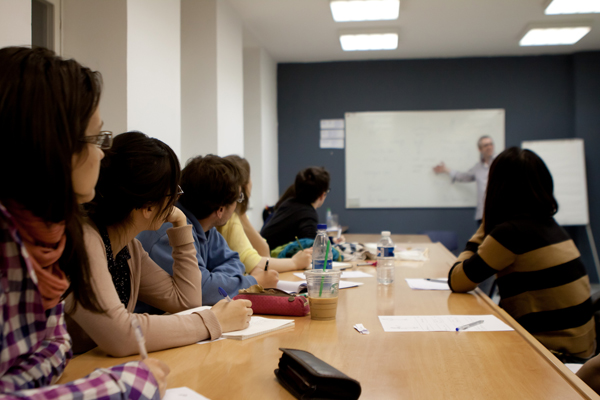
Language class (Photo: Jirka-Matousek)

Language class (Photo: Jirka-Matousek)

In a previous blog, I wrote about the determination of the origin of migrants through linguistic analysis. Since then, the refugee influx has become more significant by the day, now reaching major crisis proportions. Unfortunately it is no sort of solution to anything, but a few further reflections on linguistic aspects of this crisis come to mind.

English speakers

First, there has been much misinformation as to why so many migrants who have been camping in Calais wish to enter Britain rather than staying in France. Although the government would have us believe that it is because of our “over-generous” benefits system, in fact it is largely for other reasons, notably the fact that many of them speak English and not French.

Britain has benefited hugely in the past from English being a world language (although this is largely due to the power and influence of the US rather than that of Britain itself). Now, the status and ubiquity of English have, as it were, come back to hit us in the face.

Language lessons

Secondly, you may have read recently that the German government is offering 600 hours of German language lessons to the migrants settling in Germany. Scandinavian governments also have been offering language lessons to newly arrived settlers for many decades. This is a highly effective measure: learning a language is probably the best method for understanding the relevant culture as well as allowing suitable adaptation and integration in the host country. As an added bonus, it provides work for an army of language teachers, a fact which people reading this blog should appreciate.

IELTS exams

A third recent news item also provides food for (linguistic) thought. The Home Secretary Theresa May, desperate to cut down the number of migrants to the UK in order to fulfil election promises, plans to impose a higher IELTS English language requirement on prospective students from non-EU countries than the one demanded at the moment.

As someone who teaches students of many different mother-tongues, I agree that insufficient English language skills can be a problem. But on the whole our international students can express themselves quite adequately in oral discussion.

The problems arise with academic essay-writing, on the basis of which their university performance is graded. The difficulties there are less to do with incorrect English as such, and more to do with understanding what type of discourse is expected in such an essay – a complex linguistic and cultural question, though one which can of course be taught.

The IELTS language exams are not designed to measure these types of academic skills, so the university itself has to try to fill the gap by providing academic English and study skills training. But this is often too little and too late.

In fact, the proposal by Theresa May has nothing to do with academic motives – nobody really even pretends that it does. It is purely a way to legitimate the exclusion of one cohort of migrants and so make the overall immigration figures look better.

Excluding university students is, to put it mildly, a strange choice, since the government has elsewhere explicitly committed itself to accepting skilled, as opposed to unskilled, migrants. In purely financial terms, it means that the UK will benefit less from the overseas students’ fees – never mind the loss of goodwill which will result if we no longer allow overseas students to be educated in the UK.

In each of these news items, the linguistic issues are only part of the picture and political solutions are by far the most pressing. Still, the part played by language in day-to-day problems is evident. Applied Linguistics may not be able to solve the world’s problems, but it is important as the discipline which allows the related linguistic issues to be addressed in a scientific and well-informed manner.

Read the BBC’s recent article on “the battle over the words used to describe migrants”

Find out more

TEF, REF, QR, deregulation: thoughts on Jo Johnson’s HE talk

This post was contributed by Dr Martin Eve, senior lecturer in Literature, Technology and Publishing at Birkbeck’s Department of English and Humanities. It was originally posted on Dr Eve’s personal blog on Wed 9 September. It was then reblogged by Times Higher Education.

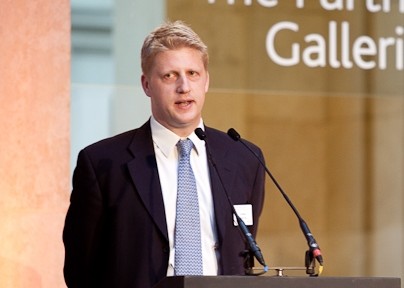
Jo_Johnson_at_British_Museum

Universities minister, Jo Johnson

I feel fairly drained today reading the speech given by the minister for Higher Education, Jo Johnson.

The inferences I make about the speech are that:

  1. There’s a massive coming wave of shake-ups to HE finance, both research and teaching, implemented through a Teaching Excellence Framework
  2. Critiques of the REF have backfired as they are used in a deft rhetorical move to cut state funding for research through QR

This is all just my reading of the speech. It doesn’t represent my employer’s views and it is speculative.

On TEF

Even while decrying REF as “bureaucratic and burdensome to academics”, Jo Johnson wants a TEF. There’s so much talk of “deregulation” in the speech, even while the crux of it is to introduce a massive top-down regulatory mechanism. The core of TEF is financial, though, regardless of what Johnson says about “teaching quality”. It is to be incentivized by allowing institutions to raise their tuition fees:

there will be financial incentives behind the TEF, with those offering high quality teaching able to increase fees with inflation

Another way of putting this is from the flip side: there will be real-term cuts to the funding of institutions that do not fare well under this system. Since assessment will presumably be relative from a single budgetary pot, this is a zero-sum game in which some universities are to be slowly de-funded.

There’s also the problem of private providers for the government. These were fairly disastrous before. TEF gives a way to control this expansion, though. It seems that the government wants to decouple fee increases from social mobility while at the same time controlling the expansion of private provision according to teaching metrics. The end point looks likely to be to cut all public support for teaching outside the fee loan system and to squeeze the loan system to drive up competition (while getting rid of social mobility regulators like OFFA). Lots of universities won’t survive that kind of move, but will be replaced by new teaching providers.

On REF and Research Councils

The current modelled spending cuts in BIS are unlikely to leave research funding untouched. The Minister for HE used a deft rhetorical elision to couple academics’ critiques of the REF with removal of state funding for teaching and research:

“To deliver our ambitions, we also plan to reform the higher education and research system architecture. […] Our regulatory regime is still based upon a system where government directly funds institutions rather than reflecting the fact that students are the purchasers. […] It is also clear to me that there are many in the sector demanding a process for assessing the quality of scholarly output that is less bureaucratic and burdensome to academics.”

These critiques, of course, were of REF as a reductive quantifying procedure. They were not meant to justify the removal of QR, just the removal of the process by which it was assigned. Be careful what you wish for. REF was the way that QR was saved. Regardless of whether you like REF or not (I hate the procedure, but want universities to continue to receive state funding for research), QR gives institutions the freedom to allow their researchers and teachers to fulfil both roles. It is naive to think that this government would continue to fund universities in this way without a procedure like REF. So, I don’t like REF, but I accept it as the pragmatic/political compromise negotiated with a centre-right government to continue funding. This is my view of a messy political compromise, not my pure ideal.

The problem is that there are now several different ideologies competing here and the government must weigh its alleigance to each before deciding what route to pursue to achieve its aims. While Johnson says that he is “committed to the maintenance of dual funding support”, i.e. Research Councils and QR, something has to give. So, the ideologies competing are:

  1. An ideology of cost-effectiveness
  2. An ideology of deregulation
  3. An ideology of strategy

REF/QR is cost-effective compared to the Research Councils:

The REF assessed the outputs and impact of HEI research supported by many types of funders. In the context of £27bn total research income from public sources in the UK over a six-year period, the £246M total cost for REF 2014 is less than 1%. In the context of dual support, the total cost amounts to roughly 2.4% of the £10.2 billion in research funds expected to be distributed by the UK’s funding bodies in the six years, 2015-16 to 2020-21. This compares with an estimate of the annual cost to the UK HE community for peer review of grant applications of around £196M or around 6% of the funds distributed by the Research Councils.

So there’s a drive to maintain REF and QR for cost effectiveness.

But REF/QR has been massively slammed by academics as “bureaucratic and burdensome”, so it doesn’t fit the ideology of deregulation (however contradictory). Furthermore, REF/QR can’t be directed, as can Research Council funding; institutions can spend it on whatever research projects they like.

So the government has to work out what it really wants. If there is to be state funding for research, does it value a cost-effective route (REF.); a de-regulated route (maybe Research Councils? Or just cut REF but keep QR? Yeah, right.); or a route that it can control (Research Councils)?

Finally, the Research Council rejection rate is massive. Only a small number of applications go through. If we’re all forced to apply for funding via this route because there is no QR, then this will get even worse. Research funding will only be available at a very small number of places as concentration rises. This protects the golden triangle while exposing everyone else.

In conclusion

Johnson said, in his speech, that he has “no target for the ‘right’ size of the higher education system”. However, we can infer from this that he does not believe the size to be “right” at the moment because of all the changes he wants to make. Indeed, he said that we need changes to ensure “that more [people going to university] does not mean worse [quality of education]”, which presumably is what he thinks happens at the moment. I speculate, from reading this talk:

  • that the government continues its policy of protecting prestigious institutions while sharpening severe financial competition among all others.
  • that TEF is a financial move, not a teaching quality move, even if you think that teaching should be better rewarded in the academy.
  • that real-term de-funding of existing institutions through TEF will be the way in which the expansion of private providers is regulated.
  • that as long as the student loan system stands, the government can have it both ways: it can claim that it does not fund universities and that this is private income, even while having a regulatory say over them because taxpayers “underwrite” the RAB charge.
  • that REF/QR and the Research Councils are up for debate but the government is to use academics’ calls for its abolition as a justification to cut QR.
  • that there are several competing motivations for the government’s actions in the research funding space that it must weigh.
  • that the stability of operation for many institutions is to be upset.
  • that the talk of de-regulation here is only possible by the introduction of massive new regulatory bodies.
Dr Martin Eve

Dr Martin Eve

None of this is new, of course. I haven’t here, also, gone into liberal humanist defences of the university, of which we will surely see many in the light of this talk. I find myself supportive of the goal to get a more diverse student body – I can’t argue with that, just the methods by which it might be achieved. For instance, while there are talks of supporting those who don’t go through a “traditional route” to HE, the government’s recent policies on funding led to a period of severe financial difficulties for institutions like Birkbeck that cater exclusively for those non-traditional students. So, again, the rhetoric is confused.

But now we have it from the Minister and I suspect we will see action on the ground very soon.

Find out more

Refugee Crisis on the Tiny Island of Leros

This post was contributed by Dr Julie Peakman, honorary fellow at Birkbeck’s Department of History, Classics and Archaeology. Dr Peakman is currently in Leros, Greece, on a research trip for her next book, but is also volunteering at the port police, offering help for refugees.

Leros is currently experiencing a huge influx of refugees – mainly Syrian and Afghan – arriving on its shores. Here, Dr Peakman writes for Birkbeck Blogs about her volunteering activity and the situation on Leros.

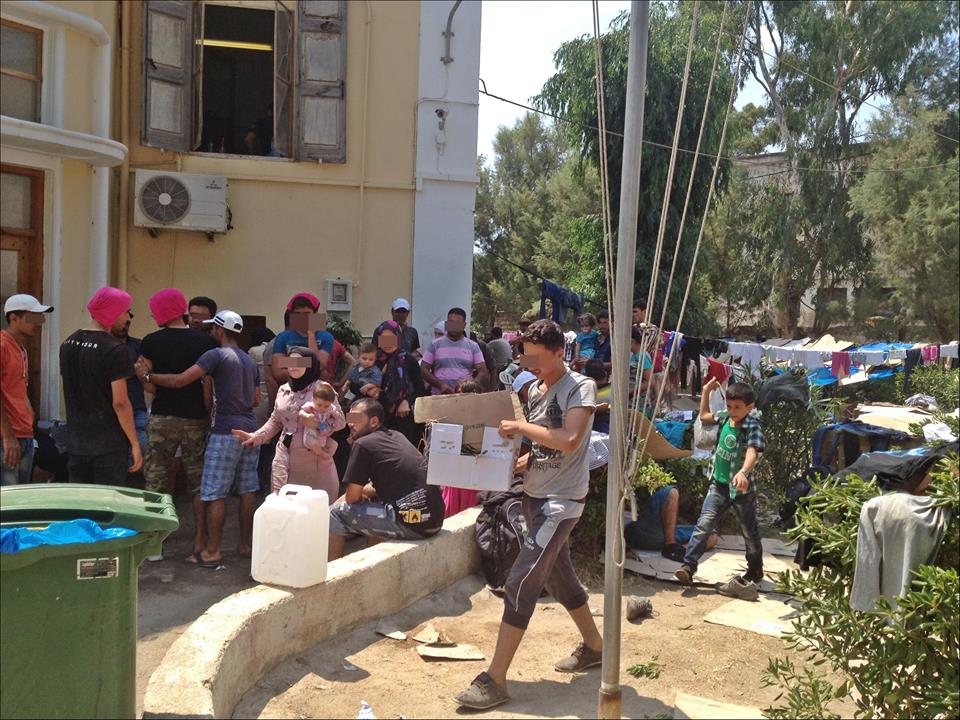
Refugees gather in Leros, Greece (picture courtesy of Anne Tee)

Refugees gather in Leros, Greece (picture courtesy of Anne Tee)

Yesterday morning when we arrived at the port police, there were three-hundred refugees waiting in the hot sun in Lakki police station without food or water.

They had been given no food last night and the only thing they had eaten was the croissants and biscuits volunteers had given them the morning before. It is a tinderbox waiting to be lit.

The police say they have no money to pay the restaurants so the restaurants will no longer supply food as they have not been paid (only five euros per refugee, but it was something). There are only a handful of port police struggling to cope with the situation. The government has no money to send the police.  Even the simple basic of water is not being supplied by the authorities.

The water tank for the refugees has not been filled for days and we wonder why this has not yet happened. The police had to take the water which volunteers had bought down to Lakki port over to more refugees in Xerocampus, at the other side of the island. These poor people are lying in the streets with nowhere to sleep while a building stands empty waiting for plumbing to be connected. This would take a couple of hours.

There is one young woman from the United Nations who says she only gives verbal advice to the refugees to tell them their rights. When I asked her why the United Nations Refugee Council are not doing anything to send food, water, shelter or clothes, she said the United Nations has not declared the situation a humanitarian crisis and she said that is the policy made in Geneva.

Refugees gather in Leros, Greece (picture courtesy of Anne Tee)

Refugees gather in Leros, Greece (picture courtesy of Anne Tee)

Meanwhile, my wonderful friends, Chris Angiel, Stella H Perlman and Patrick Muldowney made 200 sandwiches to give out to those who had no money and could not leave the station as they had not been ‘processed’.

Donations of juice, milk, nappies, soap, clothes and new flip flops were given out to as many people as we could. A wonderful Dutch couple have collected clothes from all their fellow yachties to give out to refugees. After four hours working with Patrick and a stalwart of the action Anne Tee in cramped and hot conditions, most of the refugees had at least been fed and watered. Anne goes down every morning and evening.

I am afraid I welled up when one of the people who spoke English came over and said on behalf of everyone there they would like to thank me and the other volunteers for our help. I felt very humble. The miracle worker behind all this organisation is Martina Katsiveli who is struggling to get a building opened for the refugees so they can have showers and toilet facilities. At the moment, they have one toilet.

View the Guardian’s report of the migrant crisis in Leros

Find out more

Pictures courtesy of Anne Tee

Insomnia and Interpreters – Linguistic Aspects of the Greek negotiations

This post was contributed by Professor Penelope Gardner-Chloros, Department of Applied Linguistics and Communication

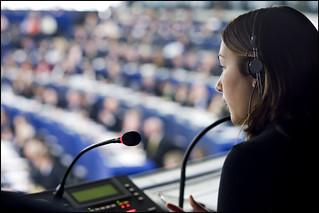
An interpreter at work during the EU - South Korea free trade agreementLast month, you may remember, while Mr Cameron was giving his views in the news on the crucial matter of fox hunting, Greece was on the brink of financial meltdown.

I was in Greece and with the banks closed and the prospect of worse to come, the sentence I kept hearing from friends and relatives was ‘I can’t sleep’. The local baker, who was lucky enough to be selling his bread to hotels, did not have the liquidity to pay his flour supplier, a small farmer. As a tourist, when you paid your bills with cash, people were abnormally grateful, though much too proud to say why. It seemed that a whole country was holding its breath while a roomful of people in Brussels decided their fate.

Such momentous decisions depend, like so much else in our lives, on language – on a group of people talking, in an airless conference room. How do their minds – and their meanings – meet? Sometimes with difficulty.

You need only read the pronouncements of the – now disgraced – Minister of Finance, Yanis Varoufakis, to realize how culturally inappropriate rhetoric can exacerbate a crisis. It was not so much Greek bravado in his case – though that was present too. His upfront Australian – trained braggadocio went down like the proverbial bag of sick with the Brussels bureaucrats.

He should perhaps have taken lessons in how to imply things without spelling them out in enormous capital letters from Christine Lagarde, who went on record for saying that the negotiations could only get anywhere if there were adults in the room. Hmmmm…

Relay interpreting

Greece-and-Austria-webSpare a thought also for the fact that these meetings would have been conducted with what is known as a ‘full regime’. This means that each country had interpretation from and into their own language – there are 23 languages.

So while some people would have been speaking and listening to, say, English, the majority would have been speaking another language and having their words translated into 22 languages. They would also, of course, have been listening to the words of the main protagonists through interpreters.

Furthermore, when there is no interpreter who is able to translate from Greek directly into, say, Italian, the Italian interpreter listens to, for example, the English interpreter, and then translates the English into Italian. This system is known as ‘relay interpreting’.

Occasionally, double relay has to be used: for example if the Dutch interpreter does not speak French, she or he has to listen to someone in another booth, say German, who is themselves getting the Greek translated by someone in the French booth. It does not take much imagination to appreciate the inevitable loss of accuracy, of nuance, and of metaphorical ‘tone of voice’ – three things which really matter in such delicate negotiations.

Cross-linguistic, cross-cultural talk

Penelope Gardner-ChlorosAs a former interpreter, I wonder how the interpreters coped with the German finance minister Wolfgang Schauble telling the head of the ECB, Mario Draghi, that he was ‘not an idiot’. They would have been caught between the ostensible need to be accurate and the need to avoid being the cause of a diplomatic incident – the latter concern being part of their DNA, if not a specific part of their professional training.

And what of the order by the Head of the European Council, after 14 hours of unsuccessful talking, ‘Sorry, but there is no way you are leaving the room’. How did that come out in Finnish, in Slovakian, in Spanish, in Danish…and in Greek?

The cross-linguistic, cross-cultural talk in that room would truly be worthy of analysis – what a PhD that could make! For the time being though, I am just glad that the messages got across well enough, and tactfully enough, so that my baker can pay for his flour again.

Find out more

Read the BBC’s recent round-up of some of the greatest mistranslations throughout history

Greece and Austria: A similar story?

This post was contributed by Barbara Warnock, third year PhD student in Birkbeck’s Department of History, Classics and Archaeology, who is currently researching the work of the League of Nations in Austria in the 1920s. The title of  thesis is ‘The Significance of Austrian Financial Reconstruction 1922-1926’.

Greece-and-Austria-webAs negotiations between the ‘troika’ and the Greek government continue, the Austrian Chancellor, Werner Feymann, has adopted a more sympathetic line than many European leaders in relation to Greece’s current predicament stating in early June: ‘I stand on the side of the Greek people’. His sentiments call to mind events more the ninety years ago when it was the plight of the Austrian people that was a cause of international concern.

The world’s attention this week is on Greece, but in the early 1920s, it was the newly founded republic of Austria that received the attention of the international community, in what was the first ever comprehensive international bailout and structural adjustment programme, orchestrated by the League of Nations in 1922.

Greece’s present problems around debt, collection of taxation and an excessively strong currency mirror aspects of Austria’s crisis after the First World War. Back then, Austria too had difficulties around debt and taxation. The issue with their currency, the Krone, however, was rather different, in that its value was collapsing.

Austria had been one of the states most badly affected by the First World War. The defeated country was shorn of empire, monarchy and to a large extent, identity. Austria was beset by a multitude of difficulties including desperate shortages of food, trading problems and the uncertainly caused by the imposition of reparations (although these were never actually collected). Confidence in the very viability of the country was scare, and the Krone became ever weaker in value. Inflation turned into hyperinflation and the government struggled to finance its expenditure. Obtaining foreign loans to help the country meet its obligations became impossible.

In this context, in 1922, the Financial Committee of the League of Nations – a precursor to the IMF – designed a rescue package for Austria. This entailed League assistance in obtaining foreign loans, which were underwritten by the governments of Britain, France, Italy and Czechoslovakia in return for a commitment that the country would not seek to unify with Germany, and measures to fix the value of the Austrian currency. The programme also included the ‘reconstruction’ of Austrian state finances, which entailed large reductions in the numbers of civil servants, cuts to government expenditure and restrictions on the salaries of state employees, all to ensure a permanently balanced government budget.

Much of this may sound very familiar to those living in Greece (or even Britain) today, and the similarities go further. Austria also had to submit to the control of a version of the modern ‘troika’, (the IMF, European Central Bank and the EU), operated via the League of Nations. A League Committee of Control (representing interested League members); the League’s Financial Committee (composed of bankers, financiers, and treasury representatives); and a League-appointed ‘Commissioner-General’, Alfred Zimmermann, all provided monitoring and oversight.

Zimmermann was dispatched to live in Vienna to enforce the terms of the deal and control the expenditure of the foreign loans. This kind of control was, like that of the troika, a source of humiliation and enormous resentment in Austria. Zimmermann, like the troika, frequently condemned the lack of progress on ‘reform’ made by the Austria government.

Another striking similarity between the work of the League and that of the current troika in Greece is the lack of real consideration on the part of those bodies overseeing such programmes for the effects that their schemes have on living standards and on the political climate. Rigid adherence to economic dogmas, as practiced by the troika, as Greece has found, can have disastrous consequences.

In Austria, the League’s programme did deliver foreign loans for the country, and produced a stabilised currency. However, it also resulted in high levels of unemployment and the reduction of government social support. Furthermore, the programme undermined the already shaky stability of Austrian banks and increased political tensions within the country.

The League essentially withdrew their control from Austria in mid-1926, only to become involved again during Austria’s economic difficulties in the 1930s. By 1933, parliament had ceased to operate in the Austrian Republic. In 1934, the Social Democratic movement was smashed, and in 1938, the country was incorporated into the German Reich.

The problems of interwar Austria were manifold, but the contribution that this inaugural attempt at an international bailout made towards creating a viable future for the country is debateable. As others, including Paul Krugman, have remarked, the apparent lack of awareness of the troika of the problems that interwar deflationary policies caused is one alarming aspect of the Greek crisis.

Find out more

Emphasising the Negative

This post was contributed by Dr Malcolm Edwards, of Birkbeck’s Department of Applied Linguistics and Communication

Emphasising-the-negative-webOne of the serendipitous joys of studying grammars is the occasional discovery that the seemingly duller bits of language often turn out to reflect underlying processes with wider implications for how grammars and languages work.

Negation doesn’t seem like an auspicious point of departure for a journey into the hidden life of language. It has, seemingly forever, provided an opportunity for those with prescriptivist or fascistic tendencies, combined with a taste for spurious logic, a stick to beat the rest of us with for our ignorant and wanton use of supposedly deviant and/or ungrammatical forms such as ‘I never did it’[=’I did not do it’], or (the Mark of the Beast, this one) the double negative ‘I didn’t do nothing’[=’I didn’t do anything’].

But negation left to itself -as it should be – does have an unsettling tendency to change form, and an equally unsettling tendency to make its point using expressions ranging from the comparatively mild (John Wayne’s ‘the Hell I do!’[roughly = ‘I most decidedly do not’), to the taboo ‘the f*** I will’ [unequivocally = ‘I will not under any circumstances’].

How negative constructions evolve

Nearly 100 years ago, Otto Jespersen proposed the Jespersen Cycle, a model of how negative constructions evolve. Jespersen described how changes in negation arise from a tension between expressive means and expressive needs.

Jespersen puts it like this: ‘the incongruity between the notional importance and the formal insignificance of the negative marker may… cause the speaker to add something to make the sense perfectly clear’ (Jespersen, 2017: 4-5). If we take French as an example, the original marker of negation was ‘non’ (itself originally Latin, and still alive and well as the French for ‘no’). Over time, ‘non’ became ‘ne’ – in Jespersen’s terms, losing formal significance – a little word easily eclipsed by bigger words, but still having a big job to do.

To reinforce ‘ne’, the word ‘pas’ was introduced to the negative construction. ‘Pas’ was (and still is, when it’s not doing a bit of negation on the side) an ordinary noun meaning ‘step’. Over more time, ‘pas’ itself begins to become the negative marker. This would be of limited interest if it only happened in French, but the same process is found in other languages. In Egyptian Arabic, for example, negation is marked by ma… sh. ‘ma’ is the negative marker proper, and ‘sh’ is a vestigial form of the word shey ‘thing’. And in Egyptian, too, there are indications that ‘sh’ is encroaching on ‘ma’s’ territory.

Squatitatives

Jespersen did not discuss the role of taboo words in negatives such as ‘He doesn’t know squat/f***/s***[=absolutely nothing at all]’, but he would undoubtedly admit that they are a clear case of the speaker adding something to make the sense clear. Horn (2001) dubs these forms ‘squatitatives’, which start life as minimising negatives, with the taboo element subsequently becoming a negative item in its own right, semantically equivalent to ‘(absolutely)nothing’, as in ‘He knows squat’. Squatitatives are not negative markers as such and we can be reasonably confident that the ruder emphatics will not be taking over responsibility for negation any time soon, but like the reanalysis of French ‘pas’ and Egyptian ‘sh’, they are instances of how words originally selected to perform an emphatic role lose their original meaning and take on a grammatical function.

Find out more

Horn, L (2001): Flaubert Triggers, Squatitative Negation and other quirks of grammar. In Hoeksma, J. H. Rullman, V. Sanchez-Valencia and T. van Wouder (2001): Papers on Negatives and Polarity Items. Amsterdam: Benjamins.

Jespersen, O (1917): Negation in English and Other Languages. Copenhagen: A.F.Host and Sons.

Cameron’s Human Rights Headache?

This post was contributed by Dr Ben Worthy, lecturer in the Department of Politics

Human-RightsAs a newly elected Prime Minister, you wait around for one European problem then two come along at once. While David Cameron is trying to deal with his EU referendum promise, another ‘European’ problem has reared its head in the Queen’s Speech. The Conservatives promised to repeal the Human Rights Act 1998 and replace it with a British Bill of Rights-see this full fact analysis for background. The Conservative manifesto stated that:

The next Conservative Government will scrap the Human Rights Act, and introduce a British Bill of Rights

The Conservatives would draw up a new Bill of Rights that ended the controversial link with the European Court of Human Rights in Strasbourg, treating their rulings as advisory and giving power back to the UK’s Supreme Court. But it looks like the commitment has at least been slowed down – to a promise to consult rather than, as was suggested, to have proposals ready in the first 100 days.

What’s caused the re-think?

The Human Rights Act is surrounded by layers of myths and half-truths. The claim is that the Act creates a set of new rights (it doesn’t, it just adds them to UK law), that it allows judges, and particularly judges from the European Court of Human Rights, to challenge and change British law (it doesn’t really, just lets them declare it ‘incompatible’) and undermines Parliament’s power (which is actually preserves)-see this famous speech by Lord Bingham. This guide to the Act concluded ‘the Government also acknowledged that a series of damaging myths about the Act had taken root in the popular imagination’.

However, the Human Rights Act has become a symbol of ‘European’ interference in ‘our’ politics and abuse of laws designed to protect us. So David Cameron is trying to change something because of what people think it is doing rather than what it is.

So why has Cameron slowed down?

Like any good politician, Cameron has looked across the battlefield and foreseen what could happen. Let’s run a little thought experiment and imagine that he and Michael Gove can draw up a new Bill of British Rights and Responsibilities, one that better reflects British values (putting aside whether it breaks any treaty obligations etc). They can send it, at least in a draft form, to Parliament and repeal the Human Rights Act. At this point, the fun would begin.

In the House of Commons, his own party is deeply divided-and even invoking the classic ‘what would Winston Churchill say’ line hasn’t helped. Some Conservatives oppose any ‘reduction’ in human rights, with one ‘senior’ politician this weekend rumoured to be considering resigning and a group of influential conservative MPs ready to oppose anything they see as a ‘weakening’ of rights.

On the other side, his Eurosceptic [or Euroexit] MPs are keen for something very different that ‘breaks’ the ‘formal link’ with the ECHR and reflects UK values. So the new Bill would have to be a masterpiece that balances these two viewpoints – different from the old Act but not giving less protection.

The truce is fragile

Dr Ben Worthy

Dr Ben Worthy

Cameron’s party, for the moment, is holding off rebellions but the truce is fragile and one issue they do like rebelling about is Europe. Just to make things more tricky for a Prime Minister with a small majority, opposite his own party the new block of 56 SNP MPs, 8 Lib-Dems and the whole of the Labour party are all firmly against scrapping the Act.

Then we get to the House of Lords. Technically the House of Lords cannot block anything promised in a manifesto-but in this case it isn’t so clear cut. The government can’t rush them to any decisions and the Lords can block legislation for some time and even ‘filibuster’ (talk until legislation is dropped).

In the House of Lords the Conservatives do not have a majority and there’s a big healthy dollop of Labour and angry Lib-Dems (there’s only 8 Lib Dem MPs but 104 highly engaged Lib-Dem Peers). Added to this, it’s full of lawyers and experts who see themselves as protectors of civil liberties. The second chamber has already issued warnings that any repeal or new bill won’t get through.

Cameron’s headache may become a migraine

So, piloting this through the House of Lords and House of Commons is very tricky. It’s at this point that Cameron’s Human Rights headache may become a migraine. The Human Rights Act 1998 is deeply tied up in the devolution settlement to Scotland, Wales and, especially, Northern Ireland, where it is embedded in the peace process.

Legally, as Mark Elliot points out, it seems Westminster can just about push a new Bill of Rights across the UK. But politically it will be extremely difficult and it’s possible that Scotland may refuse to co-operate. The ultimate danger is that, as pointed out here, a British Bill, opposed in Scotland, Wales and Northern Ireland, could become an English Bill.

So what could Cameron do? Playing for time seems a good idea. How about a referendum?

 Find out more

Saddam in Starbucks

This post was contributed by Professor Penelope Gardner-Chloros, Department of Applied Linguistics and Communication

You are probably used to it by now, but the first time you ordered a coffee in Starbucks and were asked for your name, were you a little taken aback? I certainly was.

Saddam in StarbucksWe are used to being asked for our great aunt’s middle name, when our first milk tooth fell out etc etc when contacting a bank or paying for something online. But must we really reveal our name TO BUY A COFFEE??

Of course, there is method in this madness: writing a name on the paper cup makes it easier to know who ordered a double caramel macchiato and who wanted an organic Colombian espresso at the end of the line. But for a Brit there is still something a little bit too intimate about giving a first name to a complete stranger who you will probably never see again. Deborah Cameron has written brilliantly about this ‘commodification’ of language in her books ‘Verbal Hygiene’ and ‘Talking from 9 to 5’.

Starbucks, of course, are not alone. If you phone a restaurant in London to book a table, you give your surname, but 9 times out of 10 you are then asked for your first name too. Why?! One friend systematically replies: ‘Why do you need it? We are not going on a date, are we?’

Your reaction to all this probably depends on your age. If you grew up in an age when no-one in a service industry ever addressed you with anything other than with your title and last name, this is all a big issue. On the other hand, if you are under 25, you have probably never known any other way to do business, so none of this seems at all important.

Ways of addressing have always varied according to cultural conventions, and the American culture of Starbucks is one which emphasises solidarity rather than status. These were the two dimensions picked out as most relevant to such choices in Brown and Gilman’s famous 1960 article on pronouns of address.

For different reasons, at Birkbeck, where students are often taught by lecturers younger than themselves, students and staff are usually on first name terms – and this has been so for 35 years to my certain knowledge.

But I still have students from some European and non-European countries who would never dream of calling me anything other than Professor Gardner-Chloros. To them, it would be highly disrespectful to do anything else, but I am always a little embarrassed since I call all students by their first name.

But let us return to our skinny double caramel macchiatos. I have got round my discomfort in Starbucks by giving a variety of names in Starbucks – anything but my own. Usually I choose a really appalling dictator – Hitler, Stalin etc, to make it quite obvious that I find the question a tad inappropriate.

Stalin works just as well as Penelope for identifying my coffee, after all. I also hope to raise a slightly less perfunctory smile from the poor employees who have to work all day in this artificially matey, Disneyfied ambiance. Some are so ‘well trained’ – or just plain exhausted – that they scarcely notice and just dutifully write Stalin or Pol Pot on the cup. Others give me a quick look of surprise. Very rarely is there any comment.

This week, I was Saddam in Starbucks. There was no queue so there was in fact no real need for a name at all. The assistant – sorry, ‘team member’- had more time to chat.

‘Saddam?’ she repeated, looking up. Then she smiled. ‘Why not? I have served Batman and Superman, so why not Saddam?’

She thought again. ‘And if we can’t have a bit of a laugh, what is the point of it all?’

She was right. Saddam does not matter, and nor does Penelope, but sharing a joke is really important. The lovely thing about language is that as well as allowing us to express ourselves, it also gives us such interesting issues to talk ABOUT.

Find out more