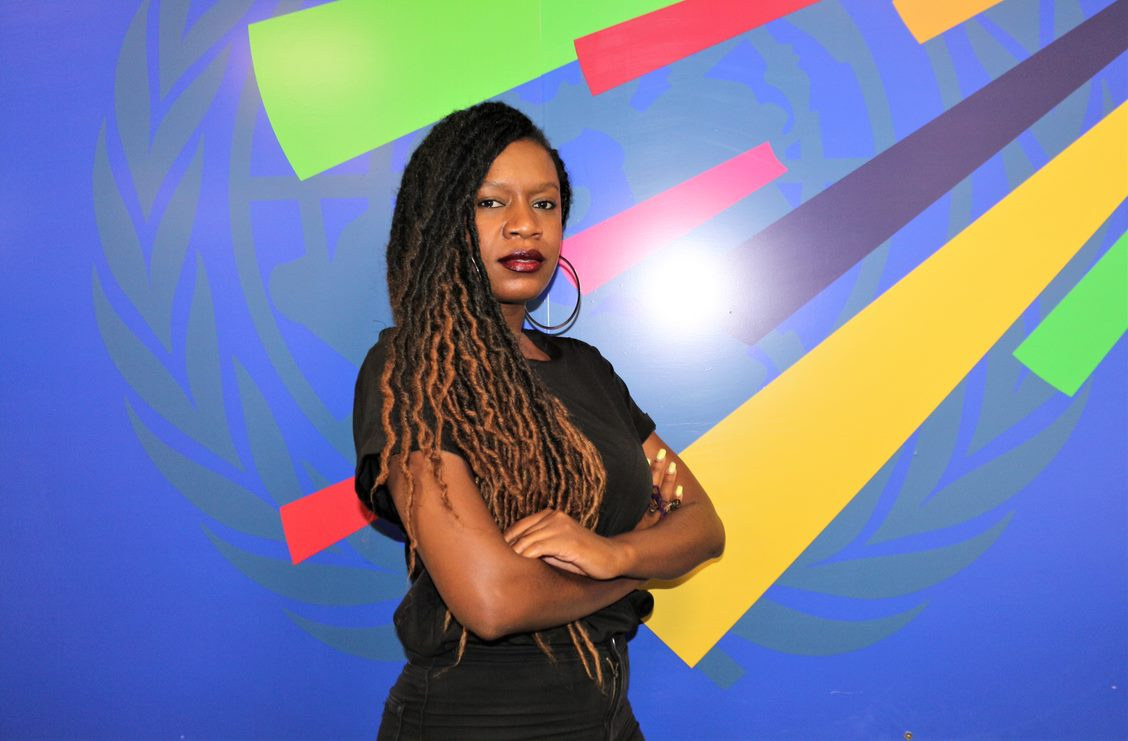
How can we manage our organisations and families out of the COVID-19 crisis? 

As we move out of crisis mode and settle into new patterns of working, Professor Almuth McDowall shares her advice on managing work and family life over the coming months. 

In MayI had the opportunity to deliver an online webinar for Barclays Eagle Labs together with their CEO Ben Davey. We tackled important and profound questions, not only about how we manage work itimes of crisis, but also our families and wider networks. 

Ben shared his experience of managing work-life balance. Initially, he explained, he fell into the trap of working very long hours and not having enough time to rest and recuperate. Now he makes an extra effort to go out, get fresh air and then comes back to his desk feeling reinvigorated. I could relate to this so much. During the first two weeks of the crisis, I must admit that I barely slept or ate, as there was so much to do, so much change to manage. Things have settled down now and we are working virtually as teams and organisations. 

Ben asked me if I had any advice for how to make this happen effectively, particularly in international contexts. The research on virtual working tells us that teams work better if they have had initial face to face meeting and bonding time. Well, none of us has had this. It might be something to go back and revisit – have you agreed a set of principles for how your team will work? Has everyone signed up? Regarding international teams, it can be really important to establish and preserve local identity, particularly during this time of crisis and uncertainty. Maybe each team could agree on a ‘strapline’ that summarises their identity and ways of working? Then provide teams with the opportunity to express their needs for how they want to work with others. Provide regular ‘feedforward forums’ so that the spotlight is not only what needs to be done, but also how you work together.  

The attendees in our online session were as concerned about managing their families as they were about managing their work. Many of them had noticed that energy levels are starting to wane. Also, how do you communicate with young children and teenagers? As the situation is so uncertain, a good approach is to focus on the short and medium term. Think about what is precious to you as a family, and what you can control. No one can control the media, or government policy, but we can control how we communicate with each other. Having been stuck in our homes for so long, it can be easy to fall into a rut and take each other for granted. Make sure you actively seek opportunities to talk to each other and share experiences. 

Another question was about how to keep teenagers motivated to do their homework. I shared my own experience. My middle daughter is doing, or rather not doing (in a traditional sense) her GCSEs. At first, we had several heated arguments as I wanted her to do more work, yet she was lying on her bed and talking to her friends. Being honest, I had to adjust my own expectations. This is an unusual situation. She is at an age where her peer group is more important than family. Will anyone really care about the grades she gets in her GCSEs this year? I think not. So I now let her be and chat to her friends. She is happier for it, and so am I.  

How can we help young children make sense of the crisis? Well, limit exposure to news at home, as ‘big words’ said in a serious tone are likely to unsettle. Children appreciate honesty, so don’t pretend. But find a way for them to express themselves. It might be helpful to get them to start a scrapbook, or a journal, where they can draw and chart their experiences visually – then talk about what you see together.  

Finally, we talked about the importance and power of goals at work, and at home. At work, many of us have been in survival and crisis mode. Now might be the time to agree what the priorities for the next few months are and state these very clearly. Then check in on progress and give each other feedback about how things are going. Revisit and revise as necessary. The same applies at home. Is there something you want to learn as a family? Something that you have learned through the crisis which you want to take forward? Get everyone involved in planning. Express your vision – write this down or draw it – but be sure this is shared.  

The crisis is hard, and we are in this for the long haul. Focus on what you can control, this will help you to sustain motivation. Don’t forget – we are in this together. Talk, share and reach out to others where you can. 

Further Information: 

Easy vanilla cupcake recipe

Third year Marketing student Pav is back to help beat the lockdown blues. This time, he shares his recipe for easy vanilla cupcakes.
Pitcure of cupcakes

Hello everyone!

It’s your Pav here. I hope that you are all keeping well and staying healthy. This time I would like to share a quick recipe for 24 cupcakes.


What you need: 

  • 250g unsalted butter, softened
  • 250g caster sugar
  • 250g self-raising flour
  • Pinch of salt
  • 4 medium eggs
  • 4 tablespoons milk
  • 1 teaspoon vanilla extract
  • 1 or 2 x 12-hole muffin tins, lined with paper cases
  • and a bit of joy 🙂

Chef Pav!

Method for your happy baking:

1) Take the butter out of the fridge – keep it out for 30 minutes for perfect room temperature (ensure the butter is not very hard or very soft).

2) Preheat the oven to 180C, gas mark 4. If you need more information, visit the BBC Good Food website for conversion guides.

3) Using a seive for all the dry ingredients, add the butter, sugar, flour, salt, eggs and whisk until the mixture is smooth – do not under or over mix. The right amount of time is 1 minute and 30 seconds at the highest speed.

5) Add any additional colouring or flavours together with milk and vanilla extract first before mixing with the dough. Once all together, mix it for another 30 seconds.

6) Use a traditional ice-cream scoop or two tablespoons to divide the mixture between all the paper cases (if you only have one tin, just split the dough and do this step twice).

7) Place both muffin tins in the oven and bake for 15 minutes, then swap over the position of the tins over and bake for a further 5 minutes. 

8) Test cupcakes with a tooth pick to see whether they are ready. The best cupcakes are golden on the top and the toothpick should come out clean.

9) Decorate with icing on top or with fresh strawberries.

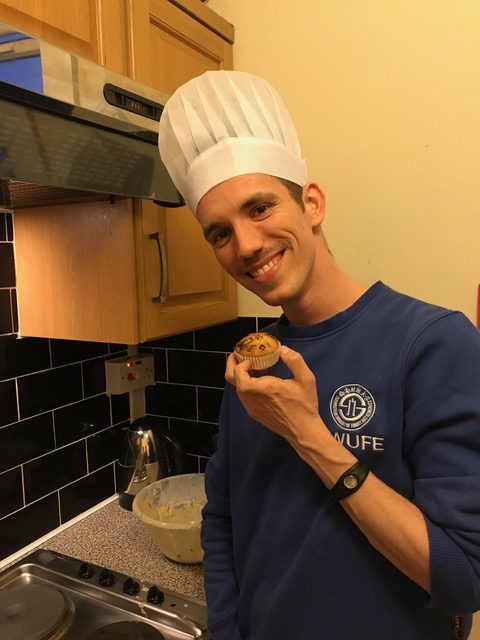
I hope you enjoy this recipe and getting creative with decoration – next time I will share the best recipe for icing sugar and blueberry muffins (which you can see in the picture of me).

Until then, stay well and don’t forget to share your creation on Instagram #Lifeofpavand @birkbeckbei.

Pav 🙂

“Birkbeck gave me the opportunity to help others.”

Marcel came to Birkbeck to follow his dream of becoming a web developer. Now teaching in the Department of Computer Science and Information Systems, he shares his passion for programming with the next generation of students.

Picture of Marcel

I’ve always wanted to work in IT. Back in the early 2000s, I was doing reprographics in a legal department, but knew I wanted to be more involved in computing. I was fascinated by computers and web design, so I began teaching myself at home. I started with Photoshop, then building websites and began to realise this was something I really wanted to do and could enjoy as a job. 

Getting a career in web development with no education and no experience was impossible, so I went along to a few university open days to explore my options. 

One Saturday, I went to Birkbeck and came across the Foundation Degree in Web DevelopmentI couldn’t afford to quit my day job and study full time, but Birkbeck allowed me to do both. 

Studying part-time and working full-time wasn’t easy and involved huge social sacrifices, but after a year and a half on the programme, I landed my first computing job as a Junior Developer for a digital healthcare agency. 

I also got to meet people in the classroom: Birkbeck has a very international community and it was amazing to learn alongside and collaborate with people from all over the world. 

Once I’d completed my studies, I was headhunted by Sky TV to work on data visualisation dashboards. This made me a proper developer, working on really cool stuff around data visualisation, but I knew I also wanted to study more, so I returned to Birkbeck to study BSc Computing. 

In some ways, when I graduated, I’d achieved what I set out to do: I had the qualification and a proper job in digital, but it felt like something was missing. Birkbeck had been a part of my life for the last five years, so I felt strangely empty without it. 

I emailed one of my teachers and asked if there was anything I could do to help out – I would have gone back just to put paper in the printer! I saw Birkbeck as a hobby where I could also help future students in some way. Some people run or play chess – Birkbeck was my hobby. 

Instead of doing the admin though, I was offered a role as demonstrator. For the first term, I helped out in lectures, providing support with the hands-on activities. In the second term I started teaching. It had never been my intention to teach, but I found it so rewarding helping others to succeed. There’s nothing like the feeling you get when you show someone how to do something and the next time you see them they say “Hey, look what I’ve done on my own.” 

I’ve changed jobs a few times since then and now work at Barclays as VP/Technology Lead, teaching at Birkbeck once a week as well. 

I know that everyone has different circumstances, but Birkbeck has shown me that if you’re willing to work hard, people will help you. Now, when my students say they can’t do it, I tell them “I know how you feel, I’ve been in your shoes, so don’t tell me you can’t do it, because everyone can.” 

Marcel currently teaches on the modules ‘Mobile Web Application Development’ and ‘Web Programming Using PHP’. 

Further Information: 

Pain, loss and protest: Black Lives Matter and the struggle for justice

Protests have broken out across the world following the murder of another unarmed black man. In this blog, Rebekah Bonaparte, Communications Officer at Birkbeck shares her view on the recent Black Lives Matter protests.

Black Lives Matter

Image courtesy of Clay Banks

On 25 May 2020, in the Mid-Western town of Minneapolis, USA, George Floyd was murdered. It is likely that many already know this with Floyd eulogized in yet another hashtag of black men and women who have died at the hands of a racist system.

Here are some things you may not know about George Floyd. He was a 46-year-old man, born in Houston, Texas and later moved to Minneapolis. He has a six-year-old child, was nicknamed ‘Big Floyd’, and has been described as a ‘gentle giant’.

News and social feeds are flooded with Floyd’s final words, “I can’t breathe”. The words he repeated over and over again as four police officers knelt on him, one on his neck for a total of eight minutes and 46 seconds, ignoring Floyd’s cries.

For centuries, black men and women have been brutalised by the police, witnessed by countless people across the globe thanks to social media and the ability to record such instances. Just in the last few weeks we have heard the stories of Breonna Taylor, a 26-year-old woman who was shot by police in Louisville, after they stormed her home looking for a suspect who they already had in custody.

Ahmaud Aubrey was killed while out jogging, by an ex-police officer, who pursued Aubrey with his son. This happened in February but it is only now that the video footage has gone viral and those men have been charged with Aubrey’s murder.

These are just some of the cases we have seen this year where black people have been murdered for the simple fact that they are black. What is left for the rest of us who witness these atrocities is the grief and loss, but also a stark reminder of the position held by black people in American society and the West.

What has ensued in the past week is a massive release of anger and frustration that has culminated in worldwide protests organised by Black Lives Matter and other parties, both peaceful and non-peaceful, against a system that perpetuates and condones the killing of black people.

Critics have condemned the use of force against property, calling protestors ‘thugs’. Yet when continual acts of violence are committed against black bodies, the level of understanding extended to the perpetrators implies that the smashing of a store front window is the more heinous crime.

At the core of these protests is a desperate plea to be seen, to be heard, for the suffering and loss of black lives to not be brushed aside once again, for all people to wake up and question and dismantle the racist system in which they live, and truly understand that until black lives matter, all lives do not matter.

Many non-black people have come out and condemned the officers who murdered Floyd and to acknowledge the perpetual racism that has not abated since the days of segregation. But moving forward, the question of how these most recent killings will affect change within people who live in a system which favours one race over another will be the true measure of how far we are willing to come after this.  It is simply not enough to declare yourself not racist, we all must act to eradicate a system built on the subjugation of black and brown people across the world.


“With the right support structure all things are possible.”

Gaining professional experience with the support of Birkbeck Careers service, making friends from all over the worldtravelling around the UK and Europe… Namibian alumna Omagano Kankondi, Head of Solution Mapping at the Accelerator Lab under United Nations Development (UNDP) talks about her experience at Birkbeck. 

Omagano Kankondi

Can you tell us about your background?  

I am originally from Okahao which is in the northern part of Namibia, I currently live in the capital city Windhoek.  In 2005, I started my tertiary education in Cape Town at the Cape Peninsula University of Technology, and I was there till 2011. During my time there I obtained a National Diploma in 3D Design, a Bachelor of Technology in Product Design and a Master’s in Design focusing on Socially Responsible Design. I graduated from my Masters in 2012 and four years later started on the MSc in Business Innovation with Entrepreneurship and Innovation Management. 

Why did you decide to study at Birkbeck?

It was always my intention to get a qualification that was business-centred because I felt as a designer who had the intention of going out on my own in the future, I really needed it. In 2012 I started working for the Ministry of Trade and Industry in Namibia as a Design Consultant, focusing on product development for SMEs. Working here, sparked my curiosity for business studies. Initially, I had wanted to pursue an MBA but after much contemplation, I realised an MBA was not the route I wanted to take.  

When I came across this programme at Birkbeck I believed it would suit me perfectly. The MSc in Business Innovation with Entrepreneurship and Innovation Management had the right balance of business focus and innovation, so I was even more pleased when I was awarded a Chevening scholarship.   

How was studying at Birkbeck?

I found the staff to be friendly and approachable, whenever I approached a staff member with a query or problem, they always offered their full assistance.  This was the case for staff on all levels.   

I made a really good set of friends. We were a diverse bunch, a small United Nations. We started off as a study group and soon we were planning epic trips together, I think our most memorable trip was to the Austrian Alps. My very patient friend Kevin tried to teach me how to ski for the very first time but despite his best efforts, I couldn’t quite get the hang of it. We all still stay in touch via our WhatsApp group and we check in every now and then.  

I didn’t officially join any social clubs, but I did attend a couple of activities organised by the International Students forum. One such activity was a tour to Houses of Parliament which I thoroughly enjoyed.  

When I started writing my dissertation, I thought it would be the right time to look for work experience because my schedule was way more flexible, but I was not making any headway. I reached out to the Birkbeck Futures and one of the staff members helped me review my CV and gave me guidance on how to improve it. I eventually secured a job at Good Innovation London. 

How was it living in the UK?

 When I moved to Cape Town it was my first time moving away from home. At that time I really wanted to live in halls of residence but was unable to get a place, so when I moved to London, I decided that I would live in halls for the experience. I got a place in Connaught Hall right next to campus which was so convenient and cost-effective for me. I loved the experience and I got to make great friends in halls (Hi Russel, Isaiah, Hanako and Shezard!) but I must admit sharing bathrooms was an interesting experience I do not need to relive.   

My London experience was amazing, and I would do it again in a heartbeat.  I made sure to get to know London; going to art shows, concerts (please tell Adele she still owes me a concert from that time in 2016), joining my brunch club in various parts of London to try out Instagramworthy dishes and chilled hangouts with friends from the African diaspora. I think my initial challenge was getting used to the pace of the work at Birkbeck but I eventually got the hang of it  my main challenge turned out to be the lack of sun! I come from one of the sunniest places in the world so this was a tough adjustment. One of the things I enjoyed and miss the most about London is the variety in Every. Single. Thing!!  

London living showed me that with the right support structure all things are possible. I think one of the ways I have changed is that my level of tenacity has been boosted, ‘try just one more time’ has become a self-cheer and part of my way of doing things.  

What have you done since graduating from Birkbeck? 

I am currently employed as the Head of Solution Mapping at the Accelerator Lab under United Nations Development (UNDP) in Namibia. The accelerator Labs are the UNDP’s new service offering that works with people, governments, and the private sector to reimagine development for the 21st century. Together with the Head of Experimentation and Head of Exploration our main objective at the #AccLabNam is to support the UNDP Country Office in addressing wicked complex challenges in Namibia. At the lab we hope to create people-centred solutions “where today’s moonshots1 become tomorrow’s breakthroughs. 

I landed a job which combines my social responsibility and design background and innovation at the United Nations Development Programme, which was on my vision board as a dream employer. 

My journey has been a little unusual, I started as an industrial designer but now work in development. The one thing that has remained consistent is that at the heart of it all, my work has always been about people so if you would like to keep people at the centre of your workmy advice would be, as cliché as it might sound, remember why you started and how it can contribute to the big picture of not leaving anyone behind.  

What advice would you give other people thinking of studying at Birkbeck?

Do it! You will have the best time, challenging at times and in times like that you can pop over to The George Birkbeck bar. 
😊  

Why businesses fail: Financial management

Welcome to the Why businesses fail series. This is the final instalment of the series that delves into the reasons for businesses failing and offering solutions. This series was launched by Lucy Robinson of Birkbeck Futures and Ghazala Zia from Windsor Swan. In this blog, they share why financial planning should be high on the list of priorities for new businesses and start ups.  

Lucy Robinson is the Employability Consultant for Business and Enterprise at Birkbeck Futures. She runs the Pioneer programme for aspiring and early-stage entrepreneurs and hosts an enterprise series on the #FuturesPodcast.

Ghazala Zia is a Venture Capital Advisor at Windsor Swan, a boutique London business advisory firm. She has an extensive legal background and currently specialises in advising start-ups of all stages on funding, strategy and business analysis.

Young businesses often prioritise hiring team members to focus on technology and sales. Obviously, these are very significant elements of the start-up, but neglecting the management of finances is a common reason businesses might fail.

A very common reason for a business failing is running out of money. Frequently, entrepreneurs will burn through cash to the brink and then be left with two to three months’ worth of cash, which is really unattractive to investors. This comes back to investors wanting to secure a return on investment and showing poor financial management makes you high-risk. Instead, having eight to twelve months’ worth of cash indicates that you’ve got time to grow your business and doesn’t come off as desperate.

In the beginning, having access to someone who performs a CFO-type function could be the difference between succeeding and failing. This doesn’t have to be a full-time team member if that’s not feasible, as this is a function that can be outsourced fairly easily. Essentially, this is someone to discuss how you allocate your costs, draw up your financial model, and manage your finances day-to-day for the business. Think about this before you receive funding, as they can also help you plan ahead. Showing investors that you’ve taken this initiative is also a big plus in terms of your trustworthiness.

The misconception is often that we don’t need to hire a CFO or shouldn’t spend money on this, as an accountant can perform the same function. Whilst accountants are great at what they do, their role is more about looking backwards than forwards. In essence, planning ahead financially isn’t exactly their purpose. When looking at the finances for your start-up, it’s speculative and forward-looking – largely making educated guesses. So, you need someone with this skill set, which is more likely to be a financial specialist who’s worked in start-ups before.

Read more from the Why Businesses Fail series:


An MBA with a difference

Sammera applied for the Central Saint Martins Birkbeck MBA to build the skills to have a greater impact in the charity sector. Her efforts have been recognised by a scholarship from the Aziz Foundation, who support British Muslims into higher education to better society.

Picture of Sammera

As Head of Development at the British Asian Trust and with over fifteen years’ experience of charity and voluntary work, Sammera speaks with authority when she talks of the need to innovate in the third sector. 

“Innovation and creativity are central to developing products or services in any leading organisation,” she explains, “but in the fast-changing and highly competitive environment in which charities operate, it is essential. There’s also the added challenge of adapting within a strictly regulated and scrutinised environment.” 

Sammera wanted to return to education to consolidate the skills she had learned through her working life. The Central Saint Martins Birkbeck MBA appealed as it provided the opportunity to bring together creative and business disciplines. 

“I didn’t want to do anything too conventional – I wanted to bring in a creative angle,” says Sammera. “The four units of the MBA programme link in with my work, so I can apply what I’m learning in my day to day integrating the business management theories practically. There are elements of the course that require independent investigation and research, while others focus on entrepreneurship, leadership and change.” 

In January 2020, Sammera successfully interviewed for a scholarship from the Aziz Foundation, which will partly cover the costs of the MBA programme. The Aziz Foundation offers Masters scholarships to British Muslims in order to empower one of the most disadvantaged communities in the country to bring positive change to society as a whole. 

For Sammera, the MBA is an opportunity to gain the skills she needs to make an even greater impact: “At the British Asian Trust, I have learned the value of social finance, making sustainable changes for the longer term and helping marginalised communities in South Asia. Beyond this course, I hope to continue to empower the diaspora and wider communities locally and internationally.” 

Dr Pamela Yeow, Programme Director of the MBA, said: “We designed the MBA to equip students with the tools to make positive change. I am delighted that the Aziz Foundation has recognised Sammera’s commitment to the charity sector and that they have seen the potential for her to have an even greater impact with the help of the MBA.” 

Further Information: 

Tap Dancing, Poetry and Black Mascara

Birkbeck PhD student is one of four prize winners at the 2020 International Book and Pamphlet Competition for her collection: ‘Black Mascara (Waterproof)’

This is a photo of Rosalind Easton

Rosalind Easton

An English teacher for the past 10 years and an English, Theatre and Creative Writing PhD student more recently, Rosalind Easton has spent as many years deconstructing poetry. But it took the interaction with and observations of her young niece to inspire her to write poetry in the first instance. 

Just two and a half years ago, she penned her first poem about the birth of her niece and found other familial influences through her grandmother’s love of literature. She shares that her writing was sporadic- just one or two poems every few months but also notes that “when you get into a rhythm of writing, that’s when you get the lightbulb. That’s why it’s so important to try and write every day.”

Easton was able to source further creative expression through her love of dance; tap dancing, in particular. She points to the correlations and expresses, “The rhythm of my tap dancing comes through in my poetry.”

Having found her rhythm and routine, Easton would spend her mornings before going into work, writing in a local cafe for just under an hour, a process driven by “50% ruthless discipline, 50% pie-in-the-sky dreaming.”

Connections between things is a key component of Easton’s work. She draws the link between poetry and mathematics for its patterns and structures; as well as likening the visual elements of poetry to paintings and sculptures. Throughout her winning collection, objects seem to take on a life of their own with judge, Imtiaz Dharker capturing this most aptly:

Catching sight of a former lover makes my iPhone flicker/ with the ghost of a Nokia brick. All kinds of inanimate things come alive enthusiastically in these poems: the stiletto heel, the music stand, the microphone, a wand with no spells, making every poem a delightful surprise.”

It’s all a far cry from when Easton had worried about her poetry being publishable, acknowledging that she writes long lines; so she was pleasantly surprised when judge, Ian McMillan praised her for this. Indeed, both judges McMillan and Dharker were emphatic in stating the“final choices were unanimous”.

A Book & Pamphlet winners reading will he held at The Wordsworth Trust in Grasmere in Spring 2021, and the four winning pamphlets will be published in Feb 2021. Read more about the competition and winners.

Meet our staff: Professor Almuth McDowall

Meet Professor Almuth McDowall, Assistant Dean for Organizational Psychology. We briefly caught up with her to discuss what she enjoys about working at Birkbeck and what she likes to do in her spare time.

I have worked at Birkbeck since 2014, and have been Assistant Dean for Organizational Psychology since 2016. In some ways, it’s been a homecoming after 30 years, as I started my UK academic education here at Birkbeck with training in systemic therapy.

What do I enjoy most about Birkbeck?

I love everything about Birkbeck, as I keep saying and genuinely mean that this is the nicest and most collegial bunch of people I have ever worked with. Our executive team

Head of Department & Senior Lecturer in Organizational Psychology

in BEI has been catching up weekly and sometimes daily, our focus is on supporting each other to plan for the uncertainty ahead; my colleagues in OP have been going the extra mile to support all our students. Human connection matters so much, particularly in these challenging times. Birkbeck students are the best. We salute you. I can’t wait for face to face lectures to begin again. I always make a point of checking in with the group, no matter how large or small and ask how they are doing. Our students make so many sacrifices to join us and learn. Huge respect!

What is most challenging about my job?

Well, let’s put it that way – academics don’t necessarily want to be managed. We relish autonomy and freedom in our work. But let’s face it, there is a job to do which involves common tasks. So coordination and getting joint agreement can be a challenge.

Describe Birkbeck in 3 words

Inspiring, eclectic, connected

What do I enjoy when I am not working?

As a former professional dancer, I spend a good part of my salary going to see the arts – classical ballet, modern dance and hard rock in equal measures. I am a regular at the Almuth dancingRoyal Opera House! I still teach dance-based fitness classes – in fact, some at Birkbeck. This helps me feel grounded and also makes me a better lecturer. In dance classes, you always have to be at least two steps ahead mentally. This is good practice to have in any lecture – stops you from ‘mentally cruising’!

Can you tell us about a good book you read, a film you watched or place you visited?

I love London and London parks, we are so lucky. During the lockdown, I have rediscovered rollerblading. I go to Burgess Park just off the Old Kent Road. On sunny days, this is not only ideal for skating around the park but also people watching. Last time I went one person was practising the saxophone (beautiful!), another group doing Salsa, all socially distanced of course, and Canada Geese were having a serious fight in the lake, scaring us all. It’s a really buzzy and very London Park – go and visit.

School of Arts Awarded Three Research Fellowships from the Leverhulme Trust

Senior Lecturer, Dorigen Caldwell, reflects on her award and looks forward to a time she can visit Italy again.

Like most art historians, I have a passion for art, and am happiest wandering around art galleries, cities and churches. It is therefore a privilege to be able to call that work!

this is a photo of a cathedral in Italy

Please tell us about your area of research. I am a Senior Lecturer in Italian Renaissance Art in the History of Art Department at Birkbeck. My area of research is early modern Italy, with a particular emphasis on religious art produced after the Council of Trent (1545-63), where the beliefs and practices of the Catholic Church were discussed and codified, partly in response to the Protestant Reformation. This marked a key moment in debates not only around religion, but also around the visual arts and their role in the propagation of faith.

What inspires you most when it comes to your academic pursuits? Like most art historians, I have a passion for art, and am happiest wandering around art galleries, cities and churches. It is therefore a privilege to be able to call that work! In both teaching and research, I think I am primarily interested in the history of ideas, and in thinking about the use of images within a broader historical and cultural context.

Why have you chosen this particular area of research? The title of my current research project, for which I was awarded the Leverhulme fellowship, is ‘Piety, Patronage and Politics in Early Modern Rome’. The focus of this research is a private chapel in a Roman church that was lavishly decorated at the beginning of the seventeenth century, and includes an altarpiece designed by the celebrated painter, Annibale Caracci. I chose this chapel because it was commissioned by a family of cardinals who came from the Northern Italian city of Trent, where the pivotal Council was held, and which at the time was a German-speaking territory. As such, these cardinals represented the interests of German catholicism in Rome, and their family chapel represents a unique opportunity to examine the relationship between the periphery (Northern Italy/Southern Germany) and the centre (Rome) of the Catholic world at the time, and to explore ideas around images, beliefs and politics at a moment of intense artistic production.

What impact do you envisage from the research? I am due to give papers at conferences in Rome and Dublin over the next year (coronavirus permitting!) and plan to write a book which I hope will disseminate my research to a broad audience beyond the disciplinary boundaries of art history. The Leverhulme Trust will be paying for a replacement post to carry out my Birkbeck duties over the course of the next academic year (apart from my PhD students who I will continue to supervise); and I plan to make two research trips to Italy to visit churches and archives. The award allows me to focus on my research for a year, to (hopefully) travel to Italy, and to get as much of my book written as possible in the time.

And lastly, can you share your sentiments on the significance of the Fellowship? I am incredibly grateful to the Leverhulme Trust for this Fellowship, as it will make all the difference to my research, allowing me to focus on my book project over an extended period of time. I am very excited about this opportunity to devote myself to my research and I look forward to the moment when I can travel to Italy again.

Learn more about the Leverhulme Trust Fellowships.