Category Archives: Humanities and Social Sciences

Finding new paths with lifelong learning

John Simons, who was recently awarded a PhD in philosophy, acknowledges his debt to Birkbeck’s commitment to the principle of lifelong learning, having been helped by the College to move from a career in campaign management to a successful academic career in sociology, and now to a new career in moral philosophy.  

When I left school, back in the previous century, my only qualification was a satisfactory set of results in the then equivalent of today’s GCSEs. It was enough to get me a job as a research assistant in a physics laboratory and to start studying at Birkbeck, where I planned to obtain the equivalent of A Levels in physics, pure mathematics, and applied mathematics and then to proceed to a BSc course in those subjects.

John Simon

John Simons

In those days, the College was in Fetter Lane and had its own theatre, which was used by an active group of drama enthusiasts, The Birkbeck Players. I joined them to play the part of Hodge, the gullible servant of an elderly countrywoman, in a production of the 16th Century rustic comedy Gammer Gurton’s Needle. I believe the happy experience of being in that play with students from across the College departments helped me finally reach a decision that I had been considering for some time: that I was on a career path for which I was not well suited. After obtaining the three A-level equivalents, I abandoned my studies and my job, determined to find a new path. But first I had to get through two years of then obligatory National Service.

After leaving the army (with Second Lieutenant, infantry, added to my very short CV), I worked in marketing for several years, and then obtained a role that would have a radical effect on my subsequent career. It was as Director of a national campaign, sponsored by the Family Planning Association, to arouse awareness of the scale of world population growth and the need for better access to birth control services in many countries. From my work in that post I acquired a strong interest in the dynamics of reproductive behaviour – so strong that I decided to change direction again and become qualified to study it. So, in my mid-thirties – married and with three small children and a mortgage – I went to the London School of Economics (initially part-time) to acquire a bachelor’s degree in sociology and demography. My A-Level equivalents gained at Birkbeck made me eligible for the course. Two other advantages made it possible for me to attend part of the course full-time: a grant that was available from the Local Authority in those days, and, even more important, a wife, herself an LSE graduate, who fully supported my career change.

The degree from the LSE enabled me to obtain a post at the London School of Hygiene and Tropical Medicine, which is just across the road from Birkbeck. There I helped the late William Brass, an internationally renowned expert in the analysis of population data, to create the School’s Centre for Population Studies, and make it one of the largest of its kind in Europe. I contributed a course on the Sociology of Fertility to its MSc programme, supervised research students interested in social research on reproductive behavior, conducted my own research in this field, and undertook consultancy assignments for the World Health Organisation, the World Bank, and other agencies. I attended to some of my own educational needs by taking specialist courses relevant to my work provided by Birkbeck and the Open University, eventually obtaining a BA from the latter. I retired from the Centre (as its Head) after 25 years, but continued to work in the field as chief editor of one of its main journals, Population Studies, a post I held for 20 years.

I also continued with a long-term quest into the explanation of differences in fertility by religion. That quest would eventually take me back to Birkbeck, because it led to an interest in the evolution of religious belief, and from that to an interest in moral philosophy and eventually a decision to study philosophy at the College. I first obtained an MA in philosophy there and then a PhD. The latter was for a thesis on the determinants of morally significant conduct in social roles. It offered a revisionary account of the moral philosophy developed by John Dewey, one of the founders of the school of philosophy known as Pragmatism.

My CV did not have the advantage of beginning with an extended school and university education. But my early experience of Birkbeck enabled me to compensate for much of what I had missed, and later made me eligible for a degree course at the LSE that would make possible my career in population studies. More recently, the College’s outstanding Philosophy department allowed me the freedom to pursue an interest that many other institutions would have regarded as outside their compass, and that enabled me to start a new career in moral philosophy. Now actively engaged in contributing to the literature of that field, it is a pleasure to acknowledge my debt to Birkbeck’s commitment to the principle of lifelong learning.

5 podcasts to listen to on Holocaust Memorial Day

Today is Holocaust Memorial Day 2021, a day that encourages remembrance in a world scarred by genocides. The 27 January marks the anniversary of the liberation of Auschwitz-Birkenau, the largest of the German Nazi concentration camps in Europe. During the Holocaust six million Jewish men, women and children lost their lives, so on Holocaust Memorial Day we honour and remember the memory of those who were lost and those who survived.

Over the years the Birkbeck Pears Institute for the Study for Antisemitism has produced podcasts that touch on different aspects of this history, through the lens of academics from a range of institutions. They are all free to listen to. There will be a live event on 2 February. 

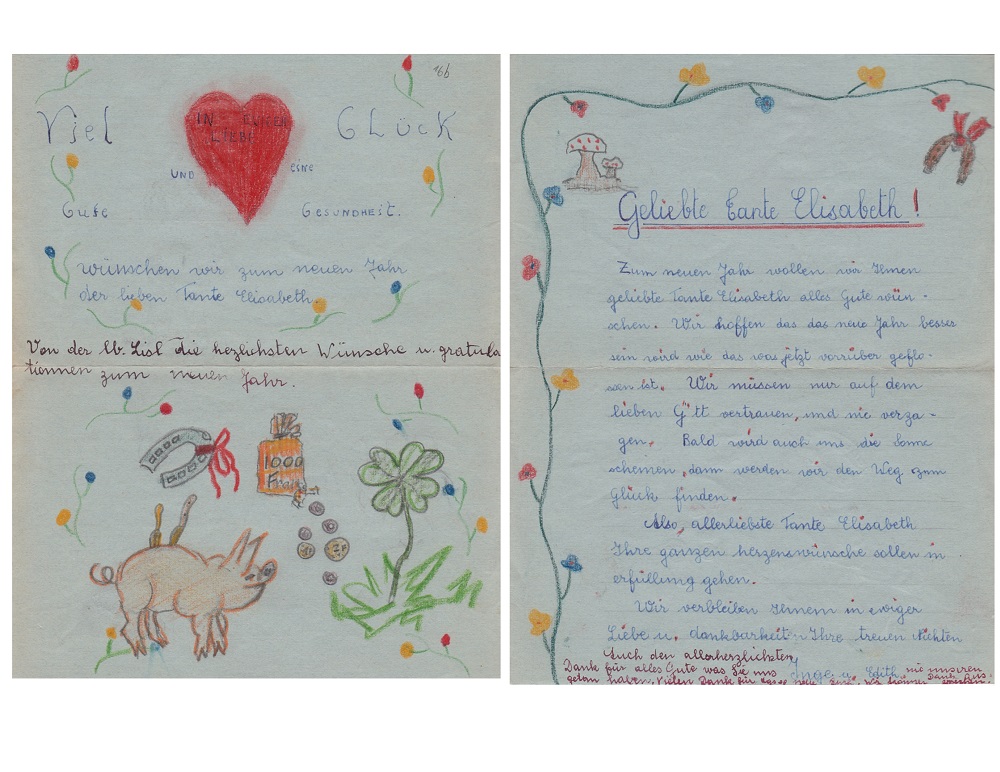
Letters EdithNewYear

A letter from a child called Edith. Letters will be discussed as part of ‘ Holding on Through Letters: Jewish Families During the Holocaust’ a live online event on that will be held on 2 February.

1. A Bystander Society? Passivity and Complicity in Nazi Germany

Professor Mary Fulbrook, University College London, 18 February 2020

Exploring experiences of Nazi persecution, Professor Fulbrook analyses the conditions under which people were more or less likely to show sympathy with victims of persecution, or to become complicit with racist policies and practices. In seeking to combat collective violence, understanding the conditions for widespread passivity, Professor Fulbrook suggests, may be as crucial as encouraging individuals to stand up for others in the face of prejudice and oppression. Listen on the Pears Institute website.

2. ‘Warrant for Genocide’? Hitler, the Holocaust and the ‘Protocols of the Elders of Zion’

Professor Richard Evans, Birkbeck, University of London, 4 February 2019

The Protocols of the Elders of Zion, a notorious antisemitic forgery dating from the beginning of the 20th century, have been called ‘the supreme expression and vehicle of the myth of the Jewish world-conspiracy’. In his talk, Professor Evans takes a fresh look at the Protocols. He asks whether either the contents of the document or the evidence of Hitler’s speeches and writings justify these claims and examines the light they throw on the origins and nature of Nazi antisemitism. Listen on the Pears Institute website.

3. Antisemitism, ‘Volksgemeinschaft’ and Violence: Inclusion and Exclusion in Nazi Germany

Professor Michael Wildt, Humboldt University, Berlin, 27 January 2016

Professor Wildt explores antisemitism and violence in Nazi Germany. By definition, the Nazi Volkgemeinschaft – the national community, barred all Jewish Germans. National Socialist politics included the exercise of violence, and violence against Jews was a visible expression of the Volksgemeinschaft – it was antisemitism in action.  Listen on the Pears Institute’s website.

4. Remapping Survival: Jewish Refugees and Rescue in Soviet Central Asia, Iran and India

Professor Atina Grossmann, The Cooper Union for the Advancement of Science and Art, New York, 28 January 2015

Professor Grossmann addresses a transnational Holocaust story that remarkably – despite several decades of intensive scholarly and public attention to the history and memory of the Shoah – has remained essentially untold, marginalized in both historiography and commemoration. Listen on the Pears Institute’s website.

On the 2 February, the Pears Institute in collaboration with the Institute of Historical Research will host a live event, that is free to attend.

5. Holding on Through Letters: Jewish Families During the Holocaust

Professor Debórah Dwork, The City University of New York

2 February 2021

Jewish families in Nazi Europe tried to hold onto each other through letters – but what to say, and about what to remain silent? In her presentation, Professor Dwork will trace how letters became threads stitching loved ones into each other’s constantly changing daily lives.  Book your free place.

What has the Covid crisis taught us about happiness?

For many, the COVID-19 pandemic has changed the way we define our happiness. In this blog, David Tross, Associate Lecturer in the Department of Geography, discusses how the crisis has changed society and definitions of happiness. 

Cup of coffee with smiley face

Given what we experienced in 2020 (and on into 2021), it might seem inappropriate to consider a pandemic and happiness as having much to do with one another. And in many ways, levels of happiness in the UK followed the bad news. The Office of National Statistics (ONS) has been measuring the nation’s happiness for almost a decade now and it has barely shifted over that time. Austerity, Brexit turmoil —none of these made a dent, until March when the first national lockdown was announced. Then, life satisfaction and everyday mood plummeted while anxiety rocketed. But by summer, with the easing of restrictions, these happiness indicators had pretty much returned to pre-Covid levels.

This resilience may also be testament to a key phenomenon identified by happiness researchers — the extraordinary ability of people to adapt to changes in circumstances and, after the initial shock, to shift their expectations to whatever the ‘new normal’ might be. This ‘adaptation’ principle explains why chasing riches produce what economists call ‘low marginal gains’ in happiness terms: you get used to your new-found wealth quite quickly and need to keep accumulating to maintain the same level of wellbeing (yes, just like addiction). New stimuli, both positive and negative, will make quite short-term, dramatic differences to wellbeing; before long, most people revert back to their normal happiness levels. So it was with lockdown. People adapted, found alternative ways to pass the time and got on with things.

But lockdown wasn’t merely tolerated. There were aspects of it people really rather liked. A clue is in the fourth indictor the ONS uses to gauge happiness, often termed the ‘eudemonic’ measure– reflecting a tradition associated with Aristotle that happiness is more than simply feeling good but is connected to the meaningful pursuits and good relationships of our lives – that asks people whether they feel their life is worthwhile. Unlike levels of anxiety, mood and life satisfaction, this measure remained relatively stable throughout 2020. Sure, some of what we find worthwhile (an active social and cultural life for example), took a hit, But the enforced hiatus from normal life that we never expected to inhabit –many dreamt of escaping the rat race; few thought the race itself would stop –has, for some at least, led to realisations and re-evaluations about the way they live.

Because by June, the ONS was reporting that almost half of us had identified some positive benefits of lockdown. One was work-related: not having to commute and spend long hours in the office (one UK wellbeing at work issue is that we put in more hours than most equivalent European nations but get less done!). Other benefits were spending more time with family (particularly quality time with children), appreciating a slower pace of life and connecting with the natural environment. People cooked more and did more exercise. During a guest lecture for UCEN Manchester students, one participant provided a neat formula for staying sane during lockdown: ‘run, plant, bake. Repeat’.

We shouldn’t be surprised. Most of the activities research studies have shown to be associated with happiness –loving relationships, achieving things, the arts, nature, doing things for others – were still possible during lockdown. Volunteering is another activity associated with happiness. ‘For me’, says Karl Wilding, CEO of the National Council of Voluntary Organisations (NCVO), ‘Covid demonstrated that people want to be part of something bigger’. Not only did the one million plus people volunteering (only the tip of the philanthropic iceberg) constitute what the NCVO called ‘the largest peacetime mobilisation in British history’, there was a demonstrable uplift in what might be termed ‘community spirit’: more people felt that others were helping one another, they were more confident that others would help them if needed, and they were checking on neighbours far more than normal. In common adversity, solidarity. Maybe Nietzsche was right when he suggested that human societies ‘build their cities on the slopes of Vesuvius!’.

Of course, even precarious living is subject to the adaptation principle. When danger becomes the new normal, it is hard to maintain this collective spirit. In addition, social solidarity depends not just on feeling connected to a larger entity but also on the idea of shared experience across social groups. This has already faded. Recent reports from the Institute of Fiscal Studies lays out in painstaking detail the ways in which the crisis has both highlighted and deepened the profound social inequalities of UK life. Going forward, unemployment – a key predictor of unhappiness– looks set to rise steeply; a really alarming bit of data picked up from a recent ONS survey was that a third of the population, and half of all renters and parents, say they would not be able to afford an unexpected emergency payment of £850.

Happiness is inseparable from its social context. Every year the UN commissions a ‘World Happiness Report’ and one theme is persistent: the happiest countries spend a higher percentage of GDP on social support systems. Therefore, during the first lockdown, the policy environment became more happiness-friendly. Witness not just furlough but also getting ‘everyone in’ off the streets, suspending housing evictions and benefit sanctions. One Department for Work and Pensions worker told me that advisors ‘no longer felt like cops’ and could offer a more efficient service when clients felt they could speak openly about their problems without a punitive threat. Pre-Covid, a softening of social attitudes towards welfare recipients were being observed in reports like the British Social Attitudes Survey, and it is hard to imagine this reversing any time soon.

In 2020 the state was back, and it felt friendlier. But will this turn out to be just a glimpse of something more hopeful and not a decisive shift? This year has given some actual substance to some of the vague nostrums rolled out by politicians: the big society, the good society, all sectors working together towards a common goal. As vaccines are rolled out, we may not be living on the slopes of Vesuvius for much longer, but we should be mindful of what Covid has taught us about happiness, on a macro level about a more generous politics and on a personal level that the mantra of happiness- Carpe Diem! has two meanings. One, invoked by Robin Williams in Dead Poets Society and by T-shirts, mugs and online dating profiles, refers to the hot pursuit of happiness. But the aphorism has been re-purposed for our frenetic age. its original meaning pays tribute to the moderate happiness philosophy of Epicurus whose idea of seizing the day was not grabbing it by the scruff of its neck. Rather, cultivate simple joys and appreciate what we have instead of always seeking more. For, he wrote, ‘nothing is sufficient for he who finds sufficiency too little’.

Other ancient philosophies had good lockdowns. The Stoic creed of equanimity seems a bit dreary when there’s fun to be had. But in times of adversity, to face one’s fears, accept what we can’t control and still retain a sense of dignity never seemed so apposite. In a timely piece, writer Brigid Delaney recalled the Roman Philosopher Seneca, who, exiled by the state, cut off from his friends, wealth and influence, began to reconcile himself with the enforced simplicity and seclusion of his reduced circumstances, noting that ‘until we have begun to go without them, we fail to recognise how unnecessary things are’. Or, as one UCEN Manchester student put it: ‘the things we thought mattered, didn’t matter’.


A moving celebration of Black History Month

Carmen Fracchia, Professor of Hispanic Art History, Cultures & Languages, School of Arts, reflects on her recent book tour and the emotive nature of the response to her book in considering the experience of Black people in Spain.

Flemish painter, Baptism of the Ethiopian Eunuch. Book of Hours of Charles V, do l. 82r. Brussels or Malines, c. 1519, Österreichische, Nationalbibliothek

On 2 October, I was invited to present my new book ‘Black but Human: Slavery and Visual Art in Hapsburg Spain, 1480-1700’ (Oxford: OUP, 2019) at the University of Lincoln (UK) to celebrate Black History Month, together with two poets, one visual artist, and an art historian. I found this event, UT PICTURA POESIS: An Evening of Poetry, Art and Art History, deeply emotional.

Organised by Dr Laura Fernández-González (School of History and Heritage), the title emerged from her belief in the power of images, following the steps of Horace’s maxime, ‘as is painting, so is poetry.’ Her aim, however, was to show new work produced as a case study on how to construct a ‘new anti-racist Art and Architectural History’. Her brief was followed by the presentation of the three artists by the art historian Michael Ohajuru, a TV personality and director of The John Blanke Project.

In my view, the most unexpected feature of the evening, was the poem ‘Negro pero humano’ (‘Black but Human’) by the literary activist, editor, publisher, and, award-winning poet, Kadija Sesay MBE. It was one of her two extremely powerful poems, written specifically for this event as a response to my book, to its title, and to two images of her choice, The Miracle of the Black Leg and The Baptism of the Ethiopian Eunuch.

The first part of the title of my book, ‘Black but Human’, was an Afro-Hispanic proverb and the prism from which I tried to foreground the forgotten presence of Africans and their descendants in the visual form in early modern Spain. This proverb also allowed me to explore the emergence of the ‘enslaved subject’ and the ‘emancipated subject’ in Spanish portraiture.

This saying, that was circulated in the Afro-Spanish oral tradition and appropriated by well-known Hispanic poets, such as Luis de Góngora in Spain and Juana Inés de la Cruz in Mexico, was also written by enslaved and liberated Africans, as the findings of anonymous black carols, in 2004, testify.

‘Black but Human’ encodes the paradoxical nature of what it meant to be a ‘black’ person in ‘white’ Spain, between 1480-1700. To be ‘black’, as I have recently written in my blog, ‘How long do we need to wait to acknowledge that black people are no longer our slaves?, ‘meant to be a chattel, a piece of property, to be hired, bought and sold as a precious commodity at auctions; to become objects of material exchange: traded to save the donor’s soul, gifts, dowry, and, heritage; money to pay debts, to settle accounts in lieu of mortgages, and rents.

To be a black person meant to be owned by a slave master and to suffer punishment at any sign of rebellion against this complete dehumanization in a society where the word ‘black’ and the physical appearance of blackness were signifiers of the specific social condition of slavery. Besides, to be a black person also meant to become a strategic resource for the colonization of the New World.’ Africans were also considered ‘children of God’ as they had a soul that was whitened by the transformative powers of baptism. Christianity made them equal to Spaniards, but only in the spiritual realm.

Kadija’s beautiful poems encapsulated the ideological, painful, and contradictory position of Africans in the Spanish empire that I explored in my book, perfectly. Her poems set up the emotional barometer of the Lincoln event that was strengthened by the topical work made by the visual artist Victoria Burgher. In her presentation, she showed ten temporary works made with ‘colonial commodities’, like sugar and cotton to ‘re-examine white-washed narratives of empire’ and as a critique to the British Transatlantic Slavery in the Caribbean and in the UK. This strong visual presentation was complemented by the speed and cascade of words by international media activist and poet-educator Mark Thompson’s brilliant performance of his personal and historical poems, that brought the energy and anger of the young.

The last half of the evening was followed by the conversation between Michael and I about my book. We discussed the historical amnesia of the African presence in today’s Spain; the title of my book; the visual representation of the Miracle of the Black Leg, as the metaphor of the violence of slavery and the roots of contemporary racism in the Hispanic world; the portraits of the enslaved Juan de Pareja (c.1606, Antequera, Málaga–c.1670, Madrid) by his owner, the court painter Diego Velázquez; Pareja’s self-portrait, as a freedman, in his painting The Calling of Saint Matthew, and, the urgent need to recover the Afro-Hispanic contribution to the Hispanic culture.

This event was attended by approximately 80 people and generated so many questions from the numerous national and international attendees (students, academics, museums curators, filmmakers, artists, writers, among many others) that time was not enough to address all of them.

Read Kadija Sesay’s poem, Negro pero Humano

Introducing Birkbeck’s 2020 Chevening cohort

This year Birkbeck is delighted to welcome 30 new Chevening scholars, hailing from all corners of the world. The prestigious Chevening scholarship is offered each year by the UK Foreign and Commonwealth Office to promising students, chosen for their leadership potential and academic promise.

Once again Chevening students from a number of countries opted to join Birkbeck, attracted by its reputation, the possibility it offers to study alongside London’s professionals.

Meet our 2020 Chevening cohort.

Nozipho Nomzana “Zana” Mziyako, Eswatini, MSc Corporate Social Responsibility & Sustainability

Nozipho Mziyako, Etiswani

Nozipho Mziyako, Etiswani

“I applied for the Chevening scholarship because it presents a big opportunity for individuals like me who envision themselves as key contributors to society’s positive development, to learn through academics, forged networks and international experiences.  I love travelling, hiking, adventures, meeting people as well as experiencing different cultures. Through this Chevening experience, I look forward to the exposure and growth and most importantly ploughing back to society.”


Joan Santani Santanasam, Malaysia, MA Journalism

Joan Santani Santansam, Malaysia

Joan Santani Santansam, Malaysia

“I’m a business journalist working with Malaysia’s National News Agency, Bernama. I have been working in the journalism industry for eight years now covering a range of news on business, finance, commodities, stock market and politics.

The Chevening Scholarship is really the gateway for me to enhance my knowledge, broaden my worldview and hone my leadership and social skills. These are essential skills to further enhance my career as a journalist.”


Bongani Njalo, South Africa, MA Arts Policy & Management

Bongani Njalo, South Africa

Bongani Njalo, South Africa

Bongani Njalo is an award-winning South African artist whose work in drawing, performance, installation and traditional bead-making explores themes in culture, collective and individual identity. Njalo was a recipient of the David Koloane Award (2014), he was named one of the Top 200 Young South Africans by the Mail & Guardian (2016) and went on to become a Mandela Washington Fellow in 2017, a programme lead by the Department of State for Young African Leaders.


Yoandra Rodriguez Betancourt, Cuba, MSc Marketing Communications

Yoandra Rodriguez Betancourt

Yoandra Rodriguez Betancourt

“As a communication specialist and marketing enthusiast, I’ve been able to work and gain experience on different scenarios; from large public companies to private small businesses in Cuba, and they all could benefit from accurate and up-to-date marketing tools.

For me, to deserve this opportunity means one of the greatest challenges that I’ll ever have, I’ve always found British culture and history fascinating, and being able to experience it in person is a unique privilege; especially for a woman like me that coming from a working-class family I’ve always felt driven to exceed expectations”.


Zeina Ramadan, Palestine, MSc Creative Industries

Zeina Ramadan

Zeina Ramadan, Palestine

“Being a professional in the creative industry in my home country and observing the sector first hand on the ground led me to choose this major. Through working on various projects and different institutions within filmmaking, animation, TV, content editing as well as the audio publishing industry, I gained a deeper insight into the needs and the hole in the wall which need to be filled not only in my home country but in the region as a whole and the potential it has to grow. This heightened my passion and consequently led me to Chevening as it was a one-of-a-kind opportunity for me to be able to make a difference. Here I am! About to start a life-changing experience whilst simultaneously gaining knowledge and connections in the field I am most passionate about.”


Chiranthi Senanayake, Sri Lanka, LLM International Economic Law, Justice andDevelopment

Chiranthi Senanayake

Chiranthi Senanayake

A youth empowerment advocate specializing in the niche area of Youth Empowerment Incubation (YEI) Chiranti Seneneyake is the Founder and President of Hype Sri Lanka which is the country’s first youth empowerment incubator. She is also the Founding President of the Young Legal Professionals Association of Sri Lanka.

She was appointed as the United Nations Youth Delegate for Sri Lanka in 2016 in recognition of her community service. In this capacity she has worked as a Youth Focal Point to the National Youth Services Council and the Ministry of National Policies and Economic Affairs. Chiranthi also served as the Global Ambassador for Sri Lanka for Youth Opportunities in 2018. She is a Women Deliver Young Leader of 2020 and the recipient of The Diana Award 2020.


Presely Gitari, Kenya, MSc Climate Change

Presley Gitari

Presley Gitari, Kenya

“I’m a conservation biologist from Kenya, who works with the country’s Ministry of Interior and Coordination of National Government in helping ex-offenders reintegrate into society by using environmental conservation as a tool of socio-economic empowerment.

“I’m also an Associate Fellow with the Royal Commonwealth Society and I am passionate about improving the lives and prospects of citizens of the Commonwealth.

“I applied for Chevening because it represents purpose beyond academic progression, as it inculcates a mindset focused on leadership and fostering networks to positively impact the lives of others. ”


Further information:

Locked down, yet together!

In this blog post, we hear from MA Screenwriting student, Omneya Okasha on the support of peers and tutors at the virtual screening of her new short film

Omneya Okasha

As a Birkbeck student and an independent filmmaker, I’ve had the double pleasure of sharing my short film, “Lippie aka Sheffa” with my tutors and colleagues via the virtual screening event that was organized by La Young Jackson from International student administration on the 17th June 2020.

The event was originally planned to take place mid March, in the vicinity of Birkbeck’s Iconic cinema. I was excitedly looking forward to sharing my directorial debut on the large screen with Birkbeck’s community, but unfortunately as we know, we all went through a global crisis and the historical event of the COVID-19 outbreak.

Hopeful as we were then, the event was postponed ’til the summer term, expecting the university buildings would reopen by then. Not too long into lockdown, it was evident we would not be returning to the University this year, and I was regretful I hadn’t held my event sooner in the year.

However an email from La Young in June gave this event another opportunity,  as she suggested that we could hold a virtual screening of my film followed by an online discussion. I was thrilled at this chance revival, though I was a little concerned that the online screening of an international short film may not draw an audience. To my surprise, many registered to the event and showed quite the enthusiasm to attend.

On the screening day, I was delighted to see my professor, classmates, and attendees who I was first acquainted with during the event. La Young has kindly introduced me and I gave a brief presentation about my background as a filmmaker, and about the film. After the introductions, we all watched the film together, then the space was given for a Q& A, which La Young moderated.

The audience’s engagement was incredible, and the discussion was highly intellectual, and I was elated to receive the audience’s questions and gestures of support for my film. It was truly rewarding for me as a filmmaker to welcome such encouragement from an amazing crowd of highly talented professionals and fellow students.

I guess we have all got accustomed to the new normal of the current situation, and it was refreshing on many levels to know that we can still go through such difficult times, making the most of them, with each other’s support. Looking back on this experience, I feel recharged with hope and drive to work hard on my upcoming project, thanks to the support and sense of unity I have received, to which I am deeply grateful.


A photo of the poster for the movie Sheffa Aka Lippie

Sheffa (meaning Lip) follows the story of a 10-year old boy and is so-called for the scar he bears. His mother scolds him and uses him and his friends to sell weed on the streets. Her ambitions are threatened when Sheffa gets a period, revealing that in fact Sheffa is a girl being raised up as a boy.

Watch the trailer for the film Sheffa aka Lippie here

The Unfortunate Persistence of Being

As the discussion over the meaning and significance of statues wears on, Gaynor Tutani, who is currently completing a PG Diploma in Museum Cultures discusses the current Black Lives Matter Movement and how cultural institutions can engage with history and encourage more inclusion within the industry. 

Perpetual Histories

I have been here before,
You have been here before,
We have been here before.
How long will we have this same conversation?

I am tired. I used to feel the pain.
Now, almost, I do not feel!
I saw the knee heavy on his neck, everyone saw it,
but the knee is always on our necks.
We carry it daily.
It’s on my SKIN,
Engraved on my Bones,
And flows through my Blood.

I am Black. I am African,
You are African too,
Evolution says so.
But somehow my Black is an outcast,
To be feared, hated and killed.
Not only a physical death.
No, the deeper death,
One that TAKES my spirit, hopes and dreams.

Regardless, I fight. I push.
I continue to BE. For there is pride in my being.
There is pride in knowing my history and who I am.
I am more than Black!
My life matters, I am human,
Just like you.

Jean Joseph, A Good Outlook, 2010, Mixed Media on Canvas

Jean Joseph, A Good Outlook, 2010, Mixed Media on Canvas

How do I feel about the Black Lives Matter movement? What does it mean to me as a Black woman and a British citizen with African origins? These are a few questions that have been playing in my mind following the passing of George Floyd. It has not been easy to digest his horrific death, and so, I have not really found any answers to my questions. Today we all call for change, but how is this change going to come about or is it even possible? I ask this because Floyd was one of many Black men that have died at the hands of White police. There have been women too, yet their stories do not receive the same attention. This is not to say that their deaths and lives were less important, but it highlights the fact that it is prevalent within the United States of America. I believe that this is why it bothers me, knowing that his story is yet another devastating headliner of perpetuated terror.

Historically Africans and those of African descent have suffered extreme injustices due to an adopted persistent backwardness based on geography and melanin. While the racists’ systems of slavery, segregation and apartheid have ended, we cannot deny their lasting imprints and legacies within our current political, socio-economic and cultural societies. Deep psychological traumas continue to affect Black people – inherited from their ancestors, termed by Dr Joy DeGruy as Post Traumatic Slave Syndrome. Although she coins it “Slave Syndrome”, I believe that the crippling impact of trauma should be considered with regards to all western encounters with Africa and its diaspora. This includes colonisation and its destruction of Africa as a whole. Therefore, when I think about these histories and the Black resistance movements that occurred – such as the Civil Rights Movement in America and the Black Consciousness Movement in South Africa, both in the 1960s –  it is disheartening  that in 2020 a movement called Black Lives Matter is even necessary to counteract current racist systems.

Nonetheless, despite this dim reality, I am encouraged by the movement’s momentum and the level of scrutiny currently on equality and social justice. But I am also concerned that this focus on racism is an unsustainable banner.

How long will the discourses continue without positive, tangible change? How do we end this perpetual cycle of action and reaction? As a keen student of history and a cultural facilitator, I believe that museums and other cultural institutions can make lasting contributions and be an example of the change we need, via a true engagement with our society. One that does more than tick the boxes of inclusion and diversity, but actually acknowledges our society’s unique cultural fabric and how it came about. We have to honestly discuss controversial topics such as racism and its intricate connection to our lives. I believe that art can inspire and change people’s perspectives and understanding of their world. Consequently, museums and curators should do more to address difficult issues within their curation and programming.

This has been my mission as a curator and co-founder of EARTHworks a curatorial duo that organically formed with my partner, Jean Joseph (a visual artist and cultural facilitator; @artmaroon). Together we have hosted and organised exhibitions, talks and events that delve into similar topics such as race, culture and history. Currently, we are working in partnership with arc Gallery to realise an exhibition that investigates the complexities of colonisation. Reading from scholars such as Frantz Fanon, Cheikh Anta Diop and Mandivamba Rukini, just to mention a few, the project draws upon theories of existentialism, as a means to discuss notions of identity. It aims to highlight how cultural institutions and those working within the arts can address uncomfortable narratives. In short, the exhibition comprises an academic interrogation of how history has shaped the lives of Black and Brown people, which sometimes is not included within museum exhibitions dedicated to people of colour.

The above comment is not an attack on museums. There has been an improvement within their structures, but I believe more can be done, especially within the operational field. There is a significant shortage of Black and Brown curators and general programming staff within museums. Although there has been a rise in exhibitions for/dedicated to people of colour, the fact that these showcases are not directed or led by those they claim to represent is problematic. Therefore, even though many museums have been working on decolonisation agendas within their operations, the extent to which these methods are effective are minimal if the decolonisation does not involve those that have been colonised by the very imperialist structures of museums.

Further, discussing issues of decolonisation within museums, Tristram Hunt, (Director of the Victoria & Albert Museum ) in his newspaper article on restitution and repatriation of previously looted collections within museums, argued that it was not possible to decolonise or return some artefacts due to the fact that losing them would be to disregard museums’ historical ties with empire. As a result, he contends that to “decolonise is to decontextualise” since the rise of empires was closely linked to collections.

Consequently, Hunt urges museums to find the right balance when dealing with their collections and the historical narratives behind them. In a way Hunt’s argument shows the reluctance of the West to relinquish its colonial hold. He proposes better museum practices and claims that the V&A has made procedural progress. However, his current idea of loaning artefacts to their countries of origin is condescending. Why should they borrow what rightfully belongs to them? Hunt’s solution does not solve the problems or issues pertaining to restitution, which I believe can be resolved if there was a commensurate staffing of people of colour within museums and galleries. Their voice, experiences and knowledge are paramount when deciding how these collections can be returned or respectful partnerships be formed with their countries of origin.

As a Black cultural curator, and being aware of the historical race debate within the arts and cultural scene, I am in support of the Black Lives Matter movement as a vehicle to address social injustice. If change can be achieved at all, I believe that it can, and should, start with productive conversations within museums and heritage institutions.

Gaynor Tutani is a student on the Postgraduate Diploma in Museum Cultures in the Department of History of Art, and an independent curator. You can read more about her work and encounters with art and museums here: https://fambaneni.tumblr.com/

Further information:
To lie about History – Statues and the British Slave Trade

Gabriel Burne, an MA History of Art student, discusses the legacy of the historical figures whose statues have been removed and how the current debates around these monuments should encourage deeper discussion about Britain’s violent and racist past. 

“The air of England is too pure for any slave to breathe.” Allegedly this was said during the trial of Shanley v. Harvey, a case where a British man, Shanley, was attempting to recoup a substantial sum of money given to Harvey by Shanley’s niece on her death bed. The basis of the claim was that Shanley had bought Harvey as a child slave to England some 12 years earlier and given him to his now deceased niece. I heard it quoted during my undergraduate degree in History in a debate about the role that slavery played in the UK economy. Even though many slaves were bought, sold and owned on the British Isles, the quote was employed as evidence of Britain’s relationship to slavery being distinct from that of the United States. Whilst the quote was likely never uttered, and the sentiment it reflected false, its popularisation reflects this Island’s complex and unresolved relationship to its violent and racist past. Much of Britain’s history of racial violence is hidden, existing only as ghosts haunting the otherwise heroic narrative of Britain and its heroes. When I embarked on a Master’s degree at Birkbeck in History of Art, it was these ghosts I wanted to know more about, in an effort to reinsert the lives and horrors which these spectres recall back into popular British history.

For many of us in Britain, our understanding of racism is taught from the perspective of the United States. The civil rights movement – Martin Luther King, the KKK, Malcolm X and segregation – are all things many in the UK have an understanding of. They are core aspects of our national curriculum and whilst they teach us important lessons on white supremacy, they create a sense of separation from the problems that exist here in Britain. To learn more about how we honour and adulate those who created this system of white supremacy in the UK, I took a module called “Slavery and its Cultural Legacies.” My reading for the course took me to some of the black theorists writing in the US currently – particularly Saidiya Hartman and Christina Sharpe. Whilst their writing was specifically speaking to an American experience, I felt there was a lot to be learned from their ideas here in the UK. Sharpe and Hartman speak of “the wake” and “the afterlife” of slavery respectively. Slavery’s violence lives on in white supremacy, a condition which is constitutive of contemporary Britain. The Research Project that I am currently writing examines the British monuments that often honour and/or neglect to acknowledge racial violence as part of the individual championed legacy.

Robert Milligan statue outside the London Docklands Museum

Robert Milligan statue outside the London Docklands Museum

In February this year, I went to the London Docklands Museum organised as part of the module. We were taken through the museum’s exhibition on slavery – London, Sugar & Slavery. The exhibition itself speaks of the ubiquity and brutality of the slave trade in the UK and is situated in the very building that was a hub for receiving the imported goods from Britain’s slave plantations. Whilst the museum takes steps to foreground black voices and highlight some of these hidden histories, a walk onto the docks outside the entrance reveals some stark reminders of this unconfronted violence. A cocktail bar serves “plantation punch” as a drink on the menu. And towering just in front of that sits a statue honouring prominent British slave trader Robert Milligan, who by the time of his death in 1809, owned two sugar plantations and 526 slaves in Jamaica.

I stared up at the dead metal eyes of Milligan looking out across the docks, posed as if smiling upon an arriving ship, bountiful with the fruits of his murderous plantations. The plinth on which the statue stands illustrates his achievements with a relief that depicts Britannia seated on her tame-looking British lion, whilst the female figure of commerce offers her riches and at her feet three cherubs help carry the bounty. The mast of an approaching ship is visible in the background, the very ships whose docking in Greenwich Milligan would have cheered.

The engraving below Robert Milligan’s statue

The engraving below Robert Milligan’s statue.

In romanticising the wealth men like Milligan brought lady Britannia, statues such as this obscure how this wealth originated in racial violence – the lucrative cargo carried aboard these ships, and which both Milligan and Britain celebrate, were produced by the enslaved. The continued existence of these statues’ silences new voices and alternative histories under the weight of the historical indulgence upon which Britain’s current power structures relies, that of a grotesque imperial and racially violent past located elsewhere, in far-off lands.

When I embarked on researching the Milligan statue, along with the statues of the slave trader Edward Colston in Bristol and Cecil Rhodes in Oxford, George Floyd was still alive. The protests catalysed by his murder at the hands of three police officers have since led to each either being removed or torn down by activists. This totally unforeseeable set of events taking place as I research these statues has left my project at an incredible crossroads that changes from day-to-day. The removal of the Colston statue in Bristol by activists, followed by its symbolically poignant casting into the harbour, prompted the Milligan statue to be removed by the local council days later. It has just been announced that the Cecil Rhodes statue that sat on Oriel College and has for years been the subject of the Rhodes Must Fall campaign, will likewise be removed. Commenting on these events, the Prime Minister stated that to remove these statues is to “lie about our history and impoverish the education of generations to come.” This statement is reminiscent of the same mental gymnastics performed by the relief that sits below the Milligan statue. Rather than being moved by watching the monuments to these men fall and cheering what is, at best, a small step toward confronting this violent past, Johnson continues the exercise of obfuscation. Not once does he mention precisely what he thinks this history is, yet he claims it to be the “truth”. To engage in the actual process of discussing this history is to highlight what these statues hide: that of a British slave-trading and imperial past not confronted, and the “afterlives” of the British slave in which non-white people in this country must live.

At the time of an anti-racist uprising alongside offering solidarity to America, we must also reflect on the constitutive role slavery and white supremacy have played in British history. As the actions of many demonstrators have movingly and powerfully shown, it is imperative to reflect on what voices are hidden when men like Colston, Milligan and Rhodes are celebrated. We must remind ourselves that the enslaved also breathed the UK’s air “too pure.”

Further reading:

On the British abolitionist movement and the Haitian revolution 

CLR James, The Black Jacobins, (Random HouseNew York, 1989)

US Black studies theorists and the afterlives of slavery 

Saidiya V Hartman Lose your mother: a journey along the Atlantic slave route (Farrar, Straus and Giroux, New York, 2007)

Christina Sharpe In the Wake: On Blackness and Being (Duke University Press, Durham and London, 2016)

Fred Moten In the Break: The Aesthetics of the Black Radical Tradition (University of Minnesota Press, 2003)

For British involvement in the slave trade

Paul Gilroy The Black Atlantic: Modernity and Double-Consciousness (Verso, London, New York, 1993)

Catherine Hall Legacies of British Slave-Ownership (Cambridge University Press, Cambridge, 2016)

A guide to mentoring PhD students

What constitutes a good PhD mentor and mentee? In this blog, Professor Jean-Marc Dewaele from the Department of Applied Linguistics and Communication shares his thoughts on how to navigate PhD supervision for both students and supervisors.

Two women chatting

Photo by mentatdgt from Pexels

I was recently invited to contribute a chapter on the supervision of doctoral students and one the delicate management of the supervisor–supervisee relationship from the first contact to the post-graduation goodbye (Dewaele, 2020).  Having led 26 Birkbeck students to their PhD as first supervisor allowed me to reflect on the uniqueness of each relationship and on the commonalities.  I realise that my perceptions might help current PhD students in handling their relationship with their supervisor(s) and their fellow students.

The most crucial aspect is the establishment of a relationship of trust and mutual respect, where constructive criticism is appreciated, where the scientific creativity and independence of the student is encouraged and where the student’s expectations are handled appropriately.

As in any relationship, there may be moments of strain and crisis and it is the supervisor’s responsibility to deal with this in a professional manner. Good supervisors are close to their students but not too close and the distance can change over time. In their book about the supervision of MA students, Harwood and Petrić (2017) explain that “different supervisees need supervisors to occupy different roles at different times” (p. 9).

I realise that as a PhD supervisor I am typically more directive at the beginning of the research project and allow more freedom and flexibility later on.  It is not unlike relationships parents have with their children, allowing them gradually more independence until they reach adulthood.

Metaphors are particularly useful in grasping abstract concepts. In the satire, Candide, ou l’Optimisme (1759), Voltaire famously wrote in the conclusion “il faut cultiver son jardin”, meaning “that we must take care of our garden”, away from the hustle and bustle. It is good to visualise a PhD research project as a private garden, to which the student can retreat to tend it, to plant flowers, to prune the trees lovingly, and to wonder where to install that water feature or statue. Spending some time in the garden is good for the garden and for the gardener’s soul, though digging can cause blisters to appear.  Conversations with fellow students allows a useful comparison of gardens. It helps understand that bigger is not necessarily better and that gardens can come in all colors, shapes and sizes.

I have had some interesting exchanges with students about the PhD being a transformative experience because it forces one to do a lot of thinking.  And because it is so long and so intense it can -and should- trigger cognitive and emotional restructuring. Students come out of this as more resilient, independent and confident (and sometimes also humbler) people.

It is also crucial to understand that comparisons with other (former or current) students can only be superficial and that having more or less of this can only refer to a very small part of a much bigger hidden picture.  My colleagues and myself love all our PhD students who work hard.  They are all bright and the fact that one can jump higher, or run faster, or cook better should be of no concern to the others.  Being unique individuals means they all have unique strengths and weaknesses.  They all face unique challenges that may sometimes stop them from reaching their full potential (like long-standing family or work issues, or a momentary problem like a numbing migraine at the viva).  And that is OK too, because each student gives it their all – professional, family and health situation permitting.

This reminds me of karate where it is also crucial not to compare oneself too much with fellow karate-ka.  Some are great at kumite (fighting), others are great at kata (choreographed patterns of 20 to 70 moves, with stepping and turning, that have to be executed while attempting to maintain perfect form), others might not excel at either but have great resilience, attitude and humility.  The standard for the black belt varies slightly according to age and health.  Being 18 or 70 makes a difference, and yet both are able to get the black belt if they can show that they have mastered the techniques and the spirit of karate, and that they are as fit as they can be and can take a solid kick in the stomach.

It is the same for getting a PhD. Supervisors make sure that students reach the threshold but how far they go above it is not really crucial. If they can, of course, they should.  That’s also why I’m so happy that no grade is awarded for a British PhD.  It either Pass or not Pass, like a driving test. If former students later end up winning prizes for their work, everybody will be proud of them, but if they don’t, they won’t be loved any less!

References

Dewaele, J.-M. (2020). Supervising doctoral students and managing the supervisor-supervisee relationship. In L. Plonsky (Ed.), Professional development in applied linguistics: A guide to success for graduate students and early-career faculty. Amsterdam: John Benjamins, pp. 153-163.  https://doi.org/10.1075/z.229.11dew

Harwood, N., & Petrić, B. (2017). Experiencing Master’s supervision. Perspectives of international students and their supervisors. London: Routledge.

(Art) History Matters

Dr Sarah Thomas, from the Department of History of Art, shares her experience of museum curation in Australia and discusses how we should interrogate the ‘hidden histories’ that underpin current debates. 

In 1993 when working as a curatorial assistant in a public gallery in Sydney I was involved in a project which I’ll never forget. Yamangu Ngaanya. Our Land Our Body was an exhibition of paintings by a group of Aboriginal artists from a remote desert community in Warbuton, Western Australia. The dazzling canvases, derived from ancestral ‘Dreaming’ stories that were traditionally painted onto the body, were accompanied by forty-five Ngaanyatjarra men and women, most of whom had never visited a city in their lives and who had travelled to Sydney by coach over several days and nights. Besides the paintings they also brought with them sixteen tonnes of red sand from their land, which over the course of several days was dispersed over the gallery floor. What had been a standard ‘white cube’ interior was radically transformed into a space for ceremony: over several days and nights separate groups of women and men prepared and performed Dreaming ceremonies, filling the space with traditional song, language, dance, swirling dust, bodies painted in ochre, the smell of smoke and sweat. This was not what an art historical training had prepared me for: ‘performance art’, ‘installation’, and ‘body art’, even ‘painting’, were all wildly inadequate terms for what I observed over the course of that week.

I am reminded of this moment by the global repercussions recently of the Black Lives Matter anti-racism protests. The Australia I grew up in was deeply racist, and it remains so. Sadly, despite years of protest, public and scholarly debate, and a government apology in 2008 for the forced removal of Indigenous children from their families by national and state agencies, Indigenous Australians remain the most incarcerated people on earth. Leading Aboriginal artists have long been highly critical of Australia’s colonial past, and the pervasive hold it has on the present. Daniel Boyd, for example, critiques the nation’s foundational myths by reworking white Australian imagery, from heroic depictions of Captain Cook (statues of whom are currently the subject of heated debate) to encounters between Aboriginal and European settlers. I included Boyd’s painting We Call Them Pirates Out Here (2007) in an exhibition I curated in 2015 called Colonial Afterlives, which brought together the work of contemporary artists from former British colonies including Jamaica, Barbados, Guyana, Canada, New Zealand, as well as Australia.

: Colonial Afterlives exhibition catalogue cover. Image by Christian Thompson, Trinity III, from the Polari series, 2014. Christian Thompson is represented by Sarah Scout Presents (Melbourne) and Michael Reid Gallery (Sydney and Berlin).

Colonial Afterlives exhibition catalogue cover. Image by Christian Thompson, Trinity III, from the Polari series, 2014. Christian Thompson is represented by Sarah Scout Presents (Melbourne) and Michael Reid Gallery (Sydney and Berlin).

Over the past decade, I’ve been researching the European representation of enslaved people in the 18th and 19th centuries across the Caribbean, Brazil and antebellum America (the subject of my book, Witnessing Slavery: Art and Travel in an Age of Abolition). More recently, I’ve been talking to museum professionals and scholars across the UK about how their institutions might publicly acknowledge the cultural legacies of slavery. The work of UCL’s Legacies of British Slave-ownership project has uncovered a wealth of data about slave-owners at the moment of British emancipation in 1833, when a grant of £20 million (40% of Britain’s national budget) was paid in compensation, by British taxpayers to slave owners. My research draws on this work, focussing on the impact of slave-owners as art connoisseurs, collectors and patrons on the early history of British art museums.

There’s no doubt that such ‘hidden histories’ are troubling. The toppling of the statue of slave-trader Edward Colston on 7 June was not simply a spontaneous action born out of collective rage, but one with a long and more complex history of thwarted community attempts to acknowledge publicly Colston’s role in the slave trade. Madge Dresser points out that when the statue was erected in 1895 (over 170 years after the subject’s death), it coincided with the building of monuments which glorified the Confederacy in the United States, and others in Britain and across its Empire, which: ‘similarly extolled the virtues of British imperial figures whose relationship with colonised people of colour ranged from the paternalistic to the genocidal’. Historian Nick Draper is right when he says: ‘Historians need to be realistic about their reach and influence. But for more than 30 years scholars have worked towards an adequate post-colonial account of Britain’s history as a colonising and imperial power.’ He cautions: ‘We have tried to establish an evidence base that can be drawn on by all parties. The hegemonic view of British exceptionalism, its unique commitment to liberty and its glorious imperial past, has been challenged, but it has survived. Had we collectively succeeded, then some of the paths not taken would have been pursued. The binary of leave it alone/tear it down might have been avoided’. There is a sense of disappointment in this statement, as if historians themselves have in some sense failed in their attempts to challenge the status quo. But it is this ‘evidence base’ that is so vital to what we do as art historians as well, and why in our teaching we often speak about ‘authoritative sources’ and the importance of primary archival research.

Australia has a longer history of grappling with its colonial (British) past. As a curator in a big state art museum in the late 1990s, I was part of a generation that began to question the traditional separation in collection displays of ‘Aboriginal art’ and ‘Australian art’, interrupting Euro-centric chronological displays by introducing works of contemporary Indigenous artists, such as Boyd. (European visitors had no doubts about what constituted ‘Australian art’: they headed straight for the Aboriginal art collections.) My first sustained encounter with Aboriginal art and its makers in 1993 was profound, and its complexities and contradictions have stayed with me over the course of my career and feed now into my teaching. In Britain, museums are starting to engage more directly with the deeper implications of empire (see, for example, The Past is Now: Birmingham at the British Empire, 2017), but there is still much work to be done.

Art historians today are attentive to the complexities of social context, and careful to avoid the simplistic dualisms that newspapers, politicians and much social media commentary thrives on. Public statues have garnered attention across the world as lightning rods for heated and often bitter debates about national identities, yet the very fabric of our cities and countryside  – street names, public buildings, museum collections, archives, country houses, to name just a few examples – is steeped in the residue of history. This reminds us that colonial business is unfinished, its legacies are raw; history is now, and it matters.


Sarah Thomas is Lecturer in Museum Studies and History of Art in the Department of History of Art, and Director of the Centre for Museum Cultures. In Autumn term 2020, she will be teaching the seminar ‘Slavery and Its Cultural Legacies’ as part of the MA Museum Cultures and MA History of Art.