Category Archives: Humanities and Social Sciences

Farewell to John Berger

Framegrab from A Song for Politics, the third essay in The Seasons in Quincy

On 2 January 2017, John Berger died. Below we offer a reflection on John from The Seasons in Quincy director and producer Colin Maccabe. This article was originally published on the Derek Jarman Lab website

John Berger was an extraordinary individual, extraordinary in the range of his creation and his criticism. But also extraordinary as a presence. He had the least sense of hierarchy of anyone I have ever known. And he was uniquely interested in the present moment. So whoever he was with, young or old, rich or poor, famous or unknown, man or woman, had his complete attention. This was in its way unnerving: you had to think about what you were saying because you were being listened to with quite unusual concentration. And you had to listen with real intensity because what was being said was being said for you and, it felt, for you alone. But if it was unnerving it was also immensely invigorating. You became more intelligent and more consequent, more insightful and more amusing. And what John said stayed with you and you felt transformed by it.

This may all sound quite pious. John could well have been an actor and there was something of the ham in his performances. He was also a seducer and you were seduced. But neither of these facts detract from the wonderful pleasure of his company, indeed they were an essential part of it.

He was the best and most reliable of friends – always willing to lend a hand, to encourage, to enthuse, and, very important, to criticise when it was necessary. His range was extraordinary: major art critic, great novelist, gifted film-maker. He even with his close friend Jean Mohr invented a genre: the committed use of photography and prose to render invisible elements of the social visible. They started with A Fortunate Man in 1967 but developed further with A Seventh Man (1975) which John thought his best book. It is 40 years since A Seventh Man was composed but the analysis of the crucial role of migrant labour in contemporary capitalism could have been written tomorrow.

It is foolish to predict reputation into the future, but I hope that people go on reading and watching John, because he joined the demand for social justice to the recognition of the centrality of desire and the importance of form. His death brought to me three quotes which touch on each of these emphases.

‘To be desired is perhaps the closest anybody in this life can reach to feeling immortal.’

John Berger ‘The Museum of Desire’ (2001) published at latimes.com, p.1

‘The poverty of our century is unlike that of any other. It is not, as poverty was before, the result of natural scarcity, but of a set of priorities imposed upon the rest of the world by the rich. Consequently, the modern poor are not pitied … but written off as trash. The twentieth-century consumer economy has produced the first culture for which a beggar is a reminder of nothing.’

John Berger ‘Keeping a Rendezvous’ published in Linda Spalding and Michael Ondaatje eds. The Brick Reader Toronto: Coach House Press, 1991, p. 330.

‘What makes photography a strange invention – with unforeseeable consequences – is that its primary raw materials are light and time.’

John Berger and Jean Mohr Another Way of Telling New York: Pantheon, 1982, p. 85.

Further information:

Will Britain’s new definition of antisemitism help Jewish people? I’m sceptical

This article was written by Professor David Feldman, Director of the Pears Institute for the Study of Antisemitism. It was originally published by The Guardian

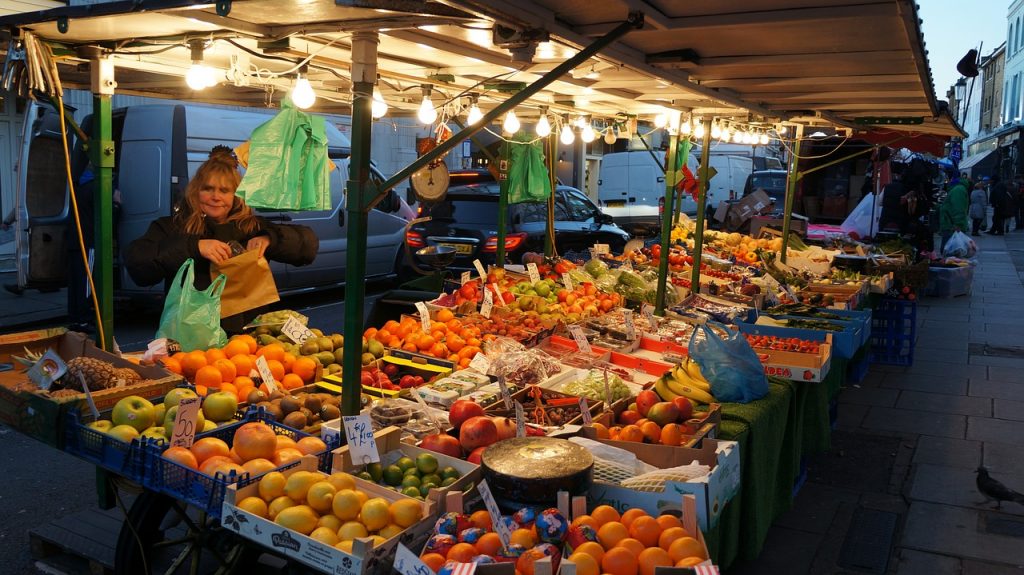
Hackney, London. Credit: kafka4prez

Hackney, London. Credit: kafka4prez

Antisemitism is anathema. From Ken Livingstone to Ephraim Mirvis, the chief rabbi, no one has a good word to say for it. For some there has been a crisis in 2016, for others there has been a witch-hunt. Everyone is against antisemitism: we just can’t agree on how to recognise it.

This year there have been no less than three inquiries and reports on antisemitism: Janet Royall’s presented in May, Shami Chakrabarti’s at the end of June (I served as one of the vice-chairs to this inquiry, although the resulting report was Chakrabarti’s alone) and the home affairs committee report published in October. All dealt exclusively or significantly with the issue of antisemitism in the Labour party.

Now, at year’s end, the prime minister has announced that the government has adopted the definition of antisemitism recommended by an inter-governmental body, the International Holocaust Remembrance Alliance (IHRA). Theresa May heralded a single standard with which we can identify and call out antisemitism. The Labour party quickly fell into line and British Jewish leaders welcomed the initiative. Does this promise a new year in which the politics of antisemitism will be less divisive? Or are the issues bound up in antisemitism too complex to be solved by fiat?

Much of the rancorous debate around antisemitism this year has circulated around three disputed terms: antisemitism, Zionism and anti-racism.

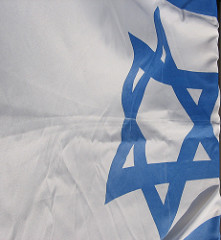
Credit: Ron Almog

Credit: Ron Almog

The term antisemitism was first popularised in Germany in the late 1870s. It is closely bound up with the experiences of Jews as a minority group. It carries memories and knowledge of discrimination, violence and genocide. Yet now the term also operates in a context created both by the formation of the state of Israel in 1948 and the consequence of its military victory in 1967. Israeli Palestinians possess citizenship rights within the country’s internationally recognised boundaries. Nevertheless, Israel’s relations with the Palestinians have also been characterised by discrimination and occupation, annexation and expropriation. Those who make Israel the target of criticism for these actions are now denounced as antisemitic by Israel’s leaders and by their supporters around the world.

In this way antisemitism is a term that does service both as a defence of minority rights, and in the context of support for a discriminatory and illiberal state power. Little wonder the word provokes so much disagreement.

At times the debate over antisemitism has been a surrogate for another quarrel: whether the Labour party should be a comfortable place for Zionists. In parts of the left the terms “Zionism” and “Zio” have become part of the lexicon of invective. Zionism and anti-Zionism encompass a range of positions, but in debate they get defined by opponents according to their maximalist connotations: religious and ethnic privilege, occupation and settlement are ascribed to one side, refusal to assent to the legitimacy of the state of Israel by the other. The facts provide a different picture. Many people who think of themselves as Zionists are at the forefront of protest against Israel’s policies. Many who conceive of themselves as anti-Zionists accept the state’s right to exist while they oppose its objectionable laws and policies.

Anti-racism too has generated conflict, not least in the Labour party. Chakrabarti provided a cautious assessment of the extent of antisemitism within Labour. But it is not only the proven incidence of antisemitism that should concern us but also the well of support that exists for people who reveal prejudice or callous insensitivity towards Jews. The last year has been punctuated by a handful of headline-grabbing incidents of this sort.

These incidents provoke debate over individuals. However, the problem also lies in political culture. The commonplace idea that racism expresses relations of power too often leads to the belief that it expresses only that. But racism can inform acts of resistance and solidarity as well as domination. If we fail to recognise this we will be poorly equipped to identify racism when it is directed against a group that is relatively affluent, coded as “white”, and most of whose members feel attached to the strongest power in the Middle East. It will increase the chances that we are blind to bigotry and myth when it is directed against British Jews.

So does the IHRA definition that Britain has adopted provide the answer? I am sceptical. Here is the definition’s key passage: “Antisemitism is a certain perception of Jews, which may be expressed as hatred towards Jews.” This is bewilderingly imprecise.

The text also carries dangers. It trails a list of 11 examples. Seven deal with criticism of Israel. Some of the points are sensible, some are not. Crucially, there is a danger that the overall effect will place the onus on Israel’s critics to demonstrate they are not antisemitic. The home affairs committee advised that the definition required qualification “to ensure that freedom of speech is maintained in the context of discourse on Israel and Palestine”. It was ignored.

The IHRA definition has been circulating for over a decade and has already been buried once. It is almost identical to the European Union monitoring commission’s working definition, formulated in 2005 as part of the global response to the second intifada in the early 2000s. The definition was never accorded any official status by the EUMC and was finally dropped by its successor body, the Fundamental Rights Agency.

The definition has been resurrected just as we are moving to new times. David Friedman, who will soon become President Trump’s ambassador to Israel, has denounced the “two-state” solution. The prospect of continued Israeli dominion over disenfranchised Palestinians, supported by a US president whose noisome electoral campaign was sustained by nods and winks to anti-Jewish prejudice, is changing the dynamic of Jewish politics in Israel and across the world.

In this new context, the greatest flaw of the IHRA definition is its failure to make any ethical and political connections between the struggle against antisemitism and other sorts of prejudice. On behalf of Jews it dares to spurn solidarity with other groups who are the targets of bigotry and hatred. In the face of resurgent intolerance in the UK, in Europe, the United States and in Israel, this is a luxury none of us can afford.

Further information:

Social justice must be at the heart of a renewed strategy for integration and cohesion

This article was written by Dr Ben Gidley from Birkbeck’s Department of Psychosocial Studies and Prof David Feldman, Director of the Pears Institute for the Study of Antisemitism at Birkbeck

It’s not unusual, when a major government report is published – not least on a contentious topic such as integration and cohesion – that the content of the report bears little relationship to how it is spun by ministers and reported in the media.

In the case of the report earlier this month of the Casey Review into Integration and Opportunity, sensationalist media reportage has amplified the elements of the report which demonise particular – mainly Muslim, migrant and Roma – communities already feeling under pressure in Brexit Britain, promoted a message that integration is somehow the solution to the problem of politically-correct multiculturalism, and highlighted the most gimmicky recommendations.

Civil society activists, academics and the liberal commentariat have understandably focused on the same problematic elements from a critical angle, while also highlighting the unevenness in the use of evidence in the report (heavy on official statistics, thinktank reports, attitudinal surveys and anecdote, light on the use of scholarly literature and in particular on qualitative research on how integration works in practice).

And so, once again, an excellent opportunity for a meaningful national debate on this important topic is slipping out of reach.

The Casey Review makes three major political interventions. The one that has been highlighted in the public debate so far is elaboration of integration as a panacea for the alleged failures of multiculturalism, with a focus on migrants’ and minorities’ responsibility to integrate and sign up to “British values”, tested, for example, through a heavy-handed integration oath on entry. In this sense, the report follows the orthodoxy embraced by New Labour, Coalition and Conservative governments since the 9/11 attacks and milltown riots of 2001.

The other two interventions, however, have received less attention, and deserve more acknowledgement. First is the insistence that, while integration happens locally, it is not enough to devolve all responsibility to it for under-resourced and under-equipped local authorities and their civil society partners. What is needed is a national strategy and national guidance – and nationally ring-fenced funding.

Second, we cannot talk about integration without talking about what Casey generally refers to as inequality of opportunity – the structural iniquities which block the path to integration of some groups. Casey is admirably clear that discrimination and racism (intensified by irresponsible media), alongside class injustice, is one of the primary barriers to integration.

These are points we made in a 2014 report to the All-Party Parliamentary Group Against Antisemitism, Integration, Disadvantage and Extremism, based on a thorough review of the evidence.

market-778851_1280There, we showed that many in Britain’s diverse population – including both minority ethnic and majority ethnic citizens – face a range of disadvantages, several of which are shared. These disadvantages give rise to both real and imagined grievances – whether about the war on terror or about rapid demographic change. We showed that social disadvantage and racial injustice, alienation and disempowerment, generate divisive social relations and political movements that feed on hate.

We concluded therefore that integration policy must be aligned with the realities of disadvantage: rather than tackle intolerance and extremism in isolation, the debate about achieving racial equality, social mobility and social justice must be at the heart of a renewed strategy for integration and cohesion.

By reviewing the evidence of what has worked at a local and national level, we concluded that the continued national abdication of responsibility for integration strategy is untenable. Crucially, a national strategy requires national guidelines for its implementation. It should set out detailed, concrete, substantive actions and a coherent methodology for measuring progress, based on robust data: such a “smart” approach is the only cost-effective approach to doing social policy in a time of austerity.

The urgency of these tasks has been amplified by the evidence presented in the Casey Review. But they will fail if the debate continues to be dominated by the shrill voices of panic and isolationism, if a rigorous analysis of disadvantage continues to be obscured by a mantra that equates the working class with whiteness and sees the white working class as some kind of ethnic group, and if the evidence required for smart interventions is dismissed in the Brexit age’s retreat from expertise.

Behind Birkbeck’s new visual identity

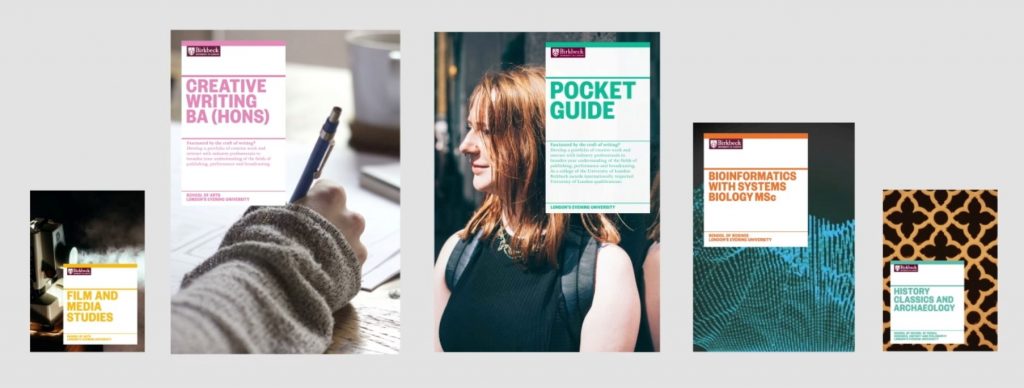
pocket-guides-etc-croppedIt’s an unusual position for an organisation to find itself in: on the brink of its third century and still no signature style. Imagine Apple without its elegant designs and simple use of space; or Google minus its primary-colours and clean white canvas.

So, just a few years shy of our 200th birthday, we thought it was time such a unique and vibrant university had the coherent and contemporary look it deserved.

What we wanted was a clear, well-considered look and feel that stands for Birkbeck, which is fortunate to possess two rare things: a real Unique Selling Point (as the UK’s only evening university) and a heritage to die for (a core mission which has remained unchanged for 200 years, of educating working Londoners).

So, where to start? We had a 20 year-old ‘lockup’ – a logotype and crest, always seen together on a burgundy panel; and a blue theme inherited from a decade-old advertising campaign. We didn’t want to change the lockup (the burgundy has been darkened and the crest reversed to give greater contrast). But the older and newer looks didn’t always sit together favourably and the visual identity void led to a variety of styles that were not always recognisably ‘Birkbeck’.

new-pop-up-exampleThe challenge, then, was to create an identity – typefaces, colour palette, ways of presenting information – that would live happily alongside the lockup and work across digital and printed channels and products for years to come.

Importantly, the identity needed to be easy for people across the university to put in to practice. We have a small central design team, but many others across the organisation have some responsibility for design, stationery or leaflets, for instance.

We hired Pentagram, the world’s largest independent design consultancy, after a competitive process during which we were wowed by their careful understanding of Birkbeck, creative problem-solving and knowledge of the Higher Education sector having worked with the University of the Arts and the University of Sussex.

A cross-university steering group of academics and professional staff were convened to discuss Birkbeck’s personality and how it might be portrayed visually. This group became essential arbiters throughout the process, helping to define and refine ideas and schemes.

And together we came up with a visual identity that is both beautiful and practical that reflects Birkbeck’s ‘attitude not age’ approach to higher education for all – inclusive, vibrant and world-class.

Domenic Lippa, partner at Pentagram, said: “We wanted to create a visual identity that used the heritage of the existing logo.  To do this, we anchored all information off of the logo, thus creating a strong hierarchy. Once we established this, the ‘heart’ of the identity, we started to introduce new typefaces, colours and imagery to support and counter-point that heritage.”

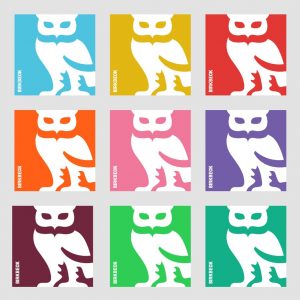
social-mock-up-croppedThere is enough flexibility to give people across the university room to ‘play’ with the identity, for instance by an unrestricted colourful palette and playful new ways of using our crest’s iconic owl – signifying our evening study. But brief, user-friendly guidelines gently help people stay within a ‘safe space’, ensuring Birkbeck always looks the part.

Needless to say the list of products queuing up for an identity make-over is long – from signage and stationery to websites – so the process of switching our look will take some time. We’ll take it gradually. We wanted to share the design with staff and students first, of course and there will be face-to-face briefings for people who work with design and on-going support from the central design team.

Externally, the new look will be debuted by our new marketing campaign which launches after Christmas with advertisements across the London underground and buses. Our annual magazine BBK will be sent to our alumni and friends shortly afterwards, sporting the new identity. And thereafter, as we proceed throughout 2017, e-newsletters, stationery, Open Evening livery, the 2018-19 prospectus, a new website design and many other products will follow on.

Professor David Latchman, Master of Birkbeck, said: “I am delighted that Birkbeck is getting its first ever visual identity. As we move towards our third century this colourful, modern look helps communicate with the vitality, passion and professionalism of our world-class university.”

–  Julia Day, Head of Communications at Birkbeck

https://youtu.be/REq6DzG4WP0

Majority avoidance: one of the few holes in Casey’s strong report

This post was written by Professor Eric Kaufmann of Birkbeck’s Department of Politics. It was originally published on the Policy Exchange blog

Dame Louise Casey’s lengthy, evidence-based report is to be commended for its rigour and steadfast defense of liberal principles. It calls out illiberalism, not shrinking from addressing this problem in conservative Muslim communities, while also highlighting racism and discrimination against Muslims by the majority. It asks for a reinstatement of budgets for teaching English and for mitigating the impact of immigration on rapidly-changing communities. There is little to quibble with here. Later in the report, Casey reviews initiatives since the 2001 Cantle Report. This makes it abundantly clear her report is in line with previous work, albeit based on more extensive and detailed quantitative evidence. The failure, it is suggested, is in the execution more than in our knowledge base.

But in two interrelated respects, the report misses a big story. The first concerns the fact that while minority groups are becoming considerably less segregated, segregation between majority and minorities (taken as a whole) remains stuck at a high level. This is a point I made in my report in 2014 and which Ted Cantle and I reiterated recently in our OpenDemocracy report.

The second – related – point, is that white British ‘avoidance’ is the principal driver of this pattern and yet white British attitudes to integration are only lightly addressed in the report. Insofar as this concern is just emerging in the UK academic literature, one cannot fault the report’s authors. Nevertheless, this is an important area that needs a great deal more research and attention.

Third, and also related to the above, is that there is very little grasp in the academic literature of what can be done in free societies to mitigate segregation. No wonder little is said about this in the report. Singapore is a statist society where housing is largely public and the government has few qualms about telling people where to live. As a result, minorities like the Malays and Indians are prevented from clustering and there is no segregation.

We cannot and should not do that in free societies, but what can be done? The report mentions a study which found that when British council tenants were offered a choice in where they would be located, this increased segregation. This gets to a fundamental reality: the more choice people have in where they are housed, the more like tend to live with like. This is not necessarily a bad thing, but if segregation is considered a problem for minority upward mobility and majority attitudes toward minorities, we need to consider unobtrusive ways to address it.

Let’s return to majority withdrawal, or ‘white avoidance.’ Imagine there were no illiberal Muslims, Hindus or ultra-Orthodox Jews in Britain and everyone signed up to British values. This may lead to less segregated ethnic communities, but would have little impact on the overall interaction between majority and minority. Instead we would simply see even more expansion of ‘superdiverse’ areas such as Luton, Newham and the like, which white British families largely avoid when searching for a place to settle down or send their kids to school. More than this, they avoid even moderately diverse communities. For example, when we examine schools and places with growing populations, white British absolute population growth is significantly higher in schools and neighbourhoods over 80-85% white British, in a rising curve.

Even if ethnic concentrations disperse, if Britain were to become two nations – one superdiverse, the other remaining White British – this would still represent an important source of division. Indeed, as the Brexit vote revealed, this split is already re-configuring the electoral map in Britain and moving the country in the geographically polarised direction of the United States. Diverse urban areas and homogeneous exurbs or rural districts increasingly see each other as alien. Because white British are so numerous, what they do matters a lot more for the total picture than the actions of small minorities, so white British movement demands more attention.

My own work with Policy Exchange will focus on retaining white residents in mixed areas, which is a major challenge in urban Britain not considered in the report. I hope to examine three ‘nudges’ that could improve white-minority integration: a) correcting whites’ misperceptions about the actual minority share in mixed schools and areas; b) providing accurate information to minorities lacking knowledge about relatively white areas; and c) designing new homes in diverse areas to appeal to white British preferences so as to retain whites in diverse communities.

Recent research suggests white Americans tend to overestimate the share of minorities in moderately diverse areas, and so avoid them and wind up living in whiter areas than they would prefer. I intend to test whether this is also the case in Britain. Using a computer algorithm, survey respondents will be asked whether they have heard of a set of neighbourhoods and schools in their area, and if so, to guess their ethnic composition. We are interested in understanding whether whites have a distorted view of the ethnic composition of mixed areas and schools, and whether minorities have heard of many largely white areas. If so, a policy recommendation might be to construct an online neighbourhood facts database with accurate ethnic (as well as socioeconomic, amenities and housing) information to help people make more informed area choices. Also, it may be worth trialing a system of listing the ethnic composition of schools on their website, as is true, for instance, in some US public school districts like Boston.

A second strand of experiments will focus on new housing, which is in high demand in London and other urban areas. We know that most of the public prefers traditional designs while planners and architects favour the modernist aesthetic which currently prevails in new housing construction. However, Experian MOSAIC data also hint at important ethnic differences, with white British prioritising period designs and gardens while minority groups may be more open to modernism and favour driveways as well as larger numbers of rooms to accommodate extended families. In this manner, it may be possible to design new housing to appeal to different groups and thus ‘nudge’ integration in an unobtrusive way. My work at Policy Exchange will consist of examining the preferences of members of different groups for alternative housing designs controlling for neighbourhood ethnic composition. In other words, might White Britons be more willing to move to a new housing development in an ethnically diverse area if these are designed in a traditional manner?

Overall then, while there is much to commend in the Casey Review, there are large and important omissions which can only be addressed through new research.

Trump and Brexit: why it’s again NOT the economy, stupid

This post was written by Professor Eric Kaufmann from Birkbeck’s Department of Politics. It was originally published on the LSE British Politics and Policy blog

As the final votes are counted, pundits and pollsters sit stunned as Donald J. Trump gets set to enter the White House. For anyone in Britain, there is a sharp tang of déjà vu in the air: this feels like the morning after the Brexit vote all over again. Eric Kaufmann explains that, as with Brexit, there’s little evidence that the vote had much to do with personal economic circumstances.

For months, commentators have flocked to diagnose the ills that have supposedly propelled Trump’s support, from the Republican primaries until now. As in Britain, many have settled on a ‘left behind’ narrative – that it is the poor, white, working-class losers from globalization that have put Trump over the top. Only a few clairvoyants – Michael Lind, Jonathan Haidt – have seen through the stereotypes.

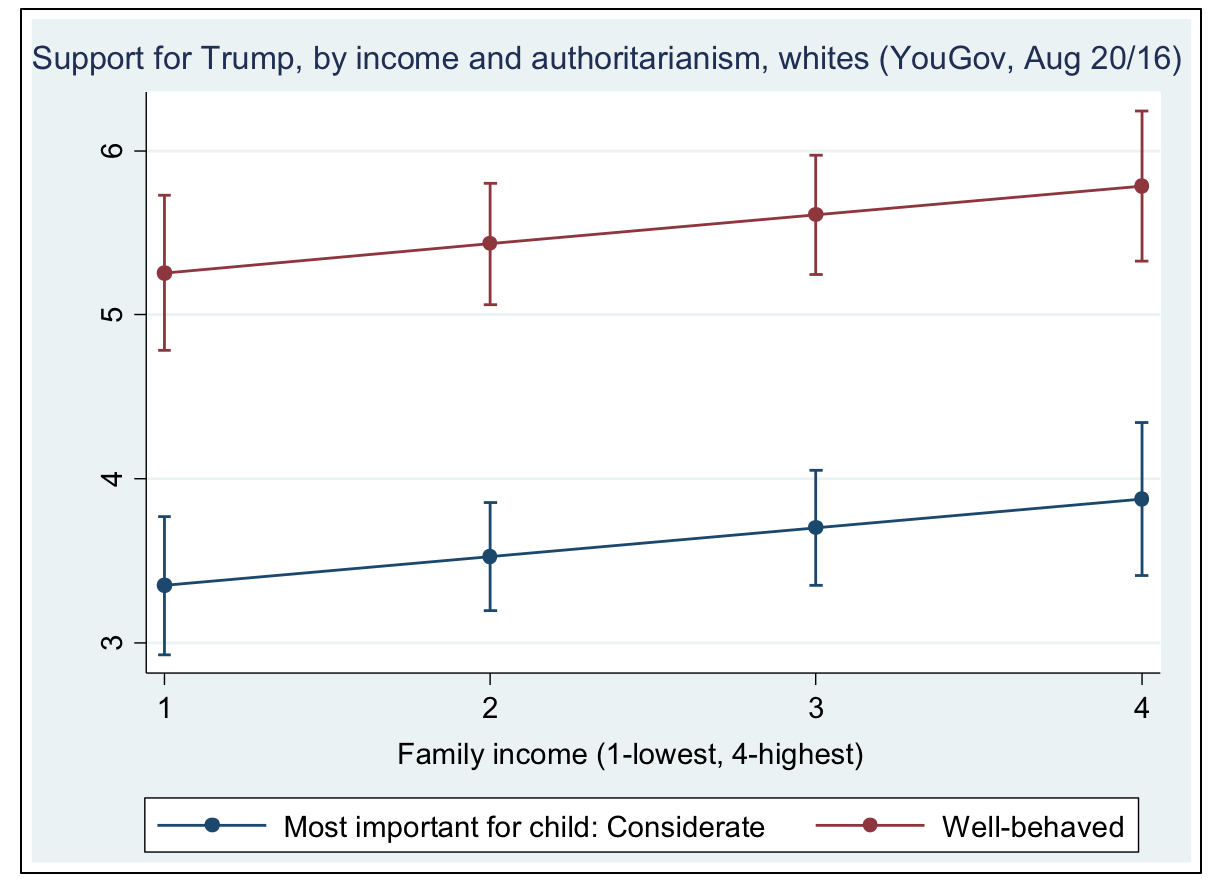
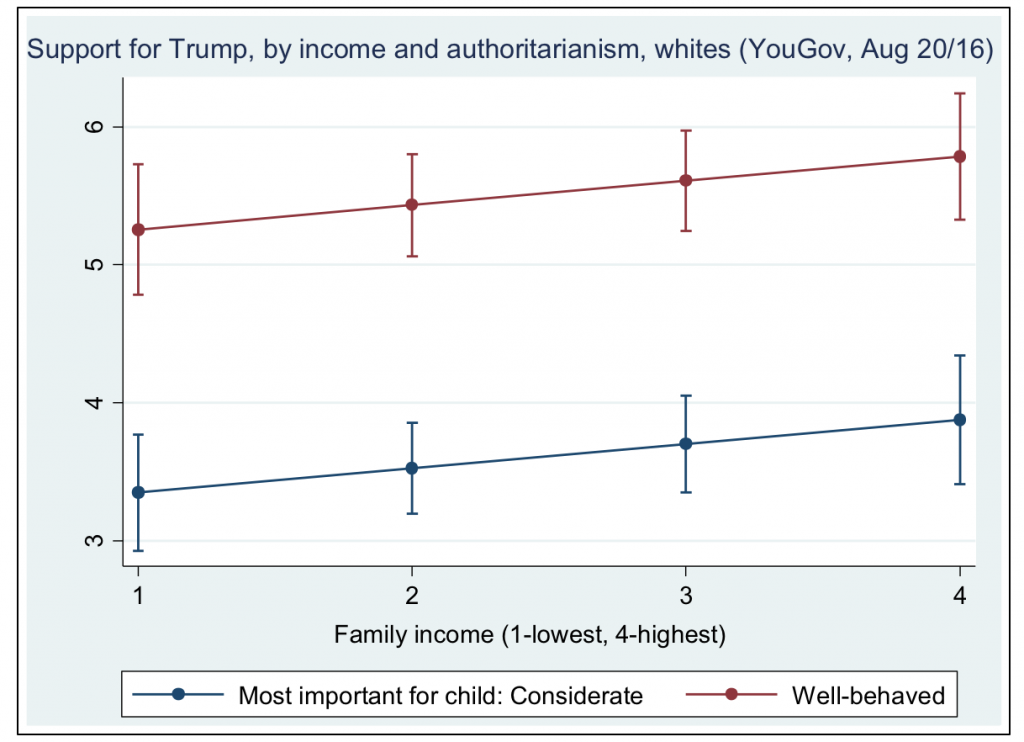
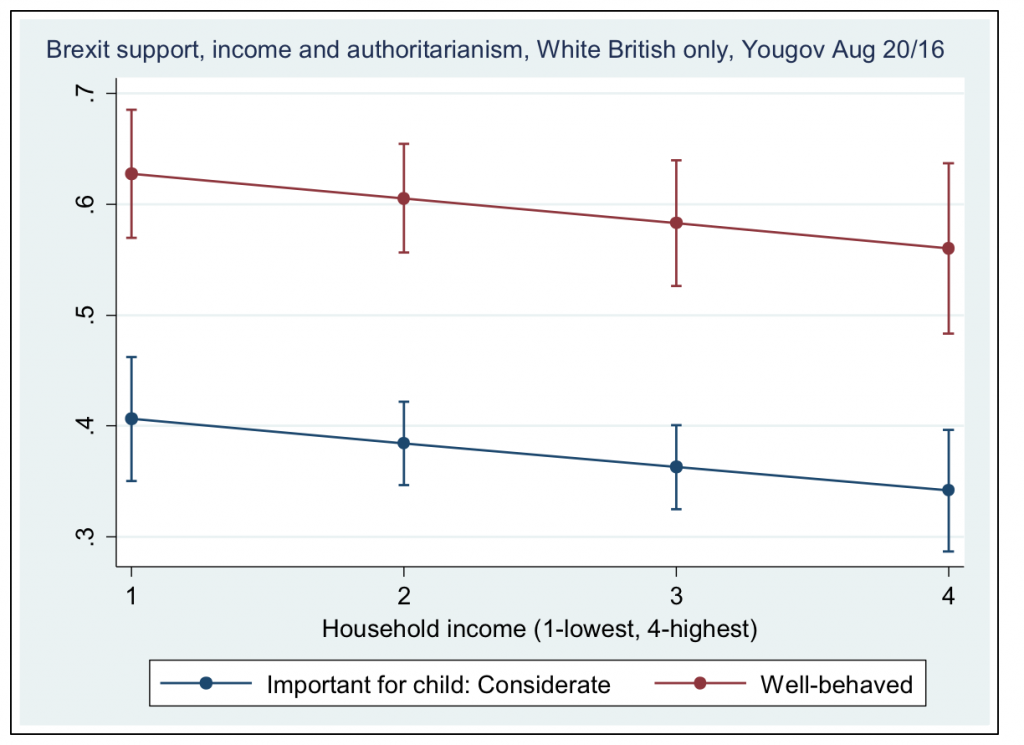
But, as in Britain, there’s precious little evidence this vote had much to do with personal economic circumstances. Let’s look at Trump voting among white Americans from a Birkbeck College/Policy Exchange/YouGov survey I commissioned in late August. Look at the horizontal axis running along the bottom of figure 1. In the graph I have controlled for age, education and gender, with errors clustered on states. The average white American support for Trump on a 0-10 scale in the survey is 4.29.

You can see the two Trump support lines are higher among those at the highest end of the income scale (4) than the lowest (1). This is not, however, statistically significant. What is significant is the gap between the red and blue lines. A full two points in Trump support around a mean of 4.29. This huge spread reflects the difference between two groups of people giving different answers to a highly innocuous question: ‘Is it more important for a child to be considerate or well-mannered?’ The answers sound almost identical, but social psychologists know that ‘considerate’ taps other-directed emotions while ‘well-mannered’ is about respect for authority.

People’s answer to this question matters for Trump support because it taps into a cultural worldview sometimes known as Right-Wing Authoritarianism (RWA). Rather than RWA, which is a loaded term, I would prefer to characterise this as the difference between those who prefer order and those who seek novelty. Social psychologist Karen Stenner presciently wrote that diversity and difference tends to alarm right-wing authoritarians, who seek order and stability. This, and not class, is what cuts the electoral pie in many western countries these days. Income and material circumstances, as a recent review of research on immigration attitudes suggests, is not especially important for understanding right-wing populism.

Figure 1.
1

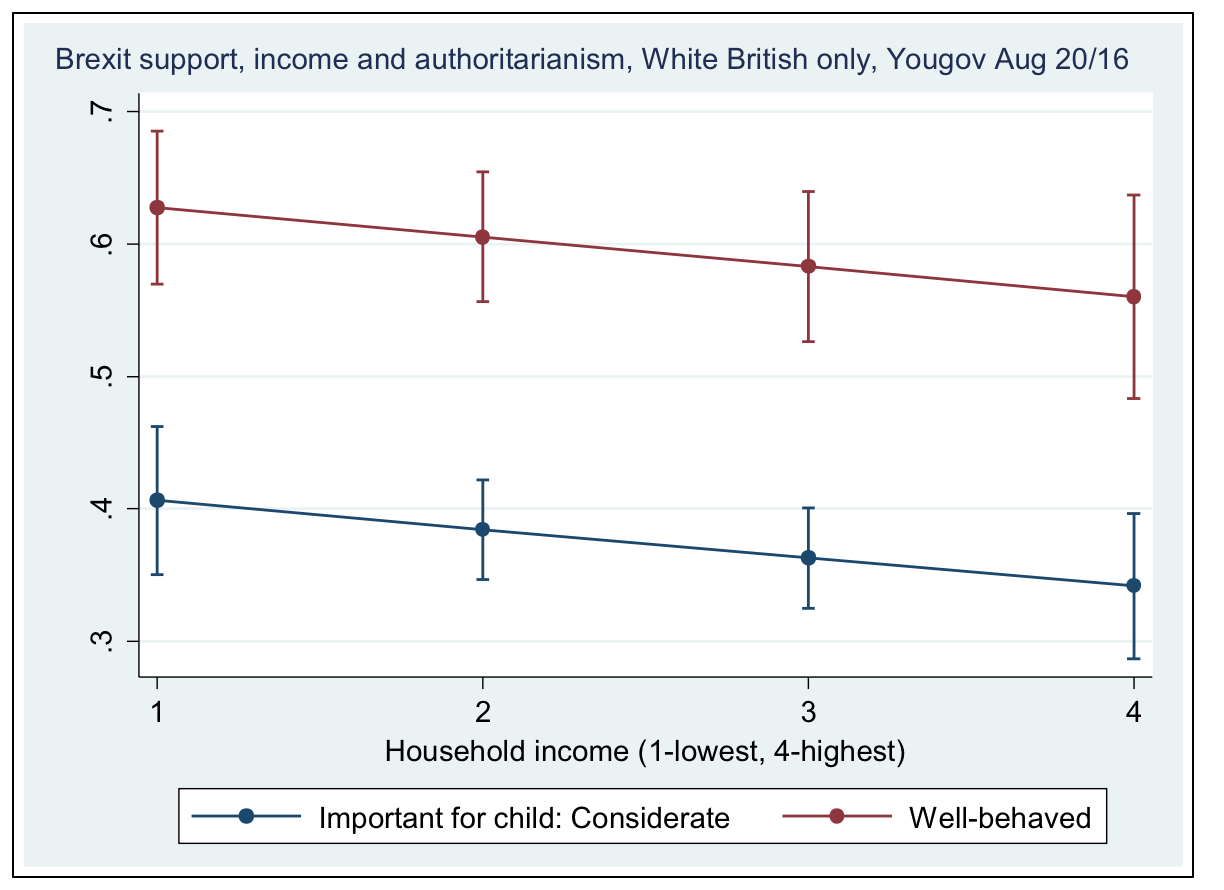
Now look at the same graph in figure 2 with exactly the same questions and controls, fielded on the same day, in Britain. The only difference is that we are substituting people’s reported Brexit vote for Trump support. This time the income slope runs the other way, with poorer White British respondents more likely to be Brexiteers than the wealthy. But income is, once again, not statistically significant. What counts is the same chasm between people who answered that it was important for children to be well-mannered or considerate. In the case of Brexit vote among White Britons, this represents a 25-point difference around a mean of 45.8 per cent (the survey undersamples Brexiteers but this does not affect this kind of analysis). When it comes to Brexit or Trump, think successful plumber, not starving artist or temporary lecturer.

Figure 2.
2

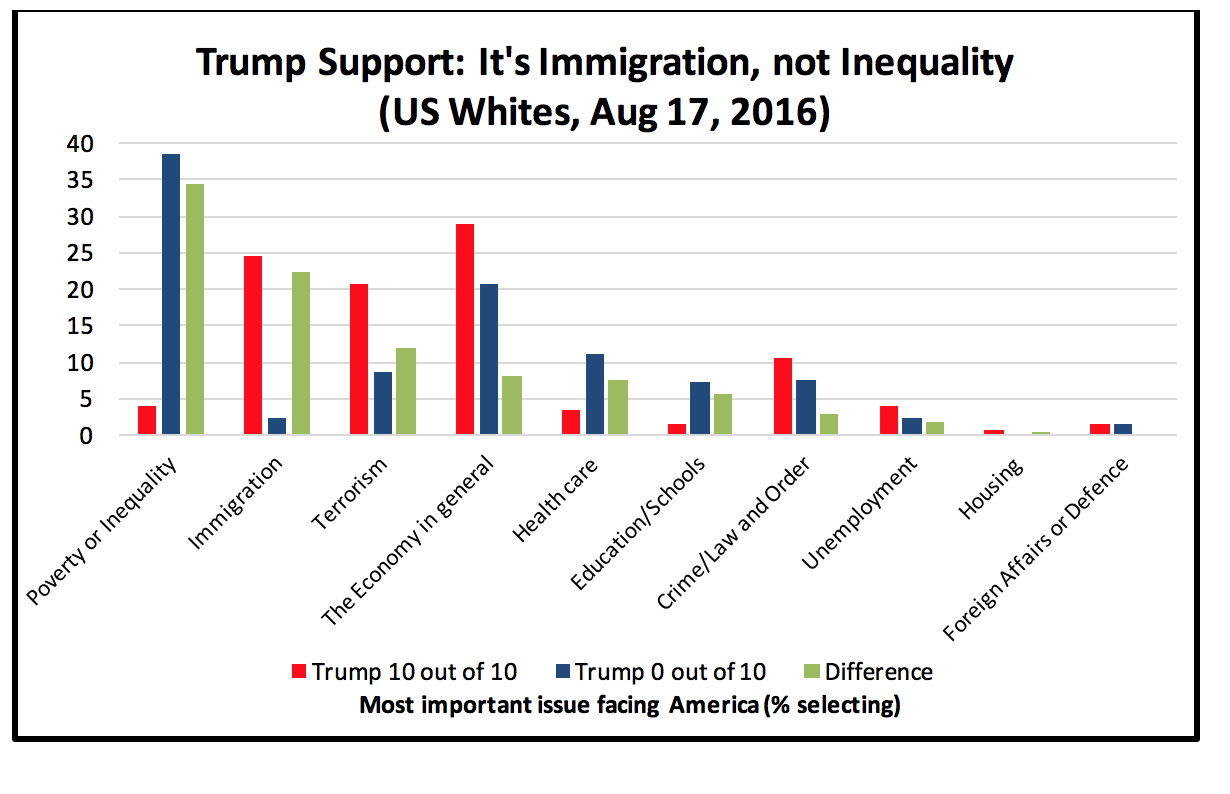
Some might say that even though these populist voters aren’t poor, they really, actually, surely, naturally, are concerned about their economic welfare. Well, let’s take a look at the top concerns of Trump voters in figure 3. I’ve plotted the issues where there are the biggest differences between Trump supporters and detractors on the left-hand side. We can start with inequality. Is this REALLY the driving force behind the Trump vote – all that talk about unemployment, opioid addiction and suicide? Hardly. Nearly 40 per cent of those who gave Trump 0 out of 10 (blue bar) said inequality was the #1 issue facing America. Among folks rating the Donald 10 out of 10, only 4 per cent agreed. That’s a tenfold difference. Now look at immigration: top issue for 25 per cent of white Trump backers but hardly even registering among Trump detractors. Compared to immigration, even the gap between those concerned about terrorism, around 2:1, is not very striking.

Figure 3.
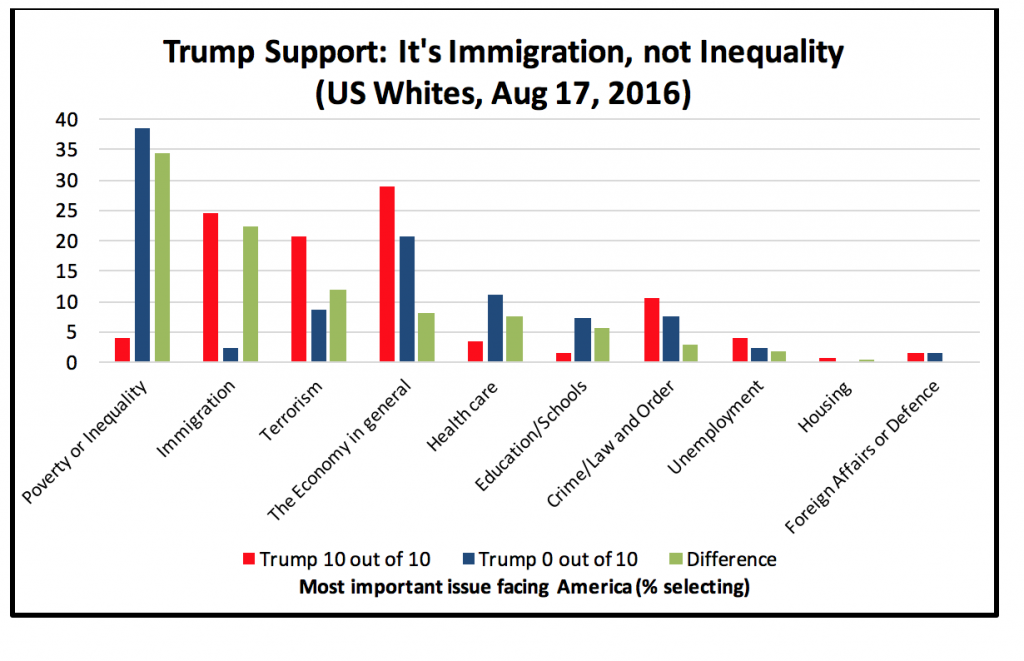
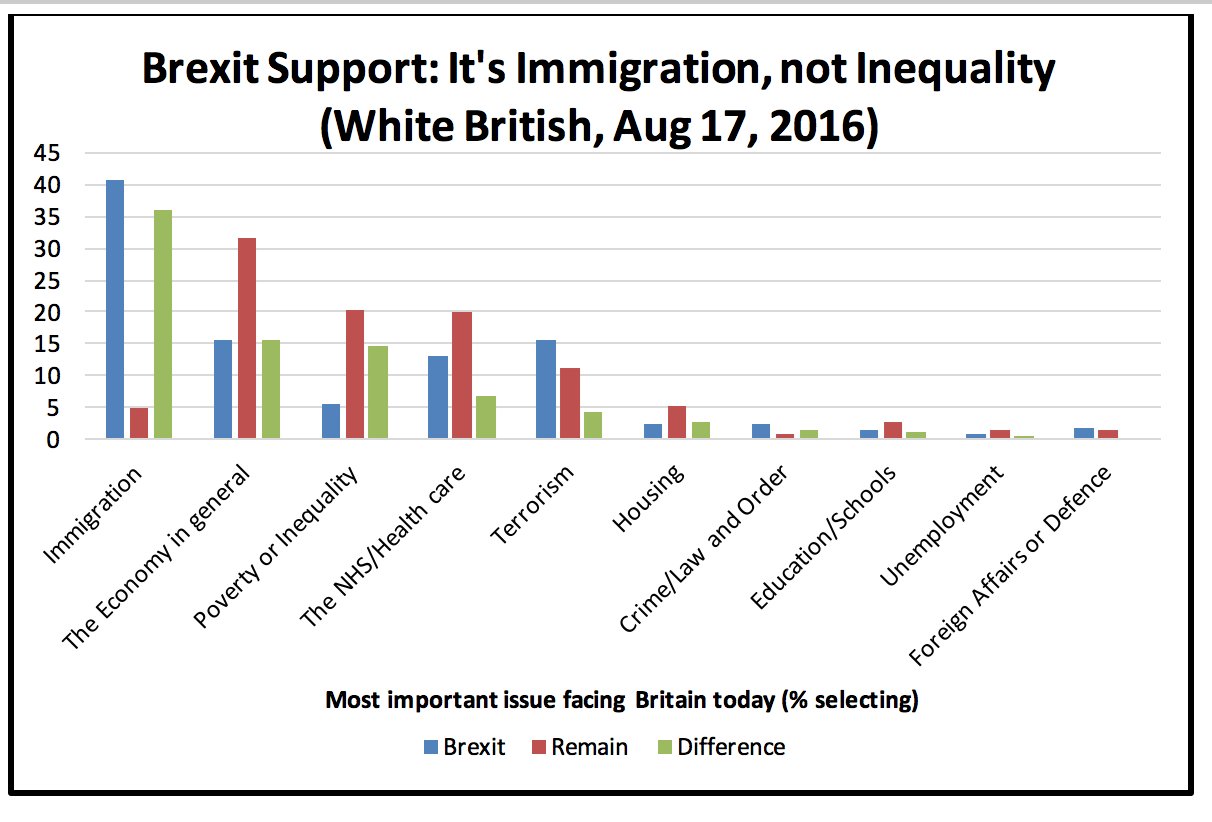
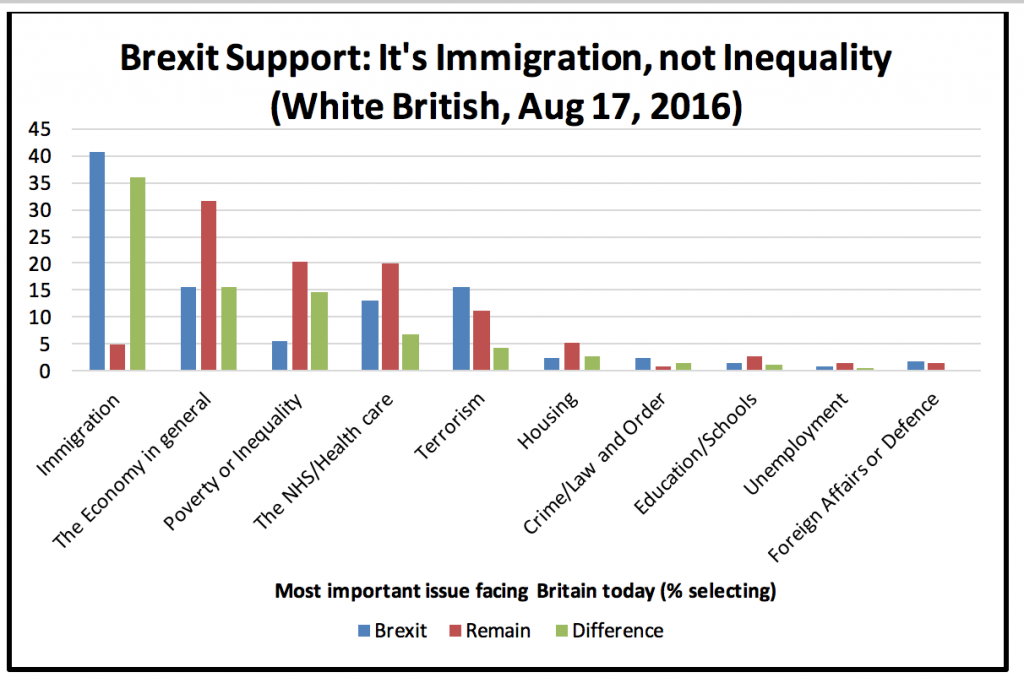
3For Brexit vote, shown in figure 4, the story is much the same, with a few wrinkles. The gap on immigration and inequality is enormous. The one difference is on ‘the economy in general,’ which Trump supporters worry about more than Brexiteers. This could be because in the graph above I am comparing extreme Trump backers with extreme detractors whereas the Brexit-Bremain numbers include all voters. Still, what jumps out is how much more important immigration is for populist voters than inequality.

Figure 4.
4Why is Trump, Brexit, Höfer, Le Pen and Wilders happening now? Immigration and ethnic change. This is unsettling that portion of the white electorate that prefers cultural order over change.

The US was about 90 percent white in 1960, is 63 percent white today and over half of American babies are now from ethnic minorities. Most white Americans already think they are in the minority, and many are beginning to vote in a more ethnopolitical way. The last time the share of foreign born in America reached current levels, immigration restrictionist sentiment was off the charts and the Ku Klux Klan had 6 million members – mainly in northern states concerned about Catholic immigration.

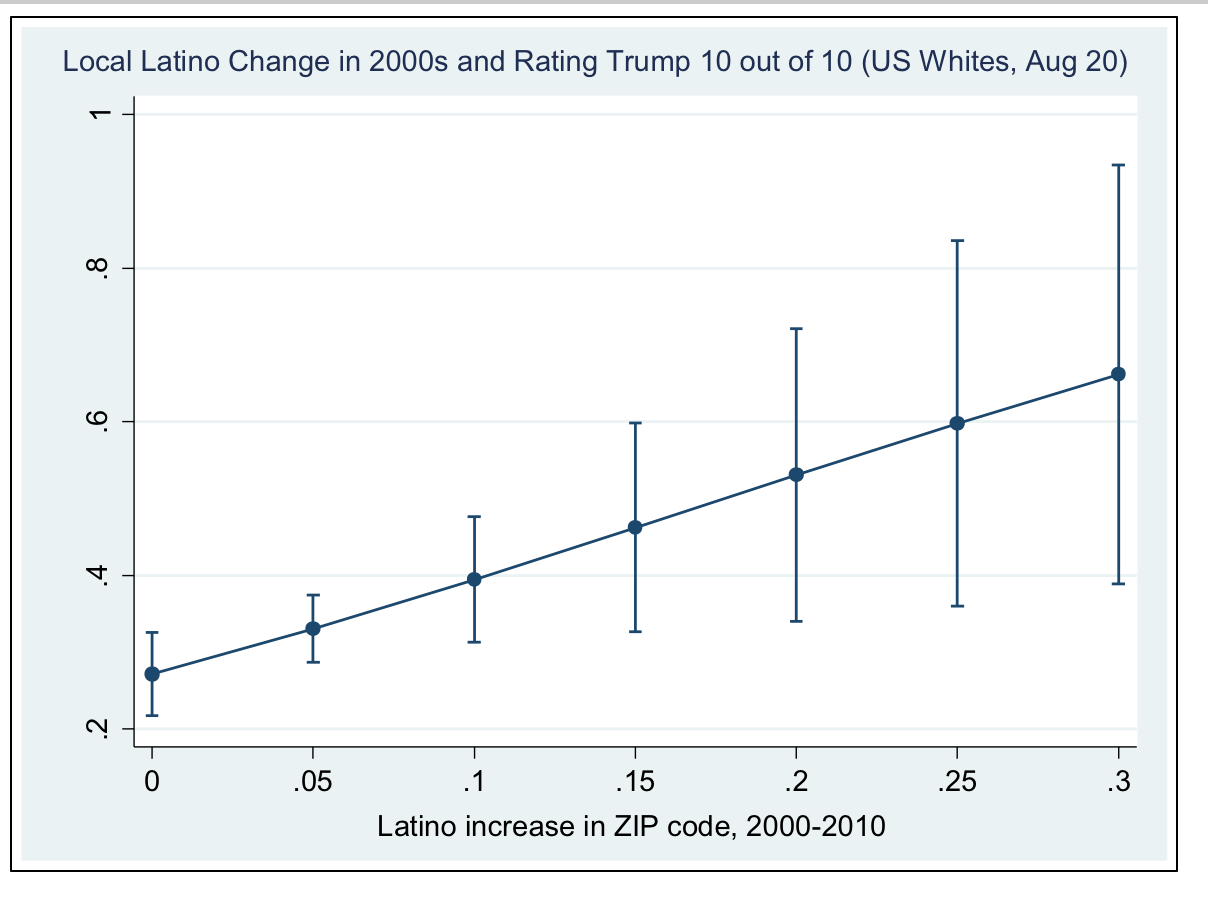
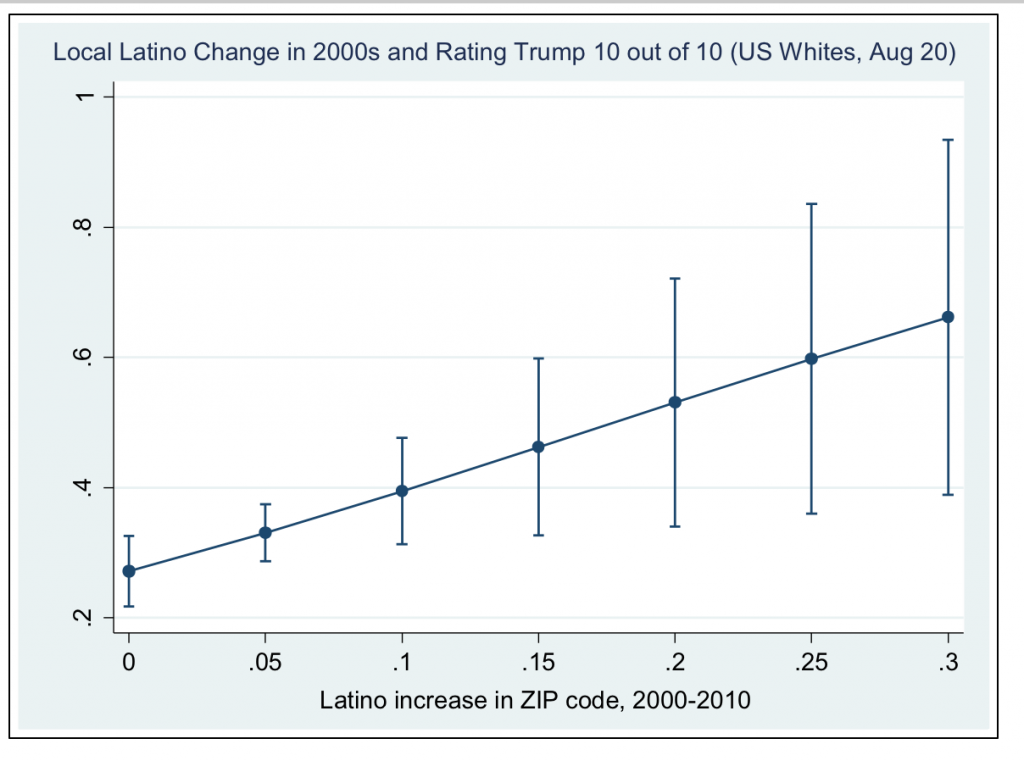
Ethnic change can happen nationally or locally, and it matters in both Britain and America. Figure 5, which includes a series of demographic and area controls, looks at the rate of Latino increase in a white American survey respondent’s ZIP code (average population around 30,000 in this data). The share of white Americans rating Trump 10 out of 10 rises from just over 25 percent in locales with no ethnic change to almost 70 percent in places with a 30-point increase in Latino population.

The town of Arcadia in Wisconsin – fittingly a state that has flipped to Trump – profiled in a recent Wall Street Journal article, shows what can happen. Thomas Vicino has chronicled the phenomenon in other towns, such as Farmer’s Branch, Texas or Carpentersville, Illinois. There are very few ZIP codes that have seen change on this scale, hence the small sample and wide error bars toward the right. Still, this confirms what virtually all the academic research shows: rapid ethnic change leads to an increase in anti-immigration sentiment and populism, even if this subsequently fades. The news also spreads and can shape the wider climate of public opinion, even in places untouched by immigration.

Figure 5.
5Now let’s look in figure 6 at Brexit, and how White British voters in wards with fast East European growth in the 2000s voted. With similar controls, it’s the same story: when we control for the level of minorities in a ward, local ethnic change is linked with a much higher rate of Brexit voting. From under 40 percent in places with no ethnic change to over 60 percent voting Brexit in the fastest changing areas. Think Boston in Lincolnshire, which had the strongest Brexit vote in the country and where the share of East Europeans jumped from essentially zero in 2001 to the highest in the country by 2011.

Figure 6.
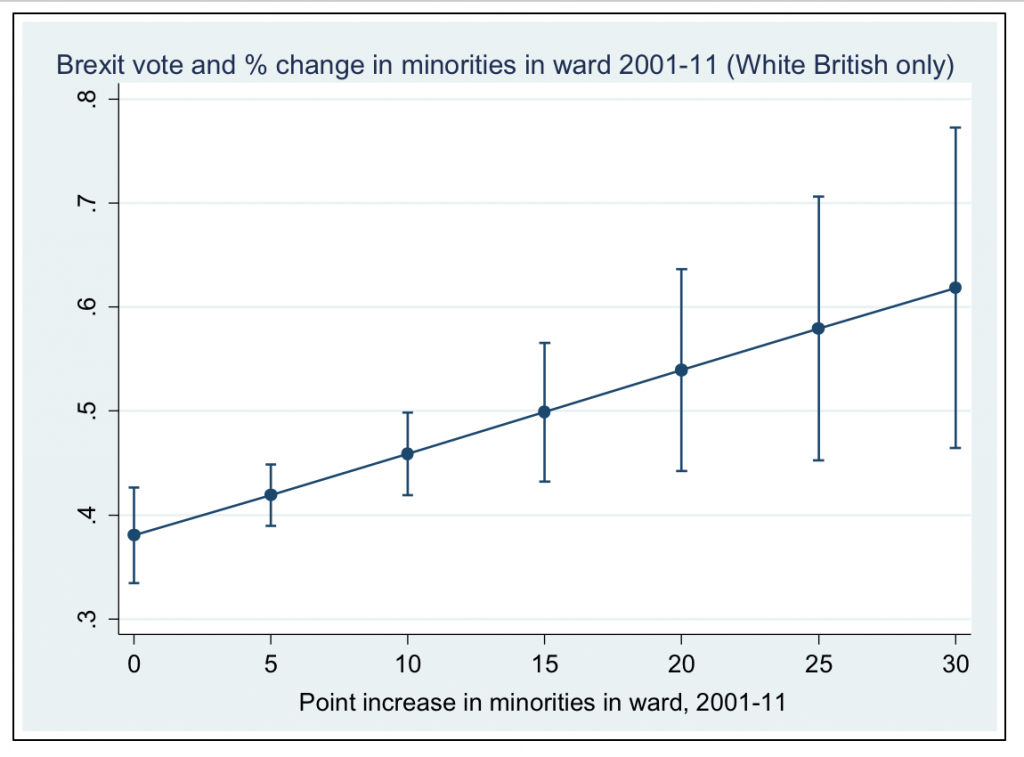
6

The Trump and Brexit votes are the opening shots which define a new political era in which the values divide between voters – especially among whites – is the main axis of politics. In a period of rapid ethnic change, this cleavage separates those who prefer cultural continuity and order from novelty-seekers open to diversity. Policymakers and pundits should face this instead of imagining that old remedies – schools, hospitals, jobs – will put the populist genie back in the bottle.

From ‘Go back to China’ to ‘Where are you really from?’: Nationality and ethnicity talk in everyday interactions

This article was contributed by Professor Zhu Hua of Birkbeck’s Department of Applied Linguistics and Communication

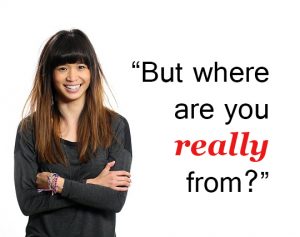
perpetual-foreigner-syndromeIn his open letter published in the New York Times on 9 October, Michael Luo, who was born and grew up in the US, told of his encounter with a woman who yelled at him and his family, ‘Go back to China!’, on the Upper East Side of Manhattan when they came out of a church service.  Puzzled by the event, his 7-year-old daughter asked ‘Why did she say, ‘Go back to China?’ We’re not from China.’

What Michael Luo experienced is ‘perpetual foreigner syndrome’, a problem facing many transnational individuals in everyday interactions, especially those who may look or sound different from the local majority.  Back in 2002, Frank Wu, the first Asian American law professor at Howard University Law School, wrote specifically on how perpetual foreigner syndrome is instantiated through recurrent and seemingly innocent questions (which, admittedly, are much milder than what was hurled at Michael Luo):

Where are you from?’ is a question I like answering. ‘Where are you really from?’ is a question I really hate answering… For Asian Americans, the questions frequently come paired like that…. More than anything else that unites us, everyone with an Asian face who lives in America is afflicted by the perpetual foreigner syndrome. We are figuratively and even literally returned to Asia and ejected from America. (Wu 2002)

His point about what these questions can do strikes a chord with me. Having lived and worked in China and Britain and travelled to many parts of the world, I find questions like ‘where you are from?’ really difficult to answer. I never seem get it right and always end it up with the feeling that the self I present in my attempted answers is not real – it is fragmented some times, and rehearsed at others.  If I say that I am from London, I know that the next question will be ‘where are you really from’. I have to look apologetic and confess that I ‘originally’ came from China more than 20 years ago and have lived in Britain longer than I had been in China.  If I take the short-cut and tell people that I am from China, the next comment I am likely to hear is a compliment ‘but your English is so good!’.  For a long time, I thought that this is just me, an applied linguist who is over-interpreting language use in everyday interactions, until I read Rosina Lippi-Green’s work on language, ideology and discrimination (1997/2012) and began to make connections with my observations on these instances of discourse in daily encounters and the existing studies including one of the strands of my work on Interculturality.

I refer to this kind of discourse that evokes or orients to one’s ethnicity or nationality either explicitly or implicitly as Nationality and Ethnicity Talk (NET). It includes questions or comments which, frequently occurring in small talk, aim to establish, ascribe, challenge, deny or resist one’s ethnicity or nationality.  The questions and comments range from direct ones (e.g. ‘Where are your people coming from?’, ‘When are you going back?’, ‘Is it as hot as this where you are from?’, ‘What is it like back home?’ to more subtle ones (e.g. ‘Your English is so good!’). There is nothing inherently wrong with questions like ‘where are you from’. The question can be genuine – people would like to find out more about China, Japan or Korea or any other culture or they are simply interested in you as a person.  But problems occur when those who are asking such questions appear to look for a certain answer and appear confused or disappointed when hearing an unexpected answer and those on the receiving end of such questions might have been asked the same questions 101 times.  And of course, in Michael Luo’s case, it made him and his daughter feel like ‘foreigners’ in their own country

Despite growing acceptance of racial equality in post-industrialised societies, NET of the above kind reflects people’s hidden and flawed folk theories of race, reproduces and reifies cultural essentialism, and can result in exclusion and marginalisation of certain social groups.  Jane Hill (2008) coined the concept of ‘folk theory of race’ to describe everyday assumptions that people have about race and ethnicity. Because the folk models or theories are often taken for granted, people tend to use them to ‘interpret the world without a second thought’. Folk theory of race can be in operation subtly and, on some occasions, it is almost invisible to those who apply it and/or those at the receiving end of it. Markus & Moya (2010) have unpicked the powerful, hidden, and flawed assumptions about the nature and meanings of race and ethnicity beneath the eight common conversations about race amongst American people. These include: ‘We’re beyond race.’ ‘Racial diversity is killing us.’ ‘Everyone’s a little bit racist.’ ‘That’s just identity politics.’ ‘Variety is the spice of life.’ ‘It’s a Black thing—you wouldn’t understand.’ ‘I’m___ and I’m proud.’ and ‘Race is in our DNA’.  They argue that ‘these eight conversations give us the illusion of understanding, but they are narrowly based on limited, flawed, and of course, unstated assumptions … Also like stereotypes, these conversations are pervasive, they are difficult to change and they have powerful consequences for our actions.’

In my recently published article co-authored with Li Wei, we examine the significance of questions such as ‘where are you really from?’ in everyday conversational interactions. We discuss what constitutes NET, how it works through symbolic and indexical cues and strategic emphasis, and why it matters in the wider context of identity, race, intercultural contact and power relations. The discussion draws on social media data including youtube videos and a blog with the title of ‘It may not be racist, but it’s a question I’m tired of hearing’ by Ariane Sherine in the Guardian’s opinion column, Comment is Free. We argue that the question ‘where are you really from’ itself does not per se contest immigrants’ entitlement. However, what makes a difference to the perception of whether one is an ‘outsider’ as Michael Luo did – is the tangled history, memory and expectation imbued and fuelled by power inequality.

There have been reports of the increase in the number of racial insults at people who look and sound different since the EU Referendum. It is important that we pay closer attention to linguistic xenophobic, but it is equally important to be mindful of the significance of the more subtle ways of Othering as exemplified in NET.

Further reading:

  • Hill, Jane H. 2008. The everyday language of white racism. Malden, MA: Wiley-Blackwell.
  • Lippi-Green, Rosina. 1997/2012. English with an Accent. Language, Ideology, and Discrimination in the United States. London: Routledge.
  • Markus, Rose & Paula Moya (eds.). 2010. Doing Race: 21 Essays for the 21st Century. New York: W.W. Norton & Company.
  • Wu, Frank. H. 2002.  Where are you really from? Asian Americans and the Perpetual Foreigner Syndrome.  Civil Rights Journal  Winter 2002. 16-22.
  • Zhu Hua and Li Wei (2016) “Where are you really from?”: Nationality and Ethnicity Talk (NET) in everyday interactions. In Zhu Hua & Claire Kramsch (eds.), Symbolic power and conversational inequality in intercultural communication, a special issue of Applied Linguistics Review 7(4), 449-470.  The article can be accessed here.

Bad Habits? France’s ‘Burkini ban’ in Historical Perspective

This article was written by Dr Carmen Mangion from Birkbeck’s Department of  History, Classics and Archaeology. The article was originally published on the History Workshop Online‘s blog.

The ‘burkini ban’ issued by 30 French beach towns at the end of July 2016 sparked a media frenzy. Town mayors saw the burkini, the full-body swimsuit favoured by some Muslim women as a means of maintaining modesty while enjoying the sea, as a symbol of Islamic extremism and a threat to ‘good morals and secularism’. France’s 1905 constitution separates Church and State, and embraces a laïcité (a secularism in public affairs which prohibits religious expression) meant to limit religion’s influence on its citizens though still allowing freedom of religion. It originated as a means of eliminating the influence of the Catholic Church.Following ministerial criticism, France’s top administrative court investigated the ‘burkini ban’, ruling in late August that it violated basic freedoms.

Nuns at the beach
Nuns at the beach (Facebook/Izzeddin Elzir)

Amidst this furore, Italian Imam Izzedin Elzir’s image of nuns on the beach in their religious habits triggered an international media response. The image, appearing across social media and in outlets as prominent as the New York Times, implied the hypocrisy of a ban targeting Muslims and ignoring Christians. The photos were ironic on two counts:

First, some French mayors were emphatic that nuns in habits were also forbidden on beaches.

Second, and more apposite to this blog post, both the media and ‘ordinary’ citizens seem to be unaware that the ‘nun’ on the streets of Paris (and elsewhere) once sparked a similar outrage.

The historical context was of course different (it always is), but the indignation and the drive to control women’s appearance was just as virulent. Such outrage was not limited to France, but as the ‘burkini ban’ was initiated by the French, it seems appropriate to begin with this bit of French history.

The French revolution of the 1790s, with its cry of liberté, égalité, fraternité was not such a good thing for Catholic nuns. The nun, in her religious habit, became a symbol of the Catholic Church’s role in upholding the inequities and injustices of the ruling classes within France. Catholic nuns, then fully habited, were visible on the streets of Paris as educators, nurses and providers of social welfare, and became targets of anti-clerical outrage. The republican political regime set French nuns ‘free’ from their lifelong vows of poverty, chastity, obedience and their religious habit. It closed convents and confiscated their property. Some members of religious communities weren’t so willing to be set free, however, and were imprisoned. They were told to remove their religious habits (made illegal in 1792) and instead wear secular garb. Nuns including the Carmelites of Compiègne and the Daughters of Charity of Arras were executed for refusing to take the oath of loyalty to the Constitution.

French citizens also made their umbrage against nuns known. One 1791 print representing revolutionary anticlericalism, La Discipline patriotique or le fanatisme corrige (‘The patriotic discipline or fanaticism corrected’), showed the market women of Paris’s les Halles disrobing and thrashing the religious fanaticism out of a group of nuns. Such disciplining of women’s bodies was both salicious and violent.

la_discipline_patriotique_ou_le_-_btv1b69446090

The patriotic discipline or Fanaticism corrected (La Discipline patriotique ou le fanatisme corrigée) (Image: BnF/Gallica)

This urge to control the religious ‘fanaticism’ of women and monitor their clothing choices was not only a French issue; it had earlier incarnations. The dissolution of the monasteries in England in the mid-sixteenth century also ‘freed’ nuns and monks from their vows — and their property. English women’s response to this was to form English convents in exile, many in France and Belgium. In the 1790s English nuns fled, often surreptitiously, back to England. But penal laws restricting Catholic practices were still in effect and English bishops initially discouraged nuns from wearing their religious habit. English citizens too showed their indignation for female religious life by throwing epithets and stones at nuns; the Salford house of the Daughters of Charity of St Vincent de Paul was set alight in 1847. Similar events happened in the United States. Most notoriously the Ursuline convent in Charleston, South Carolina was burned down in the 1830s by anti-nun rioters. In the Netherlands, in Spain, in Belgium, in Germany and more recently in Eastern and Central Europe, nuns were also targeted. Women in religious clothing were (and are) easy targets of vitriol and violence.

So burkinied Muslim women and habited Catholic nuns have far more in common than one might think. The nun’s religious habit, like the burkini, has links to religious identity as counter to cultural norms. Critics say that women in burkinis challenge the French secular way of life. History shows that the habited nun also challenged both a republican version of Frenchness and also an English version of Englishness.

Within this context, the burkini furore illustrates two points.

First, it is yet another disappointing reminder that women’s bodies and appearances remain far too often more relevant (and newsworthy) than women’s intellects and voices. Clothing regulations are an excuse to control women and to divert attention from more substantive issues. They are a means of enforcing a societal version of femininity that doesn’t allow for difference. Women choosing to wear religious dress (or dress associated with religious affiliation) should not be stigmatised.

Second, by focusing on the burkini, we forget the more salient issue of figuring out how diverse people can live together peacefully. It is the social, economic and political factors that need attention: cultural inclusion, high unemployment and participation in civic life. Criminalising what women wear on the beach doesn’t even come close to addressing these issues.

Further Reading:

  • Carmen Mangion, ‘Avoiding “rash and Imprudent measures”: English Nuns in Revolutionary Paris, 1789-1801’ in Communities, Culture and Identity: The English Convents in Exile, 1600-1800 edited by Caroline Bowden and James E. Kelly (Ashgate, 2013), pp. 247-63.
  • Gemma Betros, ‘Liberty, Citizenship and the Suppression of Female Religious Communities in France, 1789-90’, Women’s History Review, 18 (2009), 311–36
  • For a robust comparison of nineteenth-century American nativism to the politics of Islam see José Casanova, ‘The Politics of Nativism Islam in Europe, Catholicism in the United States’, Philosophy & Social Criticism, 38 (2012), 485–95. A short and accessible version of this essay can be found here.

Hard right, soft power: fascist regimes and the battle for hearts and minds

This article was written by Dr David Brydan, a post doctoral researcher in the Department of History, Classics and Archaeology and on Birkbeck’s Reluctant Internationalists project. It was originally published on  The Conversation.

A new global “soft power” ranking recently reported that the democratic states of North America and Western Europe were the most successful at achieving their diplomatic objectives “through attraction and persuasion”.

Countries such as the US, the UK, Germany and Canada, the report claimed, are able to promote their influence through language, education, culture and the media, rather than having to rely on traditional forms of military or diplomatic “hard power”.

The notion of soft power has also returned to prominence in Britain since the Brexit vote, with competing claims that leaving Europe will either damage Britain’s reputation abroad or increase the importance of soft power to British diplomacy.

Although the term “soft power” was popularised by the political scientist Joseph Nye in the 1980s, the practice of states attempting to exert influence through their values and culture goes back much further. Despite what the current soft power list would suggest, it has never been solely the preserve of liberal or democratic states. The Soviet Union, for example, went to great efforts to promote its image to intellectuals and elites abroad through organisations such as VOKS (All-Union Society for Cultural Relations with Foreign Countries).

Perhaps more surprisingly, right-wing authoritarian and fascist states also used soft power strategies to spread their power and influence abroad during the first half of the 20th century. Alongside their aggressive and expansionist foreign policies, Hitler’s Germany, Mussolini’s Italy and other authoritarian states used the arts, science, and culture to further their diplomatic goals.

‘New Europe’

Prior to World War II, these efforts were primarily focused on strengthening ties between the fascist powers. The 1930s, for example, witnessed intensive cultural exchanges between fascist Italy and Nazi Germany. Although these efforts were shaped by the ideology of their respective regimes, they also built on pre-fascist traditions of cultural diplomacy. In the aftermath of World War I, Weimar Germany had become adept at promoting its influence through cultural exchanges in order to counter its diplomatic isolation. After 1933, the Nazi regime was able to shape Weimar-era cultural organisations and relationships to its own purpose.

Leni Riefenstahl, Hitler’s film-maker. Bundesarchiv Bild, CC BY

This authoritarian cultural diplomacy reached its peak during World War II, when Nazi Germany attempted to apply a veneer of legitimacy to its military conquests by promoting the idea of a “New Europe” or “New European Order”. Although Hitler was personally sceptical about such efforts, Joseph Goebbels and others within the Nazi regime saw the “New Europe” as a way to gain support. Nazi propaganda promoted the idea of “European civilization” united against the threat of “Asiatic bolshevism” posed by the Soviet Union and its allies.

As seen in Poland: a BNazi anti-Bolshvik poster

Given the lack of genuine political cooperation within Nazi-occupied Europe, these efforts relied heavily on cultural exchange. The period from the Axis invasion of the Soviet Union in June 1941 until the latter stages of 1943 witnessed an explosion of “European” and “international” events organised under Nazi auspices. They brought together right-wing elites from across the continent – from women’s groups, social policy experts and scientists to singers, dancers and fashion designers.

All of these initiatives, however, faced a common set of problems. Chief among them was the challenge of formulating a model of international cultural collaboration which was distinct from the kind of pre-war liberal internationalism which the fascist states had so violently rejected. The Nazi-dominated European Writers’ Union, for example, attempted to promote a vision of “völkisch” European literature rooted in national, agrarian cultures which it contrasted to the modernist cosmopolitanism of its Parisian-led liberal predecessors. But as a result, complained one Italian participant, the union’s events became “a little world of the literary village, of country poets and provincial writers, a fair for the benefit of obscure men, or a festival of the ‘unknown writer’”.

Deutschland über alles

Despite the language of European cooperation and solidarity which surrounded these organisations, they were ultimately based on Nazi military supremacy. The Nazis’ hierarchical view of European races and cultures prompted resentment even among their closest foreign allies.

Jesse Owens after disproving Nazi race theory at the Berlin Olympics, 1936. Bundesarchiv, Bild, CC BY-SA

These tensions, combined with the practical constraints on wartime travel and the rapid deterioration of Axis military fortunes from 1943 onwards, meant that most of these new organisations were both ineffective and short-lived. But for a brief period they succeeded in bringing together a surprisingly wide range of individuals committed to the idea of a new, authoritarian era of European unity.

Echoes of the cultural “New Europe” lived on after 1945. The Franco regime, for example, relied on cultural diplomacy to overcome the international isolation it faced. The Women’s section of the Spanish fascist party, the Falange, organised “choir and dance” groups which toured the world during the 1940s and 1950s, travelling from Wales to West Africa to promote an unthreatening image of Franco’s Spain through regional folk dances and songs.

But the far-right’s golden age of authoritarian soft power ended with the defeat of the Axis powers. The appeal of fascist culture was fundamentally undermined by post-war revelations about Nazi genocide, death camps and war crimes. At the other end of the political spectrum, continued Soviet efforts to attract support from abroad were hampered by the invasion of Hungary in 1956 and the crushing of the Prague Spring in 1968.

This does not mean that authoritarian soft power has been consigned to history. Both Russia and China made the top 30 of the most recent global ranking, with Russia in particular leading the way in promoting its agenda abroad through both mainstream and social media.

The new wave of populist movements sweeping Europe and the United States often also put the promotion of national cultures at the core of their programmes. France’s Front National, for example, advocates the increased promotion of the French language abroad on the grounds that “language and power go hand-in-hand”. We may well see the emergence of authoritarian soft power re-imagined in the 21st century.

The Conversation

Labour Party pledge to end homelessness

This post was written by Dr Paul Watt from Birkbeck’s Department of Geography, Environment and Development Studies, and was originally published on the letters pages of the Guardian.

london-448552_640Many readers will welcome the letter calling on the Labour party to pledge to end homelessness. But there are two causes of concern. First is the letter’s focus on the most visible aspect of homelessness, rough sleeping. It claims that “under the last Labour government, homelessness fell substantially”. Although true for rough sleepers, it is not true for the numbers in temporary accommodation, which more than doubled in England from 47,000 in 1998 to 100,000 in 2005 before eventually coming down to 50,000 in 2010. A policy focus on the much smaller numbers of rough sleepers will not address the problem of temporary accommodation.

Second, in order for a sustainable reduction in temporary accommodation numbers to occur, there will need to be two policy changes, one of which gets no mention and the second bottom billing. The unmentioned policy change is an improvement in private tenants’ security in order to make them less vulnerable to landlords’ rent increases and evictions – which is now a major cause of homelessness. The second policy change is concerted investment in new social housing, especially public housing – number five in the letter’s list of priorities. Unless a future Labour government gives top priority to new genuinely affordable social rental housing, the danger is that it will simply repeat the lamentable record on this issue of the 1997-2010 New Labour governments.