Category Archives: Business and Law

Finding balance and fulfilment through the Central Saint Martins Birkbeck MBA

Before she found the Central Saint Martins Birkbeck MBA, Jennifer Chen felt that a business degree would not be a good fit for her background as a creative. Now juggling the roles of design researcher, charity trustee, Royal Society of Arts fellow, start-up mentor and mum to twin toddlers, she’s embracing new challenges and learning to balance all areas of life more than ever.

Picture of Jenn

My background is in design and advertising. As a creative, I found the work interesting, but from time to time felt a lack of control to make greater impact with my work. The agency setting I was in was rather fragmented and figuring out the why of the projects I was working on was usually someone else’s job. There were times when I would be given a task that didn’t feel quite right, but I did not have the capability or confidence to challenge it. My role was sometimes limited to form-giving, styling, making things look pretty – there is a lot of skill to that, of course, but I knew that I wanted to do more.

I began by searching for Masters programmes in innovation. I didn’t consider business programmes at first because I didn’t think they would be the right fit for me: of my friends with MBAs, as successful as they were, none of them had a job description that sounded like something I’d want to do.

I was delighted when I found out about the Central Saint Martins Birkbeck MBA. Working in the design community, I had always known about UAL, but Birkbeck’s strong research reputation gives the MBA more credibility in the business world.

From the very beginning, we were told that this was a safe space to share ideas, and that there were no stupid questions – I don’t think this is common practice in traditional MBA programmes. We learned from a team of excellent lecturers and industry leaders, but most importantly, from each other. As a more mature cohort with work and family commitments, we learned to plan for contingencies, to make sure colleagues could contribute to group projects regardless of their personal circumstances, and to be empathetic towards each other’s situations. We operated under the assumption that everybody wants to do their absolute best, but a bit of flexibility may be required here and there.

This was particularly true for me, since on the very first day of the programme I found out that I was pregnant with twins! It was almost surreal. My MBA cohort heard the news before some of my family. Birkbeck and UAL were very accommodating. To maximise my learning opportunities, Dr Pamela Yeow, the course leader, advised that I complete the first module, then helped me rejoin the programme a year later with the following cohort.

Picture of Jenn with her twins

Jennifer with her twins after rejoining the MBA in 2018.

Even then, balancing work and family life was not easy, especially as the estimated ten hours of reading per week turned out to be quite an understatement! Towards the end of the programme, we had all nearly become experts in information extraction and priority management.

The course was a transformative experience for me. Through theory and practice, I was able to develop my skillset as a design leader, especially in the areas of collaborative leadership, entrepreneurship and operations management. Having access to industry-specific knowledge and concrete, actionable advice from the teaching staff has really helped me get closer to achieving my goals: affecting change to the world through design.

Chris Cornell, our lecturer on strategy, who has worked extensively with the charity sector, helped me work out a clear action plan. I am now a marketing trustee for the Heritage Crafts Association, refreshing the brand to create a contemporary, engaging and relatable identity in order to attract a wider audience. I also mentor startups, helping their world-changing ideas cultivate the power of storytelling and develop clear communication approaches.

The MBA makes you ask a lot of questions about the work that you do, the work that you want to do, and the work that you can learn to do, in order to implement change and improve the world around us, and in doing so, enrich ourselves.

Further Information:

“I cannot stress enough how important it is to get women a seat at the table.”

Winner of Best Business Idea at this year’s Pioneer Awards, Hetty Bonney-Mercer shares how she plans to empower women in Ghana with her business, FemInStyle Africa.

Picture of Hetty Bonner Mercer

A great business idea begins when someone identifies a problem that needs solving. Sometimes, these are problems you never knew you had, as the buyers of products like these will testify.

In Hetty Bonney-Mercer’s case, however, the business idea came from a problem she found impossible to ignore. Taking home the Best Business Idea prize at this year’s Pioneer awards, it looks like the judging panel agreed.

FemInStyle Africa is a magazine for women, by women, encouraging them to live their lives to their full potential. The idea for the magazine came from a desire to present an alternative narrative for women in Ghana.

As Hetty explains, “I first had the idea when I was part of a group of women whose gender activism took Ghana by storm in 2017.” The group wanted to flip the script on toxic gender narratives, but they weren’t able to do so without resistance: “The more politicised we became, the more backlash we received. Despite being a population with an equal gender split, the idea of women occupying media spaces was unacceptable.

“In Ghana, the traditional view that the role of women is to keep the home still persists. Just 13% of national politicians are female, and when a woman is given a platform on events such as International Women’s Day, it is always a certain type of narrative being pushed; that keeping a home and a husband is the most important thing, no matter what a woman has achieved. On International Menstrual Hygiene Day, the topic was discussed by an all-male panel!

“My co-founder and I realised that we needed to create a space where we could amplify the voices and experiences of women exclusively. We wanted to change a narrative that is harming future generations of girls.”

Hetty had been working on the early stages of her business idea when she saw an email from Birkbeck about the Pioneer programme.

“I thought that this was the opportunity I needed to develop the business. I sent it to my co-founder and she encouraged me to go for it.

“I gained so much from the programme: I made some really great friends and received incredible support from the speakers and fellow students. It was amazing to be in a room filled with so much passion: everyone there had a problem to solve. Coming from a background in Politics and International Relations, I learned the practicalities of running a business from some amazing female entrepreneurs who spoke on the programme.”

The FemInStyle Africa magazine website is currently under construction and will feature five columns: politics, gender activism, working women, financial advice and travel and style. The target readership is women aged 16-45, although Hetty wants the magazine to be read as widely as possible: “We want sixteen-year-olds to read the politics column or our profile of working women and see women who they’ll aspire to be like. For more mature readers, we want them to read something and see their own experience and values reflected. We want young people to see the possibilities of what could be, despite the societal pressures around them.”

The online magazine is a starting point, but Hetty’s vision for FemInStyle Africa extends much further. “We’ve set ourselves a six-month deadline to produce the magazine in print as well. In Ghana, data is a matter of class. Not everyone can afford to be online. We’re hoping to make the magazine free to reach as many people as we can.”

There are also plans in place to establish a mentoring programme alongside the magazine, providing further opportunities to empower young Ghanaian women. It is a project close to Hetty’s heart: “I cannot stress enough how important it is to get women a seat at the table. We want women to come on this journey with us and see that their futures are not pre-determined.”

Further Information:


“A good PhD is a finished PhD”: tips for completing your thesis from academics who’ve been there

Struggling to find the motivation to get through the final furlong of your PhD? Professor Almuth McDowall, Head of the Department of Organizational Psychology, shares some top tips to help you finish strong – with many thanks to Rob Briner, Kamal Birdi, Jane Ogden, Gail Kinman, Katrina Pritchard; and Rebecca Whiting for the quote in the title.

Picture of PhD student graduating

Studying for a PhD and writing the thesis is one of the most challenging undertakings in academic life. One of the difficulties is that there is no blueprint. Each research journey is different. Each thesis is unique. Some of us, and this includes me, probably spent too much time and energy emulating others. Then the realisation dawns that it’s yours and only yours to finish.

Writing the thesis is not a linear journey. There are stops and starts along the way. We start doubting our capacity as writers. We will wonder if our research will ever be good enough. Will people care? Or will they look down on our undertakings? Self doubt tends to creep in.

Motivation is also an issue. On the home stretch, which should be the final energetic lap, many of us get bored with our own words. The end is in sight, but energy levels dip, which often means that procrastination sets in.

What can we do on the final furlong? In no particular order, here are our top tips:

Make yourself a plan and timetable

Month by month at first. Week by week on the final stretch. Share this. Make it accountable. If you miss deadlines and milestones, rethink and learn from why this happened. If you were too ambitious, revise timelines but share this with your supervisor. If slippage happened because you simply didn’t write, reflect on why this happened. Don’t beat yourself up, but recognise that this was a slip and think of strategies to do better next time.

Create a reward system and reward chart

Maybe don’t hit the biscuit tin every time you write 500 words, but think of other treats. A walk in the park? A cup of your favourite tea? Relish and notice the reward. It will feel very satisfying to tick tasks off.

Divide tasks up into ‘intellectual’ and ‘housekeeping’

Some tasks are tough mental work, such as writing a meaningful conclusion. Others are more tedious, such as formatting tables, but these tasks still need to be done. So when you are feeling fresh, do the hard stuff. When you have brain fog, do the simpler tasks. This way, productivity is kept up.

Enough is enough

No thesis is perfect. A take-home of five to six contributions, clearly articulated, is better than a long list.

Divide your attention equally

Don’t fall into the trap of going over and over a certain section, but neglecting other equally important sections of your thesis. Use your chapter structure to ensure that you work across all chapters equally. It’s a common trap to neglect the conclusion. Use your abstract to articulate and shape what your key contributions are.

Chunking is your friend

Don’t think about writing thousands of words, or an entire chapter. Think about writing lots of 500 words. It will feel much more manageable.

Use your submission form to fix the end date

Do this as soon as realistically possible. Seeing the date in print makes it more real and will focus your energies.

Let go of perfection

A perfect thesis is a rare creature. Is this really what it’s all about? Doing doctoral research is an apprenticeship which prepares you for the next chapters of your life. Celebrate what you do well, and don’t mull on your weaker points. Good research is rarely perfect but thought provoking. That’s what it is all about.

Make a plan

Our final tip is not just to read ‘top tips’ but to plan how to put them into action. What are you going to tackle first of the above? Always remember – “a good PhD is a finished PhD”. Perfectionism and ambition are helpful, but should not deter and detract you from the final submission. It’s part of an academic’s life that we worry if our work is good enough, liked, cited and used by audiences. A thesis does not have to be perfect, but needs to document a learning journey.

We wish you well in your writing journey on the ‘final furlong’.

Further Information:

New (and not so new) perspectives about humour and management

Juan Dávila, BA Global Politics and International Relations alumnus (returning to Birkbeck to undertake an LLM in the next academic year), discusses resilience, virtual socialisation and productivity in these challenging times.

In the last decades much had been written about the relationship between humour and good management. Still, considering the current global pandemic crisis originated with COVID-19, it is necessary to revisit a few key concepts that help us to contribute to the preservation of the right spirit and motivation in our organisations. After all, institutions, either seeking profit or not, are human constructions, and human nature is and has always been resilient.

Having said this, hundreds of thousands of original videos were produced in the last months, proving that self-isolation can be positively a time of self-discovery, where humour is a crucial element to enhance mental health and to deal with constant mediatic bombarding. Like Roberto Benigni in ‘La vita è bella’, people use their creativity and imagination under the worse circumstances.

Furthermore, a beneficial link between laughter and the boost of the immunological system had been traced as a result in scientific studies, since when we laugh our body produces substances like endorphins, adrenaline, serotonin, and dopamine that helps to relax our muscles and potentiate a feeling on mindfulness.

Once again, institutions, profit and non-profit, have in the last months made radical efforts to adapt their operations to the new circumstances affecting all type of practices and routines. Stress and anxiety are common symptoms that can later change the core of the organisation if they are not dealt with collectively. The challenges are indeed enormous, but also opportunities to be embraced.

But how can we apply humour to motivate our work environment? Like in any human interaction, speakers and listeners produce and exchange verbal and non-verbal communication. The effectiveness of communication is the base to reach mutual understanding. In that context, humour is an exciting tool to be used organically. Our difference with previous generations is that in times of social distance, much of our daily interaction is done online through devices that can, fortunately, allow us to retransmit image and voice in real-time.

In terms of effective communication, being funny is always about taking risks, considering the timing and other people points of view—also, project confidence and intellectual agility. Co-workers can eventually feel stimulated to work with someone that knows how de-dramatise the complexity of some operations. But, inappropriate jokes and remarks can undoubtedly cause the contrary effect and can eventually evidence incompetency. In any case, teamwork and good peer feedback are encouraged to safeguard fluent and effective communication, that at the end impact on the work environment.

When the dog is barking, or a child is crying in the middle of an urgent conference call, some things are indeed beyond our control. We have all been in similar situations. In these circumstances, a laugh can help to humanise these kinds of situations. It is essential to always take into consideration that the best humour is still coming from laughing about ourselves. In this context, leaders with a sense of humour are more approachable, helping to build up trust and boost the morale of the team.

Simple team building dynamics can also motivate people and encourage productivity. Here some tips and ideas:

  • If you want to keep your privacy at home, make sure that you use a professional virtual background. You can have a few of them to change accordingly to the situation.
  • You can all agree to wear a particular colour or dress code to attend a meeting. For example: ‘Red on Tuesday, and Green on Fridays’
  • Celebrate small steps or achievements is also a way to show appreciation to your colleagues.
  • Sharing ideas about what to do during social distance can also help to motivate people.
  • When working with colleagues in different time zones, it is vital to empathise. It could be the beginning or the end of the day for them
  • Also, working with people using different languages, it is crucial to formulate ideas and questions using simple vocabulary to facilitate understanding.

Moreover, being positive will not guarantee to succeed, but being negative will ensure that you will not. So, let us be the reason why someone smiles today.

Further information:

“Birkbeck equipped me with knowledge that has helped me continue making a difference in my community.”

Esther Joyce Ariokot, from Uganda, graduated with an LLM in International Economic Law, Justice and Development. The intensive programme involves two blocks of intensive face-to-face teaching in London, with preliminary materials and readings developed especially and sent to students in January.

Esther Ariokot

Esther Ariokot

Can you tell us about your background?

Before joining Birkbeck I had completed a Bachelor of Laws from Uganda Christian University after which I pursued the Bar Course to enable me to practice Law in Uganda.

I chose Birkbeck’s intensive LLM International Economic Law programme because it fitted within the work I was doing at the time. I was working as a Court Mediator which involved helping people settle disputes without going through the whole process of litigation. I was helping the vulnerable attain justice.

The programme includes two blocks of intensive face to face teaching. Can you tell us about your time in London and on campus?

I enjoyed studying with my classmates because we were from a range of professions, from lawyers to bankers to actresses. They brought a rich contribution to the lectures and discussions we often had. The different professions brought a different angle to the human rights course unit we were studying. I have kept in touch with four of my classmates.

I particularly enjoyed the Human Rights class and the Risks and Response class. I received additional support from the Library Team. They made using the Library easy along with the online Library. I also received a Tutorial on how to write a dissertation.

Unfortunately, I did not join any social clubs or societies as I was studying an intensive course so had little free time on my hands. But I had a great time looking around London.

What did you enjoy the most about living in London?

London has so many tourist attractions that I enjoyed going to when I got some free time. I also enjoyed the diverse range of cuisines available; I was able to eat food from my country during my stay.

I had never lived overseas before coming to UK. I was living in Harpenden and because of the efficient transport system I had no trouble coming into London for study and research.

Furthermore, I was fortunate that a British family took me in and looked after me for my whole stay. I did not have challenges living in London because I was well taken care of by the Vickers Family – I am forever grateful for their generosity.  The weather was not a problem as I was in London during spring and summer.

How has your time at Birkbeck influenced your life and career since then?

Birkbeck helped me to become a critical thinker, a skill that was key to me getting my research job. I was appointed as a lecturer to the School of Law of Nkumba University because I had an LLM and I was also given a Research Job by Judiciary because of the skills I had attained from Birkbeck.

I work under a Justice of the High Court in the Commercial Division of the High Court.  I have also started a Legal Aid Project that is helping the needy and vulnerable people where I live in Entebbe attain legal services at no cost.

What are your top tips for aspiring students?

The Legal profession requires Commitment and hard work, after attaining your law degree aim to make a difference in the community around you. I thank Birkbeck for equipping me with the knowledge that has helped me continue making a difference in my community. I am currently applying for a Law PhD at Birkbeck.

Birkbeck will make your study easy and enjoyable. It has a diverse culture, you cannot fail to fit in. The members of staff are professional and make understanding the concepts easy. Apply for a course now, don’t hesitate!

Further information:

How can we manage our organisations and families out of the COVID-19 crisis? 

As we move out of crisis mode and settle into new patterns of working, Professor Almuth McDowall shares her advice on managing work and family life over the coming months. 

In MayI had the opportunity to deliver an online webinar for Barclays Eagle Labs together with their CEO Ben Davey. We tackled important and profound questions, not only about how we manage work itimes of crisis, but also our families and wider networks. 

Ben shared his experience of managing work-life balance. Initially, he explained, he fell into the trap of working very long hours and not having enough time to rest and recuperate. Now he makes an extra effort to go out, get fresh air and then comes back to his desk feeling reinvigorated. I could relate to this so much. During the first two weeks of the crisis, I must admit that I barely slept or ate, as there was so much to do, so much change to manage. Things have settled down now and we are working virtually as teams and organisations. 

Ben asked me if I had any advice for how to make this happen effectively, particularly in international contexts. The research on virtual working tells us that teams work better if they have had initial face to face meeting and bonding time. Well, none of us has had this. It might be something to go back and revisit – have you agreed a set of principles for how your team will work? Has everyone signed up? Regarding international teams, it can be really important to establish and preserve local identity, particularly during this time of crisis and uncertainty. Maybe each team could agree on a ‘strapline’ that summarises their identity and ways of working? Then provide teams with the opportunity to express their needs for how they want to work with others. Provide regular ‘feedforward forums’ so that the spotlight is not only what needs to be done, but also how you work together.  

The attendees in our online session were as concerned about managing their families as they were about managing their work. Many of them had noticed that energy levels are starting to wane. Also, how do you communicate with young children and teenagers? As the situation is so uncertain, a good approach is to focus on the short and medium term. Think about what is precious to you as a family, and what you can control. No one can control the media, or government policy, but we can control how we communicate with each other. Having been stuck in our homes for so long, it can be easy to fall into a rut and take each other for granted. Make sure you actively seek opportunities to talk to each other and share experiences. 

Another question was about how to keep teenagers motivated to do their homework. I shared my own experience. My middle daughter is doing, or rather not doing (in a traditional sense) her GCSEs. At first, we had several heated arguments as I wanted her to do more work, yet she was lying on her bed and talking to her friends. Being honest, I had to adjust my own expectations. This is an unusual situation. She is at an age where her peer group is more important than family. Will anyone really care about the grades she gets in her GCSEs this year? I think not. So I now let her be and chat to her friends. She is happier for it, and so am I.  

How can we help young children make sense of the crisis? Well, limit exposure to news at home, as ‘big words’ said in a serious tone are likely to unsettle. Children appreciate honesty, so don’t pretend. But find a way for them to express themselves. It might be helpful to get them to start a scrapbook, or a journal, where they can draw and chart their experiences visually – then talk about what you see together.  

Finally, we talked about the importance and power of goals at work, and at home. At work, many of us have been in survival and crisis mode. Now might be the time to agree what the priorities for the next few months are and state these very clearly. Then check in on progress and give each other feedback about how things are going. Revisit and revise as necessary. The same applies at home. Is there something you want to learn as a family? Something that you have learned through the crisis which you want to take forward? Get everyone involved in planning. Express your vision – write this down or draw it – but be sure this is shared.  

The crisis is hard, and we are in this for the long haul. Focus on what you can control, this will help you to sustain motivation. Don’t forget – we are in this together. Talk, share and reach out to others where you can. 

Further Information: 

Easy vanilla cupcake recipe

Third year Marketing student Pav is back to help beat the lockdown blues. This time, he shares his recipe for easy vanilla cupcakes.
Pitcure of cupcakes

Hello everyone!

It’s your Pav here. I hope that you are all keeping well and staying healthy. This time I would like to share a quick recipe for 24 cupcakes.


What you need: 

  • 250g unsalted butter, softened
  • 250g caster sugar
  • 250g self-raising flour
  • Pinch of salt
  • 4 medium eggs
  • 4 tablespoons milk
  • 1 teaspoon vanilla extract
  • 1 or 2 x 12-hole muffin tins, lined with paper cases
  • and a bit of joy 🙂

Chef Pav!

Method for your happy baking:

1) Take the butter out of the fridge – keep it out for 30 minutes for perfect room temperature (ensure the butter is not very hard or very soft).

2) Preheat the oven to 180C, gas mark 4. If you need more information, visit the BBC Good Food website for conversion guides.

3) Using a seive for all the dry ingredients, add the butter, sugar, flour, salt, eggs and whisk until the mixture is smooth – do not under or over mix. The right amount of time is 1 minute and 30 seconds at the highest speed.

5) Add any additional colouring or flavours together with milk and vanilla extract first before mixing with the dough. Once all together, mix it for another 30 seconds.

6) Use a traditional ice-cream scoop or two tablespoons to divide the mixture between all the paper cases (if you only have one tin, just split the dough and do this step twice).

7) Place both muffin tins in the oven and bake for 15 minutes, then swap over the position of the tins over and bake for a further 5 minutes. 

8) Test cupcakes with a tooth pick to see whether they are ready. The best cupcakes are golden on the top and the toothpick should come out clean.

9) Decorate with icing on top or with fresh strawberries.

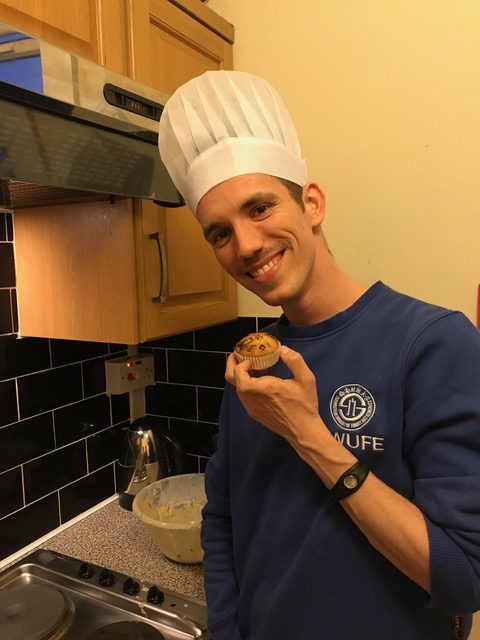
I hope you enjoy this recipe and getting creative with decoration – next time I will share the best recipe for icing sugar and blueberry muffins (which you can see in the picture of me).

Until then, stay well and don’t forget to share your creation on Instagram #Lifeofpavand @birkbeckbei.

Pav 🙂

“Birkbeck gave me the opportunity to help others.”

Marcel came to Birkbeck to follow his dream of becoming a web developer. Now teaching in the Department of Computer Science and Information Systems, he shares his passion for programming with the next generation of students.

Picture of Marcel

I’ve always wanted to work in IT. Back in the early 2000s, I was doing reprographics in a legal department, but knew I wanted to be more involved in computing. I was fascinated by computers and web design, so I began teaching myself at home. I started with Photoshop, then building websites and began to realise this was something I really wanted to do and could enjoy as a job. 

Getting a career in web development with no education and no experience was impossible, so I went along to a few university open days to explore my options. 

One Saturday, I went to Birkbeck and came across the Foundation Degree in Web DevelopmentI couldn’t afford to quit my day job and study full time, but Birkbeck allowed me to do both. 

Studying part-time and working full-time wasn’t easy and involved huge social sacrifices, but after a year and a half on the programme, I landed my first computing job as a Junior Developer for a digital healthcare agency. 

I also got to meet people in the classroom: Birkbeck has a very international community and it was amazing to learn alongside and collaborate with people from all over the world. 

Once I’d completed my studies, I was headhunted by Sky TV to work on data visualisation dashboards. This made me a proper developer, working on really cool stuff around data visualisation, but I knew I also wanted to study more, so I returned to Birkbeck to study BSc Computing. 

In some ways, when I graduated, I’d achieved what I set out to do: I had the qualification and a proper job in digital, but it felt like something was missing. Birkbeck had been a part of my life for the last five years, so I felt strangely empty without it. 

I emailed one of my teachers and asked if there was anything I could do to help out – I would have gone back just to put paper in the printer! I saw Birkbeck as a hobby where I could also help future students in some way. Some people run or play chess – Birkbeck was my hobby. 

Instead of doing the admin though, I was offered a role as demonstrator. For the first term, I helped out in lectures, providing support with the hands-on activities. In the second term I started teaching. It had never been my intention to teach, but I found it so rewarding helping others to succeed. There’s nothing like the feeling you get when you show someone how to do something and the next time you see them they say “Hey, look what I’ve done on my own.” 

I’ve changed jobs a few times since then and now work at Barclays as VP/Technology Lead, teaching at Birkbeck once a week as well. 

I know that everyone has different circumstances, but Birkbeck has shown me that if you’re willing to work hard, people will help you. Now, when my students say they can’t do it, I tell them “I know how you feel, I’ve been in your shoes, so don’t tell me you can’t do it, because everyone can.” 

Marcel currently teaches on the modules ‘Mobile Web Application Development’ and ‘Web Programming Using PHP’. 

Further Information: 

An MBA with a difference

Sammera applied for the Central Saint Martins Birkbeck MBA to build the skills to have a greater impact in the charity sector. Her efforts have been recognised by a scholarship from the Aziz Foundation, who support British Muslims into higher education to better society.

Picture of Sammera

As Head of Development at the British Asian Trust and with over fifteen years’ experience of charity and voluntary work, Sammera speaks with authority when she talks of the need to innovate in the third sector. 

“Innovation and creativity are central to developing products or services in any leading organisation,” she explains, “but in the fast-changing and highly competitive environment in which charities operate, it is essential. There’s also the added challenge of adapting within a strictly regulated and scrutinised environment.” 

Sammera wanted to return to education to consolidate the skills she had learned through her working life. The Central Saint Martins Birkbeck MBA appealed as it provided the opportunity to bring together creative and business disciplines. 

“I didn’t want to do anything too conventional – I wanted to bring in a creative angle,” says Sammera. “The four units of the MBA programme link in with my work, so I can apply what I’m learning in my day to day integrating the business management theories practically. There are elements of the course that require independent investigation and research, while others focus on entrepreneurship, leadership and change.” 

In January 2020, Sammera successfully interviewed for a scholarship from the Aziz Foundation, which will partly cover the costs of the MBA programme. The Aziz Foundation offers Masters scholarships to British Muslims in order to empower one of the most disadvantaged communities in the country to bring positive change to society as a whole. 

For Sammera, the MBA is an opportunity to gain the skills she needs to make an even greater impact: “At the British Asian Trust, I have learned the value of social finance, making sustainable changes for the longer term and helping marginalised communities in South Asia. Beyond this course, I hope to continue to empower the diaspora and wider communities locally and internationally.” 

Dr Pamela Yeow, Programme Director of the MBA, said: “We designed the MBA to equip students with the tools to make positive change. I am delighted that the Aziz Foundation has recognised Sammera’s commitment to the charity sector and that they have seen the potential for her to have an even greater impact with the help of the MBA.” 

Further Information: 

Meet our staff: Professor Almuth McDowall

Meet Professor Almuth McDowall, Assistant Dean for Organizational Psychology. We briefly caught up with her to discuss what she enjoys about working at Birkbeck and what she likes to do in her spare time.

I have worked at Birkbeck since 2014, and have been Assistant Dean for Organizational Psychology since 2016. In some ways, it’s been a homecoming after 30 years, as I started my UK academic education here at Birkbeck with training in systemic therapy.

What do I enjoy most about Birkbeck?

I love everything about Birkbeck, as I keep saying and genuinely mean that this is the nicest and most collegial bunch of people I have ever worked with. Our executive team

Head of Department & Senior Lecturer in Organizational Psychology

in BEI has been catching up weekly and sometimes daily, our focus is on supporting each other to plan for the uncertainty ahead; my colleagues in OP have been going the extra mile to support all our students. Human connection matters so much, particularly in these challenging times. Birkbeck students are the best. We salute you. I can’t wait for face to face lectures to begin again. I always make a point of checking in with the group, no matter how large or small and ask how they are doing. Our students make so many sacrifices to join us and learn. Huge respect!

What is most challenging about my job?

Well, let’s put it that way – academics don’t necessarily want to be managed. We relish autonomy and freedom in our work. But let’s face it, there is a job to do which involves common tasks. So coordination and getting joint agreement can be a challenge.

Describe Birkbeck in 3 words

Inspiring, eclectic, connected

What do I enjoy when I am not working?

As a former professional dancer, I spend a good part of my salary going to see the arts – classical ballet, modern dance and hard rock in equal measures. I am a regular at the Almuth dancingRoyal Opera House! I still teach dance-based fitness classes – in fact, some at Birkbeck. This helps me feel grounded and also makes me a better lecturer. In dance classes, you always have to be at least two steps ahead mentally. This is good practice to have in any lecture – stops you from ‘mentally cruising’!

Can you tell us about a good book you read, a film you watched or place you visited?

I love London and London parks, we are so lucky. During the lockdown, I have rediscovered rollerblading. I go to Burgess Park just off the Old Kent Road. On sunny days, this is not only ideal for skating around the park but also people watching. Last time I went one person was practising the saxophone (beautiful!), another group doing Salsa, all socially distanced of course, and Canada Geese were having a serious fight in the lake, scaring us all. It’s a really buzzy and very London Park – go and visit.