Reflections on online learning in the School of Business, Economics and Informatics

As the autumn term draws to a close, students and staff reflect on their experience of online delivery and how they have adapted to a new way of teaching and learning.

Earlier this year, we made the decision to move our teaching online for the autumn term and for as long as is needed to protect the health and wellbeing of our staff and students during the COVID-19 pandemic.

With staff having to rapidly get up to speed with online teaching and students coming to terms with a less than traditional university experience, it hasn’t always been easy, but we’ve pulled together as a community and managed to find some unexpected highlights along the way.

For students, one of the main challenges was knowing what exactly they had signed up to, but they soon found their stride:

“I was a bit apprehensive when I started regarding if I had made the right choice signing up, but Birkbeck have been really great. The virtual teaching has worked for me (and was the tipping point to make me apply), it provides a lot more flexibility. Also, having the pre-videos before the lecture I think really is so beneficial. They take me a while to go through but I can go through them at my own pace, and then because I have taken the time to understand the content, it helps me follow during the lectures.” – Student in the Department of Economics, Mathematics and Statistics

And it seems the hard work of lecturers in planning engaging online learning material is paying off:

“The slides were very well organised and in order, the concepts were explained clearly, the seminar questions were very interesting and engaging.” – Student in the Department of Organizational Psychology

“The quality of the materials has been high, they are available weeks in advance, and the organisation, clarity and administration of the lecturer is first class.” – Student in the Department of Organizational Psychology

It certainly seems that online learning has given academics cause to think more deeply about the learner experience, as Dr Federica Rossi, Reader in Innovation Policy and Management explains:

“I found delivering the module online a very interesting experience. Since it was not possible to rely on direct interaction in order to clarify specific points or to communicate expectations, I had to think in much greater detail about all aspects of the students’ learning process and how to support them.

“The module was taught in Spring 2020, during the first lockdown period, and I can imagine that it was particularly hard for our students to stay focused and motivated – many of them would have had to manage working from home, looking after children, and studying at the same time. Therefore it was particularly rewarding to see that the students did well and their marks were in line with those of students who, in previous years, attended the module in class.”

And how are staff finding online teaching? Does it compare on any level with classes or lectures? Brian Gannon, Lecturer in the Department of Computer Science and Information Systems, found unexpected benefits to taking his teaching online:

“I’ve been surprised at how effective the online delivery model has turned out to be. It actually helps to increase the level of engagement: students who would normally be too shy to ask questions or get involved seem to be quite happy to interact remotely. This has helped recreate some of the intimacy of the classroom and has been very valuable to everyone.”

Dr Muthu De Silva, Senior Lecturer in Entrepreneurship and Innovation, also found new ways to get students talking through online platforms:

“I have thoroughly enjoyed online teaching…It does require a lot of preparation but once this investment is made, it becomes a very positive experience for both the staff and students. I found that break-out groups with clearly laid out group tasks increase student engagement. Additionally, inviting guest speakers, who could discuss the application of theories has also enriched student experience.”

This is seconded by student feedback from the module:

“I have really enjoyed the guest speakers and their insights/advice for being an entrepreneur. I also enjoyed the group discussion where we get split off into different groups as I feel it makes people feel more comfortable to speak virtually.” – Student in the Department of Management.

While we’re missing Bloomsbury and seeing our community face to face, it’s clear that we’ve come a long way since March.

Dr Geoff Walters, Executive Dean of the School of Business, Economics and Informatics, says: “As the autumn term draws near to an end, I want to take this opportunity to thank all colleagues that have worked hard to make this term’s teaching happen. I also want to thank all students that have engaged with their studies this year and have embraced online delivery, attending lectures and working on material pre- and postlive sessions. In the (almost) 200-year history of Birkbeck, there has never been a start to the term like this. I do hope that the Christmas period, whatever this may look like, will be as festive and restful as possible for everyone.”

Further Information:

“Marriage or Career?”: The Times and Tribulations of Dr. Turnadge

Dr Isabel Turnadge,née Soar was a Birkbeck alumni who championed women’s right to vote and work after marriage in the 1920s. As part of the College’s 200th-anniversary celebrations Ciarán O’Donohue, PhD candidate in the Department of History, Classics and Archaeology recalls the origins and trajectory of Dr Turnadge’s activism. 

Dr Isabel Turnadge

Dr. Isabel Turnadge, née Soar, with her son, Peter James. Becoming a parent will be a turning point for anyone, but perhaps for none more so than Isabel.

Only five PhDs in the sciences were awarded by the University of London in 1921. These were the first people ever to hold the distinction. Among them was botanist Isabel Soar, who had toiled tirelessly every weekday evening after work for five years at Birkbeck College.

Soar was in many ways the archetypal Birkbeckian, engaged as she was in full-time work and part-time study. The daughter of a stationer and a book-seller, Soar was a bright child: a ‘keen student of science, and particularly fond of botany’. After her own schooling, she pursued a career in teaching, taking up her first post as a science teacher in Ipswich in 1907.

Within six short years, she found herself in the daunting position of lecturing to trainee teachers in London at Stockwell Training College: an impressive achievement for one so young. Yet, Soar was not satisfied. Perhaps inspired by the experience of teaching others, Soar was determined to deepen her own knowledge. So, working full-time in the week, Soar began evening classes in botany at Birkbeck.

All her work was crammed into long weekdays. She made ‘it a point never to study on Saturdays, Sundays or other holidays’ and was a fervent believer that there was ‘a time for work and a time for play.’ In 1916, after three years of intense study, dedication and sacrifice, Soar achieved her Bachelor of Science in Botany, with first-class honours. The Middlesex County Times highlighted Soar as ‘an outstanding example of the rewards which await industry and determination.’

Still, Soar’s thirst for knowledge remained unquenched. Immediately after the completion of her bachelor’s she began to pursue original botanical research. Her trademark abundance of determination and its seemingly inexhaustible wellspring ensured she persevered for five long years. In June 1921, Soar’s Ph.D. thesis was approved, and she became the second Birkbeck student to achieve the title of Doctor. Bearing the title, The Structure and Function of the Endodermis in the Leaves of the Abietineae, it was of substantial interest to contemporary botanists. Before the end of 1922, an abridgement was published in The New Phytologist and she was elected a Fellow of the Linnean Society.

Meanwhile, her professional life was also reaching new heights. In this same year, she was appointed headmistress of Twickenham County School for Girls by Middlesex County Council. For her work, she was to be awarded an extremely generous commencing salary of £600 per annum. And her run of good fortune was not over yet.

On Saturday 4 August 1923, Soar married Charles James Turnadge. Turnadge was a member of the Aristotelian Society, and was sometime editor of South Place Magazine, the organ of the South Place Ethical Society. Soar took her husband’s name, and they soon departed on their ‘ostentatious’ honeymoon: a six-week motor tour of Devon, Cornwall, Somerset, and Wales.

Life seemed to be going well for Isabel Soar: academically, professionally, and personally. Unfortunately, it was not to last. In November 1926, in what should have been a happy time in her life, Soar, now Dr. Turnadge, was in the newspapers again.

In May 1926, she gave birth to Peter James Turnadge. As a result, she was fired. The Twickenham Higher Education Committee beseeched the Middlesex Education Committee to terminate her employment. They argued that ‘the responsibilities of motherhood are incompatible with her school duties.’

The Chair, and Twickenham’s Mayor, Dr. J. Leeson, defended his actions to the press: ‘with characteristic male impertinence,’ according to the feminist weekly Vote. He asserted that he had warned her, spluttering that it ‘was against my advice that Dr. Turnadge, holding the position she did, ever married… We pay her a good salary, and we want her undivided interests.’

Turnadge’s argument that her being a mother would be an asset to her work was given short shrift. In an interview with the Middlesex County Times, she explained that she was ‘even bold enough to hold the view that, as a mother, I might be better qualified to teach. May not maternal sympathy… be something of a help in training the young?’ She even later argued that ‘single women are not normal, they are emotionally starved.’ Accordingly, large numbers of single women teachers posed ‘a grave menace to the pupils.’  She made the further point that it was ‘absurd to pretend that it would be impossible for me to make adequate arrangements for Peter’ during the day, given her salary. This, similarly, did nothing to move the Committee from its position either.

Her arguments fell on deaf ears. Charles’s birth was the pretence they had been searching for since the wedding. Middlesex Education Committee had a policy that the marriage of an elementary school teacher would void their contract and terminate their employment. At the time of Soar’s wedding, however, this did not cover the marriage of secondary school teachers. The loophole was promptly closed afterwards, and although they could not act retrospectively, Soar became an exception in a fragile position, with a hostile employer.

Turnadge’s case added fuel to a debate which was already raging about the state’s employment of married women. Clearly, not everyone was in favour. Upon hearing of Turnadge’s dismissal, author James Money Kyrle Lupton sent his opinions into the West London Observer. ‘This position ought to be held in all cases by a single woman, who can devote all their time to the position,’ Lupton opined, continuing that besides a ‘married woman with any family cannot do her duty to the school and her home at the same time – this is self-evident.’

Others were appalled by the decision. Bernard Shaw quipped that ‘Twickenham is not very far from the river, and the sooner the people of Twickenham put their Higher Education Committee in the river, the better.’ Vote declared the incident ‘sufficient indication of the necessity for further vindication of the important principle of the freedom of the married woman.’

As for Dr. Turnadge herself, the bar imposed on married women teachers became the next target of her fiery determination and indefatigable work ethic. On 7 February 1927, Turnadge delivered a lecture entitled “Marriage or Career?” to the Six Point Group, a feminist organisation founded by Lady Rhondda in 1921. In Turnadge’s lecture, she decried the ‘present position of women’ as ‘most unsatisfactory, because we are not chattels, yet we are not regarded as responsible individuals who should be allowed to choose our own paths in life.’ For her, this was an issue of state interference in private life, and along undeniably unequal lines. Some women wanted ‘to continue their work after marriage, and I do not see why anyone should interfere with them,’ she asserted. It was not the work of education authorities to regulate household economies. If they were economically minded, she stressed, they would realise the folly of expending public money on teaching scholarships, only then to dismiss married women outright.

By March, she was honoured at Vote’s annual spring sale, by giving the opening address whilst rubbing shoulders with veteran campaigners such as the president, Emmeline Pethick-Lawrence. Her focus had crystallised on equal suffrage, for both married and single women.

Her points were direct, brimming with a scientist’s rationality. A woman and her life must no more be interfered with than a man. Anything less than equality would rob the nation of talent. Women should be given the same rights of individual determination.  Her conviction was that possessing the vote at 21 was of the highest importance. This is when women were entering their professions, she determined, and so most needed the power to influence policy. Evidently, her experiences had left their mark on her, and she was determined no other woman should suffer the same fate.

When the Equal Franchise Act was passed a few months later in July 1928, the achievement of policy change through the exercise of the vote was in sight. For many women, their objectives had been achieved, their battles over. Lady Rhondda, a suffragette and life-long feminist, recalled some years later ‘that when, in 1928, the vote came on equal terms, one felt free to drop the business.’ For her at least, it ‘was a blessed relief to feel that one had not got to trouble with things of that sort anymore.’

As indomitable as ever, Turnadge’s years of campaigning were only just beginning. As the international organiser for the Six Point Group, we last catch a glimpse of her busy organising a conference in Geneva to lobby for an Equal Rights Treaty. With the confidence equality was well on the way in Britain, her sights were set on the League of Nations.

Today, Birkbeck awards over 100 PhDs a year; quite the difference to a century ago. Yet, it seems that Birkbeck’s students retain the same qualities. Isabel worked consistently, with perseverance and dedication, to follow her passion. She took her fate into her own hands, sacrificing her evenings to better her prospects. And although she faced it in spades, adversity never triumphed over her. She cannot help but remind us of our peers and colleagues in these current days of difficulty, and thankfully Isabel’s virtues seem set to live on in Birkbeckians for another hundred years.


“Without the Compass Project, I would never have seen myself as a university student”

The Compass Project has been successfully supporting students from forced migrant backgrounds into higher education since 2016; read what two Compass scholars have to say about the impact it has had on their lives.

Hana* joined Birkbeck in 2020 to start an LLB Law degree:
“My passion for human rights and immigration law has grown and I know I want to be a human rights lawyer in the future. For me, the Compass Project hasn’t just been an opportunity to study, it’s been an opportunity to change my life.

People coming from forced migrant backgrounds know what it means to have nothing and know how challenging life can get. Now we have the opportunity to work hard and achieve our potential. I don’t have all the words to say thank you. My advice for future Compass students is to make sure you are clear about your passions and what you want to achieve. Find the courage within yourself as you will only have regrets if you don’t. It doesn’t matter about where you come from, just about where you go. I am now at Birkbeck, studying a great course and meeting amazing people.”

Two people reading a book together to represent Compass students

Grace* joined Birkbeck in 2018 and recently completed a CertHE in Psychodynamic Counselling and Skills in a Psychosocial Framework:

“Psychodynamic Counselling was of particular interest to me because I have always wanted to help others and the theory and practical skills I gained in class also helped me with my own personal trauma. I am glad that I have now been able to turn the helping aspect of my personality into a qualification. Without the Compass Project, I would never have seen myself as a university student. Even with everything I have been through, one of the biggest barriers I faced prior to studying was my own self-doubt. However, the support I received from those on the Compass Project team and other Birkbeck staff took that self-doubt away.”

* Names have been changed

Coronation salmon curry – a fusion dish that can be cooked and served in 30 minutes

As part of a new initiative to enhance international students’ experience at Birkbeck, our students and staff will be sharing their favourite recipes over the next few months in a series of blogs. In this blog, Professor Sanjib Bhakta, Professor of Molecular Microbiology and Biochemistry shares the secret to making his home-made fish curry.

Background: Being a Bengali and a foodie, I have always gravitated towards foods like fish curry and our traditional sweets! I spent the first 25 years of my life adjacent to the Bay of Bengal and lived around the river Ganges, where there were a number of natural resources to supply sweet-water fish. Hence, when I came to the UK, a challenge for me was to get the taste of my home-made fish curry; moving from Kolkata to Oxford.

As a Wellcome Trust funded International Fellow living in my College accommodation on the Old Marston Road, I first tried the following recipe. It was a delightful triumph! Without any reservations, I can say that home-cooking has always been a stress-busting experience for me. When a recipe can connect you with your motherland, help you to make new friends, saves money, assist you with healthy living and brings joy to your life, then why not?

Let me know how your trial goes after you transform the following recipe into your evening/weekend meal…

Ingredients:

Essentials:
4 salmon* fillets (500g)
Cooking oil (~30ml)
Natural bio live set yoghurt (1 tablespoon/ tbsp)
Mayonnaise (200g)
Spicy ‘korma’ curry paste (1 tbsp)
Mustard paste (smooth) (1 teaspoon/ tsp)
Mango chutney (2 tbsps)
Juice of 1 lemon
Almond powder (2 tbsp)
Salt (1 tsp/adjust per preference)

(*salmon can be replaced by monk fish, seabass or any other white fish fillet, descaled but skin on)

Optional: Almond flakes, raisins, coriander/ thyme for garnishing.

Cooking method: Pre-heat the oven to 180 degrees/gas 4. Marinate salmon fillets with a little salt, lemon juice and cooking oil for 5 minutes. Put them in the oven for 12-15 minutes, skin side up. While the fish is in the oven, lightly mix the mayonnaise, yoghurt, curry paste, almond powder, mango chutney, mustard paste and salt in a bowl. Add a little water to help making the paste smoother if needed.

Drizzle some cooking oil on a pan. When heated, pour the sauce and a cup of water into the pan. When it starts bubbling, put the fish in the sauce, wait for 2-3 minutes and keep the heat on high to boil. After 2-3 minutes of boiling put a cover on the pan and switch off the hob.

Presentation: Garnish the dish with chopped coriander/thyme and almond flakes. Enjoy the dish with rice (basmati/jasmine)/naan/pitta/flat bread.

Further Information

Around the world in an MBA

Marketing Manager and MBA student Lorena Ramirez shares her journey on the MBA, across three continents and what she has learned along the way.

Picture of Lorena Ramirez

The first time I heard about the Central Saint Martins Birkbeck MBA was while living in Peru. I’d been working in the fashion industry for the last ten years and was ready to expand into different creative areas. I was looking for a Masters degree that focused not only on fashion, but on creativity and innovation.

There are lots of really good MBAs in London, but the Central Saint Martins Birkbeck MBA was different. There is nothing else in the market that mixes art, design, business and social innovation in that way.

I fell in love with the course immediately, but attending face-to-face sessions in London wasn’t an option for me, so I was forced to put my plans on hold.

Moving to London

It just so happened that, months after discovering the MBA, my husband was offered a job in the UK. We moved to London without any hesitation: I arrived, found a job, got pregnant and applied for the MBA! I had my interview with Dr Pamela Yeow, the Course Leader, about a week before I gave birth.

I had my reservations about starting a Masters with a newborn baby, but when I won a scholarship for the course I felt like it was a sign to just do it. I started the programme and absolutely loved it. On a course like this, it’s so important that your peers are with you on this journey. For a lot of MBAs, the average age is around 24 or 25. I’m 37, and while the youngest person in our cohort was 25, the oldest was 60. Through the MBA, I met people in media, television, different organisations and entrepreneurs. The diversity of ages and interests in my cohort was what I enjoyed most about the experience.

Then my maternity leave finished, the pandemic hit and I found myself working full-time with a baby under highly pressured circumstances. Sadly, I couldn’t continue the MBA with my cohort, but Birkbeck and Central Saint Martins were very understanding and supportive. It was not an easy decision, but looking back, I think it was the right one. I wouldn’t have had the time to properly enjoy the reading and the learning process if I had continued then.

Picture of Lorena with her son

Recognise this scenario? Lorena trying to work and study, featuring her son Noah.

A new challenge in Ceuta

Despite having to put my studies on hold, this has been a whirlwind year: I was promoted to Marketing Manager for Spain for my organisation and relocated to Ceuta, an autonomous Spanish city in Morocco. Ceuta is a small, quiet city, so it’s a big change from London!

In my new role, I am already applying the learning from the first module of the MBA, which is all about how to solve complex problems. Right now, in Spain, the gambling industry is facing new marketing regulations which drastically change the way it has worked for the past twelve years. This has a huge impact on our work, meaning we have to really think outside the box when it comes to promotion.

Changing the way an entire company works is very difficult, especially when you lead teams. For me, the MBA was the perfect preparation to face this challenge. On the course, we completed a project with the London Ambulance Service – what we are learning is not theoretical, it’s real life, day by day. In my work now, we essentially have to reinvent all the departments and how we’re working. For this to be a success, you have to change the way of thinking not of the directors but of the users and your team, and that is the most difficult thing. I’m grateful to have had the opportunity to study to have a preparation to understand this better.

Where next?

From March 2021, I’ll be travelling to London once a month to re-join the MBA programme – I can’t wait to get started again!

In the long term, I would like to go back to sustainable fashion, for which my current experience in online marketing will be really valuable. I’d like to work with artisans, especially Peruvian artisans, linking them with brands across the globe. Most artisans around the world don’t speak Spanish or English, so it can be difficult to reach them, but I hope to do this through a foundation or social enterprise – I think the MBA will lead me to the right way to do this.

Further Information

Introducing our Chevening students: Part three

In this last instalment of our 2020 Chevening scholars series we introduce six more future leaders who have joined Birkbeck from Algeria, Cote d’Ivoire, Ecuador, Georgia, Namibia and Syria. 

Nesrin Morad, Syria/Turkey, MSc Education, Power and Social Change

Nesrin Morad

Nesrin Morad

Nesrin, a Syrian and Turkish leader and activist, has around seven years of experience working in the humanitarian and development sector. In her role, she was responding to the Syrians’ needs in various countries through working with different entities and projects in education, protection, capacity development and partnership.  She believes that learning and collaboration are key to reaching the intended positive change in society. Nesrin has always been a social activist in the community, involved in voluntary and social initiatives. She was a member of the Red Crescent, JCI for youth development, an activist in the university leading different youth initiatives and a volunteer leading awareness campaigns for Syrians in Turkey. She also has a great passion for travelling to learn about different cultures and countries and learning new dances.

Birkbeck’s MSC  Education, power and social Change will complement her practical experiences, allowing her to play a leading role in organising local initiatives to empower Syrian leaders and lead the change.

Within the Chevening Community Nesrin aims to be a Syrian woman leader, share the unique experiences and stories from Syria and gain from the experiences of others.

Menessia Diergaardt, Namibia, MSc Management with Corporate Governance and Business Ethics

Menessia Diergaardt

Menessia Diergaardt

Menessia currently works as a Taxation Officer at the Ministry of Finance in Namibia. She holds a Bachelor’s Degree in Business Administration from the Namibia University of Science and Technology (NUST) and an MSc in Banking and Finance from Moi University (Kenya).

Menessia believes that her aspirations meet her country’s economic growth ambitions and Chevening will help her to become more specialists in her field, allowing her to contribute towards the management and development of the country’s economic and social resources.

Menessia was attracted by Chevening because of its track-record for producing and developing many of the world’s finest scholars, leaders and presidents and the unique opportunity it offers to transform future leaders. “Chevening will create a platform for me to connect and network with a diverse and talented community, not only will I be exposed to and experience the UK education system, but I will also develop a diplomacy relationship that will equally benefit Namibia, the UK and the world at large.”

Sami Mehiaoui, Algeria, MSc Business Innovation with Entrepreneurship

Sami Mehiaoui

Sami Mehiaoui

Passionate about management consultancy & entrepreneurship, Sami holds a Master’s degree from the National High School of Management. During his studies, Masters Sami was elected president of the Scientist Club of Future Manager. He began his career as business analyst consultant supporting the development of more than 20 small and medium-sized enterprises (SMEs) in a programme funded by the UK government.

Sami is an entrepreneur and has co-founded several innovative businesses such as the Makelti mobile app or Forward development. An active member in the social entrepreneurship network, Sami was selected by Chevening in order to pursue his research in business innovation with entrepreneurship at Birkbeck. Armed with the skills in strategic management, he will acquire Sami wants to achieve his goals of implementing strategic development with sustainability and social impact.

Adriana Borja-Enriquez, Ecuador, MA in Gender, Sexuality and Culture

Adriana Borja-Enriquez

Adriana Borja-Enriquez, Ecuador

I got a degree in Clinical Psychology at Pontificia Universidad Católica del Ecuador. I’m interested in human rights advocacy and psychoanalysis. Since 2014,  I have collaborated in psychosocial projects at non-governmental organizations that support survivors of gender-based violence, refugees, and asylum seekers in Ecuador. I aim to promote safe spaces and inclusive mental health care for women and the LGBTQI+ community.

I also hold a Postgraduate Certificate in Writing: Human Creativity and Communication from FLACSO Argentina. In 2018, The Bureau of Educational and Cultural Affairs of the US. Department of State sponsored my participation in The International Writing Program at The University of Iowa. I attended this literary residency alongside other authors that promote dialogue through literature and cultural diplomacy. My writing has been published in magazines and short-story collections in Spanish, English, and Italian.

Thanks to the Chevening Secretariat and The Foreign, Commonwealth & Development Office, I will study an MA in Gender, Sexuality and Culture at Birkbeck, University of London. It is a great honour for me to be part of a community that promotes social change while celebrating diversity.

Kristina Arakelova, Georgia, MSc in Nationalism and Ethnic Conflict

Kristina Arakelova

Kristina Arakelova

Kristina Arakelova is a member of the Core Group of Experts for the OSCE “Perspective 20-30” and a former Fellow in the UN OHCHR Minority Fellowship program 2018. She is a founder and President of the “Youth for Diplomatic Engagement” non-governmental organization (NGO) that focuses on youth involvement in the conflict, security, and ethnic minority integration issues in Georgia. As the President of the organization, she provides consultancy for state and civil society organizations working in these fields. Passionate about empowering or helping minorities/marginalized people, Kristina is an international trainer on conflict resolution and mediation.

“I applied for Chevening to contribute to bringing about much-needed peace, tolerance, and prosperity in my home country, Georgia, and beyond.”

Randolphe Severin N’Guessan, Cote d’Ivoire, MA TESOL

Randolphe Severin

Randolphe Severin

“I’ve been teaching English in Côte d’Ivoire (my country) for years, and I am also preparing a PhD in English, with the option of linguistics and didactics of languages in continuing training. This year, I am studying an MA TESOL (Teaching English to Speakers of Other Languages) at Birkbeck, University of London.

The need for modern and standardised education systems is evident in my country, which is a French-speaking one, but English is taught at school.  From my little experience, the teaching of English brings up many challenges and gaps to be bridged.  Thus, it will be interesting to attend a world-class university like Birkbeck, meet native speakers, share experiences with many others from all over the world. This will help me to be more proficient upon my return home.

I am very interested in Applied Linguistics and Intercultural Communication; and also willing to move to a more specialised position, such as teacher-trainer or language consultant and a teaching materials designer. Consequently, the MA TESOL is the relevant course that enables this.

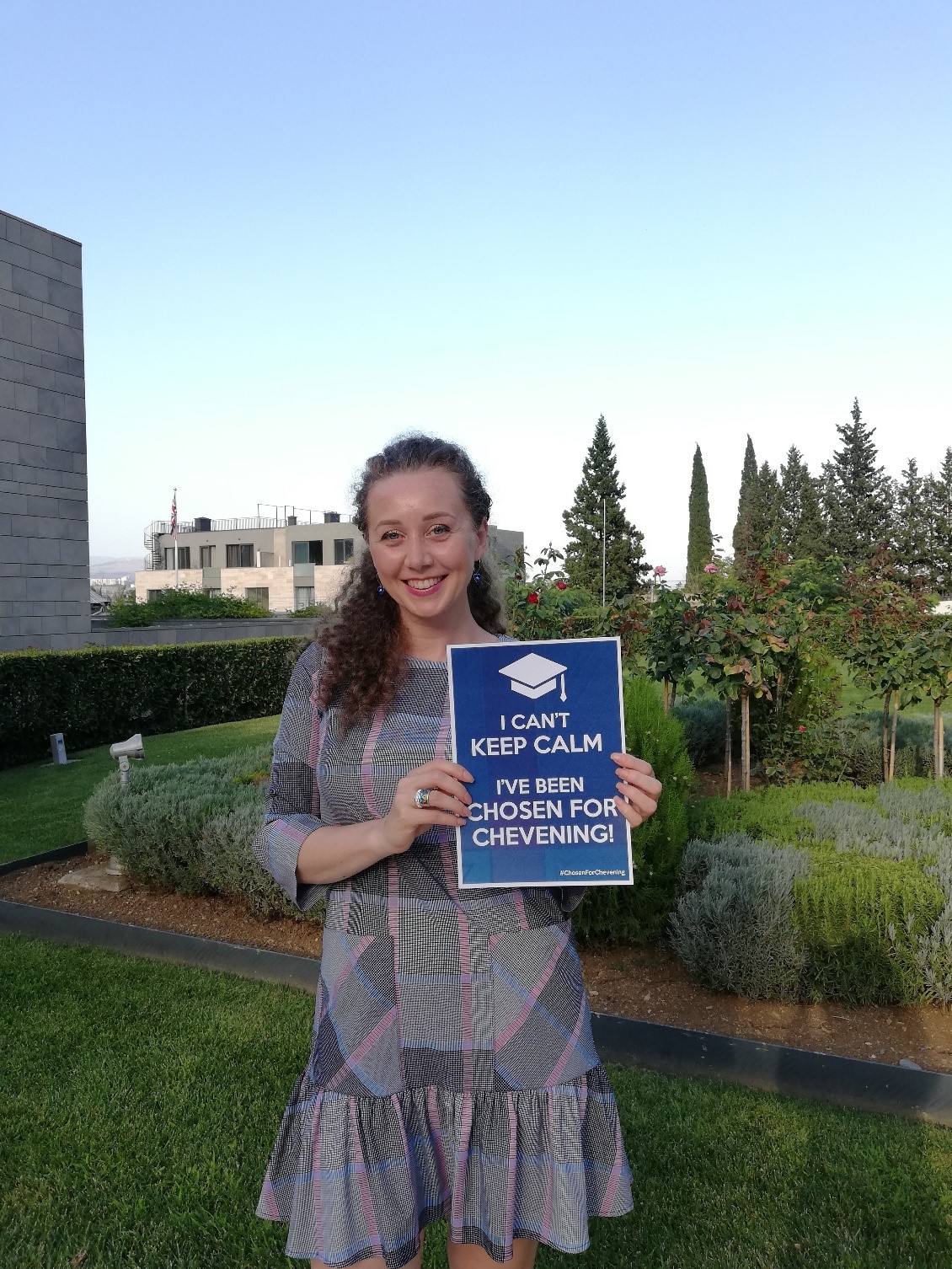
Chevening is making my dreams come true.  Great, no!  NO NO, I CAN’T KEEP CALM!!!”

Find out more about:


Top tips and benefits for using video in lectures and seminars

Jenna Davies, Birkbeck’s Enterprise and Employability Consultant, encourages students to keep their cameras on whilst attending online lectures or seminars by outlining the benefits and addressing the most common barriers.

Among the various changes that 2020 has brought – our ways of working, studying, even socialising – there is one piece of equipment that has enabled us to retain our connection to others: our cameras.

While we have been unable to physically meet and see our colleagues and peers, we are fortunate to have the opportunity to maintain a level of connection through our screens, be it our phones, iPads, laptops or computers. In our online lectures and seminars, we can replicate the classroom as best as possible through the technology that we are able to access, providing a unique experience in a challenging environment where everyone can benefit from the virtual teaching space.

However, there are a number of barriers that may prevent us from fully embracing the online learning environment; to switch our cameras on, use our microphones to speak up, and be as present as possible, as we would in person. We may not feel comfortable being on video in front of our tutors and peers, we may have distractions in the background that we don’t want to risk interrupting the sessions, or we may feel we can still get the same from the session by not being on video. To overcome these challenges and reap the benefits of having our videos on in our online lectures and seminars, there are things we can do to make sure that we maximise our learning.

“I’m not comfortable being on video in front of my tutors and peers”

The transition to remote studying and working this year has meant that our home and work/study life are much more intertwined. Our homes are our study spaces – and although it’s only our head and shoulders in shot, we may feel more exposed on video compared to in-person.

Consider how you feel when you see someone on video in an online lecture, or meeting for example. Often, we’ll feel more of a connection to that person because we can see them. If we’re in an online meeting with three other people, two of whom have their videos on and one doesn’t, we feel less of a rapport with the person we can’t see.

If we have our videos off, we may be impacting the connection that others have with us and their experience in the virtual learning space as well. Birkbeck’s Disability Service Manager, Mark Pimm, recently reflected on his experience in virtual meetings: “I’m blind, and I have become so conscious of how much I miss out on being able to see everyone in the virtual meeting. This has made me wonder if when you leave the camera turned off in your online lectures and seminars, whether your fellow students are missing out on you.”

If everyone in our online lectures embraces the virtual space and switches their videos on, we’ll feel more connected to our peers and tutors. We’ll be more engaged and avoid potential distractions because we will be more present in that space. This will positively impact our experience and the goals we may have set when we enrolled onto our courses – to learn, to meet new people, to progress our careers, to graduate.

“I have distractions in the background that could interrupt the sessions”

There will often be occasions when we can’t avoid interruptions while we’re online – we may have children to look after, someone might be at the door, we might not want to show the space around us on video. The resistance to be on screen can come from a number of reasons.

If we consider how we feel when we have seen someone else on-screen experience interruptions during a lesson or a meeting, often there isn’t an impact on the session for others. We have all become far more understanding of what it means to study and work from home, and this comes with the acceptance that people will be in different spaces and have things going on in their homes that they can’t control.

If a distracting background is the difference between turning our videos on in lectures and making the most of the lesson, having a screen behind you may be a useful option. This could be a room divider or something in the home that you can use as your background.

“I’m not sure how I should position my camera”

Whichever device you use for your online sessions, try to have your head and shoulders in the shot. This will ensure that you fill the ‘frame’ without being too close or too far away from the camera.

Aim to have your device’s camera at the same height as your head, which will help to avoid looking down at the camera lens and it will also ensure that your posture is in a good position.

There are some useful tips in this video about setting up your cameras and making more impact on video.

“I’m still getting the same level of teaching with my video off”

There are numerous benefits of being part of a group and studying alongside peers who share the same interest in the topic you’re studying. While we have transitioned from physical classrooms to virtual classrooms, this doesn’t mean that those connections with your peers should disappear.

Being able to learn from your tutors as well as your fellow students is hugely beneficial and enhances your learning experience. The more engaged and present you are in your online sessions, with your videos on and speaking up to contribute to discussions, the more you will benefit from the session.

As we continue into the academic year, embrace the virtual learning environment and the opportunity to connect with your peers and tutors by making use of the technology we have, to benefit your studies as well as your peers’.

Diwali is the festival of light and new hope!

With the recent Diwali celebrations, Professor Sanjib Bhakta, Professor of Molecular Microbiology and Biochemistry, reflects on what the festival means to him.

Mousumi Shyam, a Newton-Bhabha International Fellow at Birkbeck’s School of Science, has celebrated Diwali by decorating the International Students House with the traditional ‘Rangoli’. The purpose of the colourful design, ‘Rangoli’ is to feed strength, generosity and it is thought to bring good luck.

Diwali follows the epic story of ancient India: “Ramayana” to represent the victory of good over evil and light over darkness. The symbolism of Diwali is appropriately summarised in the simple act of lighting a lamp or ‘diya’. These are said to ward away evil and welcome the Goddess Lakshmi (the Hindu Goddess of wealth and prosperity) into the house.

The positive vibe that comes with the Diwali festival is more relevant worldwide in this challenging year than ever before with the unprecedented pandemic. During the second phase of lockdown in the UK, while we should strictly follow the Government guidelines on social distancing, face covering, good handwashing routine and patiently wait for a better control for the debilitating infectious disease to be available to us, I have been celebrating this ‘Diwali’ with my family at home and with all of you remotely over the weekend by lighting ‘diya’! Let us together give thanks for all we hold dear: our health, our family, our friends and to the scientists, NHS staff, and all the key workers who are working relentlessly to tackle the health challenges this year…

I moved to the UK precisely two decades ago but I still miss India when It comes to celebrating Diwali! To all the staff and students at Birkbeck, University of London I wish you and your family a very Happy Diwali!

Take care, stay happy and celebrate the festive season with all the available precautions and protections.

The Disability Discrimination Act – what’s changed?

This November we celebrate 25 years since the passing of the Disability Discrimination Act. In this blog, Mark Pimm, Birkbeck’s Disability Service Manager who is blind, shares his experiences as a university student and how the world has changed since the passing of the Act.

Mark Pimm with his guide dog, Sonny

Twenty-five years ago, on 8 November 1995, the Disability Discrimination Act was passed and it got me thinking about how student life has changed in a quarter of a century.  There were no tuition fee loans and a pint of beer in the Student Union bar cost a pound, but life was a lot more challenging for disabled students.  There were no disability officers, universities weren’t required to make provision for disabled students – in fact, before the Act, we had no legal rights.

There was a Disabled Students’ Allowance, but at that time it was so small I couldn’t afford a computer; all I had was a writing machine with 32 megabytes of ram.

Because I did not have a computer and could not read Braille, I did everything on tape.  I recruited a team of volunteers to read my textbooks onto tape. I drafted my notes for essays onto cassette tapes and listened back to the notes when I came to write the essay.  All my exam notes were put onto tape, and I listened to these to revise. To give an idea of the scale, I had over 500 tapes containing over 2,000 hours of recording. Even though I was organised, it often took me an hour to find the right point on the right tape.

In those days, being blind I knew I would never get a non-graduate job. If I wanted to work, I had to get a degree. I had no choice but to carry on despite extraordinary odds because if I didn’t, I would never work.

What would be the difference today? If I was coming to Birkbeck now, the Disabled Students’ Allowance would pay for a computer with specialist software and training to ensure I could use it to access our online learning. It would fund an electronic notetaker, who would provide me with notes from all my lectures by email.

The university’s virtual learning environment would be accessible to me and I’d have access to the teaching materials in advance of our lectures, enabling me to read, as well as understand the structure of the lectures, prior to attending them. I could use the platform SensusAccess to make the electronic documents accessible to me and access the Royal National Institute of Blind People’s audible book service.

The number of additional things I’d need to do for myself would be reduced. I’d have the time to think about my future career and with support like the Ability Programme would be able to develop the transferrable skills that might mean that I could progress straight from graduation to employment, as my non-disabled peers can do.

It’s truly remarkable and inspiring to see how far we’ve come, thanks to those campaigners in the 90s.

Further Information:

Community development: fostering dialogue and connections

The Community Leadership Programme for Newham Residents is run by the Access and Engagement Department and the Community Development and Public Policy BSc in the Department of Geography.

Funded by the National Lottery Community Fund, the project aims to bring learning to community spaces and is part of the Access and Engagement department’s aim to bring education and learning opportunities to groups underrepresented in higher education.

In this blog, David Tross, Associate Lecturer in the Department of Geography, talks more about the course and the Newham citizens it’s worked with over the last 13 months.

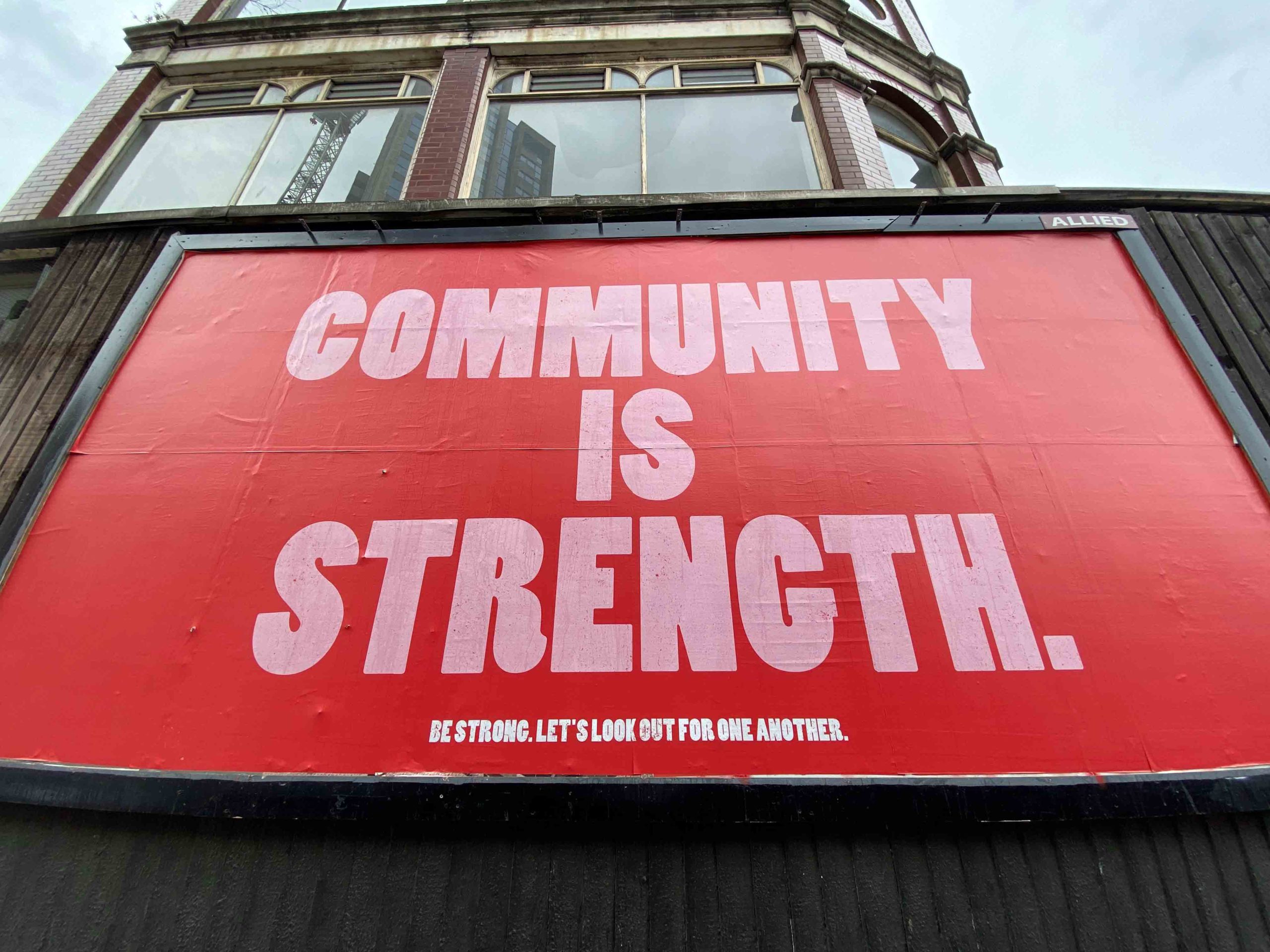
Community is strength on a billboard

Community is strength on a billboard

One extraordinary aspect of this extraordinary year was what has been called the ‘largest peacetime mobilisation in UK history’, the 1 million-plus individuals who volunteered as part of the community response to COVID-19. These included NHS responders, volunteers for local charities, the 4000 mutual aid groups that sprung up in neighbourhoods across the country and those who spent lockdown making PPE equipment for key workers. Not only this, a demonstrable upsurge in community spirit was observed during the first wave of the pandemic, with large increases in the numbers of people agreeing that their neighbourhood was a place where residents looked out for each other and over half of those polled indicating that they had checked in on their neighbours in the past week.

The Birkbeck Community Development programme has now worked with over 100 active citizens in Newham over the last 13 months. We call the course Community Leadership, not because the participants necessarily have any formal leadership role, but because they all, in various ways and through various roles, are making a contribution to their local area, demonstrating how local people can instigate change because they have a passion or will to do so.

David Tross adding ideas to a board

We have worked with a resident who works for a local community organisation providing foodbanks and delivering youth projects. He’s so good at using digital platforms and social media to market and fundraise that he’s now helping us deliver the learning and resources on this aspect of Community Development. Then we have the resident who starts conservations and spreads awareness about mental health by taking a sofa to public places and chatting to local people about their experiences, signposting to agencies who can help. One of our last cohort was working with Muslim groups to alleviate a particular local consequence of the crisis — international students whose part-time jobs, often in the hospitality industries, disappeared overnight and were then unable to access public funds, leaving them destitute and without enough food to eat

The four-week course is structured around particular themes: leadership approaches, project management, community engagement and wellbeing. We bring in ideas and resources from the degree course we run at Birkbeck, while also calling upon the local resources and contacts developed through Senior Access Officer Hester Gartrell’s work in east London with the Access and Engagement Department.

Unlike other London boroughs, Newham has no Council for Voluntary Service, local infrastructure organisations dedicated to help local community groups access funding, resources and training, and there is a need for community projects to access this support. However, the key success of the course is what participants share and learn from each other. In this sense, our job is to facilitate dialogue and connections which will sustain and strengthen the projects people are doing, often in relative isolation, and to get great ideas off the ground.

A key activity of every course is the ‘Resource Exchange’, where we simply let participants meet and share resources and information, ask each other for help and provide advice and support. These mutual connections are a part of developing the social capital- networks of mutual support and trust- that are key to Community Development activity in a locality.

Further information: