Category Archives: Uncategorized

Dear White People

In the wake of the worldwide Black Lives Matters protests Jessica Brooke, Social Media Officer at Birkbeck, offers a view on how White people can begin being anti-racist. 

In light of the recent murder of George Floyd by federal police in Minneapolis and subsequent rioting across the globe, you might find that you are asking yourself some new questions. If you’re White like me, here are some things that we can consider.

Firstly, racism is everywhere and that is a fact. Some of the most harmful racism is the most transparent. I use the word transparent because although it might not be directly visible, (particularly to a White person), such as a murder filmed on video camera, it is always there. And it is there deep in the bones of the structures and institutions within our society.

Here are some statistics that illuminate how racism is functioning in British society today:

  • Job applications in British cities from people with White-sounding names were 74% more likely to receive a positive response than applications from people with an ethnic minority name.1
  • Black British women are five times more likely to die in childbirth compared to White women.2
  • In January 2020, exclusions for racism in primary schools were up by more than 40%.3

These British statistics show areas of British life that are affected daily by racism, and that restrict and disempower Black people from living the same quality of life as White people.

This is why claiming to ‘not see colour’ is racist. To not acknowledge a person’s identity, their history, and the ways in which they are treated in society means not acknowledging that person at all. The first step to overcoming racism is to fully acknowledge and identify it within the structures around us and especially within ourselves.

None of us will get it right every time, and overcoming racism is continuous work. We have to constantly check ourselves and others around us to ensure we’re considering our race and the race of others, and the impact that has on situations. Sometimes, our racism is unconscious. But applying ourselves to make these considerations is the first thing we can do to working towards eliminating it.

And this means acknowledging our privilege as White people. I’m going to say this again because I feel this often gets misconstrued:

Being White is being privileged.

This does not mean that being White means we’re richer, healthier, more supported or successful than every Black person.

What it does mean is that we are free to exist peacefully with no negative consequence of the colour of our skin. We do not fear unemployment, arrest, or deprivation of access to basic needs because of the colour of our skin.

To expand:

  • We do not need to change our names to be invited to a job interview.
  • We are not demanded an explanation of our nationality, our ethnicity, or our religion, due to the colour of our skin.
  • When we go on holiday or move to a new house, we do not need to check whether certain areas are racist towards people of our skin colour.
  • Throughout our lives, we have opened books and turned on the television and always seen people that look like us.
  • When we look to those in power, we will see people with the same colour skin as us.
  • We are able to recognise our identity as accepted and celebrated around us.

If you’re Black, you often do not have these privileges.

If you’ve never had to question whether you’ve been held back by the colour of your skin, then you are privileged.

The first thing we can do as White people is educate ourselves on the privilege that we enjoy, and the struggles of those Black members of our society. To do this, we must reach to existing resources. Black people have struggled physically, mentally and emotionally for long enough. It is now time for us, as White people, to understand this struggle without burdening them even more with the task of educating us.

Here is a list of resources that I have found helpful:

Books:

  • Why I’m No Longer Talking to White People about Race by Reni Eddo-Lodge: this book was the first book I read about race, and it blew my mind. Includes a great chapter about Black Feminism which I thought was useful in ways we think about ‘intersectionality’, as well as a brief but informative chapter on British history.
  • Don’t Touch My Hair by Emma Dabiri, discusses the cultural relevance of Black hair and how it symbolises the subjugation of Black bodies.
  • I’m Not Your Baby Mother by Candice Brathwaite discusses being a Black British mother – from the treatment of Black women in healthcare, to knife crime in London, to moving to rural areas of Britain and the experience of that as a Black family. A humorous and fun read that also educates.
  • Girl, Woman, Other by Bernardine Evaristo is a brilliant work of fiction that plunges you into the lives of 12 different Black women and their experiences in Britain all through the 20th and into the 21st Funny too.
  • Black and British by David Olusoga provides more of an insight into Black British history, helping to understand racism in our country.
  • I listened to Becoming by Michelle Obama on audiobook and would highly recommend consuming it in the same way. She speaks calmly, articulately and firmly about her experiences with racism as a child and then as an adult. Aside from the attention she gives to issues around race, she is just an amazing and inspiring human being and I would recommend this book on that basis too.

Articles/Social Media:

TV:

  • 13th: a documentary on the U.S. prison system, looking at how the country’s history of racial inequality drives the high rate of incarceration in America.
  • When They See Us shows the story of five young men who were unjustifiably charged and sentenced of the crime of assaulting and raping a jogger in Central Park.

References

  1. 2009 research from NatCen Social Research, commissioned by the government.
  2. 2018, MBRRACE-UK, https://www.npeu.ox.ac.uk/downloads/files/mbrrace-uk/reports/MBRRACE-UK%20Maternal%20Report%202018%20-%20Lay%20Summary%20v1.0.pdf
  3. https://www.bbc.co.uk/news/education-50331687

Pain, loss and protest: Black Lives Matter and the struggle for justice

Protests have broken out across the world following the murder of another unarmed black man. In this blog, Rebekah Bonaparte, Communications Officer at Birkbeck shares her view on the recent Black Lives Matter protests.

Black Lives Matter

Image courtesy of Clay Banks

On 25 May 2020, in the Mid-Western town of Minneapolis, USA, George Floyd was murdered. It is likely that many already know this with Floyd eulogized in yet another hashtag of black men and women who have died at the hands of a racist system.

Here are some things you may not know about George Floyd. He was a 46-year-old man, born in Houston, Texas and later moved to Minneapolis. He has a six-year-old child, was nicknamed ‘Big Floyd’, and has been described as a ‘gentle giant’.

News and social feeds are flooded with Floyd’s final words, “I can’t breathe”. The words he repeated over and over again as four police officers knelt on him, one on his neck for a total of eight minutes and 46 seconds, ignoring Floyd’s cries.

For centuries, black men and women have been brutalised by the police, witnessed by countless people across the globe thanks to social media and the ability to record such instances. Just in the last few weeks we have heard the stories of Breonna Taylor, a 26-year-old woman who was shot by police in Louisville, after they stormed her home looking for a suspect who they already had in custody.

Ahmaud Aubrey was killed while out jogging, by an ex-police officer, who pursued Aubrey with his son. This happened in February but it is only now that the video footage has gone viral and those men have been charged with Aubrey’s murder.

These are just some of the cases we have seen this year where black people have been murdered for the simple fact that they are black. What is left for the rest of us who witness these atrocities is the grief and loss, but also a stark reminder of the position held by black people in American society and the West.

What has ensued in the past week is a massive release of anger and frustration that has culminated in worldwide protests organised by Black Lives Matter and other parties, both peaceful and non-peaceful, against a system that perpetuates and condones the killing of black people.

Critics have condemned the use of force against property, calling protestors ‘thugs’. Yet when continual acts of violence are committed against black bodies, the level of understanding extended to the perpetrators implies that the smashing of a store front window is the more heinous crime.

At the core of these protests is a desperate plea to be seen, to be heard, for the suffering and loss of black lives to not be brushed aside once again, for all people to wake up and question and dismantle the racist system in which they live, and truly understand that until black lives matter, all lives do not matter.

Many non-black people have come out and condemned the officers who murdered Floyd and to acknowledge the perpetual racism that has not abated since the days of segregation. But moving forward, the question of how these most recent killings will affect change within people who live in a system which favours one race over another will be the true measure of how far we are willing to come after this.  It is simply not enough to declare yourself not racist, we all must act to eradicate a system built on the subjugation of black and brown people across the world.


Personal Protective Equipment and the ‘Face-Mask’ saga!

Professor Sanjib Bhakta from the Department of Biological Sciences discusses the various forms of PPE (Personal Protective Equipment) available and how effective they may be in shielding us from catching COVID-19.

NHS workers in PPE

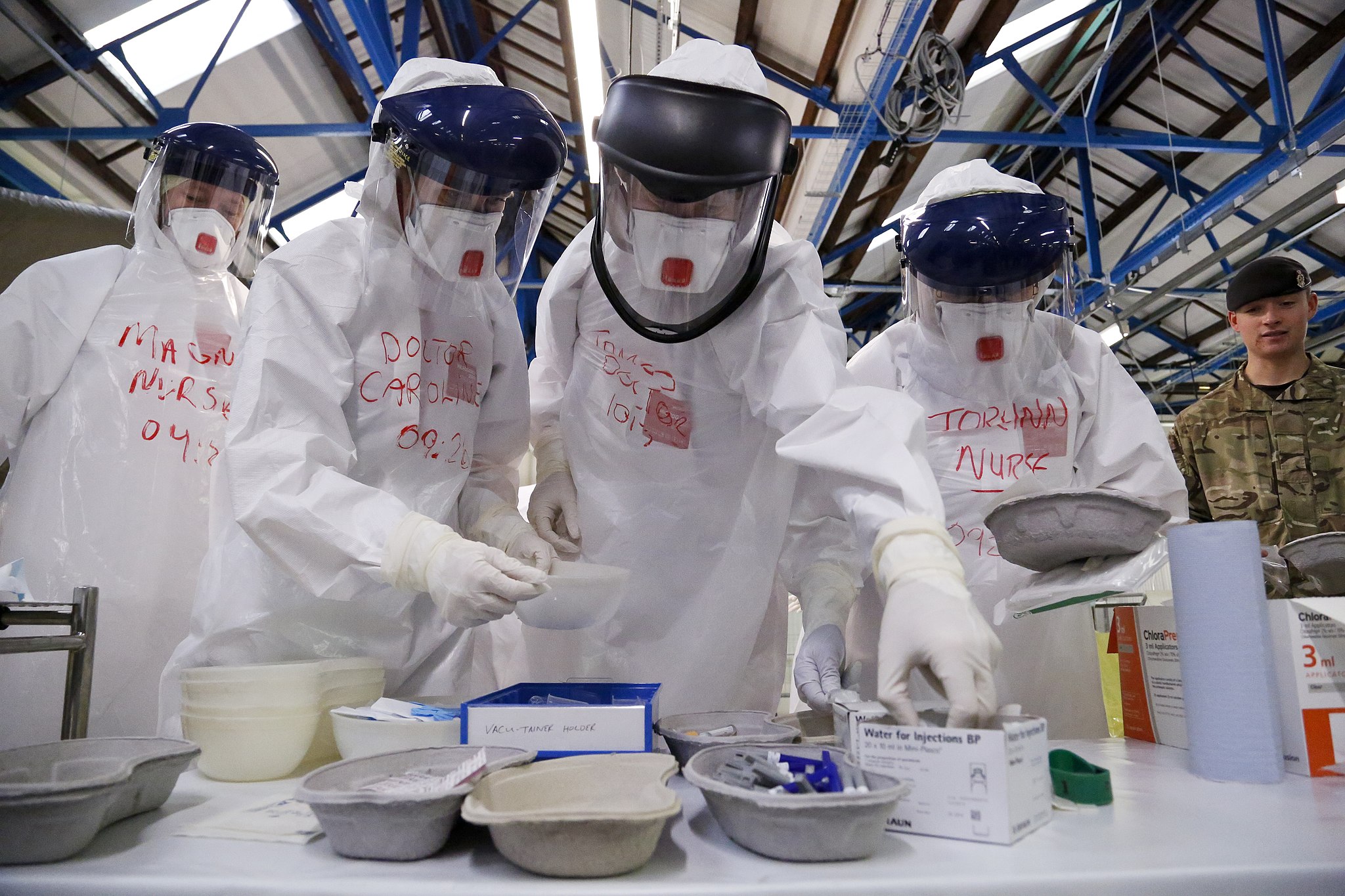
Medics from across the NHS practise in full Personal Protective Equipment (PPE)

Although PPE should be used as a last resort to reduce health risks at work, it is often essential for the health workers and laboratory researchers to use PPE. Now, practicing this has become more crucial than ever as we must consider; lab coats, gloves, safety glasses and face-masks more widely and wisely in our microbiology research laboratories with the ongoing global challenges with the COVID-19 pandemic!

It is our (both employer and employee) primary responsibility in making the workplace safe and includes providing/following instructions, procedures, training, and supervision to encourage people to work safely and responsibly. If PPE is ultimately needed after implementing other controls osubstances hazardous to health (COSHH), we must provide this for our employees free of charge. We must choose the equipment carefully (see selection details below) and ensure employees are trained to use it properly and know how to detect and report any faults.

The right mask for the right task: There are several different types of face-masks on the market with a complicated grading system. It can be difficult to distinguish the type of mask you may need or if you need it at all, so here is a useful breakdown.

The right mask for the right task: There are several different types of face-masks on the market with a complicated grading system. It can be difficult to distinguish the type of mask you may need or if you need it at all, so here is a useful breakdown.

Surgical mask

Surgical mask

Surgical masks: These are the most commonly encountered masks, frequently worn in a clinical setting. These masks contain a 3-ply barrier and do not provide a high level of protection for the wearer. Studies that compare different surgical masks by manufacturers find significant variability in their filtration potential. Depending on the manufacturer, a surgical mask can filter particles at a varied level.

Cloth masks: Cloth masks have become a popular alternative globally for social distancing. While they may create a more practical solution than surgical masks as can be worn for a longer period, they still do not block specific particles from passing through. There is little data on their efficacy.

These types of masks can be attributed to a lack of regulation over manufacturing, as well as the poor peripheral seal around the face. The porous design and gaps forming on the cheek and neck area allow airborne particles to leak through the mask. They are most effective in potentially protecting others from bodily fluids expelled by the wearer. For example, a sick (with or without clinical symptoms) person can wear this to protect others from droplets (of varied size) produced while coughing or sneezing.

Respirator

Respirator

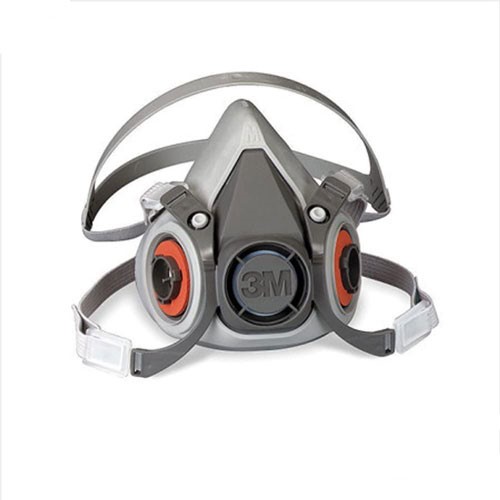
Respirator: A “respirator”, that is validated by a regulatory body, typically have an adequate seal and an air filter that regulates what particles can pass through, making them effective against airborne contaminants and aerosolized droplets. Amongst the respirators, there are disposable and reusable versions of the mask. The disposable respirators (left) are not meant to be used for more than a few hours. The reusable masks, also known as “half-face masks” (right) have cartridges to replace the air filter after several hours of consecutive use. Amongst the reusable masks, one should look for filters that block particulate matter not just gas/vapor only, to protect against pathogens. Also, users should always carry out a pre-use seal check or fit check.

Face shields: Face shields may be advantageous because they provide a single barrier against mucous membranes on the face (portals of microbial entry i.e. eyes, ears, nose, mouth). They have been shown to reduce a person’s exposure to acutely expelled large droplets. However, smaller particles can stay in the air longer and make their way around the face shield. That’s why face shields should be worn in combination with another PPE, such as a mask. Another major advantage of the face shield is that they substantially reduce surface contamination of respirators, prolonging their use.

Consider while purchasing: a combination of letters and numbers that specifies what particles the mask allows to pass through the filter. Note, respiratory pathogens are found in water-based aerosol droplets (e.g. sneezing, coughing etc).


Country Respirator Classification
 

United States (NIOSH)

N95 (95% non-oily particles) N99 (99% non-oily particles) N100 (99.97% non-oily particles)
European Norm (EN)


FFP1 (80% particles) FFP2 (94% particles) FFP3 (99.95% particles)

The letters ‘N’ and ‘FFP’ stand for ‘not oil resistant’ and ‘filtering face piece’. Next is the numbering system, which are as follows: 95 = effectively blocks out 95% of airborne particles,99 = effectively blocks out 99% of airborne particles,100 = effectively blocks out 99.97% of airborne particles. Once you understand that breakdown, it is easy to understand the masks that other countries manufacture.

Further information:

Tips for enhancing your career possibilities during COVID-19

Birkbeck Futures explore different ways to help job searching during the COVID-19 pandemic.

As companies continue to navigate the ongoing coronavirus pandemic, you may be among the growing number of workers who have lost their jobs as a result. This is a challenging situation at the best of times, let alone during a global pandemic, but your job search and career opportunities can continue. Embracing some alternative approaches will help to enhance your future possibilities, while providing an opportunity to explore different options.

These tips will support you with your job search and help you navigate your career journey during this time.

Consider your current priority

  • If your priority is to gain short term income, explore the industries that are continuing to hire at this time. Rather than put pressure on yourself to find the perfect role now, if you need a short-term solution consider checking what is available and possible for you.
  • Examples of industries that are recruiting include delivery services, supermarkets, online learning platforms (tutoring children out of school), remote working / communication platforms, among others. While it may be a necessity, view this as an opportunity as well as a temporary option for now. Every new experience brings new skills and new people into our life that may result in unexpected future opportunities.
  • Birkbeck is continuing to provide weekly updates to students and you can also gain support through our student services. Further information on support available during this time.

Embrace online networking

  • You may already be active on LinkedIn and this is one of many platforms that brings a wealth of opportunities to connect with others in your field. Joining groups, contributing to discussions and reaching out to people in your profession are great ways of building your network.
  • Not only will this develop new and existing connections, it will help to boost your visibility to others in your industry who may have job opportunities in the future. While many companies are pausing recruitment, they will be hiring again in the future and making connections now will enhance your opportunities when they do.
  • The vast majority of jobs are not advertised online and rely on referrals and connections. This has been the case for many years, so it has never been more beneficial to start networking – the results may not be immediate in terms of landing a job straight away, but it will continue to help at every stage of your career.
  • You can find out more about using LinkedIn with these resources on the Online Careers Portal.

Become familiar with online communication tools

  • Once you start to connect with groups and individuals through LinkedIn or other online platforms, take advantage of the opportunity to arrange a call with connections (also now often referred to as a ‘virtual coffee’….). This is a great chance to ask them questions about their career, any tips they may have for you and even just to build rapport with them. With most people working from home, you’re much more likely to get more ‘yes’ answers to your requests than previously.
  • The most popular tool for online calls is Skype. If you don’t have an account, consider setting up a free account or suggest a phone call instead.
  • If you’re not used to doing video calls, practice with friends or family to start getting used to it and to build your confidence ahead of calls with connections. If you’re in an interview process, you will very likely be invited to a video interview, so this is also worth investing some time to make these calls as successful as possible.
  • For tips on video interviews read this article.

Develop your skills

  • There are many articles now about ways to upskill during lockdown and things that you could do, but exploring what would be beneficial for you is certainly a worthwhile exercise. Reflect on the type of job you want and consider the skills that often come up in the job descriptions you may have read. Are there any areas you’d like to be more competent in? This could be technical expertise or soft skills.
  • As a Birkbeck student, you have access to LinkedIn Learning which has a range of online courses across various topics that you can complete. You can also add your completed courses to your LinkedIn profile, enabling others to see your updated skills.
  • Other online learning platforms are offering free trials or complimentary content, so depending on the areas you’re keen to develop, search for relevant courses that you can access.
  • Birkbeck’s Online Careers Portal also has a range of resources to develop your skills, as well as tools to enhance your CV and work on your interview technique. The next tip has more information on this.

Use Birkbeck Futures’ online resources

Birkbeck Futures, which includes your Careers, Enterprise and Talent services, is here to support you remotely in various ways. As a Birkbeck student, you have access to various online resources to support you in your job search as well as to develop your career further:

  • Access to your Online Careers Portal via your My BBK Profile.
    You can access the Online Careers Portal via your My BBK Profile, clicking the ‘Careers and Employability’ section on the homepage. Alternatively you can log in directly – enter your Birkbeck username and password to access the following:
  1. Live chat service with a Careers Adviser during the careers drop-in hours: Monday – Thursday 4pm – 6pm, Fridays 3pm – 5pm
  2. Instant CV feedback via the CV360 tool
  3. Book a 1:1 with a Careers Consultant for more comprehensive career support
  4. Receive the weekly careers newsletter with news, updates and relevant resources
  5. Access articles, videos and activities to develop your skills
  • Access to Birkbeck Talent, your in-house recruitment service.
    We are posting live roles on the Talent portal, also accessible via your My BBK Profile. There are some paid remote-working internships, as well as other live roles. You can search for roles, upload your CV and apply for roles online, as well as contacting the talent team for support.
  • Follow us on our social channels for latest updates on Twitter, LinkedIn and Instagram, where we post new roles, details of all remote workshops and events as well as our employer insight podcast series.

Contact us: employability@bbk.ac.uk | talent@bbk.ac.uk

Top tips for studying at home

In this blog, Rob Martin, a Learning Development Tutor at Birkbeck, shares five tips to help students be productive while completing their studies from home.

Photo of woman looking on computer

Studying at home can be tricky, particularly when you are in lockdown with family members or housemates. Those of us who usually use the Library to find some quiet time may be finding things even trickier. Below are some suggestions to recreate the sense of focus of studying in the Library.

1. Create a dedicated study area

If possible, find a place in your home that you only use for study. This enables your brain to become conditioned to get into gear when you are in that area.

2. Use a timer

Pomodoro Technique suggests that we can better focus on task in small bursts. The suggested timing for this is 25 minutes of the task (e.g. reading, writing) then taking a five-minute break. Use the free Timer setting on your phone or digital watch.

3. Distraction blockers

It can be tempting to use your phone to find the definition of a new word while you study, but this opens up the possibility of seeing other distracting notifications such as social media. There are apps available that block other apps and websites. For mobile devices: Forest distraction blocker is £1.99. It grows a virtual tree in your ‘Forest’ for every completed time block. The app also contributes to real reforestation according to how many people have focused that day. Cold Turkey is available for laptops and desktops. You can specify which websites to block for a length of time of your choosing.

4. Using background noise to help you focus

If you like to study with the general bustle of the library or a coffee shop, try a website like Noisili, which plays background noise themes like ‘coffee shop’ or ‘rainfall’. Alternatively, music streaming apps like Spotify and Apple Music offer continuous playlists that might drown out some distracting background noise. Calming instrumental music like Classical can help you resist the temptation to get up and dance instead of studying.

5. Connect with study buddies

In times like these, you may have less contact with your fellow students – catching up about assignment progress, sharing ideas, helping each other to understand. You could keep it low tech: schedule a series of calls with fellow students to address particular issues. Otherwise, you could use a free video call app like Zoom to stay in touch. You could study ‘together’ online, for example, using the Pomodoro technique. Spend a few moments discussing your immediate study goals, study in silence for 25 minutes still connected to the video call. Use the five-minute break to discuss what you achieved and establish your study goals for the next 25 minutes.


Building on personal identity to help overcome adversity

Sreeja, daughter of one of our Professors, aged 13, explores how we can focus on ‘diversifying our identities’ during this challenging COVID-19 period.

Orchid

Throughout this testing COVID-19 period, I want to help those of you, struggling like me with productivity, anxiety, uncertainty or simply paradoxical boredom. I thought I’d explain how to overcome this difficult mindset and extract the best out of adversity. This blog will detail the significance of diversifying our identity, spending quality family time and understanding comfort in the uncomfortable. I will be introducing a new concept called ‘Diversification of Identity,’ which I have found to help myself and others immensely.

The idea of diversifying our identity is built on an economical concept mentioned by Tim Ferriss; ‘It’s always smart to diversify your investments. That way if one of them goes south, you don’t lose everything.’ This same principal applies to our own identity, if one has been engrossed in something that has now been taken away from them – perhaps their regular job, a project or a hobby that they currently cannot undertake. They might be finding it difficult to come to terms with it, which is possibly a sign that they need to expand the basis to their sense of self.

For example, my father’s wet lab-based research for new antibiotics against tuberculosis is currently compromised. Essentially, wet-lab-research consists of interactive lab procedures, where you perform various experiments in order to reinforce research; however, at present this is not possible for his team to approach. Although my father is deeply riveted by this form of research, we, as a family, are not allowing this to affect our mind and wellbeing and we are participating in alternative pastimes (see figure 1).

This is a time when it is paramount to maintain gratitude as a daily practise. To appreciate the family members who remain with you regardless of the problems you encounter, those who unconditionally offer you love and affection, even during trying times. Our family has taken this opportunity to utilise our interests, such as cooking and baking, photography, gardening and writing, and do them together. Not only is this entertaining, but it gives time to develop bonds, communication skills and mutual respect amongst family members. During this period, we aim to act upon this knowledge and take advantage of the new-found time that is in on our hands.

“Studying for a PhD at Birkbeck is one of the best decisions I have ever made in my life!”

Zambia-born Kasoka Kasoka, who describes himself as a very proud ‘Birkbeckian’ alma mater, reflects on his time working on a PhD in Law at Birkbeck and his achievements since graduating in 2018.

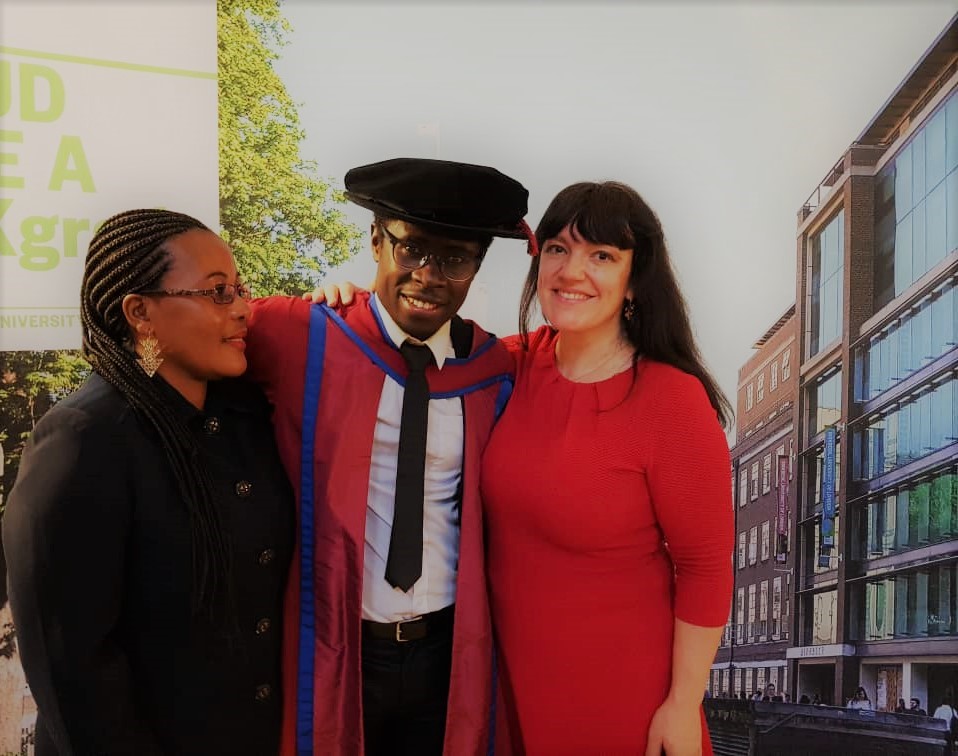
Kasoka Kasoka at graduation

Kasoka Kasoka at graduation

Tell us about your education before Birkbeck

I am from Lusaka and Zambian. In 2007 I moved to the UK where I enrolled to study for a Bachelor`s degree through the University of London International Programmes. I obtained a Bachelor`s degree in Law in 2011. Upon the completion of my degree I was admitted to study at Maastricht University in the Netherlands where I studied for a Masters degree in Forensics, Criminology and Law. I obtained my Master`s degree in 2013.

Why did you choose Birkbeck?

Firstly, I decided to enrol here because of Birkbeck`s massive ranking as one of the best research universities in the World. And yes, it is! Secondly, I applied to study here because I was attracted to the College`s interdisciplinary research study approach. As a result, my research as a doctoral student cut across; law, human rights, philosophy, sociology, anthropology, history, bioethics, and public health. Engaging in an interdisciplinary research project afforded me a rare opportunity to become an interdisciplinary thinker, be open-minded, and embrace new ideas.

Thirdly, true to its name as a research-intensive university, Birkbeck comprises of academics and researchers who are renowned experts in their fields. Thus, my great former PhD supervisors, Professor Matthew Weait and Dr Eddie Bruce-Jones, are very respected researchers and authorities in their various fields. They are exceedingly knowledgeable and  down to earth. And finally, but not exhaustively, I decided to study here due to the supportive student and staff community at Birkbeck. I indeed received a lot of support during my study from fellow PhD students, academic and research staff, and administrative staff members.

What were your relationships like with staff and other students?

I loved the critical approach to study and work culture at Birkbeck. I found my fellow PhD students to be really smart, friendly and supportive – this was endearing. As if this was not enough,  both academic and non-academic staff were very approachable, attentive and supportive. I had a lot of academic staff who were not my PhD supervisors avail me with research insights and suggested various research material to read – as a goodwill gesture. This was priceless in my doctoral study journey!

Inevitably, I was sad to leave Birkbeck when my studies came to a conclusion,  to leave behind such a great community. Nonetheless, I am still happy that I have stayed in touch and maintained the various friendships and networks I had the privilege of forming while studying at Birkbeck. Indeed, “once a Birkbeckian forever a Birkbeckian”!

It was a great honour to forge  invaluable friendships and networks with students and staff members from diverse backgrounds. I consider Birkbeck to be one of the most diverse universities in the UK.

Did you use any of Birkbeck’s additional support and activities?

I had the opportunity to intuitively avail myself to various societies and student clubs at the University, including various PhD students` social groups. Birkbeck has a lot of societies and social groups with various activities.  So, I was always happy to retire from my studies to unpack my mind by joining fellow students for some good fun. I especially enjoyed playing football! As they say “all work and no play make Jack a dull boy”!

Can you tell us more about your research project?

The purpose of my research was to investigate and analyse the appropriateness of individual autonomy in the context of informed consent HIV testing requirements in Zambia, and sub-Saharan African countries by extension.

Tell us about your experience of living in the UK.

I really loved living in London. London is no doubt one of the greatest cities to live in. What I liked most about the city is the diversity of its population. Thus, I was privileged to meet many people from every part of the world who brought with them various rich cultures, including great cuisines! With such a profoundly rich experience I agreed with Robert Endleman (1963) who observed that human beings in terms of cultures “are vastly various and yet laughably alike”! I also loved English pub food! And the museums, wow! – museums were often my favourite place of respite whenever I needed to briefly divorce myself from the usual business of life and time-machine myself into the past to admire and converse with ancient Egyptians, Greeks, Romans, Chinese, Persians, Africans, Americans, Europeans and Indians who had no internet! And behold, the British Museum is only about three minutes-walk from Birkbeck! London is also pregnant with breath-taking gothic cathedrals and other non-church buildings.

(I need to mention that there are much more things for one to see and enjoy in London than what I can enumerate – there is almost everything for everyone to see, smell, taste, hear, touch and enjoy. That`s the magic of London!)

However, living in London comes with its own downsides: especially the high costs of accommodation and transport. Food is surprisingly affordable!

Life after Birkbeck

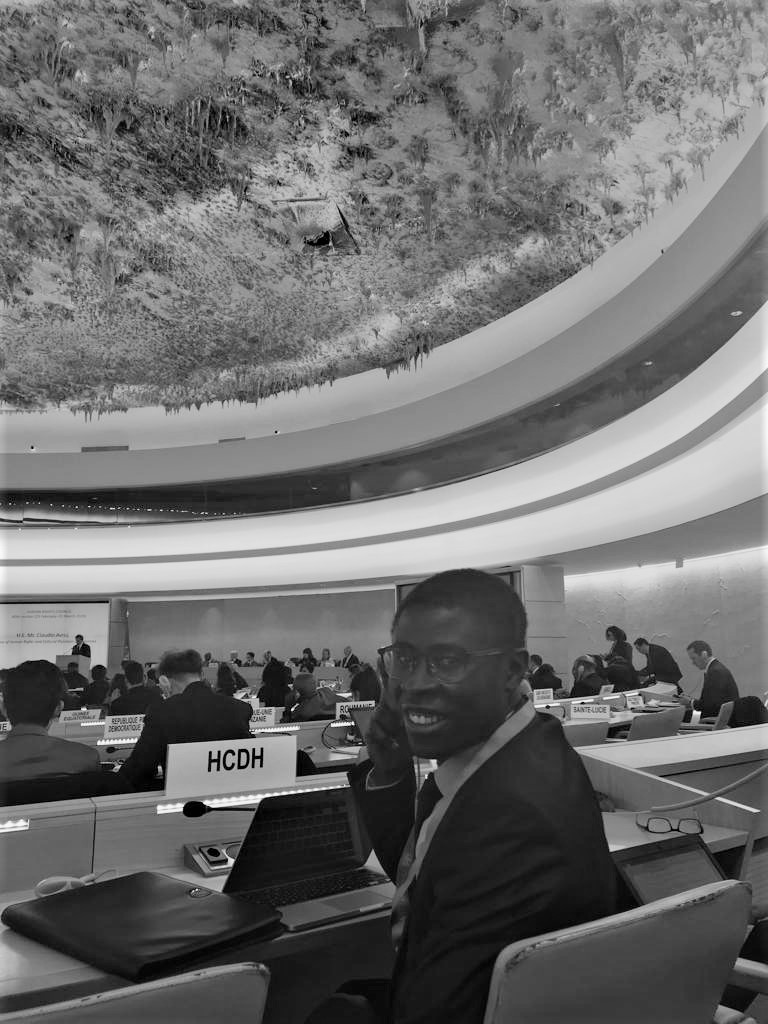
Kasoka Kasoka at a United Nations Human Rights Council (HRC) Session

It was sad saying goodbye to my community of friends and networks when my studies concluded. After completing my studies at Birkbeck, I was offered a scholarship by the Ministry of Foreign Affairs, Finland to study on an intensive postgraduate international human rights course at the Institute for Human Rights, Åbo Akademi University. Upon the completion of the course in Finland, I was an Intern at the United Nations Office of the High Commissioner for Human Rights (OHCHR) in Geneva, Switzerland. Later I worked as a Legal Intern at the World Health Organization (WHO) headquarters in Geneva. The experiences and illuminations I gained from these intergovernmental organisations are invaluable! I am a strong believer, follower and advocate that,

“All human beings are born free and equal in dignity and rights. They are endowed with reason and conscience and should act towards one another in a spirit of brotherhood.”

Currently, I am writing a research paper for journal publication, as I keenly continue to follow my career goals, and seek to contribute, no matter how tiny, to improving the wellbeing of our common humanity, without prejudice or discrimination. Indeed, as it has been said before as human beings, we are all as weak as the weakest link (other human being whose rights are not respected, protected and promoted) living among us in our society. My study at Birkbeck (through its critical review approach) and experience at the United Nations has made me see this reality clearer than never before.

What advice would you give other people thinking of studying at Birkbeck?

I highly recommend Birkbeck, University of London! You will study at a university that is known for research excellence with renowned academics; you will study in a supportive environment, with quality teaching; at the end of your studies you will graduate with a prestigious University of London qualification, and not forgetting you will become a Birbeckian; and at the end of your studies you will not look at the world the same way!

As for me, studying for a PhD at Birkbeck is one of the best decisions I have ever made in my life, and I am a very proud Birbeckian alma mater.

COVID-19 in prisons – a major public health risk

Catherine Heard, Director of the World Prison Research Programme at the Institute for Crime and Justice Policy Research (ICPR) at Birkbeck, discusses the impact of COVID-19 on prison populations.

Prison

The coronavirus pandemic presents formidable challenges for prisons worldwide – challenges they will struggle to meet, with potentially grave consequences for the health of prisoners, prison staff, their families, and all of us.

This is a fast-moving situation: since the outbreak was declared a pandemic on 12 March, prisoners and prison staff have tested positive in several European countries, and prisoners have died in England and France. These cases will only be the tip of the iceberg globally. With prison health systems in so many parts of the world struggling to provide even basic healthcare, many sick prisoners and prison staff will not have been tested. Overcrowded and under-resourced prisons offer the perfect conditions for the rapid spread of any contagious disease, including COVID-19, within and beyond their confines.

Last year, we published a report examining the effects of failed penal policies through the lens of health. We showed that well over 60% of countries have overcrowded prison systems (based on information held on our World Prison Brief database). Our research included evidence from ten diverse jurisdictions across five continents. Prisoners spoke of extreme overcrowding (for example, 60 men sharing cells built for 20 in Brazil); inadequate medical treatment, with too few doctors to deal even with routine health issues let alone serious disease outbreaks; constant hunger; lack of fresh air and exercise; shared buckets instead of toilets; not enough fresh water or soap; having to eat while seated on the toilet due to lack of space in a shared cell.

These are the realities of prisons across the world. They provide important context for the World Health Organisation’s warning that global efforts to tackle the spread of the disease may fail without proper attention to infection control inside prisons.

How have prison systems around the world responded to the pandemic? Many prison authorities – including in England & Wales – have suspended visits to prisoners, and cancelled temporary release schemes. In Columbia, Brazil, India, Italy, Romania and Lebanon, prisoners have rioted at these measures and in protest at the life-threatening conditions in which they are being held. Prisoner deaths, escapes and widespread violence have been reported.

More recently, some governments have responded by releasing prisoners: in Turkey, legislation was passed to release 100,000 of the country’s roughly 286,000 prisoners; similar steps have been taken in Iran and are under consideration in the United States, Canada and Ireland. In England and Wales, the government has so far declined to do this, despite the severe challenges already facing our overcrowded prison estate.

Now, detailed guidance from WHO, running to 32 pages, should leave no government in doubt about the serious risks presented by the virus, and how to tackle them. It states: ‘The risk of rapidly increasing transmission of the disease within prisons or other places of detention is likely to have an amplifying effect on the epidemic, swiftly multiplying the number of people affected.’ It calls for ‘strong infection prevention and control measures, adequate testing, treatment and care’ and provides detail on what this means in practice.

The parlous state in which prisons find themselves throughout the world today will make it difficult for them to follow the guidance, as they lack the resources – human, material, and financial – with which to do so. Even before the pandemic they were struggling to provide basic sanitation and healthcare for those in their care, as our research has shown.

COVID-19 provides the clearest illustration yet that prison health is public health. It is more important than ever for our governments and prison administrations to abide by the principle, enshrined in international law, that prisoners have an equal right to health and healthcare. Realistically, the only way that most countries could afford to meet this obligation is by first reducing their use of incarceration. This means ruling out custody for less serious, non-violent offending; and reversing the recent growth in the length of prison sentences.

It also means cutting substantially the use of pre-trial detention.  In America, thousands of the country’s nearly half a million pre-trial detainees are in jail for no better reason than that they cannot afford bail – although senator Kamala Harris has called for this to end.

No one should be remanded in custody unless absolutely necessary. But, of the more than three million people in pre-trial detention across the world, a large proportion are there purely because they cannot afford bail, or their country’s courts are hopelessly backlogged (a situation that will only worsen as courts around the world are forced to stop hearing all but the most urgent matters because of the current health emergency). On 2 April, we will release the latest global data on pre-trial prisoner numbers. It will reveal a significant upward trend, and should provide a wake-up call for governments the world over.

All news items and other sources referred to in this piece can be accessed via a dedicated COVID-19 page on ICPR’s World Prison Brief database: https://www.prisonstudies.org/news/news-covid-19-and-prisons

Further information:

Julie Andrea Sánchez: A Columbian student in London

Meeting Birkbeck ambassadors at an open day convinced Julie Andrea Sánchez Fula that studying for a Masters in the UK was not an unreachable dream. After being selected for an International Merit Scholarship the Colombian student completed an MSc International Business and Development at Birkbeck in 2018/19.

I decided to study at Birkbeck because my friends who live in London recommended the College for its excellent teaching. When I first came to London I attended an open day where I had the opportunity to speak with some students. Up until then, I did not think I would be able to do a Masters, but the students showed me that it was not an impossible dream.

I was also excited by the prospect of studying with London professionals who are working during the day and studying in the evening, it was certainly the right choice for me.

When it was time to start my course and move to London I opted to live in a university hall of residence because I was keen to meet students from other universities and different cultures.

I searched for accommodation online and eventually found Wood Green Hall through Birkbeck’s website. The hall is located about 25 minutes from Birkbeck and five minutes from Wood Green tube station – perfect for me as I wanted to be in North London because it is so convenient!

Meals cooked by Julia

In April, I moved to a house 3 minutes away from my accommodation and shared a house with two people and a cat.

Settling in

When I started at Birkbeck, I attended the One World Festival week. I think this orientation week is very important for international students.

Initially, I had difficulties in writing essays and referencing. The English method for academic writing is different from the Colombian where the essays are mainly free writing style. I was able to improve as I attended study skills sessions, mainly for writing and sessions for English language support.

Life in London  

Living in a big city like London can be overwhelming but also great because there are so many things to do. What I like the most is meeting people from around the world and taking advantage of the free activities that the city offers such as dance classes and going to museums and parks.

Julia on the London underground

The public transport is well organised and the tube is fast. However, I think for me it’s easier to navigate public transport in the north and the centre of London. Uber and taxis are really expensive, so I never use them.

My expenses could be divided into three main parts, food, accommodation and transport. The costs of going out to restaurants and my accommodation were four times higher than in Columbia, so I had to budget carefully. I discovered that the cost of meat and vegetables in the supermarket is similar to my country, so I decided to learn how to cook.

Julia with friends from Birkbeck

It has not been easy to make many friends at Birkbeck or in London. It could be because everyone is busy working or studying.  However, I made a good friend in my classmate Aya, who is originally from Morocco.  Although we are from different countries we have found many things in common such as our backgrounds, life experiences and humour.  Other classmates I have are from Indonesia, Taiwan, Laos, and Greece.

Extracurricular activities

In my first term at Birkbeck, I joined Student Central and tried archery, judo and dancing. As I like dancing a lot I decided to keep attending the free classes that I found in London.

I found many free activities like tours and workshops in London. I remember joining a tour of Bloomsbury where the university’s main campus is and one at the Houses of Parliament. I also attended a few workshops on career development and networking.

Future plans

My immediate plans after my course at Birkbeck include an internship in London and further study towards a qualification in accounting. After my internship, I would like to work in the financial sector, hopefully in Microfinance or Fintech.

Further information:

Ground Hog Day for our next Prime Minister

Dr Ben Worthy from the Department of Politics reflects on the challenges facing the new prime minister and suggests that there is a way to overcome them.

Only one thing is predictable about our next prime minister: they will be a ground hog day leader. For all that the candidates are promising new deals, no deals and new directions, from day one they’ll face the same traps and tripwires that have destroyed May’s premiership.

No doubt May faced an uphill task, and had one of the worst in-trays of any peacetime prime minister. Particularly after June 2017, Theresa May faced a divided party, a split House of Commons and a divided country.

We should remember, before sending off our sympathy cards, that her decisions worsened what was already a bad situation. Her premiership was wrecked on her own promises and ‘red lines’, which she had to retreat from. Her neglect of Scotland and Northern Ireland led to talk of new referendums and separation.  And the less said about her decision to hold a ‘snap’ election the better, as she manged to somehow win while losing, doing away with a majority she very, very badly needed.

The problem for whoever the next prime minister is that nothing will have changed. It may be that the new prime minister has some skills that May lacked. Perhaps she will be more decisive, a better communicator or less divisive. She could even enjoy a (brief) bounce in the polls and, if she’s lucky, some good will.

Yet like Theresa May, our next leader will be a ‘takeover’ PM, getting to power by replacement not an election win. Being a takeover almost always limits a leader’s lifespan and, sometimes, their authority. I estimated ‘takeovers’ have about three years.

The Conservative party will still be deeply, hopelessly split. There’ll still be no majority for the government in the House of Commons, and the option of a general election, given the local and EU election results, should be, to put it diplomatically, reasonably unappealing. As for ‘re-opening’ or ‘no dealing’ Brexit, the prime minister looks set to be trapped between an EU who will not renegotiate and a parliament that will not allow a no deal Brexit.

In fact, it will probably be worse for May’s successor. If our new prime minister wins by promising no deal or radical re-negotiations, they’ll have to U-turn or backtrack. Tensions will probably worsen with Scotland, where there are new referendum rumblings, and the complexities of Northern Ireland and the border will stay unsolved. Labour’s dilemmas and problem could make everything worse, not better.

Is there a way out? Perhaps. Prime ministers, like presidents, have a power to persuade. John Harris and Marina Hyde, as well as academics like Rob Ford, have been making the point that no one is trying to change anyone’s mind, or even suggesting it could be done. Yet why people voted how they did was complex and changeable. The whole debate about Brexit has been tied up with a belief that the UK is hopelessly and irredeemably polarised, and that the will of the people is now set in stone (listen in to Albert Weale’s great talk).

Instead of labelling opponents as enemies, why doesn’t our new prime minister try to persuade them? Time after time, from Iraq to same-sex marriage, politicians have tried to persuade the public to re-think their views. Parts of the population were persuaded in 2016. Can’t they be talked back again? It’s the only way out of the loop.

Ben Worthy is Senior Lecturer in Politics at Birkbeck. You can see more of his work on political leadership here.