Author Archives: I Edwards

Back to normal? The government is underestimating the scale of change for workers.

As the UK government looks for a path out of lockdown, Professor Almuth McDowall considers the psychological impact of transitioning to a new normal.

Picture of people waiting for the tube in London

On Sunday afternoon, we were on our way back from a socially distanced walk with three moderately enthusiastic teenagers when the phone rang. BBC Radio London asked if I was happy to discuss the Transport Secretary’s announcement that the government was considering a phased approach to businesses reopening their doors. The suggestion is to put a number of safety measures in place to safeguard individuals from getting infected, but also minimise pressures on transport and infrastructure.

For employers, the key propositions are to minimise the number of workers using any equipment, to stagger work start and finish times and to maximise home working. The idea is also to encourage people to engage in more active commuting, including cycling and walking.

Many organisations have of course been open and operational throughout the crisis, including our now much appreciated local shops, which have introduced social distancing measures such as limiting numbers allowed in at a time and protective screens.

But will the transition back to the workplace be as easy as some might suggest while extra precautionary measures are implemented?

When quizzed on the radio, I took a rather cautious and even cynical view. Quite frankly, I do not think that the implications of what will be a gigantic organisational change exercise have been properly thought through.

First, let’s think about infrastructure constraints. Many returning workers have children who, we hope, will return to normal nursery and/or school hours sometime soon. This would make it difficult for all workers to shift start and finish times, as there will be practical issues such as school pick up times to work around. Transport will also be a challenge for this reason, given that peak demand is also due to children travelling to and from school. 

Furthermore, not everyone lives in cycling or walking distance from their place of work, quite the contrary. Surely, we also must avoid a scenario where more people are taking to their cars and driving alone, as we are already witnessing in our neighbourhood, to avoid public transport. 

Let’s also think about who will and needs to return to work. There will be workers who are scared about returning. There are also people who will not be able to return, at least not for the foreseeable future, because they are vulnerable, or someone in their family is. 

On the other hand, there are people who are desperate to return, because they currently live and work in crammed conditions, or because they live in areas with insufficient connectivity.  

Each business has to start with a detailed analysis of how a phased return to a mix of onsite and virtual working will play out in practice and accommodate individual needs and preferences. This is not a quick solution, but takes time, skill and effort. 

Research tells us that to make virtual working effective, particularly during times of crisis and uncertainty, managers and leaders need to take an individual approach to help people feel secure and build up trust and effective ways of working. Again, this is no quick fix. 

Some organisations are getting this intuitively right, others not exactly. One of the keys is a combination of communication and clarification of expectations and roles. This will become much harder as businesses are required to adjust and manage a staged transition to open their doors again. If we are not careful, businesses will spend all their energies on managing logistics, rather than concentrating on the core business to keep their customers happy and deliver a good service.

The literature on organisational change firmly agrees on one issue. Change is hard and stressful, even where it is for the better. Humans are hardwired not to like it. This is why times are tough at the moment. Acknowledging this, and our own vulnerability is an important step to manage sustainable change. My fear is that the UK government is considering too complex a range of practical measures without due acknowledgement of the physiological impact on people. It’s time for a rethink.

Further Information: 

Managing staff who are working from home: business as usual?

Professor Gail Kinman, Professor Almuth McDowall and Dr Kevin Teoh from Birkbeck’s Department of Organizational Psychology share tips on how to manage staff who are working from home.

Empty office

Steps to manage the Covid-19 virus mean that working from home is now mandatory for many people. This will help contain the virus, but such a major shift in working practices will not be easy. Some employees will be working from home for the first time and may struggle to accommodate to their new environment. It may also pose challenges for managers who are required to ensure ‘business as usual’ but have little experience of managing people who work remotely.

The skills required to manage staff during these challenging times are quite different than those needed face to face. Below, we provide some guidance on how to manage remote workers effectively.

Set expectations from the outset signalling support and understanding

The move to remote working will make communication more challenging and you will have less insight into what staff are doing each day. The first step for any organisation is to communicate with all workers affected, setting out clearly the support you are offering, how you will communicate with them and the expectations you have for their performance.

In the current special circumstances, this may mean waving goodbye to previous management practices such as mandatory core hours and operating a flexible “work when you can, as much as you can” policy. Some workers will have challenging circumstances and may have little time or energy for uninterrupted home working. It is important to acknowledge these challenges from the outset and keeping conversation streams open will help you become aware of any changes in people’s circumstances. Also provide clear information on who staff can turn to for advice and support and issue regular updates.

A settling in period is crucial

Staff will need some time to process the change, access the necessary equipment and systems, establish channels of communication and negotiate and adjust work tasks. Do not make assumptions that people who work at home will be more productive as they have more flexibility and their commuting time is eliminated. People will typically take a lot longer to do things and be unable to work to full capacity, especially during the early days of home working. Keep reassuring your staff that you do not expect them to be as productive as usual – maybe the best that you can do in the short term is to identify priorities and work out how best to meet them. Ensure that you have a mechanism for staff to feed back on how things are working out for them. Double check also that appropriate hardware and software is in place. For instance, there are reports already that some organisations are running out of virtual protected network (VPN) licenses.

Be sensitive to role stress

People experience role overload when they are expected to fulfil multiple roles simultaneously without the resources to do so. Resources can be time, energy or attention. Role conflict occurs where fulfilling the demands of one role (e.g. work) is incompatible with meeting those of another (e.g. caring for children). Understandably, both role overload and conflict can be distracting and impair wellbeing and productivity.

Staff will have to dedicate considerable time and energy to craft a balance between their work demands and domestic responsibilities. They are also likely to be anxious about obtaining household provisions and need to monitor the health of themselves and their family members.

Build trust and avoid micromanaging

Building trust between you and your team is crucial. Jointly negotiated goals will help your staff feel engaged, productive and motivated. Deadlines can be set but, as discussed above, flexibility will be required as personal circumstances are likely to be subject to change. Bear in mind that the communication process should be two-way. It is important for managers to check in with staff to monitor their progress and their mental health, but your direct reports also have a responsibility to provide you with updates. Managers are unlikely to have the time to set up cumbersome and intrusive reporting processes, but avoid bombarding people with unnecessary requests, forms, procedures and guidelines.

Use meetings sparingly

Tools such as Skype and Zoom make organising meetings for remote workers straightforward but be aware that online meetings can be time-consuming. Ensuring that all staff members have an input is also challenging. Try not to organise meetings over lunchtime to ensure that staff have a break and are able to prepare meals for children. Send out clear meeting etiquette guidelines. Ensure that meetings are never booked backtoback, as they can become very draining. A shared diary will help mitigate this.

Be aware of the risks of being ‘always on’

Discourage staff from working long hours even if they are willing to do so, as they will be less effective and more vulnerable to health problems. Encourage people to have regular breaks away from their workstation throughout the day. As well as stopping work physically, staff should switch off psychologically to replenish their energies and to enable them to meet their domestic responsibilities. Role model the behaviour you expect from them, such as making it clear that there are times that you are not available, are resting or are meeting your other responsibilities.

Be aware of people’s personal circumstances and conscious of the challenges they are facing

What caring responsibilities do your direct reports have? Are they home-schooling? Do they have the necessary equipment and a quiet working environment? Some people may have access to a dedicated office, while others have to work on a kitchen table, a bedroom or the sofa. Encourage people to take steps to create boundaries (both physical and psychological) and avoid distractions wherever possible but accept that this will sometimes be inevitable. Children will interrupt meetings, dogs will bark and internet connections will inevitably fail.

Treat your staff as individuals

Your staff will experience the change to remote working in different ways. Some may feel anxious, while others will relish the challenge and break from routine. You will find that some people will need more support than others, so you could offer them short goal-setting meetings at the start of each day and a catch up at the end. Others, however, might find this intrusive and prefer to be left alone to get on with it. Be aware that some people will be prone to over-working and may need encouragement to switch off. Asking staff to share with you any difficulties they may be experiencing will help you gain insight into their individual circumstances, needs and preferences.

Encourage socialising and bonding

Working at home can be isolating; this will be a particular problem where staff are largely confined to their homes. Loneliness can reduce motivation and productivity and increase the risk of stress, anxiety and depression. It is important therefore for people to maintain social bonds and feel part of the team. Take some time before a meeting for people to share something personal. Encourage other social bonding opportunities such as ‘virtual coffee time’, a video chat over lunch, or a joint exercise session. Continue to celebrate people’s birthdays or other special occasions. Be creative – one manager we recently spoke to distributed a mini ‘pub quiz’ to help relieve the pressure and encourage team bonding.

Be kind, compassionate and respectful

Show genuine concern for people’s wellbeing and understanding of their personal circumstances. Provide praise and positive feedback so that people know their efforts are recognised and provide affirmation of confidence in your team. You can encourage staff to be open about any difficulties they are experiencing by disclosing that you too are struggling at times. People’s home environments are now their workspaces, but they should not feel that the organisation has moved in with them. It is important, therefore, that communication is measured and considerate.

What about your own wellbeing?

It is equally important that you show the same kindness and compassion to yourself. Expectations of managers are high, and many are now responsible for keeping the business afloat while endeavouring to support their staff through a major transition. Recognise that these are unusual times and it will be a learning experience for everyone.

Further Information:

How to set up your home working space to support mental and physical health

Dr Rachel Lewis, Registered Occupational Psychologist and Senior Lecturer in Organizational Psychology shares her tips for creating a safe and productive work or study environment at home.

Home office

Image credit: Desky

The coronavirus pandemic and ongoing lockdown have meant dramatic shifts in the way we work, much of which is beyond our control. Many of us are now working from home, sharing study space with housemates or family members and juggling childcare and other responsibilities into the mix. 

One thing we can take control of, however, is how we set up our workspace to support mental and physical health during this challenging time. The tips in this blog will help you to create an effective workspace, plan manageable routines and mitigate some of the stress that comes with adapting to a new way of work. 

Step 1: Choose your workspace 

As we continue to work remotely, it may be tempting to gravitate to your duvet or sofa and work in comfort, but doing so makes it difficult to manage the boundary between work and other areas of your life. 

Ideally, your workspace should be a separate area of your home that you can go to and leave as if you were going to work, whether that’s an office, desk or seat at your dining room table. This prevents disruption to the rest of your home and helps you psychologically to feel ready for work in that space. 

Step 2: Give your environment some love 

It’s amazing the difference that a few small touches can make to your work environment. Do you have access to natural light? Do you have a plant that could provide you with a more natural environment? While we’re in a state of uncertainty about how long lockdown could last, it’s important to create a space where you feel comfortable working. 

Think also about how to set up your desk to support your posture – could you put a few books under your laptop, or place a cushion behind your back, to help sit in a way that won’t lead to back or neck pain? Physical and mental health are closely linked, so by taking care to avoid aches and pains, you’ll be helping your mind too. 

Finally, scan the area to make sure it’s safe – are there any stray laptop wires that could be trip hazards to you or a family member, for example? 

Step 3: Define your working hours 

Without the physical boundaries that come from commuting to work, it’s tempting to just work around the clock. To ensure you take time to rest and recuperate, set (and stick to) a time to finish work each day. This time may have changed from your usual hours to accommodate other commitments – you could specify your new working hours in your email signature, so people know when you will be available. 

If possible, try to use separate devices for work and leisure – if you have been provided with a laptop or phone line for work, turn these off at the end of your working day to avoid the temptation to keep connected. 

Step 4: Be kind to yourself 

The situation we’re living through represents a significant period of readjustment, so don’t be too hard on yourself if working from home still feels alien. Set yourself goals, but be prepared for those to flex sometimes. Be kind to yourself, be kind to others and let’s help each other through until we meet in person again. 

Further Information: 

A ‘merged season’ solution for the Premier League post-coronavirus could be the best for all

Dr Richard Evans is a sports economist and an Associate Research Fellow at the Birkbeck Sports Business Centre with a focus on football finance. He discusses a potential solution to catch up the football season post-coronavirus.

It appears from the media that there is an understandable impatience, verging on panic, on the part of the FA and the Premier League to get the remaining games of the 2019/20 season played.  Clearly this would overcome commercial threats, in particular from the broadcast rights holders, and negate problems with player contracts if the season is extended.  However, even if the authorities in the UK go ahead with their preferred solution without alignment with UEFA for international competitions, it may be in the commercial interests of the Premier League to take a longer term view.

If, as seems likely, the coronavirus pandemic has not passed by the scheduled start of next season the effect on that season (and possibly future seasons) will also need to be considered. At present it appears that either this is not being considered or it is assumed that, at that point, new contracts would be negotiated and things would carry on from there as normal.

Consider the (quite likely) possibility that the point when football could continue as normal is not the convenient start of a scheduled season. Perhaps some new competition could be introduced to fill the gap until another season started. But perhaps that period could provide a window for the remaining games from this season to be played. For example, if games could resume sometime before March next year the current and next seasons could be merged into a 2019/21 season and ‘the narrative’ (as the Premier League likes to call it) could be continued to a sporting conclusion. This ‘merged season’ scenario would preserve the integrity of the competition for the Premier League and the fans and thereby be more attractive and consequently lead to a more advantageous commercial resolution with broadcasters, sponsors and players.


“By the time I finished university, I had four years’ worth of tech experience.”

BSc Computing student Trixi reflects on how combining work with part-time study at Birkbeck helped her get ahead in the tech industry.

Trixi, BSc Computing student

Why did you decide to study BSc Computing?  

I have always enjoyed problem-solving and I was curious about programming. When I asked my developer friends what their day-to-day involved, it sounded like something I wanted to try, even though I did not consider myself a computer nerd.

Why did you choose Birkbeck? 

I didn’t want to give up working full-time and Birkbeck had the option of doing evening studies. This alone really helped me make the decision, but I’d also heard good things about Birkbeck.

What aspects of the course have you most enjoyed?  

I enjoyed the learning, meeting people of similar ages and interests and the challenging assignments. I learnt that I am able to do things I thought I couldn’t possibly do before.

How has studying at Birkbeck impacted your future career plans?

I was really keen to get into the tech world as soon as it was feasible and for my studies and work to relate and feed into each other. The kind of assignments we were given helped me interview for jobs and I got my first tech job after one year of studying.

By the time I finished university, I had four years’ worth of tech experience. It helped me understand what part of technology I enjoyed the most and it feels like there will always be a job for me.

What advice would you give to a student thinking of applying for this course?  

Just apply. Start the process. If you have already considered the idea at least twice there is a likelihood that in 3-5 years you will be thinking the same. If you start now you will thank yourself later.

Further information:

Tackling lockdown boredom? Pavol is here to help.

BSc Marketing student Pavol spreads the joy and shares some tips for beating boredom during coronavirus lockdown.

Pavol, BSc Marketing student

Hey everyone!

My name is Pavol, but my friends call me Pav. I am currently in my fourth year at Birkbeck studying Marketing BSc. I decided that I would like to share a bit of joy, happiness and love with everyone who is currently #stayinghome and maybe create a ripple effect on sharing positive vibes.

I am currently sitting home and thinking about where to start. Well, I love baking, but I am not professional. I like exercising, but I am not full of muscles. I do like reading, but I have not read the whole library. So I hope you get what I mean when I say I am a regular guy with a tiny bit of quirkiness, fun and passion. I am 27 years young , and I would like to do something for our community of students. We are like a family, so I would like to share a bit of #LifeofPav with you all. Yes, it is my hashtag which I use on Instagram so please do get in touch and lets share our stories, pictures or drop me a message for an informal chat.

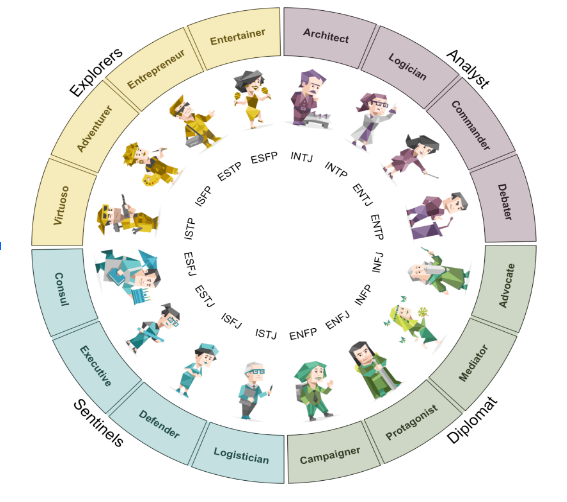
In the first chapter of this adventure, I would like to tell you about a great opportunity which I tried recently. My friend has been talking to me about this for the last six months, but you know how it is. You keep trying to do everything, and you say yes I will give it a go, but down the line, I forgot to do it. Six months ago I heard for the first time about the 16personalities.com website. Well, I finally tried it, and I am still shocked at how correct a few of the attributes are.

There are four main categories, and once you know your type, you can easily find a group on Facebook or research about famous people who are the same personality type as you. I am aware that this may not be for everyone, but maybe you would like to learn something more about yourself while we have a bit more time on our hands. The website is entirely free for the basic test, which will give you more than enough information about your personality. I find it fascinating, and I am eager to learn more about myself. Just in case you are the same and would like to share it with me or discuss your answers, I will be more than happy to do this. 

16 personalities wheel

The 16 personalities.

Until next time please all stay well, try the website, find me on Instagram as Pavol Weiss or under #LifeofPav♈ – I cannot wait to hear from you.

Your (ENFP) Pav 🙂


The silent extinction of the truffle kingdom

Could climate change lead to the complete extinction of truffles? BSc Financial Economics with Accounting student Nada Hinic explains.Mushrooms on a forest floor

         “All that is gold does not glitter,
          Not all those who wander are lost;
         The old that is strong does not wither,
         Deep roots are not reached by the frost.”

         (J.R.R. Tolkien, The Fellowship of the Ring)

Could climate change lead to the complete extinction of truffles? According to some scientists, it is quite possible: the increase of dry and hot weather in the regions of Italy, France and Spain can lead to a very serious situation for truffles, with the possibility of them disappearing completely in these regions by the end of the century. This would mean that the delicacy, which is already dizzyingly expensive and can be compared to the price of gold, would reach the value of an even more incredible level.

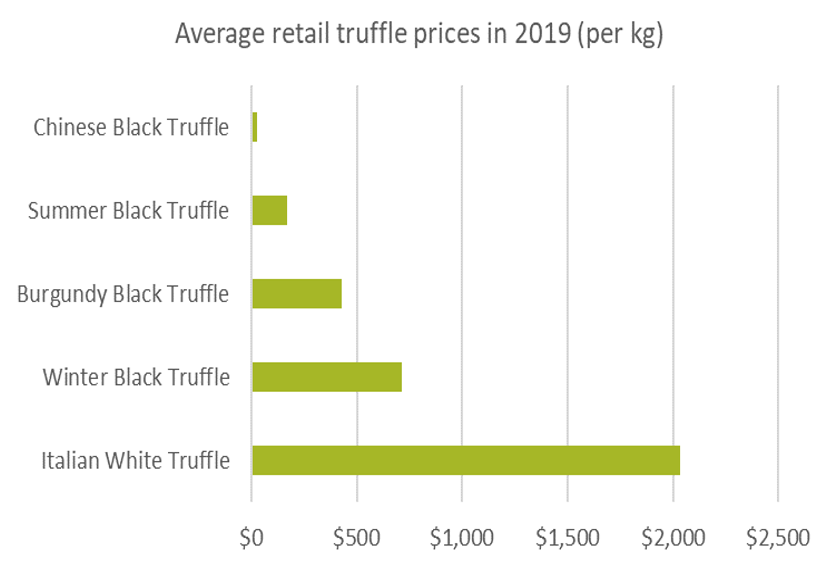
Average retail truffle prices in 2019

Source: https://truffle.farm/truffle_prices.html

We can find strong evidence in historical articles on culinary culture that 18th and 19th century Europeans consumed truffles abundantly, from which it can be concluded that this fungus was not expensive. In the last 100 years, crops in the regions of Italy, France and Spain have decreased from a harvest of 2,000 tonnes a year to just about 20, due to global warming, acid rain, and, more recently, heat waves and reduced rainfall.

Scientist Ulf Buntgen, in his latest study ‘Black truffle winter production depends on Mediterranean summer rainfall’ (for which he used 49 years of continuous harvest and climate data from Spain, France and Italy) claims that truffle production rates from November to March significantly rely on previous rainfall from June to August, and that too much autumn rain adversely affects the later winter harvest.

The question might be asked how the market manages to survive. The logical answer would be that dealers have turned to alternative sources. Truffles themselves are not uncommon. Many sources in Europe still under the radar are producers in Croatia, Poland, Serbia, Albania … where they grow the same species as in the three most popular European regions. Why is that so? Truffles that are claimed to come from France or Italy (regardless of country of origin) achieve a premium price.

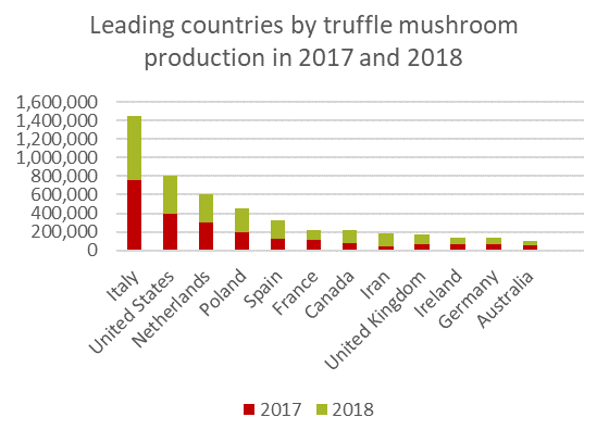
China has been, for several years now, the largest producer and exporter of truffles in the world. However, the quality of Chinese truffles is not satisfactory to any world standard, so their market price is very low. Australia and New Zealand are also on the horizon, but their production only covers their local demand. With the greatest sadness, one must also ask: will the Australian truffle market survive the devastation brought by the recent forest fires? The US has also entered the market recently, but it cannot be considered a serious competitor to the Europeans as yet.

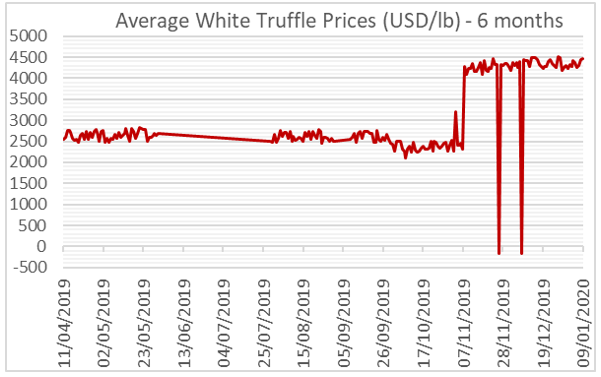
All the sources combined are not enough to keep up with the demand for this delicacy. In 2019, a pound of quality black truffle cost about $650, and white almost $2000 (however the price soared again in November 2019). In 2017, due to too much drought in the previous year, the yield of white truffles was so weak that the price of one pound of white truffles skyrocketed to $4000.

Average white truffle prices (USD/lb)

Source: https://truffle.farm/truffle_prices.html

London restaurateurs charge around £5 per gram of truffle shavings, claiming they make no profit on truffle, but the reason for the offer is the quality of the dish: ‘only few shavings can turn the dish from ordinary to extraordinary’.

Because of their hidden underground life cycle, truffles have aroused the interest of many scientists and many mysteries about them have now been revealed, though not all.

Truffles are hypogenous fungi: that is, unlike mushrooms on stems, they grow underground. Buried, their interaction with the rest of the living world is very complex. They depend on their hosts on which they feed, which are primarily oak and hazelnut trees and fir trees. The development of truffles is a wonderful harmony between the tree and the truffle itself: the tree provides the truffle with sugar and the fungus gives the tree nutrients from water and soil. Fertilisation depends on the animals they can feed with their trunks, not on the wind, to spread its spores. To attract the attention of animals, when truffles mature, they turn on their spectacular scent, sending signals to anyone available to them that they are ready to be excavated so they can be dispersed.

But if truffles are so rare and desirable, why not just grow your own? The answer is that truffle cultivation is harder than it looks, and many scientists have addressed the issue. In recent decades, techniques have been developed to vaccinate tree seedlings with truffle mycelium, but the process is still difficult and does not necessarily guarantee that truffles will mature. Italian white truffles do not respond to these techniques at all, while French black truffles, on the other hand, are more susceptible to domestication.

Leading countries by truffle production in 2017 and 2018

Source: Leading countries by mushroom and truffle production 2018 (source: https://www.atlasbig.com/en-us/countries-mushroom-truffle-production) Leading countries by mushroom and truffle production 2017 (source: https://www.worldatlas.com/articles/the-world-s-top-producers-of-mushroom-and-truffle.html)

The irrigation technique remains a safe method to preserve the survival, especially of the white truffle, as Buntgen observes in his work, but this also has its limitations. Recognising the vulnerability of the sector, there is a need to further foster stronger connections between farmers, politicians and scientists in order to maintain environmental and economic sustainability under the predicted climate change in southern Europe.

Further Information:

Brexit – a death knell for UK birds?

The UK’s wildlife is under pressure. A no-deal Brexit would only damage it further.

A skylark

Skylarks in the UK – soon to be lost?

The State of Nature Report 2019 paints a bleak picture of the condition of birdlife throughout the United Kingdom – the UK’s departure from the European Union will only exacerbate this. According to the report, since 1970 the abundance and distribution of the UK’s species has declined with “no let-up in the net loss of nature” in recent years.

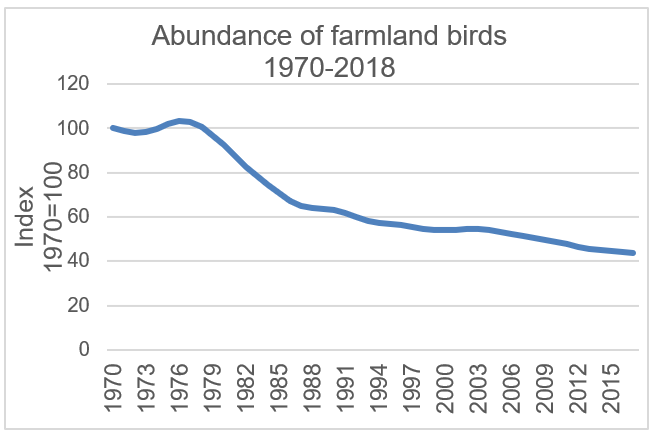
Since 1970, 41% of all UK species studied have declined and the report concluded that intensive management of agricultural land is the key contributing factor. The clearest evidence of this is the report’s findings on farmland birds – these species have been hit particularly hard by farming intensification, as shown by the 54% decrease in the Farmland Bird Indicator in this period (fig. 1).

fig 1 - British Trust for Ornithology (BTO), Royal Society for the Protection of Birds (RSPB), www.jncc.gov.uk

fig 1 – British Trust for Ornithology (BTO), Royal Society for the Protection of Birds (RSPB), www.jncc.gov.uk

While there are some exceptions to the trend and recent initiatives by Defra and the EU LIFE programme have helped to stem the decline, once-common birds like lapwings and skylarks, yellowhammers and grey partridges are fading from our countryside.

Farmers – friend or foe?

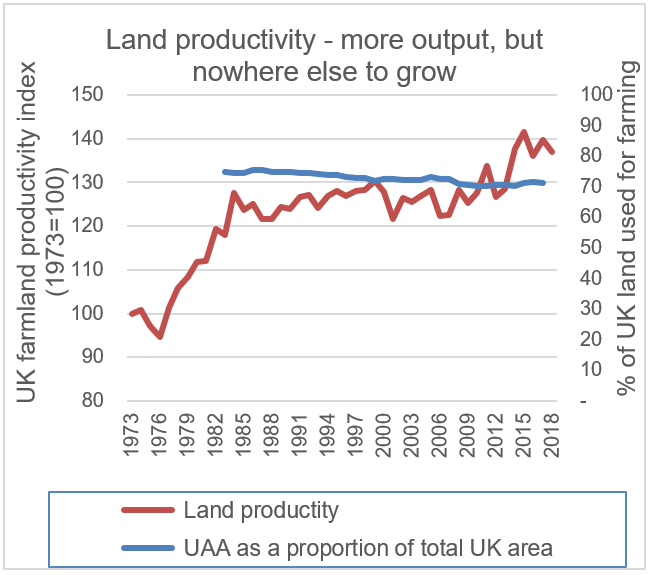
The UK’s farmers have long been seen as protectors of the countryside, but in a competitive environment the industry has resorted to increasingly intensive farming methods.  The land available for farming – the Utilised Agricultural Area (UAA) – has remained around 70% of the total UK land since the 1980s (ONS) and without more land available, farmers have been forced to improve productivity wherever they can, resulting in intensification of production methods (fig. 2).

fig 2 - Department for Environment, Food & Rural Affairs - https://www.gov.uk/government/statistical-data-sets

fig 2 – Department for Environment, Food & Rural Affairs – https://www.gov.uk/government/statistical-data-sets

The productivity index for UK farmland shows an ever upward trend – new technologies play a part, but intensive land management is the key driver of these gains.  For arable farming, intensive farming methods include increased pesticide use, planting multiple crops per year, the reduction in fallow years and extensions of planting seasons, while for livestock it is rotational grazing, higher livestock concentration and overfertilisation of pasture.  All methods impact wildlife.

Self-sufficiency

According to DEFRA, the UK is 61% self-sufficient in all foods – if, from January 1, the UK tried to survive solely on domestic production, we would run out in mid-August.  Much of this production deficit is filled by goods imported from the EU – in 2018 £19.1bn of the £24.3bn deficit was with EU 27 countries.

fig 3 - Department for Environment, Food & Rural Affairs - https://www.gov.uk/government/statistical-data-sets

fig 3 – Department for Environment, Food & Rural Affairs – https://www.gov.uk/government/statistical-data-sets

While the NFU has urged the government to focus on improved food self-sufficiency following Brexit, a trade deal with the EU is crucial to secure food provision. The UK government is working towards a trade agreement, but the timeframes envisioned by the Prime Minister make a satisfactory conclusion in this area unlikely. A 2018 report focusing on potential trade agreements between the UK and the EU, produced by LSE Consulting, noted that the “agricultural sector…is often highlighted as one of the most sensitive sectors in trade negotiations” and as a result “there may be limitations on what is attainable” when it comes to any trade agreements, particularly regarding tariffs. Products could potentially be sourced from alternative trade partners, but in the short term it is likely that the UK will look to domestic farmers to fill any shortfall.

Freedom of labour is not a topic which this blog has space to address, but 8% of UK agricultural workers are EU migrants with an uncertain future in this country (House of Commons briefing paper – 7987).  Farmers face the prospect a decreasing labour supply alongside a demand spike.  Increased demands will have to be made on the land available for production and intensification will only escalate, exacerbating wildlife decline.  Unless a trade deal can be reached with the EU the pressures from intensive farming will not ease in coming years and our countryside will be increasingly dangerous for our birds.

This blog was contributed by Henry Mummé-Young, MSc Politics, Philosophy and Economics student.

Further Information:

Introducing Birkbeck’s MSc in Governance, Economics and Public Policy

Sue Konzelmann, Programme Director, shares the rationale behind this interdisciplinary Master’s.

When, as in 2015, one group of economists publicly support proposed new economic policies in the press – immediately resulting in another set of economists reaching for their word processors with an entirely opposing view – it’s a pretty fair bet that the ensuing debate will be at least as much about politics as economics.

Nor is this anything new; John Maynard Keynes and Friedrich Von Hayek routinely traded blows in a similar public way between the two World Wars, influencing politicians and governments of very different shades in the process.

You might think that you’d be on firmer ground with corporate governance and its more legally based rules. That is, until you remind yourself that those rules are also largely set by government – and that the views of Clement Attlee’s 1945 socialist government and Margaret Thatcher’s Conservative government less than forty years later would have been as wildly opposed on corporate governance as they were on pretty much everything else. Whilst Attlee’s government was part of what is (yes, you’ve guessed it) debatably described as the “Keynesian consensus”, Thatcher’s handbag was famously home to Von Hayek’s The Road to Serfdom.

However, in spite of these three subjects – economics, politics and corporate governance – being inextricably linked, they are usually taught separately, an approach which inevitably loses much of the richness of what is, after all, a game that anyone wanting to influence public policy will have to learn to play.

There is, of course, no rule book to follow. Such rules as there are, may be rewritten at any point in time, and for a variety of reasons – but that’s what allows policy to evolve in response to a changing world, changing conventional wisdom or changing politics. It’s a heady mix.

Birkbeck’s new MSc in Governance, Economics and Public Policy not only shows how each of these areas influences – and is, in turn, influenced by – the others; it also sets them into their academic context and relates them to real world events and outcomes.

Although the course was initiated at the suggestion of the Progressive Economy Forum, which has strong links to one of the two opposing groups of economists already mentioned, the course will be taught by colleagues from three of Birkbeck’s world leading Departments – Management, Economics and Politics – with a wide variety of perspectives.

I anticipate that there will be some lively discussions with and amongst the students as well. As a result, one of the first rules to go out of the window, will probably turn out to be the one about never discussing politics in a pub!

Further Information:

Banking by day, Birkbeck by night

Mina Yau studied the BSc Economics with Business at Birkbeck while working full-time at the Bank of England.

I applied for the Bank of England school leaver programme after completing my A-levels in Economics, Accounts and History. After a successful application, I was able to start full time at the Bank of England. This meant I chose to work instead of pursuing further education, however I did not want to regret this decision and miss out on university. As such, I decided to take on further studies after my one-year probation at the Bank. It was difficult to find a university where I could continue working. However, Birkbeck gave me the opportunity to pursue further education whilst working full-time by offering evening classes (and an extra bonus of part-time studying across 4 years).

The Economics, Maths and Statistics classes at Birkbeck really helped develop my career in the bank as they taught me the necessarily skills for my day to day role. Whether it was better understanding how the economy works, the maths behind the metrics or even data programming – Birkbeck really helped widen my knowledge and skill set.

At the Bank of England, I started as a school leaver in the Data and Statistics Division, where I would collect data from banks and building societies via our internal systems and process this to specialist teams. After, I moved to the Financial Stability, Strategy and Risk directorate, working in the Macrofinancial Risks Division in the Households team. Here I was able to deep dive into risk metrics relating to Households and built a very strong understanding on housing data. I then moved to the bank’s Resilience Division where I currently work; this is similar to my last role but more focused on risks and the resilience directly to banks.

Diligence is fundamental for balancing work and study commitments. Often, late nights are required at work, which meant I was unable to attend some lectures. Luckily Birkbeck does have facilities such as room recordings which means I am able to catch up with classes over the weekend. Thankfully, the Bank of England is also filled with talented colleagues who are able to explain and help with any queries on the classes or homework which makes studying a lot easier.

If you’re in doubt on whether or not to apply to Birkbeck due to work commitments, I highly recommend just going for it. It’s an excellent learning opportunity and gives high rewards. I can proudly say that not only after four years at Birkbeck (part-time study) I have completed my degree, I also have five years’ experience at the Bank of England to go with it.

Finally, I’d like to mention Tony Humm, a fantastic lecturer for Maths for Economists – it’s a very well taught class and definitely my favourite module! If you have a choice, I highly recommend taking this class!

Further Information: