Author Archives: B Merritt

Free China?

On the anniversary of the Tiananmen Square massacre, Dr Andreas Liefooghe of Birkbeck’s Department of Organizational Psychology explores the powerful message of the award-winning documentary Free China, and asks why the West lacks the courage to believe.

For the first time, the service industry accounts for more than half of China’s economy, with manufacturing now accounting for less than 40%. Reports state that this is because of a burgeoning, and wealthy, middle-class doing what they do best: consume. Yet this is only part of a story.  For every Vuitton bag sold (fake or otherwise), someone else labours not for a minimum wage, but for nothing at all. Beyond the glossy facades of Shanghai and Beijing lies the ugly underbelly of repressive China. The laogai system provides labour from ‘criminals’ and prisoners incarcerated for ‘crimes against the regime’ who need ‘re-education’. Those Homer Simpson slippers you are wearing may just be made by one of these prisoners, and perhaps it’s time to listen to some alternative account of China’s might.
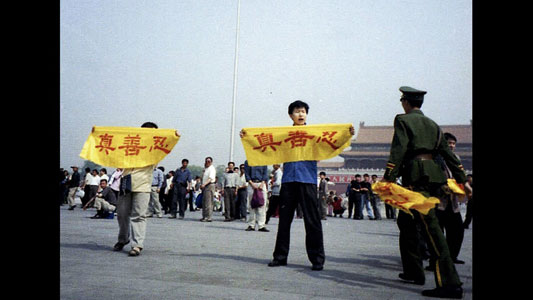
On the 24th anniversary of the Tiananmen Square Massacre, the documentary Free China: The Courage To Believe does just that. Following the lives of two protagonists, Free China tells the story of Jennifer, a mother and former Communist Party member, who along with more than 70 million Chinese people, was practicing a belief that combined Buddhism and Daoism, until the Chinese Government outlawed it. The Internet police intercepted an email and Jennifer was imprisoned for her faith. As she endured physical and mental torture, she had to decide: does she stand her ground and languish in jail, or does she recant her belief so she can tell her story to the world and be reunited with her family? A world away, Dr. Charles Lee, a Chinese American businessman, wanted to do his part to stop the persecution by attempting to broadcast uncensored information on state controlled television. He was arrested in China and sentenced to three years of re-education in a prison camp where he endured forced labor, making amongst other things, aforementioned slippers sold at stores throughout the US.

As political scandals surface and tensions rise, along with more than one hundred and fifty thousand protests occurring each year inside China, this timely documentary highlights the issue of unfair trade practices with the West, organ harvesting of prisoners of conscience and widespread forced/slave labor. The film also highlights how new Internet technologies are helping to bring freedom to 1.3 billion people in China, and other repressive regimes throughout the world. Free China also has another aim. It has partnered with an internet technology team, who have developed new peer-to-peer software, which allows users inside China to safely and securely breakthrough the Great Internet Firewall, and access uncensored information. This is hoped to allow Chinese people with alternative sources of information, to be able to make more informed decisions about their own future, and to help transform ‘China-net’ from a tool of control and oppression into one of freedom of expression on the world stage.

This week from the 4 June people can buy DVDs of the film, plus there will be theatrical releases in New York and Los Angeles, as well as a series of international screenings. Despite high-profile endorsement, very little is heard of this story. As we continue to court China for its economic power, perhaps we also need to check our courage to believe some alternative accounts.

Free China was screened at Birkbeck on 18 March 2013 as part of the Vulnerable Selves, Disciplining Others ESRC Seminar Series, examining the relationship between vulnerable individuals and oppressive regimes. We were joined by the producer Kean Wong, protagonist Jennifer Zeng, and interviewee Ethan Gutmann, and became part of a list of screenings alongside US Congress and EU Parliament.


Beyond Bad Apples: Bullying at the BBC

This post was contributed by Dr Andreas Liefooghe, a Reader in the Department of Organizational Psychology.

The Respect at Work Report states that ‘uncomfortable levels’ of bullying are being reported at the BBC. Uncomfortable to whom, we might ask.  A corporation that prides itself on people being “our greatest strength” has to cope with increasing levels of criticism of the way it treats and protects its employees. Covering the period between 2005 and 2012, bullying behaviour appeared to go unchallenged by senior managers, with certain individuals “seen as being untouchable due to their perceived value to the BBC”.

BBC director general Tony Hall wants “zero tolerance of bullying”, and emphasized he wants to get rid of the culture of fear, and “get employees to speak out” about bullying. Following in the footsteps of many a Chairman before him, he will focus on changing behaviour from the top. Professor Stale Einarsen from the University of Bergen suggested in a recent lecture at Birkbeck that bullying had little to do with good or bad leadership – it was those leaders that do nothing and create a vacuum that really damage the culture in organizations. People are not huddling in corners in fear of a perpetrator out there, but they are de-spirited and humiliated by ever demanding working practices. For this reason, a policy to ‘get rid of bullies’ in organisations will only have a limited effect, and will not address these organisational issues. Bullying is arguably far more often the system and one’s role in it than individual personalities, stated Prof Einarsen.

It strikes me that Lord Hall is somewhat disingenuous. Employees have spoken out, they may perhaps not have been heard. Bectu (the media and entertainment union) reported as early as 2008 that the culture at the BBC was one of fear. Why was this not picked up then? The Savile Enquiry gave rise to this current report, but it seems that what is being reported goes way beyond some individual culprits and bad bosses. The 500 or so voices of these employees point to something far more akin to institutionalised bullying. If the link is made here with findings on racism, for instance in the MacPherson Report , it becomes clear that it is not just about a few bad apples that need to be removed from the organisation, but the very practices (from recruitment and reward to ‘how things are done around here’) that need to be scrutinised.

The BBC is not alone. My research since 1998 has consistently shown that to stop bullying it’s not personalities but the systems and policies that need to be tackled – many of these are designed to cut costs, not to preserve dignity nor foster respect. Within these systems, managers are put under pressure to increase staff performance, reduce overtime, and cut costs to meet their targets – how employees experience this process is not top of the organizational agenda. BBC employees, like many others elsewhere, feel their respect at work is eroded by being kept in the dark, being serially restructured, not being consulted in earnest, feeling that sauce for the ‘grafting’ goose is definitely not sauce for the ‘talented’ gander. Telling the author of the report that the above is bullying corresponds closely to Bectu’s findings, and indeed the NUJ comments on institutionalised bullying.  Yet BBC responses to the report’s findings seem designed to tackle only bullying of the inter- and intra-personal kind.

Part of coping with bullying is challenging the organisational systems that in an ever increasing, unrelenting fashion erode the self-esteem and self-efficacy of an entire workforce – as evidenced by this recent report. What can be done to stop this organisational bullying and change a culture of fear? Arguably, the answer would be to question all organizational policies that are in place, and evaluate these in terms of their appropriateness with a dignified working life, balancing values with costs. So not just re-writing your bullying policy as suggested, BBC, if you really want to tackle these issues.

Dr Andreas Liefooghe has recently completed an ESRC Seminar Series on bullying at work called Vulnerable Selves, Discipling Others, footage available on line. He is currently analysing data from the first pan-ASEAN research study into bullying at work.

Should we prize literary prizes?

This post was contributed by Bianca Leggett, a research student in the Department of English and Humanities.

It only takes a cursory look around the fiction section of any bookshop to see that literary prizes are big business.  Proclamations of prizes won and novels shortlisted clamour for attention alongside ‘3 for 2’ stickers and snippets of glowing reviews on every cover.  But are literary prizes more than just another marketing tool?

The weight which literary prizes hold with the reading public suggests a desire to be guided towards new and exciting literary fiction. In this sense, literary prizes provide a healthy counterbalance to a publishing industry which sometimes only seems interested in authors who have attained the status of celebrities or celebrities who fancy themselves authors. Nevertheless, the proliferation of literary prizes in this country risks reducing the attempt to draw special attention to the chosen few into a general cacophony of criticism.

According to James F. English, the rise of literary prize culture is ‘one of the great untold stories of modern cultural life’ whose examination raises questions about ‘the very nature of our individual and collective investments in art’. Many of the questions raised relate to the criteria by which literary prizes are awarded, which is also to say, the criteria by which some are excluded. This applies, not only to the inevitable fuss when a favoured author or book fails to make the cut, but also to the way prizes are delimited on the basis of gender, genre, age or nationality. The character of each prize is defined by which particular group of literature or authors it has chosen to support and promote, yet too rigorous a policing of its own borders risks seeming arbitrary or, worse, exclusionary. Controversy last week over Granta’s inclusion of Kamila Shamsie—a Pakistani author in the process of applying for British citizenship—in their Best of Young British Novelists list, is a case in point. Had Granta chosen not to include Shamsie on the basis of her lack of citizenship, though, the result would probably have been the same.The increasingly transnational nature of authors and their works is just one of the challenges to the traditional taxonomies upon which many literary prizes are based as they attempt to keep pace with the literature they judge.

Literary excellence, always ostensibly the most important factor in prize culture, is also subject to redefinition as values shift and change. When the 2011 Man Booker Prize committee declared the importance of ‘readability’ in their judging criteria, they unleashed a storm of debate about whether literary prize culture is inherently elitist and, if so, whether this constituted a problem. Critics like Allan Massie hit back saying, ‘Everybody is elitist when it comes to subjects they care about, quick to applaud what they think good and to disparage what doesn’t, in their opinion, measure up’.

But what measures up and what does not remains a difficult question to answer. Should worthy themes weigh more with us than dazzling prose?  Should a formally innovative novel be valued over one which moves us or can tell a captivating story? Philip Hensher, compared the Man Booker unfavourably to Granta’s list, arguing that it over-emphasised ‘significance’.  He went on rather glibly, ‘[b]rio, unlike the decision to write a long dull novel about a historical genocide, is a quality that tends to last’. If Hensher is right and we have reached a point where literature is divided into well-crafted and entertaining novels on the one hand and worthy but clumsy ones on the other, then it’s a depressing state of affairs, although one suspects that as a beneficiary of the 2003 list Hensher might be talking up the ‘brio’ camp to which his own books presumably belong.

Clearly no one is impartial in the question of what makes great literature and consensus will always prove elusive, but the attempt to settle the question comes around again whenever a literary prize is on the horizon. Anticipation in the build up to the new Granta Young British Novelist list, announced last week on 15 April, was intense for a number of reasons. Not least this year was the knowledge that—since authors over the age of 40 are not eligible—Hilary Mantel would not be swiping this one…  The Granta list differs from its fellows in that it comes around only once in every ten years but also because it rewards potential rather than established talent.  It has a good track record for spotting promise in authors not yet on most readers’ radar and of suggesting the shape of the literary landscape yet to come.  Despite some sad omissions (Courttia Newland and Jon McGregor are, to my mind, the most surprisingly overlooked) it’s an exciting list which suggests some interesting new trends. For one thing, there are a record number of authors who are expats, recent arrivals or of dual heritage, suggesting (as with the inclusion of Shamsie) that the prize committee wished to reflect an increasingly global outlook. The authors chosen also tend to straddle artistic boundaries, combining their career as novelists with games writing (Naomi Alderman), film making (Xialou Guo), conceptual art (Steven Hall) or sculpting (Jenni Fagan) to name but a few.  It’s also perhaps the first list to feature two writers (Naomi Alderman and Steven Hall) who have written for Doctor Who. What does it all mean?

Perhaps not as much as all that. After all, prizes are determined on arbitrary criteria by a small number of people whose judgement often errs, blinding us to the best in literature as often as it alerts us to something worthy of our attention. At the very least, though, they stir up debate and conversation about what it is we value about literature and where we should be looking for the stories that matter to the times in which we live. Not all prizes are of equal value, however, and it’s worth staying reflective about what they really represent. It seems to me that the public needs some guidance about which are the prizes that really matter, perhaps a small committee of expert individuals who could determine what makes a good literary prize and draw attention to those which are most merit worthy… Would it be taking matters too far to establish a prize for literary prizes?

I don’t feel like dancin’

This post was written by Professor Lynne Segal, Anniversary Professor of Psychology & Gender Studies in Birkbeck’s Department of Psychosocial Studies.

‘Margaret Thatcher is Dead: This lady is not returning!’ is one way of the calmer statements celebrating Thatcher’s demise on my Facebook page. I can’t join the clamour singing ‘Ding dong the witch is dead’, trailing as it does its horrific historical sexism. More sadly, I can’t see anything to celebrate. Whilst this once formidable Tory trailblazer is dead, her ideas are more resurgent than ever. Neither Cameron nor Osborne will ever be damned as a warlocks or necromancers – this rarely happens to men – yet it is thanks to them that Margaret Thatcher dies triumphant. Thatcher’s success, like that of her pal, Ronald Reagan, was that through a combination of shrewdness and luck she could ride the high tide of corporate capital’s determination to increase profits by rolling back all the popular gains of the postwar settlement. She was neoliberalism’s willing tool, rather than something unique, evil or otherwise.

What is truly extraordinary about these times is that while Thatcher’s economic legacy has imploded, her ideological stance – which as she said was always her main agenda – is more viciously enforced than ever. “Markets know better than governments”, was her pivotal mantra, the rest flowed from this. Oh no they do not! You would think we must all have learned this from the catastrophic economic collapse in 2008, when so many banks had to be bailed out by governments, only to be returned as quickly as possible: old bonuses intact; new regulations nonexistent. All too quickly forgotten is the revelation of the cruel absurdity of the economic collapse set in motion by the buccaneers of the finance sector that Thatcher had ‘liberated’ in October 1986, with all the reckless gambling and belief that ‘toxic debt’ was itself a tradable commodity. Or at least, any such knowledge is drowned out by the continued combination of Coalition rhetoric baiting Gordon Brown and the Labour Party, together with relentless media attacks on the ‘undeserving’ poor, or any other scapegoats conjured up to misdirect people’s sense of resentment, fear and insecurity: ‘Crisis: Blame the baby boomers, not the bankers’, was a typically absurd headline in The Times when Irish Banks banks were on the point of collapse at the start of 2010, summarizing the argument by their chief economic analyst, Anatole Kaletsky.

In these topsy-turvy times, any thoughtful, reforming responses to the crisis, no matter how carefully argued and widely supported by fellow economists – such as those put forward by the highly respected American economist, Paul Klugman – are tossed aside in the UK. No reference to Keynesianism or any policies for decreasing the obscene inequality that helped generate the crisis are considered. Instead, after so much mayhem, Thatcher’s worship of market values rules supreme, motivating vicious cuts in welfare and the surreptitious turning over of what remains of the public sector to the private, even as the crisis in market forces and the finance sector continues to deepen, especially in Europe.

Of course there have been impressive flurries of resistance, and for a while in the wake of the Occupy movement, grass-roots dissent was back on the political agenda. Networks of resistance are active around the country, especially in defence of the NHS. Yet those eager to dance on Thatcher’s grave have much thinking to do, when there remains such a lack of connection between protesters and mainstream politics. Indeed, as Paul Mason admits in his book celebrating all the new protest movements around the globe, Why It’s Kicking Off Everywhere, most of the people he interviewed ‘were hostile to the very idea of a unifying theory’. Yet it is surely some sort of compelling counter-ideology and alternative strategy to the ubiquitous rule of market forces that we are desperately in need of if we are ever to safely bury Thatcher. Although the rich few get richer and the rest of us poorer, the left has yet to strike any real chord with the broader public. We know that it was Tony Blair, or ‘Blairism’, which – as Thatcher knew – did so much to entrench her legacy: with his seamless endorsement of market values and public veneration for wealth and celebrity, even as it furthered cynicism about politicians and politics generally. We have headed so far down that stream, it is hard now to turn things around.

It took the extraordinary conditions of the Second World War to create the Labour Party’s comprehensive commitment to welfare, albeit of a conservative and authoritarian kind. The reforms and nationalizations inaugurating the British welfare state, post 1945, were based on the deliberate spread of a consensus that it was economic insecurities and domestic unhappiness that created unhappy societies: ‘many of the maladjustments and neuroses of modern society’, as Bevan explained when Minister of Health, arose directly from poverty and insecurity. When will our politicians say these words again? Any direct action, movement politics or coalitions of resistance we build today has to find ways to influence national government to reaffirm that mind-set, hopefully with more creative agendas than hitherto, before we can bury Thatcher. And since I began with a feminist note, let me also end there. Some women have argued that it was Thatcher who provided the best role model for helping women release their true potential. No she did not. She was the perfect role model for the ever deepening gulf between women, as the privileged few have been able to rise to the very heights of political or corporate power, even as the majority of women, affected at every turn by the rolling back of welfare and the politics of individual success she promoted, are ever more firmly left at the bottom of the heap.

Lynne Segal’s new book Out of Time: The Pleasures and Perils of Ageing will be published by Verso in the Autumn.

World Poetry Day 2013

Today is World Poetry Day and to celebrate we are sharing a selection of poems by Birkbeck’s BA Creative Writing second year students and their teacher, lecturer Liane Strauss.

Airborne
by Samuel Langworth

The bone of those high vaults
could not contain them.
They bled from the dark ink
of their deliveries, bigger
than whiteness. They outgrew
the walls of their birth-rooms.
They could not be housed.

They were too big for their communities.
They stretched across boundaries,
monolithic capitals, more
than all cities combined.
They outgrew their horizons –

and they burned through borders,
illuminating tongues.

And Greece could not contain them,
and Taiwan could not contain them,
and Mexico could not contain them,
and Antarctica could not contain them,
and Sierra Leone could not contain them,
and the Solomon Islands could not contain them,
and Trinidad and Tobago could not contain them,
and the earth could not contain them,
and the sea could not contain them,
and they rose, they rose,
converging over the world,
and the sky could not contain them,
and they burst
in one
golden cry of light.

And the world listened.

§

A New Chapter
by Yvonne Stone

I hesitate,
then turn the handle,
opening a new chapter.
I enter the room.
I deflate my rubber legs
and collapse into the nearest seat.
The seat protests violently.
It avenges itself
and announces my arrival.
I smile politely,
Not even sure I’m in the right place.
My confidence drains
before I can plug the holes with “hellos”.
I need a witty remark
but my brain is ice,
frozen by the glare of the bright room.
A refrigerator full of talent,
freshly filled with youthful optimism.
I must be in the wrong place.

§

Swallows
by Walter Jones

In spring on a mock piazza you built
A nest inside my heart and I built one
In yours and together we flew
On the ascent of summer, crossing continents
Where nests are built under the pokey-outey
Bits of castle walls, built for war,
So we do battle
Against the rain inside this other world,
Soft and persistent, like love,
With keen eyes fixed on the future:
Our journey home, reflected on lakes and rivers
And every grain of dazzling beach sand.

Descending to rest on neglected garden furniture
Washed up in the quiet tide of winter.

§

Blow in
by Kirsten McLaughlin

What do they really think?
They are friendly enough,
will buy you a drink, laugh,
and welcome you in.
You, who carry the sins of the father,
or rather, a Mother Country, in your blood.

What do they really think,
when, God knows why, you try
to justify your presence with a genetic link
to O’Neils on your mother’s side,
and spend hours talking about mackerel
and mullet, and earnestly discuss tides
with men who know exactly who you are,
and where you live, and what you drive;
even the colour of your swim suit this year
and the rock you sometimes dive off.

What do they think when you keep coming back;
prepared to open and shut an extra gate
someone put across the track; that you stack turf;
riddle the stony earth and plant potatoes.
When you push into the bar and heads turn,
or not, in your direction, what makes you sense
you are merely a tolerable interruption?

And what do they really think,
when you sink your fourth pint of Guinness?
Does it impress? Does it make you less
of a blow in? Does learning how to build
a dry stone wall that doesn’t fall within the year
endear you to those around? Or does the sound
of your English accent grate, and agitate old wounds?

You will never know, you will blow in, and out,
harbouring doubt, which could be unfounded,
hounded, by your own ghosts.

§

Transcend
by c c bowden

He combs the shore,
strokes gold and silver particles
that glimmer from his gaze,
christened by waves
too long ago to remember.
Travelling light forever
daily dawn embraces.
Yawning je t’adore

§

Schizophrenic
by Guillaume Vandame

Sometimes it snows and seconds later the sky will shine.
The world becomes a pale blue moonstone
And you can see the thick silhouettes of the branches.

Then the snow melts and runs down the panels of glass in thin streams.
The sun reflects in low glass cells and glows for a minute.
The water dries and the sky settles into the bed of evening.

§

Shrug
by Catherine Speight

These shoulders that you liked to kiss
Are raised towards my ears
To tell you that I heard you
But I’m going to hide my tears.

You’ve felt the falter in my voice
As the countdown scratches on.
It says Dubai’s too far away
And six months is far too long.

This little fleshy crease
In the corner of my mouth
Is there to stop the caustic words
From firing straight out.

Now, awkwardly my head tilts
As it tries to say I’m strong,
But you just said “we’ll be ok”
And we both know that you’re wrong.

Maybe I can shrug you off
And let this all fall down.
Your posting starts tomorrow
And you need to pack now.

§

Paranoid
by Bruce Coker

Some days I feel like
everybody’s looking at me;
other days, nobody.
I can’t make up my mind
which is worse.

§

Glass Bottom Car
by Liane Strauss

Windows are overrated.
I never liked fairs.  Landscapes
like a ground bass, scene after scene.
Auger bit developments. Mortis and beam.
Oak elm pine white green bare trees.

The high streets, the highways
go felly round spokes. Celluloid living,
a wooden-maned horse. Film frames on sprockets
cranked by telephone poles,
trick magic old-world lantern shows.

My windscreen was snow-blacked,
bug-juice grimed. I didn’t want windows.
I covered them up. The metronome wipers
couldn’t clean or keep time.
When you’ve seen this world once it’s enough.

I like to go fast
in my glass bottom car, the macadam moonscape
is never the same, the cracks in the craters,
they break my heart,
on the coal-colored lard milky way,

and never look up,
watch the road rush black, rich river oil
torrents in hard rain, streamers riding the wind
snapped and no way back
in my glass bottom beauty machine.

The Gender Agenda in the Business Agenda: of Women’s Empowerment Principles Events and gender equality in marketing

This post was contributed by Dr Wendy Hein, a lecturer in Birkbeck’s Department of Management.

How to increase women’s leadership positions and empowerment was central to the recent UN Global Compact Women’s Empowerment Principles (WEP) Event which I attended earlier this month. These principles are an initiative, mainly adopted by private sector organisations, to work towards equality based on seven fundamental guidelines. The conference brought a range of leading companies, policy-makers, non-profit organisations and business educators together. The WEP’s main message for equality is that it ‘means business’. Equality is, in fact, seen to drive growth and potential within organisations. There is a resulting importance in retaining talent and maintaining women within the value creation process, to enable them to reach ‘the top’. This certainly touches on some important issues of contemporary work life. In this particular event, the need to mobilise men to participate in the necessary changes was also heard loud and clear. If we are looking to change existing gender dynamics and structures, we should incorporate those who are occupying ‘top spots’, who tend to be men.

Measuring talent, value and work

Yet, more fundamental challenges of how we measure talent, what we perceive as ‘value’, what constitutes ‘work’, or of the cultures that some companies are built on remained implicit. The language in the above paragraph already reflects a culture of organisations that exist from the ‘top’; that are competitive and fast-paced. Rather than seeking to integrate women into organisations that often represent masculine values, and asking them to embrace these, is there not more that women can and should do? Also, when it comes to women’s working lives, all too often it is not just about ‘business’, but also about the ‘personal’. Men’s private lives can certainly play a role at work, but particularly when it comes to maternity and motherhood, women’s families and their commitment to a home life often enter the work arena. Considering the blurring of these lives, and a call for companies to support women and men at work, shouldn’t there also be further support of home life in a similarly equal way? Shouldn’t a mother, father or partner be as valued as the worker? Then we also come to think of those who do not have a job, either in any of these great companies, or those who do not work – what kind of support can they hope for? And if you were thinking of organisations in the UK, change the context into emerging and developing countries – what support do women and men have there for receiving an education, getting work and managing a ‘home’? It just shows how our society can be perceived to value and privilege those who are in ‘producing’ positions – but is being a mother or father not some type of ‘job’ or ‘production’?

The intersection of work culture and private lives

From my own perspective as a marketing and consumer researcher, I find the issues of work cultures and organisations meeting private lives all the more interesting. As we become involved in programmes and projects through our roles as business researchers and educators, we recognise that marketing is one area where the public blurs with the private, business with the personal, and production with consumption. Think about it: the marketing industry has its own cultures – whether we are looking at marketing departments within certain companies, marketing entrepreneurs or advertising agency culture. Marketing ‘produces’, and in very gendered ways. This becomes even clearer through initiatives such as those by Kat Gordon that seek to create a contrast to the well-documented male ‘locker room’ ad agency cultures. Kat is founder of the “3% Conference” (3% being the number of female creative directors in advertising agencies) and founder of the marketing agency ‘Maternal Instinct’, which specialises in marketing for mothers, by women. She has built her reputation on understanding female consumers (who some would argue form the majority of consumers), based on her experience that marketing for these consumers is often produced by men.

Marketing as an educational tool

Now, think about this: most ads that tell women how to be beautiful (‘you’re worth it’), successful, slim, attractive, or taking care of family, house and home, are made by men. On the other hand, these men also tell other men how to shave, how to ‘fool the missus’ into believing they are vacuuming the house (when really they are in the pub), and how a regular teenager can be chased by a herd of super-model women. Of course, I am exaggerating and these are not all the images that advertising and popular culture produces… but, there are quite a few of them. Considering the number of ads and messages that we are exposed to on a daily basis marketing is placed in quite a powerful position to educate mass audiences on gender. This then is another characteristic of marketing – it does not just address the workers of one company or organisation, but can spread much wider. Wouldn’t you think that gender equality plays a more central role here? Then again, what does gender equality mean in marketing?

We started this excursion from the marketing producer side, but clearly marketing also plays a role on the consumer side. Women and men struggle on a daily basis to live their lives through and around stereotypes often perpetuated by marketing discourse, popular culture, and social structures influenced by these. Marketing pervades our public and private lives. It tells us how to be good/bad mothers, good/bad partners, good/bad men and women, often through a creation of norms based on inclusion and exclusion. Doesn’t this clash with our understanding of equality?

Gender in management education

It is surprising to see then how some companies have focused their efforts on creating gender equality as part of internal structures or policies, when our surroundings and homes are often filled with images, discourses and practices that are frequently far from equal. What’s more, if we understand the centrality of gender in business and management (as advocated by UN principles), it is also surprising to see how often gender is (not) taught as part of management education. This however, we can change.

As part of a group of academics from across the globe who cover different business and management disciplines, I am involved in collating material, research, experiences and perspectives on gender education, in my case within the marketing discipline. To view the growing repository of teaching material that members of the PRME working group on gender equality have put together, please visit this site. This work is open to ideas, support and external contributions, so please feel free to share stories, practices (both from marketing producers and educators) or resources.

We hope this initiative leads to a re-thinking of business and management schools, and to placing gender in a more central place across all of its  these disciplines. We also hope to inspire both women and men to challenge existing structures they may encounter in their work AND home lives, and to create new images, discourses and practices that can be gender aware.

Let’s not let this gender agenda fade, for the sake of both women and men, home and work lives, in emerging and developed countries. Whether it’s business or personal, men’s or women’s day, this is too important for all of us to ignore.

Media coverage of the Iraq invasion

This post was contributed by Dr Tim Markham, Reader in Journalism and Media in the Department of Media and Cultural Studies.

The build-up to the tenth anniversary of the invasion of Iraq has featured a lot of media coverage about media coverage. Dodgy dossiers and sexed-up briefing reports have been dusted off with something like affection, while the key players are wheeled out to reprise what have inevitably become hackneyed condemnations and rationalisations, former Prime Minister Tony Blair with that look of stark incredulity that has become his default countenance. There’s nothing unusual about any of this: journalists like to talk about journalism, and the added whiff of nostalgia makes this particular temptation irresistible. It’s true also of war reporting in the post-modern era, with British and American news reports often focussing explicitly on the PR tactics surrounding the toppling of a Saddam Hussein statue or George Bush’s Mission Accomplished jamboree. But there’s a broader problem here, one which I would describe as a kind of ironised distance between our elites and the public, with journalists hovering uncertainly in between.

Iraq didn’t break British politics. Disengagement has many origins, and this was just one of a series of fruitless attempts to find political meaning or even national identity through military intervention. But the prevalence of media management in both political decision-making and as a central preoccupation of journalists gives audiences an easy opt-out, enabling a reflex scepticism about foreign and domestic policy alike. David Cameron was never going to find his Falklands in Libya, not because we’re unsupportive as a nation of the uprisings of the Arab spring, but because any sense of investment in a political system that makes decisions about foreign intervention has been hollowed out.

The atrocities of Abu Ghraib, awful as they were, gave journalists a chance to atone for what is now widely acknowledged as a collective loss of nerve at the beginning of the war. Those images became a kind of functional evil, a way of ‘othering’, as we say in the trade, responsibility for all of the nihilism, politicking and casual dehumanisation that any war entails. But however many of us chanted “Not in my name” on a bleak afternoon in Hyde Park, Iraq was and remains our war. Susan Sontag put this well, describing the photographs depicting abuse of Iraqi prisoners as representative of what we condone, however implicitly, our governments doing: “Considered in this light,” she wrote shortly before her death, “the photographs are us”.

Much has been said about the need for journalists to report war responsibly and humanely, avoiding both the reduction of conflict to spectacle and the blanket victimisation or demonisation of those caught up in it. It would be helpful too if journalists could find a way of covering the politics surrounding military intervention that avoids the feedback loop of jostling egos, sanctimonious moralising and pious outrage.

But the generalised disavowal of political responsibility for what a nation does runs deeper than how it plays out in the news. If editorial responses to military intervention range narrowly from cheerleading to sulking, and with a sardonic knowingness now the chief marker of journalistic professionalism when it comes to foreign policy and domestic politics, then this is only symptomatic of a broader, festering culture of world-weary yet instinctive withdrawal.

YouTube justice UK style

This post was contributed by Professor Leslie Moran, of Birkbeck’s School of Law and Barbara Villez, Visiting Fellow at Birkbeck Institute for the Humanities, Professor Université Paris 8

The UK Supreme Court has launched a new communications initiative.  As of late January 2013 you can watch, on demand, videos of judges in the highest court in the land delivering summaries of their judgments. Who is the audience for these five minute programmes? Is it the hard pressed smart phone/iPad generation law student, lawyer or legal advisor? No; far from it.  The Court’s press release announcing the launch of the YouTube initiative suggests the target audience is much wider. Lord Neuberger, President of the Supreme Court, is quoted expressing his hope that the videos will broaden the audience for the Court’s work. Are they the next hot internet viral sensation educating the public about the work of the highest court in the land? The short answer is ‘no way’. Are these videos a ‘must watch’ offering valuable insights into the decisions of the court? We have our doubts about that too. But they do make fascinating viewing.

The visual challenge of judicial activity

Judicial activity has been described as ‘visually challenging’. These videos do much to confirm this and do little to meet that challenge. Five minutes watching someone with their head down reading out loud from a set of papers is not great telly by any stretch of the imagination. The way the images are put together adds to this static quality, with each video being made up of two basic types of shot. Throughout, the camera’s presence is unacknowledged by the speaking figure.

There is little in the way of props or costume to attract the eye. Judges in the UK Supreme Court don’t wear special robes in court. These judges look very much like ordinary business men. There is only one female judge, Lady Hale. In contrast to this there is much to distract the ear. The microphones, built into the judicial bench, not only pick up the voice of the judge but also the endless rustle of their papers.  Coughing and other background noises regularly punctuate the proceedings. All tend to obscure the words spoken by the judge.

Adaptation from written texts

What are you going to get out of watching the highest judges in the land reading out loud? The judges, so they tell us in the videos, are ‘giving the judgement of the Court’.  But law students and other diligent viewers beware; ‘giving the judgement of the Court’ is not the actual opinion of the court. What you actually get is an image of a judge delivering a speech adapted from a press summary published on the Court’s website to accompany the judgement itself. Written initially by the judicial assistants, the judges approve these summaries and then adapt them for the ‘live’ presentation in Court. The judgment is a written text. And it is written to be read, not spoken. It is available on the Court’s website, as is the accompanying press summary.

As the videos show, the adaptation of the press summaries into scripts for a courtroom performance is problematic. Despite the rearrangements, these scripts are not easy to speak. Judges stumble over the dense text and struggle to incorporate quotations from the trial judge into oral delivery.

The videos do, however, have much to offer. You not only hear the voice of the judge but also the accent which is a marker of their social class. The folding and refolding hands of a courtroom assistant on screen behind the talking head of the judge add an unexpected physical ‘commentary’.

Television trivia?

But are many of these points indicative of the dangers of putting courts and judges on TV? Are we in danger of getting caught up in what some describe as the trivia of the moving image? Our first response is that image making and image management are central to judicial authority. As the 2008 Judicial Studies Board, Framework of Judicial Abilities and Qualities reiterates time and time again, all the core judicial abilities and skills have to be ‘demonstrated’ and communication is central to this demonstration of authority. The courtroom is one long established context in which these abilities and skills have been performed and communicated. Props, wardrobe, voice and the body all have a role to play in demonstrating and communicating judicial abilities and qualities. Video is a new communication format, context and set of challenges. It has characteristics similar to and different from both face to face courtroom encounters and the more formal and enduring qualities of the text of a written judgment.

The current YouTube videos are a return to primitive television. They are simply the result of the presence of the camera in the court. The camera appears to be no more than a tool that records an event. However as the simple editing shows, the record is subject to a degree of manipulation. The resulting image is not just mediated by the technology but has been subject to judicial control. If essential information about the judgement, the press summary and the full judgement are already available what extra is provided by these judicially approved moving images? It may well be just that there is a camera in court and that camera is a symbol of openness, transparency and a form of accountability.

But is that going to satisfy a public that lives in a culture saturated with sophisticated video imagery.  One problem with them may well be that the public is too sophisticated for primitive television. Viewers have expectations acquired from countless hours of watching complex moving images, generating high levels of visual literacy. The primitive visual aesthetics of the UK Supreme court’s YouTube videos are likely to be a real turn off. If the judges of the UK Supreme Court are going to use video available via the Internet as a means of communicating, then they may have to think harder about the moving image that it is being made and adopt a different approach to the use of the moving image as a means of communication.

Beyond Citizenship? International Women’s Day: the gender agenda

This post was contributed by Sasha Roseneil, Professor of Sociology and Social Theory and Director of the Birkbeck Institute for Social Research.

International Women’s Day is the moment each year to reflect on the ongoing struggle against the inequalities and oppressions that mean that women continue to be less than fully equal citizens. It is an occasion to stand back and think about how far we’ve come, what remains to be achieved, and how we formulate our demands for the future.

Since the late 18th century, the prospect of full and equal citizenship has animated generations of feminists. Yet citizenship is a troubling proposition for feminism because whilst it promises inclusion it always also enacts exclusion. Citizenship simultaneously creates insiders and outsiders – citizens and aliens, as well as good citizens and bad citizens. And whilst feminists have fought for a say in the running of states – as voters, workers, politicians and activists – feminism has also always been a process of exposing the limitations, restrictions and violence enacted by states through their constructions of citizenship. This paradox has intensified in recent years, as the notion of citizenship has become a buzzword in politics and academia, particularly in a Europe increasingly concerned with questions of borders and membership.

On the one hand, feminists have expanded the concept of citizenship beyond the classical concern with political citizenship, to articulate demands for wider social, cultural and economic change. The notion of intimate citizenship, for instance, has been developed to refer to the goal of ensuring that every person should be free to develop her own identity and sense of self, and the close personal relationships that matter to her, with the respect, recognition and support of the state and society. And the idea of economic citizenship refers to the right to work in the occupation of one’s choice, in a non-discriminatory job market, to earn wages adequate to support self and family and to access adequate social benefits when work is not possible. Both these concepts enable us to think more clearly about the extent to which feminist claims for full and equal citizenship have been realised. They help us to see the many successes of 20th century feminism in remaking citizenship for women. So, as well as opening up access to formal politics, women’s movements have meant that social benefits and welfare provision for women were established, economic participation and financial independence became possible, and self-determination and freedom of choice in intimate and sexual life were radically extended.

But, on the other hand, feminists continue to draw attention to the lived realities of those who are still not caught in the warm embrace of a full and equal citizenship – those suffering gendered violence and sexual abuse, the disabled and the dependent, members of minoritised, racialised and sexually excluded groups, illegal aliens and the “sans papiers”, the poor and precariously positioned, gender non-conformists and many others. From this perspective, feminism needs to ask whether the incompleteness of the victories of second wave feminism actually marks the limits of what is possible under the auspices of “citizenship”?

Perhaps there are fundamental flaws in citizenship as a feminist objective, tied as it is to the liberal individual and to the nation-state? Can the inherent vulnerability of the human body, and our fundamental human interdependence, ever be truly recognised and supported when citizenship adheres to the individual? Can the differences between peoples, and the singularity of each individual, really thrive under the universalistic intentions of citizenship?

This paradoxical situation produces a “can’t live with it, can’t live without it” relationship with the ideal of citizenship for feminism. And as with any attachment that seems to offer so much, that tantalises and teases, but that continues to fail to give us what we really want, we should ask ourselves whether we should hang on in there, trying to make the relationship work, or whether we should let go and move on? Is citizenship still an idea worth fighting for, or should we find a different language to express our yearnings for equality and our desire to belong?

Sasha Roseneil is editor of ‘Beyond Citizenship? Feminism and the Transformation of Belonging’, a new book exploring the current state and history of feminist politics (to be published by Palgrave Macmillan, March 2013), and co-editor of “Remaking Citizenship in Multicultural Europe: women’s movements, gender and diversity” (Palgrave Macmillan, 2012).

Hugo Chávez kept his promise to the people of Venezuela

This post was contributed by Dr Oscar Guardiola-Rivera, Senior Lecturer in Birkbeck’s School of Law. The post was originally published on the Guardian’s Comment is Free section.

He wrote, he read, and mostly he spoke. Hugo Chávez, whose death has been announced, was devoted to the word. He spoke publicly an average of 40 hours per week. As president, he didn’t hold regular cabinet meetings; he’d bring the many to a weekly meeting, broadcast live on radio and television. Aló, Presidente, the programme in which policies were outlined and discussed, had no time limits, no script and no teleprompter. One session included an open discussion of healthcare in the slums of Caracas, rap, a self-critical examination of Venezuelans being accustomed to the politics of oil money and expecting the president to be a magician, a friendly exchange with a delegation from Nicaragua and a less friendly one with a foreign journalist.

Nicaragua is one of Venezuela’s allies in Alba, the organisation constituted at Chávez’s initiative to counter neoliberalism in the region, alongside Cuba, Ecuador and Bolivia. It has now acquired a life of its own having invited a number of Caribbean countries and Mexico to join, with Vietnam as an observer. It will be a most enduring legacy, a concrete embodiment of Chávez’s words and historical vision. The Bolívarian revolution has been crucial to the wider philosophy shared and applied by many Latin American governments. Its aim is to overcome global problems through local and regional interventions by engaging with democracy and the state in order to transform the relation between these and the people, rather than withdrawing from the state or trying to destroy it.

Because of this shared view Brazilians, Uruguayans and Argentinians perceived Chávez as an ally, not an anomaly, and supported the inclusion of Venezuela in their Mercosur alliance. Chávez’s Social Missions, providing healthcare and literacy to formerly excluded people while changing their life and political outlook, have proven the extent of such a transformative view. It could be compared to the levelling spirit of a kind of new New Deal combined with a model of social change based on popular and communal organisation.

The facts speak for themselves: the percentage of households in poverty fell from 55% in 1995 to 26.4% in 2009. When Chávez was sworn into office unemployment was 15%, in June 2009 it was 7.8%. Compare that to current unemployment figures in Europe. In that period Chávez won 56% of the vote in 1998, 60% in 2000, survived a coup d’état in 2002, got over 7m votes in 2006 and secured 54.4% of the vote last October. He was a rare thing, almost incomprehensible to those in the US and Europe who continue to see the world through the Manichean prism of the cold war: an avowed Marxist who was also an avowed democrat. To those who think the expression of the masses should have limited or no place in the serious business of politics all the talking and goings on in Chávez’s meetings were anathema, proof that he was both fake and a populist. But to the people who tuned in and participated en masse, it was politics and true democracy not only for the sophisticated, the propertied or the lettered.

All this talking and direct contact meant the constant reaffirmation of a promise between Chávez and the people of Venezuela. Chávez had discovered himself not by looking within, but by looking outside into the shameful conditions of Latin Americans and their past. He discovered himself in the promise of liberation made by Bolívar. “On August 1805,” wrote Chávez, Bolívar “climbed the Monte Sacro near Rome and made a solemn oath.” Like Bolívar, Chávez swore to break the chains binding Latin Americans to the will of the mighty. Within his lifetime, the ties of dependency and indirect empire have loosened. From the river Plate to the mouths of the Orinoco river, Latin America is no longer somebody else’s backyard. That project of liberation has involved thousands of men and women pitched into one dramatic battle after another, like the coup d’état in 2002 or the confrontation with the US-proposed Free Trade Zone of the Americas. These were won, others were lost.

The project remains incomplete. It may be eternal and thus the struggle will continue after Chávez is gone. But whatever the future may hold, the peoples of the Americas will fight to salvage the present in which they have regained a voice. In Venezuela, they put Chávez back into the presidency after the coup. This was the key event in Chávez’s political life, not the military rebellion or the first electoral victory. Something changed within him at that point: his discipline became ironclad, his patience invincible and his politics clearer. For all the attention paid to the relation between Chávez and Castro, the lesser known fact is that Chávez’s political education owes more to another Marxist president who was also an avowed democrat: Chile’s Salvador Allende. “Like Allende, we’re pacifists and democrats,” he once said. “Unlike Allende, we’re armed.”

The lesson drawn by Chávez from the defeat of Allende in 1973 is crucial. Some, like the far right and the state-linked paramilitary of Colombia would love to see Chavismo implode, and wouldn’t hesitate to sow chaos across borders. The support of the army and the masses of Venezuela will decide the fate of the Bolívarian revolution, and the solidarity of powerful and sympathetic neighbours like Brazil. Nobody wants instability now that Latin America is finally standing up for itself. In his final days Chávez emphasised the need to build communal power and promoted some of his former critics associated with the journal Comuna. The revolution will not be rolled back. Unlike his admired Bolívar, Chávez did not plough the seas.

Dr Guardiola-Rivera is the author of What if Latin America ruled the world? How the South will take the North into the 22nd century, published by Bloomsbury.