Author Archives: B Merritt

A Dance of Death

November is Beat Bullying Month. This blog post was contributed by Dr Andreas Liefooghe, a Reader in Birkbeck’s Department of Organizational Psychology.

From minor family squabbles to nations at war, conflict is a universal fact of life, and one of its most potent features is the bully.  Last month, the CIPD journal People Management ran with the headline “Are you a bully?”, and offered a Cosmo-style quiz to ascertain what kind of bully you might be (there are, apparently, four types). Glib answers for difficult questions have clearly lost none of their appeal.

As David Cameron condemns Unite’s tactics at Grangemouth as “bullying” (they took a life-size rat to a leafy suburb to protest at the house of a director of Ineos, the Grangemouth operator), Unite’s general secretary Len McCluskey dismisses “Bullingdon Bully Cameron” as whipping up media hysteria and using bullying allegations to deflect attention from the reality of closing down factories.  This is a long way away from kids stealing dinner money, or your boss undermining your confidence.  Are we still talking about the same phenomenon?

To raise awareness of bullying, subtlety had to fall by the wayside – simple messages were important, and it clearly worked.  Awareness around bullying, both in schools and at work, has increased considerably over the past two decades. This week sees the launch of anti-bullying month for schools. On the 7 November it is National Ban Bullying at Work day. Awareness, yes. But understanding?

National Ban Bullying at Work Day is held annually in memory of Andrea Adams and Tim Field, two pioneers who devoted their lives to eradicating bullying. Not so often mentioned is Adams’ co-author, Tavistock psychotherapist Neil Crawford, who also died a decade ago. Crawford brought the subtleties of psychoanalytic thinking to the bullying at work field. “I feel I was robbed … my confidence disappeared”, states a victim of bullying I talked to recently. Stealing is at the core of bullying. Envy, Crawford argues, involves identifying with the goodness of others and stealing it. Bullies are insecure, and feed off others, sucking the life out of them.

Bully Blog Nov13

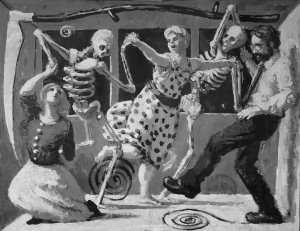
Danse Macabre, by Alex Cree

Being robbed, feeling bereft, death. Dr Sheila White, who continues and reshapes psychoanalytic thinking in the field, gives us the notion of the dance of death to understand workplace bullying.  She describes it as a perverse and pernicious form of projective identification, occurring around organizational vacuums and structural fractures. Individuals, seeking recognition, get trapped in ‘a dance of death’. Adult bullies do not have secure feelings about who they are, and through envy and the quest for recognition, hook into others and won’t let go. Her book gives in-depth insights into the core issues of workplace bullying from the perspectives of the individuals involved, their interpersonal relationships, the group dynamics and – crucially – their organizational contexts.

Bullying will only occur if the organizational context is suitable for bullying. “Just as plants only grow if the conditions of the soil, temperature, light levels etc are favourable, so bullying will only occur if an organizational context fosters a bully’s need to bully”, argues White.  So what are these unsuitable organizational contexts? White describes organizations that have vacuums where there is no support for individuals or groups. She also highlights structural fractures, where job descriptions are unclear and communication is poor or inconsistent; expectations of performance are unrealistic and there is an over-identification with targets/quotas. Often, management are unaware of how negative projections filter down the organization, generating the potential for dysfunctional behaviour along the way.

Workplace bullying is costly: increasingly petty conflicts are being registered as formal complaints and, in no time, legalities take over and costs spiral out of control. Preventive actions and interventions need to be based on a sound knowledge of the deeper issues which foster bullying scenarios.  White’s book makes a major contribution to this understanding, and is an essential read.

Dr Sheila White’s book is launched at Birkbeck on 21 November.Booking is essential.

Obituary: Post-Feminism

Professor Lynne SegalThis post was contributed by Lynne Segal, Anniversary Professor of Psychology & Gender Studies in the Department of Psychosocial Studies. This post was originally published by Feminist Times.

Writing an obituary for ‘post-feminism’ is difficult. I never loved, nor even accepted, the creature in the first place. In its different dis/guises, from Girl Power to Tory feminism, it was always a slippery, shape-shifting thing. In life, Mark Twain was declared dead twice over, quipping the first time that his death was exaggerated. In its ongoing life, feminism has been declared dead many times over, keeping its eager obituary writers always busy. Post-feminism should be easier to bury, though perhaps harder to keep safely interred.

Over sixty years ago, commencing the iconic text of second-wave feminismSimone de Beauvoir apologized for reviving a topic that was perhaps dead: ‘Enough ink has been spilled in quarrelling over feminism, and perhaps we should say no more about it’. Within days, the ink she spilled sold 22,000 copies and The Second Sex has kept selling ever since. Twenty years later, second-wave feminism could hardly have emerged with more clamour, quickly spreading the message that women’s collective efforts would change the world. ‘Goodbye to All That’, Robyn Morgan declared in 1968, when a group of young women occupied the offices of a radical left publication in New York, joined together to protest the Miss America pageant and founded the radical feminist group W.I.T.C.H. That same year, her fellow American poet Adrienne Rich was similarly celebrating the awesome collectivity of women: ‘A woman in the shape of a monster/ a monster in the shape of a woman/ the skies are full of them’.

No wonder its critics waited impatiently to bury this new force, which did indeed usher in a decade of dramatic legislative, social and cultural change. Wherever it grew, it opened doors previously closed to women. It gave women more control than ever before over our bodies and sexuality, made us – when united – more assertive in the home, the workplace and the world at large, everywhere stressing women’s disadvantage and discrimination, including the frequency of men’s violence against and sexual abuse of women and girls. It was the successful spread of feminism that itself heightened recognition of and conflicts over the divisions between women, with newly emerging voices proclaiming their distinct forms of cultural and economic disadvantage and disparagement.

Finally, the era that would be labeled ‘post-feminism’ kicked off in the 1990s, after economic crises had brought the Right into power in Britain, the USA and beyond: rolling back welfare, attacking unions and other sites of resistance, increasing workplace insecurity, above all, ubiquitously popularizing notions of ‘free choice’ as beneficial for all; collectivity as tedious and constraining when not serving market forces. The speedy rise and fall of the Spice Girls in the late 1990s epitomized this putative ‘postfeminism’. Directly produced by the record-industry, these self-proclaimed ‘feminists’ crystallized the essence of ‘girl-power’, as their ostentatious quest for individual success and their return to conventional ‘feminine’ wiles dominated the airwaves: ‘Wannabe’; ‘Spice Up Your Life’; ‘Never Give Up on the Good Times’.

This lavishly layable Lady– ‘Get Down with Me’; ‘Let Love the Lead the Way’– suggested one form of female-empowerment (however fleeting); Margaret Thatcher personified another. Out the window went gritty resistance to the increasing disruptions and strains caused by shifting gender relations in a world in which, symbolically, and for the most part materially, men still held sway over women. At the very same time, the immense appeal of Bridget Jones Diary, depicting one woman’s search for her man, or the equally popular Carrie Bradshaw, busily recording the affluent, home-buying, successful lives of four female friends dining out in New York in the stylish sit-com Sex and the City, were instances of the same phenomena. Never mind the familiar sexual hazards facing adolescent girls, the resentful failures and uncertainties of many boys and men, the overwork of countless married women, the impoverishment of lone mothers and their children, the heightening global inequalities – these ‘new’ women (real and imagined) had financial independence, sexual freedom, immense consumer choice, while pursuing the affluent men of their dreams.

Some feminist writers, especially those prominent in the media, including Naomi Wolf and Natasha Walter, at first applauded what they saw as a new form of ‘power feminism’, hoping that some women’s growing professional success would increase their ability to empower others. Yet, both were aware of the multiple problems most women still faced, as Walter called for more change to enable all women to find a place ‘in the corridors of power’. Meanwhile, older feminists, myself included, mostly rejected both this ‘new feminism’, while criticizing the very idea of ‘post-feminism’.

Times change, and militant feminism is once more on the move. Young women especially are taking to the streets, writing blogs, organizing conferences, stressing above all the collective power of women, not just to change themselves and enter the corridors of power, but to beat back violence in all its forms, asserting the value of caring and interdependence in pursuit of social transformation. Deploying new forms of communication, activism and aesthetic expression, feminist horizons broaden and deepen. They encompass the economics of globalization, as some women are shuttled around the world to survive, but also include the future of the planet itself, even while attending closely to the immensely differing, often contradictory, details of women’s lives near and far.

As I bury post-feminism, and the absurdity of imagining that any feminism worthy of the name could begin simply from notions of individual ‘free-choice’, self-assertion or glamour (much as we may delight in these things), I am deepening the hole I have been frantically digging for over forty years. Goodbye post-feminism; hello feminism.

Lynne Segal is a feminist writer and activist, and Anniversary Professor of Psychology & Gender Studies at Birkbeck. Her forthcoming book Out Of Time: The Pleasures and Perils of Ageing is published by Verso on 7 September.

Skills are a risky investment

This post was contributed by Dr Frederick Guy of Birkbeck’s Department of Management.

A shortage of skills is a source of perpetual anxiety within Britain’s political class. Here’s Tory backbencher Dominic Raab, a few months back in the Telegraph:

The next great problem is our chronic skills gap, which saw Britain plummet down the international rankings in maths, literacy and science. Labour’s arbitrary goal of getting 50 per cent of youngsters into university led to the proliferation of what one of its ministers called “Mickey Mouse” courses, which have benefited neither the students nor the economy. A 2005 Ofsted report found that almost half of those in their twenties said their education had not prepared them for their first job. Far from blaming Europe for this, Michael Gove is rightly learning from it – promoting innovative Swedish-style free schools and a more German emphasis on vocational training.

If we put aside the sniping at Labour and the currying of Gove’s favour, most of this could actually have been written by any of hundreds of politicians from any party at any time in the past thirty years: the schools aren’t delivering the goods, and we don’t do near as good a job at vocational training as the Germans. The skills gap feeds an endemic collective anxiety, the root of the county’s endless obsessive-compulsive re-engineering of its education system – because, surely, finding the right curriculum, the right way to teach, to test, or to select and motivate and cull teachers, is the key to setting this situation right. As for vocational education and apprenticeships, the on-going, multi-party failure in that area could lead one to believe that our Oxbridge-educated leaders can’t bring themselves to really care about something so far from their collective experience: true, perhaps, but like the anxiety about primary and secondary education it misses the point.

The lack of a risk insurance system 

The real problem, which no party in recent decades has even tried to face up to, is that investment in skills is risky. Britain does not have a good system for insuring against this risk. At the root of the skills crisis are the benefit system for those who lose their jobs; and the financing of further and higher education, especially for mature students.

Learning a skill is an investment, and a choice: it takes time that could have been used earning money, or in learning something different. A sensible young person, offered the opportunity to train in some specialist area, might frame the risk like this: “if this skill becomes obsolete when I am forty-five, or if the jobs in this industry get off-shored, who will support me and pay for retraining so that I can get another good job? Will I lose my house?” In many countries on the Continent – Denmark and the Netherlands are actually better examples of this than Germany – the answer is that the social welfare system and the education system will work together to see that you have a new opportunity, and that you don’t have to go through a personal financial crisis before you get to your new career.

The benefits debate

Britain’s ongoing domestic quarrel over the benefit system focuses on people who use it for the long term: are they scroungers, or do they deserve our compassion and support? Lost in this debate is the fact that the system, while too generous to some long-term claimants, is too mean with people who need serious midlife re-training in order to again be productive members of the workforce. The UK benefit system is unusual in allowing so many people to stay on benefits for so long. But for a benefit system to move people on to good jobs, it needs to provide for adequate training and education; and, if we want young people to take risks when they select their educational paths, the jobless benefit needs also to provide income insurance which is adequate to make that the investment in skill attractive despite the risk: during the re-training period it needs to be generous, and proportional (up to some cap) to the individual’s prior income.

The differences between Britain and the rest of Europe

Britain’s benefit system does not do that, and for that reason it leads people here to make different choices about what skills to obtain than do people of Germany, Scandinavia, Switzerland, and the Low Countries – the high-skill manufacturing and exporting engines of Europe. The skills employees have then affect such things as the investments companies make in innovation, a question Andrea Filippetti and I address in a study available here.

This difference between Britain and its continental neighbors is long standing: with respect both to welfare systems and skills, it has roots going back at least to the 1920s. In recent decades, however, the riskiness of investment in skill has been greatly amplified by the globalizing knowledge economy. More rapid technological change is making skills obsolete more quickly. Rapid technological change and shorter product life cycles have also increased the volatility in company financial results, and in the size of the typical company’s workforce; this undermines not only “jobs-for-life”, but also employers’ willingness to share the workers’ risk by providing training, and re-training, internally. Offshoring (made feasible by the combination of modern communications and transportation technologies, and trade liberalization) can shift whole industries from one country to another in very short periods, and that produces extreme uncertainty about the demand for the skills associated with those industries. The risk of offshoring can, in the absence of insurance, actually make offshoring inevitable: if risk depresses investment in skills an industry needs, this in itself can make the industry uncompetitive, and offshoring proceeds apace. As if all that were not enough, climate change is now making its own contribution to the volatility of demand for skill, a contribution which will grow as the needs of adaptation and mitigation will compel rapid change in the technologies we build, install, and use. As long as Britain’s social insurance system cannot compensate for the increased riskiness of investment in skill, the skills of Britain’s workforce can be expected to deteriorate in relative terms.

Skills investment from pre-school to university

Skills that are risky investments are found not only in vocational and technical training, but among university subjects. Wang et al find that students view STEM subjects (science, technology, engineering and mathematics) in that way. In response, students flood degrees in Business and Management – they are not Mickey Mouse, they are Low Risk. They are, for those who can’t go to Oxford, the modern and democratic equivalent of PPE or Classics, qualifying one to work in any industry, in a wide range of roles, up to a point. Often we pretend that this is a virtue, labeling low-risk skills as “transferable”. We do all need some transferable skills, but in education, as in entrepreneurship or in battle, some things can only be accomplished by taking risks.

Risk aversion shapes not only the choice of subjects to study, but also the way in which particular subjects are learned and taught. British employers complain that they can’t find skilled computer programmers, despite years of policy directed at improved IT training at all levels (and I do mean all: six years ago, when my son started nursery at the age of eleven months, that little institution was scrambling to deal with the one black mark in their Ofsted report – a lack of IT training. For better or worse, they fixed the problem.) Part of the problem, infamously, is that UK IT training has emphasized the use of shrink-wrapped software, the administration of Microsoft packages at the expense of the skills needed to program, and to customize collections of open-source software. This dismal offering is actually what many students want, because it economizes on investment in risky skills. In industries from banking to race cars to computer graphics, the skill shortage then shows.

Why don’t children in Britain learn enough math and science? It’s common to blame the schools, but however good the teaching a child could be expected not to concentrate on those subjects, if her literacy skills are sufficient to read the writing on the wall of the job market: knowledge of math and science may be transferable but, as we have just seen, many of the skill sets that benefit most from math and science are relatively risky investments. Universities teach a lot of overseas STEM students, in part because UK students don’t fill the places. Many of those foreign students stay on; through this avenue, and others, the UK relies on imported skills. The supply of imported skills, however, is insufficient to the task, and skills shortages remain.

All of these problems could be substantially alleviated by a generous, earnings-linked, time-limited jobless benefit, conditional on participation in an education or training program. But, even if we had that, who would pay for the training itself? Tuition fees and loans shift the risk inherent in educational choices from the state to the student, and that compounds all of the problems addressed here. The problem has been magnified by the Equivalent Learning Qualification (ELQ) rule, a foolish Treasury decision late in the last Labour government, which removed state funding (and subsidized loans) for students earning a qualification at or below a level they had already attained, with exceptions for certain subjects. There is now a good prospect that the ELQ rule will be reversed, which would be a small improvement, but still the fees remain.

One solution would be to include full fees for the duration of the approved programme, along with the jobless benefit: support the jobless as full time students. A drawback to that approach is that it punishes people who anticipate the need for re-tooling, rather than hanging on to a precarious job until they are sacked and thus eligible for benefit; it’s also not clear how it would apply to the self-employed, and if it can’t be it punishes entrepreneurship. The best way to avoid these perverse incentives would be simply to eliminate tuition fees or, short of that, to do so at least for students over some age threshold – 25, say.

Today’s educational choices are affected by expectations about what social insurance will give, and what tuition fees will take, at some unknown moment ten, twenty, or thirty years from today. The hard part of all this, for Britain, is that its majoritarian electoral system is given to extreme policy swings, making it hard to produce confidence in social policy decades hence. Short of a constitutional earthquake in favour of a more consensual system of government, it seems unlikely that the skills shortage can be solved unless there somehow emerges a cross-party understanding that a combination of good social insurance and affordable continuing education are needed if we want young people to take chances when investing in skills.

UN General Assembly another venue for Obama’s inaction

This post was contributed by Professor Rob Singh of Birkbeck’s Department of Politics. It originally appeared on The Conversation on 24 September 2013.

And so the annual autumn ritual of American masochism begins again in New York. Like inviting your least likeable in-laws to detail your worst features to your nearest and dearest after an agreeable Christmas lunch, this week’s 68th UN General Assembly welcomes heads of state and government from its 193 member states. With its plenary session overshadowed by Syria, and issues from Iran’s nuclear programme and Israeli-Palestinian relations vying for competition on the agenda, the media expectancy is even greater than usual. “The stakes are very high,” according to PJ Crowley, a former assistant US secretary of state.

What fatuous nonsense.

While the invitees marvel at the size of the food portions in New York City, and media frenzies erupt at incipient photo opportunities in Turtle Bay, let’s recognise this week for what it is – a symbolic spectacle signifying minimal substance. Yes, an enticing opportunity for non-US leaders to grandstand on the biggest international stage for strictly domestic political benefit. And yes, a chance for mere politicians – democratic and authoritarian alike – to pose as statesmen and solemnly pledge their fealty to human rights, the rule of law, and international peace (how very controversial). But, ultimately, whether New York or Washington, DC is the more reliably dysfunctional venue for serious politicking is up for debate.

Even by the standards of US politics, watching an array of exotic guests use one of the nation’s great cities to excoriate America and hail the arrival of a new “post-American era” must represent one of the more depressing spectacles for the domestic public. Sadly for the scriptwriters, the drama is not quite as vivid as when Chavez, Ahmedinajad and Gaddafi enjoyed their 15 minutes of fame denouncing George W Bush. Through fair means and foul, these characters have moved on.

But already, new scripts have been written and the question is merely whether the actors play their roles accordingly. Above all, will the Iranian and American presidents finally break a taboo and meet in the Great Satan’s living room (not, like Gordon Brown, in the UN kitchen)? Will the recent conciliatory words and gestures of President Hassan Rouhani receive symbolic reward – a presidential handshake, a deliberately accidental encounter, even a “meet and greet”?

To which the appropriate response is: “So what if they do?”.

Prior US presidents viewed the annual UN debate with emotions ranging from resignation to despair. But for Barack Obama, it’s tailor made. Teleprompter to the ready, warm words to go and nothing of substance to slog through. Only if one still buys into “Obama-world” – where grand speeches substitute for hard bargaining – can one continue to regard this earnest symbolism and soaring rhetoric as remotely consequential.

As such, it’s tempting to view the NYC goings-on as emblematic of not just the weakening of the West but also the end of US leadership.

But this wisdom is far more conventional than wise. On most measures of national power, the US remains far beyond all other nation-states. Not only is it the only player capable of global power projection, but America’s energy revival promises a “power surge” of substantial and enduring economic and geo-political dividends. No other power, or combination of powers, is likely to rival the US for decades to come.

The strategic problems, rather, are two-fold.

First, the UN’s profound limitations remain. A Security Council that reflects the power distribution of 1945, not 2013. A veto system that effectively precludes collective action even when genocide, ethnic cleansing and civil war destroy tens of thousands of lives and displace millions. And a gaping legitimacy deficit in which prolific UN declarations about the “responsibility to protect” are consistently belied as hollow by its inability, unwillingness and incapacity to do so.

Second, it is not American weakness that is at issue, but the irresolution, confusion and dwindling credibility of this particular White House. Like a poker player who believes that decent chaps don’t bluff, Obama is neither trusted by his allies nor feared by his adversaries. On the 50th anniversary of JFK’s assassination, one has to go back to Kennedy’s besting by Nikita Khruschev at the 1961 Vienna summit to recall a US president so powerfully outplayed by his Russian rival. But that was in Kennedy’s first year as president. Less than a year after his re-election, Obama appears adrift, ineffectual and preoccupied by domestic, not international, politics.

Whether or not Obama meets Iran’s president, few will mention the recent appointment of hardliner Ali Shamkhani as secretary of Iran’s Supreme National Security Council, a clear signal that Rouhani intends to preserve Iranian nuclear “rights”. Whatever the Russian delegation declares on Syria’s chemical weapons arsenal, few will focus on the 100,000 plus dead through conventional means of warfare – and counting. Festering issues from North Korea to a reconfigured and reinvigorated al Qaeda will receive minimal attention. And why should they? This week was never intended for serious diplomacy or meaningful negotiations. As for the Middle East, even now – never mind the rest of the world – Obama’s default disposition recalls Ernest Hemmingway’s in 1935: “Of the hell broth that is brewing in Europe, we have no need to drink.”

Mostly, the coming days represent theatre, and not especially impressive theatre at that. In the days of mobile phones, email and the internet, the notion that such international conflabs are necessary for genuine communication is redundant. It seems difficult, in that light, to entertain anything more than a minimal hope of substantive progress on Syria, Egypt, North Korea or any of the functional issues – from nuclear proliferation to climate change – that supposedly preoccupy our leaders.

Let’s hope I’m wrong. But ask yourself – when was the last time you either listened to, or took seriously, an Obama speech? Now imagine the response the average Syrian, Iranian, Israeli or Russian would have to that question. Ignore the theatrics and atmospherics. Lie back and take in the warm words. And watch the inaction.

Twitter trolls – it’s nothing personal…

This post was contributed by Dr Tim Markham, Reader in journalism and media in the Department of Media and Cultural Studies.

Twitter phoneTrolling has been all over the news this week, with lurid details of spiteful, sometimes threatening tweets targeting feminist campaigners like Caroline Criado-Perez and politicians such as Stella Creasy, combining with instant punditry and small-p political tribalism to create a media frenzy. The nature of the abuse is certainly eye-catching: at a time when a list of banned insults can be drawn up and distributed to fans of Liverpool FC, there’s something about seeing people being so rude that breaks through the seamlessness of our ambient, often amiable trawl through media.

Others have pointed out that it has the unmistakable whiff of a classic moral panic about it, amplified by the involvement of celebrities, half-recognised public figures and a technology still just new enough to provoke unease about how it’s wormed itself into the banalities of everyday life. This is part of a two-decade shift from the early days of the internet when fluid, un-pin-downable identity was something to play with, to today’s predominance of identity management coloured by perceived risk, actual or otherwise.

But why so nasty? For those already endowed with a particular flavour of public profile it’s a novel and often effective means of garnering attention: the mutual invective hurled by Lord Sugar and Piers Morgan can be fun to watch, though we know it’s no less confected than Gordon Ramsay’s vituperative televisual self. For others it’s a way of performing authenticity in a moment when that’s a scarce commodity and we’re open to recognising it in 140 characters or fewer on the screen of a smartphone. Irvine Welsh’s tweets are disarmingly filthy, and Caitlin Moran’s sometimes outré swagger seems unaffected, though her casual use of impolitic terms of derision has wearingly provoked accusations of hypocrisy in the current debate.

But trolling is different, right? It’s common at this juncture to evoke the driving metaphor: put a screen between yourself and the world and you experience a different kind of anonymity to what you feel on the high street or in a pub, a protective bubble that gives you licence to swear, sing, gesticulate and make (usually) hollow threats. If Twitter encourages similar disinhibition, then the solution might be to ban anonymity, Facebook-style.

Whether that is really an option depends on what sort of space we want Twitter to be, and while thousands of academic and commentators are gleefully holding forth on this question at the moment, there are four basic answers. The first comes from the network society evangelists who claim that by placing as few restrictions on social media as possible, new self-organising cultures will emerge and the best ideas will float to the surface. Well, no. Sure, Twitter is capable of making innovations and insights better known, but no more than it provides a platform for trolls – there is nothing about its architecture that naturally gears it towards democratic ends.

Next, others argue that with the right kind of restrictions on communication, including the responsibility that comes with being known to others, social media can furnish us with a new kind of public sphere where we can be more engaged, better citizens. But this expects media to solve what is essentially a problem of politics – disengagement – and while there’s no shortage of debate on Twitter, and not all of it vapid, it lends itself towards the kneejerk exchange of opinion, often entertainingly, sometimes uncomfortable, that should not be mistaken for the hard, usually boring work of public deliberation.

In the past week or so we’ve seen another vision of Twitter rear its head: a means of self-expression, a voice.  There is a real fear that trolling could lead to women writing about rape or domestic violence being silenced, and underlying this is the notion that Twitter users should above all treat each other with respect. There’s plenty of evidence of this on the platform, with some corners dripping in unctuousness rather than venom – a deluge of praise that makes some, like commentator Charlie Brooker, squirm. But this raises the difficult question of what relation tweeters actually have to one another, and what they are capable of doing to each other social media, for good or for ill. Is Twitter really a viable medium for a relationship of mutual respect between individuals with no other connection? It should go without saying that credible threats of violence should be taken seriously, and there are laws in place to make this so. Intentionality, though, is tricky, as you’ll know if you’ve joked about blowing up an airport. But what if the intention is to offend, not in the sense of being generically offensive, a cause with many supporters, but to inflict personal torment?

This is trickier still. The argument you often hear is that intention is irrelevant: if someone feels offended, then offence has been caused. But while this makes sense in the workplace, it’s not self-evident that Twitter is that kind of space of interaction. True, it’s different from being offended by a TV programme, because it feels personal, but just how personal is it? This is not to say that being trolled isn’t upsetting, nor that the internet is just a virtual space where nothing really matters. And severing the link between an author’s intention and the meanings their texts engender certainly gels with the spirit of postmodernism. But we know that people feel some kind of relation to disembodied others on social media, though it is different from interactions with people we know, or could identify if we wanted to. It can feel intimate, too intimate, to be thrown into a hostile flurry of tweets aimed at you, but it can also be put into perspective, distanced. Cambridge prof Mary Beard is adept at this, responding to tweets speculating about her genitalia by pointing out that such insults are ubiquitous in history and as such mundane, as is the sort of trolling that imagines out loud the various tortures and humiliations they’d like to see meted out on someone. It’s still uncomfortable, but not an attack on her because – to use the sociological lingo, interactions online between individuals who don’t personally know each other are not interactions of authentic selves.

Ah, the authentic self. The other cry of despair heard across the media this week has been about what trolling reveals about what people are really like when the niceties of normal social interaction are foregone. Suddenly exposed is a hard-wired culture of misogyny and violence, or, on the other side of the argument, a crisis of masculinity, an incoherent, badly spelled howl of rage from those men – working class, presumably – society has left behind as it has become more enlightened, respectful, tolerant. But to be a bit methodological about things, this implies that a twitter stream reveals the soul, the true identity of the tweeter. And this brings us to the fourth way of thinking about Twitter – as a communicative, rather than existential, space. Years ago Erving Goffman examined in great detail the rituals of interaction that people have to learn in order to participate in all manner of communication, whether through media or face-to-face. He was particularly interested in the difference between the ‘backstage’ work we do in order to present a coherent, competent self to others in social situations, and his ideas work well in the context of social media. But when asked what he felt this revealed about the true self underlying our everyday performances, he replied that he just wasn’t interested in the true self. I like to think that I am interested in other selves, but I take his point about not looking for them in the wrong places. Our selves are not manifest in our social media interactions with unknown others, and the cheering corollary is that we are not as fragile on Twitter as some have been suggesting.  Making no excuses for trolling, it can at least be put into context as a form of communication: narcissistic, certainly, and expressing alienation and animosity, but in a way that is generational rather than endemic to the social media age. It would be counterproductive at this point to diagnose a new form of evil in trolling. It may be hateful, but it’s usually nothing personal – even if it looks like it is.

Colombia’s lawyers under attack

This post was contributed by Professor Bill Bowring, of Birkbeck’s School of Law.

Lawyers in Colombia face daily threats of a severity that lawyers in Britain can hardly imagine, including murder.

On 13 June 2013 I was one of the signatories to a letter in The Times on Colombia’s lawyers. The letter was initiated by the Solicitors International Human Rights Group, and signatories included the President of the Law Society, former Court of Appeal judges and other supporters of Peace Brigades International, whose volunteers risk their lives “shadowing” lawyers at risk. We commented on the fact that while Colombia’s President Santos was in London the previous week, lawyers in his country continued to face great dangers. Six lawyers were killed between 24 January and 21 March 2013. Between 2002 and 2012, 4,400 lawyers were threatened, attacked and killed.

The letter referred to the Report of the Third International Caravana of Jurists to Colombia, dated 21 May 2003, entitled “Colombia: Protecting Access to Justice”. The Caravana consisted of 42 lawyers, mostly from the UK, barristers and solicitors, including the Chair of the Bar Human Rights Committee of England and Wales (BHRC), Kirsty Brimelow QC. I was a founder of BHRC in 1992, and am a member of its Executive Committee.

The Report observed that “The most serious concern for the Caravana is that threats, attacks, persecution and the killing of lawyers continue. Lawyers are hampered in their work by having to defend spurious proceedings against themselves and by burglaries of their offices, and cyber-attacks on websites and vandalism of their office equipment. The legacy of the surveillance by the state intelligence agency…  has interfered with the protective measures which some lawyers should receive. In addition to the problems of state interference in their work are the risks that many lawyers face of physical violence and possible assassination. The lawyers most at risk work with clients such as political prisoners, those with problems related to the use of or rights to land, those accused of collaborating with the guerrillas, and representatives of minority or repressed communities.”

I signed the letter as Professor of Law at Birkbeck, and also as President of the European Lawyers for Democracy and Human Rights (ELDH), which was founded in Paris in 1993 and is now celebrating its 20th birthday.

As well as teaching and researching at Birkbeck, I am a practising barrister, taking cases to the European Court of Human Rights, and a human rights activist. In 2003 I founded the European Human Rights Advocacy Centre (EHRAC) which represents hundreds of  applicants against Russia and other countries at Strasbourg.

ELDH has grown over the years, and now has member organisations in 10 European countries and the Basque Country, and individual members in a further 8 countries. In England I am the International Secretary of the ELDH member association, the Haldane Society of Socialist Lawyers, founded in 1930, with some 500 members, barristers, solicitors and people interested in law.

Birkbeck Law School and the Haldane Society have very close links. Several Haldane members teach in the Law programmes, and in each of the three years of its operation the Law School’s “Law on Trial” week in June has included a Haldane Society evening. This year Stephen Knight and Natalie Csengeri, young barristers in their 20s, gave brillian presentations and led a lively discussion on “legal Education – Socialist Survivors”. I am organising this year’s Cumberland Lodge weekend in September for Birkbeck law students on the theme of “Radical Lawyering – Theory and Practice”, with Mike Mansfield QC, Haldane’s president, and Liz Davies, its Chair, and other speakers.

Finally, back to Colombia.

On 24 January each year for the past two years ELDH and its partner organisation the European Democratic Lawyers (AED-EDL) have organised a “Day of the Endangered Lawyer”. Two years ago the focus was on lawyers in Turkey, especially ELDH member the Progressive Lawyers of Association of Turkey (ÇHD), still very much under attack. We picketed the Turkish Embassy. On 24 January this year Haldane members gathered outside the Spanish Embassy in protest against the treatment of Basque lawyers in Spain, and Mike Mansfield QC handed in a petition.

And on 24 January 2014 the Day of the Endangered Lawyer will focus on the situation in Colombia. Join us outside the Embassy of Colombia!

Slow-thinking the Revolution: Sound Diary from Brazil

This post was contributed by Raluca Soreanu, a Marie Curie Research Fellow in the Department of Psychosocial Studies, currently researching peace activism in Brazil.

[Homepage image of Brazilian protests: Agência Brasil.]

To move from Tahrir Square, to Syntagma Square, to Puerta del Sol, to Zucotti Park, to Gezi Park, to Brazil’s recent “20 centavos” movement, to capture their common rhythms as well as their distinctiveness, we might need a new vocabulary. To meet radical changes in the political imaginary, a new semiotics is called for. In Bracha L. Ettinger’s words, I wish we could slow-think, slow-feel and slow-paint these movements, in ways which overlay one form of understanding with another and with yet another. We could thus move beyond the hastiness of boxing one of the indeed unsettling semiotisations which the Brazilian movement has produced – “o gigante acordou” (“the giant has awoken”) as simply an instance of fascism. In the womb of the giant in the past week, I have encountered forms of social creativity and forms of sociability that invite me to slow-think. In the womb of the giant, people took care of one another, intervening to protect one another from being trampled. They met with strangers across their strangeness and across the colour codes of political parties. Surely, we will need to look closely at this alternative urban traffic of large manifestations, and see how it fits within the movement for the right to the city. There were also important forms of defence of patrimony, where the multiplicity of people surrounding a monument decided on the spot that the locus of memory that it carries is more important than the grievance of one individual who wishes to stand on its pedestal. Surely, this is not a movement toward the indiscriminate and confusion, but a collective spiral toward clarification on what matters and what needs to be preserved. And so, the chant “Vem vem vem pra rua vem!” (“Come come come to the street come!”) emanating from thousands of people on the same beat with one another is something quite localised when we shift to a new semiotics (perhaps a Deleuzian-Guattarian semiotics) where meaning is facialised and corporealised. What is the facialised consciousness and the rhythmic embodiment of the protester who does not aggress but protects, who does not provoke but contains, who does not destroy but creates political artefacts?

A multitude of voices

While many voices decry the lack of political organisation, I saw compelling organisation. How many times in our lifespan did we set a political rendezvous with 300.000 people and everyone showed up? With this new phenomenon of mobilisation we have temporarily lost our ability to count: there might have been 300.000 people out on the streets of Rio de Janeiro, or less, or more, nobody knows. This loss of the ability to count does not solely mark the scale of the protest, but its transcendence of the very context for counting and screening which the urban texture sustains. We couldn’t count the protesters because they circulated in a new way, constituting new flows of large gatherings: they were circular, oblique, spiralling, rather than just merely passing though obligatory points or grids. Zooming in, observations on robust forms of organisation continue. A community I follow closely, that of Horto Florestal, planned its presence thoroughly, walked for hours to the centre of the city, in defence of their right of dwelling, which is threatened by the redefinition of the boundaries of the Botanical Garden. There was an impressive anti-homophobia mobilisation nested within the protest. These are just instances of the plurivocality – for there were also the “negros” and the “sem-terra” embodying their long histories of struggle. There were militants of conventional party politics. And, surely, the extreme right performing its usual abuses and aggressions, but not in a position to engulf the whole vitality of the movement in its morbidities.

A temporary museum of grievances

There is plentiful organisation that we do not see for we might need a new semiotics; but there is also organisation that we do not see for there is a constant motion for opacity by an order that wishes to preserve itself unaltered. We here might need to think in terms of the lifespan of political artefacts surrounding the protest. The immense gathering in Rio de Janeiro produced thousands of banners carrying the messages of people and groups (in registers from tragic to ironic, to robustly humorous). These many hundreds of square metres of political expression were displayed on the fences of the Praça da República. People literally weaved their banners onto the fences, organising a museum of grievances. These compelling materialities, which would have helped us in the process of looking at ourselves and at one another, were no longer there ten hours later. They had been removed, cleaned away with the rubbish. I went back in the morning, anticipating the loss of this political object, and all that was preserved were the remains of broken glass panels of some bank headquarters, aiming to create an alternative museum of vandalism, underarticulation and indiscrimination. If anything, the fence of political grievances was discriminate, in its contents and weaved constitution. This too short and unaccomplished life of political artefacts speaks about capitalism’s capacity to consistently efface all traces of an emergent alternative political rationality.

The sound of war

On the scene, there is another force that disorganises. The simulation of the sound of war. On the day and night of the immense gathering, the streets sounded like war because of the constant background noise of explosions. What was exploding were the “bombas do efeito moral” (“bombs with moral effect”), as they are called here, in a perplexingly self-disclosing way. These bombs are used by the Military Police to intimidate and contain by sound a potentially or actually violent adversary. This is an ill-contained tool for containing violence, however: it does not act locally, it acts on the entire protest, even miles away; it does not clarify where actual violence might be taking place, so that protesters have a chance to synchronise away from it, or against it, but it multiplies it. But it is a fake bomb. It does not belong. Sly-bomb. Part-bomb. These tools of war institute a dangerous (and immense!) scene of constant re-traumatisation, where we indeed might lose all control we might want to be holding on to, and things might indeed drift anywhere. There are very recent traumas related to the Unidades de Polícia Pacificadora (UPPs) entering the Rio de Janeiro favelas, starting in December 2008. Memories of violence here are overlaid on one another, and none of them are respected or creatively put to work by sinking 300.000 people in the sound of war. Why should we feel, because of sound, as if we were in war? What happens to the memories of the true deadliness and death-fulness of the bomb, within this simulated bombardment? Part of the right to the city is precisely that of not feeling as though we were in war times, if we are not.

“Solidarity with the wretched of the earth”

And finally, a question I constantly return to these days: how do academics live the morning after? How does the university organise itself in relation to the polity, despite all the structural constraints, the novelty of the phenomenon to be dealt with, and the uncertainties that come with it? It is perhaps the time to return to Adorno’s thought on “solidarity with the wretched of the earth” and work humbly from there on. The matter of organisation is for me first and foremost a matter of self-organisation and of organising the proximities of our lived life. This movement will not call for leaders. It will and does call for co-inhabitors within a historical transformation. Some of the lawyers of Rio de Janeiro, for instance, responded beautifully to the local challenges, by offering their expertise to those who were subject to police abuse. I think of it as lawyer kairós. I believe the university can fast-organise frames of utterance where we can slow-think what is happening on the streets of Brazil. The intervention that I see myself a part of is one that will struggle to ensure that the fabric of the collective process we are experiencing is not being constantly ruptured and traumatised by the simulation of the sound of war. Thus, people and groups that are already thoroughly organised can sit together and organise themselves further, instead of having more recent or more distant violent past times enforced upon them.

Notes from Brazil, June 2013

This post was contributed by Belinda Mandelbaum, Associate Professor in the Department of Social Psychology of the University of São Paulo. The Department has a partnership arrangement with Birkbeck’s Department of Psychosocial Studies, involving exchanges of staff and students.

Brazil is undergoing something unheard of in its history. A series of protests that began in São Paulo, due to the increase in public transportation fees, spread to various cities in the country, taking hundreds of thousands of people into the streets at the most unthinkable moment:  the beginning of the Confederations Cup, a sort of general rehearsal for the most eagerly awaited event ever – the World Cup – that will be held this coming year in this country. This popular uprising had not been foreseen by anyone here, and certainly not at this specific moment. The truth is that nobody can explain the phenomenon we are undergoing. And, given the heterogeneity of demands that characterize this movement, what we see now is a sort of a war of interpretations, in attempts to take “ownership” of the phenomenon and offer a specific political determinant to characterize it.

One reading of the situation is that there is a type of generic indignation, with no clear goal decisively defined.  Understood as a whole, we might comprehend it as a sort of collapse in the state of things as they have been up to present. In this sense, what we are living through in Brazil comes very close to what happened in Spain in May of 2011 (movement 15M), in the United States also in 2011 (Occupy Wall Street) and even with the protests in London in the wake of Mark Duggan´s death, between the 6th and 10th of August of that same year. There is also perhaps something that resonates with the so-called Arab Spring. The form the protests take emerges from electronic media as this is the tool used most broadly to mobilize participants; it reflects the breaking out into public spaces of people used to electronic virtual reality. The content of the protests tends to be as fragmented as the electronic media and takes on the characteristic of a rebellion which generates perplexity and unrest.  Media analysts are struggling to separate the wheat from the chaff, trying to legitimate what in truth is characteristic of a peaceful and just protest for enhancements in health, education and the way the public apparatus is managed, whilst separating this from the acts of violence that have been present, such as looting in stores, attacks on public buildings, bank branches, churches and cultural institutions, calling these acts of vandalism. What the media still does not seem to want to comprehend is that this violence is inherent to the phenomenon, that this vandalism is also political, that violence is part of these so called horizontal movements.

Freud has a text that has a title that is deeply appropriate nowadays in Brazil: Civilization and its Discontents. It is precisely this we are witnessing: a sort of discontent,  an outbreak of what has been repressed, not due to one thing or another, but looking at the situation at large. Looking at the way things unravel in a globalized routine that sets forth mega events – such as the World Cup, which in the case of Brazil represents the wastefulness of enormous resources in the construction of opulent stadiums – the bureaucratized administration of life, its forms of entertainment and means of communication. The phenomenon seems to be inherent to the way we live nowadays, globally.  What nobody expected is that it would burst out as it did in Brazil. The fact is it did, and at a moment in which the economic model which had been highly successful for an entire decade now seems to be collapsing. And all of this poses something profoundly unknown for the Brazilian reality.

UN World Environment Day

This post was contributed by Dr Becky Briant, from Birkbeck’s Department of Geography, Environment and Development Studies.

A journey of discovery

When I set up the MSc in Climate Change Management at Birkbeck in 2009, I thought I knew about climate change, having studied it since I was an undergraduate student in Cambridge. What I wasn’t prepared for was how little I actually did know. I didn’t know how much change had already happened (particularly in the Arctic and high mountain regions), and I didn’t realise just how little time we have left to make the sort of changes in our carbon emissions that our societies will be able to adjust to relatively easily. So, it was fascinating to watch a similar journey of discovery played out in the Birkbeck Cinema in Gordon Square last Thursday.

Thin Ice

The Department of Geography, Environment and Development Studies (GEDS) organised a screening of the new film Thin Ice for UN World Environment Day. This film follows the geologist and amateur filmmaker Simon Lamb on a voyage of discovery to find out how reliable the science around human-induced climate change is. As a geologist, you might think that he too ‘knew’ about climate change, yet the film showed that there was so much more to know. Footage followed scientists in their ‘daily lives’, collecting data and analysing it, including shadowing scientists at the New Zealand Scott Antarctic Base. It looked at daily climate measurements and how atmospheric chemistry (including carbon dioxide) is measured at the present day. He also talked to physicists who explained the greenhouse effect and modellers about how robust their models are. What I found most fascinating however, was his interview with Phil Jones of the Climate Research Unit (CRU) at the University of East Anglia. The interview was recorded before the events of ‘Climategate’ and to me clearly showed what the independent review later stated, that the CRU undertakes robust research on instrumental temperature records, and that the trend shows the temperatures are clearly increasing, as shown below. This trend is clearly seen also in many other instrumental temperature datasets.

Graph shows globally averaged Earth surface temperature (combined land and sea) based on instrumental datasets and produced by the Met Office’s Hadley Centre and the CRU in Norwich for 1850-2006. Source: Houghton (2009) Figure 4.1a based on FAQ3.1, Figure 1 of the Intergovernmental Panel on Climate Change Fourth Assessment Report from Working Group 1 (2007).

So, what should we do?

Following the film showing, there was a spirited discussion between ‘Thin Ice’ filmmaker David Sington, Antarctic scientist Colin Summerhayes and me (Dr Becky Briant) about how this problem can be tackled. The science is clear, despite vocal sceptics working hard to hijack the debate, but the politics are much more complex. This seems to be particularly since the pace of change is slow enough, at least in temperate regions, that urgent action seems like it can be put off. Debate was particularly lively around Colin’s assertion that scientists might come across as too alarmist to try and counter the sceptics and harm our own case. This was not a popular position and I was particularly struck by a student on one of the GEDS undergraduate programmes who is from Peru where she stated that mountain glaciers are melting, water supplies are threatened and no-one doubts the reality of human-induced climate change. Overall, much food for thought, and continued discussion over drinks outside the cinema.

Lobbying: why is it so difficult to reform?

This post was contributed by Dr Ben Worthy, a lecturer in Birkbeck’s Department of Politics.

Last week David Cameron admitted that Westminster has a ‘problem’ with lobbyists. Governments have long struggled with lobbying. The Coalition has had its own share of scandal around ‘inappropriate’ influence, from former military chiefs to access to the prime minister.

However, finding a solution is tricky. Like many political issues, the solution depends very much on what you believe the actual problem to be.

Now, MP Patrick Mercer and three peers face allegations of misconduct after a lobbying ‘sting’ by journalists. As of Sunday 9 June, the controversy is spreading to Select Committee chairman Tim Yeo , and questions are being asked about Conservative election strategist Lynton Crosby. This is not only a Conservative problem – two of the peers suspended from their party are Labour.

Like ‘expenses’, the word ‘lobbying’ is now synonymous with corruption. David Cameron made this link explicit

“…secret corporate lobbying, like the expenses scandal, goes to the heart of why people are so fed up with politics. It arouses people’s worst fears and suspicions about how our political system works, with money buying power, power fishing for money, and a cosy club at the top making decisions in their own interest.”

In 2012, a report by the Political and Constitutional Reform Select Committee pointed out that lobbying is not all bad. Indeed ‘it is a fundamental part of a vibrant democracy’ – lobbying  ended the slave trade and gave us all seat belts. It is also a vital information channel for politicians.

It is the ‘perception of undue influence’ that is corrosive. So, the solution is to regulate and open up the system: sunlight, as a famous man argued, is the best disinfectant. The Coalition government has dusted off suspended plans to introduce a register of lobbyists, requiring third parties lobbying on behalf of others to sign a public register.  But why, given the continued allegations, is it so difficult to do?

How you define lobbying shapes the solution. The government pointed out in 2011 that ‘the scope of the register will in large part be set by the final definition of lobbying’.

In his statement last week Cameron defined the ‘problem’ in a particular way: ‘I think we do have a problem in Parliament with the influence of third parties’ – meaning those lobbying on behalf of others. The Committee had previously said that

“…a statutory register which includes only third party lobbyists would do little to improve transparency…as these meetings constitute only a small part of the lobbying industry. The Government’s proposals only scratch the surface.”

The groups consulted last year also felt a ‘third party’ definition was too narrow. Many ‘could not identify the problem that the register was aiming to solve’.

To further complicate things, any definition is also highly political. Does lobbying include church groups? Charities? And does it include, crucially for Labour, Trade Unions, as Cameron thinks it should?

The Committee overall took a dim view of a third party register:

“We recommend that the Government scrap its proposals for a statutory register of third party lobbyists…the proposals…will do nothing to improve transparency and accountability about lobbying.”

So is there a better solution? For the Committee, a well-functioning regulation ‘would include all those who lobby professionally, in a paid role, and would require lobbyists to disclose the issues they are lobbying Government on’. This would help ‘improve transparency about lobbying, and reduce public concerns about undue influence’ (see more here).

The government should also do more to ensure basic information, such as records of meetings published online, are kept up to date. But even keeping track of when and where lobbying is taking place is difficult. Speaker Bercow has restricted access to passes to Parliament pending an investigation. The site ‘who’s lobbying’ seeks to map who is doing what and where. Yet while having a pass and formal meetings with a Minister can be connected to lobbying taking place, where do you draw the line? Does dinner with an old (ex-minister) friend, who happens to work for company X, count as lobbying?

The key question is whether transparency promotes good behaviour or pushes bad behaviour even further underground. Work by Cornelia Woll and David Coen show how lobbying adapts to new and different systems. For example, the US has some of the strongest transparency regulations around lobbying. Yet lobbying still exerts huge amounts of pressure on politicians – see here and here. The reason is obvious – a study calculated that in lobbying over one tax issue, companies gained $220 for every $1 spent on lobbying, a 22,000% return. With such returns and no agreement on how to define it, no solution or regulation will fully ‘solve’ the lobbying ‘problem’.