Senior Lecturer in the School of Social Sciences, Dr Mara Nogueira – whose research explores urbanisation in the Global South with a focus on socio-spatial inequalities and grassroots mobilisation in Brazil – reflects on the recent elections in Brazil and what it could mean for political movements worldwide.
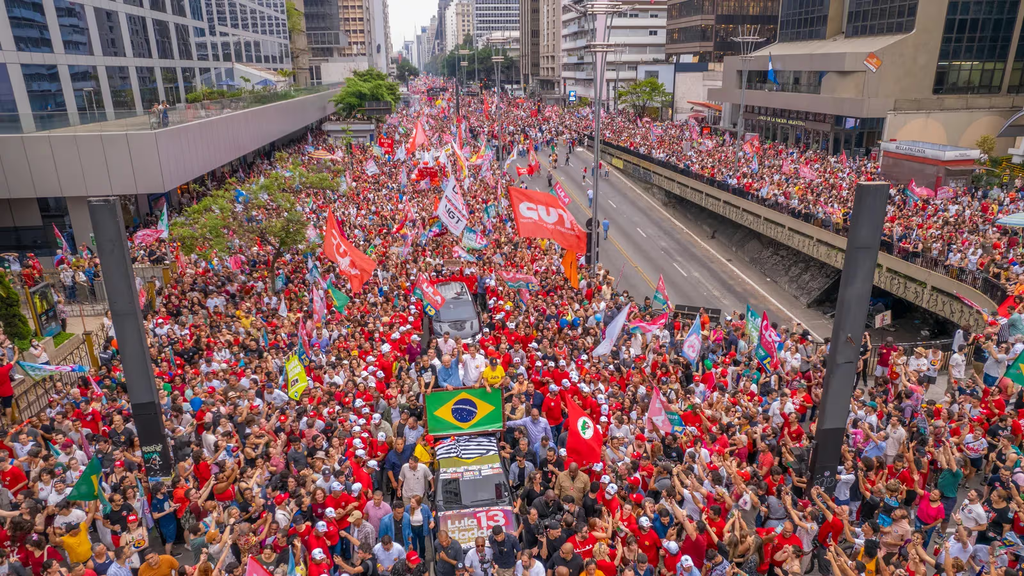
On Sunday 26 October, Brazil did something it had never done before: it elected a president who had lost the first round of voting. Against the polls and against the odds, Lula won a fourth term. His victory, made possible by an extraordinary grassroots movement, has lit a beacon of hope far beyond Brazil. But can popular mobilisation really defeat the far right? And, more importantly, what does it take?
Understanding Revanchist Populism
Trump’s return to the US presidency in 2024, alongside the election of several of his allies in Latin America, has made the far right a major political force in the Americas and beyond. In a 2024 article with my colleague Ryan Centner, we coined the term revanchist populism to capture what we described as a “turn in political imaginations towards the retaking of ‘the nation’ in line with a powerful discourse of ‘the people’ and righteousness” against supposedly undeserving populations. The idea first came to us after Bolsonaro’s 2018 victory, which rested on “a puzzling cross-class alliance that subverted familiar political geographies”. Inspired by critical geographer Neil Smith’s (1996) work on urban revanchism, we developed the concept to explain how authoritarian populist movements mobilise resentment against groups seen as having benefited from earlier expansions of inclusion. As we argued:
“Revanchist populism is about re-taking space perceived as lost to the benefit of groups identified as outsiders. Amid increasing anxiety around precarized work and economies, the desire to restore a sense of security and social mobility is ripe for political entrepreneurs to provoke reactions among uneasy segments of the populace against those regarded as unfair competitors or beneficiaries.”
At its core, revanchist populism seeks to restore an idealised political community and restrict belonging to those deemed its rightful members (Centner and Nogueira, 2024).
The Brazilian election: a different kind of coalition
Polls had pointed towards a victory for Flávio Bolsonaro, eldest son of former Brazilian president, Jair. When Lula lost the first round four weeks earlier, fears grew that the country would once again fall under an authoritarian populist, one confident of victory and already declaring his intention to change the constitution.
The Brazilian people, however, fought back. Intense popular mobilisation, on the streets and on social media, turned the campaign into a decentralised guerrilla movement, with a digital arm and demonstrations across major cities. This decentralised movement was organised by an unlikely coalition of students, superstar fandoms and political influencers.
The result was a resounding victory by four million votes, and a beacon of hope in a world increasingly dominated by authoritarian leaders. The Brazilian election has revealed some hopeful avenues, although sustaining this mobilisation beyond the electoral moment remains a challenge.
If revanchist populism builds alliances by defining who belongs to the nation and who does not, what happens when popular mobilisation brings together people whose differences cannot be neatly contained within those boundaries?
Many groups contributed to Lula’s comeback: young and older voters, Catholics, beneficiaries of social policies, students, artists and fans of national and international pop stars. Some are recognised political constituencies; others might seem almost like a typo in a political analysis. What stands out is the breadth of the coalition. If Lula’s 2022 victory was made possible by an alliance of pro-democracy political parties, this one was a popular coalition of groups with very different stakes in the race.
Can popular mobilisation endure?
Will it last? Despite Lula’s re-election, the far right made significant gains. Lula will preside over a divided country, with a hostile Congress and an even more hostile Senate. Without sustained popular mobilisation, his ability to advance his project may be tightly constrained.
The election showed that people, when united, can make a difference. But this energy will be needed again and again over the next four years. Lula will have to build on the renewed sense of political agency the election has generated and find ways to channel it into his government.
From anger to solidarity
There is an emotional side to this challenge too. Revanchist populism feeds on anger and resentment, directing frustration towards those portrayed as undeserving beneficiaries of social inclusion. But emotions are not the exclusive terrain of the far right. Hope, solidarity and even joy can be powerful forces for mobilisation.
The Brazilian campaign suggests that people can come together not only in opposition to a common enemy, but through defending one another and discovering their capacity to make a difference. The hard part is sustaining that feeling once the difficulties of governing threaten to turn hope into disappointment. It takes more than keeping the far right at bay: people need opportunities to stay politically engaged and to see the tangible effects of collective action.
Beyond the ballot box: addressing the material conditions of discontent
Preventing the far right from gaining ground will also require taking seriously the material conditions that feed anger and resentment. Despite all the controversies surrounding Flávio Bolsonaro, he was leading all the polls and gained almost 60 million votes. Not all of them came from committed far-right voters; many turned to him in the hope of change.
Elsewhere, I have argued that perceptions of the economy drove political choice in this election. Brazil remains a low-wage economy with a high cost of living, and tackling this will be paramount to addressing the frustration that fuels populist rage.
Can solidarity change the political tide?
Lula’s victory created hope that solidarity can overcome division. Whether it helps change the broader political tide will depend on whether the mobilisation behind his government can provide the legitimacy to advance policies that address the very real concerns pushing many voters towards the far right in the hope of radical change.
The challenge is not simply to defeat the far right at the ballot box, but to build a political project capable of sustaining collective action, addressing material inequalities and offering a credible alternative to the promise of revanchist populism.
References
Centner, R. and Nogueira, M. (2024) ‘Geographies of entitled anger: Revanchist populism in Brazil and beyond’, Environment and Planning C: Politics and Space, 42(4), pp. 501–508. https://doi.org/10.1177/23996544241254249.
Smith, N. (1996) The New Urban Frontier: Gentrification and the Revanchist City. London: Routledge.