If we want the UK-born poor to vote Remain we need to take their grievances seriously

This post was contributed by Professor Stephen Wright, of Birkbeck’s Department of Economics, Mathematics and Statistics.

drapeaux européens

I am a Remainer. As an economist the arguments for staying in the EU seem to me pretty clearly to outweigh the arguments for leaving. As a private individual I also clearly benefit from the EU. Polish carers look after my 97-year old mother (very well). I work in multiethnic and prosperous London. I have a Serbian-Dutch prospective son-in-law. I travel quite often in Europe and like the cheap flights (who doesn’t?). And the Central and Eastern Europeans who serve my coffee at the station are so polite and efficient.

But when personal incentives coincide with intellectual arguments we need to be careful. When I criticised the pro-Brexit arguments of Patrick Minford of Cardiff University in an email he responded that my arguments were a “metro-elite rant”. He had a point.

I quote from his email (my insertions in parentheses for clarity)

The problem is the balance between skilled and unskilled (migrants) and the complete lack of control that affects large swathes of the country with pressure from large numbers of
unskilled (migrant) workers: effects on housing, hospitals and schools, not to speak of wages (though evidence here is hard to get). Look, if the elite will not compensate these guys they must expect a political explosion which they have now got.

I reiterate: I am, and remain, a Remainer. But Patrick does have a point. If we Remainers do not take these arguments seriously, and – ideally – try to persuade policymakers to do something about these problems – there is a very serious risk that the Brexiteers will win the vote.

One chart, from the LSE’s John Van Reenen and co-authors (See Footnote 1) tells most of the story.

CEP 6

Source: CEP analysis of Labour Force Survey. Wadsworth et al. (2016: 7). Notes: Median wage is deflated by the CPI.

And, as with so many charts, the story that it tells depends on your perspective. From the perspective of a UK-born worker at the lower end of the distribution what they can see, without any advice from expert economists, is that the real value of their wages has fallen almost continuously (by around 10% for someone on the median wage –See Footnote 2) since the peak before the crisis. They can also see, without the aid of the chart (who cannot?) that at the same time the share of EU migrants in the population has risen steadily. And, inevitably they draw a link between the two phenomena.

Van Reenen and co-authors point out (quite correctly) that the share of EU migrants had been rising well before real wages started falling, indeed, as the chart shows, during a period in which real wages were still rising steadily. They also point to a range of evidence showing a lack of a link between EU migration and UK-born wages or unemployment. And they reiterate the arguments that Brexit would lower GDP via reduced trade, job losses, and higher prices of imported goods.

So should we just dismiss the arguments about EU migration as xenophobic scaremongering? Well of course a lot of it is pretty unpleasant, and often verges on the xenophobic. But that does not mean we can simply dismiss the arguments out of hand.

Wages and unemployment, first of all. Is the case against a link proven by the lack of a correlation? Here is one of the charts that Van Reenen and co-authors use to make their case.
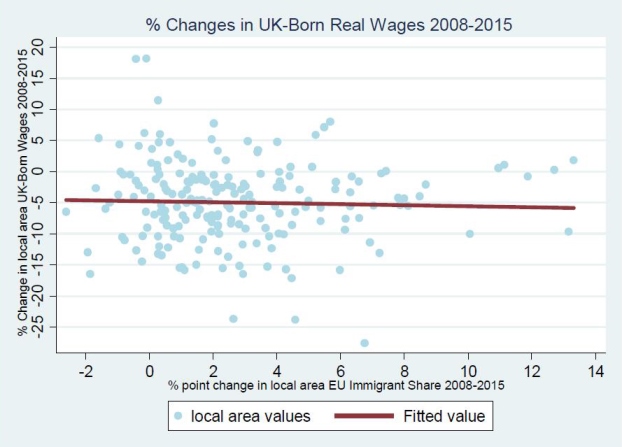
Source: CEP analysis of Labour Force Survey. Wadsworth et al. (2016: 10). Notes: Each dot represents a UK local authority. The solid line is the predicted ‘best fit’ from a regression of local authority percentage change in wages on the local authority change in share of EU immigrants. These are weighted by the sample population in each area. Slope of this line is -0.08 with standard error of 0.15, statistically insignificantly different from zero.

Source: CEP analysis of Labour Force Survey. Wadsworth et al. (2016: 10).
Notes: Each dot represents a UK local authority. The solid line is the predicted ‘best fit’ from a regression of local authority percentage change in wages on the local authority change in share of EU immigrants. These are weighted by the sample population in each area. Slope of this line is -0.08 with standard error of 0.15, statistically insignificantly different from zero.

This shows that there has been essentially a zero correlation between changes in real wages in any given local authority and the increase in EU migration in the same local authority. Case proven, it seems.

But pause, just for a moment. Basic statistics courses teach that “correlation need not imply causation”. But there is a subtler version: lack of correlation need not imply lack of causation. Here’s a simple argument (which is easy to substantiate with a couple of lines of algebra).

Suppose that real wages at a regional level tend to be stronger (which in recent years typically means to fall less rapidly than the average – look at the y-axis on the chart) where the regional economy is stronger. And suppose that EU migrants know this. Where will they tend to move to in the UK? Well, to the more prosperous regions, of course. Now suppose that the Remain arguments are correct, and more EU migrants do not have any effect on wages. If that was the case, then we should expect to see a positive correlation in the scatter diagram, but we do not. Whereas if EU migrants do depress wages, this would dampen the positive relationship and possibly result in no correlation at all. Which is what we see in the chart.

Now Van Reenen and his co-authors are all excellent econometricians so they all know this kind of argument perfectly well. Which makes their arguments all the more disingenuous. I’m not claiming that this proves there has been a serious impact on wages. There has been plenty of more sophisticated research which suggests it is hard to find an impact either way (and which Minford acknowledges in the quote above). But that does not in itself prove the argument wrong.

What about hospitals and schools? Well here the Remain argument is on the face of it much stronger. Van Reenen and others have shown that EU migrants are pretty clearly net contributors to the public purse. But the only problem with this argument to the UK-born worker is that there is no direct observable impact of these higher tax receipts on hospitals and schools. We do not have labels on CT scanners or smart whiteboards saying “these facilities were paid for using the extra tax receipts from EU migrants paypackets”. All they can see is the queues and the letters assigning their child to a school two bus rides away.

And finally, of course, housing. Well here of course, all the economists agree. And the policymakers. Everyone agrees. Absolutely everyone. We must build more houses.

But we don’t. Or at least not enough. Nor have we, for decades. As a result, UK households spend more on housing, per square metre of residential land, then any other European country except Luxembourg (See Footnote 3).

Does EU migration make things worse? Well of course it must do. (Even Nigel Farage can be right once in a while.) The CEP paper documents that the number of EU migrants in the UK rose by 2.4 million between 1995 and 2015. That accounts for roughly one third of the total growth of population in the UK over that period. And meanwhile, as Bank of England governor Mark Carney pointed out back in 2014, the UK builds half as many houses each year as Canada despite having twice the population.

No one disagrees that this is crazy. Yet neither the government nor the opposition have made any move to do anything serious about it. Despite the fact that bringing down the cost of housing could be the most effective way (and possibly the only effective way) of raising living standards for UK workers in the medium to long term.

But don’t get me started on housing. It is a serious, a very serious problem, that goes way beyond arguments about Brexit. But, I reiterate, EU migration must be making it worse.

Does all of this mean that I think we should stop EU migration? (Even if we could, which is of course debatable, even post-Brexit). It does not. Despite the fact that, as I noted at the start, my personal interests coincide with my professional judgement, I stick with that judgement. The EU brings benefits. EU migrants bring benefits. To me, and people like me, especially. To the economy on average, almost certainly. But not to everyone.

Pro-Remain policymakers need to start thinking fast about acknowledging this, and how to offer something to the poor and dispossessed of this country to compensate them explicitly for the costs of EU migration. This would not be impossible: remember the last-ditch crossparty promises before the Scottish vote? Maybe these made a difference, maybe they didn’t. But it is worth a try. Very soon it will be too late.

Find out more

Courses at the Department of Economics, Mathematics and Statistics

Images sourced from Wadsworth, J., Dhingra, S., Ottaviano, G., Van Reenen, J., and Vaitilingam, R. (2016) ‘Brexit and the Impact of Immigration on the UK’. CEP BREXIT ANALYSIS NO. 5. Available online, last retrieved 13 June 2016.

This post represents the views of the author and not those of Birkbeck

Footnotes

  1. “Brexit and the Impact of Immigration on the UK”, Jonathan Wadsworth, Swati Dhingra, Gianmarco Ottaviano and John Van Reenen, CEP Brexit Analysis No. 5.
  2. The CEP document shows that the fall for those on the 10th decile has been somewhat larger, and started
    earlier.
  3. De La Porte Simonsen, L and Wright, S (2016) “Residential Land Supply in 27 EU Countries: Pigovian Controls or Nimbyism?, paper presented to Birkbeck Centre for Applied Macroeconomics Annual Workshop, May 2016.


Europe at the Crossroads: Professor Everson comments (Part 1)

This post was contributed by Michelle Everson, Professor of Law at Birkbeck. She has written widely on European Economic and Constitutional Law and has advised the European Commission, the European Parliament and the European Central Bank on matters of European Law.

Professor Everson is hosting a week long debate on ‘Europe at the Crossroads’ at Birkbeck (13-17 June). For details and to book your place, please visit the ‘European Law on Trial’ website.

Every day this week, Professor Everson writes for Birkbeck Comments, offering up her thoughts, opinions, and analysis on the EU referendum.

Law-on-Trial-slider -WEB

Order in chaos

Assaulted on all sides by a vilely-tempered and wholly ill-informed Brexit ‘debate’, I ask myself daily why I am going to Vote Remain. I may be known as a Professor of European economic and constitutional law, but do not belong to the ordinarily-rapturous academic fan base for the European Union. Quite the country, the determination of all-too-many of my colleagues to view the EU only through rose-tinted lenses confounds me, and always has done. From the 1980s onwards, when, as a PhD student, I discovered in my own research that European integration was synonymous with a process of the disintegration of intricate historical-political accommodations, social mores and economic interest-balancing at the national level, my default appreciation of the Union has been one of suspicion. In the meantime, as the EU has been engulfed in financial and sovereign debt crisis and has been unable to respond coherently to migration crisis, my critique of the current deeds of the Union makes many a Brexit campaigner look moderate.

From the destruction of political choices within the regime of economic austerity constructed in the effort to contain sovereign debt crisis (European Stability Mechanism and Fiscal Compact), to the reduction of Greece to the colonial status of dumping-ground within a punitive migration regime that is as dysfunctional as it is immoral, the EU has been found wholly wanting. Worse still, as the normally-sustaining European rule of law has collapsed within politically-expedient judicial law-making to sustain the Eurozone through constitutionalised imposition of economic conditionality (Thomas Pringle, heard by the Court of Justice of the European Union in 2012), the very ideal of Europe as a continent of justice, democracy and solidarity has itself been traduced.

Yet, the European Union, even, and perhaps especially so in its flawed current incarnation remains one of the most ambitious political projects ever conceived. Far beyond its original pragmatically-ideational roots within the post-war desire to bind national economies so tightly to one another that any future conflict would be an impossibility, and outside the delusional realm of federalist dreams (we, the people, simply do not want one), the Union also embodies an old-new ideal of order in chaos, or of self-determination beyond the self-referential reaches of territorial sovereignties. This is its inspirational strength, but perhaps also its real-world tragedy as it is caught up in the self-same paradoxes of all such universalising projects – be they of might (colonial), or of the mind (religious) – as it equalises differences between its constituent parts, and creates its own self-referential communitarianism through the seemingly inescapable definition of its own territorial boundaries.

The Brexit debate has been dominated by a fight about facts. In the one corner, those determined to catapult the UK out of the Union have been evermore inventive (read mendacious) in their pursuit of figures that putatively demonstrate the unbearable strains of integration upon UK population numbers and the Exchequer. In the other corner, Vote Remain’s assertion that a no vote will lead to economic shock is better backed up by reputable research, but the campaign is nonetheless careless in failing to highlight that all economic prognoses contain their own uncertainties. The debate has been sadly misdirected as each side seeks to present a ‘truth’ of statistics. By contrast, little or no attention is paid in to visions of how the global world, the EU and the UK within it, might be ordered for the good. Yet, while cost-benefit analysis of EU membership will, in any objective analysis, simply falter within the complexities of the balancing of trade or social benefits against their regulatory costs, our age of economic globalisation is urgently demanding our conceptual attention: what are its challenges, how can we tame economic powers that ignore national boundaries, is there a common good within this global world and, if so, how might we defend it?

For a present-day generation of people living within Europe, a generation long distanced from the absolute moral certainty of a post-war generation determined never again to break the peace, and, in its youthful global outlook, even less inclined to commit to a culturally-foreclosing European federalism, there is only one possible ideational vision of Europe to which they might commit: the search for an order in chaos, for a form of governing beyond closed national communities; an order which defies the inequalities created by unconstrained markets and capital, and an order which seeks also to establish justice, democracy and solidarity outside the certainties of a once-sustaining but now illusionary territorial (national) sovereignty. The European Union of 2016 is not the European Economic Communities of 1958, having morphed from an international community of market building into a supranational body of ever closer Union between its peoples. Nor is the European Union of 2016 a happy or uncontroversial one, as efforts to save the Euro feed the pressure for ‘more Europe’, but simultaneously undermine the political and social values that must always be a part of the European project.

Michelle Everson

Professor Michelle Everson

Yet, throughout its history and still today, the European project has been the drawing board for a sustainable ideal of civilised internationalism. That Europe is and always will be beset by its own contradictions of equalisation and boundary-drawing, or that it seems, currently, to be complicit within rather than controlling of the economic forces that are globally threatening to overwhelm all human (non-economic) self-determination, are happenings that simply cannot be denied. At the same time, however, Europe’s current malaise cannot and should not be taken as reason to walk away from the best enunciated and most practised iteration of the search for order in chaos offered by any post-national organisation now operating on the global stage. Instead, we must learn from Europe’s failures in order to fight within the EU for all of the advantages of order in chaos; for opportunities of human innovation on the one hand (rights of engagement within markets), and for the securities of self-determination on the other (rights of control over markets).

Law on Trial 2016: The European Union at the Crossroads, runs at Birkbeck from Monday 13 to Friday 17 June. Book a free place here.

Listen to Professor Everson on the topic of the EU referendum in the latest edition of Birkbeck Voices

This post represents the views of the author and not those of Birkbeck

Find out more

The Hissène Habré trial: a triumph for victims and civil society

This post was contributed by Marie Gibert, an associate lecturer in Birkbeck’s Department of Geography, Environment and Development Studies. This post was originally published by the South African Institute of International Affairs.

Nearly 26 years after he was forced out of power, former Chadian president Hissène Habré has been found guilty of crimes against humanity, torture (including sexual violence) and crimes of war committed under his rule from 1982 to 1990. He has been condemned to life imprisonment by the judges of theExtraordinary African Chambers (EACs), a court specially created by Senegal upon the request of the African Union (AU). This was the first trial of its kind on the continent and years of lobbying were necessary to convince the AU and Senegal to proceed with it. In pushing Africa to bring Habré to justice, the victims and the international coalition of non-governmental organisations that have supported them have shown that Africa’s relationship to international criminal justice is far more open than the statements of some African leaders might suggest. Africa’s people demand such justice, and will pull all the necessary levers to obtain it.

The years that have passed seem to have reinforced the determination of the surviving victims, the victims’ families and the civil society organisations (CSOs) that have accompanied them – from the Chadian Association of Victims of Crimes and Political Repression (AVCRP) to the Chadian Association for the Promotion and Defence of Human Rights (ATPDH) to the Dakar-based based African Assembly for the Defence of Human Rights (RADDHO) to the international Human Rights Watch (HRW) and International Federation for Human Rights (FIDH). In the absence of a straightforward legal path – it was evident from early on that the Chadian justice system would not request Habré’s extradition from Senegal to prosecute him, and the International Criminal Court’s (ICC) jurisdiction does not cover crimes committed before 2002 – they have, over the years, knocked on all doors. This has included calling on Senegalese justice, of course, but also on the UN Committee against Torture, the UN High Commissioner for Human Rights, Belgium’s universal jurisdiction provisions, and the International Court of Justice, but also defending their case before the Court of Justice of the Economic Community of West African States (ECOWAS), (of which Senegal is a member) that had been seized by Habré’s supporters and lawyers.

The campaign for the Habré trial has also successfully drawn on previous cases, and on the expertise that has now accumulated across the world on cases of mass human rights abuses. Argentinian forensics experts, with similar experience in their own country, were thus called upon to analyse Chad’s mass graves and testify in the trial. The courts’ name also naturally draws on the Extraordinary Chambers in the Courts of Cambodia, set up to try the surviving leaders of the Khmer Rouge regime. It provided an initial legal template when Senegal was asked to create an ad hoc tribunal to try the former Chadian president.

The campaign, however, has not just been a legal one. In the absence of a guarantee that the trial would take place one day, the surviving victims have been keen to publish their testimonies. This has taken many forms, from the more traditional bibliographic account written by Souleymane Guengueng, to video testimonies gathered on HRW’s website or in documentary films such as Klaartje Quirijns’ The Dictator Hunter, Isabel Coixet’s Parler de Rose, or Mahamat-Saleh Haroun’s Hissein Habre: a Chadian Tragedy. There are also written testimonies in civil society publications – in 2013 HRW published The Plain of the Dead, a 714-page account of the Habré repression system in great part based on victims’ testimonies – and interventions in the media. In so doing, the survivors have not only made sure their testimonies would be available beyond their own deaths, but also helped to publicise the Habré affair and gave it a very human face. Some of them have equally been present throughout the trial, delivering most of the witness testimonies in an attempt to represent as best as they could all victims, alive and dead.

Img habre Oueddei peace treay cc Ammagina

Chad’s Government of National Unity, headed by Goukouni Ooueddei (left), was created on 23 March 1979 in an attempt to end the civil war. Hissène Habré (right) was Minister of Defence until his loyalists overthrew the government in 1982, ushering in a military dictatorship that lasted until 1990. Photo (c)Ammagina, CC BY-SA 4.0

As with many such international justice prosecutions, Habré’s trial has taken place many thousands of kilometres away from most of his victims and the places where his secret police’s crimes took place. While some observers note that geographic distance, in some cases, may contribute to greater judicial serenity, most commentators state that it also means that justice remains out of reach for many victims and most of the population, and that the national judiciary is unable to strengthen its legitimacy in the eyes of the people. These are obvious shortcomings in the Habré affair, although the Chadian justice system prosecuted and condemned 20 Habré regime officials in 2015, in an obvious effort to show that justice could also be served in Chad.

Here, too, the steady involvement of the victims and CSOs has had an important effect on reducing the distance. They, and a number of initiatives launched by volunteers and legal professionals, have also made creative use of new technologies to promote the trial, record it and reach out to Chadians.Websites and Twitter have served as platforms to post regular updates on the proceedings whileYouTube has hosted all trial recordings posted by the EACs’ interactive forum. Outreach activities in Chad are on-going and have notably included public screenings of extracts of the trial, and debates and dialogues with local inhabitants throughout the country.

Paradoxically, the victims’ long wait for a trial may well have increased the quality of the evidence presented before the EACs. It has had an obvious impact, first, on the quality of the documentary evidence used in the trial. The EAC investigators were thus able to use documents from the Direction de la documentation et de la sécurité (DDS), Habré’s political police, found by HRW investigators in 2001, as well as the testimonies gathered by CSOs and evidence collected by Belgian Judge Fransen, who investigated the case in 2001-2005 (at a time when it looked like Belgium, rather than Senegal, would prosecute Habré). Moreover, not only has the time elapsed had no adverse effect on the victims’ determination to testify, it may even have given them a greater freedom to do so. The trial thus uncovered a hitherto little-known aspect of Habré’s rule: the extent to which sexual violence was used by its repressive system (a crime now specifically acknowledged in the verdict although the EAC judges had initially refused to add it to the charges). This discovery was only possible thanks to the testimonies of a number of now middle-aged women who testified about the violence and abuses to which they were subjected with an incredible dignity and great clarity, looking Habré in the eye. It is not likely that they would have felt able, and free, to do so publicly twenty years ago, as younger women. The Habré trial has thus successfully overcome one of the main challenges in the prosecution of grave crimes, that of gathering enough high quality evidence and witness statements – something the ICC has been struggling to do, notably with regards to the Kenyan case.

In many ways, the Habré trial before the EACs and the campaign that led to it have underlined the importance of a multi-faceted approach in seeking international criminal justice. The victims and their allies have gone well beyond the obvious legal strategy to lobby the AU, Senegal and their international partners. In seeking the support of international civil society allies, drawing on existing international expertise, knocking on all institutional doors, using a wide range of media outlets, collecting, transcribing and storing evidence, and preparing for the trial and their witness statements, they have not only made sure that, in the words of one of Habré’s victims, Rose Lokissim, ‘Chad would thank [them] and History would remember [them]’, but that the long-awaited justice would be of the highest possible quality.

Brexit – is it even possible?

Law on Trial 2016This post was contributed by Professor Erik O. Eriksen, Director of ARENA Centre for European Studies at the University of Oslo, who will be participating in a panel discussion on Friday 17 June as part of this year’s Law on Trial events. Law on Trial is the School of Law’s annual week-long programme of free-to-attend public lectures and panel discussions and this year puts the European Union on trial – one week before the EU referendum in the UK.

Can the Brits actually decide if they want out of the EU on the 23rd of June?

There have been quite a few moments of truth in the British debate about leaving the European Union. Increasingly it has become evident how deeply involved the country is in the EU, and how dependent the Brits are on European cooperation. The debate has highlighted the importance of the financial industry, whereby London City would be threatened by the replacement of Frankfurt as a leading European finance centre. Then there is the issue of agriculture, which would be left without subsidies from the EU. Business in general is dependent on immigration. The same goes for healthcare. Leaving the EU is said to have consequences for staff, waiting lists and the quality of treatment in British hospitals.

And also soccer, a major industry with a turnover of billions that relies on free movement, would be affected. There are currently 332 soccer players from the EU playing in the top league in England and Scotland. These players, however, do not fulfill the criteria for working permits for citizens from non-EU (member) states. Surely such matters can be arranged, but what will withdrawal mean for the rights of Britons that live and work in the EU? And how will the relationship of the UK with third countries look after a withdrawal from the EU?

The situation of the UK in the EU illustrates a general point about an integrated Europe. Much sovereignty has been delegated, interdependence has increased. Integration has affected the very nature of nation states. Many laws will have to be rewritten if the country leaves the Union. This should however not come as a surprise. The EU is known to be more than an intergovernmental organisation, where states can easily withdraw.

The EU makes its own laws that are binding on the members. And the internal market is much more than a free trade zone. The Union abolishes differences in laws and standards and develops new rules and regulations that all members have to accept. This uniform regulatory framework provides legal certainty for market participants. Within the EU cases can be brought before a supranational court. Rules shall be interpreted, enforced and complied in the same way. The European Economic Area (EEA) Agreement that Norway, Iceland and Lichtenstein have with the EU, makes this apparent. EEA law has no material substance in and of itself, but obliges Norway to accept existing and future EU law.  It should therefore not be seen as EEA law, but rather EU law.

Right to sign out?

There is a right to withdrawal from the Treaty, but how does this work in practice? First of all, the conditions for withdrawal need to be negotiated. These negotiations can take up to several years.  At present there is no majority in the House of Commons on any option for withdrawal. Some want to negotiate first, others want to use the withdrawal-clause immediately, and then there are those undecided. The problem is that the country has to get rid of complex regulations, covering different policy areas. New policy has to be created to replace abolished EU regulation.

Second, the future relationship with the EU needs to be renegotiated. All, including EU-sceptics, acknowledge that they cannot manage without some kind of agreement with the EU. In particular, the Union represents the world’s largest market with its 500 million inhabitants. The Brits are dependent on an agreement with the EU in areas of common interest.

The example of Switzerland, a country that has 120 bilateral agreements with the EU, shows how complex such a relationship can be. Neither do we know what the political climate will be after a possible ‘no’ in the British referendum. It is difficult to first withdraw from the Union and from the incurred commitments, and then start negotiating good terms for continued cooperation. Divorces are seldom pleasant.

Third, bilateral trade agreements with third countries have to be established, to replace those that have been signed with the EU. This creates many uncertainties, especially because large trade agreements are at present negotiated between blocks of countries, where the great powers China, the USA and EU dominate. From an economic perspective, there is a risk of an economic downturn in the UK after withdrawal. Financial markets already signal unrest over a possible turbulent economic situation in the future.

These factors can lead to a legal nightmare and years of negotiations and uncertainty. One thing is for sure: leaving the Union would change the UK’s trade relations with the EU and the rest of the world significantly.

Unclear consequences

Furthermore, a whole list of other problems arises if the UK decides to leave the Union. What about the rights of the almost two million Brits that live in other EU member states, and make use of the rights they have as EU citizens? British pensioners living in Spain, for example, have access to Spanish healthcare.

The UK has also considerable clout in the foreign policy of the EU. It is therefore unclear what role the country will be able to play outside the EU. The UK will become less important to the USA and many argue that as a former empire, the country will have difficulty in being regarded a neutral broker.

Even areas where Brits enjoy opt-outs from the EU’s laws, as in asylum and immigration policy, are affected by EU decision making. If for example the Dublin Regulations in which member states are responsible for examining the application of asylum seekers is abolished, the UK will not be able to deport them.

Withdrawal is risky also because Great Britain’s unity is at stake. Scotland might withdraw from the United Kingdom.

Problems attached to the withdrawal seem insurmountable, but in a referendum it is not always the rational arguments that prevail. Often voters vote on other things, often external factors and trust in present powerholders play a decisive role. This referendum is particularly interesting for two reasons.

The fiction of alternatives

First, the referendum forces those in favour of continued EU membership to be on pitch. They have to clearly state why the EU is important, and dismantle wrong information and falsely-grounded ideas about what a country in ‘splendid isolation’ could achieve. We rarely hear Brits talk about the EU in positive terms.

Secondly, ‘Brexiters’ have to propose a realistic alternative. Those in favour of withdrawal have to present a credible alternative to EU membership. Responsible politicians have to make evident how a United Kingdom outside the EU would be able to cope in an increasingly interdependent world.

There is no current agreement on what a United Kingdom outside the EU would look like, and how relations with other countries are going to be upheld. Some argue that Britain only needs a customs union with the EU; others argue that they can expand their cooperation with the Commonwealth, and yet others look to Norway’s EEA Agreement and Switzerland’s bilateral agreements. But are any of these models realistic alternatives?

A customs union with the EU – with free market entrance – is only possible if the other 27 EU countries agree, as it requires Treaty amendment. An agreement will not be acceptable without significant contributions from the United Kingdom. Agreements with Commonwealth nations, which can be difficult enough since they now have strong relationships with other countries, would not compensate for the loss of the EU market.

Both the EEA model and the Swiss bilateral model would entail getting access to the internal market by accepting EU law and regulations. The Brits would then be no better off than today with regard to sovereignty, quite the contrary. By adopting any of these models, the United Kingdom would become partially EU member, but without being able to influence EU decision-making.

British EU sceptics want to roll back integration and return sovereignty to national institutions. They frequently reject an affiliation like the Norwegian one because it would mean even more EU dominance. Norway has abstained from having influence, but not from being affected by the EU’s decisions. The core of EU scepticism lies in the experience of being governed by others, which is the reality in the EEA. The Norwegian loss of sovereignty is not compensated by co-decision in the European Parliament and Council, as is the case for Great Britain. Power is not the same as sovereignty. The ceding of sovereignty increases power when it gives actors decision-making power in supranational bodies.

It is not obvious that the UK can actually fully withdraw from the EU. It will be difficult to avoid ending up in a similar situation to that of Norway or Switzerland, where EU laws are accepted in exchange for access to the internal market.

There is, as far as I can see, no realistic alternative to (a reformed) EU, while the fiction about an alternative is what motivates British EU sceptics. This very same fiction underpins the continued legitimation of technocratic EU adaptation made by the opponents to Norwegian EU membership. But what is a plain fact in Norway is the ultimate horror for many Brits.

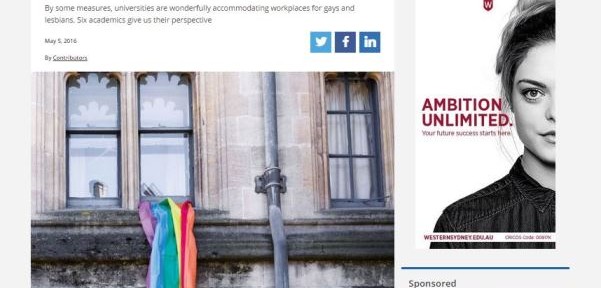
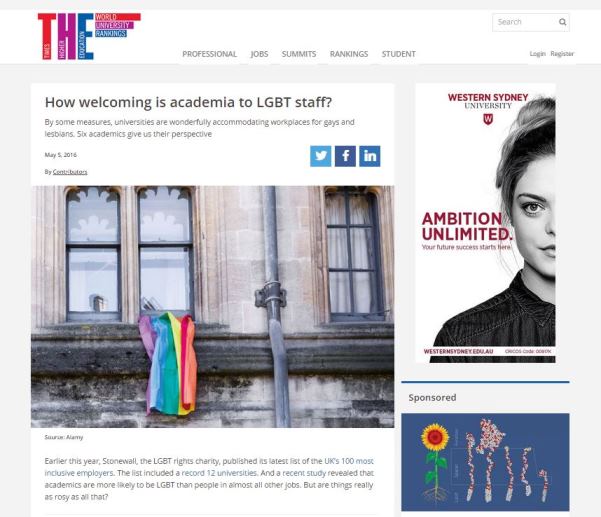
How welcoming is academia to LGBT staff?

This post was contributed by Professor Matt Cook, of Birkbeck’s Department of History, Classics and Archaeology. This comment piece first appeared on Thursday, May 5, in the Times Higher Education. The article “How welcoming is academia to LGBT staff?” features six academic’s responses to the question.

Birkbeck values its diversity and celebrates IDAHO – International Day against Homophobia, Transphobia and Biphobia.

“Many of those engaged in these early struggles and projects have sustained strong supportive networks. I have benefited hugely from these”

Professor Matt Cook

Professor Matt Cook

As a gay academic working on queer themes in history, my feelings of comfort and belonging owe a lot to the emergence of new areas of scholarship, to my discovery of community among colleagues and students – and to good timing.

I began my postgraduate studies in the mid‑1990s, just as work on gender and sexuality had gained some credibility and was even fashionable in some places – not least at Queen Mary University of London, where I found myself. By the time I emerged with my PhD in 2000, much ground had already been laid and my specialism was not the impediment to gaining an academic post that it had been for the preceding generation. There was a growing sense that explorations of sexuality had a real significance to broader understandings of society, culture and politics – past and present.

In the 1970s and 1980s, the scholars in the UK who inspired me – Jeffrey Weeks, Lynne Segal and Sheila Rowbotham among them – wrote much of their early work outside the university sector or against the grain of the jobs they were being paid for. They were nurtured instead by political and community networks arising from women’s and gay liberation, from the Gay Left collective and also from the History Workshop movement and journal (which, from its inception, had taken gender and sexuality – and those working beyond the academy – seriously). Such scholars had to argue that women’s and gay history were not marginal or peripheral areas of study and had a place in university departments. Once hired, some of them (including those I’ve mentioned) faced overt disdain or were “benignly” expected to focus on other things seen as more significant.

There was some notable resistance to this marginalisation. At the University of Sussex in 1991, Alan Sinfield and Jonathan Dollimore established the Sexual Dissidence master’s programme, exploring history, literature, post-structural and queer theory. It felt especially urgent in the context of the Aids crisis, Clause 28 (which prevented UK local councils from “promoting homosexuality”) and a broader homophobic backlash. Unsurprisingly, it was derided as insignificant, trendy (an insult in this context) and part of a “Loony Left” agenda. But, tellingly, the programme is still running 25 years on.

Read the original Times Higher Education article here

Read the original Times Higher Education article here

Many of those engaged in these struggles and projects have sustained strong supportive networks. I have benefited hugely from these. Research and teaching projects have meanwhile allowed me to work with LGBT community groups and with archive and museum professionals – giving me sustaining anchor points outside academia.

At Birkbeck, University of London – my institutional home for the past 10 years – I have found further communities. One is a history department with a collective commitment to wide-ranging historical work (and the intersections that it fosters). Another is with colleagues brought together through the Birkbeck Interdisciplinary Gender and Sexuality research centre. A third is with students whose engagement with their studies has often been underpinned by much more direct experiences of discrimination and marginalisation than I have had to deal with. Being a white, middle-class man has made me an insider in more ways than my queerness has set me apart.

Matt Cook is professor of modern history at Birkbeck, University of London and the author, most recently, of Queer Domesticities: Homosexuality and Home Life in Twentieth-Century London (2014).

Find out more

Notes from an intern at the Guildhall Art Gallery

This post was contributed by Fiona Ratcliffe, who is currently studying for an MA Victorian Studies at Birkbeck’s Department of English and Humanities. Here Fiona writes about her internship experience at the Guildhall art Gallery from January to March 2016.

The internship was carried out as a module on the MA programme – a popular element of the course in which successful students have the opportunity to spend a term working with one of London’s Victorian cultural institutions, gaining first-hand experience of working in the cultural sector and using their host institution’s archives to develop a unique research project. Previous interns have worked with the Dickens House Museum, and the Salvation Army Heritage Centre and Archive.

Guildhall Small Size-4Day One

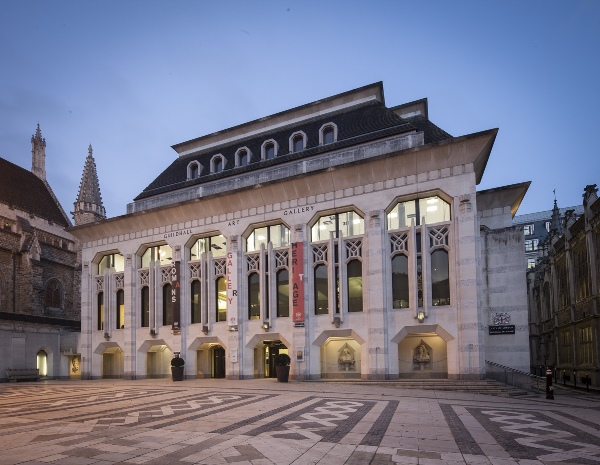
Having cleared Security (a permanent fixture at galleries today), I meet the small, industrious team behind the scenes at the Guildhall Art Gallery – Katty (Curator), Andrew (responsible for the Roman Amphitheatre) and Jeremy who, as General Manager, handles the practical running of the Gallery.

Katty warns that finding desk (and computer) space is a constant challenge and I will inevitably have a variety of work-places, including perched in a corner of the small shop, gaining an insight into that essential income-generator for museums.

My first task is to familiarise myself with the preparations for the forthcoming exhibition, Victorians Decoded, opening in September. This exhibition will commemorate the 150th anniversary of the successful Transatlantic telegraphic cable-laying, demonstrating how artists subsequently re-imagined time and space, responding to their changing world.

In addition to artworks from the Gallery’s collection, five loans have been requested from other institutions. So far, the Royal Holloway Picture Gallery has confirmed the loan of Edward Landseer’s Man Proposes, God Disposes with the stipulation of a T-Crate for transportation – leading to challenges of storing the crate, space being at a premium here.

Early Weeks

Switching tasks (a constant theme ensuring plenty of variety), I am asked to prepare visitor-friendly information on the ‘Fire Judges’ for a Museum of London exhibition on the Great Fire. This involves circumnavigating the archives – a tiny cupboard space – to research the portraits of the judges who processed property and boundary claims prior to rebuilding the City.

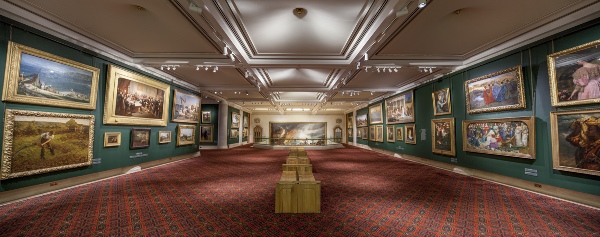
Guildhall Art Gallery

Guildhall Art Gallery

The Gallery is delightfully intimate and peaceful but being within the City’s municipal building, the Corporation’s civic presence is constantly apparent – particularly when the whole building goes into ‘total shut down’ (a security measure) while The Sun hosts The Millies, an awards ceremony commending military bravery, and I realise I may not be able to leave or return at lunchtime. In my haste to get a sandwich, I bump into Rod Stewart, Jeremy Clarkson and Boris Johnson – as a friend asked later, “What sort of gallery is this?”

It’s time for the de-installation of the exhibition “No Colour Bar”. Paintings are shrink-wrapped and swiftly taken through a side-exit by a specialist removal firm – with Katty’s eyes on every move whilst the door is temporarily de-alarmed.

Katty explains that loaned artworks are covered by ‘Nail to Nail’ insurance with the borrowing gallery insuring the painting for loss or damage for the duration. Surprisingly, the borrower also funds and organises any requisite conservation or frame refurbishment.

Exhibitions have astonishingly lengthy lead-times and London galleries are currently collaborating on exhibitions up to 2023 – including a London-themed one for which I am asked to source suitable artworks from the collection database. The remit is not just Victorian art, which is refreshing, but does lead to ‘St. Paul’s overload’.

In Week 3, Sonia (the Principal Curator) departs on maternity leave and we join the Conservation team for her farewell tea-party. Rossetti’s La Ghirlandata aloofly surveys us tucking into cake, and I notice just how exposed a painting appears without its frame. Excitingly up close to the brushstrokes, I am shown various tears and some ‘tenting’ where it has lifted from the canvas.

Middle Weeks

A memorable day! I join the planning meeting for Victorians Decoded and am asked to help with research in preparation for exhibit captions – a steep lesson in brevity. I’m struck during the meeting how much events-planning and budget control predominates – along with the logistics underpinning the positioning of cables and procurement of objects such as a telegraph machine. We didn’t discuss the art at all!

Heading towards spring, the gallery is becoming busier, visited by schools, interest-groups and individuals, many joining the in-house talks. One of the guides tells me that she’s a retired City financial journalist and had looked for voluntary work but could only find weeding in Epping Forest, so just called in at the gallery and was welcomed as a guide. Her groups are usually small and it often turns into a two-way exchange so she’s continually learning too.

In five years, footfall has increased from 30,000 to 100,000, reflecting a widening demographic – younger, international with rising tourism in the City, and also more Londoners increasingly culture-seeking in their own city. Exhibitions are vital – a way for a lesser-known gallery to achieve publicity, although a recurring tension between free access and charging for exhibitions persists.

It’s Friday afternoon and we’re surveying the new Robin Reynolds’ 2016 artwork of London commissioned by the Gallery to hang next to Visscher’s 1616 cityscape. As a commemoration of Shakespeare’s 400th anniversary, Reynolds has incorporated references to all 37 plays but we’re not here trying to identify them. Unfortunately, the canvas is ‘bulking’ where the artist has tried to fix a central rip, at eye level. The conservators arrive, armed with various canisters, but are unable to do a quick fix –it will have to be dismantled, repaired and re-framed as quickly as possible by this time-pressed team.

Final Week

Inside Guildhall Art Gallery

Inside Guildhall Art Gallery

Another exhibition, Martin Parr – Unseen City, begins and there is a flurry of media activity. Katty’s role requires multiple skills – preparing speeches for opening nights, coordinating hanging and lighting, and dealing with both the press and the local authority the Gallery belongs to, who approve the exhibitions but may still express criticisms with the outcome.

Preparations are escalating for Victorians Decoded, with the room layout established six months ahead. A balancing-act is required to ensure the technical aspects of telegraphy are comprehensible, whilst providing substance for visitors specialising in art and science. A subsequent challenge will be to fill the spaces in the permanent collection where paintings have moved to the exhibition. Katty describes it as a four-dimensional puzzle: satisfying the aesthetic, chronological & contextual, scale & size, and overall fit.

On my last day, Katty gives visiting VIPs a private viewing of two Pre-Raphaelite artworks held in store – Millais’ sketch of Lorenzo and Isabella (being watercolour the picture can’t be regularly exposed to UV for long periods of time, which precludes it from being on permanent display) and charcoal drawings from Holman Hunt’s sketchbook. Both the guests and I feel utter wonder at having access to these hidden gems – a true privilege of working behind the scenes in this very special gallery.

The internship has altered my perception of artworks and I’m now far more aware of their vulnerability. Visiting an exhibition will never be the same again, having witnessed the in-depth forward-planning and bustle behind the scenes. Ultimately, however, the experience has opened up new avenues and inspired me to pursue research opportunities with galleries after graduation.

Find out more

On being attractive – and dumbing down the blond(e)

This post was contributed by Professor Penelope Gardner-Chloros, of Birkbeck’s Department of Applied Linguistics and Communication

Briden-Starr Aspinell (8053352575)A congress of blonds/blondes[1] is holding a maths quiz on stage, in order to show the world that blonds/es are not as dumb as they are made out to be. The first contestant has great hair but is really struggling with the question put to her: “What is 3+2?” Eventually she screws up her courage and ventures: “6?”

The audience – made up of blonds/es – starts clapping but the compere interrupts: “I’m sorry, that is not correct”. The crowd roars: “Give her another chance! Give her another chance!” But when asked the sum of 4+1, the contestant stumbles again.

“Give her another chance! Give her another chance!”, the blonds/es chant once again. Finally she cries out “I’ve got it! It’s 5!” As one, the crowd roars out, “Give her another chance! Give her another chance!”

The audience at this contest might not be the ideal candidates for a university degree, but in the struggle to sign up students in difficult economic times, universities need to make themselves as attractive as possible to all potential applicants. Many of them are of course affected by which course has the lowest fees, the best location, the most famous professors. But how can we present the actual courses as attractively as possible?

Is ‘Linguistics’ too difficult?

Free College Pathology Student Sleeping Creative Commons (6961676525)In Linguistics as in other subjects, this means keeping up with current issues and interests; for example, our department would ideally like to introduce an option on CMC[2] – not just out of a desire to be trendy, but because this is a serious issue affecting not only how we communicate but also language itself (see for example the recent Routledge Handbook of Language and Digital Communication, eds. Georgakopoulou and Spilioti).

Another aspect of being attractive is to do with what courses, and even departments, are called. Two of my earlier blogs are relevant here: one about the – almost magical – power of names, and another about how Linguistics is among the least well understood of academic disciplines. In the second one, I was thinking of the public in general rather than potential students. The latter, one would hope, might at least have looked the word up on Wikipedia. However some colleagues seem to be taking the need to be attractive to heart…perhaps too much? It has been suggested that the term ‘Linguistics’ is too difficult, too intellectual, too off-putting. We should call our department and our courses by some other name. We have already become a Department of Applied Linguistics and Communication, but that was not in order to be more attractive; it is because we are now teaching a completely different subject alongside linguistics.

The study of Communication does not require burning the midnight oil over phonetics, phonology, syntax, morphology, language change, sociolinguistics, psycholinguistics, bilingualism, semantics, pragmatics – to mention but a few of the sub-categories within linguistics – and has indeed proved a crowd-puller. But does that mean we should get rid of “Linguistics”??? And that because potential students applying for postgraduate courses can’t understand what it means ?!?? Surely even in these straightened times, there are some students we actually do not want.

‘Stuff about language’

It does make you think though. How much better the History Department’s recruitment would be if it was renamed the Department of Things that Happened in the Past (or, as they define it in the History Boys, One Bloody Thing after the Other). Physics could be renamed How Objects Behave.

Why talk of Geography when you could make millions in fees by calling it Where People and Mountains Are? Economics could be How to Spend It (or Not) – though the Financial Times supplement got there first; Law could be Rules you Had Better Obey; Philosophy could be Thinking it Through, and even Media Studies could surely be made (even) more attractive by being renamed Watching the Box. Exciting possibilities.

But Linguistics? What else could we call it, with all those tiresome sub-disciplines? Stuff about Language? Suggestions from readers would be welcome – and if all else fails, I guess we could always ask a blond(e).

Find out more

[1] Linguistic fact of the day: did you know this was the only English adjective to be marked for gender?

[2] Computer-mediated communication

Tripadvisor for Linguists

This post was contributed by Professor Penelope Gardner-Chloros, Department of Applied Linguistics and Communication

I recently returned from a trip to Southern Italy. Apart from enjoying the delights of Neapolitan pizza (3 stars), the Bay of Naples (4 stars) and Pompeii (5 stars), I also went right down to the heel of Italy on a linguistic fact-finding mission, starting in the lovely Baroque town of Lecce.

SoletoGrecia Salentina – like the smaller area of Bovesia down in the toe – comprises nine villages where, intriguingly, it has been claimed that a form of Greek (written in the Roman alphabet) may have been spoken since the 8th century BC. Others say that the Greek spoken there was brought over by refugee settlers in Byzantine times; yet others claim that at least in its current form, it has more recent origins, dating to the 19th century.

Even discounting the more ancient origins which are claimed, it is intriguing that a linguistic minority should have survived so long in this context. Having failed to find any easily accessible and up-to-date sociolinguistic studies, I wanted to carry out a quick recce, and if possible hear this dialect for myself. I therefore went round all nine villages (one of them incidentally called Calimera, or ‘good day’ in Greek), looking for evidence of Greek both in the visual (‘linguistic landscape’) sense and for potential speakers.

Seeking Greek

There was plenty of evidence in the visual sphere: street signs, shop names (some even in the Greek alphabet), explanations on various monuments – even a fully fledged parish magazine trilingual in Modern Greek, Italian and Griko. There were also some clear culinary connections, probably dating back centuries: ‘chorta’ or wild greens, boiled and served as a salad in Greece, were also on the menu here, as was twice-baked bread as found in every Greek bakery.

But what of the active linguistic scene? Italian was standardised late in the 19th century and regional dialects are still widely spoken. As in Naples, in this area many locals do not speak standard Italian among themselves.

Like other Italian dialects, Neapolitan and Salentino varieties are being eaten away by the spread of the standard variety but they are still noticeably active in the local population. Our taxi driver in Naples, assailed from all sides by motorbike riders cutting in on him – a local pastime – opened his window and screamed with ferocious irony at one of them: ‘Ha raggiu! Ha raggiu!’ (‘You are right! You are right!’).

The Italian form: ‘Ha raggione’ simply would not have carried the same impact, savour or street cred. So like many other linguistic situations, the Southern Italian one is as multilayered as the local lasagne. If Greek was there to be found, it would be vying not only with Italian but on a range of local dialects. Indeed this may have contributed to its decline, since an alternative ‘in-group’ variety, closer to the standard, was also available.

‘Relic’ languages and NORMS

Greek-italian flag combinationBut what was the evidence of the ‘Griko’ dialect actually being spoken? As all sociolinguists will know, the best hope of finding speakers of ‘relic’ languages is by interviewing ‘NORMS’ – non-mobile, older rural males. Fortunately for me, one of the principal pastimes of the ‘norms’ in Mediterranean countries is hanging out in the cafe with their friends, sipping a coffee or an alcoholic beverage, flicking their worry beads round (in Greece), and toothlessly commenting on the world going by. I therefore approached and spoke to a number of elderly gentlemen in their seventies or eighties in these villages.

I told them I was carrying out a linguistic study and was interested in whether any of them spoke Griko. All were friendly and interested, but none (save one) offered to produce any words of Griko. Their near-universal opinion, whichever village you were in, was that far more people spoke it in the next door village than in their own. In fact, on reflection, they thought it was indeed still widely spoken – only definitely somewhere else.

They also universally claimed it had been the normal means of communication between their parents, but that the latter had not passed it on to them. Finally, I was given the details of someone who definitely spoke it in Castignano dei Greci, and an appointment was made for me to meet him. I also spoke to a young family who said that certain schools taught Griko since the Italian government had declared it to be a regional language of Italy, but only as an extra-curricular ‘add-on’ on a par with folk dancing, and mainly through songs. There has therefore been a revival of sorts through this policy, and perhaps a positive change in attitudes, as Manuela Pellegrino’s doctorate at UCL recently showed, but there is Vesuvius to climb before this translates into active usage.

Sadness and elation

Professor Penelope Gardner-Chloros

Professor Penelope Gardner-Chloros

When I arrived in Castrignano, my 94-year-old host and his wife could not have been more charming. He had written poetry extensively in Griko and had won prizes for it in the 1970s and 1990s. He proudly allowed himself to be recorded reading it out, occasionally checking my understanding as a Modern Greek speaker.

In spontaneous speech he did not appear to be really fluent any more – his wife was not a speaker, and at 94, there was no-one else much left to speak to. Even a mother-tongue atrophies through long disuse. But he could respond appropriately to my questions as to what his mother would have said in Griko in various circumstances, the dialect being close enough to Modern Greek, despite many borrowings and much general influence from various types of Italian, for all this to be understandable to me.

I left with a signed and dedicated copy of his Griko poetry anthology, and a feeling of sadness mixed with elation: elation to have spoken to one of the last native speakers of a language, and recorded a small piece of European history; and sadness that if I go there again, there may be no-one left to record…not even if I go to the next-door village.

Find out more

Off the agenda: Why press silence speaks volumes about the dangers of concentrated media

This post was contributed by Dr Justin Schlosberg, lecturer in journalism and media. This post first appeared on Open Democracy on Wednesday 13 April

canary-wharf-1145616_1920Real press power resides in the the ability to suppress a scandal, at least as much as the ability to produce one. This is the lesson we learn repeatedly when journalists, facing the combined pressures of austerity, failing business models and an increasingly cautious and interventionist management decide enough is enough.
The latest in this new cadres of whistleblowers from inside the fourth estate is Jim Cusick, former political correspondent for the Independent. Like his former counterpart at the Telegraph Peter Oborne, who resigned amidst the appalling silence of his paper in the face of the tax scandal embroiling HSBC (coincidentally, a major advertising account holder), Cusick has pointed the finger at senior management – and an enduring Fleet Street cabal – for strangling journalism at the Indie.

The merits of the suppressed story itself – which centres on the alleged relationship between the culture secretary, John Whittingdale, and a woman thought to be a sex worker and fetishist – are certainly questionable. But not by Fleet Street standards. And this is the crux of the matter for Cusick who suggests that the story wound its way through successive newspapers with each title deciding against publication not because they thought the allegations were baseless or not much of a story.

On the contrary, it was precisely because of the perceived ‘value’ of the story, that editors and owners decided against publication. This provided the blackmail stick that supposedly made Whittingdale an ‘asset’ for a newspaper lobby hell-bent on destroying the BBC and the new system of press self-regulation recommended by Lord Justice Leveson (and enshrined in Royal Charter and law).

To be clear, Cusick offers little to substantiate this cover up, save a published email from his editor at the Indie calling off the story for reasons undeclared. But his piece does alert us to the wider question of what gets routinely left out of the mainstream media agenda – including stories that are much less ambiguously in the public interest than the not so lurid details of a politician’s private life. From Google’s immersion within the surveillance state to allegations of rampant corruption and criminality within British American Tobacco – real scandals are often very far from the front pages of major newspapers or the headlines of broadcasters.

Stories which play to elite interests

Of course, sometimes a scandal becomes too big for Fleet Street to ignore – even when it does not suit the interests of powerful owners and editors, as when the Guardian revealed in 2011 that murdered school girl Milly Dowler was among the victims of phone hacking by journalists at the former News of the World. It is also true that when the political climate is right, newspapers can go on the front foot in exposing abuses of power at the heart of the political establishment. The backdrop of a deep fracture in the conservative elite caused by the impending EU referendum has certainly provided ripe conditions for the unprecedented onslaught on David Cameron’s personal tax affairs by the right wing press.

But we should also remain vigilant to the way in which the story can be subtly told or retold in ways that ultimately play to elite interests. So, for instance, when the Guardian and other newspapers partnered with Wikileaks in 2010 to publish a series of secret US diplomatic cables, the headlines quickly became dominated by the alleged sexual misdemeanours of Wikileaks founder Julian Assange, rather than communiqués that suggested Britain’s long-running and controversial Iraq War Inquiry had been systematically undermined by government officials from the outset; or that legal loopholes had been cynically exploited by British and American governments in order to maintain a stockpile of US cluster bomb munitions on British territory; or that British military personnel were involved in the training of a Bangladeshi paramilitary group dubbed a ‘death squad’ by human rights groups.

Optimists argue that none of this stuff matters anymore because in the digital environment, one way or another, everything gets published all of the time. But it is precisely because of such information noise that amplification – the ability to be heard­ – has become the major currency of communicative power, and that power is still very much vested in the owners of major news brands. And those who think their agenda or gatekeeping power has been diminished by the rise of digital intermediaries should take one look at Google’s most recent news algorithm patent update, which reveals the degree to which it favours dominant, western media brands like “the BBC and CNN”.

The BBC’s dominance

Others argue that if there is any problem with media concentration in Britain today, then it resides in the BBC’s dominance of news consumption across broadcasting and digital platforms. From this perspective, the mere existence of a national press, however partisan and ideologically driven in its selection of news scandals, is a much needed check on the near monopoly status enjoyed by the BBC. Rather than worrying about the agenda influence of mainstream media in general, commercial media lobbyists argue that we should be concerned exclusively with the overarching reach and influence of the BBC.

But how far does the BBC’s own news selection decisions reflect or align with that of the commercial press? When scholars at Cardiff University set out to investigate this question during the 2015 UK general election, they found a very different picture to that often conjured by critics in the right wing press. Rather than harbouring a liberal or left wing metropolitan bias, the BBC appeared to follow their story priorities which in turn synched with the Conservative Party campaign agenda. Just like the national newspapers, the BBC’s coverage systematically marginalised stories relating to both the NHS and immigration in favour of stories relating to the economy and the threat of Labour-SNP coalition, two issues at the forefront of the Conservative Party campaign. The extent of this agenda alignment was corroborated by other research conducted at Loughborough University and by the Media Standards Trust.

Media ownership

Read the original blog on Open Democracy

Read the original blog on Open Democracy

At a time when many public service broadcasters around the world – including the BBC – are facing varying degrees of existential crises, public debate is all too often reduced to a choice between preservation or market-based reforms; with the latter usually amounting to cutbacks or closures. What’s left off the policy agenda is the possibility of radical democratic reform aimed at reconstituting the independence, accountability and internal plurality of public service media.

This is also an issue that is intimately tied to questions of media ownership. The idea that a substantive section of any democratic media system needs to be in public hands is one that retains a great deal of force, in spite of the digital transition and corresponding end of channel scarcity (which underlined the original rationale for public service media). But the way in which public service broadcasters are structured, regulated and governed can have profound implications for independence in relation to both the state and market.

As for concentration in the wider media – and especially the national and local press – the evidence suggests that ownership still matters, in some ways more than ever. Far from justifying inaction or inattention to media ownership, the complexities, uncertainties and obscurities surrounding concentrated power in a converged media environment make progressive media ownership rules more necessary and more urgent. The rise of grassroots channels of resistance to mainstream media agendas has produced a limited sea-change but not a reason to refrain from tackling the problem – more a basis for doing so.

The need for reform of media plurality rules has been a much talked about issue for some time now, and in many parts of the world. But as digital news markets reach maturity and the political long grass continues to grow, we need a groundswell of pressure from below, along with politicians that have the courage to champion and act on policies that will promote a genuine redistribution of voice and communicative power.

Find out more

National Living Wage: From Classroom to Newsroom

How teaching from a Birkbeck BSc Economics module ended up in the FT

mouse and ftOn 1 April, 2016 The Financial Times reported the results of a survey of UK economists on whether the government’s new national living wage would do Britain “more harm than good” (against) or “more good than harm” (for).

Professor Stephen Wright, of Birkbeck’s Department of Economics, Mathematics and Statistics, was one of four UK economists whose views were quoted at some length in the article. He has since published his comments in full on his personal web page.

“It was good timing” said Professor Wright. “When I got the email from the FT, a few weeks back, it was the day after I’d delivered a lecture on exactly this topic, so I had all the material to hand”.

The lecture Professor Wright had just given was for the module, “Current Economic Problems”, given to 1st year undergraduates on Birkbeck’s new BSc Economics programme, which admitted its first students in 2015/16. Students receive a lecture on a particular economic problem one week, and then, the following week, are required to give a presentation on some aspect of the problem, speaking on one side of a debate.

As well as helping to improve students’ communications skills, the module is also intended to show students that the economics they learn from textbooks and in lectures can be applied to practical problems faced by policymakers. Other topics covered in the module this year include immigration, “Nudge”, inequality and the gender pay gap – but topics will change every year depending on what is in the news.

Prof. Wright concluded that, on balance, the national living wage could prove harmful – but with the caveat “that the harm may well be as much from muddying the water as from the actual economic damage done.”

Predicting the impact

Working under the premise that the Chancellor of the Exchequer, George Osborne, believes the corporate sector (or more precisely, the low wage corporate sector) should share some of the burden of mitigating poverty, Prof. Wright concluded that basic economic analysis suggests it unlikely to work as advertised: that“…ultimately consumers of goods and services produced by the low wage economy will pay.”

He argued that the most optimistic perspective you can put on this outcome is that such consumers are possibly less likely to come from the lower end of the income distribution, thus if there was zero impact on employment in the low wage sector, the policy would be mildly redistributive. However, if unemployment in the low wage/low productivity sector increases, this effect would be offset.

Acknowledging that the evidence for adverse employment effects of minimum wages is “pretty muddy”, Prof. Wright goes on to explain that, on the basis of standard textbook models, the extent of any employment losses in the low wage sectors will depend on the elasticity of demand for their goods and services. Indirectly the evidence seems to be quite strong that in the long term these effects can be quite large (viz, for example, the steady fall in the number of pubs in the UK, as drinking in pubs becomes progressively more expensive relative to competing activities).

“If the existing low wage sector contracts it is not clear where those working in it (who typically have low productivity and skills to match their low wages) will go to work instead. But just as important I believe, is that these policies muddy the water. Wages are a very blunt instrument to tackle poverty.”

Case study: The London Living Wage

To demonstrate this, Prof. Wright cites the Greater London Authority (GLA)’s calculations of the London Living Wage (“A Fairer London: The 2015 Living Wage in London”). When the GLA calculated living wages ‘bottom-up’ by looking at the consumption needs of different household types, they got very different answers for different households. Indeed, the small print of the GLA calculations show that, given the current system of benefits, their calculated living wage for a family of two working parents is actually below the current minimum wage.

Drawing from this, the FT quoted Prof. Wright’s key conclusion, that “…a single Living Wage, built up from consumption needs, is not a logical construct: if it had any basis at all it should be a set of living wages, for different household types (but with the bizarre implication that, in the current benefit regime, having children would result in a reduction in the relevant Living Wage).”

“My personal view is that poverty reduction for those in work can be, should be, and already is carried out by government benefit policies. The tax credit system was one of the great unacknowledged success stories of Gordon Brown, and I’m pretty sure that it has been the primary factor behind our sustained low unemployment rate, and the resilience of employment during the recession. It seems a shame to start to throw this away just as it has really proved its value.”

Birkbeck is known to provide the highest quality teaching, which can be applied to the workplace. For BSc Economics students on this occasion, what Prof. Stephen Wright was teaching them went from their classroom to a highly respected media publication.

All enrolled students in the School of Business, Economics and Informatics at Birkbeck, University of London can subscribe to FT.com for free through the Birkbeck e-Library.

Further Links: