Google’s new NMT speaks its own language

This post was contributed by Alan Mosca, a PhD student in Birkbeck’s Department of Computer Science and Information Systems. Alan tweets at @nitbix

A Google research group has announced a breakthrough that could have a deep impact on the field of automated translation of documents and web pages.

In the recently released article “Google’s Multilingual Neural Machine Translation System: Enabling Zero-Shot Translation” they show how their Neural Machine Translation (NMT) system is able to perform translation between pairs of languages, for which the system has never seen any examples.

In practice, this means that Google’s system is able to automatically translate between two languages, without adopting the “trick” of interlingual translation. (Interlingual translation is a technique commonly adopted in machine translation, of using a common intermediate language to bridge two languages for which there is no corpora available. In this example, the translation would be French -> English -> German, and vice versa, using English as the bridging language). This occurs through a common deep learning method called Long-Short Term Memory (LSTM), through which a machine can learn how to translate between, say, English and French and English and German by processing examples of translations.

The exciting development is that all of this is achieved in a single model, which is able to operate on multiple language pairs. It even appears to have had the effect of the model developing its own “internal representation” of concepts, which is completely independent of the specific languages it learns to translate. The examples in the paper are not limited to European languages, either – the system is able to translate between Japanese and Korean without seeing a simple example that joins the two languages. An example of how this works is shown in Fig. 1.

Fig.1: Example zero-shot translation after training on an intermediate language

Fig.1: Example zero-shot translation after training on an intermediate language


All of this, of course, is done inside a deep learning model: an LSTM. The multi-lingual translation is achievable in the single model by adding a token for the destination language in the input. For example, if one wanted to translate “Hello, my name is Bob” to Spanish, the input would be “<2es> Hello, my name is Bob”.

A further exciting observation made by researchers from Google Brain is that the system does not need to be told what language the input is in, disambiguating the difficult cases on its own. Take the word “burro” for instance: it means “butter” in Italian but “donkey” in Spanish. Even for words that have the same spelling but different meanings in different languages, the system is usually able to discriminate based on context.

The model learns an “encoder” LSTM and a “decoder” LSTM; it has a similar appearance to multi-layer auto-encoders. The centre contains an attention model, and the layer just before the attention is the one that outputs the “common encoding”: a semantic representation of the input that is language-independent.

Being Google, as well as testing on the benchmark datasets in machine translation, they used their own internal dataset, which is probably very large and certainly very private. The code is very private too, but the researchers have given us an insight into the kind of infrastructure they needed: 100 (presumably state-of-the-art) GPUs, trained for over 3 weeks. The results are impressive, beating state-of-the-art ad-hoc models in a few cases. For a single model developed for multiple languages, Google’s NMT system provides a great advantage, and we should expect ever better translations from Google Translate as a consequence.


Rebirth and regeneration, or just a Trojan horse for gentrification?

Mark Panton, researcher in the Department of Management, is currently investigating sport as a key agent for urban regeneration. Here, he considers the issues in the context of the Rio 2016 Olympic and Paralympic Games, as well as developments closer to home.

“It’s just a Trojan horse for gentrification” is a phrase I have heard frequently during my PhD research into stadium-led regeneration in Tottenham. With the Olympic Games as a “catalyst”, rebirth and regeneration was the message behind the Opening Ceremony that heralded the start of the Rio 2016 Olympics.  Where does the balance lie?

The estimated total Olympic spend in Rio is US$ 9.75 Billion[1] according to the Plan of Public Policies – Legacy report presented at the 2016 Play the Game international conference. Undoubtedly sporting facilities can have longevity and value – as can improvements in transport infrastructure tied to Olympic projects. However, they are costly and there is growing concern about “Cathedrals in the desert”; abandoned facilities that deliver little value after the event.

Transportation infrastructure is emphasised by Rio as the most substantial Olympic legacy.  Projects have included construction of two substantial museums, revamping of several public spaces and incentivized building construction. There has been urban renewal around the Maracanã stadium, but this has led to communities being evicted from surrounding areas and a public athletics centre closed without warning in 2013. None of the major environmental projects linked to the Olympics were completed before the Games and Mario Moscatelli, a biologist, who has campaigned for decades to clean-up Rio’s water, says he “only sees things getting worse”.

There is also recognition that in property terms, hosting the games creates winners and losers.  With Rio’s Games closely following the Brazil World Cup in 2014 there have been many losers. It is estimated that all over Brazil, families in their several tens of thousands have been moved.  This process has been described as “social cleansing rationalised as instrument of ‘slash and burn’ planning,” (Lawrence & Wishart Blog, 2016). For many who remain in areas of Olympic-linked reconstruction there is the fear of the effects of gentrification such as the displacement of lower-income families and small businesses – as there is in the stadium-led regeneration of Tottenham.

However, there has been an unplanned but similar legacy from these developments in Rio and Tottenham. This is the growth in community networks that have been mobilised, aided by increased access to new technologies. As RioOnWatch points out, this may be scant consolation for many of those whose lives have been harmed by the Olympic dream (or demolitions in Tottenham), but these connections may represent the real regeneration for communities wanting to influence future policy decisions.

[1] This figure used an undervalued exchange rate of US$1 = R$ 4.00.  If the exchange rate used in the dossier of the application of US$ 1.00 = R$ 2.00 had been maintained, the total cost would be US$ 19.5 billion.

The importance of language

Baroness Bakewell, President of Birkbeck, spoke during Graduation Week at ceremonies to congratulate the College’s newest graduates.

Here, she explains the importance of the skills graduates from Birkbeck learn in the course of their studies and how it is vital, now more than ever, that the use of language needs to be reasoned to foster democratic debate  

You have all been studying hard to earn the degrees you have received today.  In so doing you have come to appreciate the important of being correct in how you express yourself:  mathematicians will appreciate that a digit out of place; a miscalculation can destroy chapters of effort.

Those of you studying social sciences, history and law will be finely tuned to the need for a precise and consistent pursuit of what is exact.  Those of you graduating in philosophy will have tangled directly with the nature of truth itself and when and how to present a statement – and to refute it.

I hope you excuse my telling you what you already know: because this matter of language is playing an important role in the life of not only our country, but in the world at large.  In two major arenas of public activity – the American election and the Brexit situation – language and how it is used is coming under great strain, not to say misuse and deliberation falsification.

Does it matter? It is only politics after all; it is only election rhetoric.  My case is that it matters very much – and that now, more than ever, the nature of language needs to be safeguarded by those trained in analysis, logic and deduction; that is, people such as yourselves.  I encourage you to welcome and uphold that responsibility.  Here’s why.

We have lived through an American election that insults the reputation of that great country and the foresight and shrewdness of its founding fathers.  When one candidate can insult and distort the role of the other with such impunity – speaking of Hillary Clinton as a criminal, deserving of prison, even a possibly target for direct violence – then civilised language has reached its limit.

When there is nowhere else to go with language then strong feeling gets expressed in action – often violent action. What is significant is that the strong statement itself – eye-catching  but wrong and  taken up by the media – is unyielding to correction.

It is no good to say, ‘she isn’t a criminal’, or more challengingly ask, ‘where’s the evidence?’ Damage has already been done.  Damage in public life is what we seek to avoid.  Damage – harm to our civil life and to our political institutions – can be long term and permanently undermining. That is why respect for language and the delicacy which it can express subtle ideas needs to be part of all our – of all your – lives.

The situation with Brexit is equally alarming.  It is one of the most serious changes to our constitution in more than 50 years. Unfortunately it has been  subjected to what many of us recognised as extravagant exaggeration: quite  separate from the very important issues that deserve thoughtful  assessment and judgement.  “Come out of the EU and the NHS can get the millions saved”; “Turkey is joining the EU so soon millions of Turks will be coming to Britain” – these  widely publicized slogans were to distort the very sound case to be made for leaving the EU and damage the reputation of  leading politicians  for the foreseeable future.

Well, OK, they’re politicians and they can be expected to be casual with language. Then last week a national newspaper accused three High Court judges, ruling on the rights of Parliament to discuss Brexit or not of being ‘enemies of the people’. Historically enemies of the people have been subject to charges of treason, to Star Chamber trials, to torture and execution.  It is a use of language that is well beyond any civilised exchange of opinions. It is of course, quite correct to challenge judgements made by the courts – there are checks and balances that allow us to do so – and such a challenge will indeed take place.

My point is that the use of such emotive and irrational language drives out the more subtle arguments that are the nature of democratic exchange and leads to a gross distortion of what is actually the intended case.

While we all digest the prospect of Brexit let me address some of the crucial issues close to the heart of Birkbeck.  We are an open society:  look around at the diversity by age, gender, ethnicity and faith of those around you.  This is society as we want it to be.  We at Birkbeck know it works:  it brings happiness and fulfilment into many lives. It promotes discourse, harmony, tolerance and civic responsibility among those who come here.

We rejoice that you too have been and I hope will remain part of such a society and take into your homes, your jobs and your communities the values we all share.  Do not let false and damaged language persuade you otherwise. The society of learning is global, interconnected and mutually respectful:  you are all welcome to its ranks.

Community: The Mother of Invention

This post was contributed by Matthew Jayes, Business Development, Communication and Enterprise Manager in the School of Business, Economics and Informatics

A report into student entrepreneurship compiled by Public and Corporate Economic Consultants (PACEC) identified independence and flexibility of self-employment as the major pull for graduates to seize the opportunity to become their own bosses. But from what or from whom do they gain independence? Does workplace employability restrict flexibility, despite the right to request flexible working?

Most responsible businesses communicate their impact on their respective environment, stakeholders and employees. How, then, should universities frame the concept of student entrepreneurship? Negatively, as the freedom from external restraint on the individual’s actions; or positively, as the ability of an individual to act upon free will, providing the outcome does not harm others?

enterprise-300pxwIn all likelihood, it remains the role of the university to clearly articulate the known options and help students to navigate their chosen path. For this reason, Birkbeck offers unique support to students interested in developing new ideas (Enterprise), and new businesses (Entrepreneurship), in the form of Enterprise Pathways. Many Birkbeck students have commitments beyond their study, in the form of work, care, societies or volunteering. To accommodate these constraints the pathways on offer allow different students to engage in different ways, from a variety of starting points.

Every academic year, we offer the Boot Camp pathway, which brings together students from different organisations to work in small groups to develop new ideas on a given theme. The autumn 2016 Boot Camp will be held at Runway East in partnership with Central Saint Martins, University of the Arts London, Goldsmiths, University of London, and Sotheby’s Institute of Art, London. The theme is Future of Media and will be facilitated by invited guests such as Kirsty Styles, Programme Lead, Talent and Skills, Tech North.

Students interested in a longer path have joined the Birkbeck Enterprise Community, Competitions and Awards (BECCA) course, running from November to July. These students, from various courses at Birkbeck, build networks and develop their ideas as part of a supportive community augmented by external facilitators. The first session in November 2016 featured Damola Timeyin, Strategist, BBH London, leading the Saturday morning meeting on “Creativity”, where he urged the audience to fully embrace diverse opportunities, experiences and communities.

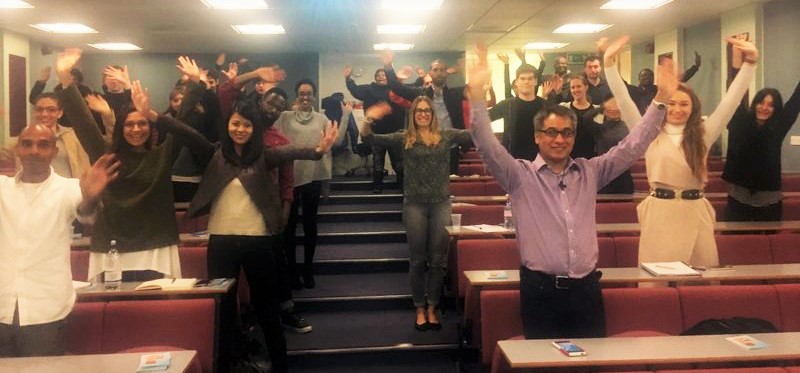
The first BECCA session

The first BECCA session

Birkbeck students hoping to develop ideas independently are encouraged to follow the digital pathways online. Simply Do Ideas offers an online idea testing tool, through which students can directly access support from the Enterprise Pathways team. Enterprise Pathways has also partnered with The Digital Garage from Google – a digital skills training platform assisting students to grow their business, career and confidence.

So –where do these pathways lead? Each has its own distinctive outcome; however by forming a strong community and deep understanding of our students, Enterprise Pathways helps to map a bespoke route to future destinations. At the heart of London, a global creative city, we help our students to identify what could enhance their enterprise journey. Enterprise Pathways empower Birkbeck students to make a positive impact on society by thinking differently.

Notes

  • Places for Birkbeck students at the Future of Media Boot Camp have now been allocated, however please email Enterprise Pathways to join the waiting list.
  • The full BECCA programme is available online. While the course is at capacity, interested students should contact Matthew at the earliest opportunity.
  • Links to Simply Do Ideas and The Digital Garage from Google are for enrolled students only, available on the Enterprise Pathways website.

Further Reading

Armistice Day: Remembering Birkbeck’s war poet

A self-portrait of Isaac Rosenberg, who as painted as well as writing poetry

A self-portrait of Isaac Rosenberg, who painted as well as writing poetry

An evening celebrating the life and work of Isaac Rosenberg is taking place on Sunday, 27th November between 6pm and 8pm in Senate House, Bloomsbury.

Featuring actress Miriam Margolyes, Alexander Knox, Simon Haynes, Philip Bell, Elaine Feinstein and Vivi Lachs and her band, this evening of words, music and images has been written and devised by Rosenberg’s biographer, Jean Moorcroft Wilson.

The event is being hosted by the Jewish East End Celebration Society to raise funds for a statue of Rosenberg in Torrington Square, outside Birkbeck’s main Malet Street building.

The First World War inspired a huge amount of poetry, by both soldiers and civilians. One of the most well-known poets, Isaac Rosenberg, studied in the evenings at the Art School at Birkbeck from 1907-1908, while spending his day as an apprentice graver. Rosenberg won several prizes during his time at the College and exhibited his work in the Art School’s annual exhibition after leaving. Rosenberg was killed while fighting in the Battle of the Somme in the spring of 1918. Today, we publish one of his most famous poems to mark Armistice Day.

In 2000, Professor Steven Connor  gave a lecture at Birkbeck about Rosenberg’s life and works. Read the lecture.

Break of Day in the Trenches

The darkness crumbles away.
It is the same old druid Time as ever,
Only a live thing leaps my hand,
A queer sardonic rat,
As I pull the parapet’s poppy
To stick behind my ear.
Droll rat, they would shoot you if they knew
Your cosmopolitan sympathies.
Now you have touched this English hand
You will do the same to a German
Soon, no doubt, if it be your pleasure
To cross the sleeping green between.
It seems you inwardly grin as you pass
Strong eyes, fine limbs, haughty athletes,
Less chanced than you for life,
Bonds to the whims of murder,
Sprawled in the bowels of the earth,
The torn fields of France.
What do you see in our eyes
At the shrieking iron and flame
Hurled through still heavens ?
What quaver – what heart aghast?
Poppies whose roots are in man’s veins
Drop, and are ever dropping;
But mine in my ear is safe –
Just a little white with the dust.

Trump and Brexit: why it’s again NOT the economy, stupid

This post was written by Professor Eric Kaufmann from Birkbeck’s Department of Politics. It was originally published on the LSE British Politics and Policy blog

As the final votes are counted, pundits and pollsters sit stunned as Donald J. Trump gets set to enter the White House. For anyone in Britain, there is a sharp tang of déjà vu in the air: this feels like the morning after the Brexit vote all over again. Eric Kaufmann explains that, as with Brexit, there’s little evidence that the vote had much to do with personal economic circumstances.

For months, commentators have flocked to diagnose the ills that have supposedly propelled Trump’s support, from the Republican primaries until now. As in Britain, many have settled on a ‘left behind’ narrative – that it is the poor, white, working-class losers from globalization that have put Trump over the top. Only a few clairvoyants – Michael Lind, Jonathan Haidt – have seen through the stereotypes.

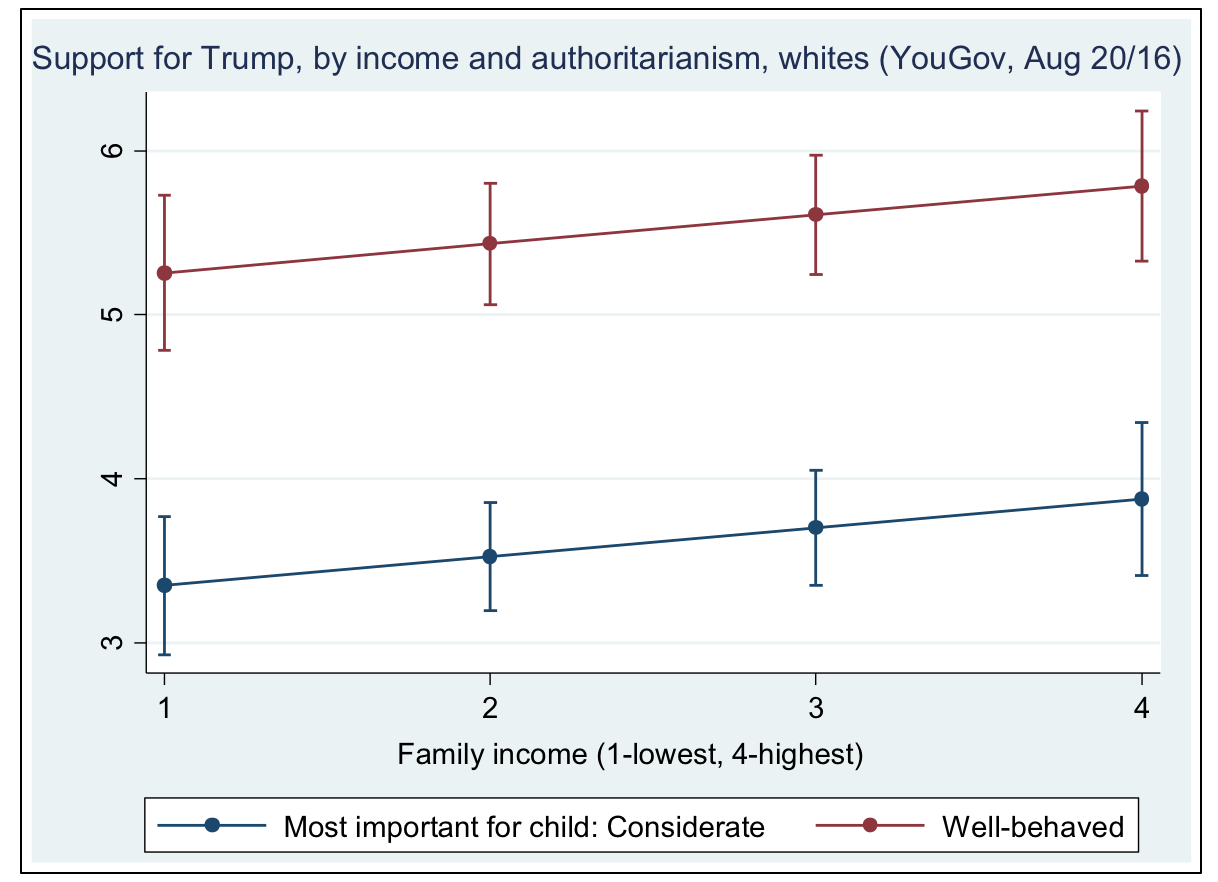
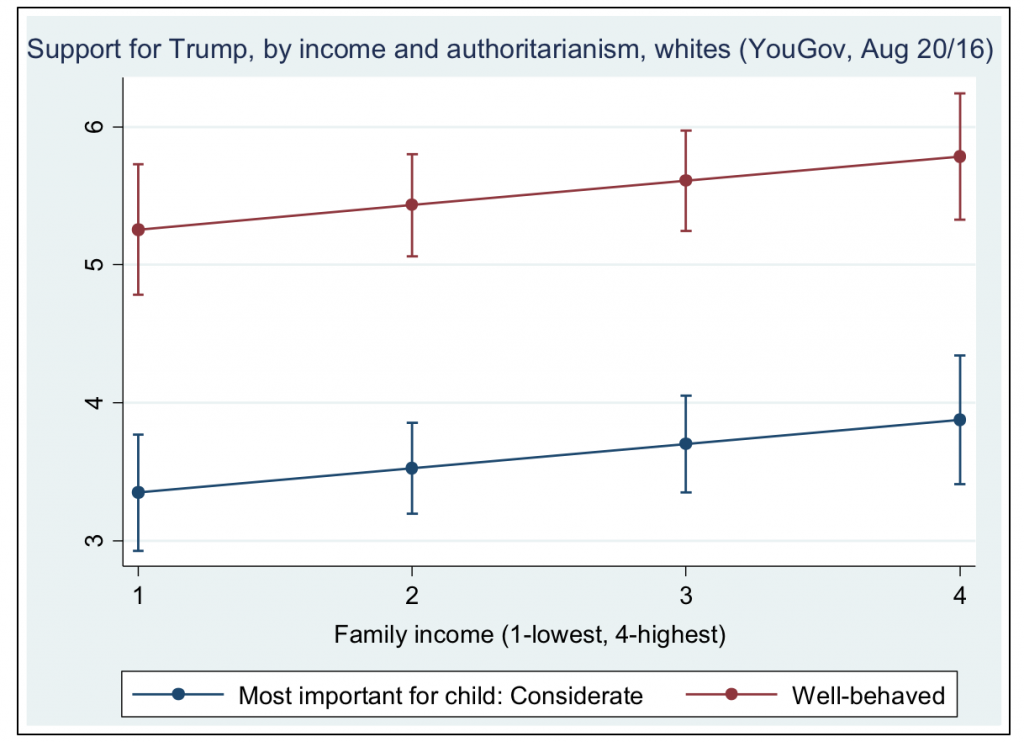
But, as in Britain, there’s precious little evidence this vote had much to do with personal economic circumstances. Let’s look at Trump voting among white Americans from a Birkbeck College/Policy Exchange/YouGov survey I commissioned in late August. Look at the horizontal axis running along the bottom of figure 1. In the graph I have controlled for age, education and gender, with errors clustered on states. The average white American support for Trump on a 0-10 scale in the survey is 4.29.

You can see the two Trump support lines are higher among those at the highest end of the income scale (4) than the lowest (1). This is not, however, statistically significant. What is significant is the gap between the red and blue lines. A full two points in Trump support around a mean of 4.29. This huge spread reflects the difference between two groups of people giving different answers to a highly innocuous question: ‘Is it more important for a child to be considerate or well-mannered?’ The answers sound almost identical, but social psychologists know that ‘considerate’ taps other-directed emotions while ‘well-mannered’ is about respect for authority.

People’s answer to this question matters for Trump support because it taps into a cultural worldview sometimes known as Right-Wing Authoritarianism (RWA). Rather than RWA, which is a loaded term, I would prefer to characterise this as the difference between those who prefer order and those who seek novelty. Social psychologist Karen Stenner presciently wrote that diversity and difference tends to alarm right-wing authoritarians, who seek order and stability. This, and not class, is what cuts the electoral pie in many western countries these days. Income and material circumstances, as a recent review of research on immigration attitudes suggests, is not especially important for understanding right-wing populism.

Figure 1.
1

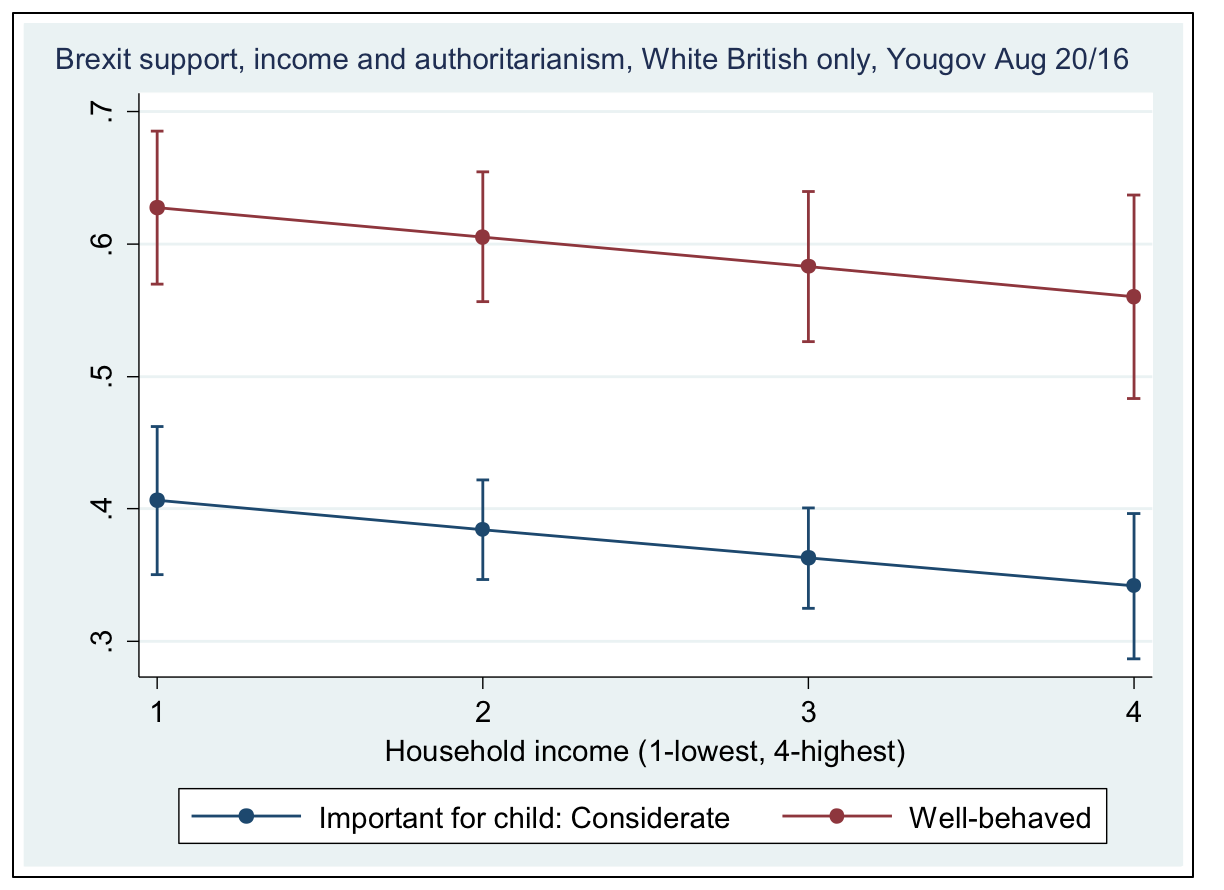
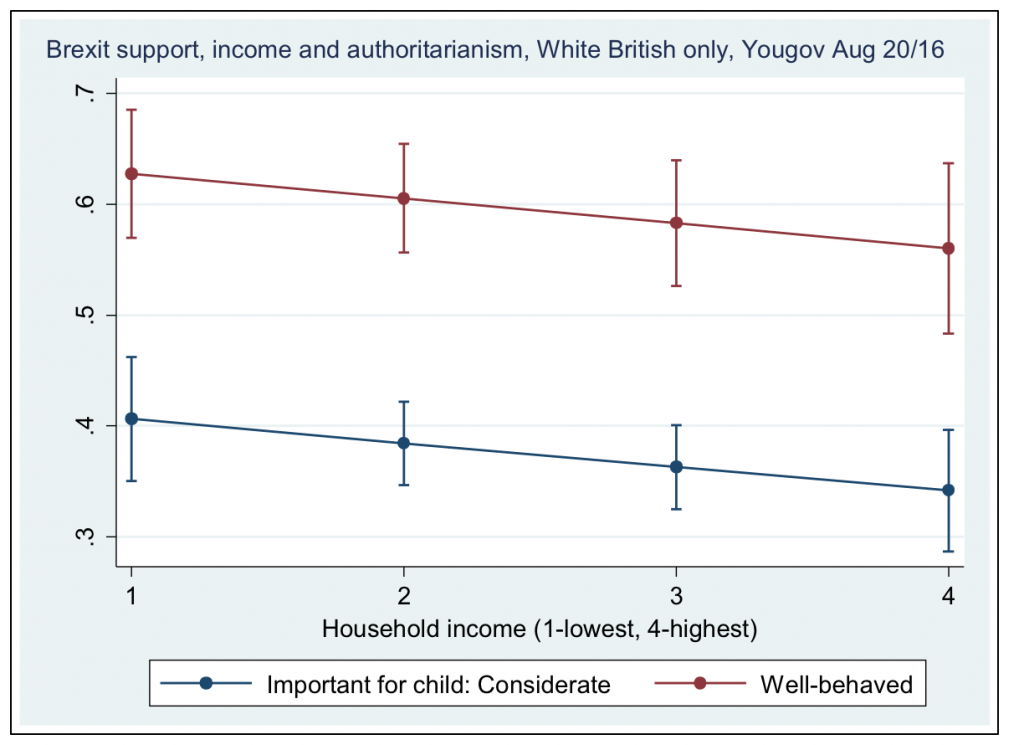
Now look at the same graph in figure 2 with exactly the same questions and controls, fielded on the same day, in Britain. The only difference is that we are substituting people’s reported Brexit vote for Trump support. This time the income slope runs the other way, with poorer White British respondents more likely to be Brexiteers than the wealthy. But income is, once again, not statistically significant. What counts is the same chasm between people who answered that it was important for children to be well-mannered or considerate. In the case of Brexit vote among White Britons, this represents a 25-point difference around a mean of 45.8 per cent (the survey undersamples Brexiteers but this does not affect this kind of analysis). When it comes to Brexit or Trump, think successful plumber, not starving artist or temporary lecturer.

Figure 2.
2

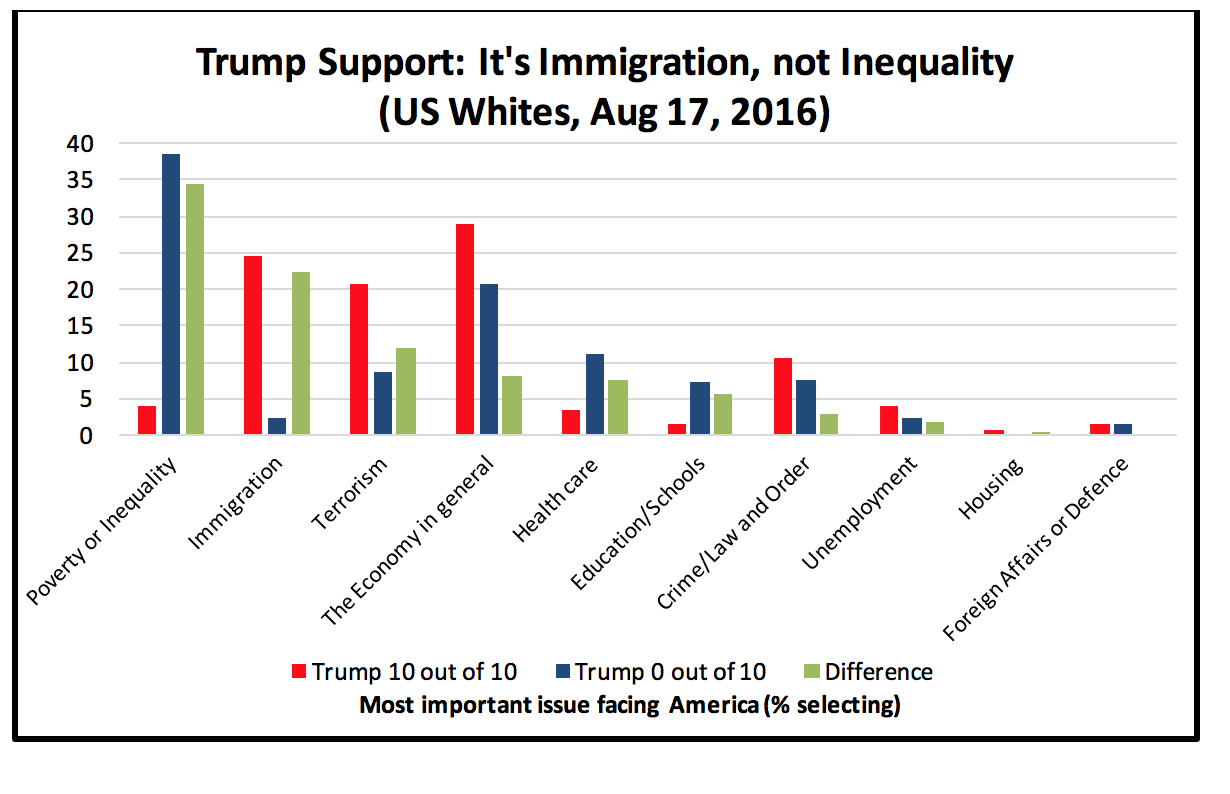
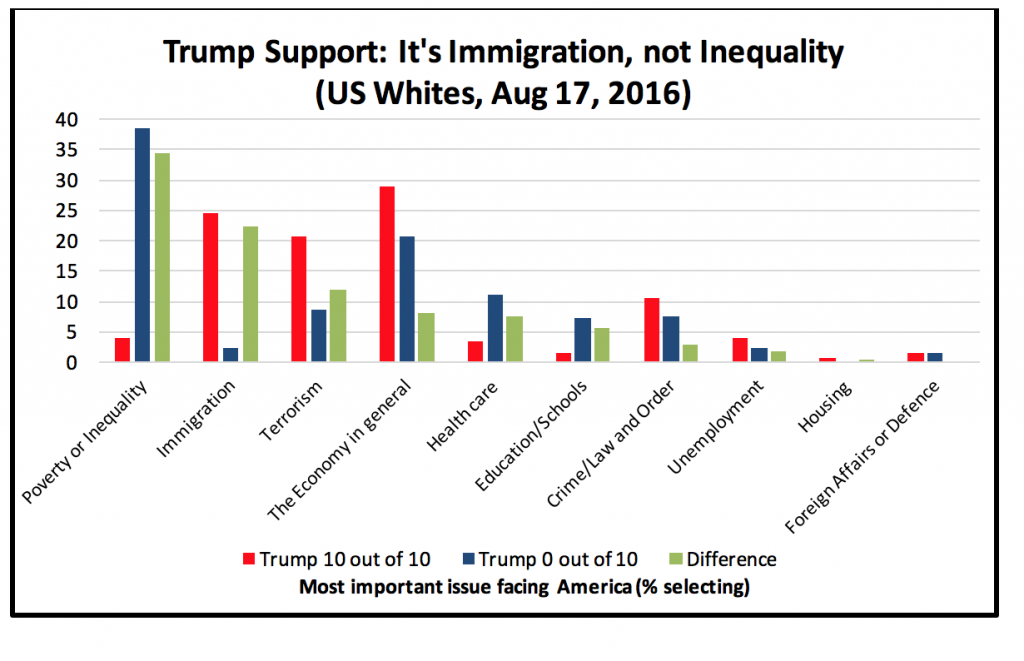
Some might say that even though these populist voters aren’t poor, they really, actually, surely, naturally, are concerned about their economic welfare. Well, let’s take a look at the top concerns of Trump voters in figure 3. I’ve plotted the issues where there are the biggest differences between Trump supporters and detractors on the left-hand side. We can start with inequality. Is this REALLY the driving force behind the Trump vote – all that talk about unemployment, opioid addiction and suicide? Hardly. Nearly 40 per cent of those who gave Trump 0 out of 10 (blue bar) said inequality was the #1 issue facing America. Among folks rating the Donald 10 out of 10, only 4 per cent agreed. That’s a tenfold difference. Now look at immigration: top issue for 25 per cent of white Trump backers but hardly even registering among Trump detractors. Compared to immigration, even the gap between those concerned about terrorism, around 2:1, is not very striking.

Figure 3.
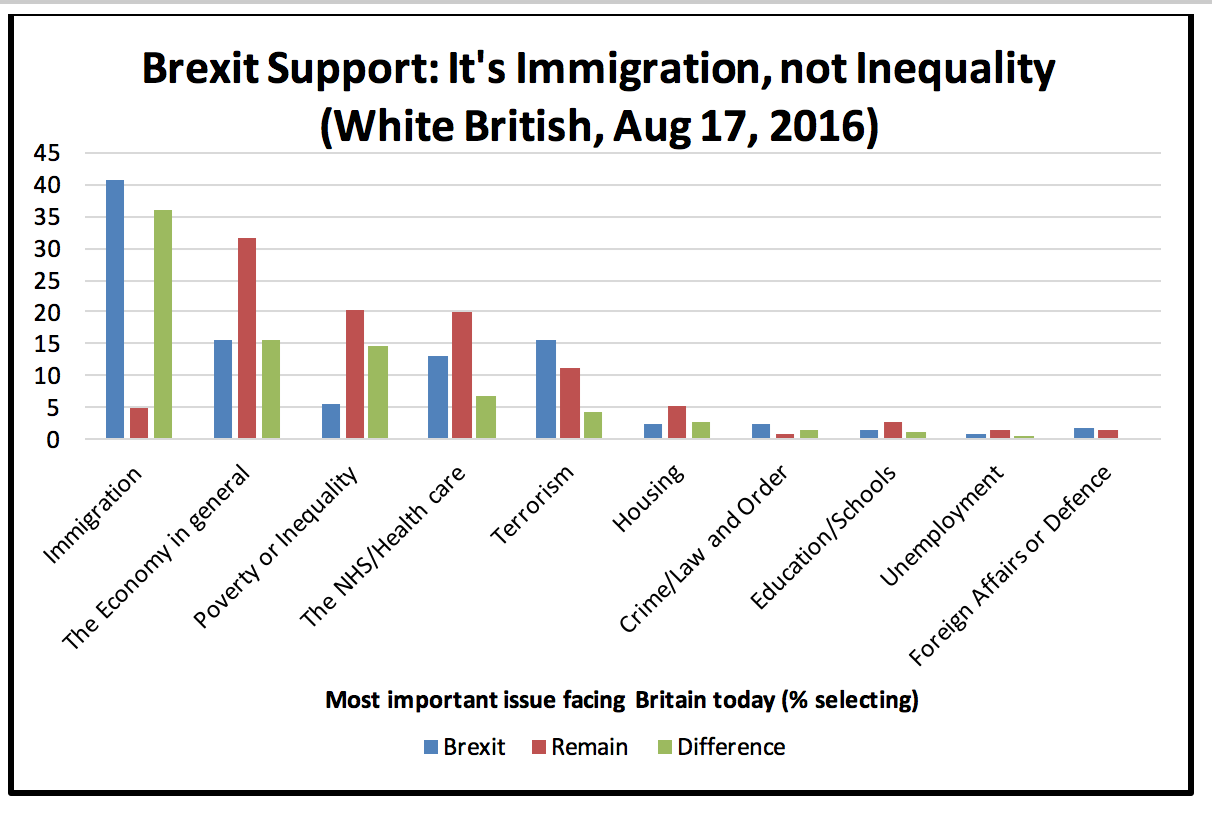
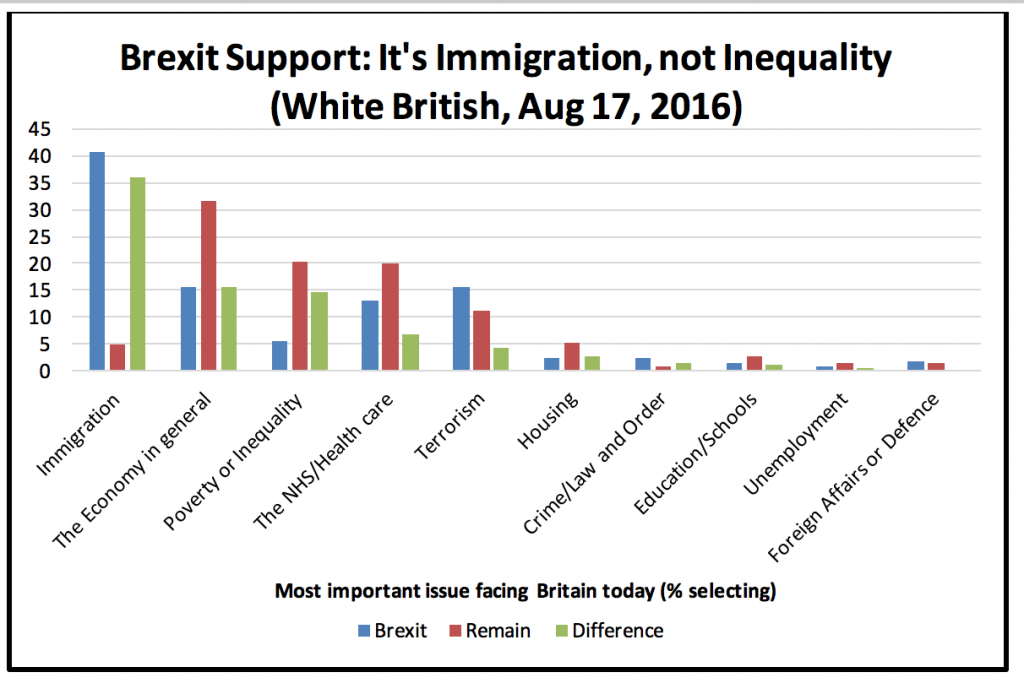
3For Brexit vote, shown in figure 4, the story is much the same, with a few wrinkles. The gap on immigration and inequality is enormous. The one difference is on ‘the economy in general,’ which Trump supporters worry about more than Brexiteers. This could be because in the graph above I am comparing extreme Trump backers with extreme detractors whereas the Brexit-Bremain numbers include all voters. Still, what jumps out is how much more important immigration is for populist voters than inequality.

Figure 4.
4Why is Trump, Brexit, Höfer, Le Pen and Wilders happening now? Immigration and ethnic change. This is unsettling that portion of the white electorate that prefers cultural order over change.

The US was about 90 percent white in 1960, is 63 percent white today and over half of American babies are now from ethnic minorities. Most white Americans already think they are in the minority, and many are beginning to vote in a more ethnopolitical way. The last time the share of foreign born in America reached current levels, immigration restrictionist sentiment was off the charts and the Ku Klux Klan had 6 million members – mainly in northern states concerned about Catholic immigration.

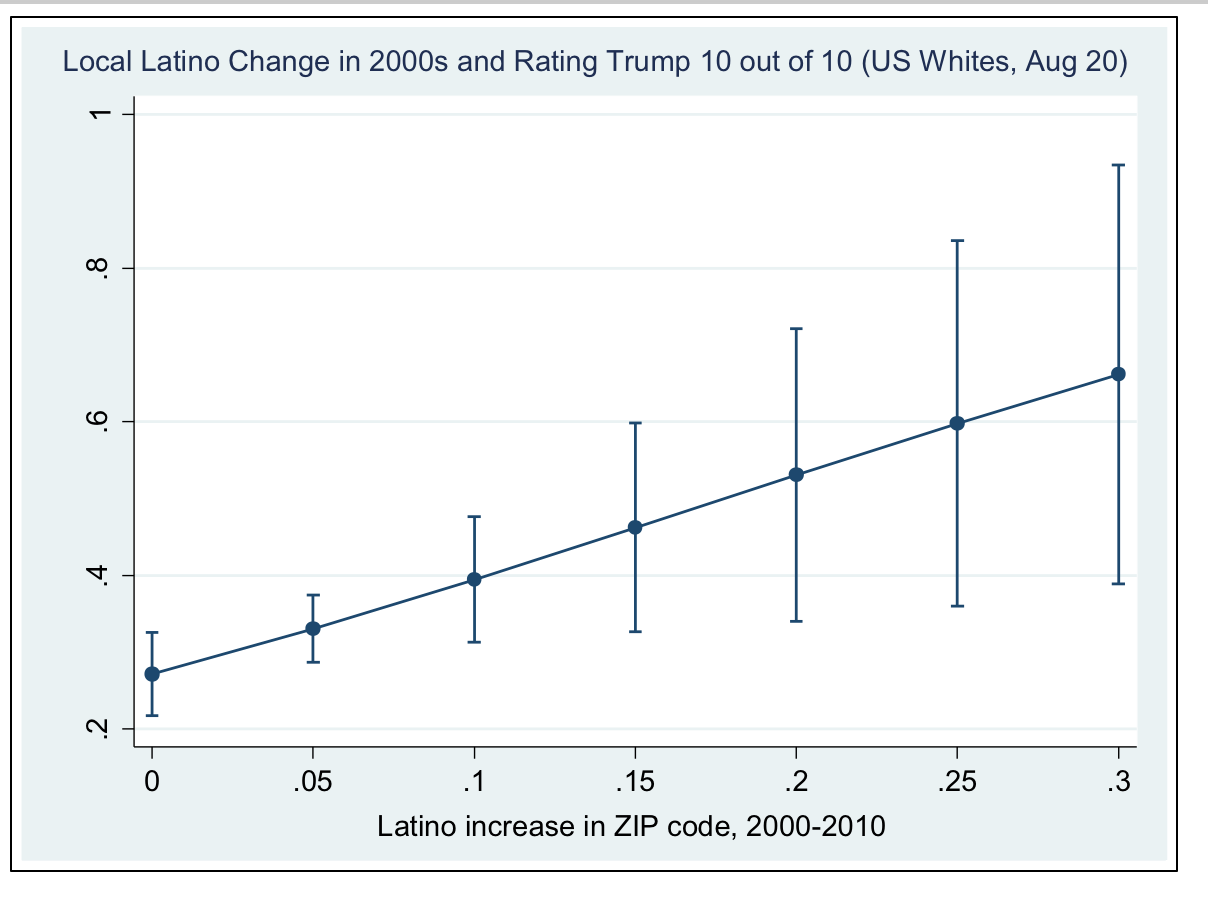
Ethnic change can happen nationally or locally, and it matters in both Britain and America. Figure 5, which includes a series of demographic and area controls, looks at the rate of Latino increase in a white American survey respondent’s ZIP code (average population around 30,000 in this data). The share of white Americans rating Trump 10 out of 10 rises from just over 25 percent in locales with no ethnic change to almost 70 percent in places with a 30-point increase in Latino population.

The town of Arcadia in Wisconsin – fittingly a state that has flipped to Trump – profiled in a recent Wall Street Journal article, shows what can happen. Thomas Vicino has chronicled the phenomenon in other towns, such as Farmer’s Branch, Texas or Carpentersville, Illinois. There are very few ZIP codes that have seen change on this scale, hence the small sample and wide error bars toward the right. Still, this confirms what virtually all the academic research shows: rapid ethnic change leads to an increase in anti-immigration sentiment and populism, even if this subsequently fades. The news also spreads and can shape the wider climate of public opinion, even in places untouched by immigration.

Figure 5.
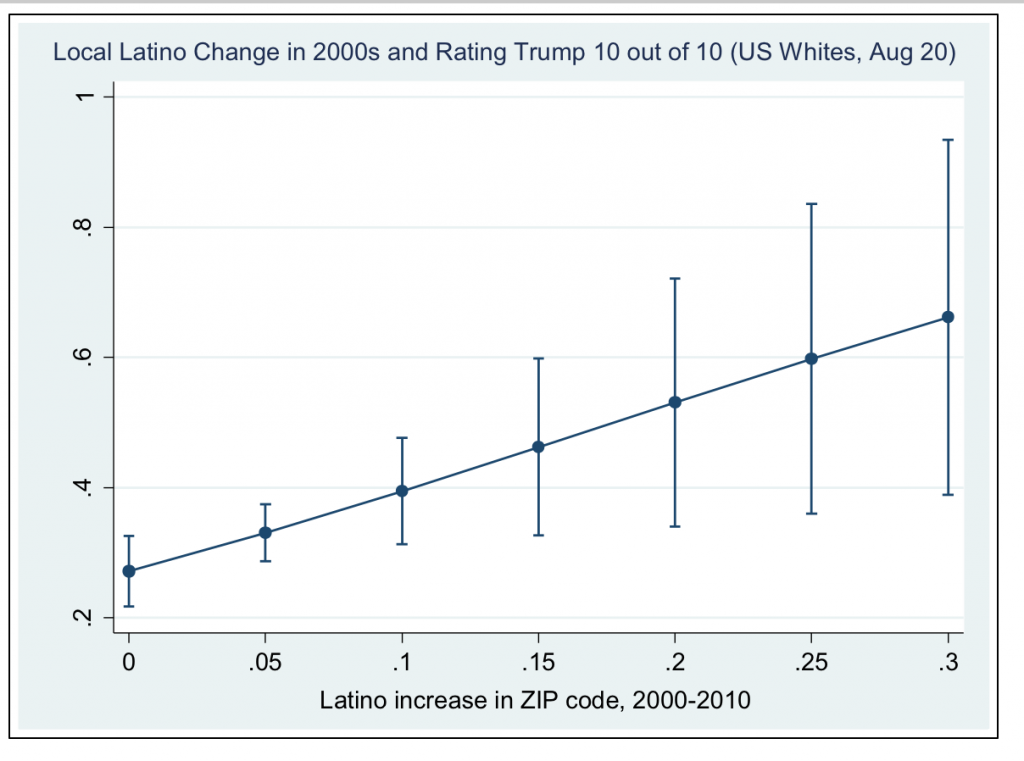
5Now let’s look in figure 6 at Brexit, and how White British voters in wards with fast East European growth in the 2000s voted. With similar controls, it’s the same story: when we control for the level of minorities in a ward, local ethnic change is linked with a much higher rate of Brexit voting. From under 40 percent in places with no ethnic change to over 60 percent voting Brexit in the fastest changing areas. Think Boston in Lincolnshire, which had the strongest Brexit vote in the country and where the share of East Europeans jumped from essentially zero in 2001 to the highest in the country by 2011.

Figure 6.
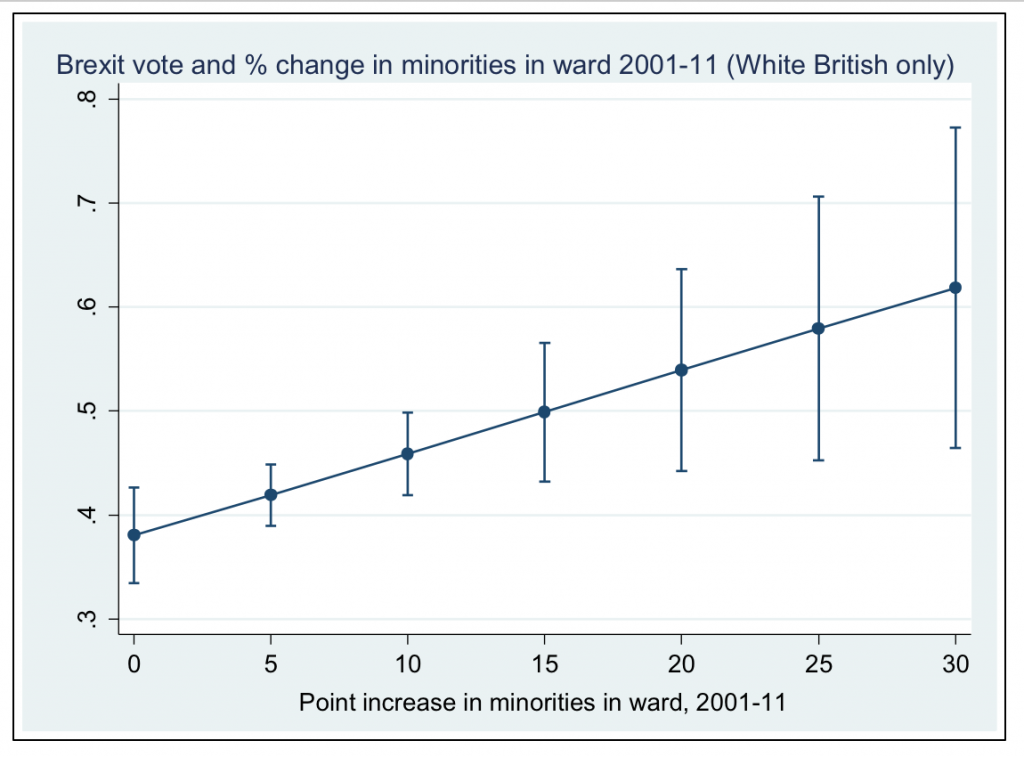
6

The Trump and Brexit votes are the opening shots which define a new political era in which the values divide between voters – especially among whites – is the main axis of politics. In a period of rapid ethnic change, this cleavage separates those who prefer cultural continuity and order from novelty-seekers open to diversity. Policymakers and pundits should face this instead of imagining that old remedies – schools, hospitals, jobs – will put the populist genie back in the bottle.


The Brexit High Court judgment: what it means

This article was contributed by Dr Frederick Cowell from the Birkbeck School of Law’s Department of Law.

The High Court today handed down their judgment in the case brought by Gina Miller and Deir Dos Santos against the Secretary of State for Exiting the European Union.

Billed as the ‘Brexit’ litigation, what was at issue was whether the Prime Minister had to go to parliament before triggering Article 50 of the Treaty of the European Union (also known as the Lisbon Treaty), which would set in motion Britain’s exit from the European Union.  The judgment was first and foremost a question of resolving a basic legal question; is it the government or parliament that has the power in these matters?

The court were, in fact, keen to cut out the party political question altogether, declaring that they were “dealing with a pure question of law”. The judgment is, however, likely to become the ultimate political football and within half an hour the Government had announced that intended to appeal the decision to the Supreme Court on the 7th of December.

The core issue was the scope of prerogative powers relating to foreign policy, which are held by the Prime Minister and other government ministers. Historically, treaties were signed between monarchs by their representatives and, as the UK’s constitution became more democratic in the nineteenth century, prerogative powers were delegated to government ministers.

Many prerogative powers are now governed by legislation – for example, the 2010 Constitutional Reform and Governance Act put the power to manage the Civil Service onto statute governed by clearly definable legal powers. Prerogative powers are not easy to control as they can be exercised by ministers without the approval of parliament – for example Margaret Thatcher’s decision to ban trade unions from GCHQ (the secret service signal intelligence headquarters) did not require an Act of Parliament in the way that her other restrictions on trade unions did.  They are also difficult to control through the courts, which are often reluctant to intervene in areas where these powers are exercised, especially when it comes to foreign policy. On the eve of the Iraq war the High Court held that they could not hear a case from the Campaign for Nuclear Disarmament, who were asking for Tony Blair to seek a resolution from the UN Security Council authorising the use of force.

Shortly after becoming Prime Minister, Theresa May took the position that she didn’t need parliament’s approval to activate Article 50 and she could exercise her prerogative powers to take the UK out of the EU. In fact, she went so far as to guarantee in October that Article 50 would be activated by the end of March.  In 1971 the question of whether the government should accede to the European Economic Community (as it then was called) was debated in the House of Commons, even though technically, under the UK’s constitutional system, the Prime Minister of the day Edward Heath did not need an Act of Parliament to accede to the EEC.

What he did need parliament’s approval for, and what was at the heart of the Brexit litigation, was the 1972 European Communities Act which brought EEC law (later EU law) into UK law. This took nearly 300 hours of debate to pass, with Labour and Conservative MPs voting against their own party line repeatedly in an early indication of how divided the two main political parties were on this issue.

The 1972 Act – as the High Court Judgment noted – created rights for individuals as well as empowering the lawmaking institutions of the EU (paragraph 37 R(on application of Miller) v Secretary of State of Exiting the European Union). There were three kinds of right created under the 1972 Act; rights the EU had created and could be incorporated into UK law (such as the 48 hour working week and the right to cheap data roaming), rights enjoyed by citizens of other EU member states in the UK (the right to work) and rights enjoyed by UK citizens in other EU member states (the right live in other EU states).

The big issue was whether the loss of rights conferred by the 1972 Act could not sanctioned by the Government acting without parliamentary authority.  The Court noted that the lawyers for the Secretary of State had effectively conceded that some rights would be lost were this to happen (para 63). Therefore, the question was who should make the decision. In deciding this, the High Court noted that since the English Civil War in the seventeenth century the basic proposition was that the Crown (the executive branch of government) could not override parliament.

It is noteworthy that when the courts have previously reined-in abuse of ministerial power they have pointed out that one of the founding principles of Britain’s unwritten constitution was parliament’s supremacy over the executive.  The Secretary of State’s lawyers relied heavily on an earlier court ruling at the time of Maastricht Treaty in the early 1990s which held that ratifying a new treaty was within the government’s prerogative powers. But this was a different question all together as Paragraph 94 of the judgment made clear, as the government’s actions on an “international plane” (i.e. activating Article 50) would remove rights granted via a domestic statute (the 1972 Act): therefore they needed the approval of parliament.

What this means is difficult to say at this point, although the Government’s strategy – and possibly its timetable for leaving the EU – have been dealt a significant blow. Whilst there are potentially points of law to appeal in the judgment, it is difficult to see some of the core conclusions reached by the High Court being overturned by the Supreme Court as they follow a century of established case law on the subject.

The real danger for the Government is that it will be very difficult to get their version of Brexit in a statute through both the House of Commons and the Lords, as Jolyon Maugham QC explains here. This is why political commentators are speculating heavily on the possibility of an election next year which would give the government the political mandate, and the Commons majority to push exit legislation through the House of Commons. Although the status of the June 23rd referendum was only advisory, were a Government to be elected in a General Election on a pro-Brexit manifesto there would be no way of stopping that in parliament.

From ‘Go back to China’ to ‘Where are you really from?’: Nationality and ethnicity talk in everyday interactions

This article was contributed by Professor Zhu Hua of Birkbeck’s Department of Applied Linguistics and Communication

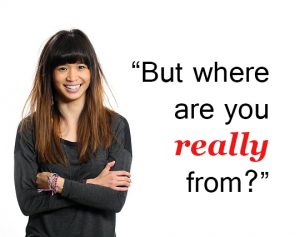
perpetual-foreigner-syndromeIn his open letter published in the New York Times on 9 October, Michael Luo, who was born and grew up in the US, told of his encounter with a woman who yelled at him and his family, ‘Go back to China!’, on the Upper East Side of Manhattan when they came out of a church service.  Puzzled by the event, his 7-year-old daughter asked ‘Why did she say, ‘Go back to China?’ We’re not from China.’

What Michael Luo experienced is ‘perpetual foreigner syndrome’, a problem facing many transnational individuals in everyday interactions, especially those who may look or sound different from the local majority.  Back in 2002, Frank Wu, the first Asian American law professor at Howard University Law School, wrote specifically on how perpetual foreigner syndrome is instantiated through recurrent and seemingly innocent questions (which, admittedly, are much milder than what was hurled at Michael Luo):

Where are you from?’ is a question I like answering. ‘Where are you really from?’ is a question I really hate answering… For Asian Americans, the questions frequently come paired like that…. More than anything else that unites us, everyone with an Asian face who lives in America is afflicted by the perpetual foreigner syndrome. We are figuratively and even literally returned to Asia and ejected from America. (Wu 2002)

His point about what these questions can do strikes a chord with me. Having lived and worked in China and Britain and travelled to many parts of the world, I find questions like ‘where you are from?’ really difficult to answer. I never seem get it right and always end it up with the feeling that the self I present in my attempted answers is not real – it is fragmented some times, and rehearsed at others.  If I say that I am from London, I know that the next question will be ‘where are you really from’. I have to look apologetic and confess that I ‘originally’ came from China more than 20 years ago and have lived in Britain longer than I had been in China.  If I take the short-cut and tell people that I am from China, the next comment I am likely to hear is a compliment ‘but your English is so good!’.  For a long time, I thought that this is just me, an applied linguist who is over-interpreting language use in everyday interactions, until I read Rosina Lippi-Green’s work on language, ideology and discrimination (1997/2012) and began to make connections with my observations on these instances of discourse in daily encounters and the existing studies including one of the strands of my work on Interculturality.

I refer to this kind of discourse that evokes or orients to one’s ethnicity or nationality either explicitly or implicitly as Nationality and Ethnicity Talk (NET). It includes questions or comments which, frequently occurring in small talk, aim to establish, ascribe, challenge, deny or resist one’s ethnicity or nationality.  The questions and comments range from direct ones (e.g. ‘Where are your people coming from?’, ‘When are you going back?’, ‘Is it as hot as this where you are from?’, ‘What is it like back home?’ to more subtle ones (e.g. ‘Your English is so good!’). There is nothing inherently wrong with questions like ‘where are you from’. The question can be genuine – people would like to find out more about China, Japan or Korea or any other culture or they are simply interested in you as a person.  But problems occur when those who are asking such questions appear to look for a certain answer and appear confused or disappointed when hearing an unexpected answer and those on the receiving end of such questions might have been asked the same questions 101 times.  And of course, in Michael Luo’s case, it made him and his daughter feel like ‘foreigners’ in their own country

Despite growing acceptance of racial equality in post-industrialised societies, NET of the above kind reflects people’s hidden and flawed folk theories of race, reproduces and reifies cultural essentialism, and can result in exclusion and marginalisation of certain social groups.  Jane Hill (2008) coined the concept of ‘folk theory of race’ to describe everyday assumptions that people have about race and ethnicity. Because the folk models or theories are often taken for granted, people tend to use them to ‘interpret the world without a second thought’. Folk theory of race can be in operation subtly and, on some occasions, it is almost invisible to those who apply it and/or those at the receiving end of it. Markus & Moya (2010) have unpicked the powerful, hidden, and flawed assumptions about the nature and meanings of race and ethnicity beneath the eight common conversations about race amongst American people. These include: ‘We’re beyond race.’ ‘Racial diversity is killing us.’ ‘Everyone’s a little bit racist.’ ‘That’s just identity politics.’ ‘Variety is the spice of life.’ ‘It’s a Black thing—you wouldn’t understand.’ ‘I’m___ and I’m proud.’ and ‘Race is in our DNA’.  They argue that ‘these eight conversations give us the illusion of understanding, but they are narrowly based on limited, flawed, and of course, unstated assumptions … Also like stereotypes, these conversations are pervasive, they are difficult to change and they have powerful consequences for our actions.’

In my recently published article co-authored with Li Wei, we examine the significance of questions such as ‘where are you really from?’ in everyday conversational interactions. We discuss what constitutes NET, how it works through symbolic and indexical cues and strategic emphasis, and why it matters in the wider context of identity, race, intercultural contact and power relations. The discussion draws on social media data including youtube videos and a blog with the title of ‘It may not be racist, but it’s a question I’m tired of hearing’ by Ariane Sherine in the Guardian’s opinion column, Comment is Free. We argue that the question ‘where are you really from’ itself does not per se contest immigrants’ entitlement. However, what makes a difference to the perception of whether one is an ‘outsider’ as Michael Luo did – is the tangled history, memory and expectation imbued and fuelled by power inequality.

There have been reports of the increase in the number of racial insults at people who look and sound different since the EU Referendum. It is important that we pay closer attention to linguistic xenophobic, but it is equally important to be mindful of the significance of the more subtle ways of Othering as exemplified in NET.

Further reading:

  • Hill, Jane H. 2008. The everyday language of white racism. Malden, MA: Wiley-Blackwell.
  • Lippi-Green, Rosina. 1997/2012. English with an Accent. Language, Ideology, and Discrimination in the United States. London: Routledge.
  • Markus, Rose & Paula Moya (eds.). 2010. Doing Race: 21 Essays for the 21st Century. New York: W.W. Norton & Company.
  • Wu, Frank. H. 2002.  Where are you really from? Asian Americans and the Perpetual Foreigner Syndrome.  Civil Rights Journal  Winter 2002. 16-22.
  • Zhu Hua and Li Wei (2016) “Where are you really from?”: Nationality and Ethnicity Talk (NET) in everyday interactions. In Zhu Hua & Claire Kramsch (eds.), Symbolic power and conversational inequality in intercultural communication, a special issue of Applied Linguistics Review 7(4), 449-470.  The article can be accessed here.

Soldiers aren’t being harangued by lawyers – it’s a myth designed to discredit the Human Rights Act

This article was written by Dr Frederick Cowell from Birkbeck’s School of Law. It was originally published on Left Foot Foward

Theresa May’s government is pushing a narrow, meaningless conception of human rights

theresa-may-3

There has been some controversy over the government’s plans to use the emergency powers provisions of the European Convention on Human Rights (ECHR) to exempt British forces from lawsuits.

Despite the bullish selling of the proposals it is worth noting they can’t exempt soldiers from being responsible for torture or allow them to use the death penalty. In these cases the Human Rights Act (HRA) could still be used to bring claims against British forces and they could still be subject to war crimes prosecutions under the International Criminal Court Act.

But it’s the tone of this announcement and the context in which it takes place which makes it worrying for the protection of human rights.

As Dr Marko Milanovic notes, there is little evidence of an ‘industry’ of ‘vexatious litigation’ against the armed forces, which is the stated rational for these proposals.

Yet, it seemed to provide the warm up to the Prime Minister’s speech at the Conservative Party conference where she promised to never again ‘allow left-wing human rights lawyers to harangue… our armed forces.’

Theresa May has been here before; in 2011 when she was Home Sectary she addressed the Conservative Party Conference claiming that there was an illegal migrant ‘who cannot be deported because, and I am not making this up, he had a pet cat.’

Except, she was making it up. Taken alongside the wider drip feed of negative stories about the HRA, many of which are based on misrepresentations of the law, this appears to be part of a process of ‘monstering’ the HRA, designed to create the political conditions for its repeal.

The repeal of the HRA and its replacement with a ‘British Bill of Rights’ has been Conservative Party Policy since 2006. In 2007 the then Leader of the Opposition David Cameron said that a British Bill of Rights could enhance the protection of rights by including rights not included in the ECHR, such as the right to a trial by jury.

Later this was quietly dropped with the emphasis on HRA repeal focusing on criminals using the right to family life to avoid deportation. In 2012 the Commission on a UK Bill of Rights concluded that the HRA shouldn’t be repealed but noted there were ‘perceived problems with the Human Rights Act… largely caused by a lack of public education’.

Ironically the escalation of anti-HRA rhetoric came precisely at the time when the UK Government achieved a major victory on reforming the European Court of Human Rights, with the 2012 Brighton Declaration, which led to a reduction in its backlog of cases. In 2014 the government were able to change immigration rules to make it much harder for criminals to use the right to a family life to resist deportation, again addressing a criticism often levelled at the HRA.

There is a split in the Conservative party between those who think a Bill of Rights should be framed narrowly, to amend the HRA, and those who think it should lead to UK withdraw from the ECHR, in a form of second Brexit. The current Justice Secretary has confirmed that it is still government policy to introduce a British Bill of Rights, although since winning the 2015 General Election this has been subject to a series of delays.

In her Conservative Party leadership campaign in July Theresa May stated that she would not campaign to leave the ECHR as there was no parliamentary majority for such a move. This leaves the door open to withdraw the ECHR at a later date which is considerably easier to do following withdrawal from the EU.

The contents of a British Bill of Rights is as of yet unknown however, the tone of announcements seem to indicate a strong focus on who shouldn’t have rights and where rights shouldn’t be applied.

The 2014 Conservative Party paper ‘Protecting Human Rights in the UK’ contain some indications, such as references to preventing human rights being used in ‘trivial’ cases, that there are moves to distinguish between undeserving and deserving rights holders in a future Bill of Rights.

Repeated criticism by many leading figures in the government of the HRA being used to challenge welfare policy or immigration decisions has been framed in language pointing to an undeserving rights holder. This is also accompanied by claims that certain groups needing to be protected from human rights law, or where human rights law is used by those charged or convicted of a crime that human rights law needs to focus on the victims of crime.

When the recent announcement on the liability of the armed forces is seen in this context, it reads like a trailer to a much narrower, and potentially more meaningless, conception of human rights being pushed by the current government.

Bad Habits? France’s ‘Burkini ban’ in Historical Perspective

This article was written by Dr Carmen Mangion from Birkbeck’s Department of  History, Classics and Archaeology. The article was originally published on the History Workshop Online‘s blog.

The ‘burkini ban’ issued by 30 French beach towns at the end of July 2016 sparked a media frenzy. Town mayors saw the burkini, the full-body swimsuit favoured by some Muslim women as a means of maintaining modesty while enjoying the sea, as a symbol of Islamic extremism and a threat to ‘good morals and secularism’. France’s 1905 constitution separates Church and State, and embraces a laïcité (a secularism in public affairs which prohibits religious expression) meant to limit religion’s influence on its citizens though still allowing freedom of religion. It originated as a means of eliminating the influence of the Catholic Church.Following ministerial criticism, France’s top administrative court investigated the ‘burkini ban’, ruling in late August that it violated basic freedoms.

Nuns at the beach
Nuns at the beach (Facebook/Izzeddin Elzir)

Amidst this furore, Italian Imam Izzedin Elzir’s image of nuns on the beach in their religious habits triggered an international media response. The image, appearing across social media and in outlets as prominent as the New York Times, implied the hypocrisy of a ban targeting Muslims and ignoring Christians. The photos were ironic on two counts:

First, some French mayors were emphatic that nuns in habits were also forbidden on beaches.

Second, and more apposite to this blog post, both the media and ‘ordinary’ citizens seem to be unaware that the ‘nun’ on the streets of Paris (and elsewhere) once sparked a similar outrage.

The historical context was of course different (it always is), but the indignation and the drive to control women’s appearance was just as virulent. Such outrage was not limited to France, but as the ‘burkini ban’ was initiated by the French, it seems appropriate to begin with this bit of French history.

The French revolution of the 1790s, with its cry of liberté, égalité, fraternité was not such a good thing for Catholic nuns. The nun, in her religious habit, became a symbol of the Catholic Church’s role in upholding the inequities and injustices of the ruling classes within France. Catholic nuns, then fully habited, were visible on the streets of Paris as educators, nurses and providers of social welfare, and became targets of anti-clerical outrage. The republican political regime set French nuns ‘free’ from their lifelong vows of poverty, chastity, obedience and their religious habit. It closed convents and confiscated their property. Some members of religious communities weren’t so willing to be set free, however, and were imprisoned. They were told to remove their religious habits (made illegal in 1792) and instead wear secular garb. Nuns including the Carmelites of Compiègne and the Daughters of Charity of Arras were executed for refusing to take the oath of loyalty to the Constitution.

French citizens also made their umbrage against nuns known. One 1791 print representing revolutionary anticlericalism, La Discipline patriotique or le fanatisme corrige (‘The patriotic discipline or fanaticism corrected’), showed the market women of Paris’s les Halles disrobing and thrashing the religious fanaticism out of a group of nuns. Such disciplining of women’s bodies was both salicious and violent.

la_discipline_patriotique_ou_le_-_btv1b69446090

The patriotic discipline or Fanaticism corrected (La Discipline patriotique ou le fanatisme corrigée) (Image: BnF/Gallica)

This urge to control the religious ‘fanaticism’ of women and monitor their clothing choices was not only a French issue; it had earlier incarnations. The dissolution of the monasteries in England in the mid-sixteenth century also ‘freed’ nuns and monks from their vows — and their property. English women’s response to this was to form English convents in exile, many in France and Belgium. In the 1790s English nuns fled, often surreptitiously, back to England. But penal laws restricting Catholic practices were still in effect and English bishops initially discouraged nuns from wearing their religious habit. English citizens too showed their indignation for female religious life by throwing epithets and stones at nuns; the Salford house of the Daughters of Charity of St Vincent de Paul was set alight in 1847. Similar events happened in the United States. Most notoriously the Ursuline convent in Charleston, South Carolina was burned down in the 1830s by anti-nun rioters. In the Netherlands, in Spain, in Belgium, in Germany and more recently in Eastern and Central Europe, nuns were also targeted. Women in religious clothing were (and are) easy targets of vitriol and violence.

So burkinied Muslim women and habited Catholic nuns have far more in common than one might think. The nun’s religious habit, like the burkini, has links to religious identity as counter to cultural norms. Critics say that women in burkinis challenge the French secular way of life. History shows that the habited nun also challenged both a republican version of Frenchness and also an English version of Englishness.

Within this context, the burkini furore illustrates two points.

First, it is yet another disappointing reminder that women’s bodies and appearances remain far too often more relevant (and newsworthy) than women’s intellects and voices. Clothing regulations are an excuse to control women and to divert attention from more substantive issues. They are a means of enforcing a societal version of femininity that doesn’t allow for difference. Women choosing to wear religious dress (or dress associated with religious affiliation) should not be stigmatised.

Second, by focusing on the burkini, we forget the more salient issue of figuring out how diverse people can live together peacefully. It is the social, economic and political factors that need attention: cultural inclusion, high unemployment and participation in civic life. Criminalising what women wear on the beach doesn’t even come close to addressing these issues.

Further Reading:

  • Carmen Mangion, ‘Avoiding “rash and Imprudent measures”: English Nuns in Revolutionary Paris, 1789-1801’ in Communities, Culture and Identity: The English Convents in Exile, 1600-1800 edited by Caroline Bowden and James E. Kelly (Ashgate, 2013), pp. 247-63.
  • Gemma Betros, ‘Liberty, Citizenship and the Suppression of Female Religious Communities in France, 1789-90’, Women’s History Review, 18 (2009), 311–36
  • For a robust comparison of nineteenth-century American nativism to the politics of Islam see José Casanova, ‘The Politics of Nativism Islam in Europe, Catholicism in the United States’, Philosophy & Social Criticism, 38 (2012), 485–95. A short and accessible version of this essay can be found here.