Birkbeck teams up with Refugees at Home

Naureen Abubacker, coordinator of the Compass Project at Birkbeck, writes about the College’s partnership with charity Refugees at Home, which matches people with spare rooms with refugees and asylum seekers in need of a place to stay.

The Compass Project at Birkbeck launched in the autumn of 2017, providing 20 fully funded places on a university level qualification for 20 asylum seekers. This offers an opportunity to students to study for and gain a UK qualification, who would otherwise face a unique barrier to accessing higher education.

With few opportunities like this elsewhere in the UK for mature asylum seekers, The Compass Project has welcomed students living outside of London, including Wales, York and Birmingham – which would mean several hours of travelling in and out of London in order to attend class. As classes at Birkbeck take place in the evening, it has been important to find ways to support these students, ensuring that they have a secure place to stay and they aren’t travelling home late into the night. For others, their precarious status has meant that overnight they have found themselves homeless.

Through the wonderful work of Refugees at Home, a charity that brings together those with a spare room with asylum seekers or refugees who need a place to stay, it has been possible to support our students who live outside London, through temporary accommodation with local host families in and around London. The accommodation provided by Refugees at Home is invaluable and offers them a safe and welcoming home environment whilst they focus their attention on their studies.

Michael, a Compass Project student who is studying for the Certificate of Higher Education in Counselling and Counselling Skills, has been living with Refugees at Home hosts Hannah and Charlie since the Spring term Michael said:

“I had the pleasure of being hosted by Charlie and Hannah and it’s been such an awesome experience. Being here allowed me to enter the year 2018 in a loving home full of love and warmth; I am not exactly sure where I would be now if Charlie and Hannah had not come to my rescue. I have been able to continue with my course.

I first heard about Refugees at Home through Naureen, the Compass Project coordinator at Birkbeck, who made several enquiries and a request on my behalf to find secure accommodation, following a challenging time. That very same night when I thought everything was against me, Refugees at Home came to my rescue and sent me to a host’s house in London whilst they sorted out a more long-term place for me with Charlie and Hannah.

The help I have received has really been overwhelming. I have been supported, shown love and affection not just by Charlie and Hannah, but their respective families, Spergen, the dog, and friends. I am treated like a member of the family by those within this lovely community.

I am by far probably the worst guest in a long time as my mood has been going up and down like a yo-yo but through it all these guys have been amazing giving me space when I needed it and always being there to talk to and help me with any difficulty I might be facing.

For those being hosted by the wonderful people through Refugees at Home, here is my tip on being a good guest: learn as much as you can from your host and for you to share any knowledge or tips about anything with your host as this allows you to better understand and be understood. Above all open mind and love in your heart, you will never go wrong.”

Hannah talks about her experience of how she became involved with Refugees at Home and what it’s been like having Michael as a guest through the scheme:

“My husband and I have spare rooms in our house and had been wanting to host for some time. I came across Refugees at Home on Facebook and got in touch. A few forms, references and a house visit later and we were contacted about a couple from Eritrea who spoke no English and had been the country a very short while. Fortunately for them, they found more permanent accommodation before they came to us. Then we were contacted about Michael. It is fair to say Michael is not the type of person we were expecting to host as a refugee – which just goes to show all stereotypes should be blown out of the water when it comes to those seeking asylum. Michael has been in the UK for over 20 years and through a series of unfortunate events and system failures has slipped through the net and is still awaiting leave to remain.

Having Michael with us has been more like having a friend to stay. He’s easy going, full of interesting facts and stories and a fantastic cook. He has been a huge support and help to another refugee we host who does not know English or the UK system well- Michael has been able to work with us to guide him through.

We’ve found hosting to be a real joy and have learnt the support of our community through it- we’ve been given bikes for everyone to get around, invites for our two guests to meals, birthday parties and cups of tea. A group from our church even wanted to give our guests Christmas presents and made up Christmas hampers for them.

It takes a while to settle into hosting if you’ve not done it before. Learning each other’s daily routines, figuring out how to do the shop (we have a list app), finding the balance between wanting guests to be at home and be autonomous in how they live, while being able to live your own life as well. But our every growing, slightly unconventional family has enjoyed working out these ways of living with others.

We have learnt the importance of time, patience and listening and have had our eyes opened to a whole world of navigating systems and of backstories of other people’s lives that we might have touched the surface of previously but never fully understood.

If you have a spare room in your accommodation I would highly recommend you consider hosting, even if for a short time!”

The success of the students on the Compass Project who have found accommodation through Refugees at Home would not have been possible without the support of this incredible organisation. To find out more about Refugees at Home and to become a host, please visit: www.refugeesathome.org

What Happens When Meghan Markle’s Blackness loses its Sparkle?

The wedding of Prince Harry and Meghan Markle has been hailed as a pivotal moment for multicultural Britain. But Dr William Ackah (Department of Geography) argues that it is just another fleeting false dawn and there will be little lasting, positive impact for Black Britons.

Symbols are important. For some people, seeing Meghan Markle marry into the monarchy, while a Black preacher expounded the word and a Black Choir sang at the ceremony, was viewed as ushering in a new area of racialised harmony and black cultural acceptance at all levels of British society. If blackness is acceptable to the monarchy, then surely it can be embraced by everyone? One can envisage that cascading out from the memories of the day; TV production companies will make documentaries on relationships across cultural and racial boundaries; there will be operas and plays about mixed cultural and racialised identities and new research council funding streams on identity, relationships and difference. Once again, black culture will be examined, explored, explained, celebrated, debated and mined by White people as something new and exotic.

In contrast to the negativity surrounding racialised minorities due to fears over migration and religious and cultural differences, Markle’s Blackness will provide the space for more and more elements of White society to once again be comfortable in talking about how they have Black friends, or how they are down with Stormzy’s lyrics, had a Black choir sing at their wedding and rap lyrically about their love of Jerk chicken. This, I envisage, will be the new language – at least for a while – that will showcase multi-cultural Britain. Meanwhile, the structures of institutionalised racism that leaves the majority of Britain’s black communities at the margins of British society remain unchanged.

We have been here before. Black culture is cool for a time; it is supposedly edgy, hip, and transgressive, and it is useful for British elites to be associated with it in order to project an image of modernity, tolerance and cultural relevance. When London made its bid for the Olympics, it projected a powerful image of itself as a global city a multicultural, multi-ethnic place with a vision of East London as a space and place of opportunity for Black communities and the descendants of migrants from all over the world. This was in contrast to the French bid – fronted by White men and regarded as old fashioned and tired. It could be said that it was the Black and Minority Ethnic Cultural presence that won it for London. Fast forward to today and in East London we have a Queen Elizabeth Park, a Westfield Shopping Complex, the great and the good of elite educational/arts/cultural institutions are moving into the area taking advantage of all the facilities and opportunities. But what has happened to those Black poster children of the Olympic vision that were the catalyst for the change? They apparently have lost their ‘sparkle’ and are being forced out of their homes, businesses and communities and are being erased from the collective consciousness of post-Olympic East London.

Britain has a long history of adoring high profile African Americans and treating them regally whilst perpetrating systematic racialised injustices against its Black British population. Muhammad Ali was a source of fascination and immense entertainment when he boxed and toured Britain in the ‘70s and ‘80s. Martin Luther King was admired and lauded when he preached in Westminster Abbey and garnered honorary doctorates here in the ‘60s. Paul Robeson the legendary singer, actor and political activist was a huge star of the stage here in the late 1920s and  early ‘3’s, and spoke to huge admiring crowds in many parts of the country. The same is true of the African American abolitionist Frederick Douglass who spoke to thousands of people across Britain in the late 19th Century. And if it was thought that Meghan Markle was the first to bring gospel music to the attention of royalty one would be mistaken. The Fisk Jubilee Singers, an African American choral group from a Black college in Nashville, sang for Queen Victoria in 1873 and toured Britain and Europe, singing for the elites who were both intrigued and moved by the power of their renditions of the Spirituals.

The British establishment has used and abused black people for centuries, whilst occasionally celebrating and feting them with adoration and praise. The Monarchy and the Church of England, both central to the representation of Blackness as a celebratory theme at the wedding, have been deeply complicit in these enterprises. It was royal charters that endorsed the heinous enterprises of transatlantic enslavement and colonisation and the Church ‘owned’ and profited from the labour of enslaved Africans. And through their missionary endeavours they provided the velvet glove of justification for the iron fist of economic, cultural and social brutalisation of many nations and people in Africa and Asia.

These historical realities, and not just historical niceties, have their contemporary manifestations in the treatment of black and minority ethnic bodies in incidences such as the Grenfell and Windrush scandals and the marginalisation and lack of equitable treatment that Black communities receive here. British institutions want to be portrayed as contributing to a world of love and cultural celebration, but they refuse to deal with the legitimate claims of Black communities for justice and reparations. While these claims for justice continue to be ignored, talk of the wedding as an example of Britain’s successful multiculturalism is, to be frank, bulls**t (for example, Douglas Murray ‘s Spectator blog Meghan Markle and the myth of ‘racist’ Britain Spectator, dated 21 May)

British institutions – political, economic, religious and cultural – are manure-peddling institutions. A few Black flowers do grow and flourish against all the odds in these institutional spaces. And when the Black exceptionalisms do emerge, they are asked to sing, play, run, jump, speak and represent the nation. Some are given knighthoods and honours, and some people do manage to have meaningful relationships in this environment. The institutions then use these small success stories to portray themselves as smelling of roses in relation to ‘diversity’ issues. What the institutions fail to acknowledge, and systematically address, are the numbers of Black people for whom the institutional manure is toxic. And how in some cases the institutional environment leads to death, imprisonment, educational underachievement, poor life expectancy, limited employment prospects, lack of political representation, deportation, poor mental health …. the list goes on and on. It needs more than an interracial romance, a few songs, some mentoring schemes and a Stephen Lawrence day to compensate for all the racist manure and meaningless diversity schemes that British institutions have been peddling in order to placate both minorities and the majority in this country.  What Black people require are concrete manifestations of compensations for past wrongs and guarantees of formal equality and justice moving forward. All this other stuff, as beautiful as it looks and happy as it makes people feel, is just bulls**t. Same old empire, just different clothes!

Our ancestors, as enslaved and colonial subjects, built and paid for the maintenance of this system – and now, in the form of tax, we still pay for it. When we complain, we are told look at Meghan, sing and be grateful! Well as far is this country is concerned the song is this: “Sometimes I feel like a motherless child a long way from home”. I wait to be culturally orphaned again, once the fascination with Meghan’s Blackness loses its sparkle.

William Ackah is Lecturer in Department of Geography, read his latest blog on this story.

Reaching out to teens with a helping hand(book)

Birkbeck PhD student and relationship writer Suzi Godson co-founded the mental health-support app MeeTwo. Now she is busy raising funds through a Kickstarter campaign to create a MeeTwo magazine – containing stories, art, photography, poetry and more – for distribution to schools to provide further help to teenagers in need. Here she explains more about the project.

Research shows that half of all adult mental health issues manifest by the age of 14 and the average age for the onset of clinical anxiety is just eight years old. One in five young people will experience a mental health issue in any given year and suicide is now the leading cause of death in young people. These figures are rolled out time and again to emphasise the dire state of teenage mental health in the UK, but the voice of teenagers themselves is rarely heard.

Two years ago, I represented Birkbeck in the Santander Universities Entrepreneur Awards with my idea for an app that would make it easier for teenagers to talk about difficult things. In September I launched the MeeTwo app and it is now a thriving community of 2,500 teenagers who have lots to say on the subject of mental health. I decided it was time to give them that voice so I am using Kickstarter to crowdfund the printing and distribution of The MeeTwo Mental Help Handbook For Teenagers.

It’s essentially a collection of very moving first person accounts from young people who are coping with a range of issues including more serious mental health issues. The clever thing about the handbook is that it also contains a turbo-charged directory that goes way beyond the usual list of helplines. As well as listing support groups and helplines, the Mental Help directory details the best apps, the best TedX talks, books, self-help, activities and products to enable young people to help themselves. It’s much needed because 61% of GP referrals to the Child and Adolescent Mental Health Services are rejected because the criteria for acceptance are so high.

That’s a scandal in itself so the handbook also provides a unique opportunity to ask experts why teenage mental health is such a big problem. We’ve pulled in some big names to help us answer this question. Professor Sir Simon Wessely, President of the Royal Society of Medicine, Regius Professor Of Psychiatry at King’s College, London and all-round boffin has given us a dynamite interview. And we will be announcing more big name contributors soon.

The MeeTwo Mental Help Handbook is going to be a fantastic resource for schools, for young people and, indeed, for anyone studying psychology, social care, or education. However, we have to reach our Kickstarter target of £10k in order to be able to print and distribute it. We are half way there but Kickstarter is an all-or-nothing funding platform, so please buy a copy (£10) of the handbook here and tell everyone you know to do the same. Help us to make it happen.

Birkbeck’s telephone fundraising campaign – meet the 2018 Student Callers

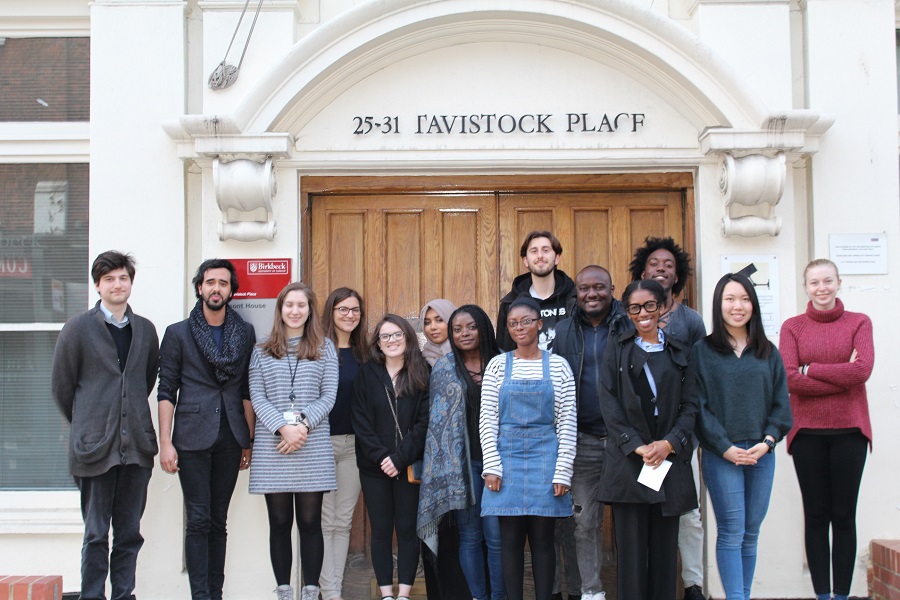
Say hello to Birkbeck’s student callers who will be working on the telephone campaign to raise valuable funds for bursaries, facilities and support services.

The Birkbeck Summer Telephone Campaign has now begun. A team of dedicated Birkbeck student fundraisers will be contacting alumni over the next five weeks to fundraise for College priorities, including bursaries. 40% of Birkbeck students require some form of financial assistance, and often this support is key to these students being able to complete their studies.

Not only do alumni gifts provide financial assistance to these deserving students but they can also have an impact on life at the College, ensuring that future generations of students have the best facilities, support, advice and career guidance during their time at Birkbeck.

We have been running telephone fundraising campaigns for the past nine years, with over 300 telephone fundraisers taking part so far. Tara Millington, Regular Giving Officer at Birkbeck has said: “The telephone campaigns are a real indicator of how engaged Birkbeck alumni are. Each campaign, more and more alumni pledge their support to the College. This makes a huge difference for both current and future students here at Birkbeck. Not only do the callers gain valuable fundraising experience, they really do enjoy speaking to alumni and hearing their stories.”

The Summer Campaign will run between 2 May and 6 June – if you’d like to receive a call from one of our students, please get in touch with Tara Millington (t.millington@bbk.ac.uk).

Meet the callers

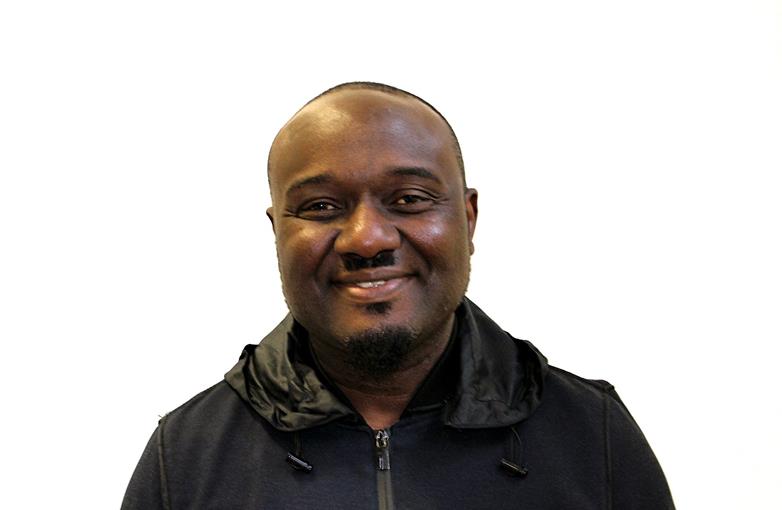
Alex, BA Global Film, third year

“I chose to study at Birkbeck because it is a university for mature students, and students working at the same time. I wanted to participate in the Telephone Campaign because it’s important to fundraise for Birkbeck to continue a high level of education, and to provide funding and help to those who need it.”

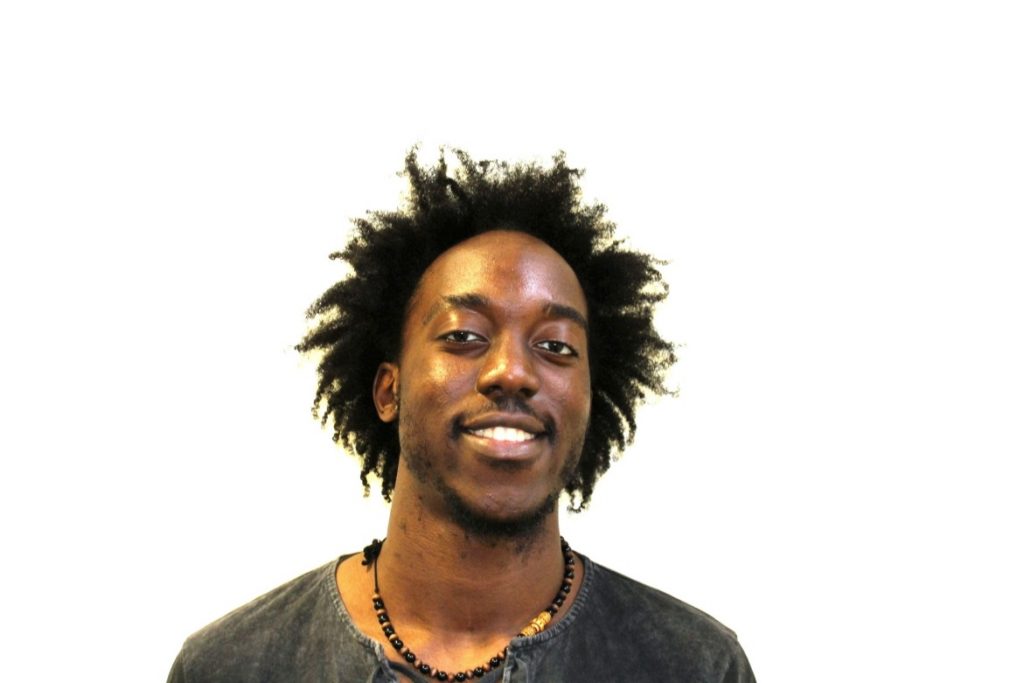
Berekad, BSc Computer Science, first year

“I wanted to be part of the Telephone Campaign to give back and get more experience. I think fundraising is important to give everyone an opportunity for support and experience that may otherwise not be available to them.”

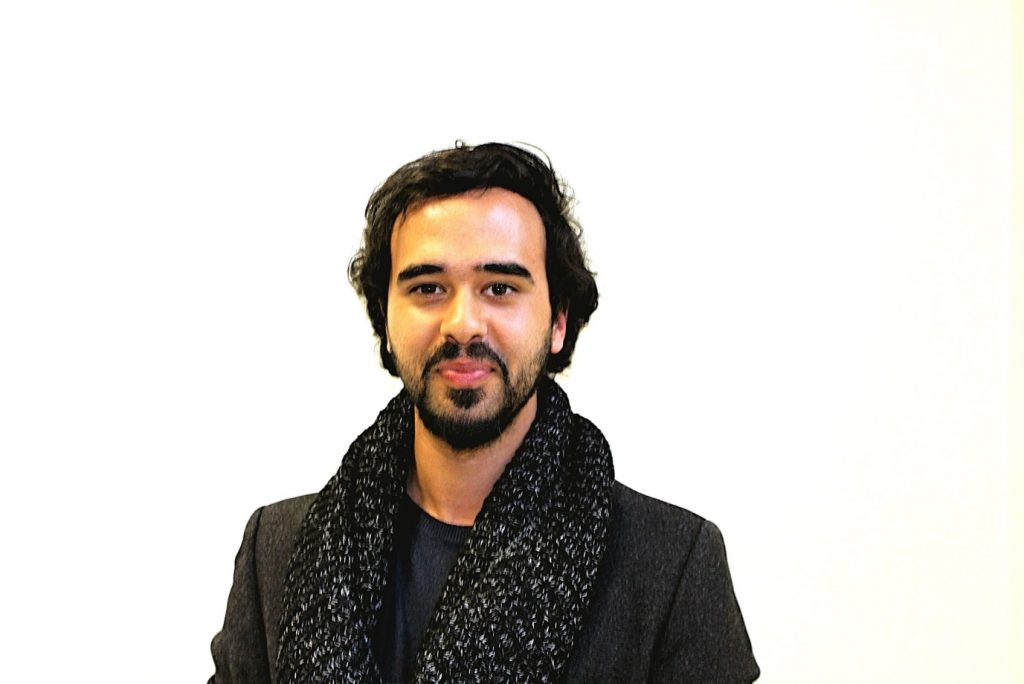
Edwin, MA Text & Performance with RADA, first year

“I wanted to participate in the Telephone Campaign because Birkbeck has contributed significantly to advancing my knowledge and skills in my chosen field (Theatre & Politics). I want to talk to alumni who have shared my experience, and to hear their stories.”Fey, BA Management, first year

“I chose to study here because it is an evening university – fundraising helps to keep all the fantastic services that Birkbeck provides for students going. I’m looking forward to learning new skills and raise loads of money for Birkbeck!”

Jenny, PhD in Computer Science, first year

“I was looking for a role that involved people skills and I thought the Telephone Campaign would be an interesting job talking with alumni about their good experiences. I am looking forward to raising money for Birkbeck – it is important so more students can come here and reach their potential through access to Higher Education.”

Madeline, BA Creative Writing and English, third year

“I chose to study at Birkbeck because I loved the atmosphere and the support offered- it just spoke to me! It is important for alumni to be able to give back to Birkbeck and create an atmosphere of support and appreciation between current and former students. I’ve been on the call team for years now – I love speaking to alumni, hearing their stories and seeing where they landed after graduation.”

Natalie, Linguistics & Japanese, first year

“I applied to be part of the call team as I found the nature of the job interesting, I like conversing with people. What I’m looking forward to most about this role is the sense of personal achievement and growth, contributing to future developments at Birkbeck”

Niamh, BSc Psychology, first year

“I wanted to study in London and Birkbeck had the best Psychology course. I wanted to work on the Telephone Campaign here to allow developments to be made to improve student life.”

Melissa, BSc Geography, third year 

“I wanted to take part in the Summer Telephone Campaign as I’m in my final year and I wanted to make the most of my final chance to give back as a student caller. I find it an enriching experience. Fundraising for Birkbeck is important because outside of being a direct source of funds, it shows a strong support network of alumni who are proud of Birkbeck and wish for it to be improved in the future.”

Ria, BSc Biomedicine, third year

“I chose to study at Birkbeck because it is a unique university that allows individuals to study whilst building a career. I think fundraising for Birkbeck is important as it supports students who have so much potential to excel in their studies. I enjoy speaking to alumni and listening to their experience and advice.”

Shakeela, Cert. H.E. Counselling and Counselling Skills, second year

“I wanted to take part in the Telephone Campaign as I like to speak to alumni and find out about their experiences. It was also a way to meet a variety of students I wouldn’t have met before. I feel fundraising for Birkbeck is important as it encourages continued support for the projects here, some of which I’ve benefitted from myself.”

Stephanie, BA Creative Writing and English, first year

“I chose to come to Birkbeck as I wanted to work and study at the same time in London, and be with non-traditional students. Fundraising for Birkbeck is a great way to give back to something one believes in. I’m looking forward to speaking with people who have befitted from a Birkbeck degree, and hopefully, want to give!”

Summer, LLM, first year

“I am both a Birkbeck student and alum! I wanted to be part of the Telephone Campaign as I would love to engage with other alumni and raise money for Birkbeck to improve and sustain services here.”

Thomas, MA Philosophy, first year

“I wanted to be part of the Birkbeck Telephone Campaign to gain experience working in a university and speak to interesting alumni. Fundraising for Birkbeck is important as it allows people from a less advantaged background an opportunity to study.”

Remembering King came from a community: searching for the British equivalent?

Following the 50th anniversary of Dr Martin Luther King Jnr’s death, Dr William Ackah from Birkbeck’s Department of Geography looks at how the civil rights leader was shaped by black churches, communities and institutions, and asks why there has been no equivalent figure in Britain.

This month has marked the 50th anniversary of Dr Martin Luther King Jnr. A 20th-century prophet and icon whose soaring oratory, towering intellect, political agitation and tireless advocacy for justice and peace still resonates today. In the rush to remember the icon what often gets left behind is the simple fact that first and foremost King was a black Baptist Church minister. The man that King became was forged and fashioned in the songs, sounds and spirit of the black church and black community. It was black institutions such as Morehouse College that educated him, it was predominantly black church members that marched, went to prison and were beaten alongside him and it was black social and political concerns that provided the motivation and inspiration for what he lived and ultimately died for. In the years since King’s death, he has been to an extent mythologised out of the black community and black spiritual prophetic tradition.  We constantly hear ‘I have a dream’ but this narrow utopian unity framing of King does a terrible disservice to the more radical King and what he stood for in regards to economic, political and social justice for black people and poor people of all races. Thinking about how King has been taken out of his community is reminiscent of how a 21st-century iconic black figure was also removed from his black spiritual heritage by a white political and media-driven campaign.

Barack Obama, it can be argued owes his soaring oratory, powerful intellect and social justice roots to his time spent in Chicago’s black community and most tellingly his spiritual foundations to Trinity United Church of Christ under the ministry of Jeremiah A Wright Jnr. Wright, like King, preached truth to power and used his pulpit to stand up for oppressed and marginalised people of colour. The white establishment and media not liking the sound of the prophetic so close to a Presidential candidates ear, set about discrediting Wright Jnr and divorcing Obama from his radical community roots in order to become electorally palatable. ‘God damn America’ the famous phrase that was used to condemn Wright could as well have come from lips of King and is certainly a feature of the tradition out of which he comes just as much as ‘I have a dream’ but that is an inconvenient truth that white society in the US and dare I say it the UK would rather not hear.

It is interesting that despite enslavement, Jim Crow segregation and virulent ongoing racism and discrimination, US African American communities and institutions notably the black church have still produced a Martin Luther King Jnr and a Barack Obama. A prophet and a president. On Wednesday 4 April, the anniversary of King’s death, I attended the Martin Luther King memorial service at Westminster Abbey sponsored by Christian Aid. It was a moving event with black and white church leaders reflecting on King’s legacy and thinking about what global justice should look like in today’s society.

Dr William Ackah

As I sat throughout the service and afterwards looked at the statue of King that is amongst the 20th century martyrs at the West gate of the abbey, I could not help but think where is the British equivalent of Martin Luther King Jnr? And for that matter Barack Obama? We have a vibrant minority ethnic-religious sector in Britain including an independent black church tradition. Many of these spaces of worship are home to the descendants of enslaved or colonised people, but our communities and in particular our churches, mosques, temples and faith-based organisations have failed to consistently preached inconvenient truth to power and to stand up for the poor and the marginalised. Without the prophetic voice to challenge racial injustice and inequality in this country, it is unlikely that we will ever see a black prime minister.

Now more than ever it is time for Britain’s black prophetic voices to emerge out of the shadows and prophecy to the nation and declare it in stark terms:

God damn Britain for enslaving and colonising our ancestors, for compensating slave owners and failing to make amends to those it has robbed, exploited and left poor and underdeveloped.

God damn a Britain that has an affirmative action pipeline for its white middle class, with pathways from public school to Russell group universities to the elite professions and yet wrings its hands when its black citizens are murdered on its streets.

God damn Britain that collects statistics on racial disparities and sets up committees but fails to invest and change outcomes for its black and minority ethnic populations that it has known for generations has been discriminated against unjustly.

God damn Britain for still tolerating racism, Islamophobia and anti-Semitism at the heart of its establishment in the 21st century.

The nation needs to repent and make amends for its iniquities. This is the message that the black church in Britain and other allied communities sorely needs to be proclaiming in the tradition of Martin Luther King Jnr.

Digital Transformation Project (DTP) stage 2: improving the school and department presence on the Birkbeck web 

Jane Van de Ban, Web Content Manager for Birkbeck, shares progress and updates on the second stage of the College’s web redevelopment project. This blog is one of a series of blogs about Birkbeck’s Digital Transformation Project

Following the successful launch of Stage 1 of our web redevelopment project (prioritising public-facing recruitment pages), we concentrated on making further improvements to our redeveloped web pages, to continue to improve these pages for our prospective students.

We have now launched Stage 2 of the DTP, turning our attention to school and department content on the Birkbeck website.

  1. Requirement-gathering with the schools

This project began during October and November 2017 with ER and ITS facilitating five workshops, one for each school. The aim was to gain a greater understanding of the challenges and priorities for school, department and research centre content, from the point of view of those working in the schools. The facilitators also spoke about the project, by invitation, at a variety of other school and department meetings.

At the workshops, ER and ITS facilitators gave participants an overview of the website transformation project work so far, including some of the evidence and research behind the work already  undertaken. We then presented attendees with data about how our current school and department content is consumed by visitors (such as the most popular content), and we watched recordings of students visiting the school and department sites and talking about what information they are trying to access and the barriers to completing their online journey with us.

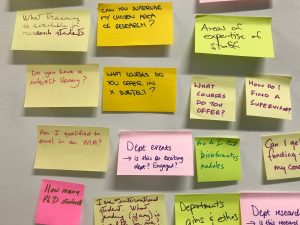
Workshop attendees discussed university websites that they thought handled school and department content particularly well, before we began an in-depth exploration of school and department content – what it does, should do, could do better. Participants were given as much time as they wanted to add notes under a range of headings, including issues with current content, and priorities for school, department and research centre content.

When everyone felt they had got all their points down, the facilitators invited contributors to expand on their notes, generating a group discussion about the topics attendees felt were most pressing, helping to draw out commonalities, outliers and voices. Minutes were recorded to capture the conversations, questions and concerns raised by participants at each workshop and the post-it notes were photographed.

1.1 Workshop discussions – recurring topics across all five schools

Staff across the College shared similar concerns. Unsurprisingly, better navigation and good, up-to-date content constantly cropped up as high-level concerns and priorities. In addition, our attendees talked about:

  • Staff profiles: These are by far the most visited area of school and department content and, thus, demand attention. Much discussion centred on questions of audience, degrees of standardisation and information management – who will update the content and how they will connect with other systems that academics use, such as BIRon.
  • Design: By far one of the greatest concerns for the project across all schools was the visual appeal and imagery of the school and department web content.
  • The web as ‘shop window’: A good deal of time was spent discussing how to showcase the best that Birkbeck’s schools, departments and research centres have to offer. There was a unanimous desire for space to show off news, events, research impact and other activities. Some schools felt that this would help garner a deeper sense of community between students and staff.
  • Showcasing department individuality: Finding the right balance between heterogeneity with the ‘corporate’ site, while allowing the personality of each department to shine through was important.
  • What role do schools play on the Birkbeck web? There were mixed opinions on the necessity of keeping school content. Some participants argued that the school is merely an internal managerial structure that does not have much relevance to the outside world, while others thought we might be missing a trick by not giving space to school-level events, news and rankings. Some consideration still needs to be given to identifying the target audience.
  • Information for current students: there was a mixed reaction to the necessity for having a section for current students in certain schools. Some departments use the current students section for essential information such as handbooks and module timetables, while others do not have a current student area at all (eg Law). This also sparked much discussion of what should be behind the current student log-in area, ‘My Birkbeck’.
  • Maintaining web standards: Finally, many participants were concerned about who will take responsibility for ensuring web content is kept up to date while maintaining consistency and how this will be resourced. Most thought that some collaboration was required between professional services and the school and department-based staff, to ensure consistency across the website while keeping content fresh and distinct.

2. The launch of the Web Working Group

Now that we have completed the initial consultation and we have a good grasp of what staff across the schools are most concerned about, we have begun working with the Web Working Group (WWG), consisting of key staff (academic and professional support) from all five schools.

The aim of this group is for the digital transformation team (comprising the ER and ITS digital teams, and our project managers, Kayleigh Woods Harley and Richard Evemy) to work collaboratively with school / department staff (academics and professional support staff who represent their schools) to redevelop the school and department content on the Birkbeck website, informed by the workshop discussions with the wider group.

  1. ‘Layering’ the new look and feel on to our school and department content

But how best to redesign this important part of the Birkbeck website? The overall look and feel of our school and department web presence will take its cue from the ‘new’ Birkbeck visual identity, which – a year into its life – is now being used extensively by every school and professional service for everything from new architectural designs for Estates to event posters and prospectuses. But what is the best way to apply the new visual identity and digital standards to our school and department web presence?

In previous years, when we upgraded school and department microsites, we did this on a site-by-site basis, which meant it took a long time for the latest design to roll out across our school and department sites. This was obviously frustrating for the departments lower down our list (which were upgraded more than a year after the first upgraded site went live). So, this time, we are taking a different approach. Rather than improve one site at a time, we are going to target specific parts of or topics on each site (eg research information, staff profiles) and, with the guidance of our WWG, we are aiming to go live with the new parts for all school/departments at or around the same time.

This means that ‘old’ and ‘new’ designs will co-exist for the school and department web, but we believe this disadvantage will be outweighed by the fact that the whole of our school and department web will feature ‘layers’ of improvements, which will – over time – eventually take over, until all of the ‘old’ content has been transformed for the better.

After our first two meetings with the WWG, we have not only started to work on two project layers, but we have identified a series of other projects that we will need to tackle:

3.1 Department gateway pages

For many staff, the most important page on a department site is the gateway page (in effect, the homepage of your department). So, rather than start with other parts of our site, we decided this would be our first priority and the first ‘layer’ to be applied.

Our aim is to develop new ‘gateway’ pages for all of our departments (school content and gateway pages will be addressed in a separate ‘schools’ project – see 3.3) that will better enable visitors to access key information, in the new design. To do this, we need to analyse feedback we’ve received from the initial web workshops with schools, the WWG meetings, and our ongoing user testing, in order to determine the requirements for our department gateway pages. We will then share our findings and results with the WWG. After this, we will develop new pages for all of the departments, with a view to getting sign off from local heads of departments (ideally, with the support of the local WWG representative).

Once we have reached this stage, we will apply this first ‘layer’ to our department content.

3.2 Academic and research staff pages

Academic and research staff pages are critical for our users, but currently they are riddled with problems and errors – a lack of consistency in respect of the type of information we present, out-of-date information, duplicate content, concerns about design and layout, etc. This is obviously of great concern to the Birkbeck community as well as ourselves. So, we need to ensure that we make this content as good as it can be.

Among other actions we need to take to improve our academic and research staff profiles, we need to:

  • Complete our analysis of requirements gathered through user testing and the WWG discussions, to inform our planning
  • Develop a comprehensive list of ‘fields’ (contact details, links to personal websites and profile information on academic.edu, LinkedIn, etc.) that apply to all academic and research staff, while providing a mechanism whereby academic staff themselves decide which of these fields should be presented on their part of the Birkbeck website
  • Consider the best way to maintain and update this information
  • Think creatively about how we can ensure that this important information is embedded with other key parts of the Birkbeck web (eg our course listings, where we need to let visitors know which of our staff teach on which courses)
  • Do a better job of rationalising our sources of information to avoid duplicate content updates on the Birkbeck site – so, for example, we need to pull information from BIRon into our staff profiles, rather than providing duplicate (and, inevitably, out-of-date) publication information pages.

After all of this, we will be able to identify the way in which we can implement this project and will discuss this with the WWG. Then we will be able to plan the appropriate stages of development for this project.

3.3 Other projects

We have also identified a range of other projects that need to be addressed in this stage (in no particular order – and probably not a comprehensive list):

  • Department research: this project will concentrate on how we can best present information on a department’s research – their aims and objectives, their activities and their outcomes.
  • Search and discovery: we know that Birkbeck’s search – course and site search – needs to be improved. This project is going to ensure that we make it easier for our web visitors to find the information they need when they are on the Birkbeck web.
  • Departmental student experience: what is it like to study in a department? What is the student experience? This project aims to address these questions and more, to give prospective students a better understanding of what it will be like to study at Birkbeck in a specific department.
  • Student funding: we know that prospective students don’t always find all the funding information that might be relevant to their studies, so we need to do something to make this information both easier to find and comprehensive. That’s what this project is about.
  • Prospective Phd students: we know that department sites are critical for prospective PhD students, and we could improve their experience. This project will look at providing the information that Phd students need in order to make the decision that Birkbeck is right for them.
  • Current students: this project will look at the best way to provide information for current students.
  • Course information: we know it’s important to let our visitors know what courses each department offers, because staff have told us this and the WWG reinforced this. This project will concentrate on how we can and should provide this information.
  • Business services / partnership project: this project will consider how best to make this important information visible to our stakeholders.
  • Schools project: in our workshops, some staff told us that school information isn’t necessary on the Birkbeck web; others told us that we needed to find a better way to showcase school information. With this project, we will need to tackle this and come up with a solution that works for everyone.

We are reliant on the WWG to help us prioritise these projects and to help us to understand the requirements better, so that each project can be tackled on a stand-alone basis and layered successfully across the Birkbeck web.

  1. When is this all happening?

Currently, the Birkbeck school and department web comprises more than 27,000 discrete items of publicly indexed content (ie content available via a Google search). Transforming this quantity of content into something better (all of which will need to be reviewed with much content either rewritten or deleted, in consultation with local content owners) is a massive undertaking, and we are only at the start.

However, this is an important project to us, and we are keen to make progress. So, although we can’t tell you exactly when your ‘old’ pages will be improved, we are aiming to go live with new layers throughout the year and we will continue to use blogs to tell you more about the reasoning behind our decisions and, once we have plotted the timeline, when we are hoping to deliver them.

BBK Chat: our experience of student mentoring

BBK Chat is a mentoring scheme which pairs students who are in their first term at Birkbeck with students further on in their studies. Mentors and mentees meet at a coffee shop near campus to chat about all things Birkbeck. The scheme runs through the autumn term and has now come to an end for the academic year. We asked Christine, a mentee, and Les, a mentor, about their experience on the scheme this year.

Christine was a BBK Chat mentee in 2018

“When I first decided to study law at Birkbeck, I was so excited. Once I received my letter of confirmation and a start date I knew I would require support to build my confidence.

Within two weeks of starting university, I received a call from the mentoring team reminding me of my request and I gladly accepted their offer of support and was told that in due course a member from the team would contact me to arrange a suitable date/time.

When I received a call from Les, he introduced himself and we agreed to meet and because it would be our first meeting we provided each other with a brief description of ourselves and what we would wear on the day to make it easy to recognise each other.

On meeting Les he gave me a guided tour of the building which I found really helpful and to date I make full use of each domain, including the calm atmosphere of the student bar; this advice I have shared and meet regularly with my fellow students.

In the following meetings with Les, he has shared so much about study skills with me that I have gained so much more confidence in myself and have put into practice much of his advice. This has made me understand my course so much better and I am even considering studying other areas in the future.

Having a mentor has made a real difference in how I see the introduction to studying as a mature student and would definitely recommend BBK Chat to other students.”

Les was Christine’s BBK Chat mentor in 2018

“My experience mentoring over the past two years has been very rewarding and enjoyable.  As a mentor, I am there to support a new student through the first stage, after the initial worries students discover how enjoyable studying at Birkbeck is. At later meetings, the discussion is about the interesting things we are studying, and the location moved to the bar (they sell tea there as well). Occasionally results after the first term are a big concern, and it is easy to feel disheartened afterwards. As a mentor I have been able to help put it into context, it’s not a disaster, learn from the feedback and apply it next time – and speak to your tutor as they are always very supportive.

For those considering mentoring, do it! It only takes up a couple of hours and changes the experience of a new student for the better. Your experience can help calm the worries we all have when arriving for our first term. Being there to offer advice if a student does struggle is vital, just being there to reply to a text message after a difficult first essay meant a student went and spoke to their tutor, got the advice they needed and didn’t drop out. On top of that, you will make new student friends from other departments. I still keep in contact with those who want to, and meet up to keep up with what’s going on.”

If you are either a current student interested in supporting a new student or a prospective student interested in having a mentor when you start at Birkbeck this autumn, please get in touch with the Widening Access team at getstarted@bbk.ac.uk.

Birkbeck Study Skills: play to win

Sal Campbell, a Learning Development Tutor at Birkbeck explains what Learning Development Tutors do and how students can use the resources available to them.

 What if I told you I knew how you could work a little less on your degree and get better results?

Imagine someone wants you to bake them a cake. You know about cakes, having eaten many of them, and you’ve been given all the basic ingredients – but not a recipe, because they thought you already have one. You don’t- but you know it involves mixing everything together and there’s an oven involved, but beyond that, it’s pure guesswork. You assume that it must be straightforward because other people seem to know what they’re doing, and you’re not going to admit you don’t know the method, because how hard can baking a cake be? So you give it a go, but it’s all a bit stressful and the result is… well, cake-like, but it’s not the best cake you could have baked, compared to if you’d had the recipe in the first place.

Birkbeck isn’t a bakery, but we do expect you to produce essays and assignments with all the ‘ingredients’ – the knowledge and skills we are trying to teach you on your courses – to prove your abilities. This can be a stressful and frustrating process if you’re not familiar with how to go about it, or it’s been a while since your first degree, and sometimes this means your ideas and understanding – which is really what your lecturers are interested in – don’t shine through as much as they could.

Across all subject assignments, as well as assessing your understanding of the content of your courses, lecturers are also assessing how well you can perform various academic skills, such as how to structure an essay, your use of correct academic English, correct referencing and citation, evidence of critical thinking and so on. We want to know that you can read and understand; that you can think critically; we want to know how well you can articulate and substantiate your own arguments, and how well you can write.

These are not personal qualities you either do or don’t have – they are skills that can be learned, and the fundamentals can be learned easily and quickly. As a Learning Development Tutor, I think it’s a tragedy when students are clearly motivated, hardworking, diligent and able –  in short, they have all the ingredients they need to reach their potential –  but they don’t know how to go about it. As a result, their efforts miss the mark, and they don’t get the grade they are capable of. The only thing missing is a kind of ‘academic capital’; it is freely available information.

Students often mistakenly believe that coming to study skills workshops is what you do if you need ‘support’, and you are not independently able to do your degree – whereas nothing could be further from the truth. Study skills tutors are academic specialists, the methodologists of academia. We are the equivalent of personal trainers for your studies, and our whole purpose is to show you how to optimise the quality of your work. Your course lecturers are experts in the content of your degree – they teach you what. We are the experts in how to do your degree, and we can show you how to do it to a higher standard and in less time than you can work it out for yourself.

Studying at university is hard work, and it is expensive – so play to win. Use the resources and services available to you to maximise your chances of doing the best you can. Don’t sweat in the library hour after hour trying to work out how to do your assignment, when you can come to a workshop, meet with a tutor, or look at the huge wealth of online resources available to find out what you need to know right now.

Our resources, workshops and tutorials are freely available. Take a look at the Birkbeck Study Skills webpage and Moodle module, the Study Skills workshop timetable, and just see what’s available.

So many students I meet don’t realise how much it can help, or how easily and quickly they can access it. Do yourself a favour – just invest a little time in investigating what is available, and if it looks helpful, pick three things to look at in more detail. Read what the lecturer feedback says on your essays and assignments and choose one or two things to improve on your next assignment, and look for resources to help with that.

As Birkbeck students, we know you are as busy as you are dedicated, and we want to help ensure that your hard work and dedication pays off. Let’s do this right: the information is there and it works – all you have to do is take a look.


Enhancing content on the Birkbeck website

Birkbeck’s Digital Editor Angela Ashby discusses how the web team are working to improve the quality of the College’s website.

Photo credit: Paul Cochrane

The digital content team in External Relations (ER) had a quandary: with a large and growing website, multiple contributors, and not enough resources to keep eyes on every page, how could we possibly monitor and maintain the quality of the website? We expected there to be broken links, which are inevitable over time, and we had created and published a style guide to keep our content consistent, but we needed both a big-picture view of the site and a way to focus our attention in order to make best use of our time.

Sitemorse

With the help of our technical colleagues in Corporate Information and Web Systems (CIWS), we explored various solutions and agreed that an online governance tool called Sitemorse would meet our needs best.

Sitemorse sends us monthly reports that pinpoint various aspects of pages that need attention and score us on issues falling into themes such as accessibility, function/links, search engine optimisation (SEO) and metadata (descriptive page tags). Sitemorse has also allowed us to build in rules that tell us when our pages don’t follow our own style guide and shows us where and how the content can be improved. These rules include decisions on abbreviations, email and phone format, italics, ampersands and link text.

Each new Sitemorse report shows our scores and ranking clearly improving for the pages that we’ve worked on. For instance, the Student Services area went from 5.7 out of 10 in December 2017 to 6.4 in January 2018. It’s a slow process, as each error needs to be individually corrected, but in the last four months, we’ve already fixed over 1000 broken links. It is still early days, but we will watch with interest to see whether errors approach zero over the long term. Our goal is to bring each section to at least a score of 7.0 out of 10.

Web maintainers meetings and Yammer

If you are the only person in your department working as a web maintainer, it’s possible to feel isolated. You are definitely not alone, though – there are at least 30 web maintainers working within Birkbeck, and we saw a need to create a community so that web maintainers feel part of a wider team, with common goals.

Our first step was to invite all web maintainers from around the College (including our Moodle colleagues) to meet every two months as a group. At meetings, the central web team shares details of projects and progress and encourages all web maintainers to raise any issues or queries, and to share their own best practice.

This inclusive approach is continued via an enterprise networking tool called Yammer. All web maintainers are encouraged to join the ‘Web support’ group, and any posted queries and requests for edits are dealt with by the relevant members of the central digital team in a way that benefits the whole community.

Another way that the central digital team extends its support to web maintainers is to invite anyone working on particular web projects to come and ‘hotdesk’ in ER, where we can offer more personalised support and collaboration.

Contact Jane Van de Ban if you’re a web maintainer and you’d like to join the group.

Fix-it Friday

The ER digital content team receives dozens of requests each week from around the College to update content on various web pages. Since our May 2017 go-live for the central pages, we’ve completed more than 200 separate pieces of work. This is in addition to the intensive improvement work we carried out on programme and module pages last year.

In order to fit this ‘quick-fix’ work in with our longer-term ongoing projects, we have initiated ‘Fix-it Friday’, where we schedule in requests that have come to us during the week. We can almost always complete small pieces of work on the next available Friday. If a request involves a larger project, such as a new set of pages, then we can discuss with the project owner how to prioritise the work over a longer period.

We prefer to receive work requests via Yammer, as it’s possible for emails to be overlooked during staff absences. To join Yammer, log in to Office 365, find the Yammer app and select to open it. Search for the ‘Web support’ group and click join. We’ll approve your request.

Training in 2018

So far, the newly designed central web pages have been maintained by the digital content team in ER. This is because we are planning briefings and a comprehensive training programme to ensure that web maintainers have the tools and the confidence to update pages in the new template. Once staff members have completed the training, they will be able to edit and maintain pages, with ongoing support from the content team.

Current and future projects

We are currently working with schools and departments, via a new Web Working Group, to scope and plan requirements for the improvement of department pages, in particular, the very important staff profile pages. We are also planning the improvement and migration of professional service pages to the new web design, beginning with Estates and Facilities, IT services and the library, with HR and the Registry Office to follow.

Like all the improvements made so far, these projects are focusing on users, the questions they need answers to and the journeys they want to make at Birkbeck. We continue to base our work and decisions on evidence and user-testing, adjusting our approach as necessary.