Birkbeck’s London Landscapes

Richard Clark, Honorary Research Fellow in the Department of Politics, writes about how Birkbeck is woven into the very framework of the capital city. This blog is a part of a series that celebrates Birkbeck’s 200th anniversary in 2023. 

Unlike paper maps, smartphone navigation will tell you how to get there but not what’s around you. But search through the index of an old ‘A to Z’ map of London and if your destination starts with ‘B’, you’ll probably be surprised to notice quite a few ‘Birkbeck’ place-names.

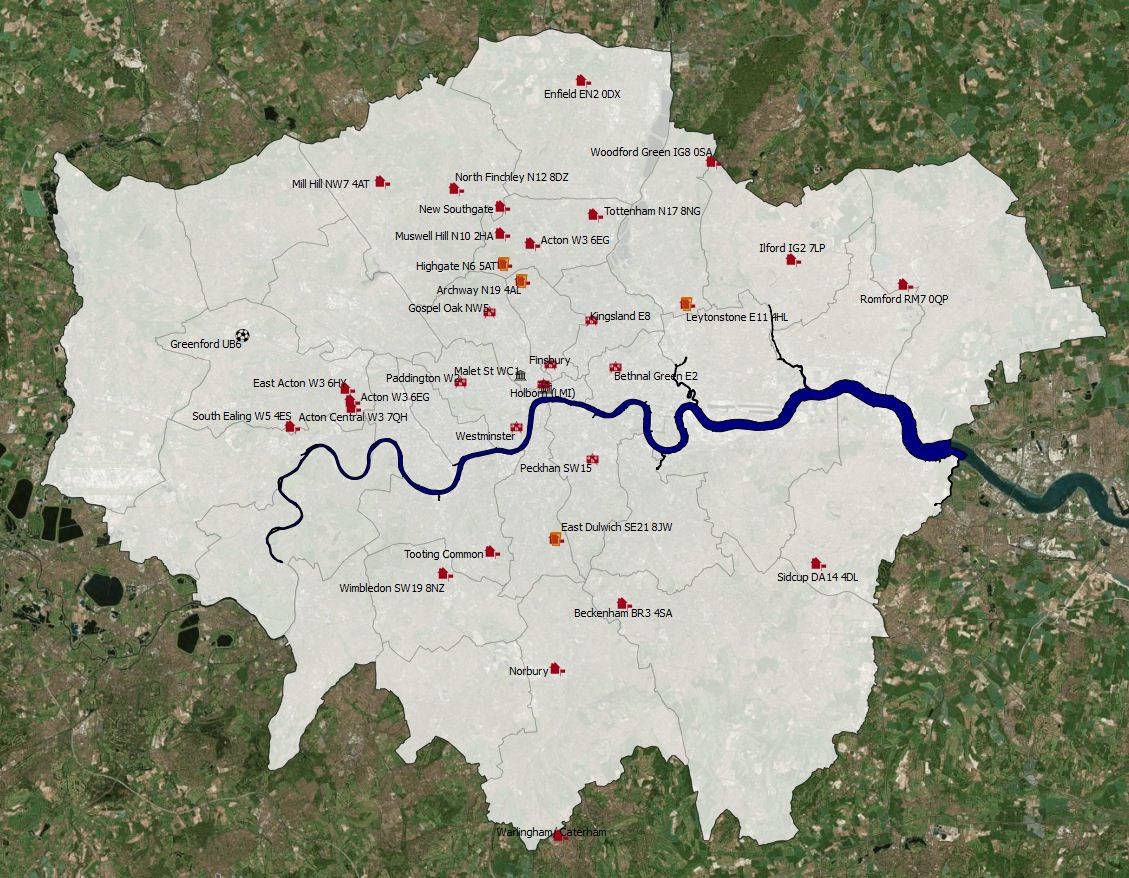
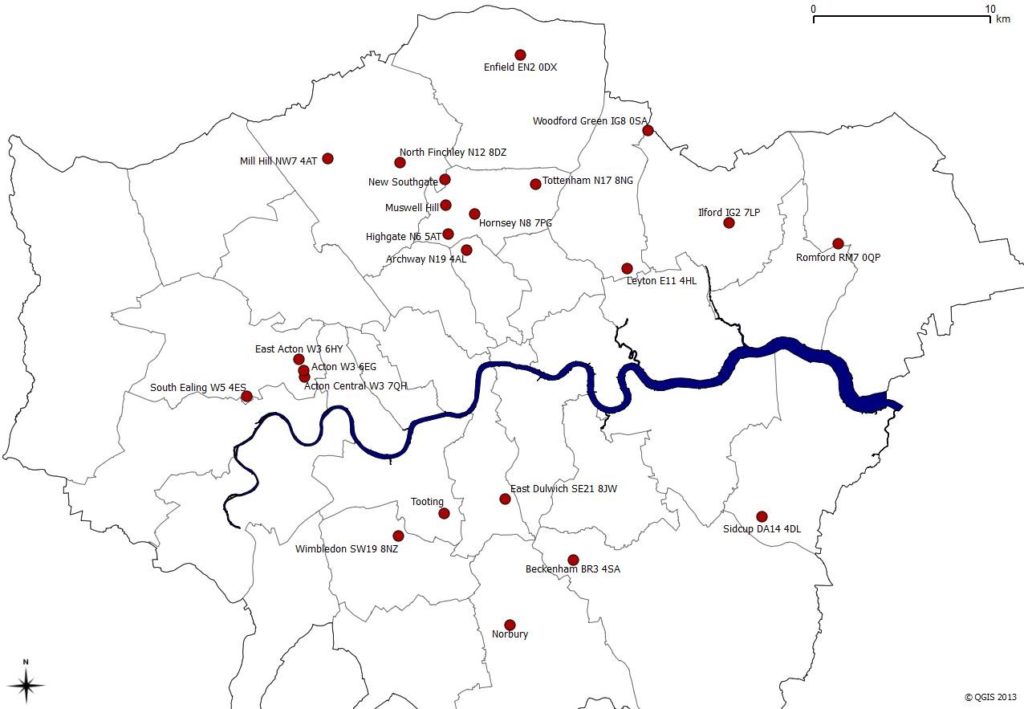
Birkbeck roads survive today in Hornsey N8, in Finchley N12, in Tottenham N17 and in Mill Hill NW7.  There are more in Ealing W5, and in Wimbledon SW7and Acton W3.  Acton also has a Birkbeck Mews, and there is a Birkbeck Grove in leafy Acton Park.  Dulwich SE21 has a Birkbeck Hill and a Birkbeck Place and the pub-like building where they join was once precisely that – the Birkbeck Tavern.  In east London, Bethnal Green E2 has a Birkbeck Street, Dalston E8 has a Birkbeck Road (as well as another Birkbeck Mews) and Leyton E11 has two Birkbeck Roads, North and South, as well as another Birkbeck Tavern – still a lively pub protected by its patrons who saved it from redevelopment by a campaigning ‘Birkfest’.

Outside the London postcode area, there are yet more Birkbeck roads — in Beckenham, in Brentwood, in Enfield, in Ilford, in Romford and in Sidcup.  There’s a Birkbeck Gardens in Woodford and a Birkbeck Avenue and a Birkbeck Way in Greenford.  Beckenham has its Birkbeck Station (established as Birkbeck Halt in 1858).

More Birkbeck place names can be found on old maps and census records of the London area.  For example Birkbeck Road, Birkbeck Place and Birkbeck Terrace in Streatham, Wandsworth, are recorded in the 1881 and 1891 census but have subsequently been lost as have Birkbeck Road and Birkbeck Place, Camberwell which appear also in the censuses of 1871.  Elthorne Road in Archway N19 started life as Birkbeck Road as did Holmesdale Road in Highgate N6.  Both had Birkbeck Taverns – the former is now converted into ‘Birkbeck Flats’ (but still, like the Dulwich Tavern, recognisably an old pub).  The Boogaloo at the top of Holmesdale Road is still a pub — a lively music and comedy venue, well worth a visit, with a ‘Birkbeck’ mosaic (desperately in need of protection) testifying to its past still on the threshold as you enter.

All the above have a close connection with Birkbeck, University of London, and reveal something of the College’s past.  Greenford’s Birkbeck Avenue and Way are the most recent.  Both are named after what used to be the Birkbeck College Sports Ground, leased to the College by the City Parochial Foundation from the 1920s until 1998 when governors felt they could no longer justify the rent.  Today’s lessee is the London Marathon Charitable Trust and the ground’s football, rugby and cricket pitches serve clubs across West London.

Several of the Birkbeck toponyms – for example those in Bethnal Green, in Dalston and in Camberwell — are associated with the Birkbeck Schools, established by William Ellis between 1848 and the early 1860s.  Ellis was one of the founders and benefactors of Birkbeck College’s predecessor, the London Mechanic’s Institute —his name appears on a foundation stone in the lobby of the Malet Street entrance.  One Birkbeck School building — today Colvestone Primary School in Dalston — still stands, its structure (including well-lit classrooms in place of dull monitorial halls) reflecting what for the time were Ellis’s progressive educational theories.  The schools were set up to teach children ‘social economy’ as an antidote to the radical socialist ‘political economy’ then gaining ground in Europe and they prefigured the civics curricula taught in English schools today.

Most of the other toponyms mark the locations of ‘Birkbeck Estates’ – land purchased and developed by the Birkbeck Land and Building Societies established in the premises of the London Mechanics Institute by Francis Ravenscroft in 1851.  Ravenscroft had joined the LMI as a student a couple of years previously, became a Governor, and set up the Building Society as a ‘penny savings bank’ to encourage thrift and diligence amongst its students, offering them the prospect of a house – and (for the men) a vote.  Initially based in a cupboard in the LMI’s office, the Societies grew to become a major bank, taking over the LMI’s premises and financing its move —as the Birkbeck Literary and Scientific Institution — to new premises nearby.  Without Ravenscroft (his bust sits on a windowsill in the Council Room) Birkbeck College would probably not exist today.  The estates played a significant role in the suburbanisation of London and are interesting for many reasons – not least because, unlike the temperance building societies of the period, they featured pubs.

For more on the story of the Birkbeck Bank and Building Society, watch out for a subsequent blog or have a look here. And there’s some information on the Birkbeck Boozers here.  I’m about to submit a paper on the Birkbeck Schools, and perhaps I’ll blog a little later about these too.

Further information: 


Dr George Birkbeck’s descendant visits the College

One of Dr George Birkbeck’s descendants dropped into Birkbeck prior to Christmas 2019 to put a name to a place!

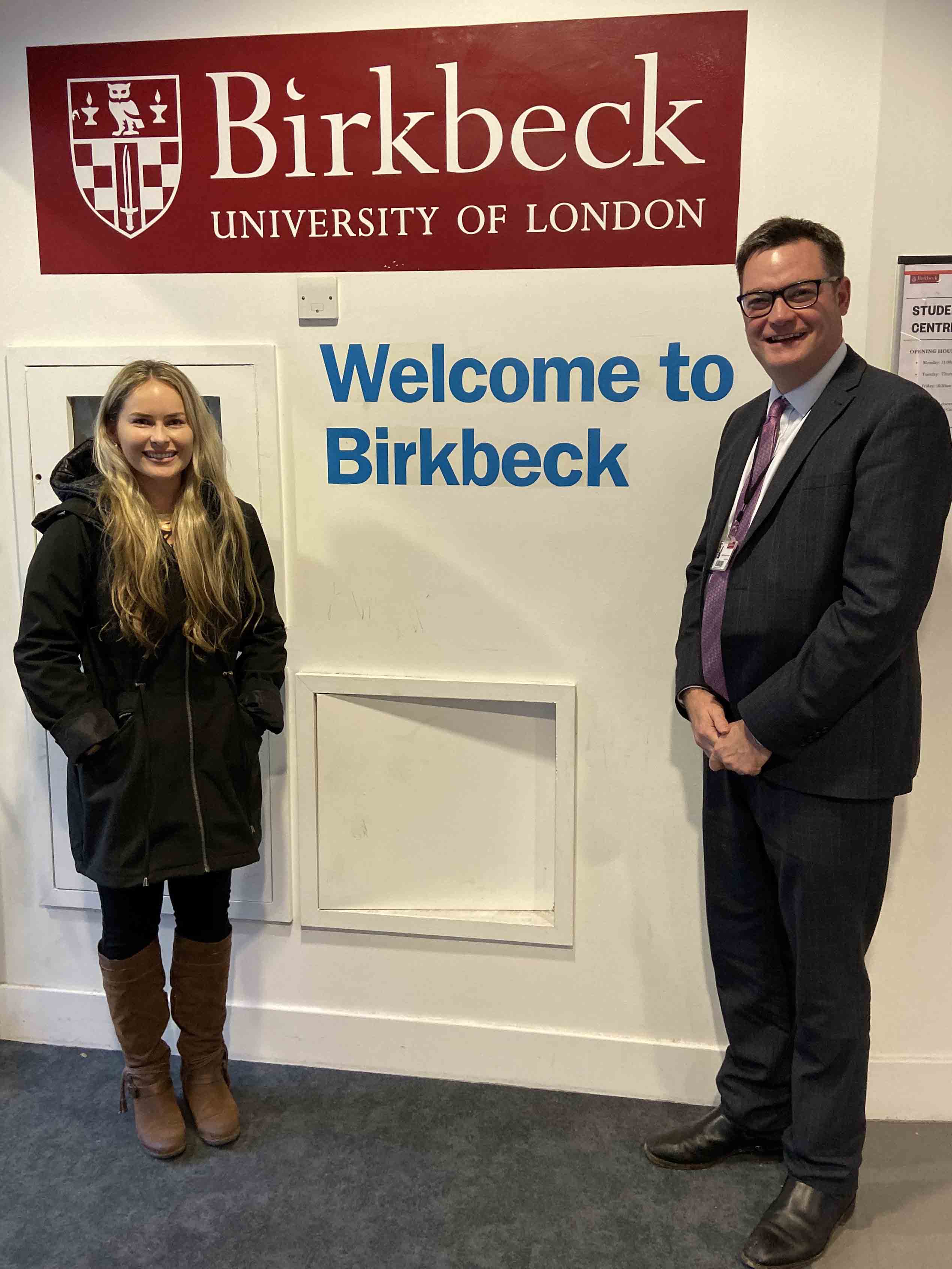
Lyndsee Baumann-Birkbeck is an academic and school teacher from Queensland, Australia and had long wanted to see the institution that bore her descendant’s name. Lyndsee was undertaking the visit, as part of a wider trip to Europe in honour of her late father who died suddenly in 2015. He never made it to visit Birkbeck and as the Birkbeck family line was through the paternal side Lyndsee felt it was the right time to visit.

Lyndsee visited Birkbeck with her husband and was greeted by Jessica Jeske, Events Manager who gave the pair a tour of Birkbeck’s Malet St building. Later on, they were greeted by Jonathan Woodhead, Birkbeck’s Policy Adviser and Jessica Goulson from the Development and Alumni team who talked through the background to the Mechanics’ Institutes which our founder was instrumental in developing. Birkbeck’s more recent history and planning of the upcoming 200th Anniversary of the founding of Birkbeck was also discussed with the pair. It is hoped that Birkbeck will be able to involve Lyndsee in any future events connected with the 200th anniversary.

Further information:

Art and Conversation at the 58th Venice Biennale

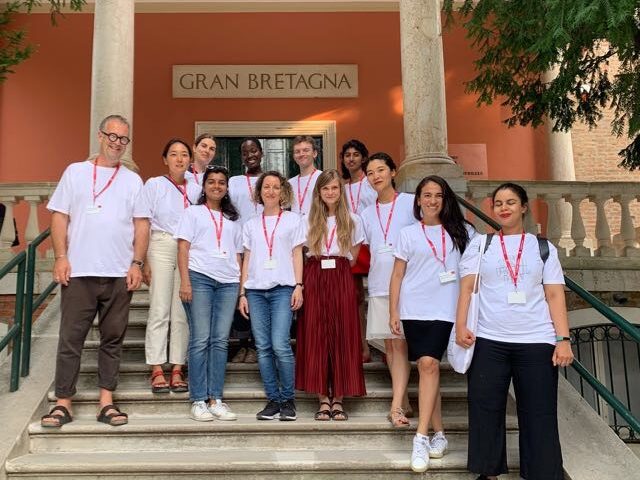
In 2019, BA History of Art student Patricia Yaker Ekall was one of Birkbeck’s British Council Fellows in Venice. In this blog, she shares her experiences in ‘The Floating City’ and what she learned from the trip. 

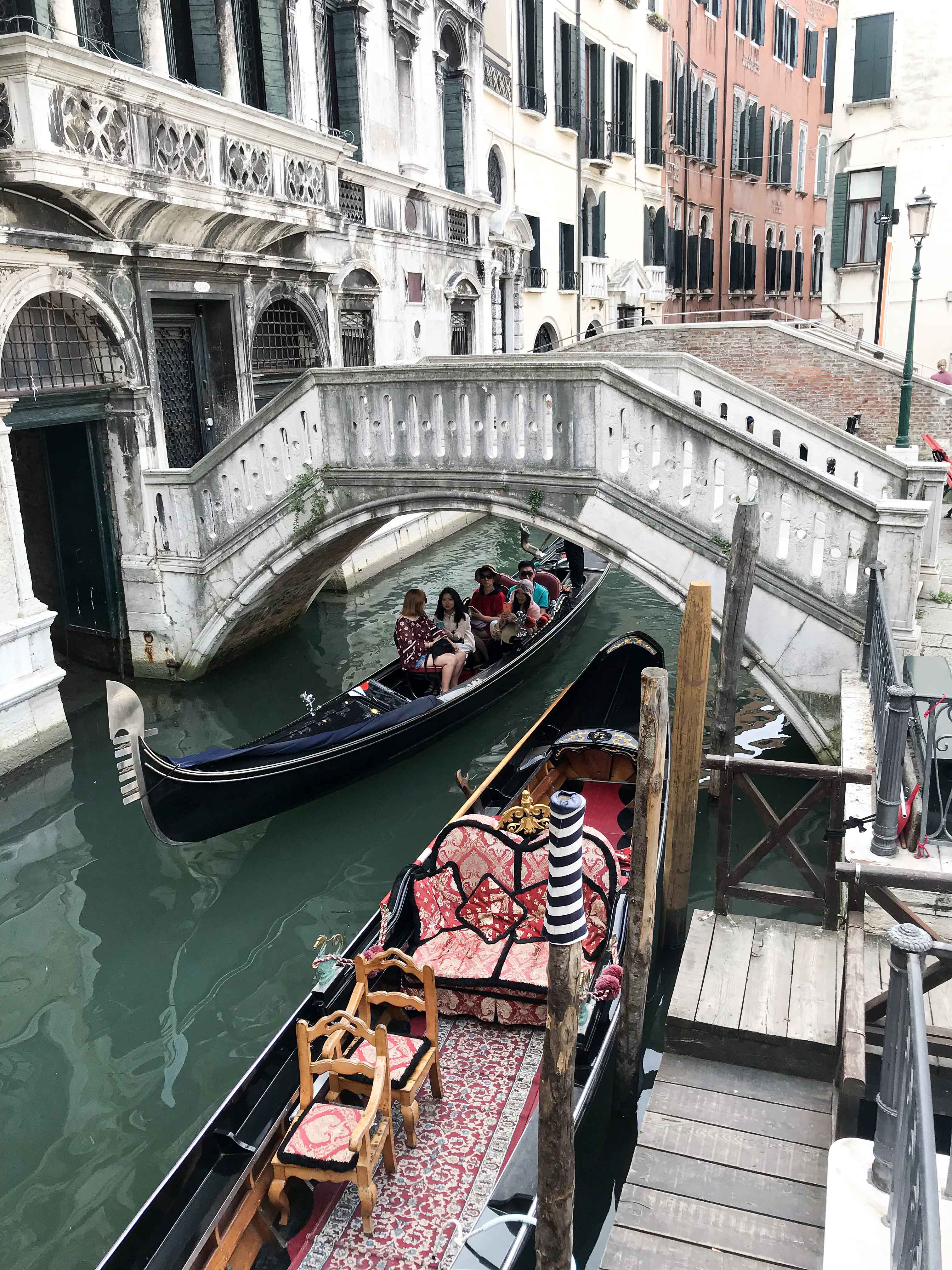
My time as a research fellow at the Venice art Biennale was an incredible experience that will stay with me for many years. With Venice, one typically thinks of the lagoon and its zany effect on perception (really, it’s like being on a giant float, often at risk, thanks to the bustle of the city, of falling into the seasoned turquoise waters). Venetian dining is famed for its cicchetti and gelato and the beloved spritz. The historical landmarks, with their height and ornamental expressions of astonishing beauty, are also of course part of Venice’s reputation as a ‘must-visit’ destination.  And, while the city is a wonderful representation of the value of tradition and heritage, Venice is equally known for its modern and contemporary art.
The Peggy Guggenheim Collection, at Palazzo Venier dei Leoni, boasts works by Jackson Pollock and Alberto Giacometti, giants among the assemblage of terrific artworks that shaped 20th-century art. With Venice being an artistic city, there are countless workshops dealing in everything from mask-making to pottery. But, bias allowing, I learned the most from the very reason I was there: the Venice Biennale, the showcase for international contemporary art that attracts thousands of visitors to Venice every other year.

My chance to be part of the Biennale was thanks to a Birkbeck/British Council Venice Fellowship, which funded a month in Venice in September, where I worked as a steward in the exhibition’s British Pavilion while pursuing my own research. The renowned event may have been in its 58th edition and 123rd year, but it was my first time attending. I tried to have as few expectations as possible, which stood me in good stead as the experience was full of unexpected elements. For example, I did not expect the dramatic variation in reactions to the art work in the British Pavilion. Cathy Wilkes’ installation drew on arte povera (a movement that subverts the commercialisation of art founded in 1960s Italy, ironically). It touched on themes of motherhood, poverty and death, and was not understood (let alone loved) by everyone. This took me by surprise, as I’d assumed the visitors would be surer of their own perspectives. Yet, alarmingly often, we were asked to explain Wilkes’ work. Since it was made deliberately inexplicable, our own interpretations would have to suffice. Another one of my assumptions was that everyone in Venice would support the Biennale and, save for a bit of context-focussed research conducted just before I travelled, I was not prepared for all the ways the event is challenged when it comes to issues around sustainability and Venice’s economic state.
It seemed to me that every aspect of this tiny jewel, Venice, was up for passionate debate. Such conversations ranged from questioning of the Biennale’s effect (and dare I say relevance) in relation to the locals, to the issue of excess tourism and the tensions between the old and new and, glaringly at times, the rich and the poor. These were the conversations that a lot of the pavilion’s visitors – be they Italian, or from France, Japan, Germany or the UK – felt at ease in bringing to us, while we as art enthusiasts were primed and keen to discuss instead materials, style and the artwork’s contextual background! Though somewhat unexpected, I very much enjoyed this part of the experience. It added another dimension to my take on the power of contemporary art and all its demands. I enjoyed these roiling debates cocooned in artistic excellence!

From the orientation evening that informed us of the fellowship, to the day before we left for England, Birkbeck and the British Council were on hand to keep us informed. I was particularly touched by the program’s flexibility and understanding in the face of the unexpected. There was a real sense of openness of conversation and options, especially when it came to planning our individual research projects. If there was a change in direction which meant more resources would be needed, for example, they would not hesitate to put us in touch with the relevant modes of help.

Moreover, the fellowship program was structured such that we were introduced to the other people we’d be working with at an early stage to facilitate an easier melding process on arrival in Venice. Now, most would probably say the same of their own group but, mine was filled with the most incredible, laid-back but focused people. From early-career Oxbridge grads, to third wave career professionals who used their research practice to inform their doctorate, there was a diverse mix of interesting people. We had one thing in common: our love of art, its histories and its contemporary practices. In a way, the Biennale was the ideal hub for all of these keen minds to meet – which was, of course, the intention.

Further information:

The London Mechanics’ Institute: Its Foundation

Helen Hudson Flexner discusses the inception and impetus behind the creation of The London Mechanics’ Institute in 1823.      

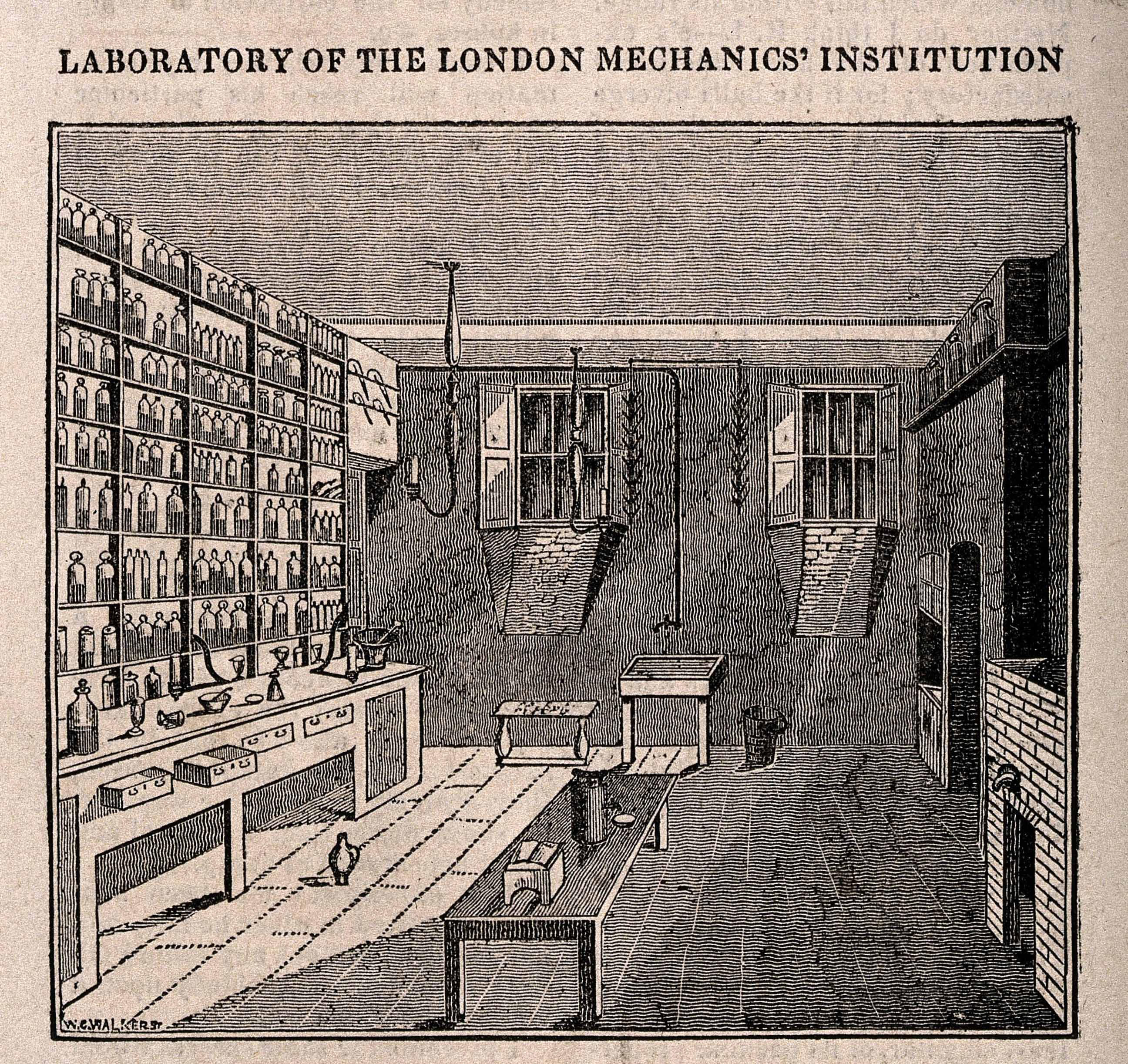
London Mechanics’ Institute, Southampton Buildings, Holborn: the interior of the laboratory, in a cellar. Wood engraving by W. C. Walker after Mr. Davy [1828].
1828 By: Davyafter: William Chester Walker
Credit: Wellcome Library, London. Wellcome Images

‘Knowledge is Power’ was the rallying cry that launched Birkbeck College in 1823, in its first manifestation as the London Mechanics’ Institute (LMI). These words, designed to appeal to uneducated men, headed the Mechanics’ Magazine proposal for a new technical institution and it couldn’t be missed, as the huge-selling magazine was a favourite among artisans interested in the latest inventions. Today large companies control major manufacturing sectors. Back then, a man could make his fortune with a new process or speedier production. So the LMI was set up to empower men with the latest science in this ‘steam intellect’ society.

George Birkbeck, radical teacher and London physician, was immediately on board.      Such was his standing that he chaired the inaugural meeting at the Crown and Anchor on 11 November 1823.  Many who flooded into the tavern were proudly working class: carpenters, jewellers, iron mongers, weavers, precision instrument makers, engineers, and printers. They were necessarily autodidacts, simply because there was no state funded education at the time. The metropolis, with its well-paid artisanal base, provided a ready audience for the new institute.

Although others who came to the launch and joined the LMI were not working class, the Institute was designed for the ‘lower orders’. Indeed, Birkbeck, president of the Institute from 1823-1842, reported in 1837 that two thirds of the membership had always been working class. The Institute even legislated to ensure that two thirds of the management committee was working class, and on nomination a man’s class had to be identified. Thus, the workers’ interests were always represented. Soon, some of the working-class members were running classes themselves, while their inventions were showcased in lectures. The Institute’s egalitarian ethos even extended to women who could attend lectures from 1825 and were able to become members in 1830.

Fees weren’t extravagant: five shillings a quarter, probably a day’s wage for an artisan, or £17 in today’s money. For this, the men gained access to workshops, a chemistry lab, an apparatus room containing geological specimens, drawing equipment and mechanical instruments, a good library, classes and lectures. In these decades before professionalisation, the lecturers encouraged their audiences to challenge what they heard. William Frend, a unitarian radical who had been expelled from Cambridge University for campaigning against the Thirty Nine Articles of the Anglian faith, told the LMI audience to ignore any ‘appeal to the wisdom of our ancestors’. Their new world was in the making.

Working Londoners made the most of this liberating environment. Some used it to change their vocation, which itself could bring higher status.  George Francis was a shoe-maker, but made his name in optics at the LMI. Called to the LMI stage to explain his improved eye glasses, he was described as ‘a plain and unassuming workman’ who ‘addressed the assembly … in very clear and intelligible language, though evidently unpolished by the refinements of education.’ By 1828 Francis had become ‘an optician of some celebrity’. The early history is replete with such examples.

So in its founding incarnation, Birkbeck College was a revolutionary educational institution encouraging and enabling social mobility. Within a year mechanics’ institutes sprouted up across England and Scotland. But none of them was so progressive. None had the two thirds rule. None appealed so consistently to working men. Our London institution remained the radical leader.

Helen Hudson Flexner is the author of The London Mechanics Institution: Social and Cultural Foundations 1823-1830‘, PhD thesis, UCL 2014. 

Zhanna Chenenk: studying theatre at Birkbeck

Moscow native and former MA Text and Performance student, Zhanna Chenenk reflects on her year at Birkbeck.

What made you decide to study at Birkbeck?

I was looking for an MA in theatre. I was intrigued by the Text and Performance course thanks to its mix of academic and practical disciplines with the bonus of being able to study at the Royal Academy of Dramatic Art (RADA).

Could you tell us about moving to London?

When I was sixteen I moved from my parents’ house in a small town close to Saint-Petersburg in Russia. That was a very stressful experience; a big city, a different culture, a huge distance (2000 kilometres) between myself and my family. Before coming to Birkbeck I had moved and travelled a lot and lived in many different cities, but it is still very hard to start from scratch in a new place. I arrived just before the course began and spent around a month searching for the right accommodation. I encountered many different people which was an interesting introduction to London life.

How was it coming to study at Birkbeck at first?

Before I applied for the course I met with a Birkbeck representative in Moscow to clarify some issues and later, when I was in London she took me on a tour of the campus and RADA. I liked the arts building as there is no logic to the room locations and you can easily find an empty space for a rehearsal.

Have you encountered any difficulties? How is the British system different from your country’s? Have you been to study skills sessions?

It was hard getting used to the British system, and once you’ve learned to cope with it, the year is over. Writing in a different language is a challenge in itself, but in addition this you are writing in many different ways; academic and narrative style, essays, scripts and portfolios. You even have to perform on stage in English – but I finally feel very comfortable using it. Now I feel it in my body. My program involved constant switching between practice and academic lessons and I wish I had more time to perfect everything.

What is it like living in London?

It took time getting used to London. Sometimes I loved it. I enjoyed wandering through the jungle of a city with my sketch book, but sometimes it was very oppressive. To escape these feelings, I travelled to new places like Berlin or Paris or Palestine, or even within the UK. I especially liked going to Brighton, Liverpool and Manchester! Most recently I discovered the Yorkshire Sculpture Park! The transport in London is also tricky to get used to and although I loved the poeticism of night buses, I hated using them during the day. Ultimately, opinions of cities are always built out of the opportunities that they give, and the connections you make. Not just the bricks and mortar which make it up.

Have you made friends on your course?

My course was international, so I’ve gained many connections across the world over the year. I participated in workshops and took on internships, so I’ve been able to build up my professional contacts to build a career upon.  London has been good to me. Whilst here I’ve met people who I have connected easily with. And even if some of them leave the UK soon I know that I have gained a wealth of friendships. I found my tribe here.

What has been your highlight of your time in London and at Birkbeck?

I would say that it has been good for me to review some of my personal values. Some of the things which were once important to me suddenly became very small. The same with my relationships; I revised all of them. I started to draw and take photos again. And I started writing. I found my experiences in London coming back to me in Berlin, when my friend asked me write a short story for his magazine. Thanks to the development of my language skills I was able to do this in in one morning and drew a picture to accompany it.

Can you tell us a little more about your dissertation?

I chose a practical path for my dissertation. For this I did a presentation – a 30-minute production and an 8000-word analytical portfolio. I chose to focus on women’s choices and the freedom to shape yourself as an artist. I have really enjoyed it, because I have had time to focus on one thing that I find interesting. It has also allowed me to make mistakes in the safety of an academic framework. I’m happy that I have had time to make these mistakes as they have taught me valuable lessons.

What are you doing since you completed your studies at Birkbeck?

I took on a thorough research tasks for my performance and now I have material to extend the performance into a trilogy. But, for now I am applying to take part in festivals for emerging directors with the presentation I created as a part of my dissertation. As for my other plans, details of these can be found in newspapers.

Further information:

Wesley’s journey on the Freshfields Law Scholarship

Birkbeck Law student Wesley Manta has recently been awarded a prestigious Freshfields Stephen Lawrence Scholarship, marking the second time that a Birkbeck student has been chosen for the mentoring and scholarship programme. In this blog, Wesley discusses his journey so far on the scheme.

I was recently awarded the Freshfields’ Stephen Lawrence Scholarship, along with 13 others across the country. The scholarship seeks to address the disproportionate under-representation of black and black-mixed race men from less privileged backgrounds in large commercial law firms, and more recently in other City careers. The scholarship award is a mixture of mentoring and interning opportunities with law firms and other commercial City firms. The scholarship programme lasts for 15 months and is aimed at complementing our busy university schedules. Though we have just begun the programme, it is clear that the programme will provide a lot of value to our professional growth.

My journey started with the insight meeting. The insight meeting was an opportunity for potential candidates to understand more about the scholarship, what Freshfields were looking for in their scholars and what the scholarship programme would entail. It was a great day, with guests from Freshfields, Bank of England and AON. Though this meeting was not compulsory, it is definitely recommended, especially as we had the opportunity to speak to former and current scholars about helpful tips for the application form.

The next step of the journey was to submit a formal application. Part of the application included producing a video with the theme “My Story”. I was grateful enough to have some friends who had some video-editing skills to help with my video. Birkbeck helped fill out the application, including giving a recommendation. The support I received from Birkbeck was exemplary throughout this process.

The final stage was attending the two-day assessment centre. The assessment centre was an exhausting array of challenging exercises, created to test several aspects of the candidates. There was a theme throughout the assessment centre which really added to idea of the exercises being tasks that clients may ask us to do in a professional setting. The exercises were hard to complete but getting to meet and network with dozens of black men in the same position as I was a wonderful part of the two days.

My cohort, the 2019 scholars, have already begin meeting and learning. In our first group meeting, meetings that are scheduled to take place roughly once a month, we were treated to several lectures by senior people from Freshfields and some of their clients. We learnt the basics of maintaining a professional looking LinkedIn page, how to protect our reputation and some tips and tricks for landing a great first impression.

I am eternally grateful to Baroness Lawrence and Freshfields for providing me with this opportunity. Breaking into the commercial world is not easy, as there are so many rules and ways of working which we are never taught in university. Through this scholarship, I hope to be able to gain the practical knowledge required to succeed in the City.

Further information:

The Bonnart Trust PhD Scholarship

Zehra Miah is a Bonnart Scholar who is currently undertaking a PhD on the experiences of Turkish immigrants in London from 1971 to 1991. In this blog, she shares what it was like applying for the scholarship and how it has allowed her to pursue her project full-time.

Pictured: Idris Sinmaz (Zehra’s grandfather) came to London from Istanbul in 1971 to work in the restaurant of his landlord’s son. His two sons and wife joined him in 1973, his married daughter stayed in Turkey. This image was taken in 1980, by which time Idris had opened his own restaurant, Abant on Kingsland High Street in Dalston. Abant is a lake in his hometown of Bolu, Turkey.

Freddie Bonnart-Braunthal founded the Bonnart Trust to fund research aimed at tackling the causes and consequences of intolerance. Largely inspired by his own experiences leaving Vienna in 1935 and being branded an enemy alien and interred in the UK, he wanted to provide funding for scholars, such as myself, to explore these topics and to use their findings to help make a more tolerant and equal world.

When considering embarking on a PhD one of the main hurdles, once you have written your proposal, met with a supervisor, perhaps even had an interview and secured a place is – how to pay for it! My own story, is that I had returned to study as a mature student with three young children and a full-time job as an Executive Assistant. I had studied for my BA and MA at Birkbeck part-time and decided that if I was going to do a PhD then I wanted it to be all or nothing, so I applied for a full-time place. Starting the PhD meant not only the loss of my salary for me but also for my family, even cobbling together the fees would have been a struggle.  In short, without the Bonnart Trust seeing value in my research and awarding me the scholarship, I would, best case scenario perhaps, be pushing through a part-time PhD or, more likely have made the decision to take a different career path.

As a prospective student, you will already know from the institutions that you have applied to that whilst there is not an awful lot of funding about, it is a different offer with every university having vastly different application processes. If you have chosen to study at Birkbeck, or you are considering it and your research area fits within the remit of the Trust, namely addresses diversity and inclusivity or social justice and equality, then I would urge you to consider applying for this fantastic scholarship.

My research considers whether ethnic, religious and racial labels have helped or hindered the Turkish speaking minorities in London between 1971-1999.  When I read the guidelines and spoke to my supervisors (Professor David Feldman and Dr Julia Laite) it was clear that the Bonnart Trust Scholarship was most closely aligned with my research interests.  I have previously held a fees scholarship for my Master’s at Birkbeck and one thing I was not aware of at the time is quite how many people I would meet, collaborate with and the opportunities to present that come along when you hold a scholarship.

These opportunities are worth just as much, as the funding,which is full fees, an annual stipend, and a research allowance of up to £1,000.  The scholarship is open to the entire School of Social Sciences, History and Philosophy so it is competitive, but I can honestly say that I thoroughly enjoyed the process. The form had very specific questions (as do all funding applications, and helpfully they all ask different things with different word counts).  For the Bonnart Trust Scholarship I had to succinctly answer a number of questions about my research in general, , why it was important, what sort of influence outside of academia I hoped for and the possibilities it might offer to help address some of the Trust’s aims; no section allowed more than 250 words.

I am naturally a ‘better in the room’ sort of person so when I was shortlisted and invited to interview I knew that this was my opportunity to demonstrate just how important I felt my research was.  I can understand though, that interviews can be a bit daunting and my interview for the scholarship involved a panel comprising a linguist, two historians and a political scientist (one of whom was a past Bonnart Scholar).  I had lots of great advice, but there are two key points I want to share; firstly, you are the expert and you love your project, but spend some time considering what could go wrong and what the challenges might be and secondly, be ready to address every member of the panel even if they are outside your discipline, find one thing to engage with them on within your research.  They aren’t there to catch you out; they simply want to hear that you have thought through your ideas.

I was in Prague Castle when I got the email informing me that I had been successful and I am so grateful that the funding is allowing me to carry out this work. Since starting my PhD I have had numerous opportunities to meet Bonnart Scholars working in other disciplines. Next term there is the annual Bonnart Trust research seminarwhich will, I hope, be a great forum to meet more people interested in what I do and doing interesting things; they are now my peers, colleagues and maybe even my future employers!

I would urge anyone who feels that their research aligns with the Trust’s mission to take a look at the website, have a read of the current and previous projects and see where you fit – and then apply!

Applications are now open for the Bonnart Trust PhD Scholarship and will close on 31 January 2020.

Further information:


Introducing Birkbeck’s MSc in Governance, Economics and Public Policy

Sue Konzelmann, Programme Director, shares the rationale behind this interdisciplinary Master’s.

When, as in 2015, one group of economists publicly support proposed new economic policies in the press – immediately resulting in another set of economists reaching for their word processors with an entirely opposing view – it’s a pretty fair bet that the ensuing debate will be at least as much about politics as economics.

Nor is this anything new; John Maynard Keynes and Friedrich Von Hayek routinely traded blows in a similar public way between the two World Wars, influencing politicians and governments of very different shades in the process.

You might think that you’d be on firmer ground with corporate governance and its more legally based rules. That is, until you remind yourself that those rules are also largely set by government – and that the views of Clement Attlee’s 1945 socialist government and Margaret Thatcher’s Conservative government less than forty years later would have been as wildly opposed on corporate governance as they were on pretty much everything else. Whilst Attlee’s government was part of what is (yes, you’ve guessed it) debatably described as the “Keynesian consensus”, Thatcher’s handbag was famously home to Von Hayek’s The Road to Serfdom.

However, in spite of these three subjects – economics, politics and corporate governance – being inextricably linked, they are usually taught separately, an approach which inevitably loses much of the richness of what is, after all, a game that anyone wanting to influence public policy will have to learn to play.

There is, of course, no rule book to follow. Such rules as there are, may be rewritten at any point in time, and for a variety of reasons – but that’s what allows policy to evolve in response to a changing world, changing conventional wisdom or changing politics. It’s a heady mix.

Birkbeck’s new MSc in Governance, Economics and Public Policy not only shows how each of these areas influences – and is, in turn, influenced by – the others; it also sets them into their academic context and relates them to real world events and outcomes.

Although the course was initiated at the suggestion of the Progressive Economy Forum, which has strong links to one of the two opposing groups of economists already mentioned, the course will be taught by colleagues from three of Birkbeck’s world leading Departments – Management, Economics and Politics – with a wide variety of perspectives.

I anticipate that there will be some lively discussions with and amongst the students as well. As a result, one of the first rules to go out of the window, will probably turn out to be the one about never discussing politics in a pub!

Further Information:

Banking by day, Birkbeck by night

Mina Yau studied the BSc Economics with Business at Birkbeck while working full-time at the Bank of England.

I applied for the Bank of England school leaver programme after completing my A-levels in Economics, Accounts and History. After a successful application, I was able to start full time at the Bank of England. This meant I chose to work instead of pursuing further education, however I did not want to regret this decision and miss out on university. As such, I decided to take on further studies after my one-year probation at the Bank. It was difficult to find a university where I could continue working. However, Birkbeck gave me the opportunity to pursue further education whilst working full-time by offering evening classes (and an extra bonus of part-time studying across 4 years).

The Economics, Maths and Statistics classes at Birkbeck really helped develop my career in the bank as they taught me the necessarily skills for my day to day role. Whether it was better understanding how the economy works, the maths behind the metrics or even data programming – Birkbeck really helped widen my knowledge and skill set.

At the Bank of England, I started as a school leaver in the Data and Statistics Division, where I would collect data from banks and building societies via our internal systems and process this to specialist teams. After, I moved to the Financial Stability, Strategy and Risk directorate, working in the Macrofinancial Risks Division in the Households team. Here I was able to deep dive into risk metrics relating to Households and built a very strong understanding on housing data. I then moved to the bank’s Resilience Division where I currently work; this is similar to my last role but more focused on risks and the resilience directly to banks.

Diligence is fundamental for balancing work and study commitments. Often, late nights are required at work, which meant I was unable to attend some lectures. Luckily Birkbeck does have facilities such as room recordings which means I am able to catch up with classes over the weekend. Thankfully, the Bank of England is also filled with talented colleagues who are able to explain and help with any queries on the classes or homework which makes studying a lot easier.

If you’re in doubt on whether or not to apply to Birkbeck due to work commitments, I highly recommend just going for it. It’s an excellent learning opportunity and gives high rewards. I can proudly say that not only after four years at Birkbeck (part-time study) I have completed my degree, I also have five years’ experience at the Bank of England to go with it.

Finally, I’d like to mention Tony Humm, a fantastic lecturer for Maths for Economists – it’s a very well taught class and definitely my favourite module! If you have a choice, I highly recommend taking this class!

Further Information:

Julie Andrea Sánchez: A Columbian student in London

Meeting Birkbeck ambassadors at an open day convinced Julie Andrea Sánchez Fula that studying for a Masters in the UK was not an unreachable dream. After being selected for an International Merit Scholarship the Colombian student completed an MSc International Business and Development at Birkbeck in 2018/19.

I decided to study at Birkbeck because my friends who live in London recommended the College for its excellent teaching. When I first came to London I attended an open day where I had the opportunity to speak with some students. Up until then, I did not think I would be able to do a Masters, but the students showed me that it was not an impossible dream.

I was also excited by the prospect of studying with London professionals who are working during the day and studying in the evening, it was certainly the right choice for me.

When it was time to start my course and move to London I opted to live in a university hall of residence because I was keen to meet students from other universities and different cultures.

I searched for accommodation online and eventually found Wood Green Hall through Birkbeck’s website. The hall is located about 25 minutes from Birkbeck and five minutes from Wood Green tube station – perfect for me as I wanted to be in North London because it is so convenient!

Meals cooked by Julia

In April, I moved to a house 3 minutes away from my accommodation and shared a house with two people and a cat.

Settling in

When I started at Birkbeck, I attended the One World Festival week. I think this orientation week is very important for international students.

Initially, I had difficulties in writing essays and referencing. The English method for academic writing is different from the Colombian where the essays are mainly free writing style. I was able to improve as I attended study skills sessions, mainly for writing and sessions for English language support.

Life in London  

Living in a big city like London can be overwhelming but also great because there are so many things to do. What I like the most is meeting people from around the world and taking advantage of the free activities that the city offers such as dance classes and going to museums and parks.

Julia on the London underground

The public transport is well organised and the tube is fast. However, I think for me it’s easier to navigate public transport in the north and the centre of London. Uber and taxis are really expensive, so I never use them.

My expenses could be divided into three main parts, food, accommodation and transport. The costs of going out to restaurants and my accommodation were four times higher than in Columbia, so I had to budget carefully. I discovered that the cost of meat and vegetables in the supermarket is similar to my country, so I decided to learn how to cook.

Julia with friends from Birkbeck

It has not been easy to make many friends at Birkbeck or in London. It could be because everyone is busy working or studying.  However, I made a good friend in my classmate Aya, who is originally from Morocco.  Although we are from different countries we have found many things in common such as our backgrounds, life experiences and humour.  Other classmates I have are from Indonesia, Taiwan, Laos, and Greece.

Extracurricular activities

In my first term at Birkbeck, I joined Student Central and tried archery, judo and dancing. As I like dancing a lot I decided to keep attending the free classes that I found in London.

I found many free activities like tours and workshops in London. I remember joining a tour of Bloomsbury where the university’s main campus is and one at the Houses of Parliament. I also attended a few workshops on career development and networking.

Future plans

My immediate plans after my course at Birkbeck include an internship in London and further study towards a qualification in accounting. After my internship, I would like to work in the financial sector, hopefully in Microfinance or Fintech.

Further information: