“I would encourage anyone thinking of studying at Birkbeck to go for it!”


Kelvin Omuojine, an MSc Sport Management, Governance and Policy student from Nigeria, tells  us about his experience as an international student at Birkbeck.

Tell us about your education before Birkbeck.

Before Birkbeck, I did a Master’s degree in Sports Law from Nottingham Trent University, in 2008/09; prior to that, I had my undergraduate education in Nigeria, where I studied law and was called to Bar.

Could you tell us about your career before starting your study at Birkbeck?

I started my career as a practising lawyer. I have worked in commercial law firms and as a Public Prosecutor at the Delta State Ministry of Justice in Nigeria. My passion for sport led me to work with the Nigeria Professional Football League, after completing my first postgraduate programme (in sports law). So, up until I started studying at Birkbeck, I was working at the Nigeria Professional Football League.

Why did you decide to study at Birkbeck?

Working in the sport industry in Nigeria, with the benefit of my background in law, I realised that the bulk of the problems impeding the development of the industry were governance related – there are people with knowledge and skills and there are regulations that are fit for purpose, all already existing, but the governance framework just did not seem right. So I wanted to learn more about not just sport management but also about sport governance. The programme at Birkbeck is unique as it effectively covers governance and policy as it relates to sport. This option was perfect for me based on my career path and progression.

How did you find the application process?

The application process was quite simple and straightforward and the officials at Birkbeck were always helpful, with enquiries and all through the process. I successfully applied for the partial scholarship for international students and was awarded £3,000, which was helpful indeed. Despite the difficulties caused by Covid-19, there was always sufficient information to guide planning.

What’s it like living in London?  

Having lived in Lagos, Nigeria, I knew I could cope with how busy I had heard London was. I found the city to be vibrant, diverse, with lots of opportunities and attractions. It is a busy city with people constantly on the move, and fast-paced too. If the right opportunity presents itself, I would be happy to live in London.

Can you tell us about the programme you are studying?

As a result of my interest in sport governance, I opted for the Sport Management, Governance and Policy programme. I found the lecturers to be quite nice and accommodating. Quite naturally, the Sport Governance module is a major highlight for me. However, I also particularly enjoyed the Sport Economics and the Design of Competitions module, as well as the Sport Events Management module. The former because of the exposure to economics of sport and the factors that go into competition design; and the latter because I am opportune to be working at the Commonwealth Games in Birmingham.

Did you take advantages of additional support and activities?

I appreciated the support services available – from one-on-one sessions with tutors, skills workshops such as on dissertation writing, to the many learning resources available both internally within the library and externally such as LinkedIn Learning. It is impressive that students can gain a lot from these resources and even get to watch recordings of both pre-class sessions and live online classes.

What are your plans for the future?

My studies at Birkbeck have equipped me with a broader understanding of the framework of sport management and governance, as well as transferrable skills in areas such as research and analysis. I’m now looking to explore career opportunities, preferably in the sports or a related industry.

What advice would you give other people thinking of studying at Birkbeck?

I would encourage anyone thinking of studying at Birkbeck to go for it! Not only does the programme have unique specialist features and is rich in content, but it is also a plus that studies are in the evenings, offering you time to get some other things done earlier in the day.

Further information:


“The Pioneer Programme was absolutely phenomenal”

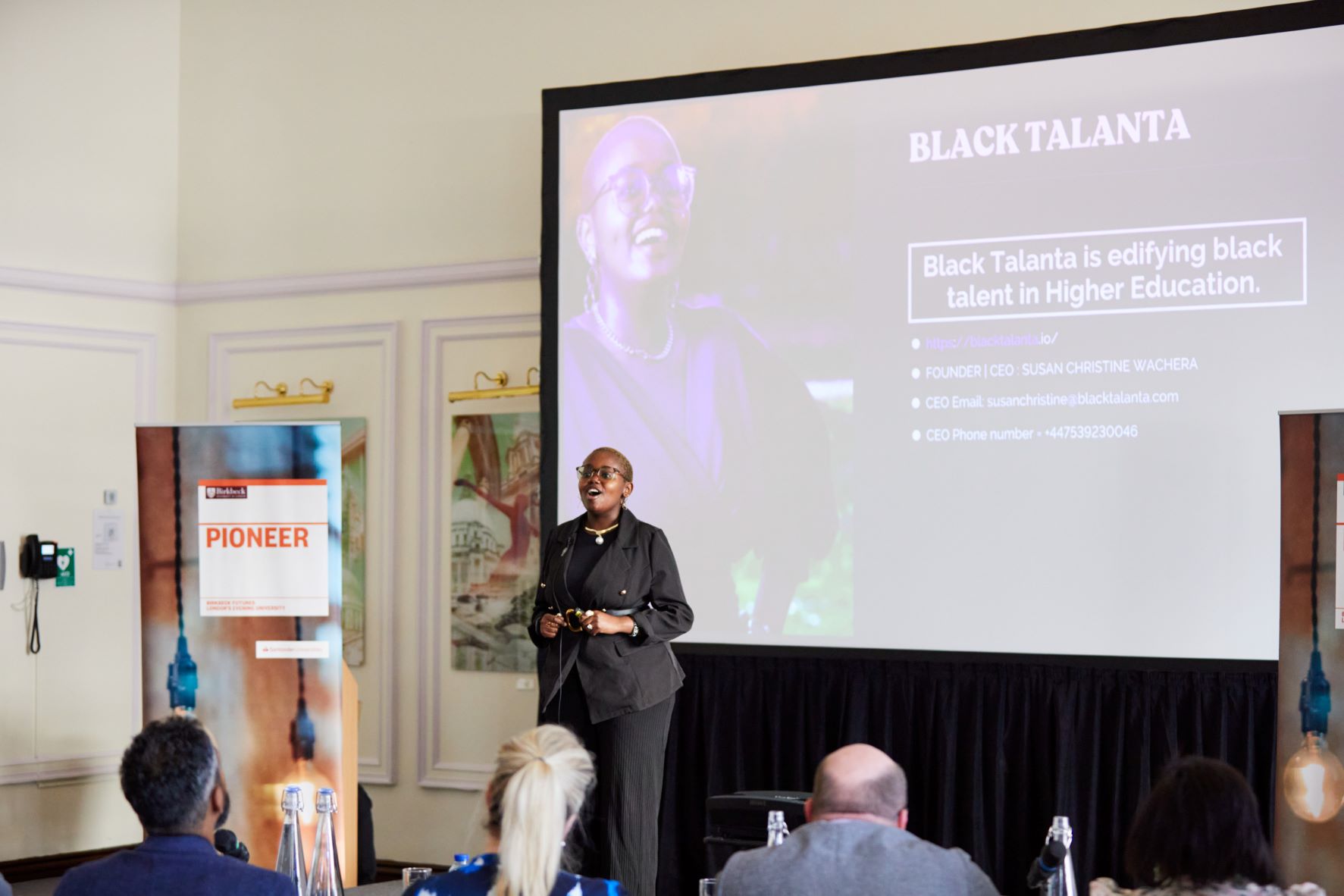
Susan Christine Wachera, MSc Organisational Psychology student and winner of 2022 Pioneer Award for the Best Business Pitch, tells the story of her business, Black Talanta, as well as sharing her experience of taking part in Pioneer, a Birkbeck programme that helps students and graduates develop the knowledge and skills they need to start a business.

Susan Wachera

What is your business about?
Black Talanta supports Black students and recent graduates in accessing highly-skilled employment, mentorships and internships.

Did you always know you’d be a businesswoman?
From the age of 10 my whole life had actually been geared towards becoming a doctor. I studied BSc Medical Biochemistry and received an offer for a place at medical school. However, I knew I also had this other side of me that was very entrepreneurial and business-minded. I’ve always had side hustles going on. I thought for a while I could balance being a part-time doctor with my other businesses. Everyone thought I was crazy!

Why didn’t you end up pursuing a degree in medicine?
During my undergraduate degree, I founded a business that helped secure students medical internships and work placements. By doing this, I realised I had a talent in supporting people write CVs and build their personal brand, and I wanted to explore this career path further. I made a big and brave decision to give up my place in medical school, the year before I was due to start. I wanted to find out who I was when medicine wasn’t involved – because my whole identity at that time was wrapped up in medicine.

What did you do next?
I discovered Birkbeck’s MSc Organisational Psychology course and I was mind blown. I never knew that I could combine my love for business and my love for psychology. I started the course in October 2020 and haven’t looked back. Black Talanta came about through my lived experience and my desire to help other Black people secure opportunities and achieve their goals. It has taken off in recent months, with the help of Birkbeck’s Pioneer programme.

Susan Wachera presenting at the Pioneer Awards ceremony

How did Pioneer help you progress your business idea?
Pioneer was absolutely phenomenal. It helped me move from concept to product in only three months, which is almost unheard of. I was focused on applying everything I learnt on the programme, and I was taught how to set up a business in the right way, so I managed to set the foundations for my business quickly. I really appreciated all the Pioneer workshops, mentors and resources – it definitely helped me get opportunities, such as working with the Deputy Mayor of London, Silicon Valley, and the United Nations. I would definitely recommend the programme to other students.

What are your plans for the next few months?
For Black Talanta to really work at the scale I want it to, I’m looking to develop more partnerships with employers, so I can bring in as much talent into the workforce as I can.

Further information

“I’ve been given the skills and confidence to put my ideas out into the world”

MSc Culinary Innovation Management student, Annabel Ola, shares her experience of taking part in Birkbeck’s Pioneer Programme and winning the 2022 Pioneer Award. 

Tell us about your business idea, what is BEKIRI?  

BEKIRI exists to expand the boundaries of modern luxury patisserie. The fusion of classic recipes and African ingredients will offer a new dimension of cultural discovery and appreciation for customers. 

How did BEKIRI come into existence?  

I’ve always loved food. On a trip to Paris, I was in local patisseries, impressed by everything but also unable to find anything I really identified with. So, I started my own specialty cheesecake market stall in my local area, hoping to fill that gap. It worked for a while, but I realised I wanted something a bit more intricate. That’s how I came upon the idea of BEKIRI.  

You had the idea, then what?  

I decided to do the MSc Culinary Innovation Management at Birkbeck, a course run in conjunction with Le Cordon Bleu London Culinary Arts Institute. While it’s not a programme on how to make a patisseries, it is about how to manage and run a food establishment – perfect for what I wanted and needed for BEKIRI.   

How did you get involved in the Pioneer Programme?  

My course was great at providing skills and knowledge for the practical management and operational side of things. But I also wanted something to help me with the vision and implementation of a business strategy. I knew Birkbeck offers lots of support for students with entrepreneurial ideas, so I was actively looking at the different schemes and came across Pioneer on the Enterprise webpage. EnterpriseEnterpriseEnterprise webpageEnterprise webpage page. One of my lecturers also recommended the programme, so I signed up. 

How was it?  

So useful! Through the programme, I was able to take something that was just an idea, identify the different areas to consider, then take action to make it a reality. I learned how to make a really clear business plan, and even got support on developing knowledge in areas like finance and marketing. We were matched with buddies – other students who had their own expertise and knowledge in specific areas – and I’ve created a marketing strategy and set up the financial side of things with the help of mine. I also got feedback and a session on pitching. I’ve never been keen on public speaking, and it was obvious that I was nervous during my entry pitch. By the time I did my final pitch, I was praised for being calm, confident and clear! 


Other than practical skills, what are some of your biggest takeaways?  

I’ve been given the skills and confidence to put my ideas out into the world. It’s given me the self-belief to put resources or pitch packs together, contact people, and make unique connections. The fact that I was doing all of this alongside a community of fellow entrepreneurs was also really helpful. All the finalists are still in touch and so supportive of one another.   

Would you recommend the Pioneer programme to current or prospective students?  

100%! It’ll give you a support network, contacts and knowledge to build your confidence. When I joined the programme at the start, I wasn’t convinced I’d enter the competition. By the end, my confidence had grown so much that I decided to enter – and I ended up winning! Even if you don’t win, it’s so valuable. You pick up so many skills and contacts, it’s a great springboard.  

What’s next?  

The prize money is going into product development to get an initial menu together. I’ve pitched for BEKIRI to trade at Mercato Mayfair – an upscale foodhall with a focus on sustainability and uniqueness – and there’s interest from them. I’m also looking for more opportunities to pitch my business and figure out what strategy is best to get more funding. Someone that I met on the programme is helping me figure that out too! I’m so excited that it’s coming together… I can’t wait to see where I can take BEKIRI next. 

More Information 


Meet Astrea: Julie Crofts, Director of Academic Standards and Quality & Deputy Academic Registrar

Julie Crofts smiling for the camera.Astrea is Birkbeck’s staff network for women and non-binary people in professional services. We talk to Astrea member Julie Crofts about her career journey.

Can you tell us a bit about your career journey so far?

I’ve worked in and around education and universities for over 30 years now. I studied English Literature (with some grammar and old English thrown in) as an undergraduate and I followed straight on with a Master’s degree in the days when the British Academy would support students to take an MA. I started a PhD on Angela Carter’s work in the early ‘90s. There wasn’t much of a support framework then for PhD students and I think I felt a bit thrown in at the deep end. I really liked the teaching I did as a PhD student and afterwards at Birmingham University, but I didn’t really have the confidence or single-mindedness to pursue an academic career. It gave me an early brush with quality assurance as I was both a postgraduate student rep and also a teacher whose class was observed in the 1994 Teaching Quality Assessment process.

I learned to type when I was 18 – my mum’s legacy – which meant I could start temping in offices when touch-typing wasn’t a universal skillset. It gave me quite a lot of work experience in multiple sectors. In higher education, I’ve worked at or studied in (or both) around 15 different institutions across the country in my career.

My first permanent job in London was at the Royal Society for Arts (if you ever see FRSA after someone’s name, by the way, that means they pay to be a Fellow) working on a project supporting accreditation for work-based learning through volunteering. It was a fantastic introduction to the city and to work from drug rehabilitation to Theatre Peckham. It also prompted a career in arts education and twenty years working in conservatoires. I made an active choice to work in dance and spent five years at the Council for Dance Education and Training which accredited professional dance programmes. I helped to set up the Conservatoire for Dance and Drama (created with HEFCE support in 2001) moving from a project officer to its Executive Director and from there to RADA as Secretary and Registrar. I also spent some time at City, University of London. Small institutions don’t always offer the complexity of bigger universities but do offer breadth. At RADA, along with the directors of education/training, we were switching between being the leadership team making decisions about the strategic direction to problems with a shower not working. I don’t think there is a ‘right’ career route; just opportunities to keep learning and developing your experience and judgment.

A few summers ago, I was working on two team restructurings: one at RADA and one at City. I learned then that it’s never the thing you think that will really be difficult, always the one you think will be easy.

I’ve known Birkbeck since I came to London and have always admired its ethos and the opportunities it provides for people. My role as Director of Academic Standards and Quality & Deputy Academic Registrar (surely the longest job title of anyone in the College) is ideal for me at the moment. I’ve got a lovely and talented team and work with great people in Registry and across the College. I’ve enjoyed working more closely with departments, learning more about the programmes we offer and getting to know people. I’m especially pleased to be on campus a bit more now and meeting people I’ve been working with for 15 months but am only now meeting in person.

What are some tips for success?

I’d like someone to tell me! But my personal guiding lights are:

  • Do something that interests you and perhaps scares you a little bit.
  • Serve the work, not the person: that really means do the best you can by the work you’re doing rather than play politics or try to undermine someone else. Try to be straightforward, don’t withhold information, work for the team. Be ambitious for your work, not for your status.
  • When they go low, we go high (Michelle Obama).
  • Be kind.
  • Not everyone will like you, and that’s ok.
  • Always say thank you.

What advice would you give to someone starting your career/field?

Quality assurance is about standards, about consistency and above all about good learning experiences. I think it’s really helpful for someone working in a ‘central’ quality team to have had experience working in a department or somewhere like student advice, basically having had day-to-day contact with our students and also the people who teach them.  In a variation of serving the work, remember that you’re backstage not the main show. Your job is to support the education offered and that’s an essential role, but if you’re doing it well, most people won’t notice. I’ve been on the academic path and I’m married to an academic and it’s a good reminder of what we’re here to do.

What was the last thing you read/heard/saw that inspired you?

Here’s a photo of a bench by the artist Jenny Holzer I saw at Easter in the Peggy Guggenheim in Venice:

Image of the words: savor kindness because cruelty is always possible later

Otherwise, I listened on Audible to Dr Julie Smith’s Why has nobody told me this before.  Her tip for stopping ruminating is to put your hand out in front and say ‘Stop!’ And it works! Try it.

Finally, I’ve recently re-read South Riding by Winifred Holtby. A book as much about the machinations of committees and local government as anything else. Heartily recommend.

What do you do to unwind after work?

Apart now from saying Stop!, in lockdown we took to playing Bananagrams as a reset for the end of the day. I love reading and I’ve knitted my way through a great many box sets. Now the weather’s better, I’m tending my balcony plants and looking forward to my Emily Brontë rose finally flowering. I’m not entirely sure I’m much of an unwinder, except of knitting, though.

My work placement experience at Europe’s biggest Chinese film festival

Shanshan Wu, MA Film and Screen Media student, shares her experience of studying at Birkbeck and finding a work placement. 

For the past four months, I have been doing my work placement at ‘Odyssey: a Chinese film season’, hosted by the non-profitable organisation UK-China Film Collab (UCFC). Thanks to Birkbeck and the placement host, I am leading the marketing team of Europe’s biggest Chinese film festival.  

A New Start 

After finishing my bachelor’s and my first master’s degrees in Filmmaking in Australia, I went back to China for work, and became a tutor of film training courses for young people. Then I realised I wanted more – I wanted to know more about the cinema market, film distribution, film curating, and, of course, film festivals. The world of cinema is so vast, and I wanted to expand my vision to different areas of the film industry in different parts of the world. 

Becoming a Birkbeck Student 

When researching film programmes in London, Birkbeck was my top choice. Its perfect location in the heart of Bloomsbury was a selling point, but so was its well-designed course modules in MA Film and Screen Media, which offered a wide range of options – from film curating to memory studies – all introducing and exploring cutting-edge topics and debates in the field. One of the things that interested me the most was the chance to do a work placement at a film or media related organisation. It seemed like a perfect opportunity to get hands on experience in the film industry to help start student’s careers. International students like me are often underrepresented in the professional circuit, so these kinds of opportunities are extremely precious to us.  

Securing the Placement 

For most of our fellow students, our tutors would listen to their work placement needs, and then match them with suitable placement hosts. I went through the same process, but I had also started looking for placements of my own accord too – I was really keen! My tutor, Dr Dorota Ostrowska, was so understanding and helpful in this process. When I said that I had been offered the voluntary Lead of Marketing role at ‘Odyssey: a Chinese cinema season’ film festival, she carefully considered the details. She wanted to make sure the work matched with my needs and really would be a beneficial placement for me. After the consideration, all the paperwork was signed, and the placement was secured!  

A Rewarding Journey 

Odyssey: a Chinese cinema season was held from May 10 to June 10.  With more than 60 films screened both online and in-person, and audience numbers over 2600, it is the biggest Chinese film festival in Europe this year. My placement has now ended, and I have learned so much and met so many great colleagues and friends.  

I’m so grateful to the festival and to the Birkbeck tutors for the support and insight they gave me on this journey. I now understand in detail the process of holding a film festival and discovered a new interest in film marketing and film distribution, which I had never thought of before. I’m sure this is just the beginning of another journey for me, and I can’t wait to explore more wonders of cinema.

Further Information:  

“Being able to function and cope well in a new academic and cultural environment has been a fulfilling and exciting experience”

Rachid Meftah, from Morocco, is a 2021 Chevening scholar. In this blog he talks about his Chevening application journey and studying Language Teaching/TESOL (MA) at Birkbeck.

How was your Chevening application journey?

Reflecting back upon my Chevening journey, I find it a rich, exciting, and fulfilling experience. I consider this journey to have been smooth – despite all the challenges – for this one main reason: I knew what I wanted to study and what to do with it.

As a teacher, I had always been looking for opportunities to expand my knowledge and expertise in the field of TESOL (Teaching English to Speakers of Other Languages). Having been introduced to this area through a short audit class had given me insights into what I could gain from doing a full-time master’s in it, and of how this could impact my colleagues and community. So, the vision had been clear in my mind: I wanted to gain valuable qualifications in TESOL that would help me to bridge the gap between practice and theory as a teacher, and to enable me to bring change to education in my community and country through teacher training.

Thus, when the Chevening opportunity came, all I had to do was to put my clear idea into words, and to showcase it as a project worthy of the Chevening award well enough throughout all the stages of the application process. Not only did this vision help me win the scholarship the first time I applied, but it also gave me enough motivation and positivity to surmount all the obstacles.

Why this course and why Birkbeck?

My choice to study at Birkbeck was guided by two things: the nature and the quality of the course and the reputation of the college. After searching and comparing Masters online, I chose TESOL at Birkbeck for these reasons:

  • The course suits my academic and professional goals since it was designed for English language teachers who already have an experience in the classroom and who want to develop their career opportunities
  • It offers me the opportunity to expand my knowledge in the field of applied linguistics and develop language awareness and analysis of English as a second language
  • It offers me the opportunity to conduct research in the field of second language acquisition

My choice of Birkbeck college was based on the search I did and on advice from a former professor. I wanted to do my master’s in central London, the hub for an international and vibrant scholarly community, and Birkbeck offered me that. In addition, a former professor advised me to choose Birkbeck for the quality and academic excellence of its research. Now that I’m conducting my research dissertation, I could see the benefits of being a part of the Birkbeck scholarly community.

Being able to function and cope well in a new academic and cultural environment has been a fulfilling and exciting experience for me.

Can you tell us about your experience as a Chevener?

My Chevening journey has been an exciting and a rewarding experience in every aspect. I feel I have gained much academically, personally, and culturally studying at Birkbeck.

My course has offered me an excellent academic experience so far! I’ve been introduced to a research oriented and positive environment where professors consider us their colleagues, not their students. This has helped me gain an intellectually stimulating content and research skills that will enable me to conduct my own research.

As a Chevening scholar at Birkbeck, I could connect with many Cheveners and with other international students through the events organized at Birkbeck. This has offered me the opportunity to network and socialize with students from different professional and cultural backgrounds.

Further information:

A day in the life of a postgraduate student

MSc Politics of Population, Migration and Ecology student, Sorrel Knott, shares a day-in-the life account of her experience as a full-time postgraduate student at Birkbeck.  

You might be wondering what a day in the life of a postgraduate student looks like. To tell you the truth, there is no ‘one-size-fits-all’ answer to that question. Birkbeck has an incredibly diverse student body, bringing together people from a variety of professional backgrounds with varying daily responsibilities. Alongside my studies, I work as a part-time marketing assistant and researcher, as well being a student ambassador for Birkbeck. My part-time professional role is completely remote; as a result, I have been able to cultivate a flexible routine, and evening study at Birkbeck has enabled this. So, here is a day in my life as a full-time postgraduate student. 

8am: *Insert irritating iPhone alarm sound effect* 

Typically, I wake up at 8am. I’ll stretch, make my bed, and get ready, before attempting my daily Wordle with breakfast. As my job is remote, I don’t commute to work unless I am working as a student ambassador at an event for Birkbeck. Therefore, I’m lucky that I can have a laid-back start to the day.

8.30am: let’s work 

I try to get started quickly. I try to get started early, helped along by the to-list that I make every Sunday, that sets out all my tasks for the week. My work includes posting on social media, academic research, compiling bibliographies and writing reports in order to build my company’s platform 

12pm: student commute 

At 12pm, I’ll have another coffee before packing my bag for university, being sure to include my laptop, chargers, headphones, notepad, pen, water bottle, reusable Tupperware and cutlery, mask, hand sanitiser and a trusty lip balm. I usually catch the bus to Euston Station and walk eight minutes past Gordon Square to reach Birkbeck’s Malet Street campus. If the weather permits, I ride my bike, as there are plenty of bike racks on campus. I tend to avoid the tube to save money, though there are convenient tube stations located at Russell Square and Goodge Street. 

1.30pm: arrive in time for some free food on campus 

If you arrive before 3pm, you can normally catch the Hare Krishna group handing out cooked food, bread, fruit and, if you are lucky, home-made cake! I will normally pick up lunch from them in my reusable Tupperware before heading to Russell Square or the green space on Birkbeck’s Malet Street campus. There are also other squares to choose from – sometimes I sit in Gordon Square by Birkbeck’s Arts building. I enjoy visiting Birkbeck’s surrounding squares as I think it’s important to visit green space when working on a laptop all day. Plus, I might get lucky and see a cute dog (or six)! 

2pm: become a bookworm in Birkbeck’s library 

After lunch, I head to the library located in Birkbeck’s Malet Street campus. Usually, I sit down in the group study area, but there are silent study areas too. I watch pre-recorded lectures, complete my pre-reading for my seminar and make notes. I’ll ensure that I understand the topic of the seminar, which might involve watching documentary clips, keeping up with the news and emailing professors with any questions. If I have an assignment, I’ll work on that after my seminar preparation, including my dissertation research. If a friend is on campus, we’ll go for a coffee at Terrace 5 on the fifth floor of Birkbeck’s Malet Street campus. Sometimes, you can get a discounted hot drink through the Twelve app! 

6pm: it’s seminar time (normally) 

On the evenings where I don’t have a seminar, such as the summer term when postgraduates only work on their dissertations, there might be a Birkbeck event, which I can work at as a student ambassador. During term time, my seminars start at 6pm on Tuesdays, Wednesdays, and Thursdays, and last for around an hour and a half. 

In the Department of Politics seminars are very collaborative, involving group discussions surrounding the pre-seminar readings and materials. My intellectual progression has been enriched by the diversity present in the seminar groups, and I have enjoyed having my viewpoints constructively challenged by others. The seminar is also an opportunity to ask your professor to clarify the pre-seminar lecture or readings, as well as an opportunity to discuss a particular topic with a Birkbeck academic. 

7.30 – 9pm: let’s go home 

If it’s a Tuesday or Wednesday, I finish at 7.30pm. If it’s a Thursday, I finish at 9pm because I have two seminars back-to-back. When you choose your modules in the Politics department, you’ll be able to see the days of the week when a module is taught, as well as having the option to choose between a 6pm or 7.30pm start time for your seminar. This has given me the flexibility to avoid clashes between two modules that are provided on the same day. 

Regardless of time, I’ll either catch a bus or cycle home. Sometimes, other members of the class will head to a pub or bar for a post-seminar drink. I don’t drink alcohol, but it’s enjoyable to attend these casual post-seminar events in order to socialise. 

The rest of the evening: time to relax 

When I arrive home, I’ll make dinner with my partner, take a shower and relax. I think it’s important to dedicate time towards your family, friends and loved ones, as well as taking time to reflect after your day. My partner and I talk about our day, watch a TV series or play video games. I’ll also complete any daily chores, like the washing up.  

 This is the time to rest and recuperate before another day, as well as checking in with yourself to see if your body is bringing anything to your attention, both physically and mentally. Sometimes, I realise that my body needs more sleep, so I allow myself an extra hour of sleep. Sometimes, I realise that my body needs some alone time, so I might read a book for an hour. I’m lucky that the combined flexibility of my professional role and evening study at Birkbeck enables me to pay attention to my own needs. 

So, there you have it! 

This is what a typical day in my life looks like; it may not be representative of every student’s time at Birkbeck, but it really works for me. It’s a stable routine that enables me to balance my professional and academic work. Other student’s days might include attending a university-related event, such as a cinema showing in Birkbeck’s Arts building or a guest lecture. Those after even more of a social student life can join a society and attend their meetings and events outside of seminars and work hours. Some students might even visit one of the galleries, museums and exhibits which the Bloomsbury area is famous for. It’s the additional experiences that are available at the university and in the surrounding area that bring a little extra joy to your life! 

More information:  


From shades of Gray to a confidence vote: three things we know about Boris Johnson

Yesterday saw UK Prime Minister Boris Johnson narrowly surviving a vote of confidence by Conservative MPs. Senior Lecturer in Politics, Dr Ben Worthy analyses the findings of the Sue Gray Report and gives his predictions for the future of Boris Johnson in Downing Street.  

There were parties  

The Gray report finally confirms that regular parties were held in Downing Street. This is simple but important. They weren’t accidental, or ‘cake ambushes’ taking the poor PM by surprise. Police investigated a total of twelve parties, with a further four left uninvestigated. The parties were organised, premeditated, and put together in advance, while the rest of the UK was in severe lockdown so stringent that funerals couldn’t be held, and relatives couldn’t visit loved ones in hospital. As the report put it bluntly: ‘It is important to remember the stringency of the public health regulations in force in England over the relevant periods and that criminal sanctions were applied to many found to be in breach of them’. What was fine for Downing Street, resulted in a fine for others.   

It shouldn’t need saying, of course. But the truth is important. Most Prime Ministers, and most politicians, are ‘economical with the truth’. But more than most, Prime Minister Johnson’s career has been built on what Nixon called ‘things that later turned out to be untrue’, from the £350 million promises written on a bus to the denial of lockdown parties. The first question on his recent Mumsnet interview was “Why should we believe anything you say when it’s been proven you’re a habitual liar?” A website has collated more examples of lies from Boris Johnson. Even his biography of Churchill was littered with ‘misunderstandings’, including that the Germans captured Stalingrad 

Amid the fog of untruth and evasions, the report sets out what happened, when and where, with photos and evidence.  Surprisingly, or unsurprisingly depending on how cynical you are, allegations of more parties have emerged since the report. As Marina Hyde, Guardian columnist, always points out, with Boris Johnson there’s always more.   

They knew they were wrong  

One of the more astonishing parts of the report is how much of the wrongdoing was recorded. What was written showed that many participating knew it was wrong. Again, there were no accidental parties but instead, instructions to ‘bring your own booze’. The report shows that someone close to the Prime Minister, warned fellow party goers:  

‘Just to flag that the press conference will probably be finishing around that time, so it would be helpful if people can be mindful of that as speakers and cameras are leaving, not walking around waving bottles of wine etc.’  

The individual went on to write: ‘Best of luck with a complete nonstory but better than them focusing on our drinks (which we seem to have got away with).’  

Perhaps the hardest parts of the report are the details of the treatment received by those who pointed out what they were doing was wrong. In the report, Gray writes: ‘I was made aware of multiple examples of a lack of respect and poor treatment of security and cleaning staff. This was unacceptable.’ Though there are no details, The Sun has reported how one security guard was mocked for pointing it out and cleaners were laughed at as they cleared up the mess. One image that stands out, is of staff, the days after the many nights before, scrubbing post-party wine stains after travelling across lockdown London.   

Conservative MPs are not happy  

If Conservative MPs were surprised by the Gray report, many were silent for some time after. In the 24 hours after its release, many thought that no news was good news, and a sign that Johnson was out of trouble. But we now know the quiet was more ominous, with MPs weighing up options. In the following days there was a steady uptick in letters to the 1922 committee which triggered a vote of confidence.  

Some Conservative MPs were genuinely outraged. Paul Holmes, who resigned from the government, spoke of his ‘distress’ at a ‘toxic culture’ in Downing Street. Others, depending on your view, may be more cunning or realistic; even before Partygate, Johnson had slowly become an electoral liability. He is now a vote loser not a vote winner.    

Already nervous Conservative MPs know that, because of the Gray report, every leaflet from a Labour, Liberal Democrat or Green opponent will feature a photo of Boris Johnson drinking, which they will have to defend or distance themselves from. This is at a time when a full 59% of the public believe he should resign (though not many think he will). One analyst has worked out that ten recent letter submitters are in vulnerable seats at greatest risk to the Lib Dems. Over in Wakefield, where there is a by-election this month, Labour are twenty points ahead, with the main reason for voters switching, according to one pollster, is ‘Boris Johnson tried to cover up partygate, and lied to the public’.  

Boris Johnson still isn’t safe  

On Monday 6 June, Johnson finally faced a confidence vote which he won but, it must be said, won badly, with 40% of his own MPs voting to remove him. More Conservative MPs voted against him than voted against Theresa May in 2018, and she lasted only a few more months in power afterwards. This leaves his leadership in the worst possible position, still in post but with almost half of his own party against him.   

Boris Johnson is now in very serious trouble, and his time in Downing Street can probably be measured in months, if not weeks. His MPs, his party and the public are deeply unhappy. The details and images from the report may mark the end of Johnson’s time in Downing Street. Whatever happens next, the Sue Gray report will be a defining document of Johnson’s premiership, and a symbol of what went wrong.     

Ben Worthy is the Director of the MSc in Government, Policy and Politics at Birkbeck. 

More information  


Five top tips from a student on how to save money

MA Applied Linguistics and Communication student, Charlotte MacKechnie, shares money-saving tips to get the most out of your student loan or monthly budget whilst studying at Birkbeck.  

  1. UNiDAYS 

UNiDAYS is a free service that you can sign-up to using your student email address that ends in .ac.uk, at myunidays.com. After signing up to the website, you will have access to ongoing and limited discounts. My favourites include £10 off £75 at Ikea, discounted Pure Gym memberships, and a 6-month free Amazon Prime Student trial (then 50% off Amazon Prime).  

I love UNiDAYS because… you can use your UNiDAYS ID on your phone to access discounts in store. No more being caught out by not having your student card with you! 

  1. Tesco Clubcard 

This free loyalty card for the British supermarket, Tesco, allows you to unlock in-store and online discounts that are exclusively available for Clubcard members. Not only do you unlock deals, but you also collect points every time you shop; you can turn these points into Tesco vouchers, or you can put them towards rewards such as vouchers for Pizza Express, the RAC, and Disney+. Sign up at Tesco.com. 

I love Tesco Clubcard because… I love the scanning my Clubcard prior to paying in-store, so that I can see how much money I have saved! 

  1. Download Microsoft Office 365 – for free!

To download Microsoft’s entire Office suite for free, you’ll need to sign up using your .ac.uk student email address at Office.com. After logging in, you’ll be guided through downloading and installing the software, plus you’ll also get 1TB free OneDrive online storage. 

I love Microsoft Office 365 and OneDrive because… I can save all my files on OneDrive, and access them from any device! 

  1. Purchase a railcard and save a third on eligible fares

If you anticipate travelling whilst at university – perhaps visiting friends at other unis, or even going home – then I’d definitely recommend getting a railcard. I travelled 300 miles away to attend university, so I started saving after my first return trip home! If you go to thetrainline.com, their railcard finder will help you decide which railcard that is right for you – there’s a card for every age. Added tip: if you sign up to Student Beans, you receive an exclusive discount on student railcards. 

I love having a railcard because… it makes visiting family and friends more affordable! 

  1. Discover free counselling and listening services

University can be a stressful time, and we want you to know that there are free counselling and listening services out there. For example, Samaritans are there for you, 24 hours a day, to help you face whatever you are going through. Also, Birkbeck offer a free, non-judgemental and confidential counselling service, as part of their student well-being services offering.   

I love knowing about the free services available to me because… I know that I am supported! 

More information 


Management Consultancy and Organizational Change: Are you up for the challenge?

Each year, students on the MSc Management Consultancy and Organisational Change work directly with major clients of PA Consulting on a variety of challenging consultancy projects.

A unique aspect of Birkbeck’s MSc Management Consultancy and Organisational Change programme is that students have the option to complete the Consultancy Challenge in place of a traditional dissertation or research project.

Partnering with PA Consulting, the global innovation and transformation consultancy, students on the Consultancy Challenge work with PA’s major clients on a range of projects across an intense twelve-week period. For these students, it is an opportunity to deliver solutions to real problems that clients face, reflecting the work of management consultants, and experiencing a unique journey alongside team members who all offer different skills and knowledge.

For the 2021 academic year, students formed two teams, each tasked with solving a problem in a large, complex organisation. The first team completed a knowledge governance project for a large UK animal charity. The second team completed a project advising a regulatory organisation in the medical field on implementing hybrid working.

Dr David Gamblin, programme director and module convenor of the Consultancy Challenge, said: “It was a joy to see the students in action over the twelve-week consulting cycle, from initial scoping of the briefs and defining the problem with their clients, to the final presentation of deliverables. The students tackled two challenging projects, put learning into practice, and ultimately delivered meaningful outputs for their clients.”

Throughout the project, each student team is mentored by a consultant from PA, who provides support and guidance, as well as assurance that the work is of a standard that PA would be proud of.

The consulting cycle culminated with the student teams presenting their final analyses and recommendations, which were met with positive reactions from the clients, PA consultants, and Birkbeck supervisors. The clients highlighted the “hard work and professionalism” of the students, and they were impressed with the practical advice that was offered.

The 2022 Consultancy Challenge officially kicked-off on 25 April 2022 with students working on two new client projects. If you think you are up for the challenge in future years, have a look at our Management Consultancy and Organisational Change programme page, or contact David Gamblin to learn more.

Find out more