Category Archives: Humanities and Social Sciences

9 Things You Need To Write A Novel

Toby LittIf your new year’s resolution was to finally write that novel, Toby Litt, writer and senior lecturer in creative writing in Birkbeck’s Department of English and Humanities has some advice for you. This article was originally published on Toby’s personal blog.

9 things you need to write a novel

Time-more-time-and-even-more-timeThe first thing you need to write a novel is… Time.

The second thing you need to write a novel is… More Time.

And the third thing you need to write a novel is… Even More Time.

This perhaps seems a bit obvious. But let me explain.

Time, More Time and Even More Time are all necessary.

I’ve divided Time up into three because you need Time for different things.

The first lot of Time is, as I’m sure you’ve guessed, Time to write. Time to sit at the desk with words coming out of you.

The second lot of time, More Time, is… Time not to write. Time to do stuff which doesn’t seem to be writing but which, in the end, turns out to have been writing all along. To the uninitiated, this may appear to be window shopping or people-watching, taking a nice long nap, or tracking down YouTube clips of something you once saw on TV – but, actually, it is when the writing bit of the brain does its hardest work. Believe me.

The third lot of time, Even More Time, is Time to rewrite, and rewrite and rewrite. But we’re not going to worry about that now. That’s for later drafts. For the moment, we’re thinking about the first draft.

As I’m sure you know, Time is never a neutral, abstract thing. Nor merely a clock-ticking-on-the-mantlepiece thing. Time for writing your novel is time not for other occupations, not for other people. It’s time stolen from your loved ones; time they will probably resent you not devoting to them. Time is closing the door behind you and not answering when people knock – not unless they knock very hard, and shout words like ‘Fire’ and ‘Bastard’ and ‘I’m leaving – I really am’.

In a way, writing is saying to your loved ones, ‘Go away, because I want to talk to you’. I want to talk to you in a more articulate and truthful way than I ever could if you were there in front of me. ‘Go away, because I want to talk to you.’

All of which explains why you’ll need the fourth thing, which is…

Some Selfishness

Some-selfishnessI could try to make this sound nicer – I could call it self-belief or determination or following your dream – but that’s not how it’s likely to appear to your loved ones, the ones outside the door, knocking, pleading.

Self-belief without justification is always going to appear selfish, and until you write your novel there won’t be any justification. In lots of people’s eyes, until your novel is published by a publisher they have heard of, and appears in shops they frequent, and is reviewed in a newspaper they read, then it is unjustified. And in the eyes of a large minority, a book isn’t really justified until it has been made into a film starring an actor or actress they have heard of – thus saving them the trouble of having to read it.

However, writing rarely has a proper justification. Not in the strictest sense. Writing with justification is the UN Declaration of Human Rights.

There is a story about James Joyce, made up by Tom Stoppard and included in his play Travesties. Joyce is in the dock. The interrogator asks him, ‘What did you do during the Great War?’ To which Joyce replies, ‘I wrote Ulysses. What did you do?’

The only real justification for a piece of writing is that it is worth reading – or feeling guilty about not having read.

But Selfishness is, of course, not enough. You will also need…

Some Generosity

Because, without making it sound like geriatric nursing or tin-shaking for the NSPCC, writing is an act of generosity. A novel that isn’t essentially for other people to read isn’t worth writing. This is the ‘..I want to talk to you’ part, the part that comes after ‘Go away.’

Many writers claim they write only to please themselves. And I believe them – but only so far as to say this is what they need to tell themselves in order to write.

A well-formed sentence has a direction: towards the reader.

So far we have: Time, More Time, Even More Time, Some Selfishness and Some Generosity.

The next thing you need is a little more prosaic. It’s…

The Means

The-meansBy The Means I mean the physical necessities of writing – a pen or pencil and some paper, or a computer.

What you use is entirely your choice. If what works for you is to write in crayon on old cornflake packets or in chalk on the gashouse wall, it doesn’t really matter.

There are some drawbacks to the gashouse wall (though in these days of digital cameras, who knows?) I would have a few cautionary things to say about word-processing.

The first is that it makes things too easy. Although I am telling you the nine things you need to write a novel, the most important is probably contained in these five words: There are no short cuts.

The sheer physical labour of rewriting a novel, start to end, by hand would certainly make one consider the necessity of every single word; copy/paste does not do this.

Of the Evils of Word-Processing, copy/paste is Number 2. (Number 1 comes a little later. Read on.)

By Means I also mean a workplace. Ideally this would be, as Virginia Woolf put it, A Room of One’s Own. But if this isn’t, a library, café, train or park bench in spring or summer will do almost as well. Quiet, too, is probably recommended.

The next thing you need – there are only three more – is something much more abstract. It is…

A Discipline.

A Discipline. Not, I repeat, not a routine, though it might on the surface resemble one.

A routine is unhelpful because, when you miss it or mess it up, you are going to feel bad, and get disheartened, and stop writing.

I think the idea of a discipline is better than that of a routine, because it is more flexible.

A routine is ‘I need to be at my desk by nine o’clock and produce 400 words by lunchtime.’ A discipline is, ‘It would be nice if I could do about a page or so every day.’

Here are a couple of famous writers’ disciplines. They are American writers. I’m not sure why but American writers seem to be more open about the craft of what they do. Perhaps because they feel awkward when anyone emphasises the art aspect.

The first discipline is Ernest Hemingway’s:

“I always worked until I had something done and I always stopped when I knew what was going to happen next. That way I could be sure of going on the next day.”

This comes from his book A Moveable Feast – a memoir of Paris in the 1920s. It is perhaps the single most useful clue I have ever come across as to how novels get written.

The second discipline is from David Mamet’s A Whore’s Profession. Mamet is a notable dramatist, and also wrote the screenplay to Wag the Dog.

“As a writer, I’ve tried to train myself to go one achievable step at a time: to say, for example, ‘Today, I don’t have to be particularly inventive, all I have to be is careful, and make up an outline of the actual physical things the character does in Act One.’ And then, the following day to say, ‘Today I don’t have to be careful. I already have this careful, literal outline, and all I have to do is be a little bit inventive,’ et cetera, et cetera.”

American writers, particularly American male writers, can often go to extremes when they set their minds to a routine. Hemingway, later in his life, became very macho about things.

He wrote standing up, usually in his bedroom in his house in Cuba, using the top of a bookcase, on which room was cleared, to quote the Paris Review, “for a typewriter, a wooden reading board, five or six pencils, and a chunk of copper ore to weight down papers when the wind blows in from the east windows.” It gets better. Hemingway “stands in a pair of his oversized loafers on the worn skin of a Lesser Kudu – the typewriter and the reading board chest-high opposite him.” He told his interviewer, George Plimpton, that he began in pencil, then shifted to his typewriter when his writing was going extremely well or when he wrote dialogue. Each day he kept count of the words he produced: “from 450, 575, 462, 1250, back to 512, the higher figures on days Hemingway puts in extra work so he won’t feel guilty spending the following day fishing on the Gulf Stream.” Hemingway was a strange old man, as he himself might have put it, but, when it came to writing, no stranger than most.

Not to be outdone, here is John Steinbeck:

“He wrote eight hours a day, six days a week for forty years. He would sharpen twenty-four pencils each morning and write with them until each one was blunt. After many years of this regimen, he had to use his left hand to insert the pencil into the calluses on his writing hand because he was unable to pick up the writing utensil with his right hand. Every few months, he would sandpaper those calluses so he could continue to write.”

British writers are different. Ian McEwan, I heard, rewards himself with a Choco Leibnitz biscuit if he’s had a good morning.

I’m not asking you to sandpaper your calluses. But I might be able to give you a few hints about finding a good, productive discipline:

To start with, don’t count the hours (a person can easily achieve nothing in eight hours), but do have a set amount you must do before you finish: one page, two, more, of hand- or typewritten words.

Wordcount is an instrument of the Devil. Don’t use it more than once a week. Of the evils of Word-Processing, it is Number 1. Especially Live Wordcount.

If it’s a choice between writing badly and not writing at all, write badly. Your only responsibility is for the final draft.

Don’t try to make it perfect on the first draft. Roughness is a virtue at this stage, because roughness is easier to cut, to rewrite.

The penultimate thing you need is the one you’ll probably have thought of first…

A Yearning.

I’ve chosen this, rather than Idea. There’s nothing more likely to close you down than someone saying, ‘You have to have an idea. Now.’

But you need to have a strong sense that there’s something not quite there that should be.

A niggling sensation. A question. Okay, I give up – an Idea.

What does an Idea look/feel/smell/taste/sound like?

Well, you tell me.

But if it’s a really good one, it’s quite possible that, even if you told it me, I wouldn’t recognise it as an Idea – and certainly not as a really good one.

I would, incidentally, recommend that you don’t ever tell people your ideas. Unless they say, ‘That’s the greatest thing I’ve ever heard. Let me sell my house to finance you as you complete this great work,’ you are likely to be disappointed with their reaction. And this may put you off seeing the idea through to its end.

The problem of The Idea is the biggest one for writers just starting out. They return again and again to the question: What do I write? And this is, of course, the question I am least able to answer for you.

But the one thing I won’t repeat is the Great Wisdom of creative writing classes, i.e., Write What You Know.

This is likely to make you think not of what you Know but what you’reCompletely Bloody Sick to Death of.

Henry James, my favourite writer, had something neat to say about the relationship between writing and knowing, expression and experience, in his essay ‘The Art of Fiction’:

‘The power to guess the unseen from the seen, to trace the implication of things, to judge the whole piece by the pattern, the condition of feeling life in general so completely that you are well on your way to knowing any particular corner of it – this cluster of gifts may almost be said to constitute experience, and they occur in country and in town, and in the most differing stages of education. If experience consist of impressions, it may be said that impressions are experience, just as (have we not seen it?) they are the very air we breathe. Therefore, if I should certainly say to a novice, ‘Write from experience and experience only,’ I should feel that this was rather a tantalizing monition if I were not immediately to add, ‘Try to be one of the people on whom nothing is lost!’’

This is a much more difficult, and useful, thing to aim for. If you aspire to being one of those on whom nothing is lost, then ideas will come to you, I promise.

An idea can be an area of mess or confusion in your head, or a line of remembered real-life dialogue, or an enticing title, or an exquisite memory, or a feeling of dreadful foreboding. It’s something, in other words, that haunts you.

A Yearning.

The final thing you need is…

A Tone

For the first-time novelist, consistency of voice is one the hardest things to achieve. You probably won’t, to begin with, have anything approaching a style, but you will have to settle upon a tone. This can range from ‘Once upon a time…’ to ‘For a long time, my mother used to…’

Here, though, is the ultimate and very simple secret of writing a novel: If you write 1,000 words a day for 75 days, at the end of those 75 days you will have a novel-length-thing. This novel-length-thing may not be a great novel, or even a good novel, or even a novel, but it’s a lot closer to being all three than the nothing you had before.

Or as Gertrude Stein said, ‘The way to do it is to do it.’

So, to conclude, let us go through the 9 things you need to write a novel:

1. Time

2. More Time

3. Even More Time

4. Some Selfishness

5. Some Generosity

6. The Means

7. A Discipline

8. A Yearning

9. A Tone

You have no more excuses. If it’s in you, it can now come out.

Let it.

Find out more about creative writing courses at Birkbeck.

Languages….what for?

Renata ArchanjoThis post was contributed by Dr Renata Archanjo, an Associate Research Fellow in Birkbeck’s Department of Applied Linguistics and Communication and the Centre for Multilingual and Multicultural ResearchIn her research, she has worked on questions about multilingual education and language policies for the improvement of languages teaching and learning strategies. Dr Archanjo is also an Associate Professor of Foreign Language and Applied Linguistics at the Federal University of Rio Grande do Norte (UFRN), Brazil.

If Brazil hopes to ensure the success of international educational exchange programmes and boost the internationalisation of economic, political, social, educational, and cultural initiatives, it needs to develop comprehensive programmes to promote multilingualism.

In Europe, the acquisition of one or more foreign languages makes a lot of sense, especially if one considers all of the countries in the European Union (EU), and others in the process of integration. According to EU policy, the promotion of language learning is an objective to be fulfilled. The inclusion of regional, minority and sign languages into society, the promotion of early language learning and bilingual education are some more specific linguistic policies. The aim is to ensure that European citizens will be empowered by those linguistic tools to move, learn, and work freely within the EU, contributing to the region’s development and the improvement of living standards. I regard this as a good strategy.

Interestingly enough, a similar policy to what happens in the EU has recently been adopted in my home country, Brazil. It is just a beginning, but more is expected to happen in the near future. In Brazil, having “one country, one language” is believed to be a mark of national identity. This is a Portuguese-speaking country, surrounded by Spanish-speaking neighbouring countries. The setting is that of a poor, third-world country. Perhaps for this reason, for several decades, public policy priorities were centred more on social and economic issues and, with less diversity, mobility and intercultural interactions than in the European context, little attention was given to language policies.

All of this has changed. Today, Brazil is the 7th major economy in the World, one of the BRICS countries, an emergent force in the G20, the leading political and economic group of world nations. The country tries to boost its development in and outwards with economic, political, social, educational, and cultural initiatives in several domains. In the education domain, particularly in the higher education sector, internationalisation is at the forefront. In line with successful initiatives in Europe such as the international mobility programmes like Erasmus, Brazil launched the Science without Borders Programme (SwB), in 2011, targeting the consolidation and expansion of science, technology and innovation. Brazilian students and researchers are awarded grants in order to go to centres of excellence all over the world for a year of exchange study. Accordingly, the programme also grants substantial resources to allow students and researchers from abroad to go to Brazil.

As expected, language competence is here of major importance. Just as European language policies promote multilingualism, Brazil needs to implement policies to ensure a multilingual education. In my current research about the linguistic competencies of Brazilian undergraduate students attending the SwB Program, the first results indicate that a high percentage of students are sent abroad with a low level of proficiency in foreign language. The results also show the improvement in language skills for the majority of students at the end of the mobility programme – which is something to be expected when one is immersed in a foreign language environment. However, language is a means – not the objective – in the SwB programme, and it should be expected that students have a good foundation and language skills beforehand. So far, Brazil is rated very low regarding linguistic capability as perceived and recognized by specialised rankings such as the EF English Proficiency Index. The country appears here in the 38th position, in the range of countries with low proficiency in English. This is something that policy-makers should worry about.

Reacting to that, a good governmental initiative has been recently announced: the Languages without Borders Programme. Developed under the auspices of the Brazilian Ministry of Education, its main goal is to encourage the learning of foreign languages by ensuring an extensive and structural change in the national foreign language teaching system in universities. Like other nations in the world, Brazil appears to understand that the teaching and learning of foreign languages are of major importance, not only for personal achievements, but for the national economic and scientific development. In a country championing social and economic equality, any initiative to improve education, especially in the public system, is to be welcomed. Much more has yet to be done and not only in higher education, as the gap in the domain of languages (both first and foreign languages) starts at an early age.

The answer to the question ‘Languages… What for?’ is not a simple one. A language helps to shape an identity. Through language we give sense to the world. Linguistic knowledge might bring development. At least, it is a condition that must be fulfilled for development to occur. In this case, a multilingual education should be provided. More importantly, extra linguistic knowledge will boost general discernment, the lenses to see the world in a more comprehensive way. Here, again, a multilingual education is critical.

Language, identity and a political hot potato

Penelope Gardner-ChlorosThis post was contributed by Professor Penelope Gardner-Chloros, of Birkbeck’s Department of Applied Linguistics and Communication

Blogs do not usually start with quotations from the Bible, but this one epitomizes the link between language, identity and danger that I want to discuss:

Gilead then cut Ephraim off from the fords of the Jordan, and whenever Ephraimite fugitives said, ‘Let me cross,’ the men of Gilead would ask, ‘Are you an Ephraimite?’ If he said, ‘No,’ they then said, ‘Very well, say “Shibboleth” (שבלת).’ If anyone said, “Sibboleth” (סבלת), because he could not pronounce it, then they would seize him and kill him by the fords of the Jordan. Forty-two thousand Ephraimites were killed on this occasion.

—Judges 12:5–6, NJB

Applied Linguistics, as distinct from more theoretical branches of the discipline, addresses real-life problems in which language plays an important role. As a linguist, I can attest that no day goes by without such an issue coming up in the press. I have several box files full of cuttings of articles which I use in my teaching, on topics ranging from the apparently inoffensive – e.g. the revival of ‘dead’ languages such as Manx or Cornish, to the highly political, such as the relationship between the use of minority languages, such as Catalan, and political separatism.

All of us are identified – and often judged – on the basis of our language, dialect or accent. The gruesome ‘beheading’ videos recently released by members of Isis were doubly chilling for Londoners, because the executioners in black hoods had unmistakable London accents, and sounded like the young people you hear on the bus on the way to work.

I want to talk about another recent example which has been in the news, and which shows how language interacts with some very practical issues with serious human consequences.

No-one in the UK needs to be told that the issue of immigration has been in the news on a daily basis for the last few weeks or months. Oddly, this is not because of any drastic change in the situation, but principally because the issue has become a populist rallying cry for politicians who, though they might not put it that way, wish to convince British people that they are going to ringfence the country’s wealth for those same British people – and prevent undefined side-effects like ‘overcrowding’ in the process. This ‘promise’ has proved so popular that politicians from all the main parties have jumped on the bandwagon. Despite clear evidence that immigrants in fact contribute positively to the economy, nothing wins votes like telling people they will get a bigger slice of the cake.

The detailed arguments, and the distinctions between different categories of immigrants, become obscured in this rhetorical assault. This is not the place to rehearse them, but there is one category of (potential) immigrants who deserve some special attention: asylum seekers, i.e. people who come to this country because they claim to be in direct danger, or subject to persecution, in their country of origin. Basic humanity dictates that such cases are dealt with quickly and fairly, and that such people are distinguished from, say, economic migrants, who come for a better life but who are not actually in fear of their life.

But how do we decide whether the asylum seeker is to be believed or not? An important aspect of the decision involves finding out where they actually come from. Do they come from South Somalia, for example, in which case it is beyond question that they should be granted protection, or North Somalia, in which case protection is not automatic? Since such people rarely have any documentation when they arrive, linguistic agencies  are employed by the Government to judge their region of origin on the basis of an analysis of their speech. So far, you may think, all well and good – this could be an effective method.

Unfortunately it has now emerged that these agencies employ people who are not qualified to take these specialized decisions, and who in some cases are totally bogus. Amongst other problems, they ignore Lesson 1 in Sociolinguistics, which is that national and regional frontiers rarely coincide neatly with languages; Lesson 2, that in circumstances where they are being judged, people will speak the way they think they are expected to speak, not the way they speak naturally – so in this case, they may try to use a standard or a national language instead of their own dialect; and Lesson 3, which is that each individual has more than one way of speaking, in fact a ‘repertoire’ which may include different registers, different dialects, and different forms of mixed or intermediate varieties. In such a delicate matter, with life or death consequences hanging on the decision, a very high degree of linguistic expertise is required to do this job properly, and several other factors need to be taken into account apart from the linguistic analysis. Imagine the outcry if we employed food inspectors with bogus or insufficient qualifications to vet the food which we import.

If you would like to read more about these issues, the links below may be of interest. And next time you yourself are in some way judged by the way you speak, think of those who are being sent back to war zones, or to face FGM or worse, because a bogus or under-qualified linguistic ‘expert’ decided they did not come from the region they claimed.

Other blog posts by Professor Penelope Gardner-Chloros:

Other blog posts about linguistics:

Need for public enquiry into the death of Peter Connolly

Professor Lynne SegalThis post was contributed by Professor Lynne Segal, Anniversary Professor of Psychology & Gender Studies in the Department of Psychosocial Studies.

I don’t like the money spent on public enquiries. However, having just watched the documentary on the untold story surrounding the appalling death of Peter Connolly (‘Baby P: The Untold Story’), the public needs to understand just how brutal and manipulative are the attempts to scapegoat social workers for our endemic social problems.

In this case there was an orchestrated campaign by The Sun (under Rebecca Brooke) to target the social workers and locum doctor involved in the case, all quickly themselves becoming the tragic victims of a contemporary witch-hunt. The evil resulting from this is that the strain on all the services involved escapes attention, as those with a huge burden of work in the front-line of patching up society’s ills are punished rather than supported.

The performance of David Cameron making political capital out of the tragedy (at the time briefed by his ‘political advisor’ Andy Coulson) was hugely significant in this modern tragedy, as were the panicked reactions of Ed Balls and the rushed report of Ofsted on the matter. After this disgraceful farce of wrongful blame (the spokespeople for the police and NHS happy to tolerate if not encourage the misleading targeting of the social workers), still, all the right questions are being ignored.

How better to support our front-line social workers is the issue. Even as the brave and compassionate Sharon Shoesmith kept trying to talk about what was needed to protect children (and damaged mothers) last evening on Newsnight, Evan Davis continued with the lazy routine of personal blame. Given that there was never even an inquest into Peter’s death (despite his father calling for one) a public enquiry might at least make more people aware the evils of these bullying diversions, perhaps as well highlighting how much more vulnerable professional women are to being scapegoated than men in similar positions of responsibility. There are so many social, political and ethical issues here, which a public enquiry might begin to flush out.

Other blog posts by Professor Segal:

If history repeats itself, it’s time for the battle stations

TProfessor Jean-Marc Dewaelehis post was contributed by Professor Jean-Marc Dewaele of Birkbeck’s Department of Applied Linguistics and Communications.

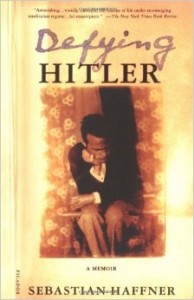
Sebastian Haffner book cover

As an applied linguist, multilingualism, multiculturalism, immigration and acculturation are central aspects of my research. This is by nature always political. My mission as an applied linguist is to defend diversity and promote tolerance – through my teaching and in my research. There are things I can observe here in the UK through my “Belgian eyes” that might not seem as immediately obvious for fellow Brits.

Reading Sebastian Haffner’s moving autobiography on his childhood and young adulthood in Germany between 1914 and 1933, I was struck by some striking similarities with the present day. In fact, “striking” is not the right word – “chilling” is more accurate.

Adolf Hitler was perceived by most Germans as a clown in the 1920s, and dismissed with a wave of the hand.

Hitler’s favourite public places in that period were beer halls where he gave impassioned speeches against Jews and Marxists: perfect scapegoats.  He presented himself as a “good German” who wanted the best for his country, pretended to value peace, but insisted on more national assertiveness.

Hitler loved to brandish the weakness of German democracy and of his political opponents, who were being forced to accommodate each other, while his own message was clear and uncompromising.

While the National Socialists (NSDAP) did poorly in the elections in 1928 (gaining less than 3% of the vote), they grew steadily, gaining 18% of all votes in 1930.  More importantly, their political agenda strongly influenced the programme of the main democratic parties.

Leaders of democratic parties did not stand up to Hitler, did not organize mass demonstrations against the NSDAP but tried to placate Hitler by offering him prominent positions in the government, which he rejected. He came second in the presidential elections in 1932, with 35% of the vote. Hindenburg appointed him chancellor in 1933.  After the Reichstag fire, Hitler forced Hindenburg to suspend basic rights and allow detention without trial. At new elections in March 1933, the NSDAP obtained 44% of the vote. The boycott of the Jews started in April 1933. No mass protests happened in reaction to this measure.

Germany withdrew from the League of Nations in October 1933. When Hindenburg died in 1934, Hitler became head of state and head of government and the ‘Hitler myth’ grew.

Now, what was it that David Cameron called UKIP supporters again: “A bunch of fruitcakes and loonies and closet racists”? It does not seem to have done the UKIP any harm. What is Nigel Farage’s favourite posture? Holding a pint of beer in an English pub with a disarming smile, and claiming to represent true Britishness. His message?  Simplistic but unambiguous: no more compromising, more assertiveness, exit the European Union, and stop immigration into the UK. What is the reaction of the Conservatives and Labour? Hardening their stances on immigration and drifting towards more and more Europhobia. Add to that Conservative plans to withdraw from the European Convention of Human Rights (on the spurious argument that prisoners can’t be allowed to vote) and claiming that a vote for UKIP would benefit the other major party.

Now, just imagine a scenario where UKIP evolves as the NSDAP did in Germany in the 1930s. As they became more powerful, they could become more radical in their agenda – or simply disclose what might still be under wraps. Being outside the EU and outside the reach of the European court in Strasbourg, they could start forcing the other parties in government to implement a more radical anti-immigration policy, and declare a state of emergency (see Sampson’s Dominion for an idea of what this would look like in the streets of London). Having stopped the foreign influx, and gained the political upper hand, they would have to turn on the immigrants inside the UK, using the full force of the law, starting “gently” and turning on the screw: limit and cut their benefits, their salaries, their role in British society. At what point, I wonder, would the British realize that their cherished democracy was being transformed into a fascist state? Because this is the main point of Haffner: why did nobody stand up to the NSDAP? How could they force a whole nation to become complicit in a world war and a genocide?

You might think at this point, “this can’t happen to us, we’re a civilized people”, and this is the 21st century after all. Haffner points out that this was exactly what the Germans had been thinking of themselves in the 1920s, watching the rise of fascism with “calm, superior indifference”. And what happened to the majority who had not voted for the NSDAP in the 1933 elections? Once the Nazis had grabbed the power, it became nigh impossible to voice dissent without risking one’s life.

We cannot let history repeat itself. Urgent mobilization is needed against the gangrene that UKIP ideology represents. As Haffner says: “Decisions that influence the course of history arise out of individual experiences of thousands or millions of individuals”. We need to urge politicians from mainstream parties not be infected by UKIP’s isolationist and anti-immigration agenda. They need to stand up for our human rights, our European union, our democracy. It’s time for the battle stations – or at least the ballot box – to keep UKIP out of power. Nationalism leads to war, and we want peace!

Other posts by Professor Dewaele:

Other blogs about linguistics:

Transparency, what transparency?

Justin SchlosbergThis post was written by Justin Schlosberg, Lecturer in journalism and media, in Birkbeck’s Department of Film, Media and Cultural Studies.

In 2011, as the phone-hacking scandal unfolded, Prime Minister David Cameron pledged a new era of transparency in the government’s dealings with the media. All meetings between senior government and media figures were to be recorded and published on a quarterly basis and a major public inquiry was launched – partly with a focus on the relationship between press and politicians.

The Leveson hearings that followed cast an unprecedented spotlight on the intimacy of these relations complete with gossip, threats, family get-togethers and texts signed off with ‘lots of love’ and kisses. It had very little to do with the day-to-day interactions between politicians and journalists – both on and off the record – which are an intrinsic part of the political newsgathering process. It revealed instead something over and above those interactions – an exclusive club at the heart of the establishment that seemed to undermine the very fabric of British democracy, and underline the growing public mistrust of both politicians and the media.

Within this dynamic, Leveson was pre-occupied with the flow of influence from media owners to politicians. The founding premise of his inquiry was that press power was out of control, undermining the integrity of government, parliament and the police, whilst severely infringing on the privacy rights of individual citizens. Leveson’s detractors, on the other hand, perceived the gravest threat to democracy as operating in the other direction. It was creeping state control of the press – supposedly heralded by his reform proposals – which threatened to fatally undermine the independence of the fourth estate. In the intense debate that followed, a fundamental truth was obscured: media and political elites are not rivals but partners in a relationship that works ultimately to promote the shared interests of power. This was vividly demonstrated when Rebecca Brooks – former editor of the News of the World – told Leveson that the Prime Minister had sent her a consoling text during the height of the scandal, apologising for not being able to be more ‘loyal’ to her in public.

And as the spotlight began to fade, business as usual resumed – behind closed doors – and the hollow rhetoric of transparency was laid bare. For a start, it soon became clear from published data that the government had no intention of divulging any meaningful details about its meetings with media bosses. Whilst the nature and purpose of other external meetings are often specified, when it comes to newspaper editors or execs, we rarely get anything beyond ‘general discussion’.

Of course, this spectacle of transparency is nothing new. After taking office in 2010, Cameron renewed the commitment to openness that is typical of incoming governments, promising to pour light into the darkest corners of policymaking. In a nutshell: ministers would be ‘transparent about what [they] do and how [they] do it’ and ‘above improper influence’.

Less than one year later, then culture secretary Jeremy Hunt was at pains to reiterate this commitment in respect of News Corp’s aborted take-over of BSkyB. He stressed the unprecedented openness of the bid process both before and after he waived it through (only to then be withdrawn by News Corp amidst the fall-out from the phone hacking scandal). But the folly of Hunt’s assurances was exposed after he told Parliament in 2012 that he had no unofficial contact with News Corp lobbyist Fred Michel during the bid process. A series of texts disclosed shortly afterward suggested otherwise, with cringe-inducing awkwardness.

Perhaps not surprisingly in the wake of phone hacking, the Prime Minister appears to be steadily curtailing his personal contact with senior media figures, based on data released by the government for 2011-13. Interestingly though, Cabinet Secretary Sir Jeremy Heywood is more than picking up the slack, with ten recorded meetings with the media in 2012 and fourteen in 2013. In contrast, Jeremy Heywood’s predecessor Gus O’Donnell had just two meetings with the media in 2011, one of which was a ‘reception’ hosted by the Financial Times.  This raises the possibility that some of the business of media management by the government (or vice versa) is increasingly being conducted through the civil service, perhaps in an effort to remain under the radar. In any case, given that Leveson’s focus was elsewhere, the spike in contact between the Cabinet Secretary and the media warrants scrutiny.

The first thing to note is that like his ministerial colleagues, the Cabinet Secretary’s contact with the media is overwhelmingly concentrated in the national press: of the twenty four meetings in 2012-13, just three were with broadcasters (BBC and ITN). This could be because of a received wisdom in government that the national press remain leaders of the wider news agenda. Or it could be because newspaper editors and proprietors are more active than broadcasters in lobbying the government for influence and/or ‘scoops’. Or it could also be because the government is conscious of the broadcasters’ regulated impartiality, whereas newspapers may be seen as more malleable targets in agenda building strategies.

In any case, the imbalance illustrates how much newspapers still matter to Whitehall, for all the talk of their demise. But it is not just newspaper bosses in general who occupy a disproportionate amount of the Cabinet Secretary’s time. Again, in line with ministerial colleagues, a significant majority of the meetings were with representatives of the right wing press. Of the ten meetings Jeremy Heywood had with the media in 2012, seven were with the Times, Telegraph, Mail and Spectator, all openly aligned with the Conservative party; two were with non-partisan outlets (the Economist and ITN) and one with the left-leaning Guardian newspaper.

This may simply reflect the market dominance of the right-wing press in Britain. It is perhaps understandable that if the Cabinet Secretary is going to meet regularly with the press, he would want to prioritise those titles that have the biggest audience reach, regardless of their political colours. But it doesn’t explain why most of his meetings are with the elite press – broadsheets and periodicals – with very limited exposure compared to the mid-market and tabloid titles. Again, there are a number of plausible explanations here. It could be that mid-market and tabloid editors and executives aren’t very interested in talking to government bureaucrats. It could be because the ‘serious’ news sector is particularly valued in Whitehall for its opinion-leading reputation and its elite audience capture. Or it could just be because these titles have the capacity to cover political issues with greater depth and complexity than their lower brow competitors.

Whatever the reason, the opacity of these meetings appeared to take something of a sinister turn in 2013. After the Guardian began publishing details of mass surveillance by the security services in June 2012, revealed by NSA whistleblower Ed Snowden, the Cabinet Secretary unusually held two meetings in short succession at the Guardian’s offices. A Freedom of Information request for details of these and other meetings with the senior newspaper figures has recently been refused and is currently under review by the Information Commissioner. According to Guardian editor Alan Rusbridger in an interview with the author, he was explicitly threatened with legal injunctions during his meetings with the Cabinet Secretary, unless he agreed to destroy hard drives of the leaked material. The only account we have from the government is the notes recorded in the meeting data. The first meeting was described simply as a ‘discussion about handling information’ whilst the follow-up apparently moved on to ‘discussion about international issues’.

In the end, the newspaper acceded to the government’s demands, confident that destruction of the hard drives would not curtail reporting. Copies of the material lodged with US publishing partners would apparently ensure the story’s endurance. Glen Greenwald, former lead journalist on the story for the Guardian and now with the Intercept, recently claimed that the biggest story relating to the leaks is yet to be published. But he made no mention of what or when, and we are left wondering whether the government’s actions had really been as futile as Rusbridger suggested.

Rusbridger himself opted initially not to make public the threatening nature of his meetings with the Cabinet Secretary, or indeed the unprecedented event that followed, with security service personnel entering the Guardian’s offices to oversee destruction of the offending hard drives. A month later the Guardian despatched David Miranda, Greenwald’s partner, to meet Laura Poitras (another Snowden confidante and co-architect of the story) in Germany, perhaps in an effort to get around the loss of direct access to the material.  According to Rusbridger, the rise in international travel was due to the necessity of face to face meetings as ‘we assumed everything was being at that point intercepted’.  But on his return to Brazil, Miranda was arrested and detained at Heathrow Airport under anti-terror laws, prompting Rusbridger to publicise the extraordinary lengths the government was going to in order to restrain the coverage.

But what about the other meetings that took place around the same time between the Cabinet Secretary and the national press? Apparently, the purpose, nature and outcome of these meetings are also exempt from disclosure under the Freedom of Information Act, partly in order to protect policymaking. But the use of this exemption (under Section 35 of the Act) raises more questions than it answers, perhaps the most obvious of which is what policy exactly do these meetings concern? In apparently typical fashion, the Cabinet Office made no attempt to explain why exemptions under Section 35 were engaged, or provide any detail as to the public interest test that is required under law.

It is fundamental to a functioning democracy that the media are seen to be free from undue influence or interference by the state and, conversely, that government and policymaking is free from undue influence or interference by the media. Over the last two years, these twin and sometimes conflicting concerns have become matters of acute public interest, fuelled by Leveson and Snowden alike. But the government’s refusal to disclose information about these meetings speaks to a wider problem. It exposes the gap between transparency rhetoric and substance which ensures that the real workings of power remain off limits to public scrutiny. It is a gap now so wide that official talk of transparency in media policymaking is tantamount to double-speak.

You can find links to the correspondence between the author and FOI authorities in the following places:

http://www.lse.ac.uk//media@lse/documents/MPP/First-Reply-to-FOI-request-on-Cabinet-meetings-with-media.pdf

http://www.lse.ac.uk//media@lse/alumni/documents/Appeal-on-FOI-319677—request-for-internal-review.pdf

http://www.lse.ac.uk//media@lse/documents/MPP/Response-to-appeal-on-FOI319677-for-Cabinet-meetings-with-Media.pdf

More blog posts by Justin Schlosberg:

Patrick Modiano, winner of this year’s Nobel Prize in Literature, is a paradox

Akane KawakamiThis post was contributed by Dr Akane Kawakami, Senior Lecturer in  20th and 21st-century French and francophone literature in Birkbeck’s Department of Cultures and Languages. It was originally published on The Washington PostDr Kawakami’s books include A Self-Conscious Art: Patrick Modiano’s Postmodern Fictions

Patrick Modiano, winner of this year’s Nobel Prize in literature, is a paradox. He writes bestsellers but shuns the media. His novels sound autobiographical, yet his declared subject is a historical period that ended just before he was born. His style is clear and simple, but it masks complex time frames, unreal scenarios and a narrator who often seems to know little about the story he is in charge of. He is a household name in France but almost unknown outside his own country. This is one reason why the recipient of this year’s literature prize may come as something of a surprise to the world at large, if not to his faithful and numerous Francophone readers.

Even for those of us who have been reading and loving his books for several decades, this honor establishing him as a “grand man of letters” seems somehow not to fit the media-shy author. Can it really be that this recluse — famously inarticulate on the French literary program “Apostrophes” and always reluctant to give interviews — has been dragged into the limelight to be given the greatest literary accolade of all?

Modiano himself has always played down his own achievements, as well as the status of his chosen medium, the novel. In 1975, after four successful novels, Modiano — in a rare interview — claimed that the novel was an “anachronistic” genre that had ”slipped away” from public view. His heroes are known for slipping away, too; they’re shadowy, furtive figures modeled on himself (they tend to be tall, dark, shy and not good at interviews). In story­lines that are reminiscent of classic detective novels, his heroes set off on their searches into the past, trying to solve mysteries rooted in the period of the Occupation, Modiano’s avowed obsession.

Modiano_Missing PersonThe Occupation of France by the Nazis during World War II — along with the collaboration of many French nationals and the murder of French Jews — is a dirty pocket of French history that was not much discussed following the Allied victory. After Charles de Gaulle inaugurated the Fifth Republic, the general tendency was to stop talking about les années noires. It was only authors of a later generation — such as Modiano, whose guilt was inherited rather than personal — who proved able to explore this painful period. His first novel, about an anti-Semitic Jew who leads a colorful and surreal existence during the war, was published in 1968. Missing Person, published in 1978, is another highlight, about an amnesiac detective who goes on a hunt for his own identity during the Occupation. Honeymoon (1990), the story of a young Jewish woman who disappears in 1942, is also a gripping read.

Modiano’s novels are usually built around several time frames. They might start off in the 1980s, go back to the 1960s to evoke his youth and then suddenly shelve down into the 1940s to reveal a crucial link between a friend of his deceased parents and the woman he is dating in the present. Or the link will not be crucial; it will simply be a case of what might have been, the possibility that one ephemeral life that was extinguished during the Occupation might have brushed past another who has happened to survive.

In Dora Bruder (1997), Modiano gave up fiction and tried to re-create the real life of the heroine of Honeymoon, relating the few facts he had recovered about her movements in 1941 to his own wanderings through the Parisian streets as an adolescent in the 1960s, and to his walks in the 1990s. Gaps in his knowledge evoke the poignancy of the subject, as, in the end, Modiano has to concede that he still knows almost nothing about the girl, except that she was eventually arrested by the Gestapo and ended her days in Auschwitz.

Modiano tells all this in a limpid, almost classical prose that belies the ugliness of the events and facts. His writing is extremely readable, which is perhaps the reason for both his popularity in France and his relative lack of academic recognition (his novels are taught more in English-speaking universities than in French ones). Yet his clear writing eases the reader through instances of formal experimentation that would not be out of place in a Paul Auster novel: bewildering shifts in time, multiple appearances of “Patrick,” who may or may not be the author, and apparently real settings transformed into strange, hallucinatory spaces.

Light is something Modiano is good at describing, and many of the scenes in his novels are almost cinematic in their visual impact. Modiano co-wrote the screenplay of Lacombe, Lucien (1974), directed by Louis Malle, and has carried on to make more films, such as The Son of Gascogne (Pascal Aubier, 1995) and Bon Voyage (Jean-Paul Rappeneau, 2003).

His prose also achieves a difficult feat, which is to get French readers to face, time and time again, the unspeakable acts of betrayal and cowardice perpetuated during the Occupation. The detective novel framework, the clear style, the diffident narrators — all this makes it deceptively simple for readers to occupy the narrator’s seat in Modiano’s novels. The narrator of Missing Person introduces himself saying, “I am nothing. Nothing but a pale shape, silhouetted that evening against the cafe terrace.”

The joy of reading a Modiano novel is to slip into that silhouette, to make the journey through the decades of French history and then — sometimes, suddenly — experience all the horror of the past at the same time as the immunity conferred by its distance.

The lessons of Clacton and Heywood: why UKIP will damage the Tories in 2015 but may ultimately harm Labour

EricKaufmann400This article was contributed by Eric Kaufmann, Professor of Politics at Birkbeck’s Department of Politics.

National attention focused on the Clacton and Heywood and Middleton byelections because UKIP support rose substantially in both contests over its level in 2010. The media and some commentators have spun the story as a tale of dispossessed voters from forgotten constituencies striking a blow against the political elite. On this view, both the main parties will suffer at the hands of the Faragists.

Yet the data does not support the contention that the economically and politically disadvantaged of all political stripes are in revolt. Instead, the by-elections, and the rise of UKIP more broadly, reflects cultural anxieties and status resentments which loom largest among middle income people who lack degrees. UKIP damages the Conservatives more than other parties and is set to tilt the electoral terrain in Labour’s favour in 2015 and beyond. This means we need to entertain the possibility the Tories may enter the political wilderness, much as the Canadian Tories did between 1993 and 2006 when the populist Reform Party split the right-wing vote.

In Clacton, Douglas Carswell, a high-profile defector from the Tories, carried the seat easily, winning 60% of the vote in a constituency UKIP did not contest in 2010. Popular in Clacton, Carswell carried wide support across a range of social and voter groups. In Heywood and Middleton, UKIP candidate John Bickley won 39%, increasing UKIP’s share by a whopping 36 points over 2010. It was an impressive UKIP tally, but the seat was held by Labour, winning 41% of the poll. Here we have two strong UKIP performances, resulting in a Tory loss in one instance, and a Labour win, albeit narrow, in the other. The constituencies are not typical of the country, but the results are indicative of what may happen in 2015. Why?

First, consider that in both by-elections, Ashcroft polls show the Tories lost a larger share of their vote to UKIP than Labour. These results are corroborated in the admittedly small sample of some 70 British Election Study (BES) internet panel respondents from these seats interviewed in early and mid-2014 about their 2015 voting intentions.

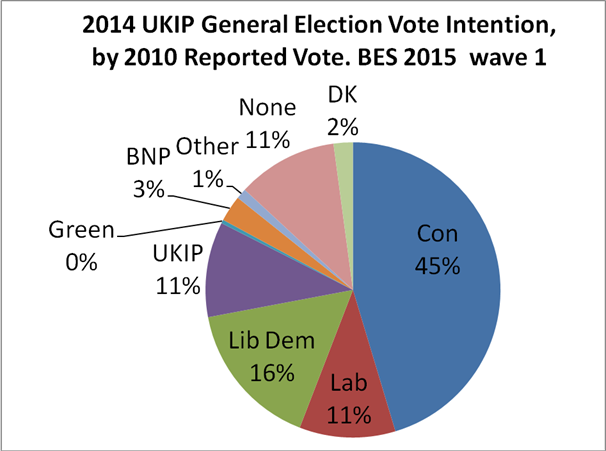
The British Election Study provides data on over 34,000 people, interviewed in both early and mid 2014. Looking at the second wave reveals a stunning pattern: 47 percent of those who voted UKIP in the 2014 European elections said they voted Tory in 2010 compared to just 13 percent from Labour. When it comes to intended vote in the General Election, it’s much the same story: 44 percent of those intending to support UKIP are ex-Tories while just 10 percent said they voted in Labour in 2010.

Kaufmann image

In terms of current party identification, while 38 percent of those intending to vote UKIP in 2015 identify their party as UKIP, 24 percent say they identify as Conservative, compared to just 10 percent of UKIP vote intenders who currently identify with the Labour party. These data rely on respondents reported retrospective vote. However, the Understanding Society longitudinal survey just compares what people said in the previous wave with what they say in the current wave. These actual results, between 2009 and 2012, confirm the self-reported results from the BES: between 2 and 5 times as many people switched allegiance from Conservative to UKIP as moved from Labour to UKIP.

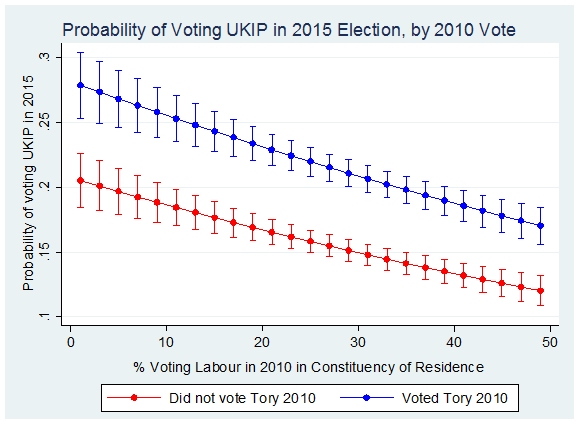
Some suggest Tory defections are in safe Conservative constituencies where they are unlikely to affect the Cameron-Miliband contest. Unfortunately for the Prime Minister, there is no evidence for this. The figure below shows the predicted probability that an individual in the BES will vote UKIP in 2015, on the vertical axis, against the Labour share of the vote in his or her constituency in 2010, on the horizontal. The blue line represents those who voted Tory in 2010, the red line those who voted for parties other than the Conservatives in 2010. This is a multivariate model where we also control for a host of other predictors of UKIP voting, such as age, education, ethnicity and so forth. The cross-hatch lines represent confidence intervals, which are longer at the extremes of Labour share because sample sizes are smaller there.

Kaufmann fig 3

Two things jump out of this chart. First, UKIP will hit the Tories harder than other parties by 6-8 points across all types of constituency. There is no reluctance among 2010 Tory voters to desert the party for UKIP in marginal seats. Nor are UKIP defectors concentrated among Tory voters in Labour strongholds. Where votes averaged 30% Labour in 2010, often indicating a tight contest, a 2010 Conservative voter has a 21 percent chance of voting UKIP, which falls to just 15 percent among their Labour counterparts. UKIP support is holding steady in the polls, and if this continues, UKIP will pose a threat to Cameron.

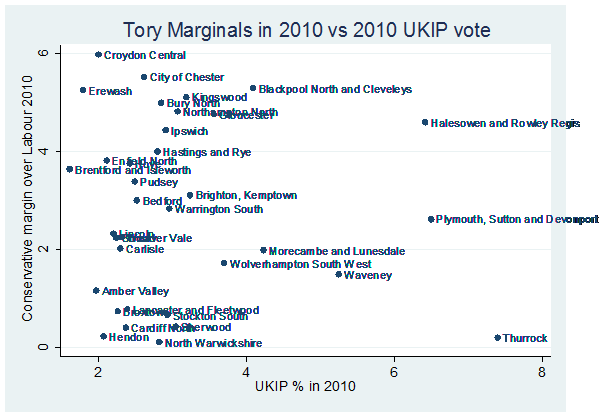
Instead of fixating on the Clactons and Heywoods where UKIP is strong, pundits should focus on marginals where even a small shift to UKIP could tilt things Miliband’s way. We could see upsets not only in UKIP strongholds like Thurrock, but in middle class spots such as Cambridge or Hendon, often in  the South of England, where Miliband may pull off an upset. The plot below shows seats the Tories won in 2010 with less than a six percent margin over Labour. These, and more, may be vulnerable.

kaufmann fig 4

If UKIP hands victory to Labour, this raises a whole series of important questions. Can the Conservatives strike a deal with UKIP, as with the ‘unite the right’ initiative between the populist Reform party and more elite Progressive Conservatives in Canada?  Should Labour rejoice, or should they look to the reinvigorated Canadian Conservatives as a warning that the rise of the populist right can shift a nation’s political culture against them in the long run? Matthew Goodwin and Rob Ford’s excellent book on UKIP warns that the party, with its working-class support base, threatens Labour as well as the Tories. My work suggests working-class Tories rather than Labour traditionalists are most likely to defect to UKIP, but their overall point holds: this is not a movement Labour can afford to ignore.

Can creative writing be taught?

Helen-Harris-Jul-2014-0366-smaller-versionThis post was contributed by Helen Harris (MA Oxon), associate lecturer in creative writing in Birkbeck’s Department of English and Humanities. Her new novel, Sylvia Garland’s Broken Heart will be published by Halban Publishers on 13 November.

Creative writing lecturers are used to the scepticism – occasionally tinged with downright hostility – with which some people react when they reveal their profession. “Do you really believe you can teach someone to write?” Well yes, personally I believe that with patience and imagination it is possible to teach anyone to do anything.

What is more disturbing is when a successful writer who also teaches creative writing loudly announces – as Hanif Kureishi did earlier this year – that creative writing courses are “a waste of time.” Cue uproar. Even as he spoke, creative writing courses were proliferating in universities up and down the country.

What is perhaps even more puzzling is that this scepticism seems to be shared by a number of students who enrol on creative writing modules. Some of them insist to me, for example, that the marking of their coursework must be subjective, that their friends thought it was brilliant and if I have not given it the high mark it so obviously deserves, that is just because my taste does not coincide with their friends’. Reminding them that all the coursework is second marked has little effect; creative writing is an imprecise individualistic business they seem to believe, certainly not an exact science with its own measures and its own criteria.

I could not walk into the classroom, certainly not at 7.30pm on a wet and windy November evening, if I didn’t believe I was teaching my students anything worthwhile. But what do I think I am actually teaching them?

For the past three years I have been delivering an introductory creative writing module which is part of Birkbeck’s BA English: “Writing Fiction”. My students are second to fourth year undergraduates. I begin the module by outlining what I believe I can – and what I can’t – teach them. The “can’t” list is actually quite short. I can’t teach them what to write; the story comes from them. Similarly, just as they all speak in their own voice with their own accent and vocabulary and mannerisms, the voice in their writing will be their voice. I tell them that within a few weeks I will be able to identify which student has written which piece of coursework even without names attached.

What I believe I can teach them is essentially craft. I run through the list of topics we cover in the first term – character, beginnings, plot, dialogue, point of view – and I explain that I am here to instruct them primarily in technique, not in how to write but how to write better. It is, I sum up cheerily, not much different from plumbing. (My all-time favourite student feedback form read roughly as follows: “I was a bit taken aback when Helen said at the beginning she would be teaching us to write in the same way that you might be taught how to assemble an IKEA bookcase. But as an approach I found it worked.”)

Of course it’s not quite like assembling an IKEA bookcase (something of which I am incidentally incapable.) But my students – and I expect most creative writing students – finish their course with a deeper understanding of what makes good fiction and how it works. Some of them lament that the way they read has changed; they fear they have lost the simple pleasure of enjoying a ‘good read’ without watching carefully to see what the writer is doing and how he/she is doing it. I tell them that this is in fact an encouraging sign of their progress.

front coverThe last session of the year was payback time. My new novel Sylvia Garland’s Broken Heart will be published in November. Over the year, we have spent many evenings workshopping their writing. For our final class I put my money where my mouth is. I emailed them the first chapter of Sylvia Garland’s Broken Heart and asked them for critical feedback in our evening workshop. They set about the task with evident relish. As I listened to their feedback – “Is this really Jeremy’s point of view here or is it actually Sylvia’s?” “You told us not to include too much descriptive writing but you’ve got loads” – I could tell how much they had learnt over the year about writing fiction. And although I may have winced a couple of times, I am confident some of them will go on to write their own novels one day.

What the **** is linguistics?

Penelope Gardner-ChlorosThis post was contributed by Professor Penelope Gardner-Chloros, from Birkbeck’s Department of Applied Linguistics and Communication.

Excuse the *rude* title of this blog – I shall have more to say about why it is rude – even though it actually only contains a few stars – in subsequent blogs.

To begin, though:

If, like me, you are a teacher of linguistics, there are two questions which people will invariably ask you:

1. What IS linguistics?
and
2. What languages do you speak?

Those are the questions I want to write about today.

In answer to the first, linguistics is the study of language, no more, no less. Since language is (almost) as fundamental to the human race as breathing, it is probably quite important to know something about it. Linguistics is actually a whole collection of subjects, from the highly scientific – like whereabouts in the brain is the language faculty located? – to the philosophical – like why does a sentence mean what it means? – to the strictly structural – like what is the difference between a noun and a verb, and does the difference exist in all languages? – to the sociological and politically relevant – e.g., in what way are women linguistically at a disadvantage in our society, and in others, compared with men?

The answer to the second question is, strictly speaking, irrelevant. Even if I only speak one language, my ‘mother tongue’, I am perfectly able to study the various issues mentioned above. Chomsky, considered the originator of modern linguistics, thought that the ideal way to study language was by analysing the productions of ‘ the ideal speaker in a homogeneous community’. Studying such an ideal speaker would allow us to uncover principles of language which underlie all languages, the basic principles of the human language faculty.

However, more recently, more and more linguists have started to realize that what is most ‘universal’ about language is actually its diversity. The fact that people speak different languages, and within languages different dialects, and speak in different ways depending on their circumstances, their topic, their interlocutor, etc. is by far the most striking fact about human language, more so than the fact that all languages have something like a verb/noun distinction.

In coming blogs I will discuss the relevance of diversity and variation in language through examples mainly taken from the news and current affairs. I will try to show that linguistic questions concern us all, and hopefully convince you that there are rational and irrational ways of finding the answers to linguistic questions. Just as the fact that we all breathe does not make us experts in respiratory medicine, so the fact that we all communicate through language does not qualify us to pronounce on linguistics – though if you read the letter pages of any major newspaper it is stunning how many self-appointed experts on language/ grammar/spelling/usage there seem to be!

Other blog posts about linguistics: