Category Archives: College

Driving Investment: The Missing Piece to your Investment Portfolio?

This blog was contributed by BSc Financial Economics student Paul Talbot and was originally written as an assignment for the module Quantitative Techniques for Applied Economics.

Picture of a classic car

Classic cars, an alternative investment that is rarely discussed when investors are looking for a strategy to increase ROI in their portfolios. Some prestige classic cars have increased over 400% in the last decade[1], but what sets these assets apart from status quo investing?

“Stories. That to me is the answer. Every car has its own history, its own adventures, its own japes and probably plenty of scrapes. Tales to be told and shared with fellow enthusiasts. Few other asset classes, however valuable or beautiful, can match it”[2]

The majority of investors would not be able to afford a 1960 Ferrari 250 GT, but investment growth has been seen across the majority of the classic car market. A more affordable sector is British classic cars, iconic cars such as the Jaguar E-Type or the Triumph TR6 has yielded over 50% returns since 2007, outpacing the heavyweight UK asset classes.

Graph showing price indices of UK classic cars

The classic car market also benefits from a favourable tax status, investors do not pay capital gains tax on profits as they are classed as “Wasting Assets” by HRMC. Movable assets such as classic cars can be gifted to family members, if no benefit is retained or lent, or for a period each year, to a car museum to avoid paying inheritance tax on death. If you intend to enjoy your investment on the road, they are also exempt from road tax and a MOT.

Tax relief of 20% on investment gains already drives these assets ahead of other financial instruments and it is no surprise that this is attracting some attention. The classic car market added significant gains to the UK economy last year[3] and is expected to continue grow from £940 Million in 2019 to £1.65 Billion in 2023.

Graph showing projected UK classic car market

Investing in classic cars does not come without a few speed bumps, it is not a case of purchasing any car and hiding it away for many years. Paul Michaels of Hexagon Classics notes “The very best cars — meaning those with full histories in exceptional condition, either completely restored or lovingly maintained with some age-related patina — will always command the highest prices.”

It is always advisable to get an expert opinion and the history authenticated before purchasing your investment and continue to keep your new asset lovingly maintained and stored away from the elements. All the above will add an upfront and annual running cost to purchasing the investment, reducing overall yield, but in turn, the better the asset is maintained and stored, the higher possibility of future gains.

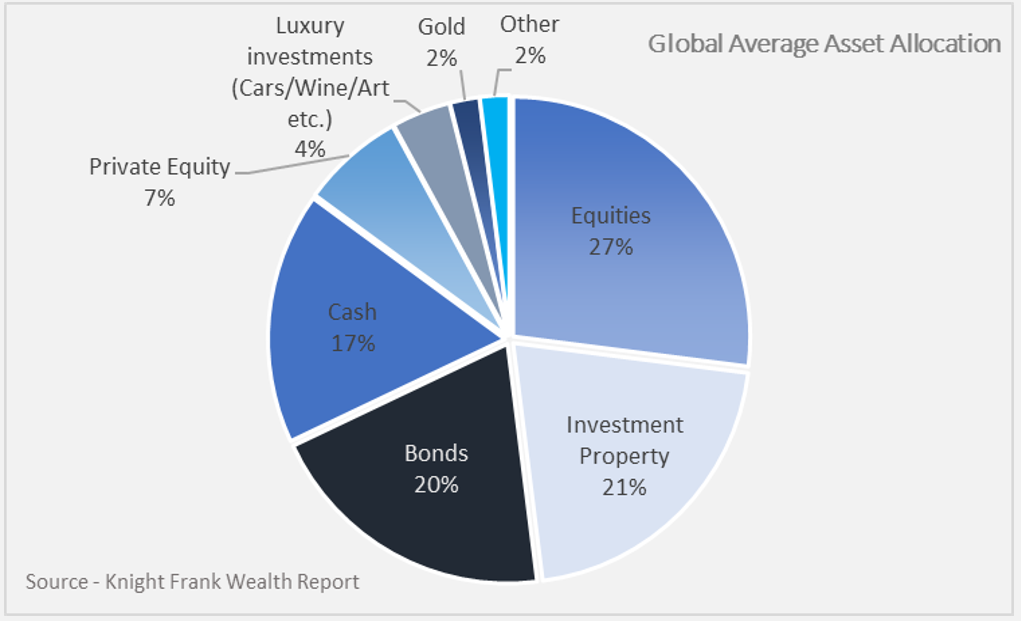
The average global investment portfolio last year contained only 4% of luxury investments, this includes fine wines, collectable coins, art, jewellery and classic cars to name a few[4]. With climate change at the forefront of government polices banning the sale of petrol/diesel cars by 2030 and the rise of autonomous vehicles, will only make these investment stars a rarer commodity.

Pie chart showing global average asset allocation.

With central banks flooding the markets with liquidity, artificially supporting equities and driving down bond yields, parking a little piece of history in your garage and diversifying your portfolio will not only provide the perfect inflation and market correction hedge, but you may have some fun along the way.

Next time you look at your annual investment report, the immortal words of Wilbur Shaw may spring to mind.

“Gentleman, start your engines”

Further Information

[1] https://www.hagerty.com/apps/valuationtools/market-trends/collector-indexes/Ferrari

[2] HRH Prince Michael of Kent interview with Knight Frank November 2020

[3] FBHVC National Historic Vehicle Survey – https://www.britishmotorvehicles.com/news/fbhvc-national-historic-vehicle-survey-reveals-significant-contribution-to-uk-economy

[4]The Attitudes Survey is based on responses from 600 private bankers and wealth advisers managing

over US$3 trillion of wealth for UHNWI clients. The survey was taken during October and November 2018

Making Working from Home Work for You

The first Birkbeck Astrea event of 2020-21 explored how small changes can make a big difference to wellbeing, productivity and work-life balance while working from home.

Picture of a laptop with coffee and a children's toy.

If you, like much of the UK population, are continuing to work from home in the New Year, how did you feel returning to your desk (/dining room table/kitchen worktop) after the Christmas break? Were you relieved to give a freezing January commute a miss, or disappointed to miss out on catching up with colleagues? Are you returning to your laptop refreshed, or is it already feeling like Groundhog Day? 

If you’ve found the prolonged absence from the office a difficult adjustment in any way, be it the technology, loneliness or struggling to switch off at the end of the day, you’re not alone, as Birkbeck Astrea members discovered in their first formal event of the 2020-21 academic year, Making Working from Home Work for You. 

Working from Home: Love it or Hate it? 

This virtual event began with an opportunity to share the highs and lows of working from homeAmong the bugbears that we’d rather not carry into 2021 were an increasingly sedentary lifestyle; technological issues ranging from Wi-Fi crises to video call etiquette; as well as habits that we just can’t seem to save ourselves from, such as the obsessive reading of bad news on social media known as ‘doomscrolling’. 

It wasn’t all bad though, as colleagues also shared some of the highs from lockdown life, such as getting to know co-workers on a more personal level by being introduced to pets and other elements of home life; having an opportunity to get chores done in the week, leaving the weekend free to relax; and enjoying more comfortable attire, as one member commented: ‘Spending my working day in outside shoes seems ludicrous and I don’t know how I ever did it.’ 

Change One Thing 

While this end of term gathering was a great opportunity to get together and let off steam about working from home, there’s a serious side to this too. The blurred boundaries created by working from home mean that many of us are working longer hours and finding it harder to switch off at the end of the day. Mental health can suffer too, both for those juggling caring responsibilities with work and for those living alone who may feel isolated. So what can we do to make an improvement in 2021? 

Thinking about how we could improve our work/life balance, productivity and foster a healthy mind in the New Year, we asked members for suggestions of one small thing we could do in 2021 to make a difference. Here’s what they said: 

One change to improve work/life balance: 

  • Turn off all notifications: social media, email – they are designed to serve someone else’s priorities. 
  • Ditch the guilt: give yourself permission to take breaks and don’t feel bad for sticking to your agreed working hours. 
  • Make plans to call a loved one on your lunch break or straight after work. 

One change for a healthy mind: 

  • Be kind to yourself: don’t beat yourself up if you don’t finish everything on your to do list. 
  • Use your commute time to walk or read a book – whatever helps you switch off from the day. 
  • Go outside: use your lunch break to get some daylight and fresh air. 

One change for increased productivity: 

  • Take breaks away from your desk – in the physical office we were much less attached to our desks than we are now! 
  • Focus on one thing at a time – multitasking is distracting. 
  • If you’re in a meeting, switch off your emails. Don’t try to spread yourself too thinly. 

Got a great tip for working from home? Add it to our list. 

What small change can you make this year to get 2021 off to a great start? Let us know what you’ll do differently in the comments below. 

Birkbeck Astrea is a grassroots networking group for women and non-binary people working in professional services roles at Birkbeck, University of London. Stay in touch with us on Twitter and Instagram.

Life of an international student during a pandemic

Embarking on studies in the UK has been made even more challenging due to the pandemic. In this blog, Presley Gitari tells us what motivated him to study at Birkbeck, and his life as an international student.

Presley Gitari

My name is Presley Gitari. I am 27 years old and my nationality is Kenyan. I am a conservation biologist currently pursuing an MSc in Climate Change at Birkbeck, University of London on a Chevening Scholarship.

Ever since I was a child I have always been fascinated by the natural world. It has fuelled my curiosity to learn about how the environment works and how we can conserve it for future generations. I attained a BSc in Environmental Conservation and Natural Resource Management from the University of Nairobi. My previous role was with Kenya’s Interior Ministry where I was working on a programme which focused on helping underserved communities in utilising environmental conservation as a socio-economic empowerment tool. I was both humbled and honoured to contribute to our country’s goal of achieving 10% tree cover by 2022.

Why Birkbeck?

Presley with Chevening scholar sign I was drawn to Birkbeck’s diverse and talented faculty and student base. While searching online for a graduate course focusing on Climate Change, I stumbled upon the College which had an impressive course overview and also had an opportunity to listen to an introductory lecture by Dr. Becky Briant on ‘Climate Change and the River Thames’ I was impressed by the factual analysis in the lecture. It was also an incentive that being an evening university, I could interact with students who bring perspectives from their daytime jobs into the classroom, which has been an enriching experience.

Being awarded a Chevening Scholarship by the Foreign Commonwealth and Development Office was an exhilarating prospect. In the backdrop of the COVID-19 pandemic, travel arrangements were thrown into disarray which created a lot of uncertainty about whether we would travel to the UK or continue our autumn lectures virtually. Eventually, Kenya lifted the ban on international flights which was a huge relief.

Moving to London

I have been to London before to attend an international meeting and as always have been fascinated how diverse London really is. A real melting-pot of cultures! Getting used to the tube was made easier by technology which makes getting between points a seamless experience. Coming from a coastal city with a laid-back demeanour it is quite a cultural turn-up for the books having to experience the hustle and bustle of an international hub that London is. I have taken a huge liking for the amazing parks where I regularly go out for a jog or just to admire the scenic beauty on afternoon walks (the squirrels are an interesting lot!).

Unfortunately, due to the pandemic, I haven’t got to visit many attractions as I would have loved to, but I keep an ever-growing list of places to visit when many of the affected places open up.

Studying during pandemic

In response to the COVID-19 pandemic, Birkbeck’s shift towards virtual learning has been possible by asynchronous as well as synchronous learning activities. The asynchronous component takes the form of pre-session activities. We get to interact with pre-recorded lectures, activities and reading material on our university Moodle platform. I usually set aside 1-2 hours in the evening in preparation for our live session where we go over the provided material with our lecturers and ask questions. This forms the synchronous component. We then join a seminar session where we are divided into groups to carry out joint activities which in many ways provides an opportunity for us to put into practice the knowledge acquired from the pre-session as well as the live session.

In a particular module, we had the opportunity to work on a group presentation highlighting a key environmental report which beyond building my in-depth understanding of the content of the material also helped me develop my communication skills. We use Blackboard Collaborate for our live sessions, as well Microsoft Teams for one-to-one interactions with our tutors and dissertation supervisors. The platforms allow for students to efficiently interact and present material, as well as take polls. We also make use of Google Jam Boards which allow all students to put in their contributions without feeling left out. The broad array of options provided by these platforms are suitable for both extroverted and introverted personalities. The live sessions and group work/presentations take about an hour and a half.

A typical day for me would start with a jog in the park or a visit to the gym. I then work from home through the afternoon. I usually take my live sessions from home but sometimes use the Library if I happen to have a book that I need to collect or drop off. The Library has set aside safe spaces to study and participate in lectures which one may access by reserving online, especially for students who may not have a conducive learning environment from home.

Challenges and highlights

Being far away from home in the midst of a pandemic has been quite a challenge. The situation diminishes any opportunities for human connections which form an important role in our mental and physical well-being as a social species. The pressure is thus more on international students who are far away from their loved ones and seek to form crucial connections with their new environment.

My highlight in the UK is when on a whim, I hired a Santander bike and decided to ride from Buckingham Palace, taking in the sights of London’s architecture, finally ending up at Canary Wharf! It was a healthy and environmentally friendly way of introducing myself to London.

I look forward to fully interacting with my fellow students as well as having the full Birkbeck experience when we will be able to. My 2020 has been an opportunity to reflect and develop gratitude for many of life’s pleasures which we take for granted.

Bringing his own dose of magic to the field of Law

Tomas McCabe is a recent prize-winner in the inaugural British Inter University Commercial Awareness Competition 2020. BIUCAC was established to provide opportunities for non-Russell Group students to develop commercial awareness and to highlight the talent at respective law schools. Contestants receive support with enhancing their CVs and win one of twelve prizes at top City law firms. Tomas won the prize offered by Simmons & Simmons and in this blog, he shares his path to success, a smart mix of the conventional with the unconventional, including a 10-year career as a magician.

This is a photo of Law student Tomas McCabe

Tell us about your course, what you’re studying and how you came to study at Birkbeck?
I am in my second year of the LLB course. My job for a long time has been as a magician, however I decided last summer (2019) that I would love to study a law degree around that work. I’ve always been interested in law and have considered studying it for a long time, and when I finally decided to go for it, Birkbeck’s evening structure allowed me to study it conveniently as well as giving me a University of London degree.

What’s your view on the opportunities available to Law students once they graduate?
I have researched a lot about the opportunities for law students after they graduate. While there are some fantastic opportunities, it is a very competitive industry and a majority of students will never get the chance to work as a barrister or solicitor simply because everyone wants to. However, with a good degree behind you and a lot of extra volunteer work, competitions and experience on your CV, it seems you stand a better chance. Thankfully, as I learnt in BIUCAC, the city law firms traditional tendency to hire from Oxbridge and Russell Group universities is being steadily improved to give more students a chance at obtaining the top positions.

What are your career plans following your course?
I have been awarded work experience at two law firms- Simmons & Simmons and CANDEY. Following my placements there, I will have a much better idea where exactly I would like to take my law career. Currently, I am simply trying to take advantage of every opportunity and keep doors open.

How has Birkbeck supported you with those plans?
Birkbeck has supported me in numerous ways. As I mentioned, I much prefer the evening scheduled work as it frees up my day to do my own combination of studying, legal research and other work to support life in London. I have jumped at opportunities presented to students, including this one (BIUCAC), representing Birkbeck at the Landmark Property Moot Competition and applying for some volunteer work. I think students themselves, however, need to do a bit more research into what needs to be done early on in order to build experience and stand out at the time when you are applying for jobs.

Tell us how you came to hear of the competition and how you went about applying?
I heard of the competition through an email sent to students. Initially I wasn’t sure about taking part as I hadn’t really thought about commercial awareness or why I might need it. As it was multiple choice, I decided to give the first few rounds a go. By the time I got to the interviews and presentations stages, I was sucked in and loved it.

How do you see competitions like this helping students, especially non-Russell Group students?
The most obvious answer here is that anything that can make your CV stand out, against the hundreds applying for the same job as you, is important. After all, most – if not all – will have a law degree. That aside, this competition has built my commercial awareness a lot and from doing my research I now realise how important this is. Also, the opportunity to network with graduate recruiters, trainees and more senior lawyers from the top firms in London – magic circle included – was brilliant. Finalists also got a Just Eat voucher!

What were your thoughts on winning 3rd place- an incredible achievement?
To say I was shocked would be an understatement. However, as the competition moved through the rounds and I became more invested in it, I decided soon enough that if I was going to do it, I should do it right. I put in the time and effort for the finals and was really pleased with my achievement. However, the whole way through I was aware of the standard of the other students and didn’t believe I could place third from over 4100 entrants. I’m really happy with myself for doing so though.

Any final takeaways from the competition?
My main takeaways from the competition are: degree class is becoming more important to the top firms than the university you study at, so never think you can’t compete with the best. And also, take every opportunity you can. At worst it’ll cost you a few hours, at best it could get you your dream job.

FURTHER INFORMATION:
More about Birkbeck’s School of Law

“Birkbeck was fantastic…I have been looking for opportunities to give something back”

In September, a 2017 recipient of the Compass Project Sanctuary Scholarship, Michael led a wellbeing workshop for mentors of the Compass Project. These mentors are academics at Birkbeck who volunteer to mentor a Compass scholar during their course.

Drawing on his past experiences as a mentee, Counselling student and person seeking asylum, here is what Michael had to say about the session.

Michael

Michael Darko

Why did you want to offer a wellbeing training workshop to Compass mentors?

My experience of being at Birkbeck was fantastic, I always felt valued there and since completing my course, I have been looking for opportunities to give something back. Drawing on my expertise as a student and in a caring role for many years, I chose to offer this workshop to mentors. Having had a superb mentor-mentee relationship, I wanted to offer this in support and appreciation of mentors’ commitment and sacrifice and importantly, share a mentee’s perspective through the workshop.

What did the workshop involve?

As the focus of the workshop was on wellbeing and self-care, I encouraged the use of a self-care ‘toolbox’ for academic mentors to support not only their mentees but themselves too. I started by giving a presentation on the complexities and challenges often faced by forced migrant students. This included the potential changes to their precarious statuses and how this might affect their university performance and health.

The second part of the workshop consisted of raising awareness of possible secondary stress responses that can affect mentors. I reflected on methods of self-care already in use by the mentors, offered practical breathing and stretching exercises and emphasised the importance of signposting to external support when necessary.

What did it feel like to be presenting to Birkbeck academics?

I felt proud presenting to Birkbeck academics. I expected to be nervous, and although I had not slept the previous night, I was surprisingly relaxed and confident about the workshop. I had a lot of support from the lovely Isabelle (Compass co-ordinator), who is always available, supportive and encouraging which helped a great deal with my confidence.

Leading the workshop was a personal goal that I accomplished. It reaffirmed that I am proud of who I am becoming and showed me that I should never be afraid of making mistakes and getting things done. Just do it and learn from the mistakes.

What are you up to now?

I am currently in my second year at Goldsmiths, University of London where I am studying BA Psychosocial Studies. Despite the volume of reading materials and the frequency of assignments, I am thoroughly enjoying the course and gaining some unimagined practical skills from my Research Methods module, a delightful surprise for someone who has a dislike for maths! Being aware of my individual learning style, which I identified during my time at Birkbeck, means that my engagement with the course contents is managed in a way that supports my development.

What is your favourite memory from your time at Birkbeck?

I genuinely had many pleasant moments, but my best memory is the help I received when I hit rock bottom. I became homeless in the winter and came close to leaving my course. I felt like everything was stacking up against me, then I made a phone call to Naureen, the Compass Project Officer at the time, who worked her magic to help me find a place to stay. Because of that help, I completed my course, without which I would not be where I am today.

Another favourite memory is of the support and safe space provided by my mentor, Ben. When Bail 201 came into effect, I was threatened with losing my freedom to study. I remember going to visit Ben, who calmly created a safe space where I could start taking apart the problem at hand and focusing on what I could do. I remember this moment fondly because I received so much support from him, my lecturer Anne and the Compass team. I tackled the Home Office in court about their ‘no study’ decision with no legal representation and won. This was an astounding moment and because of the level of support I had from Birkbeck, I was able to face the Home Office, not feeling alone or scared.


Lockdown loneliness

In this blog, Rob Martin a Learning Development Tutor at Birkbeck shares four ways to help manage loneliness during lockdown, and some resources available to Birkbeck students. 

A woman looking at her phone to depict loneliness

Some of us during lockdown are experiencing difficulties with loneliness. Many people are relying on the internet for all of their social and relational needs. This may not be the case for all students, and we will be covering other lockdown issues in further posts. Below are our top four top tips for managing your loneliness during lockdown.

1.    Quality connections, not quantity

Academic research into online communication suggests that its added distance and anonymity can provide more immediate rewards than face-to-face (FTF) communication. This might encourage us to text or chat with a greater number of people. But sometimes this can lead to frustrations, because, over thousands of years, we have evolved to relate to others through FTF communication.

In FTF we communicate through a variety of ‘channels’ – through the words we use, through the tone, pace, and volume of the speaker, body language and facial expressions, but also through silences. Silences are natural to us in FTF and allow for a moment to process what’s happening, but most online meetings contain few natural silences. Communicating through a more limited number of channels, with fewer opportunities to pause for thought, could explain why many of us feel more exhausted and could be less satisfied.

If you are noticing a sense of dissatisfaction in your relationships during lockdown, try to acknowledge that things are not quite as you would like them to be at the moment. Ask yourself “how can I take responsibility for better meeting my need for connection/company/entertainment?” Might it be better to distance yourself from certain relationships? During lockdown, it might feel tempting to try to meet our needs for connection through channels that do not serve us in the long run. Try to focus on developing higher quality connections with a smaller number of people. You can make a start on this by switching notifications off on your mobile device, even if just for 20 minutes.

2.    Give yourself permission to feel the way you feel

Give yourself permission to feel dissatisfied, if that is what you feel. Do you feel something else? That’s fine too. Some schools of thought believe that suffering comes from the sense of conflict we experience when we try to fight unpleasant emotions, rather than to understand it or simply be with it. It probably doesn’t feel good, but denying it or resisting it will likely feel worse. There are, of course, certain situations or relationships where an exit strategy is necessary, and this should not be overlooked.

Here, we are talking about particular emotions we might feel when alone – sadness, frustration, loneliness, anger. Acknowledging where we are now puts us in a better position to manage our responses and find more helpful ways of getting our needs met. If you want to learn more about managing difficult feelings, take a look at the range of free mental wellbeing apps via the NHS or contact Birkbeck’s Wellbeing Services.

3.    Use this time to develop a more compassionate relationship with yourself

The pace of life in 2020 has changed for most of us. Forgive yourself for feeling less than thrilled about it. Can you use this time to reflect on what it is that you want, or do not want, to invest your time in? Mindfulness meditation can be a good way of developing self-awareness and cultivating a sense of compassion for yourself and others. Try this list of mindfulness meditation apps to get started.

4.    Use this time to develop your personal interests

Is there something you have always wanted to read about, but haven’t? Are there hobbies you have been interested in, but never found the time or space to pursue? For example:

The Students’ Union still have active clubs and societies – perhaps there is one that matches your interests? Hopefully, you will gain a sense of satisfaction from taking up a new interest or two. It will also give you something different to talk about on Zoom.

We hope that loneliness is not affecting you adversely, but if you are finding things too much, contact Wellbeing Services to ask about counselling or contact the Samaritans. You may wish to consult your GP if you require help, or in an emergency, contact Emergency Services on 999 or visit A&E.

“My journey at Birkbeck as a trans person couldn’t have been easier”

BSc Geology student and Birkbeck Trans Students’ Officer Jayden Solitro describes the experience of coming out as transgender at school age and settling into university life at Birkbeck.

Jayden Solitro

I came out as transgender at 15-years-old on the day of my last GCSE exam. I stayed at the same school in sixth form, and when I came out to my teachers, they decided to have a “transition period” – no pun intended – in which they would call me a short-hand version of my name for a while, because they thought other students would be confused by the sudden change of my name.

To this day, I’m still speechless at the fact that my teachers were more concerned about the effect my gender identity would have had on other students.

As a transgender person, I have always felt disconnected to my gender identity due to society not acknowledging it or respecting it. Every day I feared being misgendered or being called my former name (deadnamed). After I spent two years in a small town in Surrey trying to make stubborn teenagers use the right name and pronouns, I was terrified to go to university, because I thought I would have to start my journey all over again. Luckily, I was wrong; as soon as I came to Birkbeck, I noticed that I was surrounded by respectful adults, and my journey couldn’t have been easier.

When I joined the Students’ Union in 2019 as the Trans Students’ Officer, the Supporting Transgender, Intersex and Gender Non-Binary Students policy was enforced, thanks to the collaboration of College and Union staff.

As soon as I changed my name on the Birkbeck online portal, my decision was immediately respected by all members of staff, which was such a refreshing experience after having to wait for weeks in hope that my teachers would stop deadnaming me in school.

As a fellow student, and not just the Trans Students’ Officer, I am passionate to make sure that transgender students feel safe at Birkbeck, and I would like to encourage you to read this new policy, as it is important for us to know our rights and that they are a way to make our experience as a student the best it can be.

Thanks to this policy, chances to be “deadnamed” on campus will be lowered, as students are now able to change their preferred name on My Birkbeck and receive a new student ID free of charge. As a Deed Poll is not required to do this, this is also accessible to international or EU students who can’t apply for a deed poll in the UK, like myself.

Further Information

“Marriage or Career?”: The Times and Tribulations of Dr. Turnadge

Dr Isabel Turnadge,née Soar was a Birkbeck alumni who championed women’s right to vote and work after marriage in the 1920s. As part of the College’s 200th-anniversary celebrations Ciarán O’Donohue, PhD candidate in the Department of History, Classics and Archaeology recalls the origins and trajectory of Dr Turnadge’s activism. 

Dr Isabel Turnadge

Dr. Isabel Turnadge, née Soar, with her son, Peter James. Becoming a parent will be a turning point for anyone, but perhaps for none more so than Isabel.

Only five PhDs in the sciences were awarded by the University of London in 1921. These were the first people ever to hold the distinction. Among them was botanist Isabel Soar, who had toiled tirelessly every weekday evening after work for five years at Birkbeck College.

Soar was in many ways the archetypal Birkbeckian, engaged as she was in full-time work and part-time study. The daughter of a stationer and a book-seller, Soar was a bright child: a ‘keen student of science, and particularly fond of botany’. After her own schooling, she pursued a career in teaching, taking up her first post as a science teacher in Ipswich in 1907.

Within six short years, she found herself in the daunting position of lecturing to trainee teachers in London at Stockwell Training College: an impressive achievement for one so young. Yet, Soar was not satisfied. Perhaps inspired by the experience of teaching others, Soar was determined to deepen her own knowledge. So, working full-time in the week, Soar began evening classes in botany at Birkbeck.

All her work was crammed into long weekdays. She made ‘it a point never to study on Saturdays, Sundays or other holidays’ and was a fervent believer that there was ‘a time for work and a time for play.’ In 1916, after three years of intense study, dedication and sacrifice, Soar achieved her Bachelor of Science in Botany, with first-class honours. The Middlesex County Times highlighted Soar as ‘an outstanding example of the rewards which await industry and determination.’

Still, Soar’s thirst for knowledge remained unquenched. Immediately after the completion of her bachelor’s she began to pursue original botanical research. Her trademark abundance of determination and its seemingly inexhaustible wellspring ensured she persevered for five long years. In June 1921, Soar’s Ph.D. thesis was approved, and she became the second Birkbeck student to achieve the title of Doctor. Bearing the title, The Structure and Function of the Endodermis in the Leaves of the Abietineae, it was of substantial interest to contemporary botanists. Before the end of 1922, an abridgement was published in The New Phytologist and she was elected a Fellow of the Linnean Society.

Meanwhile, her professional life was also reaching new heights. In this same year, she was appointed headmistress of Twickenham County School for Girls by Middlesex County Council. For her work, she was to be awarded an extremely generous commencing salary of £600 per annum. And her run of good fortune was not over yet.

On Saturday 4 August 1923, Soar married Charles James Turnadge. Turnadge was a member of the Aristotelian Society, and was sometime editor of South Place Magazine, the organ of the South Place Ethical Society. Soar took her husband’s name, and they soon departed on their ‘ostentatious’ honeymoon: a six-week motor tour of Devon, Cornwall, Somerset, and Wales.

Life seemed to be going well for Isabel Soar: academically, professionally, and personally. Unfortunately, it was not to last. In November 1926, in what should have been a happy time in her life, Soar, now Dr. Turnadge, was in the newspapers again.

In May 1926, she gave birth to Peter James Turnadge. As a result, she was fired. The Twickenham Higher Education Committee beseeched the Middlesex Education Committee to terminate her employment. They argued that ‘the responsibilities of motherhood are incompatible with her school duties.’

The Chair, and Twickenham’s Mayor, Dr. J. Leeson, defended his actions to the press: ‘with characteristic male impertinence,’ according to the feminist weekly Vote. He asserted that he had warned her, spluttering that it ‘was against my advice that Dr. Turnadge, holding the position she did, ever married… We pay her a good salary, and we want her undivided interests.’

Turnadge’s argument that her being a mother would be an asset to her work was given short shrift. In an interview with the Middlesex County Times, she explained that she was ‘even bold enough to hold the view that, as a mother, I might be better qualified to teach. May not maternal sympathy… be something of a help in training the young?’ She even later argued that ‘single women are not normal, they are emotionally starved.’ Accordingly, large numbers of single women teachers posed ‘a grave menace to the pupils.’  She made the further point that it was ‘absurd to pretend that it would be impossible for me to make adequate arrangements for Peter’ during the day, given her salary. This, similarly, did nothing to move the Committee from its position either.

Her arguments fell on deaf ears. Charles’s birth was the pretence they had been searching for since the wedding. Middlesex Education Committee had a policy that the marriage of an elementary school teacher would void their contract and terminate their employment. At the time of Soar’s wedding, however, this did not cover the marriage of secondary school teachers. The loophole was promptly closed afterwards, and although they could not act retrospectively, Soar became an exception in a fragile position, with a hostile employer.

Turnadge’s case added fuel to a debate which was already raging about the state’s employment of married women. Clearly, not everyone was in favour. Upon hearing of Turnadge’s dismissal, author James Money Kyrle Lupton sent his opinions into the West London Observer. ‘This position ought to be held in all cases by a single woman, who can devote all their time to the position,’ Lupton opined, continuing that besides a ‘married woman with any family cannot do her duty to the school and her home at the same time – this is self-evident.’

Others were appalled by the decision. Bernard Shaw quipped that ‘Twickenham is not very far from the river, and the sooner the people of Twickenham put their Higher Education Committee in the river, the better.’ Vote declared the incident ‘sufficient indication of the necessity for further vindication of the important principle of the freedom of the married woman.’

As for Dr. Turnadge herself, the bar imposed on married women teachers became the next target of her fiery determination and indefatigable work ethic. On 7 February 1927, Turnadge delivered a lecture entitled “Marriage or Career?” to the Six Point Group, a feminist organisation founded by Lady Rhondda in 1921. In Turnadge’s lecture, she decried the ‘present position of women’ as ‘most unsatisfactory, because we are not chattels, yet we are not regarded as responsible individuals who should be allowed to choose our own paths in life.’ For her, this was an issue of state interference in private life, and along undeniably unequal lines. Some women wanted ‘to continue their work after marriage, and I do not see why anyone should interfere with them,’ she asserted. It was not the work of education authorities to regulate household economies. If they were economically minded, she stressed, they would realise the folly of expending public money on teaching scholarships, only then to dismiss married women outright.

By March, she was honoured at Vote’s annual spring sale, by giving the opening address whilst rubbing shoulders with veteran campaigners such as the president, Emmeline Pethick-Lawrence. Her focus had crystallised on equal suffrage, for both married and single women.

Her points were direct, brimming with a scientist’s rationality. A woman and her life must no more be interfered with than a man. Anything less than equality would rob the nation of talent. Women should be given the same rights of individual determination.  Her conviction was that possessing the vote at 21 was of the highest importance. This is when women were entering their professions, she determined, and so most needed the power to influence policy. Evidently, her experiences had left their mark on her, and she was determined no other woman should suffer the same fate.

When the Equal Franchise Act was passed a few months later in July 1928, the achievement of policy change through the exercise of the vote was in sight. For many women, their objectives had been achieved, their battles over. Lady Rhondda, a suffragette and life-long feminist, recalled some years later ‘that when, in 1928, the vote came on equal terms, one felt free to drop the business.’ For her at least, it ‘was a blessed relief to feel that one had not got to trouble with things of that sort anymore.’

As indomitable as ever, Turnadge’s years of campaigning were only just beginning. As the international organiser for the Six Point Group, we last catch a glimpse of her busy organising a conference in Geneva to lobby for an Equal Rights Treaty. With the confidence equality was well on the way in Britain, her sights were set on the League of Nations.

Today, Birkbeck awards over 100 PhDs a year; quite the difference to a century ago. Yet, it seems that Birkbeck’s students retain the same qualities. Isabel worked consistently, with perseverance and dedication, to follow her passion. She took her fate into her own hands, sacrificing her evenings to better her prospects. And although she faced it in spades, adversity never triumphed over her. She cannot help but remind us of our peers and colleagues in these current days of difficulty, and thankfully Isabel’s virtues seem set to live on in Birkbeckians for another hundred years.


 

“Without the Compass Project, I would never have seen myself as a university student”

The Compass Project has been successfully supporting students from forced migrant backgrounds into higher education since 2016; read what two Compass scholars have to say about the impact it has had on their lives.

Hana* joined Birkbeck in 2020 to start an LLB Law degree:
“My passion for human rights and immigration law has grown and I know I want to be a human rights lawyer in the future. For me, the Compass Project hasn’t just been an opportunity to study, it’s been an opportunity to change my life.

People coming from forced migrant backgrounds know what it means to have nothing and know how challenging life can get. Now we have the opportunity to work hard and achieve our potential. I don’t have all the words to say thank you. My advice for future Compass students is to make sure you are clear about your passions and what you want to achieve. Find the courage within yourself as you will only have regrets if you don’t. It doesn’t matter about where you come from, just about where you go. I am now at Birkbeck, studying a great course and meeting amazing people.”

Two people reading a book together to represent Compass students

Grace* joined Birkbeck in 2018 and recently completed a CertHE in Psychodynamic Counselling and Skills in a Psychosocial Framework:

“Psychodynamic Counselling was of particular interest to me because I have always wanted to help others and the theory and practical skills I gained in class also helped me with my own personal trauma. I am glad that I have now been able to turn the helping aspect of my personality into a qualification. Without the Compass Project, I would never have seen myself as a university student. Even with everything I have been through, one of the biggest barriers I faced prior to studying was my own self-doubt. However, the support I received from those on the Compass Project team and other Birkbeck staff took that self-doubt away.”

* Names have been changed

Coronation salmon curry – a fusion dish that can be cooked and served in 30 minutes

As part of a new initiative to enhance international students’ experience at Birkbeck, our students and staff will be sharing their favourite recipes over the next few months in a series of blogs. In this blog, Professor Sanjib Bhakta, Professor of Molecular Microbiology and Biochemistry shares the secret to making his home-made fish curry.

Background: Being a Bengali and a foodie, I have always gravitated towards foods like fish curry and our traditional sweets! I spent the first 25 years of my life adjacent to the Bay of Bengal and lived around the river Ganges, where there were a number of natural resources to supply sweet-water fish. Hence, when I came to the UK, a challenge for me was to get the taste of my home-made fish curry; moving from Kolkata to Oxford.

As a Wellcome Trust funded International Fellow living in my College accommodation on the Old Marston Road, I first tried the following recipe. It was a delightful triumph! Without any reservations, I can say that home-cooking has always been a stress-busting experience for me. When a recipe can connect you with your motherland, help you to make new friends, saves money, assist you with healthy living and brings joy to your life, then why not?

Let me know how your trial goes after you transform the following recipe into your evening/weekend meal…

Ingredients:

Essentials:
4 salmon* fillets (500g)
Cooking oil (~30ml)
Natural bio live set yoghurt (1 tablespoon/ tbsp)
Mayonnaise (200g)
Spicy ‘korma’ curry paste (1 tbsp)
Mustard paste (smooth) (1 teaspoon/ tsp)
Mango chutney (2 tbsps)
Juice of 1 lemon
Almond powder (2 tbsp)
Salt (1 tsp/adjust per preference)

(*salmon can be replaced by monk fish, seabass or any other white fish fillet, descaled but skin on)

Optional: Almond flakes, raisins, coriander/ thyme for garnishing.

Cooking method: Pre-heat the oven to 180 degrees/gas 4. Marinate salmon fillets with a little salt, lemon juice and cooking oil for 5 minutes. Put them in the oven for 12-15 minutes, skin side up. While the fish is in the oven, lightly mix the mayonnaise, yoghurt, curry paste, almond powder, mango chutney, mustard paste and salt in a bowl. Add a little water to help making the paste smoother if needed.

Drizzle some cooking oil on a pan. When heated, pour the sauce and a cup of water into the pan. When it starts bubbling, put the fish in the sauce, wait for 2-3 minutes and keep the heat on high to boil. After 2-3 minutes of boiling put a cover on the pan and switch off the hob.

Presentation: Garnish the dish with chopped coriander/thyme and almond flakes. Enjoy the dish with rice (basmati/jasmine)/naan/pitta/flat bread.

Further Information