Category Archives: Business and Law

Driving Investment: The Missing Piece to your Investment Portfolio?

This blog was contributed by BSc Financial Economics student Paul Talbot and was originally written as an assignment for the module Quantitative Techniques for Applied Economics.

Picture of a classic car

Classic cars, an alternative investment that is rarely discussed when investors are looking for a strategy to increase ROI in their portfolios. Some prestige classic cars have increased over 400% in the last decade[1], but what sets these assets apart from status quo investing?

“Stories. That to me is the answer. Every car has its own history, its own adventures, its own japes and probably plenty of scrapes. Tales to be told and shared with fellow enthusiasts. Few other asset classes, however valuable or beautiful, can match it”[2]

The majority of investors would not be able to afford a 1960 Ferrari 250 GT, but investment growth has been seen across the majority of the classic car market. A more affordable sector is British classic cars, iconic cars such as the Jaguar E-Type or the Triumph TR6 has yielded over 50% returns since 2007, outpacing the heavyweight UK asset classes.

Graph showing price indices of UK classic cars

The classic car market also benefits from a favourable tax status, investors do not pay capital gains tax on profits as they are classed as “Wasting Assets” by HRMC. Movable assets such as classic cars can be gifted to family members, if no benefit is retained or lent, or for a period each year, to a car museum to avoid paying inheritance tax on death. If you intend to enjoy your investment on the road, they are also exempt from road tax and a MOT.

Tax relief of 20% on investment gains already drives these assets ahead of other financial instruments and it is no surprise that this is attracting some attention. The classic car market added significant gains to the UK economy last year[3] and is expected to continue grow from £940 Million in 2019 to £1.65 Billion in 2023.

Graph showing projected UK classic car market

Investing in classic cars does not come without a few speed bumps, it is not a case of purchasing any car and hiding it away for many years. Paul Michaels of Hexagon Classics notes “The very best cars — meaning those with full histories in exceptional condition, either completely restored or lovingly maintained with some age-related patina — will always command the highest prices.”

It is always advisable to get an expert opinion and the history authenticated before purchasing your investment and continue to keep your new asset lovingly maintained and stored away from the elements. All the above will add an upfront and annual running cost to purchasing the investment, reducing overall yield, but in turn, the better the asset is maintained and stored, the higher possibility of future gains.

The average global investment portfolio last year contained only 4% of luxury investments, this includes fine wines, collectable coins, art, jewellery and classic cars to name a few[4]. With climate change at the forefront of government polices banning the sale of petrol/diesel cars by 2030 and the rise of autonomous vehicles, will only make these investment stars a rarer commodity.
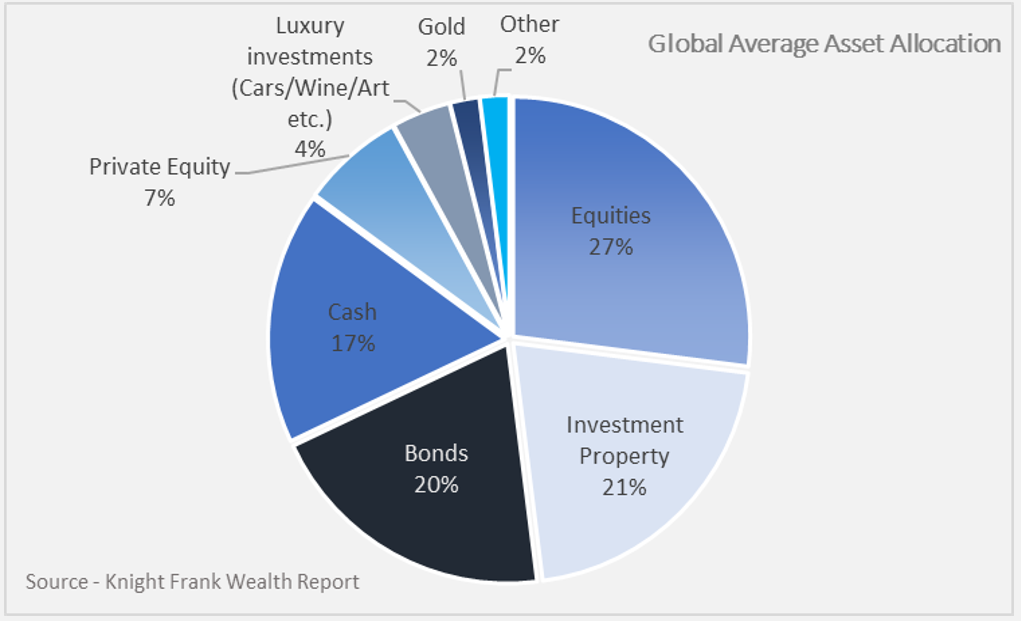
Pie chart showing global average asset allocation.

With central banks flooding the markets with liquidity, artificially supporting equities and driving down bond yields, parking a little piece of history in your garage and diversifying your portfolio will not only provide the perfect inflation and market correction hedge, but you may have some fun along the way.

Next time you look at your annual investment report, the immortal words of Wilbur Shaw may spring to mind.

“Gentleman, start your engines”

Further Information

[1] https://www.hagerty.com/apps/valuationtools/market-trends/collector-indexes/Ferrari

[2] HRH Prince Michael of Kent interview with Knight Frank November 2020

[3] FBHVC National Historic Vehicle Survey – https://www.britishmotorvehicles.com/news/fbhvc-national-historic-vehicle-survey-reveals-significant-contribution-to-uk-economy

[4]The Attitudes Survey is based on responses from 600 private bankers and wealth advisers managing

over US$3 trillion of wealth for UHNWI clients. The survey was taken during October and November 2018
“I’m finding my experience at Birkbeck studying MSc Sport Management to be precious and valuable”

Ryotaro Tsutsui, MSc Sport Management student and policy maker in the Japanese Government, describes his experiences at Birkbeck as an international student and his aspirations for the future.

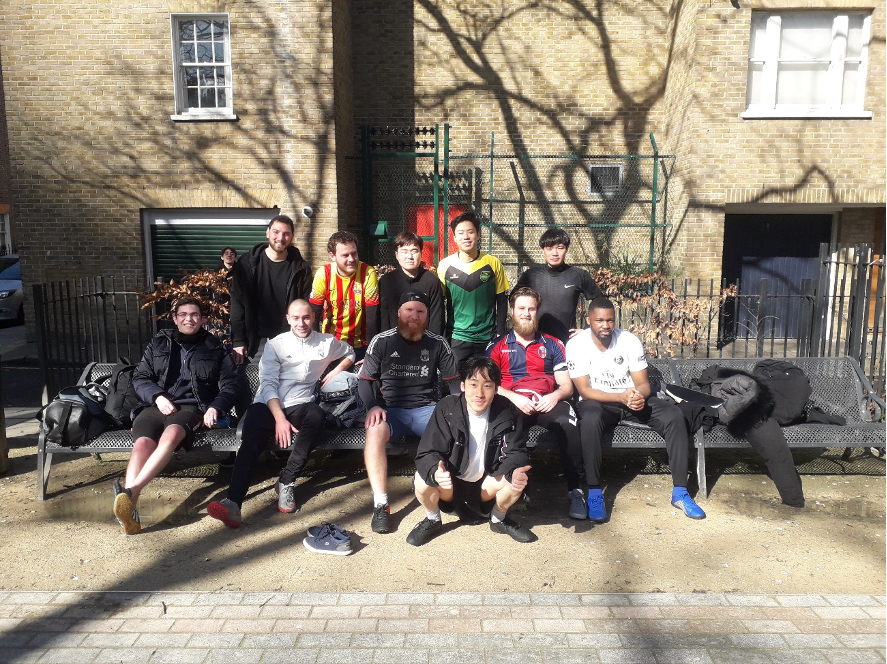
Ryotaro Tsutsui with classmates after playing football at the pitch near Birkbeck

Why did you decide to study at Birkbeck? 

I work for the Government of Japan and I’ve been working as a policy maker since 2012. As an opportunity for developing language skills and knowledge which is related to my policy area, I was allowed to study in the UK to get two Master’s degrees. I chose to join sport management courses as I’m interested in sport policy. I knew that Birkbeck is famous for sport management and my supervisor at Loughborough University (I studied at Loughborough University for the first year of my stay in the UK) strongly recommended Birkbeck.

How are you finding your course?

My experience undertaking the MSc Sport Management degree is precious and valuable. I think it is difficult for Japanese people to catch up on the global trends and affairs in the sport community as many of the international sport federations are in Europe and compared to Japan, the economic scale of the sport industry is huge. One of the advantages of the MSc Sport Management degree at Birkbeck is the wider and well-balanced range of global trends and topics covered.

How is the social life at Birkbeck?

Fortunately, I have made a lot of good friends at Birkbeck. I love the ethnic diversity of the students. There was no majority ethnic group in my course, which provided a good environment for students to form friendships. Also, a hidden advantage of life at Birkbeck – students can easily go for drink after evening lectures, which I really enjoyed!

Do you enjoy having lectures in the evening? What do you do with the time you have in the day? 

The evening based educational system suits students who want to explore new things in the day. For most of them, doing an internship in London would be the best choice. In fact, lecturers were willing to introduce various kinds of internship opportunities to students. I wanted to do an internship in the sport sector and I consulted with one of my lecturers; he kindly suggested a non-profit sport organization and I worked there for several months.

What is the best thing about studying in London? 

It was convenient to commute to Birkbeck as it is in the centre of London. There are much more opportunities in London to do internships than any other city.

What do you hope to achieve in the future? 

As a career path, I’m seeking the best way to be a competitive sport policy maker. After studying in the UK for the last two years, I realise how important it is to learn from the UK and other sporting countries about sport policy. In terms of sport policy including international and domestic policies, Japan is still behind the UK, however, this motivates me to develop sport policy in my country. I’m also motivated to keep human connections which I have made in the UK.

Any advice for international students considering studying at Birkbeck?

I’m really confident in recommending Birkbeck to international students. To make the most of studying at Birkbeck, it is important to plan what to do in the day. Mixing both studying in the evening and doing an internship or other social activities makes international students feel extremely productive!

Further information

Bringing his own dose of magic to the field of Law

Tomas McCabe is a recent prize-winner in the inaugural British Inter University Commercial Awareness Competition 2020. BIUCAC was established to provide opportunities for non-Russell Group students to develop commercial awareness and to highlight the talent at respective law schools. Contestants receive support with enhancing their CVs and win one of twelve prizes at top City law firms. Tomas won the prize offered by Simmons & Simmons and in this blog, he shares his path to success, a smart mix of the conventional with the unconventional, including a 10-year career as a magician.

This is a photo of Law student Tomas McCabe

Tell us about your course, what you’re studying and how you came to study at Birkbeck?
I am in my second year of the LLB course. My job for a long time has been as a magician, however I decided last summer (2019) that I would love to study a law degree around that work. I’ve always been interested in law and have considered studying it for a long time, and when I finally decided to go for it, Birkbeck’s evening structure allowed me to study it conveniently as well as giving me a University of London degree.

What’s your view on the opportunities available to Law students once they graduate?
I have researched a lot about the opportunities for law students after they graduate. While there are some fantastic opportunities, it is a very competitive industry and a majority of students will never get the chance to work as a barrister or solicitor simply because everyone wants to. However, with a good degree behind you and a lot of extra volunteer work, competitions and experience on your CV, it seems you stand a better chance. Thankfully, as I learnt in BIUCAC, the city law firms traditional tendency to hire from Oxbridge and Russell Group universities is being steadily improved to give more students a chance at obtaining the top positions.

What are your career plans following your course?
I have been awarded work experience at two law firms- Simmons & Simmons and CANDEY. Following my placements there, I will have a much better idea where exactly I would like to take my law career. Currently, I am simply trying to take advantage of every opportunity and keep doors open.

How has Birkbeck supported you with those plans?
Birkbeck has supported me in numerous ways. As I mentioned, I much prefer the evening scheduled work as it frees up my day to do my own combination of studying, legal research and other work to support life in London. I have jumped at opportunities presented to students, including this one (BIUCAC), representing Birkbeck at the Landmark Property Moot Competition and applying for some volunteer work. I think students themselves, however, need to do a bit more research into what needs to be done early on in order to build experience and stand out at the time when you are applying for jobs.

Tell us how you came to hear of the competition and how you went about applying?
I heard of the competition through an email sent to students. Initially I wasn’t sure about taking part as I hadn’t really thought about commercial awareness or why I might need it. As it was multiple choice, I decided to give the first few rounds a go. By the time I got to the interviews and presentations stages, I was sucked in and loved it.

How do you see competitions like this helping students, especially non-Russell Group students?
The most obvious answer here is that anything that can make your CV stand out, against the hundreds applying for the same job as you, is important. After all, most – if not all – will have a law degree. That aside, this competition has built my commercial awareness a lot and from doing my research I now realise how important this is. Also, the opportunity to network with graduate recruiters, trainees and more senior lawyers from the top firms in London – magic circle included – was brilliant. Finalists also got a Just Eat voucher!

What were your thoughts on winning 3rd place- an incredible achievement?
To say I was shocked would be an understatement. However, as the competition moved through the rounds and I became more invested in it, I decided soon enough that if I was going to do it, I should do it right. I put in the time and effort for the finals and was really pleased with my achievement. However, the whole way through I was aware of the standard of the other students and didn’t believe I could place third from over 4100 entrants. I’m really happy with myself for doing so though.

Any final takeaways from the competition?
My main takeaways from the competition are: degree class is becoming more important to the top firms than the university you study at, so never think you can’t compete with the best. And also, take every opportunity you can. At worst it’ll cost you a few hours, at best it could get you your dream job.

FURTHER INFORMATION:
More about Birkbeck’s School of Law

Is the Imprisonment for Public Protection (IPP) sentence turning into the Ministry of Justice’s own Windrush scandal?

Professor Mike Hough, Emeritus Professor and Founder of Birkbeck’s Institute for Crime and Justice Policy Research (ICPR) explains how thousands of prisoners are still facing injustice, ten years after IPPs’ failings were first exposed, and endorses latest demands for action.

Ministry of Justice, Westminster

The Prison Reform Trust (PRT) is to be congratulated on their excellent – but profoundly depressing – report No Freedom, No Life, No Future, which charts how large numbers of prisoners sentenced to the indeterminate sentence Imprisonment for Public Protection (IPP) are still stranded in prison many years after they were sentenced. As the report vividly demonstrates, part of the cause of this is the irrational and grossly unfair way in which the recall system is operating, following prisoners’ breach of their licence after release.

In 2010 Professor Jessica Jacobson and I worked on an ICPR/PRT collaboration which resulted in the report on the IPP sentence, Unjust Deserts. We showed how prisoners were required to demonstrate to the Parole Board that they were no longer a danger to the public, mainly by participating in courses to reduce the risks they posed. However, prisoners were denied means to demonstrate that they no longer posed a high risk to the public. Often courses were simply unavailable. In some cases, prisoners were told that they presented too low a risk for the course on offer, or that their levels of literacy were too low for the course in question. More broadly, the effectiveness of courses as a means of reducing dangerousness was questionable; while, at the same time, there were no obvious alternative ways in which individuals, in a prison setting, could prove the negative proposition that they no longer posed a risk to the public.  Matters were made worse by the originally mandatory nature of the sentence, meaning that many more IPP sentences were passed than originally expected, and many of these were for relatively minor offences. The Parole Board was overwhelmed by cases and delays grew. The net result was that many IPP prisoners were serving much longer sentences than expected – sentences that were, by any yardstick, grossly disproportionate.

Our report was well-received, and the then Justice Secretary, (now Lord) Kenneth Clarke, asked to see a pre-publication draft. We took some satisfaction in the announcement made shortly afterwards that the sentence would be abolished, qualified only by the fact that there were no plans to deal retroactively with those still serving IPPs, for example by converting all IPPs into determinate sentences. However, we thought that it would not take long for solutions to be found to release those prisoners in a fair and sensible way, whether through legislative or executive action.

How wrong we were! I was astonished to learn from PRT’s new report that by mid 2020 almost 2,000 IPP prisoners have never been released, and almost 1,400 have been released but are now back in prison, facing exactly the same intractable problems of proving their reduced risk as we found ten years ago.  The ongoing treatment of IPP prisoners is scandalous, and the scandal is, for the Ministry of Justice, taking on qualities that parallel the Windrush scandal that the Home Office is failing to deal with. The obvious unfairnesses and inhumanity which IPP prisoners face demand rapid attention.  We strongly endorse PRT’s call for action.

Further Information

Educating the educators

What motivates a Maths teacher to return to life as a student? From reigniting a love of learning to getting their head around applied statistics, teachers Sebastian Bicen, Donato Schiavo and Leonard Pistol share their experience of going back to school.

Picture of Maths teacher Seb Bicen.

Graduate Diploma in Mathematics alumnus Sebastian Bicen teaches Maths and Further Maths in London.

The reputation for being one of the most difficult A-level subjects is something that Mathematics has found hard to shake. Yet with rising demand for STEM teachers, it’s increasingly common for educators to find themselves teaching Maths with no experience of further study in the subject.

That’s how Sebastian Bicen, a History graduate from Oxford University, found himself teaching Maths through the Teach First training programme in 2010. Indeed, it’s easy to assume that stress around subject knowledge was what prompted Sebastian’s return to further study.

“You might expect that I went back to university because someone told me I needed a Maths degree,” he explains, “but in reality, even people with Maths-related degrees often don’t want to teach A-Level or Further Maths. Instead, it was being back in the classroom and seeing my students’ passion for the subject that reignited my own love of Maths and my enthusiasm for learning.”

The buzz of the classroom is something fellow teacher Donato Schiavo, who completed his MSc Mathematics in 2013, can relate to: “I remember as a student I really enjoyed explaining concepts and helping my friends with their homework,” he explains, “that pleasure of helping others made me realise I could be a teacher myself.”

Looking for a study route that would complement his work, Sebastian enrolled onto Birkbeck’s Graduate Diploma in Mathematics on a part-time basis: “It’s quite rare for universities to offer something that bespoke, like a personal conversion course where I could jump in at my level and not repeat the concepts I already knew.” Sebastian managed to secure partial sponsorship from his employer and, as a union member, was eligible for a 10% fee discount from Birkbeck.

What’s the point?

While every Mathematics classroom has students who love the subject for its own sake, there are many more who need some convincing, as Maths and Further Maths teacher Leonard Pistol discovered: “A lot of my students were interested in studying Maths at university, but not in becoming Mathematicians. They wanted to know how Maths could be applied in other fields and I felt like I came a bit short in providing personal, real world experience.

“I thought MSc Mathematical Finance would be a really good application. When I was talking to my students about it, I was able to give them concrete applications of the use of statistics and probabilities. The more into the applications I got, the more interested I became and the easier it was to teach as a result.”

For Donato, who now teaches at an international school in Italy, deepening his understanding of Mathematical concepts was a way to engage students in the subject: “When I tell people that I’m a Maths teacher they always say ‘I was so bad at Maths’ – it’s rare to meet someone who enjoyed Maths as a student. I had some wonderful teachers who shaped my idea of what Mathematics can be – solving a problem and understanding the logic that underpins it.

“A lot of my students can’t see the point of studying Maths, so I try to bring in examples that are tangible, like developing passwords or working out the dimensions of a room. The course helped me bring fresh examples to the classroom and teach at a higher level.”

Back to school

So, how did it feel being on the other side of the desk?

“As teachers, we forget what it’s like to be a student,” Sebastian admits, “It was really humbling being in the same boat as my students and having to take my own advice on revising! I experienced first-hand what worked and which things I was telling my students to do that even I wasn’t doing in practice.”

Re-living the university experience also enabled Sebastian to prepare sixth form students for higher education: “I want to treat my year 12 and 13 students as maturely as possible, knowing that they will be going to university. Having access to online lectures and notes from Birkbeck was really reassuring and helped me stay organised, so now I do that for my students as well. I give them lecture notes just like I had to help them experience what university teaching is like. Recording my lessons has been the biggest transformation to my teaching and the response from students has been amazing.”

Leonard, too, found that heading back to university supported his role as a Year 13 tutor: “I had fresh experience of the academic environment, so could give my students up to date advice on lectures and what life would be like. Being able to advise students on what modules to take for their specific goals was really valuable. I was reminded of the expectations lecturers have of you: asking for help, making sure you see your lecturers often, and that’s linked very much to what it’s like to be a teacher.”

Further Information

Reflections on online learning in the School of Business, Economics and Informatics

As the autumn term draws to a close, students and staff reflect on their experience of online delivery and how they have adapted to a new way of teaching and learning.

Earlier this year, we made the decision to move our teaching online for the autumn term and for as long as is needed to protect the health and wellbeing of our staff and students during the COVID-19 pandemic.

With staff having to rapidly get up to speed with online teaching and students coming to terms with a less than traditional university experience, it hasn’t always been easy, but we’ve pulled together as a community and managed to find some unexpected highlights along the way.

For students, one of the main challenges was knowing what exactly they had signed up to, but they soon found their stride:

“I was a bit apprehensive when I started regarding if I had made the right choice signing up, but Birkbeck have been really great. The virtual teaching has worked for me (and was the tipping point to make me apply), it provides a lot more flexibility. Also, having the pre-videos before the lecture I think really is so beneficial. They take me a while to go through but I can go through them at my own pace, and then because I have taken the time to understand the content, it helps me follow during the lectures.” – Student in the Department of Economics, Mathematics and Statistics

And it seems the hard work of lecturers in planning engaging online learning material is paying off:

“The slides were very well organised and in order, the concepts were explained clearly, the seminar questions were very interesting and engaging.” – Student in the Department of Organizational Psychology

“The quality of the materials has been high, they are available weeks in advance, and the organisation, clarity and administration of the lecturer is first class.” – Student in the Department of Organizational Psychology

It certainly seems that online learning has given academics cause to think more deeply about the learner experience, as Dr Federica Rossi, Reader in Innovation Policy and Management explains:

“I found delivering the module online a very interesting experience. Since it was not possible to rely on direct interaction in order to clarify specific points or to communicate expectations, I had to think in much greater detail about all aspects of the students’ learning process and how to support them.

“The module was taught in Spring 2020, during the first lockdown period, and I can imagine that it was particularly hard for our students to stay focused and motivated – many of them would have had to manage working from home, looking after children, and studying at the same time. Therefore it was particularly rewarding to see that the students did well and their marks were in line with those of students who, in previous years, attended the module in class.”

And how are staff finding online teaching? Does it compare on any level with classes or lectures? Brian Gannon, Lecturer in the Department of Computer Science and Information Systems, found unexpected benefits to taking his teaching online:

“I’ve been surprised at how effective the online delivery model has turned out to be. It actually helps to increase the level of engagement: students who would normally be too shy to ask questions or get involved seem to be quite happy to interact remotely. This has helped recreate some of the intimacy of the classroom and has been very valuable to everyone.”

Dr Muthu De Silva, Senior Lecturer in Entrepreneurship and Innovation, also found new ways to get students talking through online platforms:

“I have thoroughly enjoyed online teaching…It does require a lot of preparation but once this investment is made, it becomes a very positive experience for both the staff and students. I found that break-out groups with clearly laid out group tasks increase student engagement. Additionally, inviting guest speakers, who could discuss the application of theories has also enriched student experience.”

This is seconded by student feedback from the module:

“I have really enjoyed the guest speakers and their insights/advice for being an entrepreneur. I also enjoyed the group discussion where we get split off into different groups as I feel it makes people feel more comfortable to speak virtually.” – Student in the Department of Management.

While we’re missing Bloomsbury and seeing our community face to face, it’s clear that we’ve come a long way since March.

Dr Geoff Walters, Executive Dean of the School of Business, Economics and Informatics, says: “As the autumn term draws near to an end, I want to take this opportunity to thank all colleagues that have worked hard to make this term’s teaching happen. I also want to thank all students that have engaged with their studies this year and have embraced online delivery, attending lectures and working on material pre- and postlive sessions. In the (almost) 200-year history of Birkbeck, there has never been a start to the term like this. I do hope that the Christmas period, whatever this may look like, will be as festive and restful as possible for everyone.”

Further Information:

Around the world in an MBA

Marketing Manager and MBA student Lorena Ramirez shares her journey on the MBA, across three continents and what she has learned along the way.

Picture of Lorena Ramirez

The first time I heard about the Central Saint Martins Birkbeck MBA was while living in Peru. I’d been working in the fashion industry for the last ten years and was ready to expand into different creative areas. I was looking for a Masters degree that focused not only on fashion, but on creativity and innovation.

There are lots of really good MBAs in London, but the Central Saint Martins Birkbeck MBA was different. There is nothing else in the market that mixes art, design, business and social innovation in that way.

I fell in love with the course immediately, but attending face-to-face sessions in London wasn’t an option for me, so I was forced to put my plans on hold.

Moving to London

It just so happened that, months after discovering the MBA, my husband was offered a job in the UK. We moved to London without any hesitation: I arrived, found a job, got pregnant and applied for the MBA! I had my interview with Dr Pamela Yeow, the Course Leader, about a week before I gave birth.

I had my reservations about starting a Masters with a newborn baby, but when I won a scholarship for the course I felt like it was a sign to just do it. I started the programme and absolutely loved it. On a course like this, it’s so important that your peers are with you on this journey. For a lot of MBAs, the average age is around 24 or 25. I’m 37, and while the youngest person in our cohort was 25, the oldest was 60. Through the MBA, I met people in media, television, different organisations and entrepreneurs. The diversity of ages and interests in my cohort was what I enjoyed most about the experience.

Then my maternity leave finished, the pandemic hit and I found myself working full-time with a baby under highly pressured circumstances. Sadly, I couldn’t continue the MBA with my cohort, but Birkbeck and Central Saint Martins were very understanding and supportive. It was not an easy decision, but looking back, I think it was the right one. I wouldn’t have had the time to properly enjoy the reading and the learning process if I had continued then.

Picture of Lorena with her son

Recognise this scenario? Lorena trying to work and study, featuring her son Noah.

A new challenge in Ceuta

Despite having to put my studies on hold, this has been a whirlwind year: I was promoted to Marketing Manager for Spain for my organisation and relocated to Ceuta, an autonomous Spanish city in Morocco. Ceuta is a small, quiet city, so it’s a big change from London!

In my new role, I am already applying the learning from the first module of the MBA, which is all about how to solve complex problems. Right now, in Spain, the gambling industry is facing new marketing regulations which drastically change the way it has worked for the past twelve years. This has a huge impact on our work, meaning we have to really think outside the box when it comes to promotion.

Changing the way an entire company works is very difficult, especially when you lead teams. For me, the MBA was the perfect preparation to face this challenge. On the course, we completed a project with the London Ambulance Service – what we are learning is not theoretical, it’s real life, day by day. In my work now, we essentially have to reinvent all the departments and how we’re working. For this to be a success, you have to change the way of thinking not of the directors but of the users and your team, and that is the most difficult thing. I’m grateful to have had the opportunity to study to have a preparation to understand this better.

Where next?

From March 2021, I’ll be travelling to London once a month to re-join the MBA programme – I can’t wait to get started again!

In the long term, I would like to go back to sustainable fashion, for which my current experience in online marketing will be really valuable. I’d like to work with artisans, especially Peruvian artisans, linking them with brands across the globe. Most artisans around the world don’t speak Spanish or English, so it can be difficult to reach them, but I hope to do this through a foundation or social enterprise – I think the MBA will lead me to the right way to do this.

Further Information

Denials and ignorance in the time of a pandemic

Professor Renata Salecl, Professor of Psychology, Psychoanalysis and Law, explores how and why people react to COVID-19 with denial and ignorance.

Ignorance is often understood in a negative way, which is why we can easily accuse others of it while we rarely admit our ignorance. Most often, ignorance is understood not only as a lack of knowledge but primarily as a lack of the desire to know. However, psychoanalysts have observed that people might very well have a desire to know, but then do everything not to come close to the core of their suffering.

In politics, ignorance is often intentional or even strategic. At the start of the pandemic, many world leaders employed such deliberate strategies of ignorance. It was not so much that they did not know about the dangers of the novel coronavirus; they downplayed the pandemic for political and economic reasons.

In their private lives, people adopt their own types of denial. These denials are not so different from the types of denials that were studied in the 1980s by the Israeli psychologist Shlomo Breznitz, who questioned how people deal with potentially life-threatening health situations. Breznitz observed that many people who survived a heart attack did not think that they could suffer its repeat, even if they learned that others with a similar condition did. Denials helped people to feel confident in their wellbeing, and people often went from one form of denial to another. Altogether, Breznitz observed seven different kinds of denials among the patients he studied. One form of denial was that people felt that what happened to others cannot happen to them. Another involved a lack of urgency – when people experienced worsening of their health, they delayed seeking help. Still, another form of denial was a denial of vulnerability, when people felt that they were somehow protected from the illness because of their presumably healthy lifestyle. One of the forms of denial was the perception that illness is just luck, fate, or destiny. Moreover, while some people denied effects related to their condition or have invented an appeasing explanation for their anxiety provoked by their near-death experiences, others denied the information regarding their health. However, the most severe cases of denial included delusions, which meant that people created an explanation for their condition that was far away from reality.

With people who deny COVID-19, one can also observe how they often go through similar types of denials. Some people behave as if the novel coronavirus is of no personal relevance and that infections affect only other people. Even when already infected, some deny the urgency of the situation and do not seek medical treatment when their symptoms worsen. Many people who deny that the novel coronavirus can affect them, similarly to Breznitz’s patients, harbor illusions that they are somehow protected from getting infected because of their healthy lifestyle or even good genes. Some people take infection as merely a matter of luck or destiny. Overwhelmingly present are denials linked to people blocking unpleasant information or pushing aside their emotions related to the pandemic. Furthermore, with the continuation of the pandemic, psychiatrists are also observing delusional thinking. Some people are even developing particular COVID-19 related delusions.

Medicine often does not pay enough attention to people’s denial of illness as epidemiology says little about how ignorance and denial are played out in times of a pandemic. Now that so many countries are going through the second wave of the pandemic, many people are fatigued by it and are not willing to follow often erratic measures governments are proposing to limit the spread of the virus. While on the one hand, people need to deal with the conflicting messages about how to protect themselves and others from the infection, on the other hand, they have to deal with the emotions the pandemic is provoking. When dealing with something traumatic, anxiety-provoking or hard to grasp, people often embrace ignorance and denial, instead of knowledge and facts.

The pandemic has taught us the importance of acknowledging the unknown. As Thomas Jefferson, third President of the United States said, “He who knows, knows how little he knows.” One cannot imagine that today’s world leaders would utter something like this. Although, as German politician and epidemiologist Karl Lauterbach recently reminded us in The Guardian: “Uncertainty and doubt are not a disgrace for scientists or politicians at this time. What is disgraceful is excessive self-confidence, self-righteousness or dishonesty towards fellow human beings.”

Further Information

Keeping busy in Tier 2: Tiptop icing recipe

Birkbeck student Pav returns with more lockdown baking recipes to get the tastebuds tingling.

Picture of Pav


Hello guys, it’s me, your Pav. I hope that you are all well and keeping warm and safe. As Londoners look for ways to keep busy during the Tier 2 lockdown, please see a new addition to your baking adventures.

This time, I’m sharing my tiptop icing recipe, which you can pair with the perfect muffin recipe I promised in my last blog.

What you need:

  • 225g unsalted butter at room temperature
  • 450 grams (1pound) icing sugar
  • 2 teaspoons vanilla extract
  • 3 tablespoons double cream or semi-skimmed milk
  • Pinch of salt

How to do it:

1. Mix the butter for 10-15 minutes. Don’t worry about overdoing it – the more you mix it, the better it gets.

2. Add sifted 225 grams of icing sugar (cover the bowl with a clean kitchen towel to prevent icing going everywhere) – mix for approximately 5 minutes. The key is to ensure that you sift the icing sugar before mixing it to avoid big lumps of sugar and to make sure that all the icing sugar incorporates nicely with the butter.

3. Include 2 teaspoons of vanilla extract and mix for another minute. During mixing, add one tablespoon at a time of double cream or milk up to 2 tablespoons. Don’t forget to leave the last tablespoon for the second part of the icing.

Top tip – the higher quality of vanilla extract you use, the better the icing will taste.

4. Once the icing is coming nicely together, add the second half of sifted icing sugar and a pinch of salt and mix for 2-3 minutes. After 3 minutes, add the last tablespoon of milk and mix for another 5 -6 minutes.

Should I use milk or double cream for the icing?

The difference is in consistency – double cream is creamier, where milk is better for basic icing on fairy cupcakes. However, it does depend on preference and season. I tend to use double cream in winter and milk in summer.

How do I know when the icing is ready?

Try it and if you feel sugar bits, continue mixing. If the icing is too watery, add a bit of sifted icing sugar at a time to change the consistency. If your frosting is too dry, add a tablespoon of milk. The key is in proportion and mixing it all well together.

How to decorate with your icing

Before decorating, be mindful of the current season – in summer ingredients get wet very quickly. That is why in summer, I tend to put the icing in the fridge for 10 minutes to reach a thick consistency for the best decoration. However, not too thick – the best icing is the one which creates strong shapes once squeezed through the icing bag.

In terms of piping and decoration, the world is your oyster – so enjoy your baking and do not forget to let me see your creation on Instagram adding #lifeofpav♈️.

Your Pav.

Making a difference in the local community: learning from the Central Saint Martins Birkbeck MBA

With over thirty years’ experience working in his local authority, Eubert Malcolm brought a wealth of knowledge to the classroom. Having just been promoted to Assistant Director for Stronger and Safer Communities, he reflects on how the MBA has supported him to make a positive difference.

Picture of Eubert Malcolm

As local authority leaders go, Eubert Malcolm must be among the most personally invested in his community.

“Somebody said to me the other day that I’ve been in Haringey from boy to man,” he laughs, but with over thirty years’ experience in various roles in the local authority, this isn’t far from the truth. Eubert joined Haringey Council as an environmental health officer apprentice in 1988. From there, his role expanded into different fields as his skillset developed, encompassing housing, food safety and pollution.

“I made my way up the local authority and picked up Diplomas in Environmental Health and Management Studies along the way,” explains Eubert, “but I always felt that not having a first degree would hinder me at some point.”

The value of life experience

It was during the hunt for an undergraduate degree that Eubert stumbled across the Central Saint Martins Birkbeck MBA. The idea of studying part-time at the weekends was a particular draw, but was it really possible to do a Masters level programme without an undergraduate degree?

“I went along to the open evening without much hope,” says Eubert, “but I really liked the course leaders and they encouraged me to apply. I think I was the least qualified but most experienced of that first cohort, and the idea of a co-production and developing new types of leaders seemed perfect for my role. It felt like I was in the right place at the right time.”

Seeing things differently

The collaboration between Central Saint Martins and Birkbeck’s School of Business, Economics and Informatics offers an innovative perspective on businesses and the problems they face. This, combined with the diverse international cohort on the MBA, gives students an opportunity to look at situations from a fresh angle. For Eubert, this proved invaluable when looking for ways to connect with the local community:

“When I first started the MBA, there was lots of gang activity and a spate of deaths in the community. I wanted to learn more about how violence was affecting young people in Haringey, so I commissioned a community group to speak to them and to people in prisons to figure out the drivers of criminality. Until you actually sit down with young people and hear from them, their teachers and their parents, you don’t really understand the challenges that they are facing. We need to engage with them and ensure that they are part of the solution.”

Eubert’s MBA dissertation was Haringey’s public health approach to tackling serious youth violence, a combination of academic research and an in-depth evidence base that came from his experience in the local authority, which informed the young people at risk strategy.

“At Haringey, we want to co-produce strategies with the community,” he explains. “Now, we’re incorporating business principles into our local authority point of view and using action learning techniques to think issues through from beginning to end, predicting the challenges we might need to address along the way. It’s an approach the managers I work with are now also starting to adopt.”

Leading in the pandemic

The rapid unfolding of events in the COVID-19 pandemic has made an agile approach essential:

“If you look at how much COVID-19 has cost local authorities,” says Eubert, “I don’t think we’re going to be fully recompensed for that. It has made us look at what opportunities could come out of it instead.

“For example, we couldn’t deliver a lot of our face to face services during the pandemic and many of them went online. We found that the young people we work with instantly took to that approach, which we hadn’t really considered before.”

Now Eubert, his team and the wider council are working on campaigns to bring the local community together to reduce the spread of COVID-19: “The approach we’re taking, trying to get right to the hearts and minds of people in the borough, is something I don’t think we would have attempted before. It just goes to show that with the right support and network in the workplace, you can be successful even through challenging times. I know that anything I set my mind to I will be able to achieve.”

Further Information