Category Archives: Business and Law

Flight MH370’s disappearance does not demand a xenophobic response

This post was contributed by Dr Nadine El-Enany, a lecturer in Birkbeck’s School of Law. It originally appeared on The Guardian.

We now know that the two men travelling on stolen passports on board the missing Malaysian Airlines flight MH370 are thought to be Iranian asylum seekers en route to Europe. This has exposed as unwarranted the alarmist response to the discovery that passengers with falsified or stolen passports were on the flight. For the poorest people living in the global south, often from war-torn countries or repressive regimes, obtaining a falsified or stolen document is often the only way out.

And yet the mundane, everyday phenomenon of falsified travel documentation rapidly attracted a disproportionate degree of attention. The suspicion was quickly aired in the media, spurred on by officials, that those passengers holding falsified passports might have terrorist connections. And this has come hard on the heels of the story of the easyJet flight grounded when schoolchildren panicked after seeing a fellow passenger writing in a script they believed to be Arabic. All this is symptomatic of a moral panic that is presenting the “Islamic radical” and the “illegal immigrant” as the folk devils of our age.

In fact, it was always unlikely that either of these passengers were terrorists. Much more likely is that these were desperate individuals trying to better their lives.

The facilitation of terrorist activity by the market in falsified travel documentation is rare. The real story is the ordinariness and everyday necessity of this market due to strict immigration and border controls. Common EU visa rules are applicable to nationals of 128 countries, including the majority of African and Asian countries and significant parts of Central America. Many of these are refugee-producing countries.

Further, EU countries require a special airport transit visa for nationals from countries producing high numbers of asylum seekers, including Iran. The reality for most refugees fleeing to Europe in search of safety is a life-threatening journey by sea or stowing away in transport containers. In 2011, at least 1,500 people perished attempting to cross the Mediterranean alone. Only a tiny minority of irregular migrants can afford the cost of a forged passport and flight ticket, the extortionate cost of these – about $1,000 for a European passport – is indicative of the desperation of those willing to pay.

Due to EU carrier sanctions it is almost impossible for migrants – whatever their motivation for moving, whether economic or in search of safety from war or persecution – to enter the EU in a regular manner. Carrier sanction regimes entail fining airlines and other transportation companies for bringing individuals into the EU who do not have the required documentation. Transporters are fined and designated as responsible for returning or paying the cost of detaining such persons. It is these border control regimes that should be subjected to scrutiny, rather than the phenomenon they create: “illegal immigration” facilitated through falsified documentation. Carrier sanctions together with visa regimes force some migrants into a situation where they have to obtain forged or stolen documentation in order to be able to travel.

In the wake of the disappearance of flight MH370, Interpol’s secretary general called for stricter security measures at borders. This, he says, would ward off speculation of terrorism in the event of flight tragedies. But shouldn’t common sense and decency be sufficient to deter such speculation? Even more stringent security measures will mean that asylum seekers will be unable to flee their countries. It is due to the absence of legal migration routes that many asylum seekers are forced to travel irregularly. A xenophobic response to the tragic disappearance of flight MH370 even before the facts are known is reckless and unseemly.

Latin America is being transformed by a vision of post-human rights

This post was contributed by Dr Oscar Guardiola-Rivera of Birkbeck’s School of Law. It originally appeared on The Guardian.

In Latin America, as elsewhere, progressive governments of the centre and left struggle with a seemingly intractable dilemma: should the country exploit its natural resources to the fullest, no matter what the consequences – or consider ethical questions such as the wellbeing of the natural environment and future generations?

Countries such as Colombia, Ecuador, Bolivia, Argentina and Brazil hope to benefit from the commodity boom in global markets, fuelled by demand in China and elsewhere. At the same time their constitutions, as well as the manifestos of progressive political parties, pledge allegiance to a whole new variety of non- and post-human rights – rights of nature, declarations of inter-generational justice, and the recognition of Amerindian cultures.

These cultures are being celebrated in Beyond El Dorado, an exhibition at the British Museum in London. It includes hundreds of gold objects excavated in the early 20th century; and ceramics and stone necklaces from the Museo del Oro in Bogotá – which has one of the best collections of pre-Hispanic gold in the world – and the British Museum’s unique collections.

The British public has responded en masse to the profound spiritual and aesthetic message expressed by the gold objects displayed in the museum. But now it is time to consider the ethical and political implications of that message: not as a relic of the distant past, but because it may contain some of the answers we desperately seek to the most relevant questions of our time. A discussion organised by the Guardian and the British Museum next month aims to do just that with the help of a distinguished panel.

These big questions – climate change, food security, equality – are already being discussed in Latin America thanks to the social movements that are helping to remould politics and political discourse. In these countries both the electoral survival of progressive parties and the continuity of crucial processes of reconciliation and democratisation depend on the support of increasingly active social movements. These often include rural as well as urban campaigners, concerned about the social and environmental devastation caused by global market forces.

In this respect, social movements in the Americas display an attitude that cannot be dismissed simply as backwards or anti-business. They demonstrate a legitimate critical attitude towards the contradictions inherent in processes of globalisation. And rather than withdrawing into some fantasy zone, these movements seek to engage actively with the state and transform the relationship between the state and the people from within.

The concept that explains this interdependence between social movements and progressive parties in government goes by the name of “dual power“: the underpinning of vertical state-citizen relations by horizontal social movements, ready to criticise the decisions of the parties they elect on the basis of a commitment to a progressive agenda. This is how the protests that rocked the politics of countries such as Colombia, Brazil, Chile and Bolivia last year must be understood: as manifestations of dual power, and expressions of the terms of a new social contract – one that includes nature not only as a reservoir of resources but as an agent of politics and of the wellbeing of society.

As far as these movements are concerned, democracy and ethical politics go hand in hand. They discuss the big questions of our time – climate change, food security, the role of commons, the rights of nature, equality – in a political arena that until recently appeared to offer no alternative to the “one size fits all” view of globalisation and the market.

Crucially, in most Latin American countries such dogmatic views were imposed by sheer force, either military – as in Chile, Brazil, Argentina or Bolivia –or paramilitary, as in Colombia. To most Colombians it is now clear – a matter of indisputable record – that the paramilitary violence that engulfed the country with peculiar intensity during the last decade and a half, with the leading intervention of the United States, was part and parcel of an economic project rather than solely a counter-insurgency exercise.

The model still in place depends on the unbridled extraction of natural resources from parts of the country that have traditionally sustained peasant, indigenous and Afro-Colombian ways of life, and is the result of such violence. Because of this, as far as the social movements are concerned, any peace process worthy of the name must also consider the serious ethical questions posited by climate change science, food security and so on.

According to the information provided by climate science, as well as from anthropology and the humanities, it is no longer possible to keep human history separate from the history of the planet. We have become geological agents, capable of affecting and even destroying nature as a whole. We do this through the very processes that we considered to be at the heart of freedom in the 20th century – chief among them free trade. What we need now is a new politics, not only a politics of freedom, but one of post-human rights and cosmopolitics.

Trenton Oldfield’s win is a defeat for Theresa May’s deportation policy

Nadine-El-EnanyThis post was contributed by Dr Nadine El-Enany, a lecturer in Birkbeck’s School of Law. It was originally published on The Guardian’s Comment is Free.

On Monday 9 December, Trenton Oldfield won his appeal against Theresa May’s decision to deport him to Australia after he carried out a direct action protest against elitism at the Oxford Cambridge boat race in 2012. The home secretary had deemed Oldfield’s presence in the UK to be “undesirable” and “not conducive to the public good” after he was convicted of causing a public nuisance when he swam into the Thames and disrupted the boat race last year. Oldfield’s win is not only a victory for the right to protest, but a serious defeat for May’s deportation policy.

May had delivered a tub-thumping speech to Tory party members at their September conference in which she promised to “deport foreign criminals first, then hear their appeals”. In spite of this, at yesterday’s tribunal the Home Office’s legal representative did not seem to be trying very hard to win the case. He asked few questions of Oldfield and his wife, Deepa Naik, and chose not to quiz the witnesses at all. He presented little evidence, basing his entire case on the fact that Oldfield had carried out a direct action protest. It seemed the Home Office expected to lose. Was this a U-turn in disguise?

May should never have taken the decision to deport Oldfield. In cases of foreigners who serve sentences of less than 12 months, the home secretary has the discretion to order deportation if she considers it to be “in the public interest”. Oldfield’s crime was to carry out a peaceful direct action protest in the name of equality. At his tribunal hearing, he spoke of how he had not expected to have been dealt with so harshly by the state. Britain, he believed, was a “mature democracy”, which this year commemorated 100 years since Emily Davison staged her final protest calling for women’s suffrage at the Epsom Derby, where she was trampled by King George V’s horse. But the historical tradition that May seems to be following is a quite different one: Britain’s shameful history of deporting political activists to Australia – the Tolpuddle Martyrs in 1834, the Chartists in 1842 and the Fenians in 1868, to name but a few.

The state’s reaction to Oldfield’s protest is one of a long list of the coalition government’s repressive responses to dissent. Recall the police brutality and criminalisation with which students were met when they resisted the tripling of student fees three years ago; scenes which were replayed on campuses last week when students staged “cops off campus” protests following the violent eviction of a student occupation calling for an end to the marketisation of education.

Oldfield and his wife have lived through months of anxiety, facing the possibility that their family, including their five-month-old daughter, could be separated from each other. This anguish is felt by thousands of migrants forcibly removed from Britain every year. Addressing the press following his victory, Oldfield called for attention to be focused on all the other migrants “going through the same process”. Most deportees do not have the cultural capital and support network from which he, as a white middle class man, has benefitted.

Consider the case of Luqman Onikosi, an anti-racist activist who suffers from hepatitis B and is under threat of deportation to Nigeria, where he will be unable to access treatment. Or Isa Muaza, for whom May ordered an “end of life” plan be drawn up after he went on hunger strike for 100 days in protest at his deportation to Nigeria. Despite being so ill that he had to be carried out of Harmondsworth immigration removal centre in order to be deported, May refused to back down. As a result of his protest, Muaza’s case has attracted the support of MPs, the public and celebrities. The home secretary no doubt fears that other migrants in seemingly powerless positions will be similarly inspired to resist deportation through protest.

In carrying out his protest against elitism, Oldfield focused on a symbolic site: the Oxford-Cambridge boat race. In winning his appeal, he succeeded in disrupting something weightier and more sinister: the attempt by May – herself an Oxford alumnus – to use his case to send a message of deterrence to migrants who might consider engaging in political protest.

Chile election: young Chileans have voted for a radical change of direction

This post was contributed by Dr Oscar Guardiola-Rivera of Birkbeck’s School of Law. It originally appeared on The Guardian.

Sunday’s elections in Chile will prove significant, regionally and globally. The centre-left candidate, Michelle Bachelet won nearly twice as many votes as her closest rival, Evelyn Matthei, of the governing rightwing Alliance for Chile. Bachelet, Chile’s president from 2006 to 2010, will have to go through a second-round runoff in December but is expected to win. Meanwhile, a new generation of student leaders – most notably, 25-year-old Camila Vallejo, who helped lead Chile’s student uprising in 2011 – has been elected to Congress as part of Bachelet’s coalition. It is this younger generation that is set to radically transform the direction of the country. In doing so, they’re breaking apart the dominant myths concerning the relation between politics and economics in the region – and in the world at large.

At the national level, the rightwing government of Sebastián Piñera is struggling to understand how, after four years of high growth, fiscal discipline and low inflation – which many would argue are the very measures of success – Chileans failed to award his party another term in office. Some commentators are already beating their chests at the apparent scandal of “irresponsible” Chileans voting the wrong way. Others argue that the conservatives “couldn’t transform a successful government into political success”.

The right’s resounding defeat, however, isn’t simply a case of its inability to tap into middle-class frustration. For some time now, many Chileans have been rejecting the very economic model that Piñera, Matthei and their supporters around the world continue to praise: that there may be change – a transition to democracy, the implementation of human rights, and so on – but only insofar as the “model” stays as it was before.

The “model” is what Chileans call both the economic and paternalistic establishment that emerged under Pinochet’s dictatorship and the myth that underpins it – that nothing can change. The myth is based on the terror and violence following the violent overthrow of Salvador Allende in 1973, and the attempt to erase history and hope from minds and hearts.

Chileans, especially the young, have realised this. They have blown apart the message of good cheer, that if the economy is well, all is well. Their reasoning is clear: the economic model produces wealth for the benefit of the few and widespread unhappiness. In Chile, the wealthiest 5% earn 257 times more than the poorest 5%. Higher education is private and expensive. Parents are left with huge debts, and their children face impossible odds to start a family or envisage a hopeful future.

The Chilean youth have an agenda: free higher education and replacing the Pinochet-era constitution through a self-appointed popular assembly. Some also want renationalisation. However, the rebellion that exploded in Santiago in 2011 is not simply against this or that policy. This is a rebellion against historical compulsion – the idea that no matter what you do, nothing changes.

Vallejo has warned that this will not be a repeat of the same compromise-prone Concertación government, which won every election from the end of military rule in 1990 until Piñera came to power in 2010. A considerable percentage of voters responded to the students’ call for a constitutional assembly. As the new generation of politicians is swept to power, the next step towards reform is given radical legitimacy.

For the region this means that just as the first wave of leftism may be reaching an impasse in Argentina and Venezuela, a second, more profound one is beginning in unexpected parts of Latin America: conservative Chile, ultra-conservative Colombia and moderate Brazil. For the world, this spells the end of the dogma that the economy determines people’s consent rather than the other way around. It is the time of the people once again.

Commonwealth hamstrung to fight abuse in Sri Lanka

This post was contributed by Frederick Cowell, a lecturer and researcher in international law in Birkbeck’s School of Law. This article first appeared on The Conversation.

The list of crimes alleged to have been perpetrated by brothers Mahinda and Gotabhaya Rajapaksa – respectively the president and defence minister of Sri Lanka – are truly horrifying. During the last few months of the civil war in 2009, the Sri Lankan army was alleged to have deliberately shelled civilian areas and since the ceasefire, as the Sri Lanka justice campaign has detailed, there have been numerous extrajudicial killings and incidents of torture.

Rather than being treated as international pariahs, though, the Rajapaskas are hosting the Commonwealth Heads of Government Meeting this week, attended by representatives of more than 40 governments from around the world.

Since 1965 the Commonwealth has been an independent intergovernmental organisation, with its own headquarters and secretariat. From 1971 it took a leading role in facilitating negotiations over ending white minority rule in Southern Africa.

Sincere commitments at the organisational level, however, did little to affect the Commonwealth’s membership. Military regimes and dictatorships were prominent members of the Commonwealth throughout the 1980s. When the Commonwealth broadened its focus to the protection of human rights with the passage of the 1991 Harare Declaration, committing Commonwealth member states to the protection of “fundamental human rights” and democracy, it was clear a more robust enforcement mechanism was needed if the declaration was to have any meaningful effect.

Suspension is easy

Article 3 of the 1995 Millbrook Action Programme allows states to be suspended from the organisation when they were clearly “in violation” of the Harare Principles, “particularly in the event of an unconstitutional overthrow of a democratically elected government”. This was the first instrument of its kind and was a radical move. At the time the UN Human Rights Commission didn’t even have an instrument for suspending serial human rights abusers or illegal governments.

In 1995 Nigeria became the first country to be suspended from the Commonwealth after General Abache’s regime rejected the results of the 1993 elections and went onto commit series of human rights abuses including the execution of activist Ken Saro Wiwa. This was followed by the suspension of Pakistan in 1999 and Fiji in 2000, both following military coups.

The Millbrook action programme also allowed the appointment of ad-hoc groups of high level officials. Zimbabwe was suspended from the Commonwealth in 2002 after a troika of officials, including then Australian prime minister John Howard, concluded Robert Mugabe’s re-election that year had been “marred by a high level of politically motivated violence”. This led to Zimbabwe withdrawing from the organisation a year later. The most recent suspension was Fiji in 2009 after the government refused to accept a domestic court ruling that a 2006 coup was illegal.

Human rights play second fiddle

The focus of the Commonwealth Ministerial Action Group (CMAG), the decision making body of the Commonwealth, has been largely on the overthrow of democratically elected governments. This has led to the relative relegation of the protection of human rights, effectively turning Article 3 into an anti-coup instrument. And even as an anti-coup instrument, it has been applied inconsistently. When Maumoon Abdul Gayoom took power unconstitutionally in the Maldives in February 2012, CMAG issued a statement urging the government to hold fresh elections, but little action has been taken since.

It is also increasingly unclear what suspension is actually for. Fiji has been suspended for nearly four years, during which time it has made scant progress towards returning to constitutional government. Fiji’s government has covered the shortfall in development aid it suffered by receiving aid from China.

Anti-coup instruments have been adopted in several other international and regional organisations including the African Union. The problem is that they can easily become mechanisms that protect governments rather than human rights.

An anti-coup mechanism is also a barrier to gaining international recognition for a new government that comes to power through a coup. This can help deter future coups, which benefits exiting governments. This is why the Millbrook Action plan has received so much support from Commonwealth members. Commonwealth states have resisted attempts to create an independent Commonwealth Human Rights Commissioner, meaning that the decision to suspend states still rests with diplomats from member states.

The situation in Sri Lanka has split opinion among Commonwealth governments about the best way to respond to the human rights abuses taking place in Sri Lanka. Until a strong independent mechanism is brought in to assess suspension, Sri Lanka will remain a Commonwealth member, despite the atrocities that occur on its soil.

Torture prevention in Uzbekistan: my return visit

This post was contributed by Professor Bill Bowring of Birkbeck’s School of Law

In March 2012 I travelled to Uzbekistan for the United Nations Office on Drugs and Crime (UNODC) to lecture to practising defence advocates on torture prevention. In October 2013 I was invited back, and in this blog I explain Uzbekistan’s global significance, its paradoxical engagement with United Nations treaties and mechanisms, and my own activities.

This was not my first visit to this Central Asian country of some 28.5 million people. It is about the size of California, which has a population of 38 million. I have visited several times from the 1990s, carrying out human rights training.

The population of the capital, Tashkent, is nearly 2.5 million, the largest in the region, and more than twice the size of Britain’s second city, Birmingham. Having been largely destroyed by an earthquake in 1966, it is a modern city. Tashkent has been named the “cultural capital of the Islamic world”, and has the earliest written Qur’an, as well as a beautifully decorated three line metro system, and since 2012 a high speed train line to Samarkand. Tourists know Uzbekistan for the Silk Road, and for the gorgeous historical cities of Samarkand, Bukhara and Khiva. But Tashkent is the business, industrial and educational powerhouse.

Uzbekistan is a very serious and ambitious regional power. It has the largest population of the Central Asian states, double the population its nearest rival, Kazakhstan. There are substantial Uzbek minorities in its neighbours: 3% in Kazakhstan, 5% in Turkmenistan, 14% in Kyrgyzstan, and 15.5% in Tajikistan. In Afghanistan, General Abdul Rashid Dostum leads the Uzbek minority, about 10% of the Afghan population; and the most effective military force in the country, never defeated by the mujahedin or the Taliban. Uzbekistan sees itself as the regional leader. Uzbek is a Turkic language and there is substantial Turkish investment and involvement. I stayed in a hotel which is part of a Turkish chain, though I was able to enjoy some delicious traditional plov, rice with lamb, herbs and spices, in an enormous House of Plov.

As The Guardian reported on 9 October, British universities are, controversially, moving in. Westminster has set up a campus in Uzbekistan and at least five others, Cambridge, Bath, East Anglia, the London College of Fashion and London Metropolitan University, have partnerships with colleges in Uzbekistan.

That Uzbekistan is an authoritarian state is beyond question. 75 year old President Islam Karimov has been in power since 1989 when he became First Secretary of the Uzbek Communist Party. He has been elected President three times by overwhelming majorities in elections which have been condemned as unfree and unfair.

According to the United States State Department’s Country Report for 2012 on human rights practices in 2012: “The most significant human rights problems included: torture and abuse of detainees…; denial of due process and fair trial; restrictions on religious freedom; … incommunicado and prolonged detention; harsh prison conditions; arbitrary arrest and detention; restrictions on freedom of speech, press, assembly, and association; on civil society activity;  and on freedom of movement; violence against women; and forced labor in cotton harvesting… human rights activists, journalists, and others who criticized the government [suffered] harassment, arbitrary arrest, and politically motivated prosecution and detention.”

That is, egregious violations of human rights, carried out by a strongly centralised regime, under a president for life, in which rights are subordinated to development.

Yet Uzbekistan participates energetically in UN human rights mechanisms. In 1994, after the collapse in 1991 of the USSR, Uzbekistan acceded to the UN’s Convention on the Rights of the Child, and in 1995 to the International Covenant on Civil and Political Rights, the Convention for the Elimination of Racial Discrimination, the Convention for the Elimination of All Forms of Discrimination Against Women, and – the Convention Against Torture (CAT).

In 2006 the UN created the Universal Periodic Review (UPR) mechanism, in which the human rights records of all 193 UN Member States are reviewed by the UN’s Human Rights Council. On 24 April 2013 the Council considered Uzbekistan’s second report – the first was in 2008 – and over one hundred recommendations were made by member states.

And on 30 October 2013, immediately after my visit, Uzbekistan defended in Geneva, in a public hearing which may be seen on You Tube, its Fourth Periodic Report to the UN Committee Against Torture. Its representative, Professor Akmal Saidov, Chairman of the National Human Rights Centre of Uzbekistan (NHRC), described this as a “fiery dialogue”.

Indeed, it was Professor Saidov and his Centre who invited me this time, and the British Embassy in Tashkent which paid for my visit. I had four engagements in my three days in Tashkent – with a ten hour journey via Istanbul overnight each way. It was made very clear that I was not representing the UK or the Foreign Office, but was in Uzbekistan as an independent expert.

On 24 and 25 October I attended an international conference organized by the NHRC with Uzbek and foreign experts to discuss human rights in Uzbekistan and international best practice. I gave a presentation on UK legislation and institutions for the protection of human rights. I also participated in a meeting between the NHRC and various UN agencies on the implementation of recommendations following Uzbekistan’s recent UPR report to the UN Human Rights Council.

I also spoke, on the morning of 25 October, to a large audience at the Training Centre for Lawyers. I gave a lecture on the British judicial system and the training of legal professionals in the UK, to future judges, practising lawyers, government officials and academics. There was tremendous interest and many questions.

On 26 October I visited the Uzbek Human Rights Ombudsman, Mrs Rashidova together with the British Ambassador, George Edgar, and Professor Saidov. I gave a presentation on the UK experience since 2009 in establishing a National Preventive Mechanism (NPM) under the CAT. Uzbek officials and legal experts discussed the establishment of an Uzbek NPM and Uzbekistan’s implementation of the CAT in the context of the hearing in Geneva on 30 October.

That evening I attended the inaugural event of the British Alumni Network, with over 40 graduates of Master’s degrees in the UK, many supported by Chevening and other scholarships.

Was my visit simply an opportunity for attempted window-dressing by Uzbekistan?  I argue that Uzbekistan’s engagement with international human rights, the enormous effort put into writing reports and defending them in Geneva, and the internet publicity which does not go unnoticed by Uzbek civil society, do indeed bear fruit. As Professor Saidov emphasised in Geneva, Uzbekistan has recently abolished the death penalty, reduced its prison incarceration rate to the level of the UK, and begun to introduce habeas corpus.

But most importantly, Uzbeks become ever more conscious of the yawning gap between their country’s proclaimed compliance with international standards, and its actual practice. I think I have made a very small but significant contribution to this process.

A Dance of Death

November is Beat Bullying Month. This blog post was contributed by Dr Andreas Liefooghe, a Reader in Birkbeck’s Department of Organizational Psychology.

From minor family squabbles to nations at war, conflict is a universal fact of life, and one of its most potent features is the bully.  Last month, the CIPD journal People Management ran with the headline “Are you a bully?”, and offered a Cosmo-style quiz to ascertain what kind of bully you might be (there are, apparently, four types). Glib answers for difficult questions have clearly lost none of their appeal.

As David Cameron condemns Unite’s tactics at Grangemouth as “bullying” (they took a life-size rat to a leafy suburb to protest at the house of a director of Ineos, the Grangemouth operator), Unite’s general secretary Len McCluskey dismisses “Bullingdon Bully Cameron” as whipping up media hysteria and using bullying allegations to deflect attention from the reality of closing down factories.  This is a long way away from kids stealing dinner money, or your boss undermining your confidence.  Are we still talking about the same phenomenon?

To raise awareness of bullying, subtlety had to fall by the wayside – simple messages were important, and it clearly worked.  Awareness around bullying, both in schools and at work, has increased considerably over the past two decades. This week sees the launch of anti-bullying month for schools. On the 7 November it is National Ban Bullying at Work day. Awareness, yes. But understanding?

National Ban Bullying at Work Day is held annually in memory of Andrea Adams and Tim Field, two pioneers who devoted their lives to eradicating bullying. Not so often mentioned is Adams’ co-author, Tavistock psychotherapist Neil Crawford, who also died a decade ago. Crawford brought the subtleties of psychoanalytic thinking to the bullying at work field. “I feel I was robbed … my confidence disappeared”, states a victim of bullying I talked to recently. Stealing is at the core of bullying. Envy, Crawford argues, involves identifying with the goodness of others and stealing it. Bullies are insecure, and feed off others, sucking the life out of them.

Bully Blog Nov13

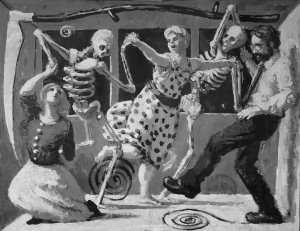
Danse Macabre, by Alex Cree

Being robbed, feeling bereft, death. Dr Sheila White, who continues and reshapes psychoanalytic thinking in the field, gives us the notion of the dance of death to understand workplace bullying.  She describes it as a perverse and pernicious form of projective identification, occurring around organizational vacuums and structural fractures. Individuals, seeking recognition, get trapped in ‘a dance of death’. Adult bullies do not have secure feelings about who they are, and through envy and the quest for recognition, hook into others and won’t let go. Her book gives in-depth insights into the core issues of workplace bullying from the perspectives of the individuals involved, their interpersonal relationships, the group dynamics and – crucially – their organizational contexts.

Bullying will only occur if the organizational context is suitable for bullying. “Just as plants only grow if the conditions of the soil, temperature, light levels etc are favourable, so bullying will only occur if an organizational context fosters a bully’s need to bully”, argues White.  So what are these unsuitable organizational contexts? White describes organizations that have vacuums where there is no support for individuals or groups. She also highlights structural fractures, where job descriptions are unclear and communication is poor or inconsistent; expectations of performance are unrealistic and there is an over-identification with targets/quotas. Often, management are unaware of how negative projections filter down the organization, generating the potential for dysfunctional behaviour along the way.

Workplace bullying is costly: increasingly petty conflicts are being registered as formal complaints and, in no time, legalities take over and costs spiral out of control. Preventive actions and interventions need to be based on a sound knowledge of the deeper issues which foster bullying scenarios.  White’s book makes a major contribution to this understanding, and is an essential read.

Dr Sheila White’s book is launched at Birkbeck on 21 November.Booking is essential.

Skills are a risky investment

This post was contributed by Dr Frederick Guy of Birkbeck’s Department of Management.

A shortage of skills is a source of perpetual anxiety within Britain’s political class. Here’s Tory backbencher Dominic Raab, a few months back in the Telegraph:

The next great problem is our chronic skills gap, which saw Britain plummet down the international rankings in maths, literacy and science. Labour’s arbitrary goal of getting 50 per cent of youngsters into university led to the proliferation of what one of its ministers called “Mickey Mouse” courses, which have benefited neither the students nor the economy. A 2005 Ofsted report found that almost half of those in their twenties said their education had not prepared them for their first job. Far from blaming Europe for this, Michael Gove is rightly learning from it – promoting innovative Swedish-style free schools and a more German emphasis on vocational training.

If we put aside the sniping at Labour and the currying of Gove’s favour, most of this could actually have been written by any of hundreds of politicians from any party at any time in the past thirty years: the schools aren’t delivering the goods, and we don’t do near as good a job at vocational training as the Germans. The skills gap feeds an endemic collective anxiety, the root of the county’s endless obsessive-compulsive re-engineering of its education system – because, surely, finding the right curriculum, the right way to teach, to test, or to select and motivate and cull teachers, is the key to setting this situation right. As for vocational education and apprenticeships, the on-going, multi-party failure in that area could lead one to believe that our Oxbridge-educated leaders can’t bring themselves to really care about something so far from their collective experience: true, perhaps, but like the anxiety about primary and secondary education it misses the point.

The lack of a risk insurance system 

The real problem, which no party in recent decades has even tried to face up to, is that investment in skills is risky. Britain does not have a good system for insuring against this risk. At the root of the skills crisis are the benefit system for those who lose their jobs; and the financing of further and higher education, especially for mature students.

Learning a skill is an investment, and a choice: it takes time that could have been used earning money, or in learning something different. A sensible young person, offered the opportunity to train in some specialist area, might frame the risk like this: “if this skill becomes obsolete when I am forty-five, or if the jobs in this industry get off-shored, who will support me and pay for retraining so that I can get another good job? Will I lose my house?” In many countries on the Continent – Denmark and the Netherlands are actually better examples of this than Germany – the answer is that the social welfare system and the education system will work together to see that you have a new opportunity, and that you don’t have to go through a personal financial crisis before you get to your new career.

The benefits debate

Britain’s ongoing domestic quarrel over the benefit system focuses on people who use it for the long term: are they scroungers, or do they deserve our compassion and support? Lost in this debate is the fact that the system, while too generous to some long-term claimants, is too mean with people who need serious midlife re-training in order to again be productive members of the workforce. The UK benefit system is unusual in allowing so many people to stay on benefits for so long. But for a benefit system to move people on to good jobs, it needs to provide for adequate training and education; and, if we want young people to take risks when they select their educational paths, the jobless benefit needs also to provide income insurance which is adequate to make that the investment in skill attractive despite the risk: during the re-training period it needs to be generous, and proportional (up to some cap) to the individual’s prior income.

The differences between Britain and the rest of Europe

Britain’s benefit system does not do that, and for that reason it leads people here to make different choices about what skills to obtain than do people of Germany, Scandinavia, Switzerland, and the Low Countries – the high-skill manufacturing and exporting engines of Europe. The skills employees have then affect such things as the investments companies make in innovation, a question Andrea Filippetti and I address in a study available here.

This difference between Britain and its continental neighbors is long standing: with respect both to welfare systems and skills, it has roots going back at least to the 1920s. In recent decades, however, the riskiness of investment in skill has been greatly amplified by the globalizing knowledge economy. More rapid technological change is making skills obsolete more quickly. Rapid technological change and shorter product life cycles have also increased the volatility in company financial results, and in the size of the typical company’s workforce; this undermines not only “jobs-for-life”, but also employers’ willingness to share the workers’ risk by providing training, and re-training, internally. Offshoring (made feasible by the combination of modern communications and transportation technologies, and trade liberalization) can shift whole industries from one country to another in very short periods, and that produces extreme uncertainty about the demand for the skills associated with those industries. The risk of offshoring can, in the absence of insurance, actually make offshoring inevitable: if risk depresses investment in skills an industry needs, this in itself can make the industry uncompetitive, and offshoring proceeds apace. As if all that were not enough, climate change is now making its own contribution to the volatility of demand for skill, a contribution which will grow as the needs of adaptation and mitigation will compel rapid change in the technologies we build, install, and use. As long as Britain’s social insurance system cannot compensate for the increased riskiness of investment in skill, the skills of Britain’s workforce can be expected to deteriorate in relative terms.

Skills investment from pre-school to university

Skills that are risky investments are found not only in vocational and technical training, but among university subjects. Wang et al find that students view STEM subjects (science, technology, engineering and mathematics) in that way. In response, students flood degrees in Business and Management – they are not Mickey Mouse, they are Low Risk. They are, for those who can’t go to Oxford, the modern and democratic equivalent of PPE or Classics, qualifying one to work in any industry, in a wide range of roles, up to a point. Often we pretend that this is a virtue, labeling low-risk skills as “transferable”. We do all need some transferable skills, but in education, as in entrepreneurship or in battle, some things can only be accomplished by taking risks.

Risk aversion shapes not only the choice of subjects to study, but also the way in which particular subjects are learned and taught. British employers complain that they can’t find skilled computer programmers, despite years of policy directed at improved IT training at all levels (and I do mean all: six years ago, when my son started nursery at the age of eleven months, that little institution was scrambling to deal with the one black mark in their Ofsted report – a lack of IT training. For better or worse, they fixed the problem.) Part of the problem, infamously, is that UK IT training has emphasized the use of shrink-wrapped software, the administration of Microsoft packages at the expense of the skills needed to program, and to customize collections of open-source software. This dismal offering is actually what many students want, because it economizes on investment in risky skills. In industries from banking to race cars to computer graphics, the skill shortage then shows.

Why don’t children in Britain learn enough math and science? It’s common to blame the schools, but however good the teaching a child could be expected not to concentrate on those subjects, if her literacy skills are sufficient to read the writing on the wall of the job market: knowledge of math and science may be transferable but, as we have just seen, many of the skill sets that benefit most from math and science are relatively risky investments. Universities teach a lot of overseas STEM students, in part because UK students don’t fill the places. Many of those foreign students stay on; through this avenue, and others, the UK relies on imported skills. The supply of imported skills, however, is insufficient to the task, and skills shortages remain.

All of these problems could be substantially alleviated by a generous, earnings-linked, time-limited jobless benefit, conditional on participation in an education or training program. But, even if we had that, who would pay for the training itself? Tuition fees and loans shift the risk inherent in educational choices from the state to the student, and that compounds all of the problems addressed here. The problem has been magnified by the Equivalent Learning Qualification (ELQ) rule, a foolish Treasury decision late in the last Labour government, which removed state funding (and subsidized loans) for students earning a qualification at or below a level they had already attained, with exceptions for certain subjects. There is now a good prospect that the ELQ rule will be reversed, which would be a small improvement, but still the fees remain.

One solution would be to include full fees for the duration of the approved programme, along with the jobless benefit: support the jobless as full time students. A drawback to that approach is that it punishes people who anticipate the need for re-tooling, rather than hanging on to a precarious job until they are sacked and thus eligible for benefit; it’s also not clear how it would apply to the self-employed, and if it can’t be it punishes entrepreneurship. The best way to avoid these perverse incentives would be simply to eliminate tuition fees or, short of that, to do so at least for students over some age threshold – 25, say.

Today’s educational choices are affected by expectations about what social insurance will give, and what tuition fees will take, at some unknown moment ten, twenty, or thirty years from today. The hard part of all this, for Britain, is that its majoritarian electoral system is given to extreme policy swings, making it hard to produce confidence in social policy decades hence. Short of a constitutional earthquake in favour of a more consensual system of government, it seems unlikely that the skills shortage can be solved unless there somehow emerges a cross-party understanding that a combination of good social insurance and affordable continuing education are needed if we want young people to take chances when investing in skills.

Colombia’s lawyers under attack

This post was contributed by Professor Bill Bowring, of Birkbeck’s School of Law.

Lawyers in Colombia face daily threats of a severity that lawyers in Britain can hardly imagine, including murder.

On 13 June 2013 I was one of the signatories to a letter in The Times on Colombia’s lawyers. The letter was initiated by the Solicitors International Human Rights Group, and signatories included the President of the Law Society, former Court of Appeal judges and other supporters of Peace Brigades International, whose volunteers risk their lives “shadowing” lawyers at risk. We commented on the fact that while Colombia’s President Santos was in London the previous week, lawyers in his country continued to face great dangers. Six lawyers were killed between 24 January and 21 March 2013. Between 2002 and 2012, 4,400 lawyers were threatened, attacked and killed.

The letter referred to the Report of the Third International Caravana of Jurists to Colombia, dated 21 May 2003, entitled “Colombia: Protecting Access to Justice”. The Caravana consisted of 42 lawyers, mostly from the UK, barristers and solicitors, including the Chair of the Bar Human Rights Committee of England and Wales (BHRC), Kirsty Brimelow QC. I was a founder of BHRC in 1992, and am a member of its Executive Committee.

The Report observed that “The most serious concern for the Caravana is that threats, attacks, persecution and the killing of lawyers continue. Lawyers are hampered in their work by having to defend spurious proceedings against themselves and by burglaries of their offices, and cyber-attacks on websites and vandalism of their office equipment. The legacy of the surveillance by the state intelligence agency…  has interfered with the protective measures which some lawyers should receive. In addition to the problems of state interference in their work are the risks that many lawyers face of physical violence and possible assassination. The lawyers most at risk work with clients such as political prisoners, those with problems related to the use of or rights to land, those accused of collaborating with the guerrillas, and representatives of minority or repressed communities.”

I signed the letter as Professor of Law at Birkbeck, and also as President of the European Lawyers for Democracy and Human Rights (ELDH), which was founded in Paris in 1993 and is now celebrating its 20th birthday.

As well as teaching and researching at Birkbeck, I am a practising barrister, taking cases to the European Court of Human Rights, and a human rights activist. In 2003 I founded the European Human Rights Advocacy Centre (EHRAC) which represents hundreds of  applicants against Russia and other countries at Strasbourg.

ELDH has grown over the years, and now has member organisations in 10 European countries and the Basque Country, and individual members in a further 8 countries. In England I am the International Secretary of the ELDH member association, the Haldane Society of Socialist Lawyers, founded in 1930, with some 500 members, barristers, solicitors and people interested in law.

Birkbeck Law School and the Haldane Society have very close links. Several Haldane members teach in the Law programmes, and in each of the three years of its operation the Law School’s “Law on Trial” week in June has included a Haldane Society evening. This year Stephen Knight and Natalie Csengeri, young barristers in their 20s, gave brillian presentations and led a lively discussion on “legal Education – Socialist Survivors”. I am organising this year’s Cumberland Lodge weekend in September for Birkbeck law students on the theme of “Radical Lawyering – Theory and Practice”, with Mike Mansfield QC, Haldane’s president, and Liz Davies, its Chair, and other speakers.

Finally, back to Colombia.

On 24 January each year for the past two years ELDH and its partner organisation the European Democratic Lawyers (AED-EDL) have organised a “Day of the Endangered Lawyer”. Two years ago the focus was on lawyers in Turkey, especially ELDH member the Progressive Lawyers of Association of Turkey (ÇHD), still very much under attack. We picketed the Turkish Embassy. On 24 January this year Haldane members gathered outside the Spanish Embassy in protest against the treatment of Basque lawyers in Spain, and Mike Mansfield QC handed in a petition.

And on 24 January 2014 the Day of the Endangered Lawyer will focus on the situation in Colombia. Join us outside the Embassy of Colombia!

Free China?

On the anniversary of the Tiananmen Square massacre, Dr Andreas Liefooghe of Birkbeck’s Department of Organizational Psychology explores the powerful message of the award-winning documentary Free China, and asks why the West lacks the courage to believe.

For the first time, the service industry accounts for more than half of China’s economy, with manufacturing now accounting for less than 40%. Reports state that this is because of a burgeoning, and wealthy, middle-class doing what they do best: consume. Yet this is only part of a story.  For every Vuitton bag sold (fake or otherwise), someone else labours not for a minimum wage, but for nothing at all. Beyond the glossy facades of Shanghai and Beijing lies the ugly underbelly of repressive China. The laogai system provides labour from ‘criminals’ and prisoners incarcerated for ‘crimes against the regime’ who need ‘re-education’. Those Homer Simpson slippers you are wearing may just be made by one of these prisoners, and perhaps it’s time to listen to some alternative account of China’s might.

On the 24th anniversary of the Tiananmen Square Massacre, the documentary Free China: The Courage To Believe does just that. Following the lives of two protagonists, Free China tells the story of Jennifer, a mother and former Communist Party member, who along with more than 70 million Chinese people, was practicing a belief that combined Buddhism and Daoism, until the Chinese Government outlawed it. The Internet police intercepted an email and Jennifer was imprisoned for her faith. As she endured physical and mental torture, she had to decide: does she stand her ground and languish in jail, or does she recant her belief so she can tell her story to the world and be reunited with her family? A world away, Dr. Charles Lee, a Chinese American businessman, wanted to do his part to stop the persecution by attempting to broadcast uncensored information on state controlled television. He was arrested in China and sentenced to three years of re-education in a prison camp where he endured forced labor, making amongst other things, aforementioned slippers sold at stores throughout the US.

As political scandals surface and tensions rise, along with more than one hundred and fifty thousand protests occurring each year inside China, this timely documentary highlights the issue of unfair trade practices with the West, organ harvesting of prisoners of conscience and widespread forced/slave labor. The film also highlights how new Internet technologies are helping to bring freedom to 1.3 billion people in China, and other repressive regimes throughout the world. Free China also has another aim. It has partnered with an internet technology team, who have developed new peer-to-peer software, which allows users inside China to safely and securely breakthrough the Great Internet Firewall, and access uncensored information. This is hoped to allow Chinese people with alternative sources of information, to be able to make more informed decisions about their own future, and to help transform ‘China-net’ from a tool of control and oppression into one of freedom of expression on the world stage.

This week from the 4 June people can buy DVDs of the film, plus there will be theatrical releases in New York and Los Angeles, as well as a series of international screenings. Despite high-profile endorsement, very little is heard of this story. As we continue to court China for its economic power, perhaps we also need to check our courage to believe some alternative accounts.

Free China was screened at Birkbeck on 18 March 2013 as part of the Vulnerable Selves, Disciplining Others ESRC Seminar Series, examining the relationship between vulnerable individuals and oppressive regimes. We were joined by the producer Kean Wong, protagonist Jennifer Zeng, and interviewee Ethan Gutmann, and became part of a list of screenings alongside US Congress and EU Parliament.