Category Archives: Business and Law

If we want the UK-born poor to vote Remain we need to take their grievances seriously

This post was contributed by Professor Stephen Wright, of Birkbeck’s Department of Economics, Mathematics and Statistics.

drapeaux européens

I am a Remainer. As an economist the arguments for staying in the EU seem to me pretty clearly to outweigh the arguments for leaving. As a private individual I also clearly benefit from the EU. Polish carers look after my 97-year old mother (very well). I work in multiethnic and prosperous London. I have a Serbian-Dutch prospective son-in-law. I travel quite often in Europe and like the cheap flights (who doesn’t?). And the Central and Eastern Europeans who serve my coffee at the station are so polite and efficient.

But when personal incentives coincide with intellectual arguments we need to be careful. When I criticised the pro-Brexit arguments of Patrick Minford of Cardiff University in an email he responded that my arguments were a “metro-elite rant”. He had a point.

I quote from his email (my insertions in parentheses for clarity)

The problem is the balance between skilled and unskilled (migrants) and the complete lack of control that affects large swathes of the country with pressure from large numbers of
unskilled (migrant) workers: effects on housing, hospitals and schools, not to speak of wages (though evidence here is hard to get). Look, if the elite will not compensate these guys they must expect a political explosion which they have now got.

I reiterate: I am, and remain, a Remainer. But Patrick does have a point. If we Remainers do not take these arguments seriously, and – ideally – try to persuade policymakers to do something about these problems – there is a very serious risk that the Brexiteers will win the vote.

One chart, from the LSE’s John Van Reenen and co-authors (See Footnote 1) tells most of the story.

CEP 6

Source: CEP analysis of Labour Force Survey. Wadsworth et al. (2016: 7). Notes: Median wage is deflated by the CPI.

And, as with so many charts, the story that it tells depends on your perspective. From the perspective of a UK-born worker at the lower end of the distribution what they can see, without any advice from expert economists, is that the real value of their wages has fallen almost continuously (by around 10% for someone on the median wage –See Footnote 2) since the peak before the crisis. They can also see, without the aid of the chart (who cannot?) that at the same time the share of EU migrants in the population has risen steadily. And, inevitably they draw a link between the two phenomena.

Van Reenen and co-authors point out (quite correctly) that the share of EU migrants had been rising well before real wages started falling, indeed, as the chart shows, during a period in which real wages were still rising steadily. They also point to a range of evidence showing a lack of a link between EU migration and UK-born wages or unemployment. And they reiterate the arguments that Brexit would lower GDP via reduced trade, job losses, and higher prices of imported goods.

So should we just dismiss the arguments about EU migration as xenophobic scaremongering? Well of course a lot of it is pretty unpleasant, and often verges on the xenophobic. But that does not mean we can simply dismiss the arguments out of hand.

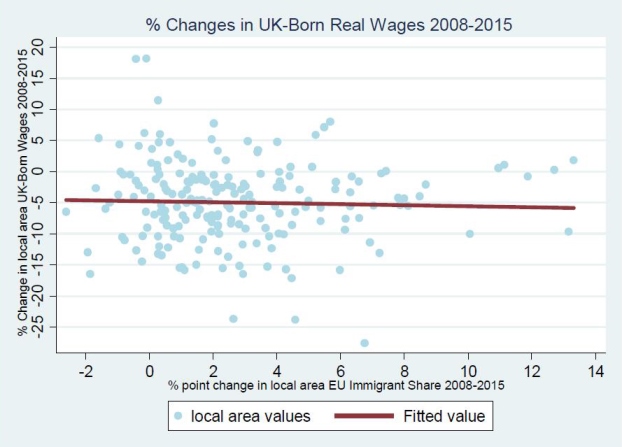
Wages and unemployment, first of all. Is the case against a link proven by the lack of a correlation? Here is one of the charts that Van Reenen and co-authors use to make their case.

Source: CEP analysis of Labour Force Survey. Wadsworth et al. (2016: 10). Notes: Each dot represents a UK local authority. The solid line is the predicted ‘best fit’ from a regression of local authority percentage change in wages on the local authority change in share of EU immigrants. These are weighted by the sample population in each area. Slope of this line is -0.08 with standard error of 0.15, statistically insignificantly different from zero.

Source: CEP analysis of Labour Force Survey. Wadsworth et al. (2016: 10).
Notes: Each dot represents a UK local authority. The solid line is the predicted ‘best fit’ from a regression of local authority percentage change in wages on the local authority change in share of EU immigrants. These are weighted by the sample population in each area. Slope of this line is -0.08 with standard error of 0.15, statistically insignificantly different from zero.

This shows that there has been essentially a zero correlation between changes in real wages in any given local authority and the increase in EU migration in the same local authority. Case proven, it seems.

But pause, just for a moment. Basic statistics courses teach that “correlation need not imply causation”. But there is a subtler version: lack of correlation need not imply lack of causation. Here’s a simple argument (which is easy to substantiate with a couple of lines of algebra).

Suppose that real wages at a regional level tend to be stronger (which in recent years typically means to fall less rapidly than the average – look at the y-axis on the chart) where the regional economy is stronger. And suppose that EU migrants know this. Where will they tend to move to in the UK? Well, to the more prosperous regions, of course. Now suppose that the Remain arguments are correct, and more EU migrants do not have any effect on wages. If that was the case, then we should expect to see a positive correlation in the scatter diagram, but we do not. Whereas if EU migrants do depress wages, this would dampen the positive relationship and possibly result in no correlation at all. Which is what we see in the chart.

Now Van Reenen and his co-authors are all excellent econometricians so they all know this kind of argument perfectly well. Which makes their arguments all the more disingenuous. I’m not claiming that this proves there has been a serious impact on wages. There has been plenty of more sophisticated research which suggests it is hard to find an impact either way (and which Minford acknowledges in the quote above). But that does not in itself prove the argument wrong.

What about hospitals and schools? Well here the Remain argument is on the face of it much stronger. Van Reenen and others have shown that EU migrants are pretty clearly net contributors to the public purse. But the only problem with this argument to the UK-born worker is that there is no direct observable impact of these higher tax receipts on hospitals and schools. We do not have labels on CT scanners or smart whiteboards saying “these facilities were paid for using the extra tax receipts from EU migrants paypackets”. All they can see is the queues and the letters assigning their child to a school two bus rides away.

And finally, of course, housing. Well here of course, all the economists agree. And the policymakers. Everyone agrees. Absolutely everyone. We must build more houses.

But we don’t. Or at least not enough. Nor have we, for decades. As a result, UK households spend more on housing, per square metre of residential land, then any other European country except Luxembourg (See Footnote 3).

Does EU migration make things worse? Well of course it must do. (Even Nigel Farage can be right once in a while.) The CEP paper documents that the number of EU migrants in the UK rose by 2.4 million between 1995 and 2015. That accounts for roughly one third of the total growth of population in the UK over that period. And meanwhile, as Bank of England governor Mark Carney pointed out back in 2014, the UK builds half as many houses each year as Canada despite having twice the population.

No one disagrees that this is crazy. Yet neither the government nor the opposition have made any move to do anything serious about it. Despite the fact that bringing down the cost of housing could be the most effective way (and possibly the only effective way) of raising living standards for UK workers in the medium to long term.

But don’t get me started on housing. It is a serious, a very serious problem, that goes way beyond arguments about Brexit. But, I reiterate, EU migration must be making it worse.

Does all of this mean that I think we should stop EU migration? (Even if we could, which is of course debatable, even post-Brexit). It does not. Despite the fact that, as I noted at the start, my personal interests coincide with my professional judgement, I stick with that judgement. The EU brings benefits. EU migrants bring benefits. To me, and people like me, especially. To the economy on average, almost certainly. But not to everyone.

Pro-Remain policymakers need to start thinking fast about acknowledging this, and how to offer something to the poor and dispossessed of this country to compensate them explicitly for the costs of EU migration. This would not be impossible: remember the last-ditch crossparty promises before the Scottish vote? Maybe these made a difference, maybe they didn’t. But it is worth a try. Very soon it will be too late.

Find out more

Courses at the Department of Economics, Mathematics and Statistics

Images sourced from Wadsworth, J., Dhingra, S., Ottaviano, G., Van Reenen, J., and Vaitilingam, R. (2016) ‘Brexit and the Impact of Immigration on the UK’. CEP BREXIT ANALYSIS NO. 5. Available online, last retrieved 13 June 2016.

This post represents the views of the author and not those of Birkbeck

Footnotes

  1. “Brexit and the Impact of Immigration on the UK”, Jonathan Wadsworth, Swati Dhingra, Gianmarco Ottaviano and John Van Reenen, CEP Brexit Analysis No. 5.
  2. The CEP document shows that the fall for those on the 10th decile has been somewhat larger, and started
    earlier.
  3. De La Porte Simonsen, L and Wright, S (2016) “Residential Land Supply in 27 EU Countries: Pigovian Controls or Nimbyism?, paper presented to Birkbeck Centre for Applied Macroeconomics Annual Workshop, May 2016.

Europe at the Crossroads: Professor Everson comments (Part 1)

This post was contributed by Michelle Everson, Professor of Law at Birkbeck. She has written widely on European Economic and Constitutional Law and has advised the European Commission, the European Parliament and the European Central Bank on matters of European Law.

Professor Everson is hosting a week long debate on ‘Europe at the Crossroads’ at Birkbeck (13-17 June). For details and to book your place, please visit the ‘European Law on Trial’ website.

Every day this week, Professor Everson writes for Birkbeck Comments, offering up her thoughts, opinions, and analysis on the EU referendum.

Law-on-Trial-slider -WEB

Order in chaos

Assaulted on all sides by a vilely-tempered and wholly ill-informed Brexit ‘debate’, I ask myself daily why I am going to Vote Remain. I may be known as a Professor of European economic and constitutional law, but do not belong to the ordinarily-rapturous academic fan base for the European Union. Quite the country, the determination of all-too-many of my colleagues to view the EU only through rose-tinted lenses confounds me, and always has done. From the 1980s onwards, when, as a PhD student, I discovered in my own research that European integration was synonymous with a process of the disintegration of intricate historical-political accommodations, social mores and economic interest-balancing at the national level, my default appreciation of the Union has been one of suspicion. In the meantime, as the EU has been engulfed in financial and sovereign debt crisis and has been unable to respond coherently to migration crisis, my critique of the current deeds of the Union makes many a Brexit campaigner look moderate.

From the destruction of political choices within the regime of economic austerity constructed in the effort to contain sovereign debt crisis (European Stability Mechanism and Fiscal Compact), to the reduction of Greece to the colonial status of dumping-ground within a punitive migration regime that is as dysfunctional as it is immoral, the EU has been found wholly wanting. Worse still, as the normally-sustaining European rule of law has collapsed within politically-expedient judicial law-making to sustain the Eurozone through constitutionalised imposition of economic conditionality (Thomas Pringle, heard by the Court of Justice of the European Union in 2012), the very ideal of Europe as a continent of justice, democracy and solidarity has itself been traduced.

Yet, the European Union, even, and perhaps especially so in its flawed current incarnation remains one of the most ambitious political projects ever conceived. Far beyond its original pragmatically-ideational roots within the post-war desire to bind national economies so tightly to one another that any future conflict would be an impossibility, and outside the delusional realm of federalist dreams (we, the people, simply do not want one), the Union also embodies an old-new ideal of order in chaos, or of self-determination beyond the self-referential reaches of territorial sovereignties. This is its inspirational strength, but perhaps also its real-world tragedy as it is caught up in the self-same paradoxes of all such universalising projects – be they of might (colonial), or of the mind (religious) – as it equalises differences between its constituent parts, and creates its own self-referential communitarianism through the seemingly inescapable definition of its own territorial boundaries.

The Brexit debate has been dominated by a fight about facts. In the one corner, those determined to catapult the UK out of the Union have been evermore inventive (read mendacious) in their pursuit of figures that putatively demonstrate the unbearable strains of integration upon UK population numbers and the Exchequer. In the other corner, Vote Remain’s assertion that a no vote will lead to economic shock is better backed up by reputable research, but the campaign is nonetheless careless in failing to highlight that all economic prognoses contain their own uncertainties. The debate has been sadly misdirected as each side seeks to present a ‘truth’ of statistics. By contrast, little or no attention is paid in to visions of how the global world, the EU and the UK within it, might be ordered for the good. Yet, while cost-benefit analysis of EU membership will, in any objective analysis, simply falter within the complexities of the balancing of trade or social benefits against their regulatory costs, our age of economic globalisation is urgently demanding our conceptual attention: what are its challenges, how can we tame economic powers that ignore national boundaries, is there a common good within this global world and, if so, how might we defend it?

For a present-day generation of people living within Europe, a generation long distanced from the absolute moral certainty of a post-war generation determined never again to break the peace, and, in its youthful global outlook, even less inclined to commit to a culturally-foreclosing European federalism, there is only one possible ideational vision of Europe to which they might commit: the search for an order in chaos, for a form of governing beyond closed national communities; an order which defies the inequalities created by unconstrained markets and capital, and an order which seeks also to establish justice, democracy and solidarity outside the certainties of a once-sustaining but now illusionary territorial (national) sovereignty. The European Union of 2016 is not the European Economic Communities of 1958, having morphed from an international community of market building into a supranational body of ever closer Union between its peoples. Nor is the European Union of 2016 a happy or uncontroversial one, as efforts to save the Euro feed the pressure for ‘more Europe’, but simultaneously undermine the political and social values that must always be a part of the European project.

Michelle Everson

Professor Michelle Everson

Yet, throughout its history and still today, the European project has been the drawing board for a sustainable ideal of civilised internationalism. That Europe is and always will be beset by its own contradictions of equalisation and boundary-drawing, or that it seems, currently, to be complicit within rather than controlling of the economic forces that are globally threatening to overwhelm all human (non-economic) self-determination, are happenings that simply cannot be denied. At the same time, however, Europe’s current malaise cannot and should not be taken as reason to walk away from the best enunciated and most practised iteration of the search for order in chaos offered by any post-national organisation now operating on the global stage. Instead, we must learn from Europe’s failures in order to fight within the EU for all of the advantages of order in chaos; for opportunities of human innovation on the one hand (rights of engagement within markets), and for the securities of self-determination on the other (rights of control over markets).

Law on Trial 2016: The European Union at the Crossroads, runs at Birkbeck from Monday 13 to Friday 17 June. Book a free place here.

Listen to Professor Everson on the topic of the EU referendum in the latest edition of Birkbeck Voices

This post represents the views of the author and not those of Birkbeck

Find out more

Brexit – is it even possible?

Law on Trial 2016This post was contributed by Professor Erik O. Eriksen, Director of ARENA Centre for European Studies at the University of Oslo, who will be participating in a panel discussion on Friday 17 June as part of this year’s Law on Trial events. Law on Trial is the School of Law’s annual week-long programme of free-to-attend public lectures and panel discussions and this year puts the European Union on trial – one week before the EU referendum in the UK.

Can the Brits actually decide if they want out of the EU on the 23rd of June?

There have been quite a few moments of truth in the British debate about leaving the European Union. Increasingly it has become evident how deeply involved the country is in the EU, and how dependent the Brits are on European cooperation. The debate has highlighted the importance of the financial industry, whereby London City would be threatened by the replacement of Frankfurt as a leading European finance centre. Then there is the issue of agriculture, which would be left without subsidies from the EU. Business in general is dependent on immigration. The same goes for healthcare. Leaving the EU is said to have consequences for staff, waiting lists and the quality of treatment in British hospitals.

And also soccer, a major industry with a turnover of billions that relies on free movement, would be affected. There are currently 332 soccer players from the EU playing in the top league in England and Scotland. These players, however, do not fulfill the criteria for working permits for citizens from non-EU (member) states. Surely such matters can be arranged, but what will withdrawal mean for the rights of Britons that live and work in the EU? And how will the relationship of the UK with third countries look after a withdrawal from the EU?

The situation of the UK in the EU illustrates a general point about an integrated Europe. Much sovereignty has been delegated, interdependence has increased. Integration has affected the very nature of nation states. Many laws will have to be rewritten if the country leaves the Union. This should however not come as a surprise. The EU is known to be more than an intergovernmental organisation, where states can easily withdraw.

The EU makes its own laws that are binding on the members. And the internal market is much more than a free trade zone. The Union abolishes differences in laws and standards and develops new rules and regulations that all members have to accept. This uniform regulatory framework provides legal certainty for market participants. Within the EU cases can be brought before a supranational court. Rules shall be interpreted, enforced and complied in the same way. The European Economic Area (EEA) Agreement that Norway, Iceland and Lichtenstein have with the EU, makes this apparent. EEA law has no material substance in and of itself, but obliges Norway to accept existing and future EU law.  It should therefore not be seen as EEA law, but rather EU law.

Right to sign out?

There is a right to withdrawal from the Treaty, but how does this work in practice? First of all, the conditions for withdrawal need to be negotiated. These negotiations can take up to several years.  At present there is no majority in the House of Commons on any option for withdrawal. Some want to negotiate first, others want to use the withdrawal-clause immediately, and then there are those undecided. The problem is that the country has to get rid of complex regulations, covering different policy areas. New policy has to be created to replace abolished EU regulation.

Second, the future relationship with the EU needs to be renegotiated. All, including EU-sceptics, acknowledge that they cannot manage without some kind of agreement with the EU. In particular, the Union represents the world’s largest market with its 500 million inhabitants. The Brits are dependent on an agreement with the EU in areas of common interest.

The example of Switzerland, a country that has 120 bilateral agreements with the EU, shows how complex such a relationship can be. Neither do we know what the political climate will be after a possible ‘no’ in the British referendum. It is difficult to first withdraw from the Union and from the incurred commitments, and then start negotiating good terms for continued cooperation. Divorces are seldom pleasant.

Third, bilateral trade agreements with third countries have to be established, to replace those that have been signed with the EU. This creates many uncertainties, especially because large trade agreements are at present negotiated between blocks of countries, where the great powers China, the USA and EU dominate. From an economic perspective, there is a risk of an economic downturn in the UK after withdrawal. Financial markets already signal unrest over a possible turbulent economic situation in the future.

These factors can lead to a legal nightmare and years of negotiations and uncertainty. One thing is for sure: leaving the Union would change the UK’s trade relations with the EU and the rest of the world significantly.

Unclear consequences

Furthermore, a whole list of other problems arises if the UK decides to leave the Union. What about the rights of the almost two million Brits that live in other EU member states, and make use of the rights they have as EU citizens? British pensioners living in Spain, for example, have access to Spanish healthcare.

The UK has also considerable clout in the foreign policy of the EU. It is therefore unclear what role the country will be able to play outside the EU. The UK will become less important to the USA and many argue that as a former empire, the country will have difficulty in being regarded a neutral broker.

Even areas where Brits enjoy opt-outs from the EU’s laws, as in asylum and immigration policy, are affected by EU decision making. If for example the Dublin Regulations in which member states are responsible for examining the application of asylum seekers is abolished, the UK will not be able to deport them.

Withdrawal is risky also because Great Britain’s unity is at stake. Scotland might withdraw from the United Kingdom.

Problems attached to the withdrawal seem insurmountable, but in a referendum it is not always the rational arguments that prevail. Often voters vote on other things, often external factors and trust in present powerholders play a decisive role. This referendum is particularly interesting for two reasons.

The fiction of alternatives

First, the referendum forces those in favour of continued EU membership to be on pitch. They have to clearly state why the EU is important, and dismantle wrong information and falsely-grounded ideas about what a country in ‘splendid isolation’ could achieve. We rarely hear Brits talk about the EU in positive terms.

Secondly, ‘Brexiters’ have to propose a realistic alternative. Those in favour of withdrawal have to present a credible alternative to EU membership. Responsible politicians have to make evident how a United Kingdom outside the EU would be able to cope in an increasingly interdependent world.

There is no current agreement on what a United Kingdom outside the EU would look like, and how relations with other countries are going to be upheld. Some argue that Britain only needs a customs union with the EU; others argue that they can expand their cooperation with the Commonwealth, and yet others look to Norway’s EEA Agreement and Switzerland’s bilateral agreements. But are any of these models realistic alternatives?

A customs union with the EU – with free market entrance – is only possible if the other 27 EU countries agree, as it requires Treaty amendment. An agreement will not be acceptable without significant contributions from the United Kingdom. Agreements with Commonwealth nations, which can be difficult enough since they now have strong relationships with other countries, would not compensate for the loss of the EU market.

Both the EEA model and the Swiss bilateral model would entail getting access to the internal market by accepting EU law and regulations. The Brits would then be no better off than today with regard to sovereignty, quite the contrary. By adopting any of these models, the United Kingdom would become partially EU member, but without being able to influence EU decision-making.

British EU sceptics want to roll back integration and return sovereignty to national institutions. They frequently reject an affiliation like the Norwegian one because it would mean even more EU dominance. Norway has abstained from having influence, but not from being affected by the EU’s decisions. The core of EU scepticism lies in the experience of being governed by others, which is the reality in the EEA. The Norwegian loss of sovereignty is not compensated by co-decision in the European Parliament and Council, as is the case for Great Britain. Power is not the same as sovereignty. The ceding of sovereignty increases power when it gives actors decision-making power in supranational bodies.

It is not obvious that the UK can actually fully withdraw from the EU. It will be difficult to avoid ending up in a similar situation to that of Norway or Switzerland, where EU laws are accepted in exchange for access to the internal market.

There is, as far as I can see, no realistic alternative to (a reformed) EU, while the fiction about an alternative is what motivates British EU sceptics. This very same fiction underpins the continued legitimation of technocratic EU adaptation made by the opponents to Norwegian EU membership. But what is a plain fact in Norway is the ultimate horror for many Brits.

National Living Wage: From Classroom to Newsroom

How teaching from a Birkbeck BSc Economics module ended up in the FT

mouse and ftOn 1 April, 2016 The Financial Times reported the results of a survey of UK economists on whether the government’s new national living wage would do Britain “more harm than good” (against) or “more good than harm” (for).

Professor Stephen Wright, of Birkbeck’s Department of Economics, Mathematics and Statistics, was one of four UK economists whose views were quoted at some length in the article. He has since published his comments in full on his personal web page.

“It was good timing” said Professor Wright. “When I got the email from the FT, a few weeks back, it was the day after I’d delivered a lecture on exactly this topic, so I had all the material to hand”.

The lecture Professor Wright had just given was for the module, “Current Economic Problems”, given to 1st year undergraduates on Birkbeck’s new BSc Economics programme, which admitted its first students in 2015/16. Students receive a lecture on a particular economic problem one week, and then, the following week, are required to give a presentation on some aspect of the problem, speaking on one side of a debate.

As well as helping to improve students’ communications skills, the module is also intended to show students that the economics they learn from textbooks and in lectures can be applied to practical problems faced by policymakers. Other topics covered in the module this year include immigration, “Nudge”, inequality and the gender pay gap – but topics will change every year depending on what is in the news.

Prof. Wright concluded that, on balance, the national living wage could prove harmful – but with the caveat “that the harm may well be as much from muddying the water as from the actual economic damage done.”

Predicting the impact

Working under the premise that the Chancellor of the Exchequer, George Osborne, believes the corporate sector (or more precisely, the low wage corporate sector) should share some of the burden of mitigating poverty, Prof. Wright concluded that basic economic analysis suggests it unlikely to work as advertised: that“…ultimately consumers of goods and services produced by the low wage economy will pay.”

He argued that the most optimistic perspective you can put on this outcome is that such consumers are possibly less likely to come from the lower end of the income distribution, thus if there was zero impact on employment in the low wage sector, the policy would be mildly redistributive. However, if unemployment in the low wage/low productivity sector increases, this effect would be offset.

Acknowledging that the evidence for adverse employment effects of minimum wages is “pretty muddy”, Prof. Wright goes on to explain that, on the basis of standard textbook models, the extent of any employment losses in the low wage sectors will depend on the elasticity of demand for their goods and services. Indirectly the evidence seems to be quite strong that in the long term these effects can be quite large (viz, for example, the steady fall in the number of pubs in the UK, as drinking in pubs becomes progressively more expensive relative to competing activities).

“If the existing low wage sector contracts it is not clear where those working in it (who typically have low productivity and skills to match their low wages) will go to work instead. But just as important I believe, is that these policies muddy the water. Wages are a very blunt instrument to tackle poverty.”

Case study: The London Living Wage

To demonstrate this, Prof. Wright cites the Greater London Authority (GLA)’s calculations of the London Living Wage (“A Fairer London: The 2015 Living Wage in London”). When the GLA calculated living wages ‘bottom-up’ by looking at the consumption needs of different household types, they got very different answers for different households. Indeed, the small print of the GLA calculations show that, given the current system of benefits, their calculated living wage for a family of two working parents is actually below the current minimum wage.

Drawing from this, the FT quoted Prof. Wright’s key conclusion, that “…a single Living Wage, built up from consumption needs, is not a logical construct: if it had any basis at all it should be a set of living wages, for different household types (but with the bizarre implication that, in the current benefit regime, having children would result in a reduction in the relevant Living Wage).”

“My personal view is that poverty reduction for those in work can be, should be, and already is carried out by government benefit policies. The tax credit system was one of the great unacknowledged success stories of Gordon Brown, and I’m pretty sure that it has been the primary factor behind our sustained low unemployment rate, and the resilience of employment during the recession. It seems a shame to start to throw this away just as it has really proved its value.”

Birkbeck is known to provide the highest quality teaching, which can be applied to the workplace. For BSc Economics students on this occasion, what Prof. Stephen Wright was teaching them went from their classroom to a highly respected media publication.

All enrolled students in the School of Business, Economics and Informatics at Birkbeck, University of London can subscribe to FT.com for free through the Birkbeck e-Library.

Further Links:

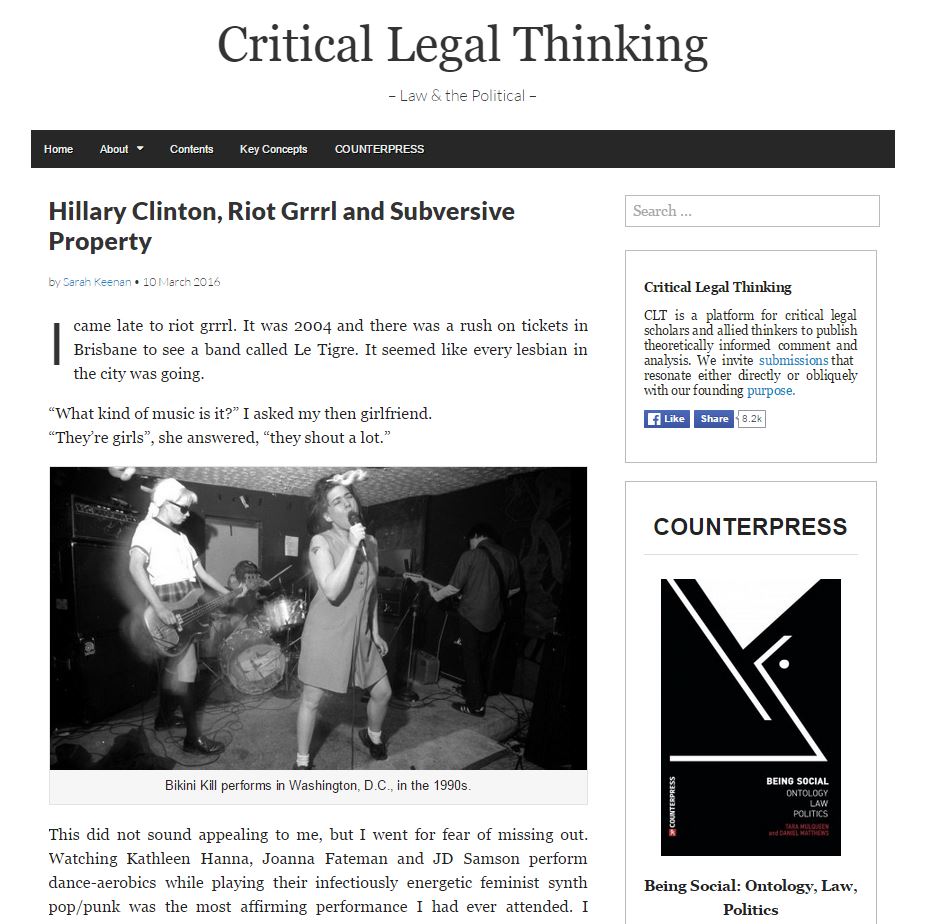
Hillary Clinton, Riot Grrrl and Subversive Property

This post was contributed by Dr Sarah Keenan, lecturer at Birkbeck’s School of Law. Her book ‘Subversive Property: Law and the Production of Spaces of Belonging’ is published by Routledge.

This post was originally published on Critical Legal Thinking on Thursday 10 March

I came late to riot grrrl. It was 2004 and there was a rush on tickets in Brisbane to see a band called Le Tigre. It seemed like every lesbian in the city was going.

“What kind of music is it?” I asked my then girlfriend.
“They’re girls”, she answered, “they shout a lot.”

Bikini Kill performs in Washington, D.C., in the 1990s. (Image copyright Pat Graham / www.patgraham.org)

Bikini Kill performs in Washington, D.C., in the 1990s. (Image copyright Pat Graham / www.patgraham.org)

This did not sound appealing to me, but I went for fear of missing out. Watching Kathleen Hanna, Joanna Fateman and JD Samson perform dance-aerobics while playing their infectiously energetic feminist synth pop/punk was the most affirming performance I had ever attended. I bought their three album back catalogue the following day, started reading up on them, and discovered Bikini Kill, Kathleen Hanna’s previous band, one of the founding bands of the riot grrrl movement.

Riot grrrl began as a group of bands playing hardcore feminist punk on the northwest coast of the USA in the early 90s, and grew into a cultural force which continues to influence DIY culture and ‘third wave’ feminism today. Rather than political lobbying, riot grrrl feminism was and is focused on women creating spaces where they can create music and other art, exchange ideas and embrace punk’s anger while completely rejecting its machismo. While riot grrrl was by no means a perfect political movement – most significantly, it was very white-dominated – it did forge a new kind of grassroots anti-establishment feminism that continues to inspire and provide a psychic home for many women, queers and nerds.

It’s now eleven years since that Le Tigre gig, and barely a week goes by without my playing a track from this feminist punk genre. The discordant pain and uncensored rage of riot grrrl music, balanced by its sharp irony and humour regularly helps me to leave home in the mornings, and recover when I return. Riot grrrl, together with the new wave, post-punk and queercore genres that followed, have profoundly helped to shape my view of the world and my place in it.

I was sickened at the discovery that ‘Rebel Girl’, a classic Bikini Kill track, had been used in a recent promotional video for Hillary Clinton’s presidential nomination campaign. Clinton — former US Secretary of State and multi-millionaire Democratic Party establishment figure, who voted for the war on Iraq, has consistently supported Western military intervention in North Africa and the Middle East, sat on the Wal-Mart board of directors while the company waged a campaign against unions, retains complex and significant ties with corporate power, and whose friend and supporter Gloria Steinem recently suggested that young women supporting Bernie Sanders are doing so to get attention from ‘boys’ — is not a rebel girl.

https://www.youtube.com/watch?v=DzMGqVh8G20

While Clinton is keen to claim the feminist label, her proven commitment to US capitalism and imperialism mean that her feminist politics will only ever be narrow, white and liberal. For Clinton’s capitalist-loving, war-mongering machine to exploit the radical, grassroots, anti-establishment, DIY-sound of riot grrrl was a particularly offensive co-optation.

Within a few days of the Clinton campaign releasing the video, Tobi Vail, Bikini Kill drummer and feminist punk icon, responded by issuing YouTube a copyright infringement notice. As a result, the video was taken down. Now those clicking on the link get this.

Unsurprisingly, copyright and other forms of intellectual property are not generally associated with the riot grrrl movement. Vail filed the notice reluctantly, stating in an interview:

I was seriously trying to just ignore it (because I’m not so into telling people what to do and that song has a life of its own and I’m just one person in the group Etc Etc) but Bikini Kill fans and friends would not allow it… it’s basically an advertisement… we don’t authorize use of our songs in advertisements…

It was not the royalties that mattered to Vail. She was not seeking to enforce a right to exclusively possess the song; as she said, it ‘has a life of its own’. Rather, issuing the notice was about retaining political integrity and meaning for ‘Rebel Girl’ and for the riot grrrl movement more broadly. The fact that it was Bikini Kill fans who ‘would not allow’ this track to be used by the Clinton campaign is significant. Part of the joy and momentum that powered the riot grrrl movement was the space that it created for fans — primarily young women — not only to consume music and ideas, but to participate in their making and to take ownership of them. Riot grrrl belongs to its fans, who in turn constitute the movement.

Building a space of belonging for girls and queers who did not otherwise feel safe anywhere, including in their family homes, was central to riot grrrl. This centrality is made clear in recent reflective pieces written by key figures in the movement. In ‘Run Fast’, the title track of Kathleen Hanna’s current band, The Julie Ruin, Hanna looks back on riot grrrl as a movement of collectively making space and forging identities:

in the end we made
tiny islands where we didn’t always have to be afraid.

In her recent memoir, Carrie Brownstein of Sleater-Kinney similarly describes her journey from riot grrrl fan to key player as one of creating a particular kind of space.

I’ve always felt unclaimed. This is a story of the ways I created a territory, something more than just an archipelago of identities, something that could steady me, somewhere that I belonged.1

When Vail issued the copyright notice on the Clinton video, it was to protect the space of belonging that has been carved out by riot grrrl over the last three decades. While property tends to operate in the interests of power, it can also be used as a tactic to subvert hegemonic relations of belonging and create new ones.

While lawyers tend to emphasise the right of exclusive possession that comes with property, feminist writers have highlighted the importance of belonging.2 Belonging is a more complex concept than exclusion: while it relates to questions of ownership and possession, it is also about identity — about fitting in and feeling safe or ‘at home’.

In my work on property, I have argued that property can be best understood as a relationship of belonging that is contingent on space. My relationship of belonging with riot grrrl culture, for example, will constitute property while I am at an L7gig (yes, they have recently reformed), where I will stride in like I own the place, confidently take up space in the crowd, sing/shout along to the choruses, laugh at jokes about tampons and exchange knowing glances with other fans. But my relationship of belonging with riot grrrl culture will not provide me with any of the privileges of membership or ownership were I to attend a classical music performance at the Southbank Centre. My attribute of being a riot grrrl fan will operate as property in some spaces but not in others.

Read the original article on Critical Legal Thinking

Read the original article on Critical Legal Thinking

More significantly, if we accept that attributes such as whiteness, masculinity and heterosexuality are relational rather than essential or biological, then we can agree with writers such as Cheryl Harris3 and Margaret Davies4 that such attributes can constitute property — they are relations of belonging. However, those attributes will only function as property if they exist within broader spaces that give them power and meaning. Whiteness will only constitute property while we continue to live in a white supremacist world. Similarly, masculinity will only constitute property while we continue to live in a patriarchy, and so on. This analysis means that if the normative goal is to challenge the way whiteness and other identity categories operate as structures of exploitation and oppression, then it is the spaces that privilege whiteness etc which must be undermined and challenged. We need to build different spaces, as the riot grrrl movement did.

Understanding property in this way allows for property to be subversive. The spaces that give power and meaning to relations of belonging are not fixed and do not have to empower relations that are oppressive, exploitative or conservative. Property is experienced in complex and overlapping ways not solely determined by law.

Property can be productive of social goods in a way that subverts hegemonic power relations. By creating spaces where young women, queers, punks and nerds not only belong but also feel ownership of what is produced, riot grrrl was and is a powerful materialisation of subversive property. By preventing (or at least delaying and inhibiting) Hillary Clinton from using Bikini Kill to fuel her campaign for the ultimate position of establishment power, Vail’s copyright notice was an effective assertion that this music and the psychic and material space it created still belong to us.

 Find out more

Article footnotes:

  1. Carrie Brownstein, Hunger Makes Me a Modern Girl (Riverhead Books 2015) 11. 
  2. Brace, Laura, The Politics of Property: Labour, Freedom and Belonging (Edinburgh University Press, 2004); Cooper, Davina, “Opening Up Ownership: Community Belonging, Belongings, and the Productive Life of Property” Law & Social Inquiry 32, no. 3 (2007): 625-664; Keenan, Sarah, Subversive Property: Law and the Production of Spaces of Belonging (Routledge, 2015); Strathern, Marilyn, “Cutting the Network” Journal of the Royal Anthropological Institute (1996): 517-535. 
  3. Harris, Cheryl I, “Whiteness As Property” Harvard Law Review 106, no. 8 (1993): 1707-1791. 
  4. Davies, Margaret, “Queer Property, Queer Persons: Self-Ownership and Beyond” Social and Legal Studies 8, no. 3 (1999): 327-352. 

Who remembers Aylan Kurdi now?

This post was contributed by Dr Nadine El-Enany lecturer in Birkbeck’s School of Law. This first appeared on Media Diversified on 4 January 2016

Moments of Mourn held in memory of Aylan Kurdi and other refugees

Moments of Mourn held in memory of Aylan Kurdi and other refugees

Who remembers Aylan Kurdi now? The photograph of the Syrian toddler that so galvanised Europe’s public over the question of refugees seems a distant memory now. Is it that a genuine concern for the wellbeing of refugees has merely been displaced by other political priorities in the minds of Europeans? Or is it that the basis for the mass outpouring of grief and the acts of generosity and solidarity that followed the publication of the photo was always fickle, contingent upon white Europeans’ limited capacity to humanise the other?

What was it about the photo of Aylan Kurdi that so stirred Europe’s public over the question of refugees? Aylan Kurdi was by no means the first child to drown en route to Europe and since his death, more than 70 children have lost their lives off the Greek coast. Since 1993, more than 22, 394 people are known to have died attempting to enter Europe. The actual figure is likely to be much higher. The blood on the hands of Europe’s fortress-makers had long dried before Kurdi’s body washed up on a Turkish beach in September. How did it come about that white Europeans were able, all of a sudden, to humanise the body of a refugee, least of all, the body of a Muslim?

What did white Europeans see when they looked at the photo of Aylan Kurdi? They saw their own sons and nephews in the photo, aptly illustrated by the #CouldBeMyChild hashtag which was trending on Twitter following the discovery of Kurdi’s body. The image was of course particularly potent in depicting the tragic end of a life so young. But was there something else about this particular child that enabled his humanisation by white people, when so many others had died before?

Perhaps it was the innocence evoked by the body of a light-skinned child that enabled the temporary, fleeting awakening among white Europeans to a refugee movement that long-preceded the media spotlight on that photo. The news has moved on, but the situation persists and grows more desperate daily. According to the International Organisation for Migration, an estimated 700,000 people arrived at Europe’s borders between January and October 2015, compared with 280,000 for the entirety of 2014. Refugees fleeing persecution and war in Syria have been trying to reach Europe since 2012. The majority remain in neighbouring countries in the region, with only 10% of those fleeing Syria seeking protection in Europe. Many have perished along the way together with refugees from Afghanistan and Iraq.

Those white Europeans with a new penchant for carrying #RefugeesWelcome tote bags are unlikely to be amenable to the argument that this is the result of an awakening of their conscience made possible by the coincidentally fair hue of Aylan Kurdi’s skin. Yet, research has shown that the extent to which white people feel empathy and humanise others correlates with implicit racial biases, with negative stereotyping of those with darker skin coresponding to a lower level of empathy shown for them. Feelings of empathy are known to encourage cooperation and assistance between human-beings, while an absence of identification with the suffering of others can lead to violence and abuse, both characteristics of Europe’s militarised border regime.

What of the refugees who do not evoke in the mind of the white European an image of their own offspring? The images of black African bodies washed up on the shores of Europe’s mediterranean beaches last Spring did not prompt an equivalent outpouring of compassion and charitable action. What of the bearded male refugee? What of the woman in the hijab or burka? What of their dark-skinned children? These coded images of Muslims inhibit their humanisation. The Islamophobia that thrives in European societies today means that rather than compassion, they elicit feelings of apprehension and fear.

In the wake of the Paris attacks, the British newspaper, the Daily Mail, published a cartoon depicting racialised images of Muslims crossing Europe’s borders along with rats. Poland reneged on its refugee quota agreement following the attacks and more than half of all US state governors have refused to accept Syrian refugees. Meanwhile, Australia declared its policy was to focus its protection efforts on Christian Syrians.Each of these decisions is reproductive of Islamophobia in buying into the idea that Muslims are associated with terror by virtue of being Muslim.

Read the original article on Media Diversified

Read the original article on Media Diversified

Rather than acknowledge the racism endemic in European societies, many white Europeans prefer to see the dehumanisation of refugees as merely an expression of anti-migrant sentiment, or different values, or viewpoints in what is presented as a fair debate on migration. In what amounts to a dangerous apologia for racism, Slavoj Zizek has categorised the claims of anti-immigrant populists as being about the “protection of our way of life” and argued that the claim Europeans lack empathy for the suffering of others is “merely the obverse of…anti-immigrant brutality”. In a move demonstrative of his attachment of negative stereotypes to refugees, Zizek insists that it be “made clear” to them that they are to “respect the laws and social norms of European states” which entails “No tolerance of religious, sexist or ethnic violence”, as though sexist, racist and religious violence were not fundamental aspects of European life.

While Aylan Kurdi’s light skin colour may have allowed white Europeans to humanise him and partake in large-scale charity-giving, petition-signing and demonstrations, their children could not of course have met Aylan Kurdi’s end. It was, after all, the ancestors of the white Europeans tweeting selfies taken with their babies as they headed for their nearest #RefugeesWelcome march who colonised the lands from which these desperate people come. And it is white Europeans occupying positions of power and privilege today who continue to give orders for bombs to be dropped on their homes.

Absent from the #CouldBeMyChild hashtag was an understanding of the specificity of colonial histories and present imperial wars and the way in which these structurally determine positions of power and privilege as between white people and people of colour. Refugees are here, their bodies washing up on European beaches, because white Europeans were, and continue to be, there.

Find out more

Addressing the skills gap through partnerships between education and business

This post was contributed by Elena Georgalla, Work Readiness Programme Officer at Birkbeck. Elena’s article follows the recent roundtable discussion (hosted by the college’s Careers and Employability team) which explored cross-industry perspectives on the skills gap and social mobility

Universities and businesses alike suffer from the skills gap. Working closer together can have transformative potential.


Mind The Gap Logo by rrward on DeviantArt

Mind The Gap Logo by rrward on DeviantArt

The perceived growing gulf between the skills and abilities the workforce offers today and the skills and abilities businesses consider crucial to their success – the so-called skills gap – is old news to the UK job market.  Although its severity and extent remain highly contested, often distorted by politically-loaded debates on immigration and Tier 2 Visas, the overwhelming consensus among employers is that there is a deficit in graduates’ ability to communicate effectively and to solve problems creatively, to think critically, to work collaboratively and to adapt to changing priorities.

Further to these “soft skill” shortages, businesses report that job seekers also lack the technical “hard” skills, associated with specific jobs, including, most alarmingly, key digital skills. The latter has given rise to a wide range of public and private sector initiatives to inspire more young people to take up STEM subjects. As universities and businesses alike are affected by the skills gap, joining forces could have a transformative potential.

Universities and employability

Education has been quick to receive the blame. Despite the UK’s massive expansion in university education – 2015 saw a record number of undergraduates admitted to British universities – no parallel increase in skills has occurred as a result. Universities are at a watershed; their perceived value is reducing as they are faced with challenges that are intensified by burdensome tuition fees and a policy shift that favours apprenticeships for school-leavers to recalibrate the apparent skills malaise.

At a recent roundtable discussion organised by Birkbeck, University of London, chaired by Prof Philip Powell, Pro-Vice Master for Innovation, senior decision makers and university recruitment managers from some of the UK’s largest graduate employers questioned the role of university education as a sufficient indicator of a candidate’s potential. More often than not, they would favour a strong track record of work experience over academic achievement.

Are universities then in danger of becoming redundant if the norm of a university degree being the golden ticket to employment no longer stands? Is work experience a better indicator of ability than an undergraduate degree let alone a postgraduate one? Should more school-leavers consider alternative routes to employment, such as well-remunerated apprenticeships with clear progression paths, rather than three or four years of study followed by many years of paying off student debts and no correlated career outcomes?

It’s time for universities and employers to come together.

Addressing the skills gap

A growing number of universities have been responding to these questions by establishing direct partnerships with businesses in a variety of ways to take direct action towards addressing the skills gap and at the same time avoiding the bleak scenario of the overqualified unemployed graduate.

Indeed, the best universities for graduate employment have one thing in common: strong employer presence on campus. This, in tandem with academic excellence and playing to the strengths of each institution, appears to be a good recipe for success. This was certainly the overwhelming view of our roundtable participants who admitted that, empirically, the most successful candidates come from universities that excel at building partnerships with employers, increasing employer presence on campus, embedding employability in the overall student experience, and crucially, working with businesses to design academic curricula.

Apprenticeships have a key part to play in this model; there is large scope for universities to work with employers to establish high quality degree apprenticeships that allow students to gain a university qualification and invaluable (paid) work experience. Birkbeck, being London’s original evening only university, is currently exploring a day-apprenticeship/evening-study model. Overall, as employers demand more from their graduates with the modern job market increasingly requiring employees to be forward-thinking, problem-solving and entrepreneurial, it is clear that constructive dialogue, ground-breaking initiatives and a common, mutually-reinforcing approach between universities and business is the best solution.

There is an abundance of case studies demonstrating the importance and success rate of such university-business synergies. But to be truly successful, such partnerships need to go beyond the usual talent scouting and guidance on dealing with interviews and over-demanding assessment centres. They also need to focus on issues that can bring about genuine long-term change: social mobility, diversity and dealing with the chronic lack of women in technology. Such a focus is to the advantage of both sides because failing to tackle these issues will only compound the skills gap if fewer people are able to meet their full potential. Whatever the relationship that universities and businesses build, it ought to be reciprocal, mutually-reinforcing, sustainable and must speak to the needs of both sides.

Work Readiness: J.P. Morgan case study

At Birkbeck, we partnered with J.P. Morgan to launch the Work Readiness Programme, an initiative targeted specifically at students from underrepresented backgrounds, which aims to enhance social mobility and promote diversity in the job market, specifically in technology. Birkbeck prides itself on the diversity of our student body and on our reputation as an inclusive institution. J.P. Morgan has identified work readiness and social mobility as their top community engagement priorities. At the same time, Birkbeck has a campus in East London home to J.P. Morgan’s largest UK operation.

The reasons to join forces are evident. Since its launch, the programme has been very well-received among students and employers alike. On the one hand, employers see the value the programme adds to their efforts to become more inclusive and diversify their workforce; it speaks to real needs. On the other hand, our students have benefitted immensely from interacting with employers on campus and creating their own informal networks, whilst it has given our Career Service the opportunity to veer away from dull traditional career support limited to CV checks and “I’m not sure what I would like to do” conversations. In addition, we are soon to announce a partnership with TechCity UK which aspires to bridge the digital skills gap.

A collaborative approach

University education has a key role to play in driving the success of UK business. But in order to remain relevant, institutions must adapt. Universities are discovering the importance of increasing their collaboration with businesses beyond applied academic research and into preparing graduates for the world of work.

This, of course, does not absolve employers from their responsibility to provide training and opportunities for up-skilling. As emphasised, collaborative approaches should bear something for both sides. Most crucially, both sides should be willing to break the mould and innovate. Ideally, such partnerships should be focused around creating flagship initiatives, with a clear manifesto, well-defined aims and objectives, a robust structure and a progression plan.

Equally, there are many areas that still remain to be explored. Employer engagement in education provision (course development and delivery) for example, is still in its infancy and there is a lot more to be understood and to be implemented. Degree apprenticeships are another area with great potential to transform not only the university experience but also how people progress from education into work.

Finally, the true potential of employer-education partnerships does not solely lie in their ability to nurture super-graduates who are client-friendly, critical thinkers and also experts in Excel, Python and Matlab; it rests in the recognition of the potential to create real societal change and opportunities for everyone.

Find out more

Santa’s Job: An Occupational Health Psychology Perspective

This December, Kevin Teoh (Department of Organizational Psychology, Centre for Sustainable Working Life) makes some light-hearted observations on the psychosocial working conditions of Santa Claus.

Santa Claus has a tough job (By Jonathan G Meath (Jonathan G Meath) [CC BY-SA 2.5 (http://creativecommons.org/licenses/by-sa/2.5)], via Wikimedia Commons)

Santa Claus sighs as he reviews his list of kids who have been naughty, and then goes over those who have been marked nice. The increasing global population means the number of children on his list grows with each passing year. Currently, it’s estimated to contain the names of between 152 and 526 million children (Bump, 2011; Svan, 2009), meaning a lot of presents to sort out and deliver. This is concerning, as there is ample evidence demonstrating that high workloads are linked with poorer health and lower job satisfaction (Goetz et al., 2013; Ree et al., 2014). Gosh, a sick and unhappy Santa, we wouldn’t want that.

Santa’s demanding job

As Christmas approaches and work intensifies, Santa’s standard 9-5 hours five days a week gradually extends into the evening and the weekends, increasing the number of hours worked. The seasonal nature of work faced by Santa and his team exists in other industries as well. Accountants during tax filing season go through a similar increase in their working hours, which has a detrimental impact on their health and work-life balance (Sweeney & Summers, 2002). Putting aside the amazing feat delivering presents around the world on December 25th, cognitive functioning after more than 24 hours of continuous wakefulness is similar to having a blood alcohol concentration level that is over the legal limit (Dawson & Reid, 1998). If we are concerned for the safety and wellbeing of Santa, perhaps he shouldn’t be operating his sleigh under such conditions.

While the job of Santa is likely to be very secure, I wonder whether his crew of elves and reindeers experience similar precarious working conditions that many seasonal workers do. Unfortunately, across Europe the high prevalence of temporary contracts faced by such workers not only increases job insecurity, but temporary workers often have fewer employment rights, perform more hazardous jobs, have poorer working conditions and are paid less (Hesselink et al., 2015). But surely though, given the charitable nature of Santa he must be as close to the best employer you will find?

Taking control of your work environment

Santa has little influence over the fact the busy festive season peaks at the end of December. This isn’t desirable considering the importance control at work has in relation to worker happiness and health. However, the reality of many jobs is the presence of external factors beyond a person’s control. To manage this, job crafting has emerged with growing support as an approach encouraging workers to alter aspects of their own jobs that they can (Wrzesniewski & Dutton, 2001). We actually see Santa himself do this in trying to manage his big deadline. While many countries see December 25th as the day Santa visits with presents, Santa has staggered the dates on which he visits different countries. For example, he distributes gifts in the Netherlands on the 5th of December (as Sinterklaas), before moving onto Germany, Switzerland and neighbouring countries the next day. On the 18th, you will find him as St. Nicholas in the Ukraine, while on the 6th of January a Father Frost gives out gifts to many children of a Russian Orthodox background.

In addition, we see that Santa has crafted part of the job for himself, and delegated aspects of the role to others. Across the world we see Santa as the bearer of gifts and happiness. However, in many cultures Santa partners local representatives who handle issues relating to discipline and punishment. The distributed work often involves beating misbehaving children or taking them away in sacks, and is carried out by Santa’s assistant Krampus (Austria and Germany), Schmutzli (Switzerland) or Zwarte Pieten (Belgium and the Netherlands), amongst others. It is not clear why he has crafted his job in this way. It could be to manage the overwhelming workload, or perhaps it’s an aspect he does not feel comfortable about or even competent at. Regardless, it seems to contribute to Santa’s success.

Why is Santa, Santa?

Santa-Hat-webConsidering these points above, what motivates Santa to work through such difficult working conditions? He is likely to be eligible for retirement, and while he may be doing it for the fame it is unlikely that the role provides a strong financial incentive. It is, however, far more likely that Santa draws meaning and purpose from this job of his. We know that individuals working or volunteering with charity and religious organisations are motivated by their values and their propensity for prosocial behaviour (Cnaan et al., 1993). Furthermore, having a sense of purpose and meaning at work is positively linked with better work and general wellbeing, engagement and performance (Shuck & Rose, 2013). Focusing specifically on Santa, two studies (Fletcher & Low, 2008; Hancock, 2013) involving a group of Santa Clauses found that these actors frequently perceived authenticity in their role as Santa. The job was not only because of the money, but was driven by a sense of recognition that they were doing something worthwhile, bringing happiness to the kids and making it a magical experience for them.



From a distance, it seems that Santa has most things under control. Yes – it is not a perfect working environment, but Santa has taken charge of his work environment, moving deadlines and empowering partners to work with him where possible. He appears to be very much in touch with why he is doing this job, providing meaning and purpose to his role. There is still scope to improve, a better understanding of the demands will help develop and target resources relevant to Santa. Listening to and appreciating Santa is also imperative. After all, if we don’t support and believe in Santa, how can we expect Santa to continually believe in himself?

*A longer version of this article first appeared in the European Academy of Occupational Health Psychology Newsletter (2015, Volume 12, Issue 2).

Find out more

References

  • Bump, P. (2011, December 14). Santa’s Christmas Eve Workload, Calculated. The Atlantic
  • Cnaan, R.A., Kasternakis, A., & Wineburg, R.J. (1993). Religious people, religious congregations, and volunteerism in human services: Is there a link? Nonprofit and Voluntary Sector Quarterly, 22, 133-151.
  • Dawson, D. & Reid K. (1998). Fatigue, alcohol and performance impairment. Nature, 388, 235.
  • Fletcher, R. & Low, D. (2008). Emotional Labour and Santa Claus. ANZMAC 2008, December 1-3, Melbourne, Australia.
  • Goetz, K., Musselmann, B., Szecsenyi, J., & Joos, S. (2013). The influence of workload and health behaviour on job satisfaction of General Practitioners. Family Medicine, 45, 2, 95-101.
  • Hancock, P.G. (2013). ”Being Santa Claus’: the pursuit of recognition in interactive service work. Work, Employment & Society, 27, 6, 1001-1020.
  • Hesselink, J.K., Verbiest, S., & Goudswaard, A. (2015). Temporary workers. OSH Wiki: European Agency for Safety and Health at Work.
  • Ree, E., Odeen, M., Eriksen, H.R., Indahl, A., Ihlebæk, C., Hetland, J., & Harris, A. (2014). International Subjective health complaints and self-rated health: Are expectancies more important than socioeconomic status and workload? Journal of Behavioural Medicine, 21, 3, 411-420.
  • Shuck, B. & Rose, K. (2013). Reframing employee engagement within the context of meaning and purpose: Implications for HRD. Advances in Developing Human Resources, 15, 4, 341-355.
  • Svan, K. (2009). Santa Claus at Risk. Faculty of Science, University of Gothenburg.
  • Sweeney, J.T. & Summers, S.L. (2002). The effect of the busy season workload on public accountants’ job burnout. Behavioural Research in Accounting, 14, 1, 223-245.
  • Wrzesniewski, A. & Dutton, J.E. (2001). Crafting a job: Revisioning employees as active crafters of their work. Academy of Management Review, 26, 2, 179-201.

Unavoidable distractions

This post was contributed by Alexis Alvarez Nakagawa, PhD Candidate and associate tutor in the School of Law

“After each death, I find myself mouthing a cumbersome chain of lawyerly words, hoping for ironclad prosecution and maximum sentences, to bring to justice those who have killed Rekia Boyd, Tamir Rice, Mike Brown, and numerous others. I hear myself invoking the heroic terror of the criminal justice system. I make no illusions that this will spackle the gaping fault of the United States’s racial terrain.

Open window

To digress for a moment, I also work on refugee law, and though I support and believe in refugee claims for securing better lives for individual applicants, these prosecutions seem to me much like the promise of refugee law to affect real change: vacant. The international refugee law system, while important to scores of individual claimants, represses a more meaningful commitment to free movement and serves to further stabilize and legitimize a system of border violence and geopolitical exploitation.


Criminal prosecutions in these cases of police murder are (sometimes) offered as individual sanctions only after the harm has been done, and they do not seek to reduce the widening net of carceral politics. But then again, is this the time to abandon the use of criminal justice?”

Eddie Bruce-Jones, Black Lives and the State of Distraction.

Eddie Bruce-Jones’ article Black Lives and the State of Distraction, which appeared in at the Los Angeles Review of Books last week, is a beautifully written and insightful short piece that shows the difficulties and tensions that arise for anyone who tries to think critically from and through the experience of being involved, at some stage of their life, in the criminal justice system and tries to relate this experience to a broader agenda of social change and political emancipation.

However, perhaps what is most striking about Eddie’s article, beyond his thoughtful analysis is his sensibility in approaching very difficult political and theoretical issues. A sensibility that shows that this piece was written not only as a insightful meditation about the barbarities and paradoxes of the system, but also by the stroke of a cathartic impulse –an impulse that many of us feel from time to time – that departs from the unpleasantness of and discomfort with current theoretical standpoints in criminology and criminal justice studies.

In what follows, I would like to deploy some thoughts that focus more on where I might disagree with Eddie, even if I really feel identified with his mood and even when I believe that, very probably, he will identify with my own. That is why, more than to formulate some serious objections to his thinking, I would like to suggest a slightly different but complementary approach with the ultimate aim of opening up a discussion. Thus this commentary on Eddie’s work is also an invitation to debate to anybody that would want to add or move forward our ongoing conversation.

Dr Eddie Bruce-Jones

Dr Eddie Bruce-Jones

I would like to formulate three brief points of difference with Eddie’s piece.

1) Maybe I should begin by stating that I sadly believe that there is no effective way, for the moment at least, to provide some kind of real and effective reckoning of state violence within an abolitionist framework. I have to wonder, on this point, what we would do in these cases of structural violence, of racism and sexism if we do not plead for “justice” or at least for the application of the same standards that allegedly everybody would receive in those circumstances?

I recall that Nils Christie, one of the founders of the abolitionist theoretical and political movement, used to say that even in the cases of state violence (more precisely, he was speaking about genocide) an abolitionist position would be to sit the “perpetrators” and the “victims” together so that they can negotiate towards a solution (and also maybe a “reconciliation”). Besides this solution not seeming very “practical” in our current cultural context, more importantly, in many respects, this approach seems familiar to some past failed experiences and, more precisely, similar to the “state mandated reconciliation” of South Africa’s transitional process. Though, we know with some detail how this story ends: nothing changed very much in South Africa in the wake of its transition to democracy.

On the contrary, we can suggest that this transition legalized a “double way” system in which the state violence was acquitted in exchange for lean confessions, while still all the inhabitants at the margins of South African society continued to be “processed” by a very racialized criminal justice system. In other words, they legalized what we already have in fact in every criminal justice system around the world.

2) One thing that needs not to be left out of view, I believe, is that abolitionist strategies can also legitimate undesirable agendas (such as prosecutions, as Eddie points out). Leaving aside how many abolitionist strategies and alternatives to prison have been used so far to extend the scope of the criminal justice system and with that the framework of social control (rather than reducing them as was the original idea), I think that this strategy, in this context of state violence, can even also be used to legitimate the grounds of an state of exceptionality (in other words, “impunity”) precisely in these, that are what we can call fairly, “the worst cases”.

This is especially true if we know, as we surely do, that the criminal justice and prison system will not disappear in the short term and will continue to exist for all the other “regular crimes”. As Eddie himself has noted to me in a subsequent conversation, it is very hard to envision the end of the criminal justice system without thinking at the same time about abolishing the state and without disclosing the intertwined relationship between law and violence—so hard, in fact, immediately after one starts to seriously contemplate abolitionism, the very idea of it begins to fade away as a too-distant outcome.

But, I may add that, to make matters even worse, if we accept, as I am probably keen to accept, that we need to abolish state sovereignty to be able of practically think about abolishing the criminal justice system, we face a new and more intractable problem: the very idea of sovereignty is so centrally tied to the state as with notions of autonomy, self-determination and freedom that underpin the idea of political emancipation (and which in turn encompass the main goals of abolitionism), that we very quickly reach an unavoidable dead end: we cannot have abolitionism with sovereignty, but it seems that we also cannot have abolitionism without it.

On the other hand, I think that some matters of principle (let’s say “the prison is bad, and therefore we should not take the risk of legitimating it in any case”) may lead us to a form of practical paralysis. Or, in other words, to even worst “distractions” than the distraction of prosecutions: it may lead us to the work of engineering “beautiful distractions” that very probably will not have any political relevance today. Or is it that only prosecutions can be a distraction? Can’t be a purist abolitionist strategy constitute an even worst distraction for current and pressing issues that needs an answer today? I am not saying that we must always surrender to the tyranny of the now, but I strongly believe that the danger and temptation of being “distracted” is equally present in many abolitionist positions. How then can we be able to stand by the side of a radical openness to an alternative future without being distracted from our current, present demands? How can we avoid allowing our radical goals from stealing us completely from this untreatable reality?

Alexis Alvarez Nakagawa

Alexis Alvarez Nakagawa

3) In another but related vein, I believe that still some prosecutions can serve to expose structural violence, racism and sexism and that some criminal trials are more than just distractions and can be good “catalysts” or “triggers” of broader political struggles. And not only that! To some extent, in these kind of cases, not only can (human) perpetrators go to trial, but also in many relevant ways, the state or sovereign violence is put under scrutiny at the dock.

And of course, there is a lot of space there for de-legitimating state violence and even the criminal justice system. It might be possible to think in a way of de-legitimating the structural violence of the system with the tools of the system itself. Can we use the criminal justice system against itself? Can we re-direct its violence against its violence? I believe that precisely in these cases of police violence, racism, sexism and even genocide or other gross human rights violations, we have a very good opportunity to achieve this.

I think that it is even possible, within this framework, to defend a more “up-to-date” abolitionist position: one that of course pursues the same goals as the other more purist abolitionism, but by more unclean, impure and maybe effective ways. Can we find within all this a thread, a hint, the onset of a road towards a new abolitionism? Can be this a good synthesis between a radical openness and an engagement with current pressing issues?

Find out more

Examining the economy: Forecasting the Osborne’s summer budget

This post was contributed by Charles Shaw, 4th year BSc Financial Economics student, and member of the Birkbeck Economics & Finance Society

Emergency-budgetOn the 8th of July, the Chancellor of the Exchequer will announce his summer budget, and with it the next stage of cuts.

The latest official estimates indicate that the Government will announce an additional £30bn of austerity measures, with substantive cuts in FY 2016 and 2017, to stabilise in 2018 and rebound in 2019. Although the impact of such cuts will largely depend on how they are allocated across UK Government departments, the Chancellor has already signalled that £12bn of these cuts will come from welfare spending.

This should, if delivered, be sufficient to meet the George Osborne’s own key fiscal targets i.e. to have debt falling as a share of GDP in 2016-17 and to achieve a cyclically adjusted current balance in 2018-19 without having to resort to tax rises.

This trenchant commitment to eliminate the deficit by the end of the decade echoes the pledges made in the Conservative Party manifesto, which set out to “balance the books” and to have “the government taking in more than it is spending for the first time in 18 years.”

Figure-1

UK recovery

This is an ambitious task, considering other manifesto-related spending commitments, such as the doubling of the free childcare allowance, Dilnot reforms, extension of income tax breaks for those on minimum wage, and a freeze on VAT, income tax and NI contributions. An additional constraint is the subdued nature of the UK recovery, which so far has meant that growth in tax receipts has been slower than the UK Government anticipated when it set out its fiscal consolidation plans in 2010.

The current macroeconomic outlook is seemingly benign. Aggressive monetary policy has done its job of stimulating demand in the UK and, as tail risks fade, we can continue to expect growth around 2.5% at low inflation, supported by strong tailwinds of cheap oil and weak euro.

The situation in Europe

At the same time, the Chancellor must be keenly aware of the situation – both economic and political – in Europe. Despite the fact that relations between the United Kingdom, the EU and the City of London have become more fraught since 2008, much of the EU’s economic agenda overlaps with United Kingdom’s. What happens in Europe is and will continue to be vitally important to Britain’s economic interests.

We may bear witness to the fact that the moderate recovery in the Eurozone is ongoing, buoyed by the OMT programme, while QE, oil and the euro should continue to add momentum. The latest macroeconomic projections from the staff at the Eurosystem – the monetary authority that is made up of the ECB and the national central banks of the EU Member States whose currency is the euro – indicate that the euro area will see its annual real GDP increase by 1.5% in 2015, 1.9% in 2016 and 2.0% in 2017.

Figure-2

The global economy

So far so good? Not quite. Perhaps economists are by nature pessimistic, but one cannot escape from the fact that recent growth numbers for the global economy have been disappointing. The details of the growth figures should give pause for thought, too. Lost trend output is not regained, not least in developed economies; growth dynamics, in emerging markets and elsewhere, have dampened; ECB could have done much more to stabilise confidence and demand.

The fact that the UK has seen its growth rate shrink does not augur well for prospects of a full recovery. To make matters worse, it has become patently obvious that the lower crude price is less of a driving force for the global economy than had been previously anticipated. Perhaps, against this background of disappointment, the optimists should start to wonder whether a slowdown is under way.

Critics of the Chancellor’s plans say that the scale of the spending cuts set out in the previous Budget significantly exceeds what is required to meet the UK Government’s own fiscal targets. We shall need to wait and see if the summer budget heralds the return of animal spirits.

Find out more

About EFS: Birkbeck Economics & Finance Society promotes informed discussion of economic questions. We aim to be a source of educational and networking opportunities by providing access to high calibre speakers, industry intelligence and leading edge ideas. To become a member, to view the full list of events or to register for a talk please visit our society website at www.BirkbeckEFS.org