Author Archives: I Arden

Meet the Chevening Scholars: Immanuel Tangi Shilamo, from Namibia

In this series we profile Birkbeck’s Chevening Scholars to find out about their backgrounds, what makes them tick and their experiences while studying at Birkbeck. In this edition we get to know Immanuel Tangi Shilamo, from Namibia studying LLM Criminal Law and Criminal Justice. 

Tell us your background and what led you to studying LLM Criminal Law and Criminal Justice?  

I am a Police Officer in the Namibian Police Force. My undergraduate and honours degrees were in criminal justice, and I decided to pursue an LLM in Criminal Law and Criminal Justice because it represents a step-up on the work I have done at undergraduate and honours level. It offers a unique opportunity to integrate criminal law and criminal justice from an interdisciplinary position. This was a very attractive aspect of Birkbeck’s course for me, owing to my experience as a police officer and also coming from a criminal justice background where criminal law was one of the core modules. 


What’s the Chevening Experience been like for you? 

Applying to Chevening has been a fascinating process on the whole. From preparing essays that had to meet certain requirements to progress to the interview stage, to the waiting periods between the stages – there was a level of trepidation at every turn. But actually, every second of the application process is worthwhile when you finally get selected. I was selected after my second application.   

As a scholar, I attended the Chevening conference in Coventry and also the Peak District event in Edale. I also participated in the football match between Chevening and Commonwealth scholars in Manchester. These sorts of events have been great, because I got to meet and get to know other scholars.  

Between tight academic schedules and a busy London social life, I think my Chevening highlight is simply the fact that I have met and engaged with so many people from different backgrounds – from both intellectual and literal perspectives. Everyone has come from all over the world and is studying something different and fascinating.   

What advice would you give to future Chevening scholars?  

Make the best of your year in the UK. Time really flies. Before you know it, you are booking your flight back home. Therefore, when you get a chance, expand your circle, make friends, engage with new people. But don’t forget your purpose for coming to the UK either! Prioritise your schoolwork as much as possible. 

How about your Birkbeck experience?  

The highlight at Birkbeck has been the quality of the education. The delivery of the modules really stands out. The demonstration of the depth of knowledge by the tutors and module convenors is very clear to see and understand. Also, the diversity of module topics and how they were offered was impressive. Birkbeck created a highly intellectually stimulating environment for me. 

What plans do you have for the future?  

After completing my studies, I plan to return to my home country and share the knowledge and experience I gained while studying in the UK, both with my colleagues in the Namibian Police Force and also generally with the criminal justice community in Namibia. Through this, I am hoping to contribute to the goals and aspirations of the Namibian Police Force in particular, and the criminal justice system at large. 

What would you say to someone thinking of applying to Birkbeck? 

You don’t need a second invitation. Birkbeck will not only serve as an intellectually stimulating knowledge hub, but you will also enjoy the convenience of evening education, which offers you time to expand your horizons and get to experience the best of both social and academic life on offer in London.  

More information: 

75 years of the world’s first stored program computer

Dr Roger Johnson, Fellow of Birkbeck College and Emeritus Reader in Computer Science, reflects on the world’s first stored program computer as created and demonstrated by Professor Andrew Booth and Kathleen Booth (née Britten) 75 years ago.

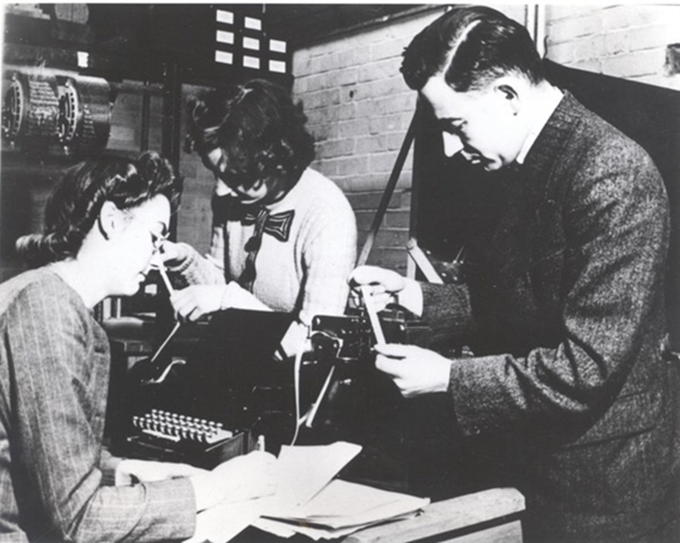
Kathleen Booth, Miss Xenia Sweeting and Andrew Booth in the lab during the construction of the ARC.

At the heart of the modern computer is a memory that holds both the program to be run and the data to be processed. The first successful demonstration of the modern computer was by two members of staff from Birkbeck College: Andrew and Kathleen Booth.

Starting in the late summer of 1947, they designed and then built a computer which they called ARC (Automatic Relay Computer). The first public demonstration of the computer was on May 12th 1948 – exactly 75 years ago.

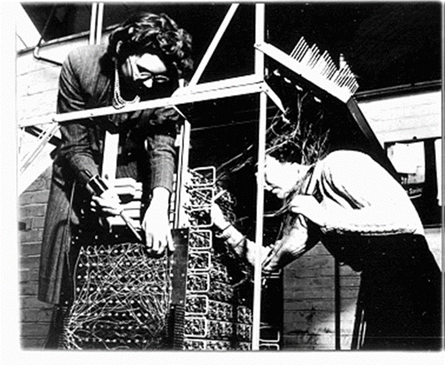
Kathleen Booth and Xenia Sweeting working on ARC.

Kathleen and Andrew Booth shared the task of building the computer helped by one research assistant, Xenia Sweeting.

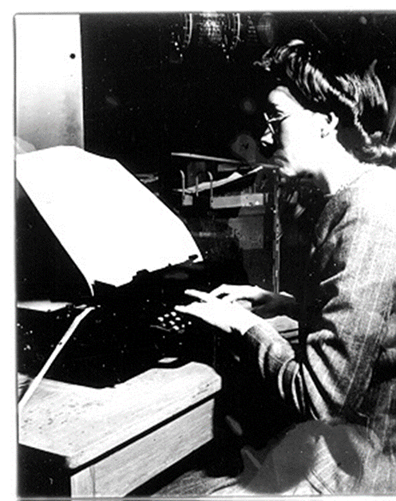
In accounts of her work, Kathleen Booth, who wrote the first program, recounted: “We demonstrated the generation and printing of a table of the squares of the natural numbers 0-255 in the scale of 10”.

Kathleen Booth at the keyboard preparing a program for ARC

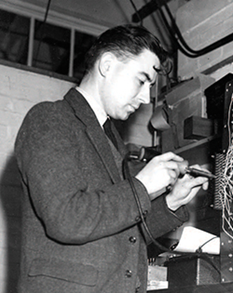
Technically, the computer’s memory was a brass drum with an oxide coating which could store in total 256 words each of 21 bits revolving at 3000 revolutions per minute. By modern standards, this is absolutely tiny, but was significant for the time. The computer was also very slow by today’s standards because the logic of the computer was built using relays.

Andrew Booth working on the selenium diode function table of ARC

However, from this first basic computer have developed the massively powerful modern computers which can run programs of a complexity which few even dreamt of in those early days.

Further Information:

Linking higher education skills to everyday life through the ‘Fake or Real News?’ workshop 

Anna Hetherton, Access Officer for the Adult and Community strand of Birkbeck’s Access and Engagement department, shares details of the ‘Fake or Real News?’ Digital Information Skills Workshop that Access and Engagement have developed 

As the Adult & Community team in the Access and Engagement department of Birkbeck, it is our role to foster relationships with community partners and adult learning groups to provide relevant and fulfilling learning opportunities to those in the boroughs of Camden and Newham. By collaborating closely with these partners, we are able to combine key priorities of residents to create a useful and novel outreach project. 

A common theme identified across the adult learning sector was the number of adults who had been digitally upskilled, out of necessity, over the lockdown period. Many people were using smart phones and the internet for longer periods of time and in a different way than they had expected. Although many organisations had successfully stepped up to support people by providing technology and tutorials, there was still a gap in learning how to navigate information once people gained access to the online world.  

As the public moved life online, so did scammers, news outlets, retailers and businesses. With the arrival of the COVID-19 vaccine there was an influx of information sharing, news, and of course – fake news. Partners identified that low vaccine uptake was a key priority within both target boroughs and was directly impacted by fake news.  

In response, the ‘Fake or Real News’ workshops were created. These workshops are light touch, drop-in sessions that address these themes, relate higher education to everyday life and give people tangible tools to help them navigate information online.  

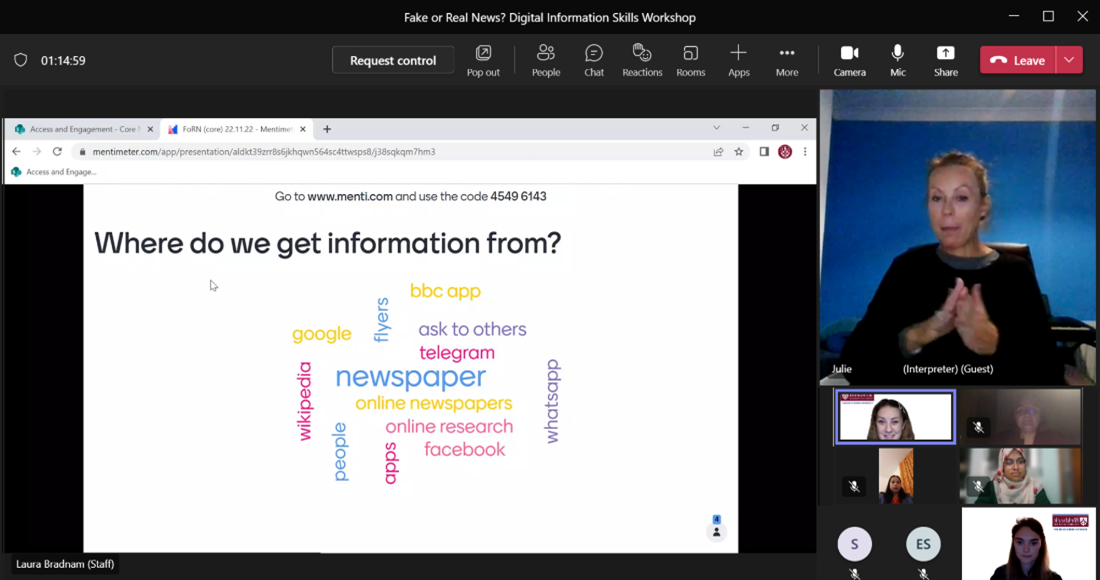
A screenshot of a virtual meeting showing a slide asking the question 'Where do we get information from'

Participants discuss where we receive information in an online session.

 The importance of conversation
As with all our work, we take a holistic, strengths-based approach. The session does not aim to “give” participants a skill they are lacking, but to bring focus to a skill they use every day and give that skill recognition and a space to put it into practice.  

Using real life case studies and videos, participants practice the tangible steps to analysing a piece of information outlined the workshop. This always brings about thought provoking and fruitful discussions. Since September, we have run this workshop over ten times for different audiences, and no two discussions have been the same. Participants bring stories from their own lives to the table – perhaps a scam they came across or two conflicting articles on their newsfeed. This process sees participants complicate the world of online information, cultivating nuance. Personal anecdotes are valued and woven into the discussion as evidence and a key part of the workshop, showing attendees they are already critical thinkers. Even shy participants become involved with interactive elements like a quiz involving an online dating orangutan. As the workshop evolves, we have found new ways to spark conversation and debate in these sessions. 

A table on which lots of paper is spread. People sit around the table.

Is this misinformation or disinformation? Participants explore the different types of fake news.

One activity uses real life case studies of fake news and challenges the participants to think about the intention and impact of the pieces. Did they mean to cause harm? Were they trying to sell us something? The debate and the conflicting opinions urge participants to inadvertently think critically, challenge their own perceptions and put across their opinions in a logical structured way. 

Realising classroom skills
Ultimately, the goal of the Access and Engagement team is to break down the barriers people face to higher education. Through our Fake or Real News? workshops participants: 

  • Realise and practice their critical thinking skills 
  • Increase confidence in a classroom setting and group discussion 
  • Witness how lived experience belongs in classrooms, and in turn understand that learning is for everyone 
  • Consider next steps in learning and skill development 
  • (In some cases) engage with an online learning environment 
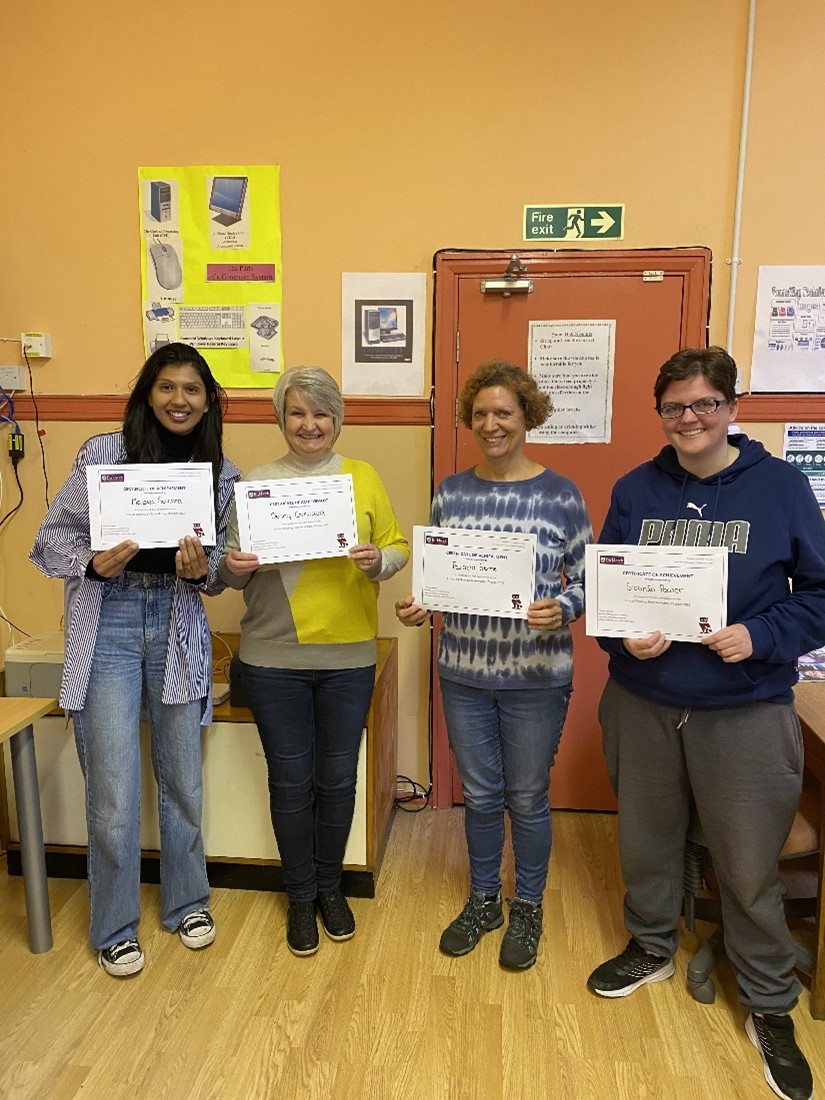
Four workshop participants smiling and holding their certificates of completion.

Participants receive their certificate of completion at the end of a workshop in Newham. 

During one workshop, a participant looked at the opening slides and stated, “I think this might be a bit beyond me”. They approached the content cautiously, but once the conversations and activities began, they realised that they could engage thoroughly, because their own experience and skillset was everything they needed. It is this shift in mindset that these workshops aim to achieve. By the end, this same participant said “brilliant… everyone should do this”. 


A very London Christmas… My first time experiencing Christmas in the capital.

BA Global Politics and International Relations student, Aditya Mukherjee, shares what his experience of Christmas in London has been like, and what made it so special.

Winter is the season we all wait for, it is the time Christmas brings all the joy. Those who live up North especially, experience Christmas in the snow; the building of snow men, and for the flexible amongst us, ice skating. This is the season I certainly allow myself to indulge in cheese fondues, baileys Irish creams in several flavours, and a range of foods in addition to spending evenings in front of a fireplace with loved ones.

The Christmas lights in London is a must see for anyone that has not been to this magical city. Every borough has its own Christmas theme and adds to the festive feeling. The Christmas Markets always spark the magical joy of seeing folks enjoying the festivity with food and drink. Christmas is also the time of year that most travel to be with their families.

Last year was my first Christmas in the UK and I was invited over by a close friend. Despite offering to help with cooking, I was asked to come in the late afternoon and bring some drinks and desserts. My friend had planned everything in detail and made sure all groceries were bought before the 24th as shops have limited opening times or can run out of stock through the days leading up to Christmas.

We enjoyed a meal with multiple courses, including a traditional roast with trimmings and Christmas pudding and watched one of the classic Christmas movies ‘The Grinch’, along with aperitifs and drinks. There are many brands that have their own Christmas flavors, and I was sure not to miss the Baileys red velvet cupcake – a symbol of the festive period.

As some of you may be celebrating your first Christmas in the UK this year, I have a few tips for you. I recommend staying over if you plan on visiting a friend in London, or arranging your mode of transportation in advance. Public transport will be closed on the 25th: this includes trains, the tube, and buses. Luckily, my friend lives walking distance from my house, so I decided to go by foot last year.

Also, if you plan to go out to a restaurant, book in advance as most of the restaurants are booked and have limited availability. As I mentioned earlier, many supermarkets have limited operating hours, so plan your Christmas meal in advance and get those groceries in a few days prior to Christmas. The same goes for present shopping, as one of the greatest joys is you never know what gift might be waiting for you under your Christmas tree.

I wish you all a Merry Christmas and a successful 2023!

10 places to visit in London during the Christmas season 

Join MSc Political Communication student, Mariam Baladze, for a whistle-stop tour of London’s most festive spots.

London is a huge city, with many spectacular sights and sounds to take in. So, if you are uncertain about what to see in London during Christmas, don’t worry – I’ve got you covered. Let’s unravel the magic together, shall we?

Skate at Somerset House
Who doesn’t fancy a twirl on the ice? If you go skating at Somerset house you’ll get a magical ice rink, a 40-foot eye-catching Christmas tree, and sparkling decorations that will make you feel like you’re on cloud nine. And as an added bonus: what if I told you that several scenes from the Christmas film ‘Love Actually’ were shot here?

Kew Gardens
At Christmas time, the beautiful greenery in the 300-acre botanic gardens is filled with an eye-watering assortment of glittering lights. The twisting and turning path, neon swirls, and festive projections make this Christmas experience unlike any other.

Winter Wonderland
Located in the heart of London in Hyde Park, Winter Wonderland takes you on Christmas journey that includes a Ferris wheel, loads of funfair rides, ice skating, and much more. Especially popular at night when the festive spirit is in the air, make sure you get a Bavarian beer and tour the Bavarian village for an extra dose of cosiness.

Covent Garden
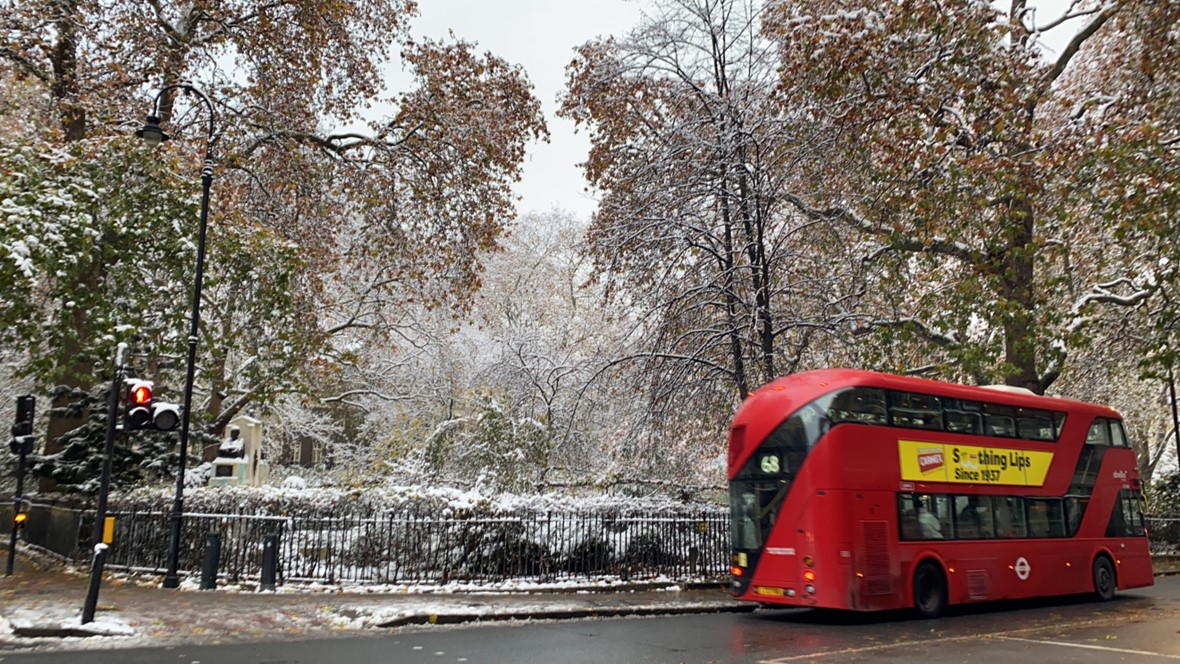
The legendary 60-foot British-grown Christmas tree outside the Apple Market in Covent Garden is decked with nearly 30,000 lights, making it spectacular. If you enjoyed the early snow this year, you’ll absolutely love the flurry of snow in Covent Garden’s Piazza!

Trafalgar Square
In 2022, Trafalgar Square not only has a massive Christmas tree, but also a Christmas market for the first time. Set in front of the National Gallery, with energising festive treats and handcrafted offerings in the heart of London, this spot will always get you in the festive mood.

Winter Festival at the Southbank Centre
Southbank Christmas Market is the ideal place to spend the night wandering among the Christmas lights and alpine wooden huts without worrying about being cold or hungry. Set next to the iconic Thames river, there are plenty of food and drink options to keep your hands warm, your belly happy, and your spirits jolly.

Christmas at the Churchill Arms
If you fancy a drink during the festive period, don’t think twice about popping into the Churchill Arms. Covered with illuminated Christmas trees and 22,000 lights, this spot will lift your spirits even before you’ve had anything to drink.

Christmas lights in central London
A highlight of the holiday season is walking around the city to see the Christmas lights on Oxford Street, Regent Street, Carnaby Street, and Bond Street. Five thousand suspended angels are adorned with LED pea lights that shine in tandem to provide a ripple effect along the roadway. A truly magical sight to behold!

Hogwarts in the snow
Experience the magic of Harry Potter amplified, by visiting the Warner Bros studio tour around Christmas. The beautiful details of the Gryffindor common room and the Great Hall will be enhanced by amazing festive decorations, sparkling snow and dripping icicles. Wow!

Attend Christmas services
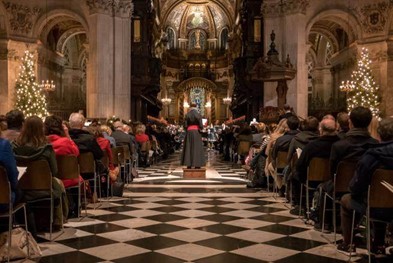
For those wanting to experience some of the more spiritual elements of Christmas, there are plenty of beautiful, old churches and cathedrals dotted around the city. For an extra special experience, you can attend Christmas Eve or Christmas Day services at St Paul’s Cathedral, Southwark Cathedral, or Westminster Abbey.

“There’s no doubt that the MSc got me to where I am today.”

MSc Management with Marketing graduate Sophie Attard took home a prestigious Worshipful Company of Marketors award for her dissertation ‘Listening to Branding: Proposing a method to evaluate consumers’ perceptions of sound in branding.’ She shares how she transformed her career through evening study.

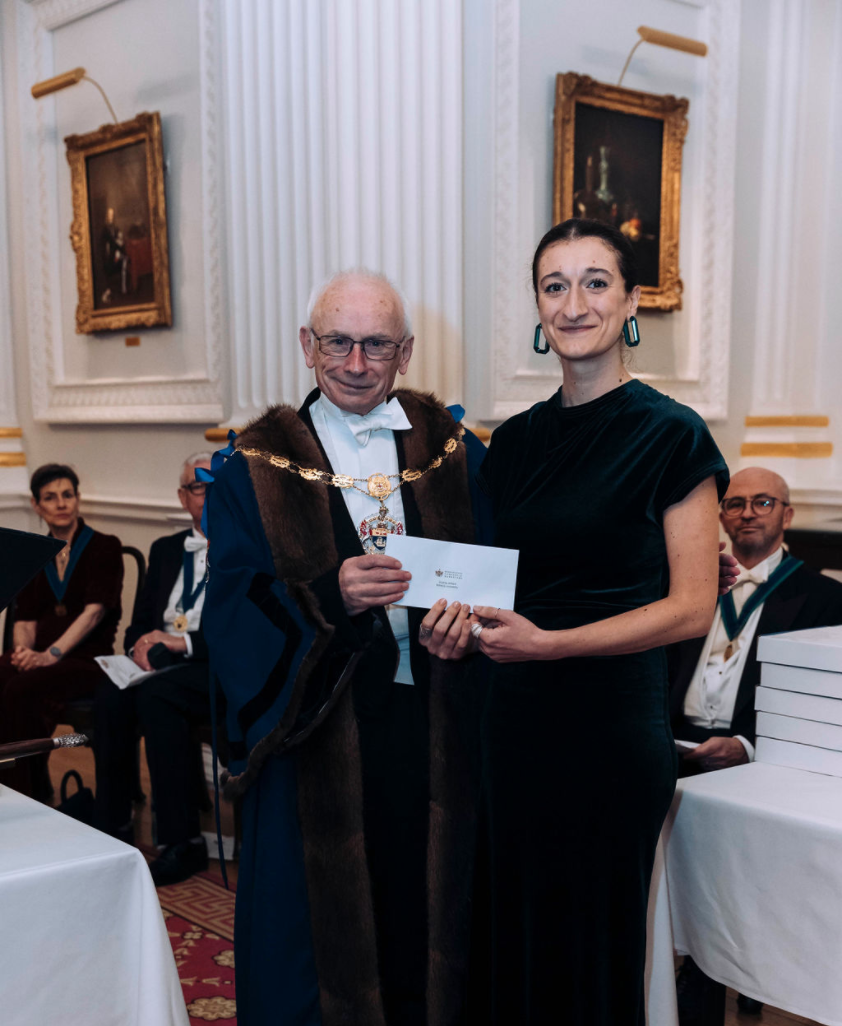
Sophie receiving her award. Photo by Harry Pseftoudis Photography .

I’d been working in music management for about four years when I was furloughed during the first Covid lockdown. It was the first time since leaving university that I’d time to think about my life and where it was going. I realised that I hadn’t been happy in my old job and started to look at other options.

I wanted to study and work at the same time and keep that momentum, so Birkbeck was an obvious choice. I chose MSc Management with Marketing because the management side would open up new opportunities and broaden my skills, while marketing appealed to my creative background.

The teachers at Birkbeck are outstanding: I got great support and it always felt like they really cared about the lectures and our learning. A particular highlight was working with Benedetta [Crisafulli], my dissertation supervisor. I picked quite a niche topic for my dissertation and she was really encouraging and took the time to understand what I was trying to achieve and to push me to write something I was passionate about.

When you do a master degree, regardless of the topic, it trains you to think differently and that is something you can apply to any field and role. I’ve learned how to back up everything I say with facts, to extract key information from large repertoires or datasets, to make up my own mind and make my own decisions. Building that sort of confidence is so important in management positions. I’d advise anyone to do a masters in any field that they’re passionate about to gain those skills.

Birkbeck’s Careers service gave me a way into the job I have now. I applied for a traineeship role in a start-up, which was a lower level than my previous role, but allowed me to switch industries while not interfering with full-time study. I now work for the same company as a product and brand manager, in charge of launching multiple different products, and there’s no doubt that the MSc got me here. The training in areas such as market research, brand development and thinking from a consumer point of view has equipped me with the skills to know what to expect and think about all these different areas while we develop and launch products.

For someone considering a masters, I’d advise to pick a topic that you’re really passionate about, because you will work on it a lot! Be clear on your ‘why’ – do you want career progression, to transition to a new field, or to increase your knowledge of a topic you love?

I’m now working with Benedetta to convert my master dissertation into a published paper. Winning the award from the Worshipful Company of Marketors has been the thing that keeps me going through the hard work. Benedetta encouraged me to apply for the award – collecting it at the ceremony will be the first time we meet face to face, as all our work together was done online due to the COVID lockdowns!! It will be a fantastic opportunity to celebrate. I’m really happy with where my life is now and Birkbeck has played a big part in that process.

Find out more: 

How can we be accommodating of neurodiversity in dance?

This is an interview with Professor of Organisational Psychology, Almuth McDowall, that appeared in One Dance Magazine UK.  

Jessica Lowe spoke to former classical ballet dancer, Almuth McDowall, Professor of Organisational Psychology at Birkbeck. Almuth specialises in diversity and inclusion, occupational health psychology and professional competence at work. 

In your experience and work, how might a neurodiverse dancer be experiencing dance differently to someone who is ‘neurotypical’?  

Can I start by clarifying what we mean by ‘neurodiversity’? The term originates from the work of hugely influential sociologist Judy Singer. Her writing argued to frame all human functioning as biodiversity, including how we think, feel and act. There are conditions (or neurominorities, or neurotypes) that make people different, such as autism, dyslexia, attention deficit hyperactivity disorder (ADHD) or mental health issues. Judy’s work encouraged everyone to look at strengths, not just deficits. I suspect that many dancers are ADHD-ers – hands up who was sent to dance school because they would not sit still? A dancer who has a different neurotype might be particularly good at experiencing the world in a sensory way – hearing music differently or more poignantly, having a real need to express through movement and not through words. 

From your own work, can you give some examples of how the dance sector can be thinking about, and accommodating neurodiversity? 

A good place to start is your own observations – how do you observe that dancers are doing their best work? What are good practices that help everyone? One of the features of a neurodivergent mind (although I don’t like this word too much!) is great sensory sensitivity. A cluttered, noisy studio where music mixes with voices can be distracting. A calm environment with good lighting benefits everyone. Regular breaks are important, too, as is giving people the opportunity to take solitary time out – their social batteries might be empty.  

Our research shows that there is a big gap between what people think neurodiversity is, and what it means in practice. Take the example of dyslexia. Most think that it’s about reading and writing difficulties. We find common challenges are forgetting things, self-organisation and managing stress levels. So, a holistic approach to dance and education is vital. We should ensure that dance educators and leaders have some knowledge and know when to consult professionals as appropriate. 

What advice would you give to those seeking to make their dance business, school, or organisation more inclusive and accessible for neurodiverse dance students or professionals? Where might somebody start? 

  • Engage a specialist for introductory training.  
  • Don’t make assumptions about why someone is not performing – forgetting a rehearsal time might not mean they don’t want to do it; perhaps their mind finds it hard to remember. 
  • Put genuine inclusion at the heart of your practice. What benefits neurodiverse dancers benefits everyone. 
  • Ensure that you canvass what people’s needs are and listen attentively. Commit to action plans and put these into practice. 
  • Remember your legal obligations – the Equality Act 2010 says that when someone reports a protected characteristic (and several neurodiverse conditions are recognized disabilities) then the environment must adapt to the individual. Not the other way around. 

In your experience, what might be some simple approaches that we as a sector could adopt to better accommodate people’s individual differences?  

Greater schedule flexibility, both formally and informally, paired with clear communication and considered scheduling of work. Often, rehearsal times are changed at short notice, and casting decisions announced with little lead time. Our research has shown that this needs careful consideration to make the sector more inclusive. 

What kinds of support are available for dancers who suspect they might be neurodiverse? 

It can be difficult as an adult to get a diagnosis, as waiting lists on the NHS are long. Think about a private diagnosis – might your employer or school even pay for this? An alternative consideration could be a cognitive assessment to profile your strengths and weaknesses. This is done by a psychologist. They can recommend onward referrals, and specialist providers will link in with government schemes such as ‘Access to Work’ (see link below). A few sessions with a specialist workplace strategy coach can be beneficial.  

I am less keen on some of the self-diagnostic tools out there (although we are developing a better one!) and please all be cautious with non-professional mental health advice on TikTok! 

Further information 

Wonder inside and outside the classroom: an international student’s first month in London

Emi Nguyen came to the UK from Vietnam to study a Master’s in Culinary Innovation Management at Birkbeck. Here she talks about her discoveries during her first month in the capital 

The beginning of something new
It’s my fourth week living and studying in London and sometimes it still feels a bit surreal. I have visited London dozens of times before but it’s completely different to live here and be a part of the innovative current flowing through this multicultural city. I’m truly grateful for choosing this journey, especially when I have supportive staff and friends at Birkbeck going through this with me. 

A welcoming orientation
I must be honest, though I have been regularly travelling abroad from my home country of Vietnam since the age of 16, this time I felt quite anxious leaving my nest. A million questions popped up in my head during the twelve hour flight. Will I fit in? What’s it like being a student in the UK? Is being a Master’s student different to being an undergraduate student? But all of those worries were eased on the orientation day. Yes: orientation is important! I got to meet all my course mates who share a passion for culinary innovation with me. The staff at Birkbeck were dedicated, kind and helpful throughout the orientation and since then too. Before orientation I didn’t know how best to construct an academic paragraph, or how to make the most of the library. The whole event was not just useful, but also heartwarming and reassuring; Birkbeck gave us the kindest welcome. 

When learning feels magical
What’s better than a warm welcome? Two warm welcomes! As a Master’s student in Culinary Management, I have contact with both Birkbeck academics and teachers from Le Cordon Bleu. If Birkbeck staff support me to aim for and achieve a high academic standard, the chefs and lecturers at Le Cordon Bleu open the door for me to explore the colourful culinary world. It feels like a dream come true to explore my passion for food in this way. Walking into Le Cordon Bleu for the first time, I felt like a child visiting Disneyland. Everything is so dynamic, lively and full of wonders, and my lessons continue to feel this way. What a magical place! 

The surprises of the capital
I knew that London offered a lot to do outside of classes. For an art enthusiast like me, there are plenty of artistic activities and exhibitions to dive into outside of my studies. I had the opportunity to look at Cezanne’s paintings at Tate Modern and it was an extremely emotional experience for me. All that I have watched and learned from books about this legendary artist and his work… was suddenly there in front of me! And I was looking at his brush strokes and vivid colours in a crowded room, with others also sharing the experience! What a time to be in London.  

Final words for the first month
Change can be scary. Moving to a new city, starting a new course, and following your passion are not always easy things to do. But learning to embrace fear and diving in can lead to a world of wonders. 

More Information: 

An international student’s life changing experience of living, studying and interning in a law firm in London

Eucharia Chikodi Egemole came to the UK from Nigeria to study LLM General Law at Birkbeck. Here she shares her experience so far, including highlights, tips and things she wished she knew before coming to the UK.  

Eucharia looks into the camera. Behind her the Thames is visible and in the distance, Tower Bridge.

Exploring London

When I decided to do a Master’s in Law, I chose to do so in the UK because of the quality of education and also because the legal system of my home country, Nigeria, was largely developed from the English legal system. What better way than learning the law directly from the source? 

I applied to Birkbeck because, amongst other qualities, it was an evening university that allowed me the freedom to intern at a law firm during the days to gain legal experience. After being offered a place, I was swiftly issued with my Confirmation of Acceptance for Studies (CAS). Compared to the experiences my friends had when they applied to other universities, getting my CAS from Birkbeck was a very smooth experience.  Below is my account of how it’s all gone so far – hopefully it can be helpful for any other international students!  

The visa process
For international students wishing to study in the UK and in need of a visa to do so, time is of the essence. It is advisable to apply for a visa at least three months before the course commencement date. This allows enough time for you to get the visa, plan for any delays and prepare for travel. It’s also essential to submit all required documents as not doing so could lead to visa delay or denial.  

Moving to London
I arrived in London on 6th October 2022, excited to be in the great city and ready for new experiences. It was my first time in the city and I’d never left my country before. My accommodation is in Chiswick, an area of West London, and I found it with the help of a fellow student who I met in a Facebook page created for Birkbeck international students called the ’Pre-departure Lounge for BBK 2022 International’. The page was very helpful as it gave information on how to collect the Biometric Residence Permit (BRP), open a bank account, the times and dates of study events, and a lot of other helpful information for international students.  

Living in London
Living in London so far has been quite amazing. I thought I would feel homesick, but that is far from the case. London is so multicultural that even though it is miles away from your country, the chances are that you could meet someone from your background on the street or even bump into someone that speaks your language while strolling in the park. It is a home away from home.

Eucharia stood on the concourse of a station with a sign reading St Pancras behind her.

About to ride the tube for the first time at London St Pancras

Here are some highlights for me:  

  • Sightseeing: there are so many famous landmarks and places to visit, like London Bridge, Tower Bridge, the London Eye, Buckingham Palace or any of the museums and galleries.  
  • Food: London has an exceptional offering of different cuisines from all over the world including African, Chinese, Italian, and not forgetting English dishes too! I love good food and any time I am about to have a good multicultural food experience, I borrow the biblical verse and tell my soul to “eat and be merry”.  
  • Transport: the public transport system of tubes and buses is commendable. The network is designed so that a person can connect to anywhere across the city quickly and with ease.  

While there are opinions that London is quite an expensive city to live in, I have found a way to manage my expenses and still have a good time. I have Railcard and an Oyster card that offer me discounts on transport; I try to do my shopping in stores that are having clearance sales; and I also prepare many meals at home. I am having an amazing time in London on a minimal budget.  

Things I wish I knew before I travelled
If I were to prepare to travel all over again, I would not have packed and paid for extra luggage of foodstuffs. I could have got the same items in any African shop in London (there are many!) and at affordable rates too, saving myself the trouble, time, and money.  

The native clothes and attire I brought with me also ended up as decoration in my suitcase, because I don’t wear them. If I knew, I wouldn’t have packed them as they mostly don’t suit any occasion here in London.  

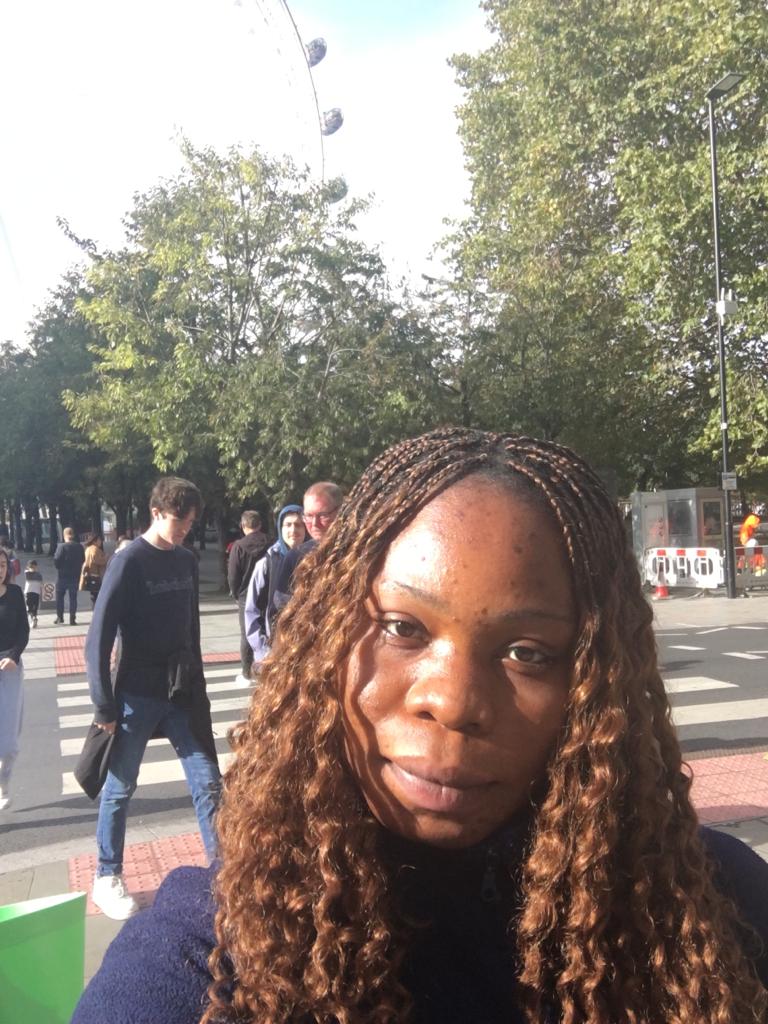
Eucharia looking into the camera with the London Eye visible just behind her

At the London Eye

Another big thing is timekeeping. For an African like me, an hour or two past the agreed time is still within time. But that is not so in London. An appointment fixed for a particular time starts at that time and not a minute later.  

And finally, in the UK, people queue up for services. In my home country, there are hardly any queues as a person takes their turn depending on how sharp or smart they are, or if they can pay their way.  

My experience at Birkbeck so far
The learning experience at Birkbeck has been a highlight. Courses are taught by class discussions and lectures, and I have found this to be a great way for me to assimilate and retain information. It has also honed my communication skills.  

The staff have been amazing, especially those working for the Student Advice Service. They are always available to listen to students, decipher their problems, and offer lasting solutions, which I have benefitted from. 

Another highlight has been interacting with my fellow students. Chatting with them and hearing about their diverse cultures and backgrounds is fascinating and adds to the whole experience.   

Conclusion
Living in London for me has been a life-changing experience. Meeting and interacting with people from diverse cultures has contributed to my personal growth and development – I now understand more about the world and myself. I had the challenge of coming to a new country and meeting new people, and I rebuilt myself to do this. Now, I am all I was before, but I have also acquired the confidence of a Londoner. I wouldn’t trade this experience for anything in the world.  

More information:  

How studying in my 40s gave me much more than new knowledge and skills

Fabien Littel did an MSc in Organisational Psychology at Birkbeck. Here, in a blog post that originally appeared on his personal site in October, he talks about his experience studying whilst in his forties. 

Fabien sitting in front of an open laptop looking at the screen with a dog sitting on his lap.

It’s only been two weeks since I handed in my dissertation, the final step in completing my MSc in Organisational Psychology, at the end of a life-changing 2-year adventure. It’s only been two weeks, and it will be another good few weeks before I get my final results and know if I’ve been awarded the Masters. Still, I already know just how much I have learned and how I developed a new perspective on work, and life in general, which no grade won’t take away. I have often used the term “life-changing” to refer to this experience, very mindful of how cliché and over-hyped it may come across. It is however merely a fact: through these studies, my life has changed. I am now embarking on an academic path I would have only dreamt of a few years ago, and most importantly have developed the courage and confidence to understand, accept and express my individual beliefs and views on the world around me, and to move away from the comfort and convenience of general blind acceptance.

From jigsaw puzzles to research journals
Looking back at September 2020, why did I suddenly decide to get back to university? My light-hearted answer to this question is usually that, during the first few months of covid-19 lockdowns, I had developed a dangerous addiction to jigsaw puzzles, and needed to find something else to occupy my free time. This was only partly a joke; I had genuinely built a large collection of jigsaw puzzles, was on them before, after – and sometimes during – work

(I’d argue that it helped me focus my mind…), and they frequently invited themselves in my dreams too. Aside from that, I was increasingly interested in what motivates people to work, what makes them feel good about their job, and what might they feel more conflicted about. The pandemic played a part in this too, as companies had to take responsibility for their employees in a way they never had before, and many employees had opportunities to contribute, in one way or another, to the response to this crisis, and gain a new sense of purpose in the work they were doing. I started reading on the topic, and gradually felt that I wanted to develop some more in-depth foundational knowledge to shape my own thinking. From there on, it became a relatively quick process, and probably just a matter of days until I enrolled onto my MSc. Organisational Psychology quickly appeared like the most appropriate choice for my area of interest, and to build on my first Masters in HR by approaching work from a different angle. And the choice of university was quite straightforward too, once I had narrowed down the options for part time online learning. Birkbeck, which I ended up joining, stood out with its mission of supporting lifelong learning, designing classes for people who study alongside work, and for its longstanding expertise in organisational psychology – a choice I never regretted, quite the opposite.

Learning about yourself while learning about others
The nature of the course and what we were studying meant that it enabled us not only to learn about careers and organisational behaviours of others, but also to reflect on our own. And this started quite early on, as we looked at career development, or employee motivation. A large part of the learning was about reading required lists of weekly research journals and additional material in support of essays and other work. And we weren’t short of additional recommendations from lecturers.

One of the first ones I took up was to read Herminia Ibarra’s book Working Identity. It provides a perspective on the sense of identity attached to people’s careers, and importantly how a change of direction and transition in one’s career can help reinvent this identity, or how Ibarra calls it, “becoming yourself”. She describes a process consisting of experimentations and sensemaking to define your new self, and a long process of transition made up of small steps, taking place through the course of several years. The book is illustrated with examples which bring to life these experiments, and steps people have taken to lay the foundations of a new career, and indeed reinvent themselves. It was a fascinating read, which I did just as I was beginning to envisage what a different second half of my career might look like, therefore couldn’t help seeing it both as a complement to the course, and a self-development book for myself. From that perspective, it made a great difference to read it when I did; while I was at first concerned about this perspective on career transition as taking years, requiring deep-level self-reflection and experimentation (especially when feeling a certain sense of urgency for change), it helped me take a more measured and long term view on a process which I am still only just probably half way through, and helped me come to terms with the fact that you shouldn’t just expect to wake up one day with a clear view of where your career, and life more broadly, should go, but that it requires time and effort.

“Resistance is fertile”
From the very start of the MSc, we were told that one the main skills we should develop was our critical thinking, and that we needed to find our voice. At first, this might have seemed like a contradiction as we were also told to base our writing and arguments on existing research and scholar literature – so how can we be critical, and find our own voice, if we can only repeat what has been said before? It turns out we were vastly underestimating the spectrum of ideas and perspectives already out there, and still learning the art of taking existing views, organising them and building on them in a way that becomes deeply personal to you (an art I am still working on…). The most energising and stimulating side of the reading we were doing was to read papers with opposing views and paradigms, particularly those highlighting the shortcomings and challenges with what had been seen and applied as most mainstream theories for decades. This came through particularly in a couple of modules, including one looking at selection and assessment, led by an inspiring lecturer who was committed to providing insights on not only the widely accepted theories and processes, but also the challenges of racism and social injustice which came with them, including issues such as racial bias in cognitive ability testing, and perpetuation of social inequalities via practices mostly developed through the lens of white western men.

Her teaching took inspiration from Paulo Freire’s Pedagogy of the Oppressed, particularly in rejecting the “banking” view of education, whereby someone in position of power imparts the knowledge they are the custodian of, to others in a position of inferiority who are expected to receive and accumulate this knowledge. Instead, it advocates for co-creation of knowledge, which is something we experienced through this teaching. Of course, some concepts and ideas were presented and shared with us, however through discussions opened up by the lecturer, there was a clear acknowledgement and respect of everybody’s individual experiences, and how much these experiences contributed towards everyone’s learning, and provided much richer perspectives.

I was fortunate to also get the opportunity to join this lecturer, together with a couple of other students, in a collective writing project, which I hope to share more about in due course, and was for us an amazing way to bring co-creation to life, and constructively share and bring together our lived experiences and beliefs, in an environment of solidarity and support.

Becoming a truer version of myself
University, and studying in general, is a time for exploring, exchanging, and experimenting with ideas, developing your own thoughts and beliefs, your hopes for the world. Too often, for young people, this risks getting quashed when confronted with the reality of the corporate world. One of the benefits of experiencing this after twenty or so years working, observing the dynamics of corporations, getting satisfaction from achieving things and bearing the scars of burnout, is that it enables you to pause and revisit those twenty years with a little bit of distance, and some new perspectives. What it did for me, was to bring out views on the world of work, and systemic injustice or harmful phenomena, as well as hope for meaningful and fundamental change, which I would have briefly thought about and kept well hidden in the past. It gave me permission to think these ideas through, resist the sense of inevitability I had felt up until that point. Learning, reading and discussing new concepts such as neoliberalism, social constructionism, social Darwinism, moral disengagement, and many more, which wouldn’t have meant much two years ago, put names on what had only been until then passing thoughts, and opened up the door for even greater exploration, and knowledge that not only did others share similar thoughts, some had actually spent much of their careers defining and studying them.

Practically, unearthing and embracing these views throughout the MSc, together with conducting my research project on matters related to moral reasoning at work, contributed to me questioning in more depth my own contribution to the world through my work. This led to my decision to leave the defence industry (which I have talked about in an earlier article), and to find a way to continue on this academic path. “Following your dreams / passions” is an easy piece of advice often given, however remains a very privileged thing to do, when the reality of daily life and cost of living hits, and prevents many from exploring a path of their choosing. And so I do feel privileged that I was able to find arrangements I could put in place to enable me to follow this path further through starting a full-time PhD.

I am only a couple of weeks into my PhD with the University of Southampton, grateful, energised and excited about what the next three years will enable me to learn and do. And I remain very mindful that I wouldn’t have reached this point if it hadn’t been for the opportunity to conduct part-time studies online while working. Both the practicality of what Birkbeck had to offer, and the commitment and dedication of its staff to deliver a truly transformative learning experience, despite some of the challenges they may have faced in trying to safeguard this level of quality and acceptable conditions for themselves, is to be applauded. At times when careers are stretching longer and many people will look to transition part-way, enabling access to higher education to the working population should be seen for the powerful and genuinely life-changing impact it can have.

More information: