Author Archives: B Merritt

Why Remember Shoulder to Shoulder?

This post was written by Dr Janet McCabe, a lecturer in Birkbeck’s Department of Film, Media and Cultural Studies, and Vicky Ball, De Montfort University

Helena Bonham-Carter and Carey Mulligan recently marched through the corridors of Parliament agitating for female suffrage. It made the news. Not the protest. But because it was the first time that a commercial film had been shot inside the Palace of Westminster. In recreating what women did in that constitutional space to get the vote 100 years ago Suffragette, written by Abi Morgan and directed by Sarah Gavron, brings that historic campaign back into public consciousness. While the struggle for emancipation shaped the political landscape in Britain in the early 1900s and changed irrevocably the position of women in society, it is a story that hardly ever makes it on to our screens; and it has been 40 years since we saw the suffragette movement last dramatized for television.

2014 marks the fortieth anniversary of the BBC miniseries, Shoulder to Shoulder, which focused on the activities of the Women’s Social and Political Union, founded by Emmeline Pankhurst and her daughters Christabel and Sylvia (1898-1918). It consisted of six specially written plays and it came about through the collaboration of three women, the actress Georgia Brown, filmmaker and feminist Midge Mackenzie and TV producer Verity Lambert. A sense of the public service remit pervades the series as Shoulder to Shoulder dramatizes particular events of the early suffrage movement, albeit from a decidedly socialist perspective. Its importance as a landmark BBC drama documenting the history of feminism and the emergent public voice of women is unquestioned. That said, the series seldom gets repeated and has never been released on DVD. This neglect prompts us to ask: why is such a politically important drama about women’s history still buried deep in the BBC archive?

Shoulder to Shoulder first aired on Wednesday 3 April 1974 at 9pm on BBC 2. It seemed an inauspicious start. Competing as it did with the extensively praised documentary series, The World at War, on ITV, and the popular ‘fly-on-the-wall’ series, The Family, on BBC 1. A quirk of scheduling has perhaps contributed to the amnesia, with the suffragette drama squeezed out of our collective TV memories as we recollect instead the ambition of the multi-award winning World War II series (still on television screens somewhere) and one of the first ‘reality’ shows in the history of television, which documented the everyday life of the Wilkins, a working-class family from Reading. What defined these shows at this moment in British television culture when BBC and ITV dominated was a focus on stories rarely told: ordinary people caught up in history; or those who had scarcely been given representation or a public voice on television before.

It is well known that Emmeline Pankhurst was alive to the importance of capturing the media to help shape her political message; and some of the W.S.P.U.’s preoccupations—with the media, penal reform and direct action—chimed in with Britain in the early 1970s. The IRA bombing campaign (with the Price Sisters on hunger strike in Holloway prison—and forcibly fed), industrial strife and economic crisis meant that the series carried more than a whiff of controversy.

Shoulder to shoulderBut maybe it was its feminism that lay at the heart of why Shoulder to Shoulder has been forgotten then and why we should remember it now. At the cast and crew reunion held at Birkbeck last Thursday both Siân Phillips and Angela Down, who play Emmeline and Sylvia Pankhurst respectively, admitted to knowing little about these women before making the series. While Phillips was politically active and involved in the trade union movement, she had no formal education about the Suffragettes.

She wasn’t alone.

Midge Mackenzie spoke often of how the project grew out of her experience of filming the Golden Jubilee of Women’s Suffrage in 1968, when she discovered the story of how women won the right to vote had been ‘almost successfully erased from the history books. The women who fought for the vote had vanished from our history,’ she wrote. ‘Their writings were long since out of print and their newspapers buried in archives’ (Shoulder to Shoulder 1988; ix). In good documentary fashion Mackenzie filled her book, which one feels was a response to the betrayal she somehow felt at having men write the TV series, with women’s voices—original experiences as expressed in the words of those taking part, from diaries, letters, memoirs, speeches, as well as newspaper reports and the Suffragettes own publications, Votes for Women and The Suffragette.

The series, like the book, focused on the militant campaign; but these Suffragettes were by no means the only campaigners demanding enfranchisement. Shoulder to Shoulder (like all history) is a product of its time and, for example, it doesn’t address the contribution of other dedicated Suffragettes like Countess Markievicz, the first woman elected to Parliament, or Charlotte Despard, an Irish-based campaigner and Sinn Féin activist, for as Irish revolutionaries it probably was not the right time for reassessment as the troubles in northern Ireland still raged. And the non-violent, but constitutionally minded, Suffragists, led by Millicent Fawcett, barely got a look in either. But then committee work and letter writing is far less televisual than the drama of arson campaigns and bruising clashes with the police. What is rescued and recovered is not random, but the fragility of remembering the complexity of our history adds to ignorance and concealment.

But this is no excuse to forget Shoulder to Shoulder. Margaretta Jolly, Reader in Cultural Studies at the University of Sussex, offered a useful intervention at the symposium that followed the screening, when she spoke of using the Suffragettes to ‘measure new feminisms’ and of the importance of passing these stories onto the next generation, however difficult and contested. What the act of recovery from this entanglement of ‘official’ history and personal stories, public speeches and oral testimonies, teach us is that the fight for equality didn’t end with enfranchisement—despite what postfeminism would have us to believe.

Remembering Shoulder to Shoulder isn’t only about reclaiming our stories, but about who has the power to tell them. Even within the production of the series there was a feminist struggle (of sorts) between an ideal and a challenging of power from the margins—Mackenzie, and shattering the glass ceiling and able to change the script but from the inside—Lambert.

Remembering the earlier fight for emancipation happened in the early 1970s at a time when a new feminism was struggling over questions of inequality, images of woman as Other and the culturally awkward position of women within the public sphere and their right to speak. Forty years and we remain preoccupied with similar questions. Reconnecting voices and the experience of women and women’s history across time and space is crucial.

Shoulder to Shoulder thus reminds us why the struggle still matters.

Michael Gove should not kill the Mockingbird

This post was written by Dr Anna Hartnell, Lecturer in Contemporary Literature in Birkbeck’s Department of English and Humanities. It was originally published in the Guardian.

‘Neighbours bring food with death and flowers with sickness and little things in between. Boo was our neighbour. He gave us two soap dolls, a broken watch and chain, a pair of good-luck pennies, and our lives. But neighbours give in return. We never put back into the tree what we took out of it: we had given him nothing, and it made me sad.”

This poignant moment from the last few pages of Harper Lee’s 1960 novel, To Kill a Mockingbird, records the instant where a girl, about nine years old, finally recognises the humanity of her childhood bogeyman. This is a coming-of-age story, unusual for the fact that it charts the development of a female protagonist, Scout, and explores issues around racial violence, rape, and social marginality in the depression-era deep south of the United States. It has stirred up controversy across US school districts since it first entered the classroom in 1963.

Michael Gove’s decision to remove this book – along with a number of other American classics such as John Steinbeck’s Of Mice and Men and Arthur Miller’s The Crucible, which similarly explore political persecution, social exclusion and the oppression of the weak – from the English literature GCSE syllabus, is not just parochial and regressive, it also fails to recognise the dynamics that make up modern Britain. It fails to understand that a large part of the value of reading literature lies precisely in the kind of empathic leap Scout makes at the end of Lee’s novel, one that enables her to see herself through the eyes of an “other” and so more fully comprehend her own identity.

To Kill a Mockingbird is arguably itself limited by the vision of a white liberal, but it tends to strike a chord with young people because its voice is faltering and uncertain and wide open to just the kind of debate that makes teaching literature about ethics and politics as much as it is about language and form.

However, schoolchildren in the UK are now going to be given a “more traditional” syllabus made up of largely British texts penned prior to the 20th century. Such a syllabus harks back to the myth of a “pure” origin for English literature, uncontaminated by the unintended consequences of empire, and ignoring the multicultural, multilingual and multinational space that Britain is today. Gove and his colleagues at the Department for Education are fantasising about a nation unencumbered by racial or cultural difference, or calls for greater social and economic equality.

This fantasy recalls an earlier moment in British imperial history when the colonial government in India decided in 1835 that education, conducted up to that point in native languages, would henceforth happen in English only. This narrow linguistic agenda ironically contributed to the reality of “literatures in English” – those other English voices that bear witness to the fact that the nation’s literary tradition does not have an uncomplicated beginning in medieval England.

At a time when the right is on the rise across Europe, immigrants are under attack from right and left, and the UK’s criminal justice system increasingly resembles the disastrous US model – which has seen the mass incarceration of black people under what many characterize as a new system of racialized control – the DfE’s decision plays into a poisonous atmosphere. There are of course other literary texts that are equally relevant for GCSE students; they need not be Anglo-American or indeed all be post-1900. But pre-20th century English culture should not dominate the syllabus: Gove’s attempt to wind the clock back overlooks the myriad identities of the children now populating British schools.

As Scout opens her narrative she reveals that her family can trace its lineage back to Simon Finch, a man from Cornwall who was persecuted as a Methodist and duly left England for the New World. There he acquired slaves, thus substituting one form of oppression for another. This knotty and discomforting genealogy that binds Englishness to empire and slavery and their fractious legacies of racism and inequality seems to be too thought-provoking for Gove’s deeply conservative vision of English literature. Our children should not be prevented from discovering it.

The Fox in the Hen House? UKIP and the 2015 General Election

This post was written by Dr Ben Worthy, a lecturer in Birkbeck’s Department of Politics. It was originally published on the Department of Politics’ blog, 10 Gower Street.

This week’s European elections have produced fascinating and, in many countries, uncomfortable shifts in electoral support (though we shouldn’t forget Italy, where the centre-left has won and Greece and Spain, where the far left topped the polls). The results have already led to the Irish Deputy Prime Minister and leader of the opposition in Spain stepping down.

In the UK, attention has focused on UKIP, the minority anti-EU party that has ‘won’ the European Parliamentary elections, or at least got more votes than any other party, and done relatively well locally. The big question is whether UKIP will influence the 2015 General Election or fade away. Will UKIP be the (indirect) kingmaker or just a bad dream by this time next year? Below I’ve set out some of the different sides of the argument so that you can make up your own mind.

UKIP is here to stay: Kingmaker in 2015?

Journalist Michael Crick points out that the UKIP vote in the local elections is slightly down on previous years. However, winning council seats means being able to build organisations and networks in local areas to help get out the UKIP vote in 2015. UKIP is putting down roots across the country.

But will voters stay with them? Some argue that the UKIP votes are just a ‘protest’ vote and supporters will ‘return’ to their ‘normal’ parties for the election that matters-the General Election. This data from Lord Ashcroft’s polling shows that many UKIP voters (they estimate 50%) are likely to stay with UKIP in 2015 – other pollsters agree.

Just to make the situation more complicated, it isn’t clear that UKIP will cut down Conservative votes and ‘let in’ Labour. Analysis by the authors of the new book about UKIP voters, Revolt on the Right, indicates that UKIP’s appeal is cross-party and attracts as many unhappy Labour voters as Conservatives – see their results in Rotherham (Ed Miliband’s constituency).

So UKIP may not win seats but may make the 2015 General Election very complicated and unpredictable. The party could cause ‘chaos’ and create ‘an electoral map of nightmarish complexity’ in certain crucial seats. Even before the UKIP surge, 2015 was already going to be very close indeed. This prediction gives a ‘dead heat in 2015’ with the Conservatives on 36.1%, and Labour on 36.5%. On a side note, Ashcroft’s poll for the constituency of South Thanet, where Nigel Farage is rumoured to be standing in the General Election, puts UKIP support very high – see pg 1 column ‘voting intention’ and ‘certain to vote’.

UKIP fades away: A bad dream in 2015?

Not everyone is sure of UKIP’s new power. Smaller parties votes have always fallen back, often sharply, in national elections. More importantly, the First Past the Post system at Westminster makes it very difficult for minor parties to win seats.

The Telegraph’s Benedict Brogan is not convinced that UKIP’s momentum can be maintained. He points out that UKIP will now be under sustained media scrutiny (which didn’t always work successfully for them, especially in the last few weeks) and will have to begin explaining its domestic policies, which may be difficult. One of the most important players will be the media and how it covers UKIP for the next 12 months.

How well UKIP as a party can cope with the stresses and strains of being a ‘fourth’ political party is debateable. Brogan also points out that there have been many ‘new’ political parties ‘enjoying a moment of popularity…Remember the SDP? The Alliance? The Greens? Or even the Lib Dems, who under Nick Clegg have gone from breakthrough in 2010 to breakdown this weekend’.

One thing we can say for certain is that the next year will be interesting. Success is not all about seats and you may see UKIP’s influence in the policies that other parties now start to adopt. Keep an eye on the coming Newark by-election – will UKIP win their first seat?

India fights for a pension: a campaigning success story

This post was written by Dr Penny Vera Sanso, a Senior Lecturer in Development Studies and Social Anthropology in Birkbeck’s Department of Geography, Environment and Development Studies. It was originally published on the Age International blog.

India is home to around 104 million people aged over 60. Despite producing at least 50% of India’s GDP and despite contributing to the 4.5% growth rate – 90% of workers in India are trapped in low paid, insecure and pension-less work.

So, it is good news that, after many years of side-lining, social pensions are again on the political agenda; appearing on the manifestos of several national and regional parties.  This is a giant step forward.

India is a deeply divided and unequal country, but if you want to see another side to India, one promoting collaboration across socio-economic and cultural diversity, and one that is likely to have a positive outcome for older people, you would be hard pressed to find a better example than the campaigns that are pressing for a pension revolution – the Pension Parishad and the Right to Food Campaign.

A side of India that doesn’t hit the headlines

In March this year, the 5th National Convention of the Right to Food and Work Campaign was held. Over 2000 people participated from across the country.

It is a side of India that rarely hits the headlines; a side where differences of caste, class, religion, education, gender, age and able bodied-ness make no difference.

Held outside Ahmedabad in the grounds of the Dalit Empowerment Centre, a training centre for India’s most stigmatised castes, the Right to Food and Work Campaign transformed unpromising scrubland into a colourful covered meeting place for people to come together to discuss their concerns and formulate solutions on which all would campaign. I participated in the Pension Parishad workshop where almost all participants were women. When asked where the men were the women answered, as one, ‘At the food ration workshop’. And this was where I found them  – a perfect demonstration of how people were ensuring that they covered as much common ground as possible by participating in the framing of strategy and taking it all back home to their local organisations.

But this convention was just one of the proud moments of a campaign which began its journey many years earlier.

How did it start?  

First, in 2001 an extraordinary alliance of diverse groups and individuals came together to support each other in a common effort to secure basic human rights – that of the right to life and dignity for everyone in India.

Then at the 2010 Convention of the Right to Food and Work Campaign a unanimous decision was reached to campaign for a universal social pension. This spurred the development of the ‘Pension Parishad’ – a further network of NGOs and individuals focused on securing a universal social pension set at half the minimum wage.     

This led to thousands of older people across the country participating in rallies, but they were not alone.  They were joined by, and themselves supported, campaigns for widow’s pensions, disability pensions and pensions for sex workers and transgender people.

A comprehensive, cradle to grave campaign

The Right to Food Campaign uses all democratic means available to secure widespread support for the right to food and work and, latterly, the right to pensions. The Supreme Court has been moved (in both senses of the word), political parties lobbied and the media engaged.

Alongside this have been specific campaigns – to extend the public distribution system (that provides families with subsidised basic foods) and to enforce schemes supporting breast feeding and free cooked mid-day meals for school children and older people.  This has created a comprehensive, cradle to grave campaign to overcome endemic hunger.

There’s much to be learnt here but what I like best is: first, that despite deep social divisions people will come together to fight for their own and each other’s rights and second, that older people are willing and capable of fighting for their own and others’ rights.

Dr Penny Vera-Sanso has been researching and publishing on age, gender and poverty in India since the early 1990s. Recently she has been exploring visual methods for sharing research with non-academic audiences and of encouraging popular participation in research projects in order to spur public debate.  Her collaboration with The Hindu on the National Photographic Competition on the Working Elderly resulted in a unique permanent on-line gallery of nearly 3000 photographs of older workers from across India.  She has made two documentaries, We’re Still Working and The Forgotten Generation,  released in 2013 and her photo essay, ‘We too Contribute’, has been displayed as pop-up exhibitions across India.  

British universities need Black Studies

This post was written by Dr William Ackhar, a lecturer in community and voluntary sector studies in Birkbeck’s Department of Geography, Environment and Development Studies. It was originally published on the Guardian’s Comment is Free site.

In San Francisco in 1968 a group of primarily black students went on strike to demand that their college establish an academic programme that reflected their lives and experiences. Their demand was met, and San Francisco State College became the first in the US to have a department and degree programme in Black Studies.

Nearly half a century later, Black Studies, Africana Studies or African-American Studies, as they are now variously named in different institutions, are a coast-to- coast academic discipline. Their academic departments in Ivy League institutions such as Harvard, Yale and Columbia are home to internationally renowned scholars.

Built on the two foundational pillars of academic excellence and social responsibility, Black Studies in the United States has led to the emergence of more black professors, heads of department and university administrators. From small beginnings, it has emerged as a genuine success story of the 1960s Civil Rights struggle.

As someone who draws heavily on the work of African-American scholars to inform my own teaching and research, I can only look with envy at what has been achieved in the US and wonder why, after all this time, there are still no equivalent Black Studies degree programmes and academic departments here in the UK.

In the past, universities did not feel there was a demand, need or interest in the subject but this is no longer the case. Britain’s black population is approaching 3 million and its increasing significance nationally and internationally in politics, religion, economics, science and the arts more than justifies the need for an academic discipline dedicated to researching and teaching the black experience, to UK society and the wider world.

On 15 May, a group of black scholars will meet to set up a British Black Studies Association, which will call for Black Studies degree programmes to be established. There has been a growing sense of frustration and anger among black British academics over how our communities have been treated by the British university system.

Black students are being encouraged to enter higher education in ever increasing numbers, yet there are no courses or departments where we can learn about ourselves, there is very little likelihood of being taught by a black professor, and according to the latest data there is no chance of seeing a black person leading and shaping the strategic direction of the university.

No wonder many black students, according to the National Union of Students, have a demoralising experience in higher education and on average are leaving university with poorer results than white counterparts who entered with equal A-level grades.

Black Studies – a social science covering subjects such as history, politics, religion, the arts, economics, geography and psychology – is needed to counter the damaging and corrosive idea that black culture is somehow anti-intellectual and that black people are not capable of contributing meaningfully to the intellectual life of this country. For example, it could include study of the Notting Hill carnival, building insight into its historical significance and connections to the Caribbean, South America and Africa, the complex religious symbolism that underpins it, its economic, geographical and cultural impact, and its role in establishing London as a global city.

Gender Studies has played an important role in shifting cultural attitudes and public policy towards women. The study of the black experience could be transformative for schools, police forces, mental health services and other arenas of public life that still have issues with black people. In education, a Black Studies perspective could be instrumental in tackling the underachievement of African-Caribbean boys.

By seeing their intellectuals, scientists, artists, technicians, being discussed, analysed and eulogised in schools and universities, the relationship between the black community and the authorities would change from that of “problem” to one of being productive contributors to society, resulting in engagement and achievement rather than continuing disengagement and underachievement.

This enhanced status of black life in Britain would ultimately result in more black teachers, intellectuals, and professionals being seen and heard in public life. And that is something many communities and public institutions in Britain need as a matter of urgency.

Our favourite diarists

Ahead of the Arts Week event ‘Stranger than Fiction‘ about London Diarists on Wednesday 21 May, Birkbeck academics share who their favourite diarists are, and why. Please use the comments section to tell us about your favourite diarists.

Book M
Sue Wiseman
, Professor of Seventeenth-Century Literature

Austin Street signMy favourite London diarist is Katherine Austen. Next time you go to Shoreditch consider stopping for a moment at Austin Street, next to St.Leonard’s church. You will be where much of Austen’s diary-notebook, ‘Book M’, was written in the second half of the seventeenth century.

Some of London’s most celebrated diarists, such as Samuel Pepys and John Evelyn, were writing during the Restoration, when Austen was writing hers. Like Pepys, Austen was a successful and enterprising Londoner, but her voice and concerns add a new dimension to our understanding of Restoration scribbling. Austen had a substantial house in Shoreditch, an area that mixed poor houses, orchard and newly enclosed land. She notes her accounts in ‘Book M’ and is clearly prosperous, but she is pious and almost superstitious too. However, she also had strong views, railing against the ‘abominable rudeness’ of ‘Mr. C’ (he owed her money) and complaining that sending her son to university simply meant that he learned ‘ill-breeding and unaccomplishments’ at his Oxford College. As a young, rich, widow she worried about whether or not to marry again. ‘The world may think I tread upon Roses’, she wrote, but ‘they know not’.

I came across Austen’s ‘Book M’ in the manuscripts room at the British Library. Intrigued by the ‘M’ I ordered it up. My attention was immediately caught by a prose passage concerning ‘a Fall off a Tree where I was sitting in contentment’. The description of the fall was followed by a poem in which she claims that spirits, ‘the crew of Beelzebub’, were responsible for the accident. (You can read the passage and poem here.) Why had Katherine Austen gone from Shoreditch to Essex? Did most seventeenth-century women climb trees for fun? What made her think that the tree was inhabited by ‘revolted spirits’? Was it? I wanted to know and read on slowly, stumbling over her handwriting.

Tillingham_small

Churchyard at Tillingham

By the end of the day I knew that she had fled to Essex to avoid the plague. She comments that plague ‘is not yet’ in ‘my house’, but it is a race against time. She notes ‘Aug 28th 1665: on going to Essex … the day before I went there . . .was dead that week 7400.’ Soon after this the scene of the diary shifts to the village of Tillingham, Essex. She does not record what she thought and saw as she left the safety of her house to travel East through the poor, plague-racked eastern suburbs to ford the Lea and escape. But it may be that the plague travelled silently with her. For a mysterious physician and suitor that she took with her on her journey died while she was there and is buried in Tillingham churchyard (see here for a walk in Tillingham). Austen survived to return to London and pursue her many plans.

I left the Manuscripts Room that day excited but sad. How could this fascinating writer ever get the readers she deserved? Luckily it turned out that several other people had been at work and now there are two editions of ‘Book M’, one for easier reading and the other for scholarly detail.  Maybe someone will find books ‘A’ to ‘L’. I hope so.

Diary at the Centre of the Earth
Dennis Duncan, Lecturer in Modern Literature and Culture

My favourite London diarist is still writing today. In fact they’re a current undergraduate at Birkbeck. Actually, it’s one of my personal supervisees. This feels like an awkward confession. I have never discussed with him the fact that I read his diary. It always seems like an inappropriate digression in the context of the supervision session, like a psychoanalyst asking a novelist patient to sign their book. But let it be known henceforth that I have long been an admirer of Dickon Edwards’s online Diary at the Centre of the Earth.

Edwards describes his diary as ‘sporadic and slightly celebrated’, although there is characteristic modesty in both these descriptions. The Diary at the Centre of the Earth has been maintained since 1997, making it one of the longest-running internet diaries around, and it’s more than a little celebrated (indeed it contributes a fair few entries to Elborough’s London Year). Edwards’s delicate prose elegantly captures the life of a twenty-first-century flâneur, partaking of, and sometimes contributing to, the cultural life of the capital. It has its dandyish moments – Edwards is quite at home with the Soho in-crowd, and his writing has the precision of the Wildean bon mot. Yet for the most part this precision is gentle rather than ostentatious. Diary at the Centre of the Earth describes an attempt to experience London, in its brash, brand-conscious, contemporary configuration, through the aesthetic sensibilities of an earlier age. Its sentences are shot through with a wistfulness at the difficulty of maintaining the illusion.

There is, of course, another more specific pleasure in reading this diary, which comes about when Edwards describes his studies at Birkbeck – a subject he addresses frequently. Here, for me, is the thrill of an intimate association with the narrative – places I inhabit every day, courses I’ve taught, texts I know inside out – caught in the diarist’s lens, assigned a place alongside other, more decadent staples of Edwards’s unfolding life story.

The cat is out of the bag now. Perhaps next time we meet for supervision we’ll make small talk about the parties and private views Edwards has attended most recently. But I think I’d prefer it if we don’t; I’d prefer simply to admire the diary from a distance, to glimpse Edwards’s life – at least his life beyond the purview of a personal supervisor – only through the careful charm of his prose.

The Brixton Diaries
Joe Brooker, Reader in Modern Literature 

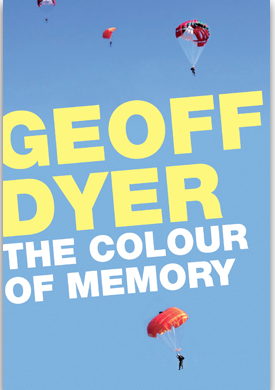
The Colour of MemoryGeoff Dyer’s first novel, The Colour of Memory (1989), began life as ‘The Brixton Diaries’. In 1986 Dyer was commissioned by the New Statesman to write about life as he and his friends were experiencing it in South London. In a note to the revised edition of his novel (2012), Dyer recalls that it was hoped that the diary would have ‘an interest that was more than local and personal’. But what had been a factual writing commission subtly became a fictional writing project: ‘Gradually I saw a way of using and shaping the material in a slightly different way, in a form that would deploy it to better, more personal ends (I invented a sister for myself, or for my narrator, rather) and, hopefully, more lasting effect’.

The Brixton Diaries had recorded facts from his real life, whereas the novel takes liberties: introducing invented characters, but also clouding the Dyeresque narrator himself in fiction and leaving him nameless and unidentifiable with the author. In a late twist, it appears that the entire narrative is to be taken as written by a character who has appeared in the third person throughout it. The move renders the novel a teasing paradox, a metafictional circle in the key of Calvino or Borges. But we note that Dyer, in retrospect, presents the shift from diary to novel as a move to a more personal mode of writing. It seems that the Brixton Diaries sought public resonance, as reportage from a riot-scarred area of London during Margaret Thatcher’s third term of office; whereas their metamorphosis into fiction somehow allowed Dyer to write a more truly subjective account of the times.

In any case, The Colour of Memory’s roots in diary are unmistakable. The novel recounts the events of a year in Brixton, around 1986-7, essentially in chronological order. It is divided into sixty chapters which count down from 060 to 000. This device lends the book an obscure suspense, but as Dyer admits, suspenseful narrative was not his forte nor his aim: ‘The book did not start out as a novel (and, for anyone expecting a plot, never adequately became one)’. Each small vignette – involving the theft of the narrator’s car, a party, or a trip to Brixton market – could just about claim to include narrative, and certain tendencies grow through the book, notably the fear of crime which culminates in a mugging. But by most standards, The Colour of Memory is distinguished by the absence of narrative, or at any rate of any plot that soars beyond the plausible. The novel’s fascination is with the texture of life, unmomentous yet constant.

This fascination sometimes takes the idiom of photography: the book declares itself to be ‘like an album of snaps’, in which ‘what happens accidentally, unintentionally, at the edges or in the margins of pictures – the apparently irrelevant detail – lends the photograph its special meaning’. Dyer’s book was thus a rarity: an English novel that not merely relayed but formally embodied the advanced continental ideas of the time, in this case those of Roland Barthes’ late work on photography Camera Lucida (1980). In its hospitality to contingency, it also stands as an ambiguous text, between the genres of personal journal and narrative fiction. The Colour of Memory invites us to think about the common ground occupied by the novel and the diary: that less public and celebrated genre that has so often nourished fiction.

(Birkbeck’s Centre for Contemporary Literature will hold a day conference on the work of Geoff Dyer on 11 July 2014.)

Who can control the post-superpower capitalist world order?

This post was written by Slavoj Žižek, Director of the Birkbeck Institute for the Humanities. It was originally published on the Guardian’s Comment is Free site.

To know a society is not only to know its explicit rules. One must also know how to apply them: when to use them, when to violate them, when to turn down a choice that is offered, and when we are effectively obliged to do something but have to pretend we are doing it as a free choice. Consider the paradox, for instance, of offers-meant-to-be-refused. When I am invited to a restaurant by a rich uncle, we both know he will cover the bill, but I nonetheless have to lightly insist we share it – imagine my surprise if my uncle were simply to say: “OK, then, you pay it!”

There was a similar problem during the chaotic post-Soviet years of Yeltsin’s rule in Russia. Although the legal rules were known, and were largely the same as under the Soviet Union, the complex network of implicit, unwritten rules, which sustained the entire social edifice, disintegrated. In the Soviet Union, if you wanted better hospital treatment, say, or a new apartment, if you had a complaint against the authorities, were summoned to court or wanted your child to be accepted at a top school, you knew the implicit rules. You understood whom to address or bribe, and what you could or couldn’t do. After the collapse of Soviet power, one of the most frustrating aspects of daily life for ordinary people was that these unwritten rules became seriously blurred. People simply did not know how to react, how to relate to explicit legal regulations, what could be ignored, and where bribery worked. (One of the functions of organised crime was to provide a kind of ersatz legality. If you owned a small business and a customer owed you money, you turned to your mafia protector, who dealt with the problem, since the state legal system was inefficient.) The stabilisation of society under the Putin reign is largely because of the newly established transparency of these unwritten rules. Now, once again, people mostly understand the complex cobweb of social interactions.

In international politics, we have not yet reached this stage. Back in the 1990s, a silent pact regulated the relationship between the great western powers and Russia. Western states treated Russia as a great power on the condition that Russia didn’t act as one. But what if the person to whom the offer-to-be-rejected is made actually accepts it? What if Russia starts to act as a great power? A situation like this is properly catastrophic, threatening the entire existing fabric of relations – as happened five years ago in Georgia. Tired of only being treated as a superpower, Russia actually acted as one.

How did it come to this? The “American century” is over, and we have entered a period in which multiple centres of global capitalism have been forming. In the US, Europe, China and maybe Latin America, too, capitalist systems have developed with specific twists: the US stands for neoliberal capitalism, Europe for what remains of the welfare state, China for authoritarian capitalism, Latin America for populist capitalism. After the attempt by the US to impose itself as the sole superpower – the universal policeman – failed, there is now the need to establish the rules of interaction between these local centres as regards their conflicting interests.

This is why our times are potentially more dangerous than they may appear. During the cold war, the rules of international behaviour were clear, guaranteed by the Mad-ness – mutually assured destruction – of the superpowers. When the Soviet Union violated these unwritten rules by invading Afghanistan, it paid dearly for this infringement. The war in Afghanistan was the beginning of its end. Today, the old and new superpowers are testing each other, trying to impose their own version of global rules, experimenting with them through proxies – which are, of course, other, small nations and states.

Karl Popper once praised the scientific testing of hypotheses, saying that, in this way, we allow our hypotheses to die instead of us. In today’s testing, small nations get hurt and wounded instead of the big ones – first Georgia, now Ukraine. Although the official arguments are highly moral, revolving around human rights and freedoms, the nature of the game is clear. The events in Ukraine seem something like the crisis in Georgia, part two – the next stage of a geopolitical struggle for control in a nonregulated, multicentred world.

It is definitely time to teach the superpowers, old and new, some manners, but who will do it? Obviously, only a transnational entity can manage it – more than 200 years ago, Immanuel Kant saw the need for a transnational legal order grounded in the rise of the global society. In his project for perpetual peace, he wrote: “Since the narrower or wider community of the peoples of the earth has developed so far that a violation of rights in one place is felt throughout the world, the idea of a law of world citizenship is no high-flown or exaggerated notion.”

This, however, brings us to what is arguably the “principal contradiction” of the new world order (if we may use this old Maoist term): the impossibility of creating a global political order that would correspond to the global capitalist economy.

What if, for structural reasons, and not only due to empirical limitations, there cannot be a worldwide democracy or a representative world government? What if the global market economy cannot be directly organised as a global liberal democracy with worldwide elections?

Today, in our era of globalisation, we are paying the price for this “principal contradiction.” In politics, age-old fixations, and particular, substantial ethnic, religious and cultural identities, have returned with a vengeance. Our predicament today is defined by this tension: the global free circulation of commodities is accompanied by growing separations in the social sphere. Since the fall of the Berlin Wall and the rise of the global market, new walls have begun emerging everywhere, separating peoples and their cultures. Perhaps the very survival of humanity depends on resolving this tension.

The Coach on the Couch

This post was contributed by Dr Andreas Liefooghe, Reader in Organizational Psychology and Programme Director for the Postgraduate Certificate in Coaching, launched this week. 

The rise of executive and other forms of coaching is arguably one of the most significant changes in the work context so far this century. Prior to 2000, professional helping relationships were clearly linked to the tasks and operations of the organization, mainly in the guise of consultants. Care of the personal kind, when it happened, had a whiff of failure – no-one would admit to seeing a counselor, far less a psychotherapist or psychiatrist. So the idea that conversations in a specific professional relational context can help someone has finally shifted from Viennese couches to executive boardrooms.

Coach!

Of course, the name helps.  Coaching, derived from sport, has a much more macho feel than the more feeble counseling. Primarily, the focus is on ‘reaching your full potential’, ‘increasing your performance’, ‘finding solutions’. Coaching carries no stigma, unlike counseling with its progression from madness to neurosis to ordinary unhappiness.

Once the sole preserve of the executive classes, coaching has now been democratized and is accessible to most levels in organizations. The focus has shifted for coaches, too. Largely gone is the soul-searching about whether coaches deliver coaching or therapy. It has been replaced by angst about which accrediting professional body will legitimize their actions.

There is still, of course, the niggling doubt as to why coaching should be necessary in organizations. Is there not enough help already? Why does this helping relationship need to be outsourced, and in such numbers?

Helping others

We believe the answer to this might be found in social psychology. Rather glumly, experiments from the sixties and seventies provide evidence that when we would expect people to help, they actually don’t. The famous Good Samaritan experiment demonstrated that, ultimately, we see ourselves as more important than others, particularly when pressed for time. As Darley and Batson (1973) put it, morals are a luxury when the speed of life increases. In today’s fast-paced organizational cultures, helping others may not be efficient.

Instead of a more positive picture, Organizational Citizenship Behaviour (OCB) research sets out why investing more time cultivating OCBs makes commercial sense. Also referred to as contextual performance, this field of study maps the extent to which altruism, civic virtue, sportsmanship, courtesy and conscientiousness are manifested at work. One important predictor of OCB is leadership – if there is a good relationship between the leadership and the employees, more examples of helping behaviours will be found, and higher performance levels (Motowidlo, 2011). And it is perhaps here that an executive coach can make a difference.

Coaching – a menace or a miracle?

Neither. Coaching can promote understanding, facilitate change, and develop potential, amongst others – but it would be wrong to claim it is a silver bullet to organizational helping and performance. Coaching is not a unified approach, and many different things manifest themselves under this moniker.

Edward Wray-Bliss (2013) writes of the deification/demonification of CEOs, and how they become the absolute Good and Evil. These attributions, while flawed, help organizational members make sense of a complex environment. Executive coaching in this context is no exception. Loh and Kay (2003) warned of the coaching menace, where coaching was seen as the silver bullet, and delivered by individuals with dubious credentials to people who didn’t need this macho sports-metaphor at the company’s expense. On the contrary, others see the miracle of executive coaching as further evidence of the well-deserved, god-like status, imbued with machismo, of the Glorious Leader. Indeed, in the late nineties one of the first CEOs I coached mentioned that I came third only to the private jet and his chauffeur…

The Post-Graduate Certificate in Coaching

Given that coaching is perhaps one of the most important organizational developments in the last decade, we decided it was important to spend more time reflecting on its impact. This one-year programme is designed for both established coaches who want more structure to their work, and to help those new to the field build a strong grounding. As you would expect from the Department, we emphasise rigorous academic theory and practice, combined with skills development and reflexive practice.

Today is happiness day, but could greater happiness be a permanent reality?

David TrossThis post was contributed by David Tross, associate lecturer at Birkbeck. David is running a series of workshops on happiness and wellbeing as part of Birkbeck’s Pop-up University in Willesden Green, which is running until the end of May.

The 20 March is the UN International Day of Happiness, recognizing, it says, ‘the relevance of happiness and well-being as universal goals and aspirations in the lives of human beings around the world and the importance of their recognition in public policy objectives’. If you visit the UN’s observance day website, happy images include Ban Ki Moon dancing ‘gangnam style’ with puffy South Korean popster Psy, though paradoxically its text also recommends marking the occasion ‘in an appropriate manner, including through education and public awareness-raising activities.’ If this doesn’t sound particularly joyful, the UK organisation Action for happiness suggests a range of everyday activities to increase your happiness and those around you. If hugging strangers on the street sounds more dangerous than life-enhancing, then other ideas, including mindfulness meditation and keeping gratitude journals, are in keeping with older, eastern and western philosophical notions of how to live a good life.

What’s new is the shift in the claims made about the efficacy of these methods, with many contemporary scholars hailing happiness as a ‘new science’ on the basis of developments in measuring happiness that can be applied not just to individuals but to whole countries. The latest World Happiness Report, taking measures of self-reported life satisfaction and mood data from 156 countries, has proclaimed Denmark as the happiest country in the world, with fellow Scandinavian countries following close behind. (The UK is in 22nd place). Forget the bleakness and bad weather of popular scandi-noir TV shows, the research suggests. Denmark’s secret? Social equality, socialising across social classes, generous childcare policies, realistic personal expectations and a cozy spirit of togetherness the Danes call ‘hygge’ ( the closest translation might be the Irish ‘craic’). Although the scientific validity of these measures have been questioned, particularly  in terms  of cross-country comparisons, the findings are supported by claims brought to the public’s attention in 2008 with the publication of The Spirit Level, that the most unequal countries perform worst across a range of wellbeing indicators including trust, mental health, drug addiction, obesity and literacy.

This is the happiness paradox in action: after basic needs have been met, increased wealth has not produced greater happiness in rich countries, the gains made in life expectancy and income cancelled out by the personal and social stresses of a competitive, materialistic society. If happiness and wellbeing provides an alternative measure of social progress to economic growth then surely we should be encouraged by the enthusiasm of politicians, with David Cameron’s commissioning of an ONS-led UK happiness index the latest in a series of government-backed initiatives in France, Canada and the original happiness pioneers, the tiny nation of Bhutan. But some are suspicious. Government-backed happiness is the dystopian vision of Huxley’s Brave New World, where everybody feels good and nobody is free. And if the number of people relying on food banks to survive has tripled over the last year, why are we wasting our time on happiness when there are more pressing concerns? As the philosopher Julian Baggini has noted, ‘If you look at the countries that do best in surveys of wellbeing, they haven’t got there by having these indices. They’ve got there by agreeing what priorities should be”.

Such concerns are understandable in the context of recent ONS data suggesting the UK has become happier from 2012 to 2013; instead of an antidote, happiness measures could be used to legitimise austerity economics and increasing inequality.

The British economist Richard Layard declares that ‘happiness must be the business of government’. yet his policy recommendations, including spending to alleviate unemployment and poverty, sound almost socialist. Could it be that the happiness agenda could be a way of sneaking the politically taboo concepts of social justice and greater income equality in through the back door? Should you eliminate poverty because it makes people (including the rich) unhappy, or because it is the right thing to do? The answer might be to create the wider social and economic conditions conducive to individual fulfilment and not micro-manage the personal paths. But paradoxically, happiness is serious. Scroll along from the dancing UN secretary general on the UN website and you get a caption celebrating ten years of peace in Liberia. No disrespect to Psy, but that’s the kind of happiness many more would get behind.

Flight MH370’s disappearance does not demand a xenophobic response

This post was contributed by Dr Nadine El-Enany, a lecturer in Birkbeck’s School of Law. It originally appeared on The Guardian.

We now know that the two men travelling on stolen passports on board the missing Malaysian Airlines flight MH370 are thought to be Iranian asylum seekers en route to Europe. This has exposed as unwarranted the alarmist response to the discovery that passengers with falsified or stolen passports were on the flight. For the poorest people living in the global south, often from war-torn countries or repressive regimes, obtaining a falsified or stolen document is often the only way out.

And yet the mundane, everyday phenomenon of falsified travel documentation rapidly attracted a disproportionate degree of attention. The suspicion was quickly aired in the media, spurred on by officials, that those passengers holding falsified passports might have terrorist connections. And this has come hard on the heels of the story of the easyJet flight grounded when schoolchildren panicked after seeing a fellow passenger writing in a script they believed to be Arabic. All this is symptomatic of a moral panic that is presenting the “Islamic radical” and the “illegal immigrant” as the folk devils of our age.

In fact, it was always unlikely that either of these passengers were terrorists. Much more likely is that these were desperate individuals trying to better their lives.

The facilitation of terrorist activity by the market in falsified travel documentation is rare. The real story is the ordinariness and everyday necessity of this market due to strict immigration and border controls. Common EU visa rules are applicable to nationals of 128 countries, including the majority of African and Asian countries and significant parts of Central America. Many of these are refugee-producing countries.

Further, EU countries require a special airport transit visa for nationals from countries producing high numbers of asylum seekers, including Iran. The reality for most refugees fleeing to Europe in search of safety is a life-threatening journey by sea or stowing away in transport containers. In 2011, at least 1,500 people perished attempting to cross the Mediterranean alone. Only a tiny minority of irregular migrants can afford the cost of a forged passport and flight ticket, the extortionate cost of these – about $1,000 for a European passport – is indicative of the desperation of those willing to pay.

Due to EU carrier sanctions it is almost impossible for migrants – whatever their motivation for moving, whether economic or in search of safety from war or persecution – to enter the EU in a regular manner. Carrier sanction regimes entail fining airlines and other transportation companies for bringing individuals into the EU who do not have the required documentation. Transporters are fined and designated as responsible for returning or paying the cost of detaining such persons. It is these border control regimes that should be subjected to scrutiny, rather than the phenomenon they create: “illegal immigration” facilitated through falsified documentation. Carrier sanctions together with visa regimes force some migrants into a situation where they have to obtain forged or stolen documentation in order to be able to travel.

In the wake of the disappearance of flight MH370, Interpol’s secretary general called for stricter security measures at borders. This, he says, would ward off speculation of terrorism in the event of flight tragedies. But shouldn’t common sense and decency be sufficient to deter such speculation? Even more stringent security measures will mean that asylum seekers will be unable to flee their countries. It is due to the absence of legal migration routes that many asylum seekers are forced to travel irregularly. A xenophobic response to the tragic disappearance of flight MH370 even before the facts are known is reckless and unseemly.