This World TB Day (24 March), Professor Sanjib Bhakta from Birkbeck’s School of Natural Sciences reflects on the ongoing global challenge of tuberculosis and how Birkbeck researchers are contributing to the fight against drug-resistant infections.
On 24 March each year, World TB Day serves as a powerful reminder that tuberculosis (TB), a disease many consider a relic of the past, remains one of the deadliest infectious diseases worldwide. Caused by Mycobacterium tuberculosis, TB continues to claim nearly 1.5 million lives annually, disproportionately affecting communities in low- and middle-income groups locally in London and globally.
The story of TB research began in 1882, when Dr Robert Koch announced his discovery of the TB bacillus, transforming scientific understanding of the disease. More than a century later, the challenge has evolved. Today, the rise of antimicrobial resistance (AMR) and the burden of prolonged, complex treatment regimens demand new and innovative solutions.
At Birkbeck, University of London, the Mycobacteria Research Laboratory is at the forefront of this global effort. Through cutting-edge research in molecular microbiology and biochemistry, the team is working to develop new therapeutic strategies to combat drug-resistant mycobacterial infections.
A key milestone in this journey is a new collaboration with the Ineos Oxford Institute, as part of the Oxford Consortium on Drugs for Drug-resistant TB (OxCoD4TB). This partnership brings together leading researchers, clinicians, and industry experts to accelerate the discovery of next-generation TB treatments. This spirit of collaboration and innovation was on full display at the Ineos Oxford Institute’s annual Early Career Researcher Conference 2026 this month, hosted at Saïd Business School, University of Oxford. Bringing together more than 200 participants from across disciplines, including microbiology, drug discovery, genomics, clinical science, and social science, the conference provided a vibrant platform for sharing ideas and forging new partnerships.
Birkbeck’s School of Natural Sciences team of early career researchers made a strong impact at the event. Among them, Dr Nupur Angrish, a postdoctoral scientist, was awarded the Best Poster Prize. Reflecting on the experience, she described the conference as “incredibly inspiring,” highlighting the breadth of approaches being taken to tackle AMR. She added: “It means a great deal to have our work recognised by such an engaged and knowledgeable audience.”
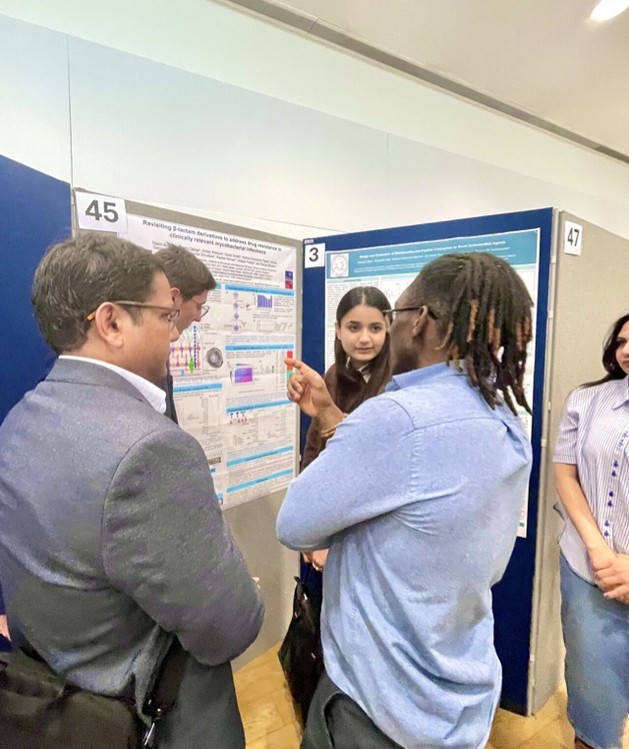
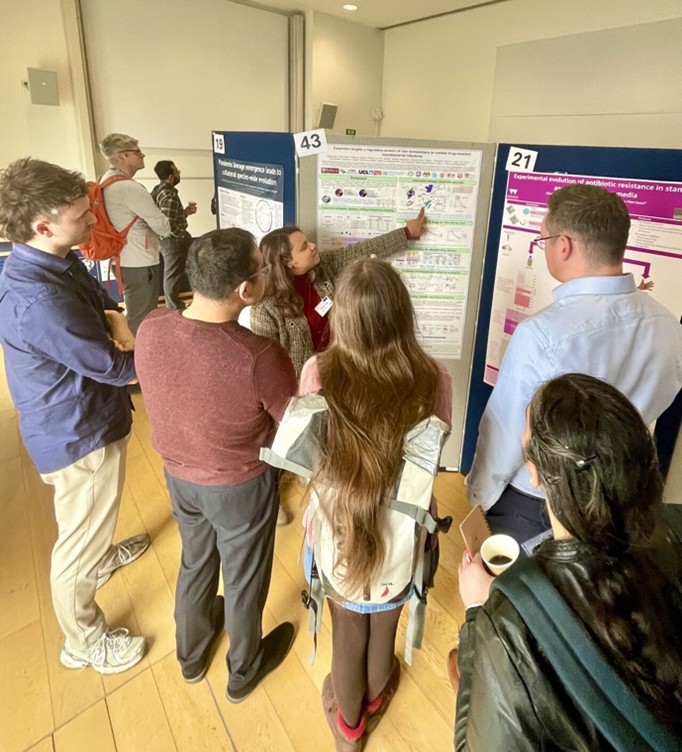
Dr Ankita Nag (left) and Dr Nupur Angrish (right) presenting their research posters at the IOI Oxford Early Career Researchers Conference 2026.
Beyond the conference, Birkbeck’s contribution to World TB Day also extends to global policy and public engagement. This week, I am co-chairing a session at the UCL–LSHTM World TB Day event at Great Ormond Street Hospital, exploring how artificial intelligence could help accelerate progress towards ending TB – an area of growing importance in infectious disease research.
Tackling TB, particularly drug-resistant forms of the disease, requires coordinated, global action. We must use antimicrobials responsibly while strengthening effective prevention, quicker detection and shortening, and simplifying TB treatment to deliver a faster, more efficient cure.
Echoing the World Health Organization’s World TB Day call, “Yes! We can End TB!”, progress will depend on country-led action, people-powered change, and a united One Health effort.
More information