Valentine’s Day

This post was contributed by Professor Lynne Segal, Anniversary Professor of Psychology & Gender Studies in the Department of Psychosocial Studies.

Not again? Are you home alone on Valentine’s day, feeling yourself like a miserable old ghost, excluded from the feast of love? If so, you could join up with the ‘one-billion-rising’, the global feminist campaign which, in the footsteps of Eve Ensler seventeen years ago, turned Valentine’s Day into V-Day. Women and men everywhere are being urged to take a stand against violence against women, so often perpetrated through sexual assault. Here the V stands for Victory over men’s Violence against Women. It is a victory that is to be achieved through, among other things, everybody learning to love, instead of hating and abusing, the Vagina. It’s a crucial movement, with rape culture still endemic around the world.

But let me return to my opening question, the thought of being home alone on Valentine’s Day. Are we unlovable if tonight we find ourselves undatable, living alone, outside any couple? Of course not! We all know that there are so many different kinds of love, some might even reflect, like Jeanette Winterson this time last year, that all our relationships are based on love of different kinds: ‘If we could try to experience love as a quality – like compassion or courage – and focus less on love as an event, something that happens, then love would belong to us, rather than being dependent on us belonging to someone’.

In his conversation, In Praise of Love, the philosopher Alain Badiou echoes some of Winterson’s thoughts, though reinstating the couple as the site of ‘love’. Disdaining what he sees, rather oddly, as the ‘risk-free’ commercialization of love in internet dating, Badiou affirms the truth of ‘love’ in the movement from the chance encounter to the challenging commitment of an enduring recognition and acceptance of ‘difference’ between two people, as each negotiates a shared encounter with the world, no longer ‘from the perspective of the One, but from the perspective of the Two’.

Love may indeed be best seen as a quality of commitment, acceptance and enduring negotiation. However there is surely a little more to add when Winterson or Badiou object, as many do, to the commodification of the trade in ‘love’ nowadays, exemplified by those roses and chocolates on Valentine’s Day. This is because, even when free from the taint of commercialism, love is always shadowed by various forms of envy, dread of abandonment, and more, on the one hand; constraint and fears of suffocation, on the other.

This underbelly of love persists, whether we see ‘love’ as a type of event (the expression of desire, the occurrence of sexual activity, the declaration of strong affection); or alternatively, as a quality of lasting attachment and care (trying to be always dependable, supportive, comforting, responsive, in sharing one’s life with another). In a brief meditation on the risks of love the philosopher Judith Butler agrees, when she writes, ‘love is not a state, a feeling, a disposition, but an exchange, uneven, fraught with history, with ghosts, with longings that are more or less legible to those who try to see one another with their own faulty vision.’ The archetypal bond of love, that of a child for its mother, conveys it all; soon enough the child will be caught between need and flight, even as the mother was perhaps once caught between fear and flight at the initial total dependence of the infant on her ceaseless ministrations.

We could all love each other more, even that passing stranger, and the world be a better, indeed unrecognizable, place. But who dares ask for love without fear of rejection? It is the horror of the pitying smugness of the securely (or insecurely) coupled that single people experience, especially on Valentine’s Day. Now where exactly can I find those billion people rising, tonight?

Listen to a podcast from the School of Social Sciences, History and Philosopy’s lecture series ‘The Importance of Being Human’ (2011). Professor Lynne Segal and Professor Stephen Frosh discuss : Is love possible?

Reflections On Gay Marriage

This post was contributed by Daniel Monk, Reader in Law, in Birkbeck’s School of Law.

When the result of the House of Commons vote on gay marriage was announced I was surprised not so much by the result – 400 in favour/175 against – but by how moved I was by it.

Full Equality?

If enacted, gay marriage will not add any rights or benefits to those already provided for by the Civil Partnership Act 2004. The marriage rules relating to adultery and consummation (which never applied to civil partnerships) will still not apply to same sex marriage. And Christian gays and lesbians will be prevented from being married by the established Church of England (even if their local clergy wants to). So, while close, it is not full legal equality. And add to this the fact that Prime Minister David Cameron’s support of gay marriage has been seen by many political commentators as an attempt to prove himself to be a moderniser in the run up to the 2015 General Election, a more cautious reaction to the vote might have been in order.

Past injustices

But the reason why it moved me and many other gays and lesbians attests both to the symbolic significance of marriage and to law’s function, too often unacknowledged, as a vehicle for the expression of emotions. Oscar Wilde on being released from Reading Gaol in 1897 is recorded as saying, “Yes, we will win in the end; but the road will be long and red with monstrous martyrdoms”. The overwhelming support for gay marriage by the House of Commons is moving then, not primarily because of what it enables in the future, but because of the perspective it provides for viewing and remembering that long road. For many gay men alive now sex between men was illegal for a major part of their lives and lowering the age of consent to 16 (making it equal for gays and straights) was only achieved in 2000. As an undergraduate student in the 1980s not only was it potentially criminal for me to have any male partners but in family law I read about contemporary cases where lesbians were losing custody of their children simply on the basis of their sexuality. And at the same time the notorious Section 28 in 1986 outlawed the ‘promotion of homosexuality’. In this context the vote for gay marriage, in a bitter sweet way, is experienced as a form of reconciliatory justice, an implicit political acknowledgment and apology for the violence of the law in the past.

Why Marriage?

That marriage has been the vehicle for expressing a commitment to respecting gays and lesbians is not surprising. For those who see analogies between gay rights and the US Black Civil Rights movement, the right to marry (as opposed to entering a civil partnership) is comparable to the right to travel on non-segregated buses. Equal but different simply isn’t good enough. But marriage is a complex institution and its ‘true’ function has always been contested. Gay marriage is only one site of contemporary conflict. Other current debates concern the status of pre-nuptial agreements, the legal distinction between ‘forced’ and ‘arranged’ marriages, and extension of marriage-like rights to cohabitants (conjugal, coupled or otherwise). This broader context opens up the debate to principles other than formal legal equality and reveals alternatives to simply voting for or against gay marriage.

Alternatives

One alternative, which is adopted in many continental countries, is that ‘marriage’ is left totally to the authority of religious bodies and all legal consequences are removed from it, while at the same time opening up civil partnerships to both heterosexuals and non-conjugal relations. One benefit of this is that the rules relating to adultery and non-consummation would not apply to anyone, again a reform adopted in other jurisdictions. Of course this route would require the disestablishment of the Church of England and the separation of Church and State. (Section 3 of the gay marriage Bill refers to the Submission of the Clergy Act 1533; in family law the battle between Church and State goes back a long way!)

A second even bolder alternative would be to leave marriage to religious bodies and to simply dispense with the legal regulation of conjugal couple relationships altogether. This approach asks us to question not ‘why should gays be excluded from marriage’ but ‘why does the State regulate relationships’? This focus requires us to engage seriously with David Cameron’s claim that he supports gay marriage, ‘not despite being a Conservative but because I’m a Conservative’.

These are important questions for the future. But in looking back to the past and fittingly as Birkbeck for the time marks LGBT History Month, gay marriage is unquestionably cause for celebration.

Defence policy for an independent Scotland

This post was contributed by Ron Smith, Professor of Applied Economics in the Department of Economic, Mathematics and Statistics.

Scottish independence is a low probability event, but low probability events like the break-up of the Soviet Union or of Czechoslovakia do happen, so it is sensible to do some contingency planning. The Scottish Affairs Committee of the House of Commons has been examining the defence policy for an independent Scotland as part of its enquiry into The Referendum on Separation for Scotland. Together with Professor Malcolm Chalmers of the Royal United Services Institute I gave evidence to the Committee on January 23.

The Scottish National Party, SNP, has suggested a defence budget for an independent Scotland of around £2.5 billion with armed forces of 15,000 personnel. A comparison with other small countries with populations of around 5m, like Ireland, Norway, Denmark or New Zealand suggests that these are reasonable numbers for steady state spending and armed forces. However, the transition to steady state is likely to be difficult.

The sort of equipment that Scotland might inherit from the UK is unlikely to be appropriate for an independent Scotland. The obvious example is the Trident nuclear deterrent, which is located in Scotland on the Clyde, on which the Scottish Affairs Committee has already reported.

Scotland is likely to follow those other small countries which inherited nuclear weapons on separation. Belarus, Ukraine & Kazakhstan all denuclearised, and that is SNP policy.  They had aid under the US Nunn-Lugar Cooperative Threat Reduction program to help them repatriate the weapons to Russia. How one would repatriate Scottish nuclear weapons would be a central issue.

A major problem in the transition is that the military or defence civil servants that Scotland inherits from the UK are likely to have UK preconceptions and a mindset that is inappropriate for a small country like Scotland. They would face the same problems that somebody leaving a large company for a small firm faces. Some of the suggestions that have been made for a possible Scottish force structure reflect that mindset.

Because of the SNP’s commitment to the traditional Scottish regiments, their proposed structure is rather infantry heavy, whereas it is likely that naval and air assets for protection of fisheries and oil fields will be more useful. However the ships and aircraft they might inherit from the UK are not likely to be suitable, so they would need to buy new equipment appropriate for a small country.  Heavy investments in infrastructure may also be needed to provide for command and control, training and intelligence.

My suggestion would be that an independent Scotland should follow the example of the appointment of a Canadian as Bank of England Governor and hire a foreigner. Scotland should bring in a defence planner from somewhere like Ireland, Denmark or New Zealand, who understands how to run the defence of a small country.

The scientific legacy of the Apollo Moon landings and the case for a return to the Moon

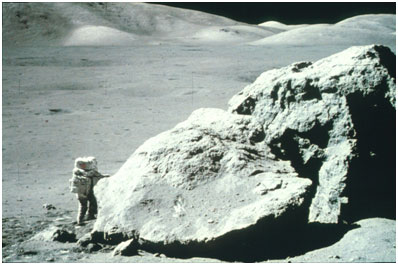
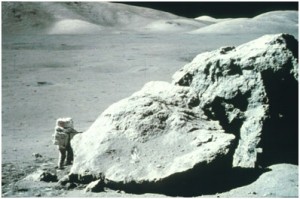
Fig. 1. One of the last two men on the Moon: Harrison Schmitt stands next to a large boulder at the Apollo 17 landing site in December 1972. (NASA).

Today, 19 December 2012, marks exactly 40 years to the day since the last human beings to set foot on the Moon, Gene Cernan and Harrison “Jack” Schmitt of Apollo 17 (Fig. 1), returned safely to Earth. In the three and a half years between Neil Armstrong’s ‘first small step’ in July 1969 and the departure of Cernan and Schmitt from the lunar surface in December 1972, a total of twelve astronauts explored the lunar surface in the immediate vicinity of six Apollo landing sites (Fig. 2).

Fig 2. The Apollo landing sites. Note their restriction to the central part of the nearside – there is a lot more of the Moon to explore! (Image: NASA).

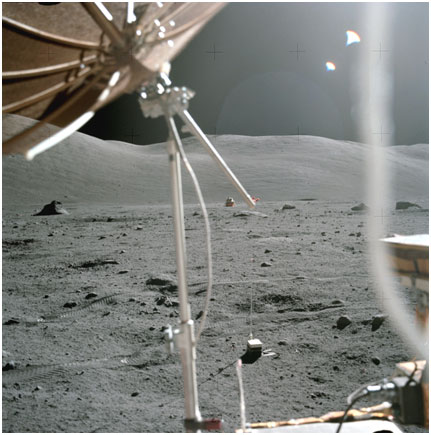
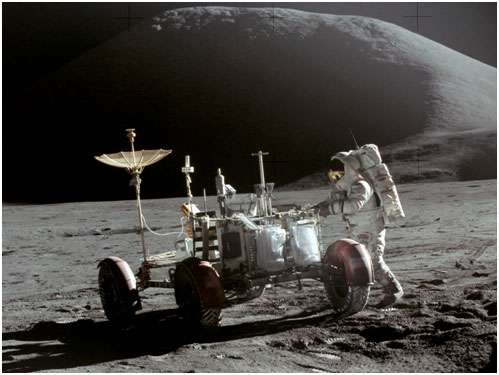
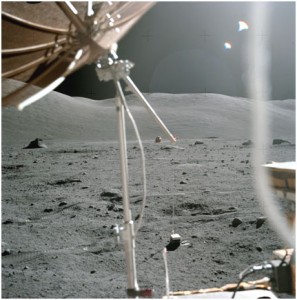
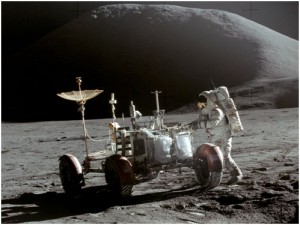
In their cumulative 12.5 days on the lunar surface, the twelve Apollo moonwalkers traversed a total distance of 95.5 km from their landing sites (heavily weighted to the last three missions that were equipped with the Lunar Roving Vehicle (or ‘moon buggy’), collected 382 kg of rock and soil samples, drilled three geological sample cores to depths greater than 2 m, and deployed over 2100 kg of scientific equipment (Fig. 3). The results from all this activity continue to have a major scientific impact today.
 

Apollo science

Probably the greatest scientific legacy of Apollo has resulted from analysis of the 382 kg of rock and soil samples returned to Earth. One of the key results has been the calibration of the lunar cratering rate. Only by comparing the density of impact craters on surfaces whose ages have been obtained independently by laboratory analyses of returned samples is it possible to determine the rate at which meteorite impacts have created craters on a planetary surface. Analysis of the Apollo samples has enabled this to be done for the Moon, which remains the only planetary body for which such a data-set exists, and which is used, with various assumptions, to estimate the ages of cratered surfaces throughout the Solar System from Mercury to the moons of the outer planets.

Fig. 5. The current theory of the Moon’s formation from debris produced by a giant impact on the early Earth is largely based on the geochemical analysis of samples collected by the Apollo missions (image: Wikipedia Commons).

Another important result of Apollo sample analysis has been the evidence provided for the origin of the Moon. In particular, the discovery that lunar materials have compositions broadly similar to those of Earth’s mantle, but that the Moon is highly depleted in volatiles and has only a small iron core, led to the current view that the Moon formed from debris resulting from a giant impact of a Mars-sized planetesimal with the early Earth. It is very doubtful that we would have sufficient geochemical evidence usefully to constrain theories of lunar origins without the quantity and diversity of samples provided by Apollo.

Birkbeck’s involvement

The Apollo samples have of course also been central to our understanding of the Moon’s own geological history and evolution. While lunar geology may at first sight appear to be a relatively parochial area of planetary science, it is important to realise that the Moon’s surface and interior retain records of planetary processes which will have occurred in the early histories of all the terrestrial planets. In all these respects the Moon acts as a keystone for understanding the geological evolution of rocky planets, and is an area in which we at Birkbeck are actively engaged (Fig. 6).

Fig. 6. Fragments of Apollo 12 soil sample 12023 at the Lunar Sample Laboratory at the NASA Johnson Space Center, Houston, being selected for a lunar volcanic diversity study by Birkbeck scientists in 2009. Inset (left to right): PhD student Joshua Snape (now a post-doc at the Open University), the author, and Dr Katherine Joy (now at the University of Manchester); since this photo was taken Birkbeck PhD student Louise Alexander has also joined the project (photo: I.A. Crawford).

Lunar geophysics

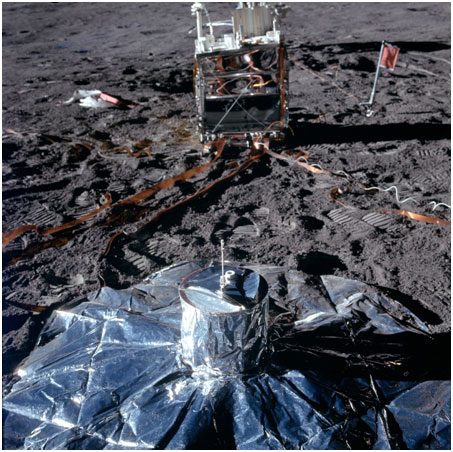
In addition to study of the Apollo samples, many other areas of scientific investigation were also performed by the Apollo missions, especially geophysical investigations of the Moon’s interior (Fig. 7). Key results included the discovery of natural moonquakes and using them to probe the structure of the crust and mantle, geophysical constraints on the existence and physical state of the lunar core, and measurements of the flow of heat from the Moon’s interior. Although these data are over thirty years old, advances in interpretation means that they continue to give new insights into the interior structure of the Moon. For example, only last year an apparently definitive seismic detection of the Moon’s core, and strong evidence that, like the Earth’s, it consists of solid inner and liquid outer layers, was made by a re-examination of Apollo seismic data.

Fig. 7. Apollo 14 seismometer deployed on the lunar surface; the silvery skirt provided thermal stability. These instruments, also deployed at the Apollo 12, 15 and 16 landing sites, constituted the Apollo passive seismic network which remained active until 1978 and yielded valuable data about the interior of the Moon (NASA).

Looking over the totality of the Apollo legacy, I think one could reasonably make the case that Apollo laid the foundations for modern planetary science, certainly as it relates to the origin and evolution of the terrestrial planets. Arguably, the calibration of the lunar cratering rate, and its subsequent extrapolation to estimating surface ages throughout the Solar System, could alone justify this assertion. If one also considers the improvements to our knowledge of lunar origins and evolution, and the records of solar wind, cosmic rays and meteoritic debris extracted from lunar soils, it is clear that our knowledge of the Solar System would be greatly impoverished had the Apollo missions not taken place.

Time to go back?

However, it is also clear that Apollo did little more than scratch the surface, both literally and figuratively, of the lunar geological record. With only six landing sites, all at low latitudes on the nearside (Fig. 2), it is clear that much remains to be explored. Moreover, precisely because we have the Apollo legacy as a foundation on which to build, supplemented by recent orbital remote-sensing missions, it is now possible to formulate much more sophisticated lunar exploration strategies than was possible forty years ago. There are now key, specific, scientific questions which can only be addressed by once again returning to the lunar surface (Fig. 8).

Fig. 8. Artist’s concept of astronauts supervising a drill on the Moon. Returning humans to the lunar surface later in the 21st century would facilitate larger scale exploration activities than was possible with Apollo, and will further increase our knowledge of lunar and Solar System evolution (artwork: NASA).

Therefore, as we pass the 40th anniversary of the last human expedition to the Moon, there are good scientific reasons to start planning for a return. However, unlike the Cold War competition that drove Apollo, a human return to the Moon in the coming decades would ideally be part of a sustained, international, programme of Solar System exploration such as the emerging Global Exploration Strategy.

Ian Crawford is Professor of Planetary Science and Astrobiology in the Department of Earth and Planetary Sciences, Birkbeck, University of London. His group is actively engaged in a number of areas of lunar science, and has recently been awarded a grant of £99,300 by STFC to study lunar meteorites found on Earth. This blog article is based on a popular article published in the December 2012 issue of the Royal Astronomical Society journal Astronomy and Geophysics, and a more technical review paper just published in Planetary and Space Science.

The Justice and Security Bill – a threat to open justice

Professor Bill Bowring of Birkbeck Law School, who is also a practising human rights barrister, writes about the potential impact of the controversial Justice and Security Bill.

The Justice and Security Bill, presently going through Parliament, threatens to take Britain back to the 17th century, through the regular use of secret evidence. The Coalition Government intends to expand the use of secret evidence to ordinary civil proceedings. As Liberty has pointed out, enactment of the Bill would be an unprecedented encroachment on the rule of law, and the principles of open and fair trial.

This controversial Bill is a panic reaction to the Labour Government’s defeat in 2010 in the Binyam Mohammed case. Binyam Mohamed was arrested in Pakistan and subjected by the US authorities to ‘extraordinary rendition’. He claimed that a confession that he had been trained by Al-Quaeda had been obtained by torture. Charges against him were dropped, after the US District Court of Columbia vindicated his claim that UK authorities had been involved in and facilitated ill-treatment and torture to which he was subjected while under the control of US authorities. He was released and arrived in the UK on 23 February 2009.

When he claimed damages, the UK Government attempted to exclude the evidence that he had been tortured, despite the fact that this was public knowledge in the US as a result of the judgment. On 10 February 2010 the Court of Appeal dismissed the Labour Government’s appeal against a series of Divisional Court judgments ordering that the Government was not permitted to exclude the information obtained from US sources. Jonathan Sumption QC, who is now a Justice of the Supreme Court, told the Court of Appeal on behalf of the Government that the Divisional Court’s decision was “unnecessary and profoundly damaging to the interests of this country”, and indeed that part of the reasoning of the Divisional Court was “irresponsible”. In fact all the information was already in the public domain.

Binyam Mohamed has now been paid a very large sum in compensation.

The Justice and Security Bill was introduced into the House of Lords on 29 May 2012 by Lord Wallace of Tankerness QC, a Liberal Democrat peer and Advocate General for Scotland. The Bill proposes a new Ministerial power to instigate, by application to the Court, a Closed Material Procedure (CMP), in cases where the Minister considers that disclosure of certain material would be damaging to national security. Until now, CMP has only been available in a very small number of specialist proceedings, such as in relation to “Terrorism Prevention and Investigation Measures”, and Control Orders. CMP takes place entirely in private; only the judge, the Government’s lawyers and a Special Advocate appointed by the Government for the litigant. The litigant and their lawyers are excluded. Unlike normal legal representatives Special Advocates are unable to disclose material to their ‘client’.

On 21 November 2012 Louise Christian of leading civil liberties solicitors Christian Khan chaired a public meeting at Garden Court Chambers, sponsored by the Haldane Society of Socialist Lawyers (of which I am International Secretary) and CAMPACC – the Campaign Against Criminalising Communities. The meeting was addressed by the human rights QC Dinah Rose; Richard Norton-Taylor, journalist on defence and security on The Guardian; Clare Algar, Executive Director of Reprieve; and Saghir Hussain Director of CagePrisoners. The theme running through the meeting was that open justice is a central principle of British law, and the right to a fair trial is a centuries-old feature of the common law and is enshrined in the European Convention on Human Rights.

I agree with the practising lawyers organised in the Bar Council and the Law Society that secret trials and withholding evidence are the standard practices of repressive regimes. The Bill if enacted will erode core principles of justice. The UK’s international reputation for fair trials will be significantly damaged.

Professor Bowring and Birkbeck Law School work closely with solicitors like Christian Khan, and the barristers at Garden Court, for example in the Law School’s annual week-long event “Law on Trial”.

Building a Media Reform Coalition: Real change for real journalism

Justin Schlosberg, Lecturer in journalism and media, in Birkbeck’s Department of Media and Cultural Studies reflects on the forthcoming publication of the Leveson report.

As Leveson’s report into the ethics and standards of the press nears completion, the closure of ranks among the media against any form of real change is intensifying. What we are presented with is a pseudo-choice between self or statutory regulation. What we end up with will most likely be a reformed Press Complaints Commission (PCC) with some kind of notional statutory underpinning. But it will be decried as an open door to state intrusion not seen since the repeal of censorship and stamp duties.

A lack of accountability

In the midst of this fervour, it may be forgotten that Hackgate was first and foremost about institutional corruption of the gravest order between the media, police and politicians of all colours, which testimony to the inquiry has underlined. The result has been a media that is not adequately accountable and does not do its job of holding others to account adequately.

The press themselves have sought to emphasise that the problem facing Lord Leveson is solely to do with the behaviour and ethics of (some) journalists. Even within this narrow framework, there have been increasing complaints that his remit is too wide and not appropriate to the extent of the problem; that British journalism is, on the whole, a robust and vigorous defender of the public interest. Within this narrative, the Guardian in particular is hailed as the champion of a pluralised press that can deliver accountability of itself.

But a genuinely democratic and accountable media system cannot be upheld by one or two titles with relatively minor readerships. What’s more, these titles have failed comprehensively to promote public interest journalism in other areas. For instance, the Guardian’s disastrous handling of Cablegate in 2010 (the series of US diplomatic cables released in partnership with WikiLeaks) resulted in stories about Gadaffi’s mistresses gaining more prominence than those about the Government undermining the Iraq Inquiry to protect US interests, or misleading Parliament over the banning of cluster bombs.

The real problem for democracy is not so much that bad journalism gets published, but rather that good journalism often doesn’t.  Finding alternative ways to regulate press ethics will deal only with a marginal and surface symptom of a much broader disease that has seen the space for real, professional journalism in the public interest progressively diminish. It’s about decades of unchecked concentration of media power and a resurgence of press baronism; it’s about structural declines in circulation exacerbated by the migration of readers and advertisers online; and it’s about incessant closures and cutbacks to operational journalism across all platforms and sectors, but most acutely affecting those areas central to the media’s democratic role: investigative and local journalism.

The issue of press ownership

Consequently, Lord Leveson could only do justice to his original remit (which includes examination of broader issues to do with media plurality) by addressing the ownership and funding of news in conjunction with press ethics. Specifically, by introducing media ownership thresholds that trigger public interest obligations and/or divestment; and by recommending new ways to fund and support journalism that serves the public interest over profit. Crucially, he should not allow the ownership question to be side-lined because of technicalities. Media concentration is notoriously difficult to both measure and apply remedies to. But this is not a reason for abandoning policy altogether and there are certainly historical and contemporary precedents elsewhere on which to base a renewed approach to ownership regulation; one that takes into account the emergence of new oligopolists in the digital domain, whilst acknowledging the enduring capacity of legacy media to dominate public conversation.

It is precisely this capacity which has enabled the whole issue of ownership regulation to be marginalised from the debate. It has fostered a view of new rules as unrealistic or unfeasible which has found its way into the discourse of politicians and even campaigners who are nonetheless committed to substantive reform. The press has opted to engage these voices on its own terms, allowing editors to espouse a sense of libertarian defiance whilst continuing to dance to the strings of their owner-bosses.

It is unlikely that Lord Leveson will seize this opportunity to redress the balance and make a genuine difference to media plurality and freedom. And even if he did, it is even less likely that the government will act upon his recommendations with the prospect of a general election looming. It is telling that even those, like Peter Preston, who acknowledge the enduring fear of politicians to contravene the will of the press, at the same time emphatically demand that the press be left alone. Yet the fear of politicians – exemplified by Labour’s recent recoiling from earlier calls for ownership caps – should itself be a warning sign for Leveson.

Media regulation?

Politicians will not be able to counter the dominant narrative emerging from a closing of ranks among the press without a concerted mobilisation of grassroots pressure. An IPPR poll six months ago suggested that a sizeable majority of the public support both statutory regulation of the press, and limits on media ownership. Regardless of what Leveson recommends, now is the time to establish and expand a movement for change that gives voice to this silent majority.

There are perhaps few issues that provoke a broader spectrum of opinion than media regulation. Familiar lines between left and right become blurred and no one seems to agree on what is really meant by media plurality, freedom or the public interest.  In his calls for evidence in regards to media reform proposals, Leveson has unwittingly induced a focus on difference rather than core common principles.

But there is certainly a clear majority support among reformers for a new regulatory framework that has both statutory underpinning and representation from working journalists as opposed to just editors. Equally, there is a wide consensus that something needs to be done about the concentration of media ownership which has fostered the kind of awkward and insidious relationships between media and political elites so vividly exposed by the Leveson hearings.

A media reform coalition is seeking to build on these core principles and engage broad support for real change in favour of real journalism. It has emerged from a cross section of civil society and campaigning groups including Hacked Off, Avaaz, the National Union of Journalists, 38 Degrees and the Coordinating Committee for Media Reform. Together, these groups are mobilising for a public lobbying of Parliament on the 29 November – when the Leveson Report is expected to be published. It will demonstrate the cross-section of public support for reform that goes beyond a new name for the PCC, and for new laws that will promote a genuinely democratic and accountable media.

A Time for Entrepreneurs

Andrew Atter, Birkbeck’s Entrepreneur-in-Residence, writes about the current opportunities for entrepreneurship in London.

As we draw to an end of Global Enterpreneurship Week, you might be forgiven for being overwhelmed by all the hype. Everywhere you look there are conferences and workshops. President Clinton delivers his key note speech at Entrepreneurs 2012 today. And, as you flick through papers, millionaires promise to share their secrets of success. Who said there’s no free lunch!

What does all this mean?

Well, behind the entire buzz, is a very serious point. As anyone who has seen the expression on Mervyn King’s face will have realized, as a society we face years of stagnation and low growth.

This means for students and alumni, work opportunities, job prospects and career growth through traditional corporate structures will be far more limited than in the past. As both an economy, and as individuals, we will all need to access new markets and create new products and services. This is what Entrepreneurs do: they take initiatives that create wealth and opportunity, for themselves and the society around them.

Looked at through the lens of an entrepreneur, the conditions for starting new businesses are good. According to the FT, new company formations rose by 2% last year, and HEFCE report that knowledge transfer from universities increased by 7% in 2010-11. The UK economy overall might be stagnant, but that is not true for London, and certainly not true for the M11 and M40 corridors linking London to Cambridge and Oxford.

Entrepreneurs with sharp business plans, focused on early sales growth, can get funding. And, the good news is that businesses formed in recession tend to be leaner, meaner and more sustainable that fanciful creations funded by bank debt in boom times. I speak from experience.  A business I founded in the post dot.com crash is still going strong, whereas a business launched at the peak in 2007 became an out of control, over complicated monster, and had to have the plug pulled out.

So, beware of the hype generated by charlatans and snake oil salesman, but also don’t be out off by the Mervyn Kings of the world.

Birkbeck students are situated at the nexus of the greatest concentration of financial, technical and creative resources on the planet, in one of the world’s most entrepreneurial societies. To prove it, next time you have a Dhall Curry at the farmers market in Torrington Square, just reflect on the simple fact that someone put the formula Students+Curry+Lunch = Opportunity together before you did. In other words, someone ate your lunch.

To avoid that happening again, simply join the Birkbeck Enterprise Hub (aka Starts Hub), join a Coaching Seminar, attend a CEO Workshop, and start making things happen for yourself and those around you!

Austerity under Thatcher and the Coalition: the second time as tragedy

By Professor Deborah Mabbett, who will be delivering her inaugural lecture this evening, 8 November 2012.

In 1979, a new government came to power in Britain determined to rein in public spending and set the economy on a new path led by private innovation and enterprise. Sound familiar? There are certainly some parallels between the Thatcher government and the current Coalition, but there are also some puzzling differences. Take social security. Both tried, or are trying, to cut back this unloved area of government spending, but their cuts are quite different. Thatcher cut back the state pension, but more or less maintained the safety net of means-tested benefits. The Coalition has targeted many parts of the means-tested system for cuts, while the state pension is to be protected with a ‘triple lock’: indexed to the best of wages, prices or 2.5%. Thatcher’s policy was based on the philosophy that the state should provide a minimal, residual safety net, and the private sector would do the rest. But what philosophy guides the Coalition’s pattern of cuts?

The answer shows something important about the relationship between the government and the financial services sector. Under Thatcher, this sector was not only the great hope for the deindustrialised British economy; it also had a key role to play in privatising welfare. Council tenants exercising their right to buy would get their mortgages from the newly-liberalised building societies, while workers would entrust their pension contributions to investment funds which held out the promise of good returns, albeit reduced by large fees.  Twenty-five years on, the government was forced into a dramatic bailout of the financial system. Less noticed, it is also locked into supporting privatised welfare in expensive ways.

Problems with privatised pensions have been apparent: mis-selling, fraud and high fees have afflicted the sector. The government’s response has been to tighten the regulatory framework, while continuing to encourage contributions with generous tax incentives. Regulation was the price of making finance the agent of the government’s plans: private pensions had to be made to work, and if they didn’t, the government would step in to ‘correct’ the market.  Regulation was seen as a burden by the financial sector, but it could also be costly for the government, as the Equitable Life case showed. Equitable Life made commitments to its policyholders that it was unable to honour: the government ended up having to compensate policy-holders for ‘a decade of regulatory failure’. The failings of private sector agents could come back to bite the government.

Indexing the state pension only to prices meant that it failed to keep up with rising living standards. This was intentional: the idea was that private pension provision would expand to fill the gap. For those who lacked a private pension top-up, means-tested benefits were available. However, the rise of means-testing conflicted with the aim of expanding private provision, because workers can contribute to a pension scheme and then find that state benefits are reduced. While successive governments tried to mitigate the effects with various allowances and tapers, it remained the case that pension contributions could bring a very small return in increased retirement income.

The decision to adopt ‘automatic enrolment’ made it a necessity to do something to restrain means-testing. This policy aims to boost private pensions by relying on workers to accept ‘defaults’ in market transactions rather than actively evaluating their options. The problem with this type of ‘nudge’ is that the nudger must be quite sure that the default is in the interests of the worker. In short, the government must make private pensions pay. The triple lock on the state pension is one step towards this, as it should slow down the growth of means-testing.

Is there any alternative? A much larger compulsory state scheme would avoid many of the problems with private pensions, but apparently that is politically untenable. What makes it so is the continued power of the financial services sector. Privatisation does not stand for individual autonomy and choice – the contributing worker is a passive figure in pensions policy. Instead, privatisation stands for making policies for the financial services sector, protecting its role in provision. The result is inefficiency and expense, complex regulation and a high risk that the government picks up the tab in the end.

The Thatcher government sowed the seeds of a private welfare sector, and the Coalition has reaped an unwelcome harvest. Privatising welfare has locked government and finance into a tight embrace which neither desired but neither can bear to leave.

Watch the “P is for politics” video series produced by our Department of Politics.

A 21st century Berlin Conference on Africa

This post was contributed by Professor Patrick McAuslan, from Birkbeck’s School of Law.

In July I went to the Rockefeller Centre in Bellagio on Lake Como to discuss with 19 other panjandrums the issue of why planning law reform in Africa is so difficult to achieve. Most of the experts were from Africa which certainly made a change from the Berlin Conference of 1885 but seven were, like myself, non-African although with varying degrees of ‘expertise’ in planning issues in Africa. To state the fact of the workshop however is to invite some critical reflections. Why Bellagio? If we had wanted to puzzle out why planning law reform is so difficult to achieve in Africa, wouldn’t it have been better to be somewhere in Africa – preferably in a less salubrious part of a city in Africa – than in a palatial mansion set in some 37 acres of grounds in Lake Como in north Italy? What was our authority to issue a pompous communique to the world at the end of our deliberations saying that urgent action was needed on planning law reform in Africa? Who will pay any attention to us and our proposals to divide up countries and cities in Africa as of old, via planning laws and zoning codes?

After all, as I pointed out in my introductory paper to the workshop, UN-Habitat has been based in Nairobi in Africa for over 30 years, had an excellent African Executive Director of the agency for 10 years yet when planning law reform was actually undertaken by several states in the very region where Habitat is based, not a blind bit of notice was taken of the precepts it has been urging on governments, ever since the UN City Summit of 1996, of the need for a more inclusive, open and participative planning system: the same old centralised, top-down, semi-authoritarian planning systems were provided for, which the colonial powers had introduced some 50 or more years ago. It may be, as was urged upon us at the workshop, that it is a little too facile to see the issue purely as one of the elites v the masses, as elites are not by any means all of one mind, have different interests and may differ from each other quite sharply. Nor can the masses be seen as united in their misery but such a blunt analysis is, in my view, likely to be more relevant than an over-sophisticated approach to the problem. Fear of the urban masses lay behind colonial urban planning and government: that same fear permeates the thinking of the elites that have taken over the upper income salubrious areas of cities in Africa now.

I can give one absolutely classic illustration of this. When I first went to Dar es Saalam in 1961, Selander Bridge divided the African and Asian areas of the city from the European area in Oyster Bay and was an effective barrier to movement from the former areas to the latter area. The bridge was very narrow; sea was on one side, swamp was on the other. There was talk then of the need to widen the bridge. There were no impediments in the way; no housing to remove; no people to relocate. 51 years on, nothing has changed; the old narrow bridge is still in place and still provides a bottleneck and impediment to movement from the African low-income areas of the city to the African high-income areas. Selander Bridge performs the same function today as it did all those years ago. The elites in their cars may complain about the traffic jams, the delays in commuting but if they were serious on the need to do something about the problem, the bridge would have been widened two or three decades ago. But they don’t want it widened: Oyster Bay and the newly developed areas towards the University of Dar es Salaam are in effect a gated high income community with Selander Bridge acting as the gate.

Ultimately, what’s needed is not workshops of the elite in a palace in Italy but an African urban spring with the masses coming out to dismantle the system and set about developing a fairer system of urban governance catering to the needs of the majority.