Trenton Oldfield’s win is a defeat for Theresa May’s deportation policy

Nadine-El-EnanyThis post was contributed by Dr Nadine El-Enany, a lecturer in Birkbeck’s School of Law. It was originally published on The Guardian’s Comment is Free.

On Monday 9 December, Trenton Oldfield won his appeal against Theresa May’s decision to deport him to Australia after he carried out a direct action protest against elitism at the Oxford Cambridge boat race in 2012. The home secretary had deemed Oldfield’s presence in the UK to be “undesirable” and “not conducive to the public good” after he was convicted of causing a public nuisance when he swam into the Thames and disrupted the boat race last year. Oldfield’s win is not only a victory for the right to protest, but a serious defeat for May’s deportation policy.

May had delivered a tub-thumping speech to Tory party members at their September conference in which she promised to “deport foreign criminals first, then hear their appeals”. In spite of this, at yesterday’s tribunal the Home Office’s legal representative did not seem to be trying very hard to win the case. He asked few questions of Oldfield and his wife, Deepa Naik, and chose not to quiz the witnesses at all. He presented little evidence, basing his entire case on the fact that Oldfield had carried out a direct action protest. It seemed the Home Office expected to lose. Was this a U-turn in disguise?

May should never have taken the decision to deport Oldfield. In cases of foreigners who serve sentences of less than 12 months, the home secretary has the discretion to order deportation if she considers it to be “in the public interest”. Oldfield’s crime was to carry out a peaceful direct action protest in the name of equality. At his tribunal hearing, he spoke of how he had not expected to have been dealt with so harshly by the state. Britain, he believed, was a “mature democracy”, which this year commemorated 100 years since Emily Davison staged her final protest calling for women’s suffrage at the Epsom Derby, where she was trampled by King George V’s horse. But the historical tradition that May seems to be following is a quite different one: Britain’s shameful history of deporting political activists to Australia – the Tolpuddle Martyrs in 1834, the Chartists in 1842 and the Fenians in 1868, to name but a few.

The state’s reaction to Oldfield’s protest is one of a long list of the coalition government’s repressive responses to dissent. Recall the police brutality and criminalisation with which students were met when they resisted the tripling of student fees three years ago; scenes which were replayed on campuses last week when students staged “cops off campus” protests following the violent eviction of a student occupation calling for an end to the marketisation of education.

Oldfield and his wife have lived through months of anxiety, facing the possibility that their family, including their five-month-old daughter, could be separated from each other. This anguish is felt by thousands of migrants forcibly removed from Britain every year. Addressing the press following his victory, Oldfield called for attention to be focused on all the other migrants “going through the same process”. Most deportees do not have the cultural capital and support network from which he, as a white middle class man, has benefitted.

Consider the case of Luqman Onikosi, an anti-racist activist who suffers from hepatitis B and is under threat of deportation to Nigeria, where he will be unable to access treatment. Or Isa Muaza, for whom May ordered an “end of life” plan be drawn up after he went on hunger strike for 100 days in protest at his deportation to Nigeria. Despite being so ill that he had to be carried out of Harmondsworth immigration removal centre in order to be deported, May refused to back down. As a result of his protest, Muaza’s case has attracted the support of MPs, the public and celebrities. The home secretary no doubt fears that other migrants in seemingly powerless positions will be similarly inspired to resist deportation through protest.

In carrying out his protest against elitism, Oldfield focused on a symbolic site: the Oxford-Cambridge boat race. In winning his appeal, he succeeded in disrupting something weightier and more sinister: the attempt by May – herself an Oxford alumnus – to use his case to send a message of deterrence to migrants who might consider engaging in political protest.

Thoughts on the recent UN climate meeting in Poland

This post was contributed by Marit Marsh Stromberg,  a PhD student from Birkbeck’s Department of Geography, Environment and Development Studies. Her scholarship is funded by Good Energy – a renewable energy company.

One might have hoped for strong words and swift implementation from world leaders following the latest round of international climate change talks. The evidence and reality point towards the need for action. Firstly, the high likelihood that temperature rise has been caused by humans was emphasised in the Fifth Assessment Report on climate change, which was released recently by the Intergovernmental Panel on Climate Change (IPCC). Secondly, typhoon Haiyan, which hit the Philippines earlier this month, has killed more than 5,000 people. Despite these facts, there was no new strongly-phrased climate agreement at the Warsaw Climate Change Conference from 11-22 November.

As usual, things move slowly and are more complex than that.

The gathering of the UN Framework Convention on Climate Change in the Polish capital, also known as Conference of the Parties (COP) 19, was part of a series of conferences to create a new Kyoto protocol ready to be signed in Paris in 2015. This time the hope is to get every country on board as the last treaty didn’t include major players like the US and China.

The host of the conference, Poland, has been criticised by environmental groups for hosting, at the same time, the Coal and Climate Summit (18-19 November) with the World Coal Association. While this choice to host climate change talks and a coal industry meeting simultaneously could be seen as hypocritical, I say it was a good choice. If it was not held in Poland, that coal conference would have taken place in some other country. The coincidence of the apparently mutually exclusive conferences taking place at the same time sheds lights on the current status of things: while governments all over the world may invest in renewable energies and energy efficiency measures, at the same time they allow business-as-usual in the fossil fuel sector; while the Arctic is melting, new fossil fuel extraction opportunities are revealed and explored. I am sure it is not only Poland that could be accused of hypocrisy and caught red-handed.

Now, how about the outcome of the UN climate conference? It has been reported as limited, but some small steps are still considered to have been made. As one-fifth of the CO2 emissions are related to deforestation the creation of a fund helping developing countries to keep their forests is considered as one of the more substantial outcomes. Another step forward have been the decisions taken regarding the compensation of loss and damage in relation to climate change for developing countries.

As regards the important question of assigning specific CO2 emission reduction targets, it was decided that countries should be able to present their proposed contributions (the exact word was a result of some longer negotiations and chosen instead of commitments) in early 2015 to allow time for the combined efforts to be evaluated before the final meeting later the same year.

The phrasing can apparently now be interpreted in two ways. Firstly, from the perspective of some developed nations (e.g. the US) it is clear that all countries need to make some actual reduction commitments, resting on the the argument that it is necessary that we target those countries that will be emitting the most in the future. Secondly, from the perspective of some developing nations (e.g. China, India) it is clear that developed countries need to take more action since they have the historical responsibility for the current state of affairs. I appreciate both arguments: the current emission trends need to be addressed, but we can’t forget the socioeconomic divisions that exists between (and within) countries and how history brought us here in the first place.

While the world leaders and the UN now have the delicate task of trying to reach a far-reaching and shared platform by the end of 2015, I will continue my own journey in a field related to climate change. This autumn I have started a PhD in Geography at Birkbeck. I will be looking into the characteristics of spatial and temporal variability of intermittent renewable energies, such as wind and solar energy, in the UK and how these characteristics can be used for finding a suitable renewable energy mix for a future reliable and greener electric power system. My studies are funded by Good Energy – a renewable energy company.

I will update you on my progress via a termly blog on these pages. I can’t wait to contribute to research to help reduce CO2  emissions. After all, time is running out.

Chile election: young Chileans have voted for a radical change of direction

This post was contributed by Dr Oscar Guardiola-Rivera of Birkbeck’s School of Law. It originally appeared on The Guardian.

Sunday’s elections in Chile will prove significant, regionally and globally. The centre-left candidate, Michelle Bachelet won nearly twice as many votes as her closest rival, Evelyn Matthei, of the governing rightwing Alliance for Chile. Bachelet, Chile’s president from 2006 to 2010, will have to go through a second-round runoff in December but is expected to win. Meanwhile, a new generation of student leaders – most notably, 25-year-old Camila Vallejo, who helped lead Chile’s student uprising in 2011 – has been elected to Congress as part of Bachelet’s coalition. It is this younger generation that is set to radically transform the direction of the country. In doing so, they’re breaking apart the dominant myths concerning the relation between politics and economics in the region – and in the world at large.

At the national level, the rightwing government of Sebastián Piñera is struggling to understand how, after four years of high growth, fiscal discipline and low inflation – which many would argue are the very measures of success – Chileans failed to award his party another term in office. Some commentators are already beating their chests at the apparent scandal of “irresponsible” Chileans voting the wrong way. Others argue that the conservatives “couldn’t transform a successful government into political success”.

The right’s resounding defeat, however, isn’t simply a case of its inability to tap into middle-class frustration. For some time now, many Chileans have been rejecting the very economic model that Piñera, Matthei and their supporters around the world continue to praise: that there may be change – a transition to democracy, the implementation of human rights, and so on – but only insofar as the “model” stays as it was before.

The “model” is what Chileans call both the economic and paternalistic establishment that emerged under Pinochet’s dictatorship and the myth that underpins it – that nothing can change. The myth is based on the terror and violence following the violent overthrow of Salvador Allende in 1973, and the attempt to erase history and hope from minds and hearts.

Chileans, especially the young, have realised this. They have blown apart the message of good cheer, that if the economy is well, all is well. Their reasoning is clear: the economic model produces wealth for the benefit of the few and widespread unhappiness. In Chile, the wealthiest 5% earn 257 times more than the poorest 5%. Higher education is private and expensive. Parents are left with huge debts, and their children face impossible odds to start a family or envisage a hopeful future.

The Chilean youth have an agenda: free higher education and replacing the Pinochet-era constitution through a self-appointed popular assembly. Some also want renationalisation. However, the rebellion that exploded in Santiago in 2011 is not simply against this or that policy. This is a rebellion against historical compulsion – the idea that no matter what you do, nothing changes.

Vallejo has warned that this will not be a repeat of the same compromise-prone Concertación government, which won every election from the end of military rule in 1990 until Piñera came to power in 2010. A considerable percentage of voters responded to the students’ call for a constitutional assembly. As the new generation of politicians is swept to power, the next step towards reform is given radical legitimacy.

For the region this means that just as the first wave of leftism may be reaching an impasse in Argentina and Venezuela, a second, more profound one is beginning in unexpected parts of Latin America: conservative Chile, ultra-conservative Colombia and moderate Brazil. For the world, this spells the end of the dogma that the economy determines people’s consent rather than the other way around. It is the time of the people once again.

Commonwealth hamstrung to fight abuse in Sri Lanka

This post was contributed by Frederick Cowell, a lecturer and researcher in international law in Birkbeck’s School of Law. This article first appeared on The Conversation.

The list of crimes alleged to have been perpetrated by brothers Mahinda and Gotabhaya Rajapaksa – respectively the president and defence minister of Sri Lanka – are truly horrifying. During the last few months of the civil war in 2009, the Sri Lankan army was alleged to have deliberately shelled civilian areas and since the ceasefire, as the Sri Lanka justice campaign has detailed, there have been numerous extrajudicial killings and incidents of torture.

Rather than being treated as international pariahs, though, the Rajapaskas are hosting the Commonwealth Heads of Government Meeting this week, attended by representatives of more than 40 governments from around the world.

Since 1965 the Commonwealth has been an independent intergovernmental organisation, with its own headquarters and secretariat. From 1971 it took a leading role in facilitating negotiations over ending white minority rule in Southern Africa.

Sincere commitments at the organisational level, however, did little to affect the Commonwealth’s membership. Military regimes and dictatorships were prominent members of the Commonwealth throughout the 1980s. When the Commonwealth broadened its focus to the protection of human rights with the passage of the 1991 Harare Declaration, committing Commonwealth member states to the protection of “fundamental human rights” and democracy, it was clear a more robust enforcement mechanism was needed if the declaration was to have any meaningful effect.

Suspension is easy

Article 3 of the 1995 Millbrook Action Programme allows states to be suspended from the organisation when they were clearly “in violation” of the Harare Principles, “particularly in the event of an unconstitutional overthrow of a democratically elected government”. This was the first instrument of its kind and was a radical move. At the time the UN Human Rights Commission didn’t even have an instrument for suspending serial human rights abusers or illegal governments.

In 1995 Nigeria became the first country to be suspended from the Commonwealth after General Abache’s regime rejected the results of the 1993 elections and went onto commit series of human rights abuses including the execution of activist Ken Saro Wiwa. This was followed by the suspension of Pakistan in 1999 and Fiji in 2000, both following military coups.

The Millbrook action programme also allowed the appointment of ad-hoc groups of high level officials. Zimbabwe was suspended from the Commonwealth in 2002 after a troika of officials, including then Australian prime minister John Howard, concluded Robert Mugabe’s re-election that year had been “marred by a high level of politically motivated violence”. This led to Zimbabwe withdrawing from the organisation a year later. The most recent suspension was Fiji in 2009 after the government refused to accept a domestic court ruling that a 2006 coup was illegal.

Human rights play second fiddle

The focus of the Commonwealth Ministerial Action Group (CMAG), the decision making body of the Commonwealth, has been largely on the overthrow of democratically elected governments. This has led to the relative relegation of the protection of human rights, effectively turning Article 3 into an anti-coup instrument. And even as an anti-coup instrument, it has been applied inconsistently. When Maumoon Abdul Gayoom took power unconstitutionally in the Maldives in February 2012, CMAG issued a statement urging the government to hold fresh elections, but little action has been taken since.

It is also increasingly unclear what suspension is actually for. Fiji has been suspended for nearly four years, during which time it has made scant progress towards returning to constitutional government. Fiji’s government has covered the shortfall in development aid it suffered by receiving aid from China.

Anti-coup instruments have been adopted in several other international and regional organisations including the African Union. The problem is that they can easily become mechanisms that protect governments rather than human rights.

An anti-coup mechanism is also a barrier to gaining international recognition for a new government that comes to power through a coup. This can help deter future coups, which benefits exiting governments. This is why the Millbrook Action plan has received so much support from Commonwealth members. Commonwealth states have resisted attempts to create an independent Commonwealth Human Rights Commissioner, meaning that the decision to suspend states still rests with diplomats from member states.

The situation in Sri Lanka has split opinion among Commonwealth governments about the best way to respond to the human rights abuses taking place in Sri Lanka. Until a strong independent mechanism is brought in to assess suspension, Sri Lanka will remain a Commonwealth member, despite the atrocities that occur on its soil.

Torture prevention in Uzbekistan: my return visit

This post was contributed by Professor Bill Bowring of Birkbeck’s School of Law

In March 2012 I travelled to Uzbekistan for the United Nations Office on Drugs and Crime (UNODC) to lecture to practising defence advocates on torture prevention. In October 2013 I was invited back, and in this blog I explain Uzbekistan’s global significance, its paradoxical engagement with United Nations treaties and mechanisms, and my own activities.

This was not my first visit to this Central Asian country of some 28.5 million people. It is about the size of California, which has a population of 38 million. I have visited several times from the 1990s, carrying out human rights training.

The population of the capital, Tashkent, is nearly 2.5 million, the largest in the region, and more than twice the size of Britain’s second city, Birmingham. Having been largely destroyed by an earthquake in 1966, it is a modern city. Tashkent has been named the “cultural capital of the Islamic world”, and has the earliest written Qur’an, as well as a beautifully decorated three line metro system, and since 2012 a high speed train line to Samarkand. Tourists know Uzbekistan for the Silk Road, and for the gorgeous historical cities of Samarkand, Bukhara and Khiva. But Tashkent is the business, industrial and educational powerhouse.

Uzbekistan is a very serious and ambitious regional power. It has the largest population of the Central Asian states, double the population its nearest rival, Kazakhstan. There are substantial Uzbek minorities in its neighbours: 3% in Kazakhstan, 5% in Turkmenistan, 14% in Kyrgyzstan, and 15.5% in Tajikistan. In Afghanistan, General Abdul Rashid Dostum leads the Uzbek minority, about 10% of the Afghan population; and the most effective military force in the country, never defeated by the mujahedin or the Taliban. Uzbekistan sees itself as the regional leader. Uzbek is a Turkic language and there is substantial Turkish investment and involvement. I stayed in a hotel which is part of a Turkish chain, though I was able to enjoy some delicious traditional plov, rice with lamb, herbs and spices, in an enormous House of Plov.

As The Guardian reported on 9 October, British universities are, controversially, moving in. Westminster has set up a campus in Uzbekistan and at least five others, Cambridge, Bath, East Anglia, the London College of Fashion and London Metropolitan University, have partnerships with colleges in Uzbekistan.

That Uzbekistan is an authoritarian state is beyond question. 75 year old President Islam Karimov has been in power since 1989 when he became First Secretary of the Uzbek Communist Party. He has been elected President three times by overwhelming majorities in elections which have been condemned as unfree and unfair.

According to the United States State Department’s Country Report for 2012 on human rights practices in 2012: “The most significant human rights problems included: torture and abuse of detainees…; denial of due process and fair trial; restrictions on religious freedom; … incommunicado and prolonged detention; harsh prison conditions; arbitrary arrest and detention; restrictions on freedom of speech, press, assembly, and association; on civil society activity;  and on freedom of movement; violence against women; and forced labor in cotton harvesting… human rights activists, journalists, and others who criticized the government [suffered] harassment, arbitrary arrest, and politically motivated prosecution and detention.”

That is, egregious violations of human rights, carried out by a strongly centralised regime, under a president for life, in which rights are subordinated to development.

Yet Uzbekistan participates energetically in UN human rights mechanisms. In 1994, after the collapse in 1991 of the USSR, Uzbekistan acceded to the UN’s Convention on the Rights of the Child, and in 1995 to the International Covenant on Civil and Political Rights, the Convention for the Elimination of Racial Discrimination, the Convention for the Elimination of All Forms of Discrimination Against Women, and – the Convention Against Torture (CAT).

In 2006 the UN created the Universal Periodic Review (UPR) mechanism, in which the human rights records of all 193 UN Member States are reviewed by the UN’s Human Rights Council. On 24 April 2013 the Council considered Uzbekistan’s second report – the first was in 2008 – and over one hundred recommendations were made by member states.

And on 30 October 2013, immediately after my visit, Uzbekistan defended in Geneva, in a public hearing which may be seen on You Tube, its Fourth Periodic Report to the UN Committee Against Torture. Its representative, Professor Akmal Saidov, Chairman of the National Human Rights Centre of Uzbekistan (NHRC), described this as a “fiery dialogue”.

Indeed, it was Professor Saidov and his Centre who invited me this time, and the British Embassy in Tashkent which paid for my visit. I had four engagements in my three days in Tashkent – with a ten hour journey via Istanbul overnight each way. It was made very clear that I was not representing the UK or the Foreign Office, but was in Uzbekistan as an independent expert.

On 24 and 25 October I attended an international conference organized by the NHRC with Uzbek and foreign experts to discuss human rights in Uzbekistan and international best practice. I gave a presentation on UK legislation and institutions for the protection of human rights. I also participated in a meeting between the NHRC and various UN agencies on the implementation of recommendations following Uzbekistan’s recent UPR report to the UN Human Rights Council.

I also spoke, on the morning of 25 October, to a large audience at the Training Centre for Lawyers. I gave a lecture on the British judicial system and the training of legal professionals in the UK, to future judges, practising lawyers, government officials and academics. There was tremendous interest and many questions.

On 26 October I visited the Uzbek Human Rights Ombudsman, Mrs Rashidova together with the British Ambassador, George Edgar, and Professor Saidov. I gave a presentation on the UK experience since 2009 in establishing a National Preventive Mechanism (NPM) under the CAT. Uzbek officials and legal experts discussed the establishment of an Uzbek NPM and Uzbekistan’s implementation of the CAT in the context of the hearing in Geneva on 30 October.

That evening I attended the inaugural event of the British Alumni Network, with over 40 graduates of Master’s degrees in the UK, many supported by Chevening and other scholarships.

Was my visit simply an opportunity for attempted window-dressing by Uzbekistan?  I argue that Uzbekistan’s engagement with international human rights, the enormous effort put into writing reports and defending them in Geneva, and the internet publicity which does not go unnoticed by Uzbek civil society, do indeed bear fruit. As Professor Saidov emphasised in Geneva, Uzbekistan has recently abolished the death penalty, reduced its prison incarceration rate to the level of the UK, and begun to introduce habeas corpus.

But most importantly, Uzbeks become ever more conscious of the yawning gap between their country’s proclaimed compliance with international standards, and its actual practice. I think I have made a very small but significant contribution to this process.

A Dance of Death

November is Beat Bullying Month. This blog post was contributed by Dr Andreas Liefooghe, a Reader in Birkbeck’s Department of Organizational Psychology.

From minor family squabbles to nations at war, conflict is a universal fact of life, and one of its most potent features is the bully.  Last month, the CIPD journal People Management ran with the headline “Are you a bully?”, and offered a Cosmo-style quiz to ascertain what kind of bully you might be (there are, apparently, four types). Glib answers for difficult questions have clearly lost none of their appeal.

As David Cameron condemns Unite’s tactics at Grangemouth as “bullying” (they took a life-size rat to a leafy suburb to protest at the house of a director of Ineos, the Grangemouth operator), Unite’s general secretary Len McCluskey dismisses “Bullingdon Bully Cameron” as whipping up media hysteria and using bullying allegations to deflect attention from the reality of closing down factories.  This is a long way away from kids stealing dinner money, or your boss undermining your confidence.  Are we still talking about the same phenomenon?

To raise awareness of bullying, subtlety had to fall by the wayside – simple messages were important, and it clearly worked.  Awareness around bullying, both in schools and at work, has increased considerably over the past two decades. This week sees the launch of anti-bullying month for schools. On the 7 November it is National Ban Bullying at Work day. Awareness, yes. But understanding?

National Ban Bullying at Work Day is held annually in memory of Andrea Adams and Tim Field, two pioneers who devoted their lives to eradicating bullying. Not so often mentioned is Adams’ co-author, Tavistock psychotherapist Neil Crawford, who also died a decade ago. Crawford brought the subtleties of psychoanalytic thinking to the bullying at work field. “I feel I was robbed … my confidence disappeared”, states a victim of bullying I talked to recently. Stealing is at the core of bullying. Envy, Crawford argues, involves identifying with the goodness of others and stealing it. Bullies are insecure, and feed off others, sucking the life out of them.

Bully Blog Nov13

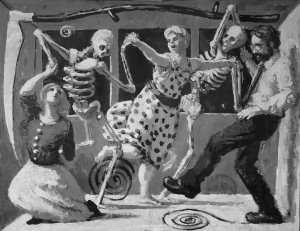
Danse Macabre, by Alex Cree

Being robbed, feeling bereft, death. Dr Sheila White, who continues and reshapes psychoanalytic thinking in the field, gives us the notion of the dance of death to understand workplace bullying.  She describes it as a perverse and pernicious form of projective identification, occurring around organizational vacuums and structural fractures. Individuals, seeking recognition, get trapped in ‘a dance of death’. Adult bullies do not have secure feelings about who they are, and through envy and the quest for recognition, hook into others and won’t let go. Her book gives in-depth insights into the core issues of workplace bullying from the perspectives of the individuals involved, their interpersonal relationships, the group dynamics and – crucially – their organizational contexts.

Bullying will only occur if the organizational context is suitable for bullying. “Just as plants only grow if the conditions of the soil, temperature, light levels etc are favourable, so bullying will only occur if an organizational context fosters a bully’s need to bully”, argues White.  So what are these unsuitable organizational contexts? White describes organizations that have vacuums where there is no support for individuals or groups. She also highlights structural fractures, where job descriptions are unclear and communication is poor or inconsistent; expectations of performance are unrealistic and there is an over-identification with targets/quotas. Often, management are unaware of how negative projections filter down the organization, generating the potential for dysfunctional behaviour along the way.

Workplace bullying is costly: increasingly petty conflicts are being registered as formal complaints and, in no time, legalities take over and costs spiral out of control. Preventive actions and interventions need to be based on a sound knowledge of the deeper issues which foster bullying scenarios.  White’s book makes a major contribution to this understanding, and is an essential read.

Dr Sheila White’s book is launched at Birkbeck on 21 November.Booking is essential.

Obituary: Post-Feminism

Professor Lynne SegalThis post was contributed by Lynne Segal, Anniversary Professor of Psychology & Gender Studies in the Department of Psychosocial Studies. This post was originally published by Feminist Times.

Writing an obituary for ‘post-feminism’ is difficult. I never loved, nor even accepted, the creature in the first place. In its different dis/guises, from Girl Power to Tory feminism, it was always a slippery, shape-shifting thing. In life, Mark Twain was declared dead twice over, quipping the first time that his death was exaggerated. In its ongoing life, feminism has been declared dead many times over, keeping its eager obituary writers always busy. Post-feminism should be easier to bury, though perhaps harder to keep safely interred.

Over sixty years ago, commencing the iconic text of second-wave feminismSimone de Beauvoir apologized for reviving a topic that was perhaps dead: ‘Enough ink has been spilled in quarrelling over feminism, and perhaps we should say no more about it’. Within days, the ink she spilled sold 22,000 copies and The Second Sex has kept selling ever since. Twenty years later, second-wave feminism could hardly have emerged with more clamour, quickly spreading the message that women’s collective efforts would change the world. ‘Goodbye to All That’, Robyn Morgan declared in 1968, when a group of young women occupied the offices of a radical left publication in New York, joined together to protest the Miss America pageant and founded the radical feminist group W.I.T.C.H. That same year, her fellow American poet Adrienne Rich was similarly celebrating the awesome collectivity of women: ‘A woman in the shape of a monster/ a monster in the shape of a woman/ the skies are full of them’.

No wonder its critics waited impatiently to bury this new force, which did indeed usher in a decade of dramatic legislative, social and cultural change. Wherever it grew, it opened doors previously closed to women. It gave women more control than ever before over our bodies and sexuality, made us – when united – more assertive in the home, the workplace and the world at large, everywhere stressing women’s disadvantage and discrimination, including the frequency of men’s violence against and sexual abuse of women and girls. It was the successful spread of feminism that itself heightened recognition of and conflicts over the divisions between women, with newly emerging voices proclaiming their distinct forms of cultural and economic disadvantage and disparagement.

Finally, the era that would be labeled ‘post-feminism’ kicked off in the 1990s, after economic crises had brought the Right into power in Britain, the USA and beyond: rolling back welfare, attacking unions and other sites of resistance, increasing workplace insecurity, above all, ubiquitously popularizing notions of ‘free choice’ as beneficial for all; collectivity as tedious and constraining when not serving market forces. The speedy rise and fall of the Spice Girls in the late 1990s epitomized this putative ‘postfeminism’. Directly produced by the record-industry, these self-proclaimed ‘feminists’ crystallized the essence of ‘girl-power’, as their ostentatious quest for individual success and their return to conventional ‘feminine’ wiles dominated the airwaves: ‘Wannabe’; ‘Spice Up Your Life’; ‘Never Give Up on the Good Times’.

This lavishly layable Lady– ‘Get Down with Me’; ‘Let Love the Lead the Way’– suggested one form of female-empowerment (however fleeting); Margaret Thatcher personified another. Out the window went gritty resistance to the increasing disruptions and strains caused by shifting gender relations in a world in which, symbolically, and for the most part materially, men still held sway over women. At the very same time, the immense appeal of Bridget Jones Diary, depicting one woman’s search for her man, or the equally popular Carrie Bradshaw, busily recording the affluent, home-buying, successful lives of four female friends dining out in New York in the stylish sit-com Sex and the City, were instances of the same phenomena. Never mind the familiar sexual hazards facing adolescent girls, the resentful failures and uncertainties of many boys and men, the overwork of countless married women, the impoverishment of lone mothers and their children, the heightening global inequalities – these ‘new’ women (real and imagined) had financial independence, sexual freedom, immense consumer choice, while pursuing the affluent men of their dreams.

Some feminist writers, especially those prominent in the media, including Naomi Wolf and Natasha Walter, at first applauded what they saw as a new form of ‘power feminism’, hoping that some women’s growing professional success would increase their ability to empower others. Yet, both were aware of the multiple problems most women still faced, as Walter called for more change to enable all women to find a place ‘in the corridors of power’. Meanwhile, older feminists, myself included, mostly rejected both this ‘new feminism’, while criticizing the very idea of ‘post-feminism’.

Times change, and militant feminism is once more on the move. Young women especially are taking to the streets, writing blogs, organizing conferences, stressing above all the collective power of women, not just to change themselves and enter the corridors of power, but to beat back violence in all its forms, asserting the value of caring and interdependence in pursuit of social transformation. Deploying new forms of communication, activism and aesthetic expression, feminist horizons broaden and deepen. They encompass the economics of globalization, as some women are shuttled around the world to survive, but also include the future of the planet itself, even while attending closely to the immensely differing, often contradictory, details of women’s lives near and far.

As I bury post-feminism, and the absurdity of imagining that any feminism worthy of the name could begin simply from notions of individual ‘free-choice’, self-assertion or glamour (much as we may delight in these things), I am deepening the hole I have been frantically digging for over forty years. Goodbye post-feminism; hello feminism.

Lynne Segal is a feminist writer and activist, and Anniversary Professor of Psychology & Gender Studies at Birkbeck. Her forthcoming book Out Of Time: The Pleasures and Perils of Ageing is published by Verso on 7 September.

Skills are a risky investment

This post was contributed by Dr Frederick Guy of Birkbeck’s Department of Management.

A shortage of skills is a source of perpetual anxiety within Britain’s political class. Here’s Tory backbencher Dominic Raab, a few months back in the Telegraph:

The next great problem is our chronic skills gap, which saw Britain plummet down the international rankings in maths, literacy and science. Labour’s arbitrary goal of getting 50 per cent of youngsters into university led to the proliferation of what one of its ministers called “Mickey Mouse” courses, which have benefited neither the students nor the economy. A 2005 Ofsted report found that almost half of those in their twenties said their education had not prepared them for their first job. Far from blaming Europe for this, Michael Gove is rightly learning from it – promoting innovative Swedish-style free schools and a more German emphasis on vocational training.

If we put aside the sniping at Labour and the currying of Gove’s favour, most of this could actually have been written by any of hundreds of politicians from any party at any time in the past thirty years: the schools aren’t delivering the goods, and we don’t do near as good a job at vocational training as the Germans. The skills gap feeds an endemic collective anxiety, the root of the county’s endless obsessive-compulsive re-engineering of its education system – because, surely, finding the right curriculum, the right way to teach, to test, or to select and motivate and cull teachers, is the key to setting this situation right. As for vocational education and apprenticeships, the on-going, multi-party failure in that area could lead one to believe that our Oxbridge-educated leaders can’t bring themselves to really care about something so far from their collective experience: true, perhaps, but like the anxiety about primary and secondary education it misses the point.

The lack of a risk insurance system 

The real problem, which no party in recent decades has even tried to face up to, is that investment in skills is risky. Britain does not have a good system for insuring against this risk. At the root of the skills crisis are the benefit system for those who lose their jobs; and the financing of further and higher education, especially for mature students.

Learning a skill is an investment, and a choice: it takes time that could have been used earning money, or in learning something different. A sensible young person, offered the opportunity to train in some specialist area, might frame the risk like this: “if this skill becomes obsolete when I am forty-five, or if the jobs in this industry get off-shored, who will support me and pay for retraining so that I can get another good job? Will I lose my house?” In many countries on the Continent – Denmark and the Netherlands are actually better examples of this than Germany – the answer is that the social welfare system and the education system will work together to see that you have a new opportunity, and that you don’t have to go through a personal financial crisis before you get to your new career.

The benefits debate

Britain’s ongoing domestic quarrel over the benefit system focuses on people who use it for the long term: are they scroungers, or do they deserve our compassion and support? Lost in this debate is the fact that the system, while too generous to some long-term claimants, is too mean with people who need serious midlife re-training in order to again be productive members of the workforce. The UK benefit system is unusual in allowing so many people to stay on benefits for so long. But for a benefit system to move people on to good jobs, it needs to provide for adequate training and education; and, if we want young people to take risks when they select their educational paths, the jobless benefit needs also to provide income insurance which is adequate to make that the investment in skill attractive despite the risk: during the re-training period it needs to be generous, and proportional (up to some cap) to the individual’s prior income.

The differences between Britain and the rest of Europe

Britain’s benefit system does not do that, and for that reason it leads people here to make different choices about what skills to obtain than do people of Germany, Scandinavia, Switzerland, and the Low Countries – the high-skill manufacturing and exporting engines of Europe. The skills employees have then affect such things as the investments companies make in innovation, a question Andrea Filippetti and I address in a study available here.

This difference between Britain and its continental neighbors is long standing: with respect both to welfare systems and skills, it has roots going back at least to the 1920s. In recent decades, however, the riskiness of investment in skill has been greatly amplified by the globalizing knowledge economy. More rapid technological change is making skills obsolete more quickly. Rapid technological change and shorter product life cycles have also increased the volatility in company financial results, and in the size of the typical company’s workforce; this undermines not only “jobs-for-life”, but also employers’ willingness to share the workers’ risk by providing training, and re-training, internally. Offshoring (made feasible by the combination of modern communications and transportation technologies, and trade liberalization) can shift whole industries from one country to another in very short periods, and that produces extreme uncertainty about the demand for the skills associated with those industries. The risk of offshoring can, in the absence of insurance, actually make offshoring inevitable: if risk depresses investment in skills an industry needs, this in itself can make the industry uncompetitive, and offshoring proceeds apace. As if all that were not enough, climate change is now making its own contribution to the volatility of demand for skill, a contribution which will grow as the needs of adaptation and mitigation will compel rapid change in the technologies we build, install, and use. As long as Britain’s social insurance system cannot compensate for the increased riskiness of investment in skill, the skills of Britain’s workforce can be expected to deteriorate in relative terms.

Skills investment from pre-school to university

Skills that are risky investments are found not only in vocational and technical training, but among university subjects. Wang et al find that students view STEM subjects (science, technology, engineering and mathematics) in that way. In response, students flood degrees in Business and Management – they are not Mickey Mouse, they are Low Risk. They are, for those who can’t go to Oxford, the modern and democratic equivalent of PPE or Classics, qualifying one to work in any industry, in a wide range of roles, up to a point. Often we pretend that this is a virtue, labeling low-risk skills as “transferable”. We do all need some transferable skills, but in education, as in entrepreneurship or in battle, some things can only be accomplished by taking risks.

Risk aversion shapes not only the choice of subjects to study, but also the way in which particular subjects are learned and taught. British employers complain that they can’t find skilled computer programmers, despite years of policy directed at improved IT training at all levels (and I do mean all: six years ago, when my son started nursery at the age of eleven months, that little institution was scrambling to deal with the one black mark in their Ofsted report – a lack of IT training. For better or worse, they fixed the problem.) Part of the problem, infamously, is that UK IT training has emphasized the use of shrink-wrapped software, the administration of Microsoft packages at the expense of the skills needed to program, and to customize collections of open-source software. This dismal offering is actually what many students want, because it economizes on investment in risky skills. In industries from banking to race cars to computer graphics, the skill shortage then shows.

Why don’t children in Britain learn enough math and science? It’s common to blame the schools, but however good the teaching a child could be expected not to concentrate on those subjects, if her literacy skills are sufficient to read the writing on the wall of the job market: knowledge of math and science may be transferable but, as we have just seen, many of the skill sets that benefit most from math and science are relatively risky investments. Universities teach a lot of overseas STEM students, in part because UK students don’t fill the places. Many of those foreign students stay on; through this avenue, and others, the UK relies on imported skills. The supply of imported skills, however, is insufficient to the task, and skills shortages remain.

All of these problems could be substantially alleviated by a generous, earnings-linked, time-limited jobless benefit, conditional on participation in an education or training program. But, even if we had that, who would pay for the training itself? Tuition fees and loans shift the risk inherent in educational choices from the state to the student, and that compounds all of the problems addressed here. The problem has been magnified by the Equivalent Learning Qualification (ELQ) rule, a foolish Treasury decision late in the last Labour government, which removed state funding (and subsidized loans) for students earning a qualification at or below a level they had already attained, with exceptions for certain subjects. There is now a good prospect that the ELQ rule will be reversed, which would be a small improvement, but still the fees remain.

One solution would be to include full fees for the duration of the approved programme, along with the jobless benefit: support the jobless as full time students. A drawback to that approach is that it punishes people who anticipate the need for re-tooling, rather than hanging on to a precarious job until they are sacked and thus eligible for benefit; it’s also not clear how it would apply to the self-employed, and if it can’t be it punishes entrepreneurship. The best way to avoid these perverse incentives would be simply to eliminate tuition fees or, short of that, to do so at least for students over some age threshold – 25, say.

Today’s educational choices are affected by expectations about what social insurance will give, and what tuition fees will take, at some unknown moment ten, twenty, or thirty years from today. The hard part of all this, for Britain, is that its majoritarian electoral system is given to extreme policy swings, making it hard to produce confidence in social policy decades hence. Short of a constitutional earthquake in favour of a more consensual system of government, it seems unlikely that the skills shortage can be solved unless there somehow emerges a cross-party understanding that a combination of good social insurance and affordable continuing education are needed if we want young people to take chances when investing in skills.

UN General Assembly another venue for Obama’s inaction

This post was contributed by Professor Rob Singh of Birkbeck’s Department of Politics. It originally appeared on The Conversation on 24 September 2013.

And so the annual autumn ritual of American masochism begins again in New York. Like inviting your least likeable in-laws to detail your worst features to your nearest and dearest after an agreeable Christmas lunch, this week’s 68th UN General Assembly welcomes heads of state and government from its 193 member states. With its plenary session overshadowed by Syria, and issues from Iran’s nuclear programme and Israeli-Palestinian relations vying for competition on the agenda, the media expectancy is even greater than usual. “The stakes are very high,” according to PJ Crowley, a former assistant US secretary of state.

What fatuous nonsense.

While the invitees marvel at the size of the food portions in New York City, and media frenzies erupt at incipient photo opportunities in Turtle Bay, let’s recognise this week for what it is – a symbolic spectacle signifying minimal substance. Yes, an enticing opportunity for non-US leaders to grandstand on the biggest international stage for strictly domestic political benefit. And yes, a chance for mere politicians – democratic and authoritarian alike – to pose as statesmen and solemnly pledge their fealty to human rights, the rule of law, and international peace (how very controversial). But, ultimately, whether New York or Washington, DC is the more reliably dysfunctional venue for serious politicking is up for debate.

Even by the standards of US politics, watching an array of exotic guests use one of the nation’s great cities to excoriate America and hail the arrival of a new “post-American era” must represent one of the more depressing spectacles for the domestic public. Sadly for the scriptwriters, the drama is not quite as vivid as when Chavez, Ahmedinajad and Gaddafi enjoyed their 15 minutes of fame denouncing George W Bush. Through fair means and foul, these characters have moved on.

But already, new scripts have been written and the question is merely whether the actors play their roles accordingly. Above all, will the Iranian and American presidents finally break a taboo and meet in the Great Satan’s living room (not, like Gordon Brown, in the UN kitchen)? Will the recent conciliatory words and gestures of President Hassan Rouhani receive symbolic reward – a presidential handshake, a deliberately accidental encounter, even a “meet and greet”?

To which the appropriate response is: “So what if they do?”.

Prior US presidents viewed the annual UN debate with emotions ranging from resignation to despair. But for Barack Obama, it’s tailor made. Teleprompter to the ready, warm words to go and nothing of substance to slog through. Only if one still buys into “Obama-world” – where grand speeches substitute for hard bargaining – can one continue to regard this earnest symbolism and soaring rhetoric as remotely consequential.

As such, it’s tempting to view the NYC goings-on as emblematic of not just the weakening of the West but also the end of US leadership.

But this wisdom is far more conventional than wise. On most measures of national power, the US remains far beyond all other nation-states. Not only is it the only player capable of global power projection, but America’s energy revival promises a “power surge” of substantial and enduring economic and geo-political dividends. No other power, or combination of powers, is likely to rival the US for decades to come.

The strategic problems, rather, are two-fold.

First, the UN’s profound limitations remain. A Security Council that reflects the power distribution of 1945, not 2013. A veto system that effectively precludes collective action even when genocide, ethnic cleansing and civil war destroy tens of thousands of lives and displace millions. And a gaping legitimacy deficit in which prolific UN declarations about the “responsibility to protect” are consistently belied as hollow by its inability, unwillingness and incapacity to do so.

Second, it is not American weakness that is at issue, but the irresolution, confusion and dwindling credibility of this particular White House. Like a poker player who believes that decent chaps don’t bluff, Obama is neither trusted by his allies nor feared by his adversaries. On the 50th anniversary of JFK’s assassination, one has to go back to Kennedy’s besting by Nikita Khruschev at the 1961 Vienna summit to recall a US president so powerfully outplayed by his Russian rival. But that was in Kennedy’s first year as president. Less than a year after his re-election, Obama appears adrift, ineffectual and preoccupied by domestic, not international, politics.

Whether or not Obama meets Iran’s president, few will mention the recent appointment of hardliner Ali Shamkhani as secretary of Iran’s Supreme National Security Council, a clear signal that Rouhani intends to preserve Iranian nuclear “rights”. Whatever the Russian delegation declares on Syria’s chemical weapons arsenal, few will focus on the 100,000 plus dead through conventional means of warfare – and counting. Festering issues from North Korea to a reconfigured and reinvigorated al Qaeda will receive minimal attention. And why should they? This week was never intended for serious diplomacy or meaningful negotiations. As for the Middle East, even now – never mind the rest of the world – Obama’s default disposition recalls Ernest Hemmingway’s in 1935: “Of the hell broth that is brewing in Europe, we have no need to drink.”

Mostly, the coming days represent theatre, and not especially impressive theatre at that. In the days of mobile phones, email and the internet, the notion that such international conflabs are necessary for genuine communication is redundant. It seems difficult, in that light, to entertain anything more than a minimal hope of substantive progress on Syria, Egypt, North Korea or any of the functional issues – from nuclear proliferation to climate change – that supposedly preoccupy our leaders.

Let’s hope I’m wrong. But ask yourself – when was the last time you either listened to, or took seriously, an Obama speech? Now imagine the response the average Syrian, Iranian, Israeli or Russian would have to that question. Ignore the theatrics and atmospherics. Lie back and take in the warm words. And watch the inaction.

Twitter trolls – it’s nothing personal…

This post was contributed by Dr Tim Markham, Reader in journalism and media in the Department of Media and Cultural Studies.

Twitter phoneTrolling has been all over the news this week, with lurid details of spiteful, sometimes threatening tweets targeting feminist campaigners like Caroline Criado-Perez and politicians such as Stella Creasy, combining with instant punditry and small-p political tribalism to create a media frenzy. The nature of the abuse is certainly eye-catching: at a time when a list of banned insults can be drawn up and distributed to fans of Liverpool FC, there’s something about seeing people being so rude that breaks through the seamlessness of our ambient, often amiable trawl through media.

Others have pointed out that it has the unmistakable whiff of a classic moral panic about it, amplified by the involvement of celebrities, half-recognised public figures and a technology still just new enough to provoke unease about how it’s wormed itself into the banalities of everyday life. This is part of a two-decade shift from the early days of the internet when fluid, un-pin-downable identity was something to play with, to today’s predominance of identity management coloured by perceived risk, actual or otherwise.

But why so nasty? For those already endowed with a particular flavour of public profile it’s a novel and often effective means of garnering attention: the mutual invective hurled by Lord Sugar and Piers Morgan can be fun to watch, though we know it’s no less confected than Gordon Ramsay’s vituperative televisual self. For others it’s a way of performing authenticity in a moment when that’s a scarce commodity and we’re open to recognising it in 140 characters or fewer on the screen of a smartphone. Irvine Welsh’s tweets are disarmingly filthy, and Caitlin Moran’s sometimes outré swagger seems unaffected, though her casual use of impolitic terms of derision has wearingly provoked accusations of hypocrisy in the current debate.

But trolling is different, right? It’s common at this juncture to evoke the driving metaphor: put a screen between yourself and the world and you experience a different kind of anonymity to what you feel on the high street or in a pub, a protective bubble that gives you licence to swear, sing, gesticulate and make (usually) hollow threats. If Twitter encourages similar disinhibition, then the solution might be to ban anonymity, Facebook-style.

Whether that is really an option depends on what sort of space we want Twitter to be, and while thousands of academic and commentators are gleefully holding forth on this question at the moment, there are four basic answers. The first comes from the network society evangelists who claim that by placing as few restrictions on social media as possible, new self-organising cultures will emerge and the best ideas will float to the surface. Well, no. Sure, Twitter is capable of making innovations and insights better known, but no more than it provides a platform for trolls – there is nothing about its architecture that naturally gears it towards democratic ends.

Next, others argue that with the right kind of restrictions on communication, including the responsibility that comes with being known to others, social media can furnish us with a new kind of public sphere where we can be more engaged, better citizens. But this expects media to solve what is essentially a problem of politics – disengagement – and while there’s no shortage of debate on Twitter, and not all of it vapid, it lends itself towards the kneejerk exchange of opinion, often entertainingly, sometimes uncomfortable, that should not be mistaken for the hard, usually boring work of public deliberation.

In the past week or so we’ve seen another vision of Twitter rear its head: a means of self-expression, a voice.  There is a real fear that trolling could lead to women writing about rape or domestic violence being silenced, and underlying this is the notion that Twitter users should above all treat each other with respect. There’s plenty of evidence of this on the platform, with some corners dripping in unctuousness rather than venom – a deluge of praise that makes some, like commentator Charlie Brooker, squirm. But this raises the difficult question of what relation tweeters actually have to one another, and what they are capable of doing to each other social media, for good or for ill. Is Twitter really a viable medium for a relationship of mutual respect between individuals with no other connection? It should go without saying that credible threats of violence should be taken seriously, and there are laws in place to make this so. Intentionality, though, is tricky, as you’ll know if you’ve joked about blowing up an airport. But what if the intention is to offend, not in the sense of being generically offensive, a cause with many supporters, but to inflict personal torment?

This is trickier still. The argument you often hear is that intention is irrelevant: if someone feels offended, then offence has been caused. But while this makes sense in the workplace, it’s not self-evident that Twitter is that kind of space of interaction. True, it’s different from being offended by a TV programme, because it feels personal, but just how personal is it? This is not to say that being trolled isn’t upsetting, nor that the internet is just a virtual space where nothing really matters. And severing the link between an author’s intention and the meanings their texts engender certainly gels with the spirit of postmodernism. But we know that people feel some kind of relation to disembodied others on social media, though it is different from interactions with people we know, or could identify if we wanted to. It can feel intimate, too intimate, to be thrown into a hostile flurry of tweets aimed at you, but it can also be put into perspective, distanced. Cambridge prof Mary Beard is adept at this, responding to tweets speculating about her genitalia by pointing out that such insults are ubiquitous in history and as such mundane, as is the sort of trolling that imagines out loud the various tortures and humiliations they’d like to see meted out on someone. It’s still uncomfortable, but not an attack on her because – to use the sociological lingo, interactions online between individuals who don’t personally know each other are not interactions of authentic selves.

Ah, the authentic self. The other cry of despair heard across the media this week has been about what trolling reveals about what people are really like when the niceties of normal social interaction are foregone. Suddenly exposed is a hard-wired culture of misogyny and violence, or, on the other side of the argument, a crisis of masculinity, an incoherent, badly spelled howl of rage from those men – working class, presumably – society has left behind as it has become more enlightened, respectful, tolerant. But to be a bit methodological about things, this implies that a twitter stream reveals the soul, the true identity of the tweeter. And this brings us to the fourth way of thinking about Twitter – as a communicative, rather than existential, space. Years ago Erving Goffman examined in great detail the rituals of interaction that people have to learn in order to participate in all manner of communication, whether through media or face-to-face. He was particularly interested in the difference between the ‘backstage’ work we do in order to present a coherent, competent self to others in social situations, and his ideas work well in the context of social media. But when asked what he felt this revealed about the true self underlying our everyday performances, he replied that he just wasn’t interested in the true self. I like to think that I am interested in other selves, but I take his point about not looking for them in the wrong places. Our selves are not manifest in our social media interactions with unknown others, and the cheering corollary is that we are not as fragile on Twitter as some have been suggesting.  Making no excuses for trolling, it can at least be put into context as a form of communication: narcissistic, certainly, and expressing alienation and animosity, but in a way that is generational rather than endemic to the social media age. It would be counterproductive at this point to diagnose a new form of evil in trolling. It may be hateful, but it’s usually nothing personal – even if it looks like it is.