Category Archives: College

Why Businesses Fail: Business Plans & Financial Models

Welcome to the Why businesses fail series. This is the fourth of five blogs that delve into the reasons for businesses failing and offering solutions. This series was launched by Lucy Robinson of Birkbeck Futures and Ghazala Zia from Windsor Swan. In this blog, they share why having a carefully considered business plan is essential to the success of your business.  

Lucy Robinson is the Employability Consultant for Business and Enterprise at Birkbeck Futures. She runs the Pioneer programme for aspiring and early-stage entrepreneurs and hosts an enterprise series on the #FuturesPodcast.

Ghazala Zia is a Venture Capital Advisor at Windsor Swan, a boutique London business advisory firm. She has an extensive legal background, and currently specialises in advising start-ups of all stages on funding, strategy and business analysis.

We all know the importance of a decent pitch deck when it comes to presenting a business idea to investors, but ultimately, they’ll be looking at the detail behind the pitch when making their decisions. Once you’ve started your business and got a few customers, you should be looking at your business plan and preparing it for an investor. This seems early but is the right time because that’s how long it takes to prepare for investment.

Investors might not ask for a business plan straight away, often they’ll request to see this after a few meetings. Entrepreneurs often wait until they’re explicitly asked before creating a business plan, which isn’t setting yourself up for success.

In reality, a business plan is a living, breathing document, not just something you rustle up on request for the purpose of your funding application to an investor. Showing an investor, a rushed, poorly considered, or insufficiently detailed business plan won’t fill them with confidence.

A detailed and carefully considered business plan isn’t just important for impressing investors – it’s one of the most important tools in your arsenal as an entrepreneur, and when used correctly it can be incredibly valuable for planning ahead, making decisions and staying on track.

The business plan should work for the life cycle of the business, which is approximately 3-5 years. Consider the milestones you’ll reach and issues you’ll face within this timeframe. It should be a professionally written document that you and your team refer to time and time again, meaning that everyone is literally on the same page. It’s not static, and should be amended as you go along. This allows you the flexibility to adapt to new circumstances and continue planning ahead.

As well as your business plan, you also need a detailed, well-evidenced and realistic financial model. The first question to answer here is that of why your business needs funding in the first place. Where are you hoping the business will go in the next 3-5 years? What specifically will the funding be spent on? How have you arrived at these costs? How will the meeting of these needs lead to more growth and profit? Specificity is needed here, as investors awarding significant amounts of money will want to know exactly where that money is going, and how it contributes to their return on investment.

You also should be proportionate and realistic about the amount of funding you ask for. There’s no exact rule about how much funding to request, as it ultimately comes down to your planning, but you shouldn’t expect to waltz out of your first investment meeting with one million pounds. It’s speculative at the early stages, but you can come up with a good financial model that’s relevant to the type of investor you’re approaching if you take the time to look at the detail of your business. Seeking the guidance of a financial advisor is a good step to take here, as they’ll know the right questions to ask you.

When it comes to your business plan and financial model, sit down and spend a lot of time on these. This is why investors often prefer to back entrepreneurs who’ve already tried and failed, because they know the steps to take and the questions to ask themselves.

Read more from the Why Businesses Fail series:


Pioneer Programme 2020: Meet the Finalists 

Meet the entrepreneurs in the running for the Best Business Pitch and Best Business Idea awards. Winners will be announced at a virtual ceremony in June. 

Picture of a lightbulb
As the government, businesses and individuals adapt to a “new normal” in the wake of COVID-19, the case for innovative thinking in the workplace has never been clearer. With this in mind, we’re delighted to introduce this year’s Pioneer Programme finalists.

Pioneer is an extra-curricular course for Birkbeck students looking to develop the knowledge and skills to excel as an entrepreneur. Over seven Saturday sessions, participants learn from a range of entrepreneurs, industry experts and each other to build the skills needed to develop their business idea or scale up an existing business. 

Representing the best entrepreneurial minds in Birkbeck, the finalists are in with a chance of winning either the Best Business Pitch or Best Business Idea award, each worth a £1000 cash prize to support their business, along with a bespoke package of mentoring, coaching and promotion. 

Participants’ achievements will be celebrated at a virtual awards ceremony on Thursday 18 June, with a panel of five independent judges, themselves entrepreneurs and industry leaders in start-ups and innovation. 

Meet the Finalists

Jody Halstead

Jody Halstead
MSc Management with Business Strategy and the Environment
Business: Circular Surrey 

My business, Circular Surrey, is a platform for local business leaders who want to transition to a low carbon circular economy. 

Research shows that more localised solutions are needed in order to make the shift to a low carbon circular economy. Alongside this, business owners and leaders often don’t have the resources to fully apply their time and need some additional support. 

The Purpose of Circular Surrey is to provide clear and tangible support for local businesses to enable them to shift to more sustainable business models and practices whilst continuing to power Surrey’s economy.


Alexander Flint Mitchell

Alexander Flint Mitchell 
MSc Business Innovation (specialising in Entrepreneurship) 
Business: Blind Cupid 

Blind Cupid is for people who want lasting love and are frustrated by the time and money wasted dating incompatible people. Blind Cupid offers fast, fail-safe matchmaking. Unlike eHarmony and Hinge, our product matches users with people who share the same values and fundamental way of thinking via a never-before-used science. This creates a fast-track to lasting love. Far from the superficiality of Tinder, profile compatibility is scored and bios are seen before a user chooses which of their matches to reveal photos to. This leads to better dating decision-making. 

You can take Blind Cupid’s ‘Sense of Life’ Questionnaire today and get a very informative report about who you fundamentally are as a person.

I am currently fundraising for Blind Cupid and the product should be on the market within the next three months. 


Picture of James Shepherd

James Shepherd 
MSc Cognitive Neuroscience and Neuropsychology 
Business: Smart Therapy Tools  

Smart Therapy Tools aims to modernise psychological therapy treatment by providing both therapists and service users with an interactive and engaging smart phone app.  

Cognitive Behavioural Therapy (CBT), a therapy based on a structured understanding of how mental health issues maintain themselves, is at the forefront of modern mental health treatments and the NHS alone aims to treat over 1.5 million people a year with this approach. To improve the experience of this therapy, I have developed a prototype smartphone app which brings important techniques away from static pen and paper approaches into a more engaging and dynamic domain.

In the future, I aim to put data science at the heart of the app by using statistical modelling to learn from user inputs. As the app is used more often, more information from the heart of the service user/therapist collaboration can be utilised to help understand the complexity of mental health problems and inform new treatments.


Picture of Kevin Tsai
Kevin Tsai 
MSc Innovation and Entrepreneurship 
Business: Anywhere Bear 

Anywhere Bear is a vision born from my passion for travelling. However, I have come to realise how damaging air travel is for the environment – even a short haul flight from London to Edinburgh contributes more CO2 to the atmosphere then an individual’s average annual emissions. 

My wife and I recently took a holiday around Italy without flying and we loved the experience of travelling around by train.  We then looked at other holidays around Europe but found it difficult to plan without flying. There is no one go-to site that we trust and find easy to use for our needs, hence the decision to pursue the idea of a travel platform specialising in helping holiday makers to plan and book their holiday around Europe without flying. We want to build a fun and engaged community of people who will enjoy sharing their travel stories and be able to challenge and inspire their network to join them as they go flight free.  

Due to COVID-19we’ve had to rethink our strategy, as we foresee travel being impacted by this pandemic.  We’re now going to be providing travel inspiration to places around the UK.  We plan to partner with eco-hotels and restaurants and build a platform to allow people to still enjoy their holidays with a minimal carbon footprint.  

Our plan is still at the ideation stage so watch this space as we reinvent the way people holiday!


Picture of Hetty Bonney-MercerHetty Bonney-Mercer 
BA Global Politics and International Relations 
Business: FemInStyle Africa 

In the near future, representation of women in Ghana’s politics will be higher, women in Africa will be more financially independent, women who have broken the glass ceiling in their respective fields will be the norm instead of the exception, solo female travel will be safer and gender activism will have reached new heights. 

Because in 2019, two gender activists decided that there weren’t enough publications in the country that really focused on amplifying women’s voices exclusively and in a positive way and decided to do something about it. 

FemInStyle Africa is a magazine for women by women which aims to encourage women to live their full potential. We have five columns dedicated to politics, gender activism, profiling working women, financial advice and travel and style: always written with women as the central focus. FemInStyle Africa aims to mobilise women to bring about lasting changes in the fight for gender equality. 

We are currently building our website, recruiting writers, and finalising our marketing plan with a view to launching in Q3 2020. We welcome you to be a part of our journey.


picture of Mukesh Bhatt

Mukesh Bhatt 
PhD Law 
Business: inSTEAD – integrating Space Technologies into the lives of the Elderly and Disabled 

 The inSTEAD project wants to re-purpose, re-innovate and re-invigorate space technologies, which can be used to help the elderly and disabled. Over 700 astronauts in space and returning to Earth are supported by a multi-billion-dollar industry, prototyping and patenting health support and rehabilitation mechanisms. The astronauts suffer from the same health problems as the elderly and disabled on Earth, and yet solutions for the latter are priced beyond their reach. However, anything used by astronauts can also be used by the elderly and disabled because each is human. 

Encouraged by the Birkbeck Pioneer programme, the International Space University and the European Space Agency at its Noordwijk business incubation centre, inSTEAD (AbleSpace Paradigms) aims to translate the hardware and psychological technologies and methods used for astronauts into a form suitable for the support and rehabilitation of the elderly and disabled on Earth. 

The inSTEAD project includes in its mission both commercial and philanthropic aims and objectives for high social impact and making the best use of opportunities for collaboration with national space, technology and development agencies and initiatives. It requires a team of dedicated and impassioned personnel to help make it a success. If you wish to become involved please contact Mukesh. 

Further Information: 

Why businesses fail: customer acquisition strategy

Welcome to the Why businesses fail series. This is the third of five blogs that delve into the reasons for businesses failing and offering solutions. This series was launched by Lucy Robinson of Birkbeck Futures and Ghazala Zia from Windsor Swan. In this blog, they share how you can narrow down your customer and find an effective marketing strategy to attract and retain them.  

Lucy Robinson is the Employability Consultant for Business and Enterprise at Birkbeck Futures. She runs the Pioneer programme for aspiring and early-stage entrepreneurs and hosts an enterprise series on the #FuturesPodcast.

Ghazala Zia is a Venture Capital Advisor at Windsor Swan, a boutique London business advisory firm. She has an extensive legal background, and currently specialises in advising start-ups of all stages on funding, strategy and business analysis.

Once the product or service has been tested, it’s not enough to assume that it will speak for itself. Customers don’t come without being invited. It’s crucial to have a detailed customer acquisition strategy and a relevant, targeted marketing strategy alongside in order to succeed.

Firstly, define your customer. Not just ‘young women’ or ‘professional millennials’, but very specifically identified. Think about gender, age group, location, profession, and more. Similarly, your customer might not be an individual but a service provider themselves. You still need to be specific here. For example, if you want to sell to a university, who do you want to reach within the organisation? The students, the lectures, the staff? Knowing who your customers actually are is vital to the short- and long-term success of your start-up. Conducting market research tests on your intended audience is also a great way to measure if they actually want your product – often, you may be surprised by who your actual customers are.

At the early stages of a start-up, it’s wise to channel funds (even if they’re limited) into a solid marketing strategy. Test your consumer behaviour, determine advertising costs, and determine how many customers you’ll reach. Similarly, build up your brand reputation in order to garner recognition and ultimately, loyalty from your intended audience.

Customers show loyalty to authenticity, and your marketing should reflect a strong and consistent brand identity that is honest to the product itself. If you have a flashy marketing campaign but the product itself doesn’t hold up to scrutiny, you risk being slated online and by word of mouth. This is why the marketing strategy itself only holds up when the product does – which bring us back to the importance of understanding the problem you’re solving, and carrying out extensive testing on your intended audience.

Within your customer acquisition strategy, you should be familiar with certain metrics. How will you acquire your customers? What is your cost of acquisition? How much marketing do you need to spend to acquire one customer? How are you going to retain that customer?

Read about how to identify a need in the market and attract investors in the first two blogs of the series.


I’m not looking for a career in accountancy, engineering or anything that needs Maths. Why do I need to think about my numeracy skills?

It’s National Numeracy Day 2020 on the 13 May and Birkbeck Futures takes a look at why numeracy skills are important no matter what career you choose.

Picture of dominoes

Many jobs that we typically don’t think involve numbers usually require some level of numeracy.

Being numerate means that you can confidently and effectively use mathematics to meet the everyday demands of life.

You may not be asked to solve complex equations, but you could be required to complete tasks that involve numeracy skills. For example, if you’re in Human Resources, you may be asked to provide a report on gender diversity figures. Similarly, if you’re in the Arts, you may need to put together a budget for an exhibition. Both of these require some level of numeracy.

The OECD reports that there is a direct relationship between wage distribution and numeracy skills. The better your numeracy skills, the greater your earning potential.

Why?

Because all those things you learnt in Maths help build the skills employers are looking for.

Employers aren’t just looking for technical skills and subject knowledge when they recruit someone. They need you to have employability skills – transferable skills that enable you to do the job successfully. For example:

Digital Skills

Digital skills are required in at least 82% of online advertised jobs across the UK.* We live in the digital age and as a result, we deal with more numerical data that we ever have before. You need good numeracy skills to be able to work with computers, otherwise you’re unable enter the right data or identify if the answer is in the right area.

Problem Solving

Problem solving skills are vital to any graduate level job. Maths is all about solving problems; take working out an equation for example. You need to pick out the important parts of the problem and then work out the knowledge required to solve it. This skill is transferable to solving any problem, mathematical or not.

Communication

When studying Maths, or working with numbers, you will have developed your ability to assimilate and communicate information in a clear and concise way. Everything we do in the workplace is a result of and requires communication of some kind.

Employers are increasingly using numeracy tests as part of recruitment processes.

As numeracy is such an important skill for employers, many use numerical reasoning tests as part of their recruitment processes. These types of assessments measure your ability to interpret, analyse and draw logical conclusions based on numerical data presented in graphs and tables.

Students can find out more about these tests and have a practice on the online Careers Portal (accessed through your My Birkbeck Profile).

But what if I’m not good with numbers?

We all have areas of ability that we feel more confident in than others. You might not think that you’re good with numbers because of experiences with Maths in school, for example. But chances are you’re much more competent than you think.

Our level of confidence often impacts our ability to take on new challenges or face up to things we may usually avoid doing. To reiterate the problem-solving example above, when we don’t know something, we can find out how to do it. Embrace your numeric abilities and enhance your skills to help boost your confidence in this area.

Birkbeck is supporting National Numeracy Day for the first time this year. Join the conversation on Twitter or see if you can build your everyday Maths confidence by taking the challenge.

Get in contact with Birkbeck Futures at employability@bbk.ac.uk or follow us on our social channels:

*Source: “No longer optional: Employer demands for digital skills” report – June 2019

Cancel the Window-Cleaning Contract!

Professor Jerry White, Professor of Modern London History at Birkbeck recounts how the College faired during the Second World War. This blog is part of the 200th-anniversary series, marking the founding of the College and the 75th anniversary of Victory in Europe Day.

Bomb damage to Birkbeck Library

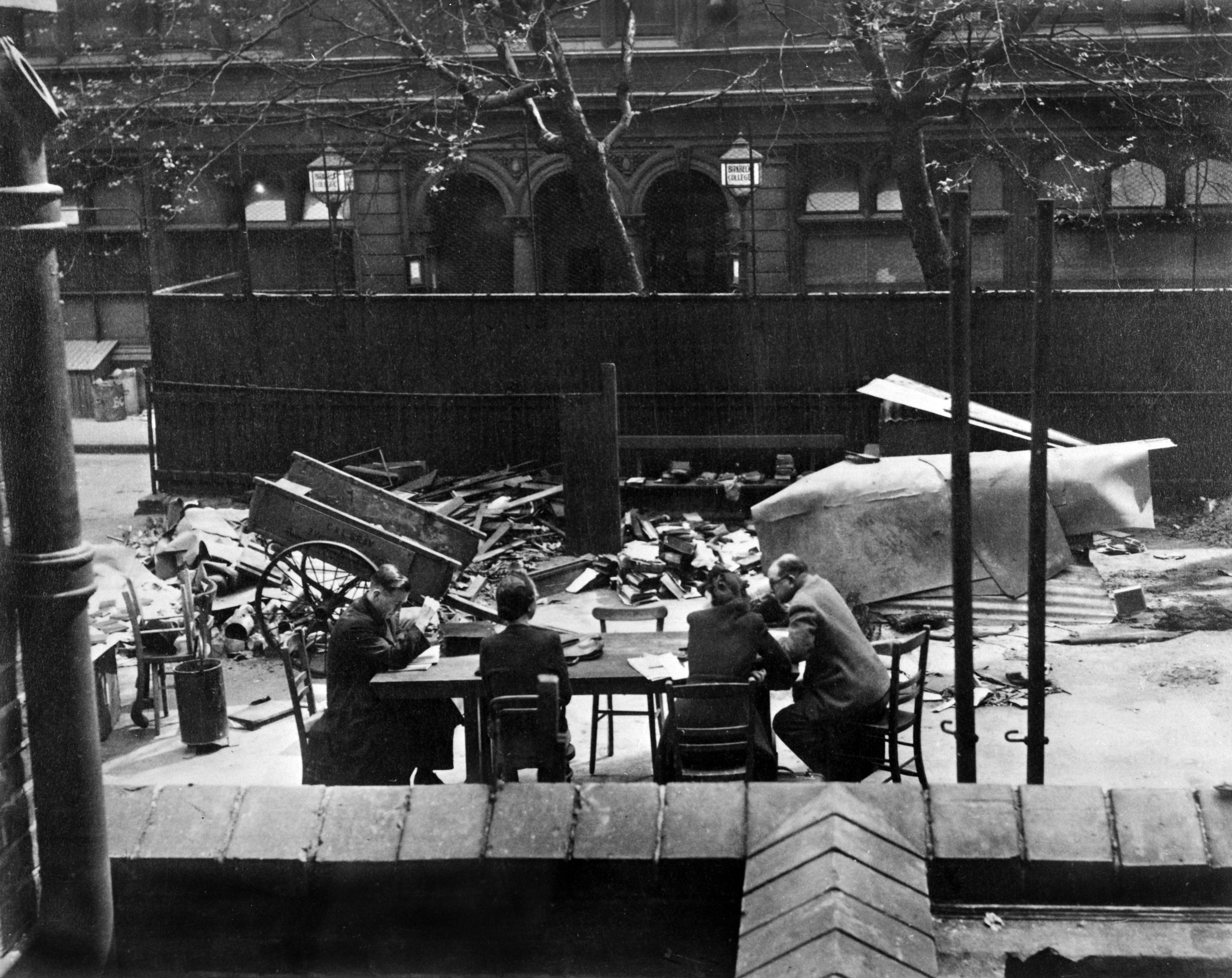
Bomb damage to Birkbeck Library. The area around Birkbeck College was bombed during the air-raid of 10-11 May 1941. The resultant fire destroyed the Library. Image courtesy of Birkbeck History collection.

Most of London University shut down on the declaration of war in September 1939. The headquarters at Senate House was taken over by the Ministry of Information and most colleges were evacuated (like much of the BBC, many government departments and most of London’s hospitals) to areas thought to be less vulnerable to bombing. University College shifted to Aberystwyth and elsewhere in Wales, King’s to Bristol, LSE and Bedford to Cambridge, and so on. Birkbeck, its London roots deeper than any of its sister colleges and so unable to be useful to Londoners if sent to the country, resolved to close on the outbreak of war and for a time did so. But the war failed to open with a bang and in the absence of air attack, or apparently any likelihood of bombing for the immediate future, Birkbeck reopened at the end of October 1939. Indeed, it didn’t merely reopen but expanded its offer: for the first time, extensive daytime teaching was made available for those London students unable to follow their chosen university colleges out of the capital. And despite the blackout, a wide range of evening teaching also resumed.

Birkbeck was not yet at its present Bloomsbury site. That building contract had been let but work had to stop in July 1939 because of the uncertain international situation – contractors were given more pressing projects to work on, both civil defence and industrial – and in fact the new college would not be completed and occupied till 1951. So Birkbeck was still in its late-Victorian location in Breams and Rolls Buildings, straddling the City and Holborn boundary west of Fetter Lane, incidentally sharing a party wall with the Daily Mirror building. It had some near misses during the main blitz of 1940-41 and narrowly escaped total destruction in the great City fire raid of 29 December 1940, which opened a view – never before seen – of St Paul’s from the college windows. From that time on all places of work had to arrange a fireguard of staff to be in the building at night time to deal with incendiaries and raise the fire brigade if necessary. There followed nearly three-and-a-half years of relative quiet, with sporadic bombing of London and the Baby Blitz of early 1944 rarely troubling the college and its work. But Birkbeck would nearly meet its nemesis from a V1 flying bomb (or doodle-bug) at 3.07am on 19 July 1944.

Dr A. Graham was a member of the college fireguard that night, on the 1-3am watch.

I wakened Jackson [the College accountant] to do the 3-5am spell…. We were saying a few words to one another when we heard The Daily Mirror alarm go. Suddenly the bomb, which had merely been a near one until that second … dived without its engine stopping. Its noise increased enormously; Jackson and I looked at one another in silence; and I remember wondering what was going to happen next. What did happen was all over before we realised it had happened … a gigantic roar from the engine of the bomb, not the noise of an explosion, but a vast clattering of material falling and breaking, a great puff of blast and soot all over the room, and then utter quiet. Massey [another fire watcher] raised his head from the bed where he had been asleep and asked what all that was….

As the dust settled Graham climbed over the flattened metal doors of the College and went into the street. The first thing he heard was footsteps coming at a run up Breams Buildings. It was a Metropolitan police constable: ‘he called backwards into the darkness… “It’s all right, George, it’s in the City”’; satisfying himself there were no urgent casualties he promptly disappeared. Troup Horne, the College secretary from 1919-1952, was also one of the fireguard but, not wanted till 5am, was in a makeshift bed in his office: ‘At 3.06am I was awakened by a doodle overhead. Thinking we were for it, I pulled a sheet over my head to keep the plaster out of my remaining hairs; and five seconds later the damned thing went pop.’ Horne was found ‘covered from head to foot with soot, dust, and thousands of fragments of broken glass and other bits scattered from the partition which separated the general office from his room.’ His chief assistant, Phyllis Costello, was also sleeping in the College that night and was frequently part of the fireguard. She rushed to see if he was injured and was greeted by Horne instructing, ‘Cancel the window-cleaning contract’.

Indeed, there were no windows left anywhere in the College. For some time after, a witticism coined in Fleet Street during the main Blitz, was Birkbeck’s watchword: ‘We have no panes, dear mother, now.’*

*Edward Farmer (1809?-1876), ‘The Collier’s Dying Child’: ‘I have no pain, dear mother, now.’ All the information used here comes from E.H. Warmington, A History of Birkbeck College University of London During the Second World War 1939-1945, published by Birkbeck in 1954.

Why businesses fail: Being unattractive to investors

Welcome to Why businesses fail, the second of five blogs that delves into the reasons for businesses failing and offering solutions. This series was launched by Lucy Robinson of Birkbeck Futures and Ghazala Zia from Windsor Swan. In this blog, they share some practical tips to get investors to demonstrate traction in your business and attract potential investors.

Lucy Robinson is the Employability Consultant for Business and Enterprise at Birkbeck Futures. She runs the Pioneer programme for aspiring and early-stage entrepreneurs and hosts an enterprise series on the #FuturesPodcast.

Ghazala Zia is a Venture Capital Advisor at Windsor Swan, a boutique London business advisory firm. She has an extensive legal background and currently specialises in advising start-ups of all stages on funding, strategy and business analysis.

Being unattractive to investors is a primary reason why some start-ups fail, and there’s a few pitfalls to avoid here. One big one is not showing traction.

Having a strong and evidenced market need for your product or service is the best way to demonstrate traction. By traction, we don’t mean a few thousand likes or free users – that’s not enough for an investor. It needs to be clear that this engagement is converting into paying customers, which is a trackable and easily identifiable metric. Engagement without custom isn’t traction or validation of your product. It could be a sign that you’ve got great marketing or that you’ve got a particularly active customer base, but if they’re not actually buying your product it suggests they don’t really need it.

One metric you should always know as part of your financial model is how many customers you need to stay viable. Before you start pouring hours into creating content, or spending time and money adding new features to your product, ask yourself: “What value am I adding?”. If the effort, energy and resources you use won’t actually convert to more sales, you should consider if it’s really necessary.

Investors vary with the level of traction they’d like to see, and different types of investors look for different amounts. For example, if you’re an early-stage start-up you’re likely looking at individual investors like Angels. Angels want to get involved at an early stage and take a punt on your business, if they see something in you. At a later stage, when you’re in revenue, you might use Seed Investors. Seed Investors get involved when you can demonstrate more growth that they want to get on board with. Generally speaking, investors want to make ten times return on their investment. This means you need to demonstrate traction which suggests they’ll be able to achieve this by investing in you.

Further information:


Why businesses fail: Identifying market need

Welcome to Why businesses fail, five blogs that delve into the reasons why businesses fail and offering solutions. This series was launched by Lucy Robinson of Birkbeck Futures and Ghazala Zia from Windsor Swan.

Lucy Robinson is the Employability Consultant for Business and Enterprise at Birkbeck Futures. She runs the Pioneer programme for aspiring and early-stage entrepreneurs and hosts an enterprise series on the #FuturesPodcast.

Ghazala Zia is a Venture Capital Advisor at Windsor Swan, a boutique London business advisory firm. She has an extensive legal background and currently specialises in advising start-ups of all stages on funding, strategy and business analysis.

According to CB Insights in their 2019 update on a post-mortem of over 300 failed start-ups, “No Market Need” is the most common and significant reason for young business failure. A start-up can have the best team and a truly great product, but it can still fail if no customers need it.

The key mistake here is entrepreneurs going straight into their solution, and basing that solution on a perceived problem rooted in their own assumptions. In short, not properly identifying the problem they’re actually solving. Basing a business idea on untested and often biased assumptions is the quickest way for a product to fail.

Without a real problem to solve, the product won’t be offering a solution that customers want to buy. Without customers, sales won’t come. Without sales, a product will have no traction. Finally, without traction, investors won’t touch the business with a 10-foot pole.

Luckily, this is a failure that can be avoided by putting in the right work at an early stage. The three most important things an entrepreneur can do at the ideation stage of their business? Test, test, and test again!

A good way to start testing is through surveys, from which you can get an idea of your intended audience’s perceptions and priorities. Following this, you can create a beta version or prototype – this is your MVP (Minimum Viable Product). With this, start with just one or two features so you know exactly what you’re measuring a reaction to. Once you’ve got your MVP, consider offering the product or service for free to some users to gather feedback, data and insights.

Always be focusing on moving towards paid users, but don’t discount the value of free users for the valuable insights you can gain. Once you’ve got the data you need on your customer-base, it should be clear what problem your business is solving. Free users give you insight, paid users give you traction.

In short: don’t assume the way you experience a problem is the same as the way everyone experiences it. Test it objectively.


This is the first in the Why Businesses Fail series. Come back next week to find out how to appeal to investors.

Further information:


Maths for the Masses

In this blog, Ciarán O’Donohue a PhD student in the Department of History, Classics and Archaeology, discusses the decision to teach mathematics to the first students of the Mechanics Institute. This is part of the 200th anniversary blog series that celebrates the College’s bicentenary in 2023.   

The Massacre of Peterloo

The Massacre of Peterloo. The commander is saying “Down with ’em! Chop ’em down my brave boys; give them no quarter! They want to take our Beef & Pudding from us – & remember the more you kill the less poor rates you’ll have to pay so go on Lads show your courage & your Loyalty!”

Many of us will be familiar with the common questioning of why certain concepts are taught in our schools. Mathematics, and especially its most intricate systems, are often first to face the firing squad. It is not unusual to hear someone discussing education to ask: “Why are we not taught about credit, loans, and tax? I’m never going to use Pythagoras’s Theorem!” Certainly, when the subject of mathematics is brought up, the utility of algebra and theorems are often jovially dismissed as unimportant.

Two centuries ago, the picture was very different. The question of whether mathematics would be useful or dangerous knowledge to teach to the working class was one that was debated extremely seriously. In November 1823, the same month that the London Mechanics’ Institution was founded (which has now come to be named Birkbeck, University of London), Bell’s Weekly Messenger seized upon the propriety of teaching maths to London’s lower orders, lamenting that “the unhappy scepticism in France has been justly ascribed to this cause.” The implication was that teaching maths to the wider populace had caused them to question the order of society, and directly contributed to the French Revolution and its aftermath. Pertinently, this was an order which the British government had spent a fortune, not to mention the lives of hundreds of thousands of British subjects in the Napoleonic Wars to restore.

A revolution in Britain itself was still palpably feared in the 1820s, and its spectre was made more haunting by the Peterloo massacre just four years before this particular article was written, in August 1819. And so, surrounding the foundation of our College, and which subjects were appropriate, a war of words was waged.

The idea of teaching London’s working classes mathematics filled many with visceral dread. It was believed this would cause them to also become questioning like France’s peasants, eventually seeking proof for statements which they had hitherto blindly accepted.

The teaching of mathematics to mechanics, then, was considered by many to be socially, politically, and morally dangerous. Not only might it turn them into a questioning multitude, unwilling to simply accept what they’re told, it might also make them question the very structure of society and push for a semblance of equality. For critics, both outcomes could readily lead to revolution.

Henry Brougham, one of the founders of the College, believed that this catastrophe could be averted by teaching a reified body of knowledge, including a simplified version of mathematics. Writing of geometry, Brougham argued that, rather than “go through the whole steps of that beautiful system, by which the most general and remote truths are connected with the few simple definitions and axioms” it would be sufficient (and indeed safer) if the masses were to learn only the practical operations and general utility of geometry.

Similarly, many religious supporters of extending mathematical education to the mechanics believed that it would make people more religious, not less, if only it were taught in the right way. As God was believed to have created the world, the logic and order inherent in mathematic systems was held to show traces of his hand at work. An appreciation of mathematics and its traceable, systematic connections would thus create a renewed appreciation of God; not to mention for the order of the world as divinely ordained.

Likewise, moralists perceived more benefits in teaching the mechanics mathematics than drawbacks. The issue for them was not if the mechanics were to learn or read, but rather what. The key issue was that the mechanics were already largely literate. The rise of cheap literature, especially of the sentimental and pornographic varieties, preoccupied the minds of moralists and industrialists.

As the lower orders were believed to be motivated primarily by sensuality, learning mathematics was presented as a salve to degeneracy; a way to occupy their time with higher minded pursuits and strengthen their characters against wanton immorality.

Perhaps most worrying was the growing and uncontrollable availability of radical political writings. This more than anything was likely to upset the current order of society. The perceived and highly theoretical disadvantages of a mathematical education were thus infinitely preferable to such a realistic and allegedly growing threat. It was believed that the teaching of mathematics and science through a dedicated course of study, being undertaken as in the evenings, might reduce the time and energy the working man would have to devote to reading political tracts, let alone political activism.

It is, however, worth noting that, although many mechanics were literate, and most had rudimentary mathematical skills, the wider debate was far removed from the reality. Many mechanics required far more elementary lessons in mathematics before the advanced classes could even be attempted.  Although mathematics and science initially formed the centre of the curriculum at Birkbeck in the 1820s, by 1830 the reality of need had been discovered: advanced classes had been removed altogether, and instruction in elementary arithmetic was given to vast numbers of members. This was to continue to be the reality for much of the next 30 years.

How far, then, the raging debates about the inclusion of mathematics in the curricula of new centres for working-class education impacted the trajectory, is still a topic for debate.

Further information: 


Tackling lockdown boredom? Pavol is here to help.

BSc Marketing student Pavol spreads the joy and shares some tips for beating boredom during coronavirus lockdown.

Pavol, BSc Marketing student

Hey everyone!

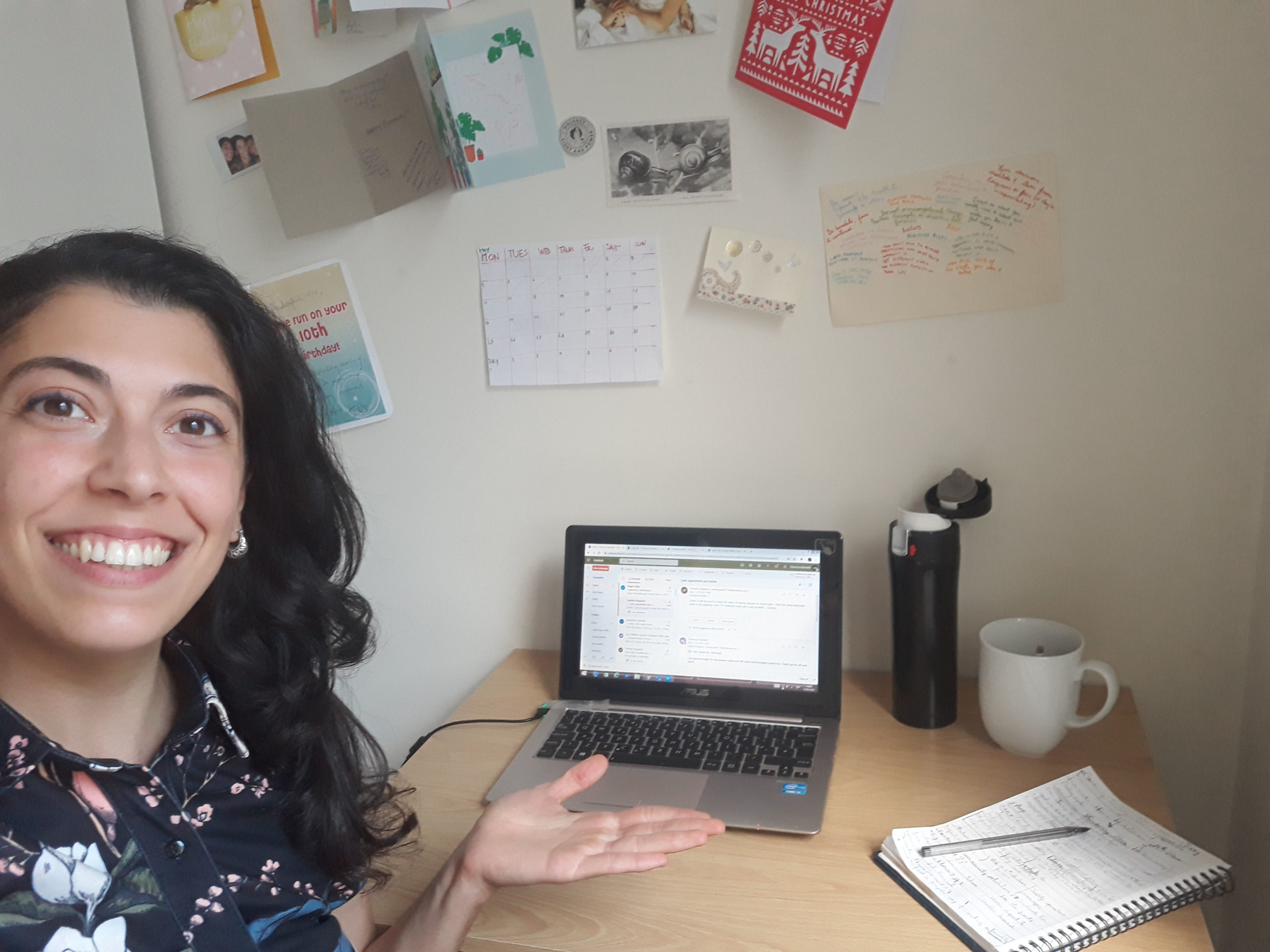
My name is Pavol, but my friends call me Pav. I am currently in my fourth year at Birkbeck studying Marketing BSc. I decided that I would like to share a bit of joy, happiness and love with everyone who is currently #stayinghome and maybe create a ripple effect on sharing positive vibes.

I am currently sitting home and thinking about where to start. Well, I love baking, but I am not professional. I like exercising, but I am not full of muscles. I do like reading, but I have not read the whole library. So I hope you get what I mean when I say I am a regular guy with a tiny bit of quirkiness, fun and passion. I am 27 years young , and I would like to do something for our community of students. We are like a family, so I would like to share a bit of #LifeofPav with you all. Yes, it is my hashtag which I use on Instagram so please do get in touch and lets share our stories, pictures or drop me a message for an informal chat.

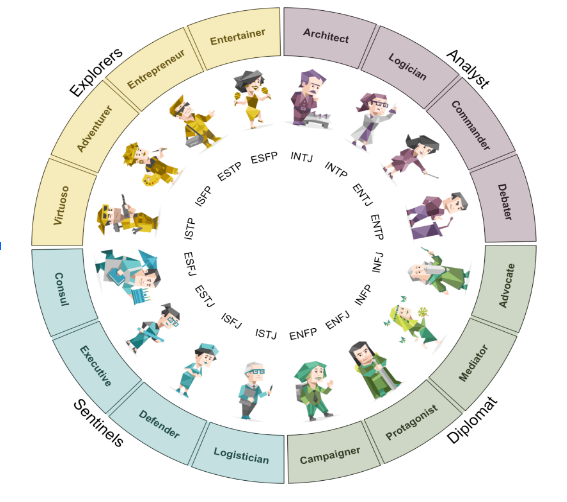
In the first chapter of this adventure, I would like to tell you about a great opportunity which I tried recently. My friend has been talking to me about this for the last six months, but you know how it is. You keep trying to do everything, and you say yes I will give it a go, but down the line, I forgot to do it. Six months ago I heard for the first time about the 16personalities.com website. Well, I finally tried it, and I am still shocked at how correct a few of the attributes are.

There are four main categories, and once you know your type, you can easily find a group on Facebook or research about famous people who are the same personality type as you. I am aware that this may not be for everyone, but maybe you would like to learn something more about yourself while we have a bit more time on our hands. The website is entirely free for the basic test, which will give you more than enough information about your personality. I find it fascinating, and I am eager to learn more about myself. Just in case you are the same and would like to share it with me or discuss your answers, I will be more than happy to do this. 

16 personalities wheel

The 16 personalities.

Until next time please all stay well, try the website, find me on Instagram as Pavol Weiss or under #LifeofPav♈ – I cannot wait to hear from you.

Your (ENFP) Pav 🙂


The Students’ “Joy-Night”

Professor Joanna Bourke, Department of History, Classics, and Archaeology, recalls a period in history when student expression was far more rambunctious and gave way to the ritual of ‘ragging’

Ragging

‘Ragging’

Once a year between the 1880s and the 1930s, Birkbeck students went wild. In what was called the “Joy Night”, they threw their energies into a boisterous ritual that saw hundreds of fancifully dressed (often in gender-bending ways) students waylaying the Foundation Day speaker prior to his lecture. They would then ceremoniously cart him to the College’s theatre, just off Fetter Lane. The noise was deafening: bells were rung, whistles blown, clappers thwacked, and rattles vigorously shaken. This was a very public ritual: in Fleet Street and Fetter Lane, crowds of people stepped out of their offices and shops to watch this “students’ rag”. Most witnesses to the “ragging” cheered the high-spirits of Birkbeck’s students; a few “tutted” disapprovingly about “childish” antics. Once at the theatre, Birkbeck students sang silly songs, beat drums, released balloons or streamers, and mocked the authorities. They refused to let speakers start their lecture until they had loudly sung the “Birkbeck Anthem”.

College song

College song pt 1

College song pt 2

College song pt 2

In 1934, it was the turn of Walter Elliott (the Minister of Agriculture) to be “ragged”. The students forced him out of his taxi and made him ride up Fetter Lane on pantomime-cow. He was photographed “clinging with one hand” to the “cow” and waving his hat with the other hand “in the manner of a Wild West rider (but looking less sure of his seat)”. The Minister was then led up the steps to the platform of the lecture theatre by two young men: one dressed as a yokel and the other as a fairy. Once on the platform, the “fairy” curtsied before presenting the Minister of Agriculture with “a basket containing a pig’s head and some kippers”. The Minister was then required to sign this declaration:

“I, Walter Elliott, alias Bo-Bo the Gadarene, whose father was Hi-To, begat of Circe, do hereby present all my estate in piggery to the students of Birkbeck College.”

Under Elliott’s signature were the words “Chief of the Pig Board, Chief of the Milk Board, Chief of the Hops Board, Chief of the Herring Board”. The fairy then reappeared, giving everyone on the platform a bottle of milk, each with a straw stuck through the tab, to suck. Only then was the Minister of Agriculture allowed to give his lecture.

Ridiculous? Well, yes, but that was the point. Foundation ceremonies could be very dreary occasions: “ragging” certainly livened things up. They were also an effective way for graduating students to “let off steam”. More importantly, they were a negotiated inversion of staff-student relations in an institution that was markedly hierarchical. “Ragging” was a classic example of “authorised transgression”. They were carnivalesque, temporarily inverting the rules and power structures while simultaneously blunting social criticism.

From 1939, however, a more serious mood crept over university culture as well as British life more generally. Austerity was not conducive to the wild pelting of eggs and flour, let alone men wearing lipstick in lecture theatres. Birkbeck students were also increasingly part-time and older: they had less time for the “high jinxs” of their predecessors. Alas, the carnivalesque misconduct of the “Joy Night” faded away.

Our website: http://www.bbk.ac.uk/about-us/200th-anniversary/

Visit our Instagram: Birkbeck_Knowledge

Follow our tweets: @ BBKKnowledge