Category Archives: College

Birkbeck beyond the boundaries

In 2023, Birkbeck celebrates its 200th anniversary. In this blog, Richard Clarke, a researcher, discusses how the College developed its extra-mural provision from the end of the Second World War to the beginning of the 21st century. 

One hugely significant event in the post-1945 history of Birkbeck College was its amalgamation with the (federal) University of London Department of Extra-Mural Studies (DEMS, or, simply ‘Extra-Mural) in 1988.  Then, almost all of the (pre-1992) British universities had some form of ‘outreach’ unit, charged with delivering their scholarship to a wider audience, and these tended to fall into one of two categories, both funded directly by the state under the 1944 Education Act.
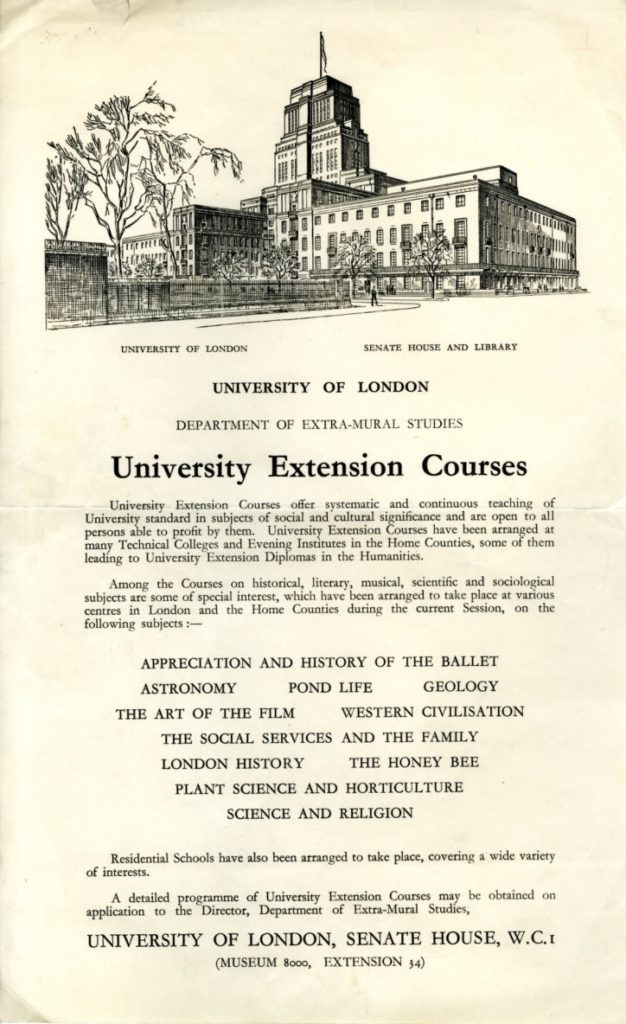
A flyer advertising University Extension courses, featuring a drawing of Senate House One was the (Cambridge) ‘university extension’ model which typically involved academics travelling to deliver their expertise some distance from their university base.  Launched in 1873 and focused first on northern manufacturing cities, it reached London with the establishment of the London Society for the Extension of University Teaching (LSEUT) in 1876.  The other, beginning in 1878, was derived from a parallel (Oxford) ’tutorial classes’ model in which tutors (not ‘lecturers’) were provided by the university but the syllabus was negotiated with students themselves.  Courses were typically delivered in collaboration with other organisations including the Workers’ Educational Association (WEA, founded in 1903).  This provided two distinct traditions in tertiary level adult education, manifest variously in different university extra-mural departments.

London University DEMS was unique in that it consisted of two ‘Responsible Bodies’, each separately funded under the 1926 University of London Act which established its governing University Extension and Tutorial Classes Council (UETCC).  Both grew rapidly in the decades following the end of the Second World War.  The ‘Extension Section’ delivered a programme comprised mainly of accredited Certificates and Diplomas – everything from archaeology to religious studies, and it included several relatively autonomous vocational units, notably in nursing, in social work and in transport studies.  The other, the ‘Tutorial Classes Section’, focussed principally on non-accredited classes, covering if anything an even wider range of subjects, mostly delivered in conjunction with what was then a strong network of local WEA branches as well as with trades unions, local community organisations and third-sector organisations.  Together with their programme – in terms both of subjects, student numbers and of full-time equivalent (FTE) grant was significantly bigger than that of the College to which the amalgamation brought important additional funding.

By the time of the London ‘Extra-Mural’ centenary in 1976, Birkbeck College had itself survived more than one crisis.  This included a proposal in the 1960s “to change the character of the College from an institution for part-timers and evening students to a college for full-time undergraduate school-leavers, on some green-field site outside central London.” (1). While this was defeated by determined opposition on the part of Birkbeck’s staff and supporters, the consequence was that the College and the federal University’s Extra-Mural department continued their development along parallel, but largely separate paths – the College focussing on high-quality research and part-time degree teaching, and the Department developing an extraordinary diversity of activities beyond its traditional ‘liberal’ core.

By the mid-1980s, however, the anomalies had become a major challenge.  The independence of ‘extra-mural’ had been an advantage in the early post-War period when degree-level study was restricted to a few; but with the growth of the university sector the lack of connection between extra-mural ‘outreach’ and teaching and research within the University’s walls had become increasingly apparent.

Many of those taking extra-mural certificates and diplomas wished to progress to degrees and postgraduate work but found it easier to do so at universities outside of London.  A major growth in the numbers of young – and not-so-young – people going ‘to’ university, reduced the demand for degree-level certificates and diplomas.  The success of the Open University had shown that universities do not need to have walls at all; there was a growing demand “to study with and through the University of London but not necessarily at it.”(2)  And the establishment of new universities (Essex, Surrey, Kent and later Brunel) all involved a contraction of the London extra-mural area.  This nevertheless by the mid-1980s still stretched “north to south from Chorleywood to Croydon and east to west from Southend to Uxbridge.”)(3)

At the same time, the distinction between what went on ‘inside’ and ‘outside’ the walls had become an encumbrance.  Staff within the Extra-Mural Department were increasingly developing their own research specialisms and reputations and making, or wishing to make, links with cognate departments within Colleges and Schools.  It happened also that the then Master of Birkbeck, George Overend, was also Chair of the Senate Committee of Extra-Mural Studies.  In the session 1985-6, a Working Group was established, chaired by Overend, to consider future options for the London DEMS.  The Group had only met on a few occasions (its deliberations inclining towards some kind of merger with Birkbeck) when Birkbeck itself suffered a major financial crisis.  This led to another committee, chaired by Sir Barney Hayhoe MP, charged specifically with restructuring the College to meet the challenge.  The Hayhoe Committee, amongst its other recommendations, endorsed the proposal that DEMS should become part of Birkbeck as one of its new resource centres. The proposal also began to interest the University which had recently appointed Dorothy Wedderburn, the Principal of Royal Holloway and Bedford New College, as its first Pro-Vice Chancellor for Continuing Education, as part of a policy to develop a coherent federal policy in this area.  Wedderburn in turn endorsed the proposal for incorporation, and established a formal University Working Party, chaired by Tim Brinton, a lay member of the University Court, to take this forward.

A key proposal of the Brinton report was for ‘complementary development’ of Extra-Mural Certificates and Birkbeck degree programmes.  Where cognate provision existed in both institutions, Brinton argued, it should be linked; subjects offered only ‘extramurally’ might stimulate the development of new degree programmes (acting, inter alia, as progression routes for certificate students) or offered as options within existing degrees, and elements of Birkbeck degree programmes not already matched by certificates and diplomas could be offered ‘extra-murally’.  In practice, integration did not go nearly as quickly as Brinton envisaged, partly as a consequence of the size of the extra-mural programme and fears of College staff that they might be ‘swamped’; perhaps because of reciprocal fears of ‘absorption’ and ‘dilution’ which had prevented any progress towards a merger in 1976, but also because of the significant organisational barriers to collaboration produced by the new College ‘resource centres’ that arose from the implementation of the Hayhoe Report.

Initially, DEMS was simply incorporated within Birkbeck in 1988 as a semi-autonomous Centre for Extra-Mural Studies (CEMS).  Subsequently, when the resource centre structure (introduced by Tessa Blackstone upon her appointment as Master in 1987) was replaced by academic faculties in 1999, it was renamed the Faculty of Continuing Education (FCE) and then in 2007, the Faculty of Lifelong Learning (FLL), throughout still occupying the two buildings; 26-28 Russell Square and 32 Tavistock Square (which hosted the WEA’s regional office on its top floor) to which it had moved in 1975 from its earlier home in Ridgemount Street.

At the end of the 2008-9 academic session — after two decades of semi-autonomous existence (and little more than a year after its change of name from ‘continuing education’ to ‘lifelong learning’) Birkbeck’s FLL, its staff, their teaching and research were finally assimilated into four new ‘super-schools’ alongside colleagues in cognate subjects ‘across the car park’ from their base in Russell Square.

Writing in 1988 on the eve of the incorporation of the ‘Extra-Mural’ Department within Birkbeck, its then Director, Brian Groombridge, had described the incorporation as “one of the most profound structural changes in the Department’s history.”(2).  The incorporation reflected the start of much broader changes in the structure of part-time higher education.

One factor was a rise in credentialism – both a demand for certification and an insistence on it by the DES as a condition of funding.  ‘Mainstreaming’ – the requirement for formal assessment of learning outcomes for all funded students meant a loss of flexibility in the Tutorial Classes curriculum.  This was followed in 2008 by the introduction of the European Qualifications Framework (EQF), implemented in Britain as the National Qualifications Framework (NQF) whereby all awards were referenced to a series of levels and carry a credit rating in the Credit Accumulation and Transfer Scheme (CATS).  NQF was accompanied by ‘ELQ’ – the withdrawal in 2007 of funding from students already in possession of a qualification at equivalent (or higher) level than that at which they wished to study.  ELQ anticipated the subsequent abandonment of all state funding for liberal adult education by an increasingly instrumentalist neoliberal government.  In combination, their consequences (and the end of one of the last remaining university departments of adult and continuing education) may be seen also as the final stage in inexorable erosion of the ‘liberal ethic’ (and of partnership provision) within the university sector.

Paradoxically, the final assimilation of FLL within the new College structure made possible the realisation of some of the possibilities envisaged over two decades previously in the Brinton Report.  One of the DES funded innovatory projects already in progress as the 1988 incorporation of DEMS within Birkbeck was underway (and cited in the Brinton Report as potentially beneficial to the outreach capacity of Birkbeck) was an ‘East London Project’, aimed at exploring ways in which the University, through its extra-mural department, might contribute to the social and economic regeneration of the area.  Then the collaboration envisaged was with Queen Mary College and the London Docklands Development Corporation; today it is with the (‘new’) University of East London, the London Borough of Newham, and other organisations in the region of the London Olympics and the Thames Gateway, but Stratford East represents in many ways the fulfilment of the opportunities identified in the Brinton Report and by the 1988 incorporation of ‘Extra-Mural’ within Birkbeck.

Other recommendations of the Brinton committee were manifest in different ways.  For example, complementary development and integration of certificate and degree programmes were limited in practice to the Certificate in Ecology and Conservation which, in 1988, became a key ‘vertical’ slice through Birkbeck environment degrees, providing an ‘outreach’ element to students who might not otherwise have considered a full degree as well as an exit route for those who had done so but who found the time commitment of three evenings per week too demanding.  Other attempts to develop new integrated degrees and certificates by means of newly created joint (extra-intra mural) posts (for example in archaeology, development studies and in science & society) placed an enormous strain on the colleagues appointed, who were not only expected to do far more than their notional fractional allocation to each ‘home’ but had to operate dual incompatible assessment and administrative systems.

At the same time however new awards were developed within the new Centre, in part as a response to – or a defence against – a perception within ‘main College’ that much of its work was of ‘sub-degree’ standard.  Several of these new awards were at postgraduate level.  Examples included postgraduate diplomas in Environmental Management and in Counselling.  Partly because of a concern within the Centre that progressing approval through the College’s academic board might meet with opposition, these were taken through the Council for National Academic Awards (CNAA) route in 1992 – just before the CNAA was itself set up as part of the process of transferring degree awarding powers to the ‘post ‘92’ universities.  The CNAA confirmed their rating as postgraduate, and they became the core of new Masters’ awards (the first in the Centre) in 1995.
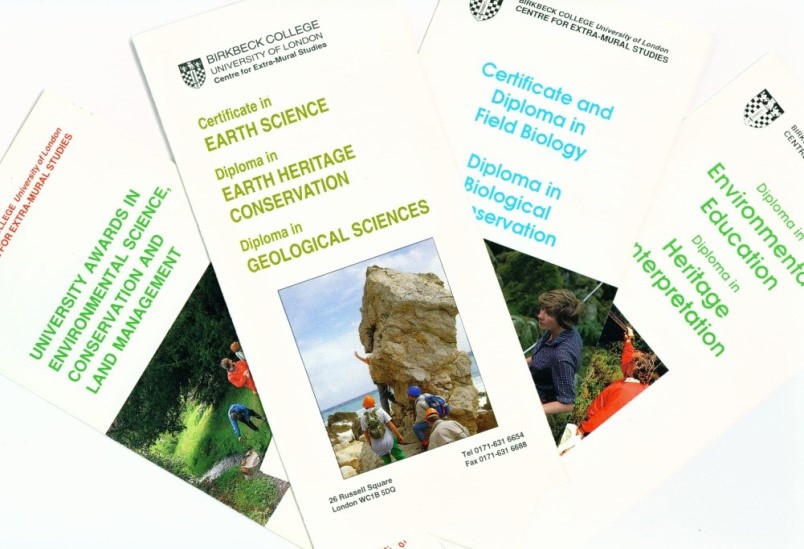
A leaflet that says 'Certificate in Earth Science'

The Masters in Environmental Management (Countryside and Protected Area Management) and another MSc in Environmental and Heritage Interpretation were particularly significant in that, being taught at weekends (coupled with week-long residential modules elsewhere) they attracted students from well beyond the London area, including Scotland, Switzerland and the USA.  Moreover, being ‘national’ in appeal, they attracted sponsorship, so that for a number of years both the then Countryside Commission and The National Trust each funded six scholarships – the former for local authority countryside staff and the latter for the Trust’s own employees.

Today few universities retain a significant level of extra-mural provision – part of the generalA leaflet saying 'Environmental Training collapse of liberal, non-vocational adult education.(4)  Exceptions include Oxford University’s Department for Continuing Education and Cambridge University’s Institute of Continuing Education.  Within Birkbeck, while little of the 1988 ‘outreach’ provision survives today, legacies of the incorporation can be found in the College’s research and teaching, for example in London studies, in links with significant institutions in working-class education such as Toynbee Hall and the Bishopsgate Institute, and in other, now mainstream areas of university provision which were pioneered with DEMS/ FLL.  For example, DEMS and – by inheritance, Birkbeck – was the first university institution to recognise women’s studies as a legitimate field of scholarship and teaching, manifest in the appointment of Britain’s first lectureship (Mary Kennedy) in the subject.  Extra-mural traditions of radical history and critical science complemented those that had already been pioneered within the College by such prominent individuals as Eric Hobsbawm and J D Bernal.  Another legacy is the relatively large number of hourly-paid associated fixed-term ‘teaching and scholarship’ staff which remains a feature of Birkbeck today.

  1. Hobsbawm EJ. ‘Birkbeck and the Left; Concluding address to the 175th Anniversary Appeal Lectures at Birkbeck’. Times Change 2001:14-17.
  2. Groombridge B. Extra-mural Futures: The Prospects for London. London: University of London Department of Extra-Mural Studies; 1998.
  3. Brinton Report 1986, unpublished
  4. Clarke R. ‘‘Really useful’ knowledge and 19th century adult worker education – what lessons for today?’. Theory & Struggle 2016;117:67-74: https://online.liverpooluniversitypress.co.uk/doi/abs/10.3828/ts.2016.17.

Further information:

  • Read more of our 200th anniversary blogs

Championing rights for disabled people in the workplace 

As the world prepares to observe the United Nation’s International Day of Persons with Disabilities, on Friday 3 December, we speak to Birkbeck PhD student, Stephen ‘Ben’ Morris who shares details of his own journey with a disability and his research on how neurodiverse individuals can be supported into the workforce. 

Stephen 'Ben' Morris

 The global, annual observance of the International Day of Persons with Disabilities was proclaimed in 1992 by the UN to promote the rights and wellbeing of disabled people.  What has been your own personal experience with a disability? 

When people meet me, I hope they see me as ‘Ben,’ with all of the positive characteristics and contributions I can provide as a fellow human being. In most cases, I feel this is accurate; yet, when it has been determined that I am a person with a disability, the way I am treated varies on a regular basis. Some of the treatment is due to other people’s ignorance – for example, I can be bypassed in conversations even if they are about me; or, on occasion, malice, because others don’t understand or are afraid of my difference. Even when the intentions are positive, how I am treated can still have an effect on me.  

For example, people can become overprotective because of my disability, which can limit the opportunities accessible to me. I have been passed over for promotions because my employer is concerned about the expectations this advancement will place on me. Personally, I consider my disability as a positive because it gives me many strengths; nevertheless, I believe society needs to change its perspective and see me as a whole, not just see my limitations. 

Coinciding with the UN day of observance on 3 December is UK Disability History Month, which runs until 18 December. One of the key themes is around hidden disabilities- can you share a bit about your research and its links to those disabilities which are not necessarily ‘seen’? 

My research will centre on assisting neurodiverse individuals (who have a divergence in mental or neurological function from what is considered typical or normal) in entering the workforce. This will be a two-pronged strategy. The first approach is to listen to the neurodiverse community and understand their needs, desires, and barriers to work. The second approach focuses on the employer and teaching them how to support neurodiverse individuals in order to make work more accessible and achievable.  

From the research, I hope that finding the correct ‘fit’ will benefit both the neurodiverse individual and an organisation. The individual will be included in the working society and possibly feel self-worth, while an organisation can utilise untapped skills and talent. 

What do you see as the greatest challenges as you proceed through your research? 

Right now, I’m concerned about the future. I’m concerned about those who refuse to take part in my research. I recognise that people are frequently afraid of change, and I hope that the findings can be used and benefited from. Fortunately, I am being sponsored by Hays Recruitment and have connections with employers and neurodiverse communities, so I’m hopeful that will help me to locate participants for my studies. 

I’m also concerned by the data: only 31% of disabled people in the UK are in employment. Many desire to work but for a variety of reasons, they are unable to do so. Getting a job, if you are neurodiverse, can be very difficult.  

What are you most inspired by when it comes to the disabled community and the progress in terms of championing for disabled rights, better services and more exposure of the issues? 

People should be willing to speak up for their beliefs, especially if it would benefit others. When people speak up for what they believe in, it can spark a movement in which other like-minded people work together to achieve a common objective. This collaboration decreases loneliness and isolation, and as this movement gains traction, more people will listen, and more action and understanding will begin. I believe that during the last few decades, there has been a growing sense of solidarity in the disabled community, and that some others are taking notice. More, though, is still required. It is vital to remember that it is just as difficult for a neurotypical (non-diverse) person to enter the realm of disability as it is for a neurodiverse/disabled person to enter neurotypical society. 

I wish to live in a world where everyone is recognised for their uniqueness and individuality. I believe that everyone has something to offer society, from innovative new ideas to spreading happiness and love. I believe there is an overemphasis on labels…people frequently notice the label before the person. I constantly campaign to highlight the advantages of what minority groups can do if they are given the opportunity. I believe it is equally vital for me to share my thoughts with other persons with disabilities, their family members, co-workers, and experts, because the more one teaches, the more one learns. It would be an accomplishment if my stories/experiences helped improve the lives of even one person. 

Further information 

Spanner in the works for a parasite motor

Throughout World Antimicrobial Awareness Week, we’re featuring key areas of research at Birkbeck relating to the management of diseases. In this blog, we feature the work of former PhD student, Alex Cook, who is looking at new approaches to malaria control.

Alex Cook

Alex Cook

Separated by 85 million years of evolution, the parasite Plasmodium falciparum that causes the most deadly form of malaria, is a very different beast to its human host. Yet the challenge for malaria treatments is that they must kill the parasite but not destroy the cells of their human host in which the parasite hides. Malaria is a massive disease burden world-wide. Hundreds of thousands of people are killed each year, the majority of which are children younger than five. In Africa, disruption arising from the COVID-19 pandemic to existing measures also threatens to undo the last decade of malaria control. With resistance to current frontline therapeutics rapidly rising, new drug targets and vaccines are urgently needed.

Malaria-causing parasites are single cells and have a complex life-cycle within both human and mosquito hosts. The many iterations of parasite proliferation that are essential for disease transmission are driven by intracellular machinery called the mitotic spindle, which is built of cytoskeleton components called microtubules. This machinery ensures the correct distribution of replicated chromosomes to the newly produced cells. Targeting of the mitotic spindle by drugs is well-established in a variety of settings – notably human cancers – and components of the malaria proliferative machinery are thus attractive anti-parasite targets.

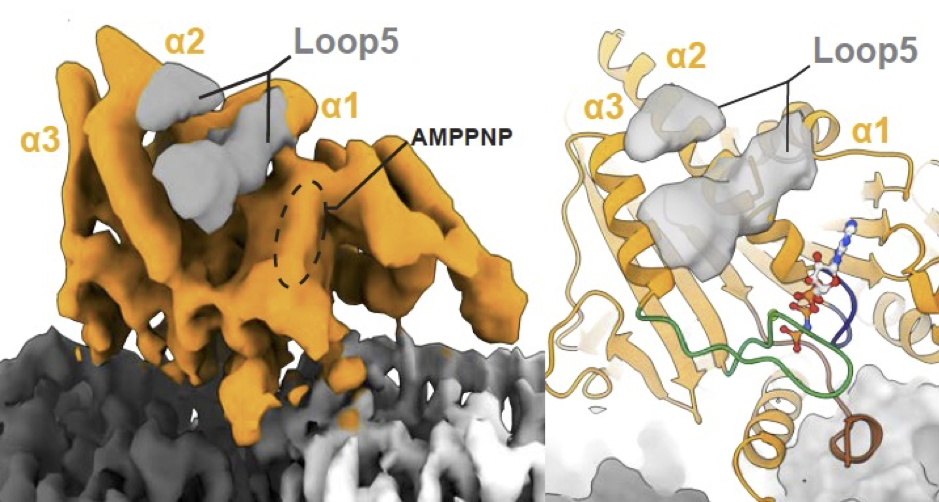
As part of his PhD work in the research group of Professor Carolyn Moores (Biological Sciences), Alex Cook studied a component of the malaria mitotic spindle machinery, a molecular motor called kinesin-5. Kinesin-5’s are a family of proteins known for their ability to ‘push and pull’ microtubules to create ordered structures within the cell. Alex used a very powerful electron microscope to take images of kinesin-5 molecules – which are around a millionth of a millimetre in size – bound to individual microtubules. He then used computational analysis to combine these pictures and calculate their three-dimensional shape, thereby providing information about how the motors work in the parasite themselves.

the Kinesin protein that contributes to malaria

Using this information, Alex – who is co-supervised by Professor Maya Topf and also collaborates with Dr Anthony Roberts, both also in Biological Sciences – showed that although the malaria kinesin-5 motor shares some functional properties with human kinesin-5, there are several key differences that indicate it might be susceptible to specific drug targeting. Confirming this idea, Alex found that a drug-like molecule that blocks human kinesin-5 activity does not affect the parasite motor.

Alex Cook, who is now a postdoctoral researcher at the University of Oxford said: “To uncover new approaches to malaria control, we urgently need to look at new molecules from the parasite. Using high resolution electron microscopy, this first look at a parasite cell division motor will provide a springboard for discovery of small molecules that can disrupt malaria replication.”

Professor Moores commented: “Alex’s hard work, together with vital support from our department’s lab and computational teams, demonstrates the power of electron microscopy to explore medically important challenges.”

Alex’s work was recently published in The Journal of Biological Chemistry (https://doi.org/10.1016/j.jbc.2021.101063). Future directions for the project involve further investigation of specific motor inhibitors, and also of the function of kinesin-5 in the parasite itself, in collaboration with the research group of Professor Rita Tewari at the University of Nottingham.

Further information

Birkbeck academic makes the ‘Disability Power 100’ list

Professor Martin Paul Eve (School of Arts) has been named on the Shaw Trust’s ‘Disability Power 100’ list, which celebrates the UK’s most influential disabled people. Here, he shares his own experience with a disability and speaks on both the ongoing challenging environment for the disabled community plus their heightened visibility.

Professor Martin Paul Eve

Q1) What does it mean to be one of the 100 finalists, selected from over 550 nominations?

This is an important award for me. My health and disability have played majorly detrimental roles in my life and it’s something I have to fight against almost every day. To be recognised as successful in spite of this is, I feel, extremely important, although celebrating the achievements of disabled people who do well should never be used as a comparator to people who aren’t able to ‘overcome’ their own challenges to the same extent. I am fortunate, in many ways, to have got where I am and luck plays a huge role.

Q2) Shaw Trust uses the annual event to highlight how businesses, and others, can champion more opportunities for the disabled. What progress have you witnessed at Birkbeck with respect to this?

Birkbeck is committed to the Disability Confident Scheme and I applaud that, but I would like the College to go further. I have co-chaired the Staff Disability Network for the past year and it’s clear that we have the opportunity to make a step change around disability in the same way that we have seen for gender and race. But it needs people to prioritise it.

Q3) In your view, what are the most critical issues facing the disabled community in the UK?

Disabled people, or people with disabilities (this terminology is contested), face continued persecution in their day-to-day activities. This should be unacceptable in the twenty-first century. That is why I am pleased to stand up and declare my status from a position of relative privilege. The ongoing impact of the pandemic also affects this group disproportionately. It is still not safe for me to leave the house and I remain in lockdown/shielding, despite the withdrawal of government support for people in this group.

Q4) What more can we all do to address those issues?

The visibility of disabled people does a lot to help. The Paralympics, actress Rose Ayling-Ellis on Strictly Come Dancing and the Shaw Trust’s list are all ways of showcasing the rich lives of disabled people, as people. But we also need a more empathetic society; one that values disabled people’s lives. In the past year, 60% of deaths from the pandemic have been disabled and vulnerable individuals. Writing this off as collateral is simply barbaric.

Q5) Disability History Month is being observed later this month (18 November). What value do you see from such events and how would you like to see people getting involved?

Disability History month is an important way in which the complex historical narratives about disability can be brought to greater attention and used to alter how disability is perceived in our present. For example, not many people outside of disability studies know of the ‘social model’ of disability, in which disability is seen as a socially constructed phenomenon. That is, rather than a person ‘having’ a disability, they are disabled by society. A good example is the use of stairs instead of ramps. It’s not that the person has a dis-ability to get to the top of the stairs, it’s that the societal choice to use stairs rather than an accessible ramp caused the disability. Disability history month is a time when we can celebrate the achievements of the disability rights movement and use this space to educate people about issues like this.

FURTHER INFORMATION

10 recipes to try this Diwali that are not curry

Today (November 4) is Diwali or Deepavali, a religious Indian festival of light that celebrates victory of light over darkness, good over evil, and knowledge over ignorance. This celebration comes from the legend of Lord Rama, who was deprived of his kingdom and sent into exile for 14 years. Rama eventually defeats the evil spirit Ravana and returns to his home. Diwali honours this triumphant return and is celebrated by Hindus, Sikhs, Jains and some Buddhists all over the world. Here, Birkbeck final-year Marketing student, Shweta Menon shares the festival’s culinary delights.

UG Marketing student Shweta Menon

Shweta Menon

Diwali has distinctive celebrations across India and in more recent times around the world. However, lip-smacking vibrant foods, a variety of Indian sweets and the combined play of colours and fireworks remain a constant. Growing up I would see my grandmother prepare an array of snack and sweets for Diwali. There were some traditional items like murukku (crispy rice stick), sheera (semolina pudding), rava laddoo (sweet semolina balls) and some innovative ones.

If you, like me, are away from home this Diwali or want to put on your chef’s hat to try some Indian delicacies, here are some recipes for you:

  1. Murukku

Murukku

Murukku is a traditional South Indian deep fried snack recipe made with rice flour, urad dal and spices. Chakri is like Murukku, but the ingredients slightly differ They are savoury and crispy.

  1. Shankarpali

shankarpali

Shankarpali, sweet diamond cuts, is a crispy sweet snack made with flour, ghee and sugar. These can last you for a good week or two.

3.Gulab Jamun

gulab jamun

Gulab Jamun is a classic Indian sweet made with ghee, milk solids and cardamom powder.

  1. Rava Ladoo (Sweet Semolina Balls)

rava ladoo

Rava Ladoo is yet another classic indian sweet made with semolina, ghee and sugar.

5.Kaju Katli

kaju katli

Kaju Katli is popular Indian sweet made with cashew nuts, sugar and cardamom powder. Kaju, in Hindi, means cashew and katli refers to thin slices.

  1. Aloo Tikki Chaat

aloo tikka chaat

Aloo Tikki Chaat is a famous Indian street food made of spiced fried potato patties served with yogurt, pomegranate and chutneys.

  1. Carrot Halwa

carrot halwa

Carrot Halwa, natively known as Gajar Halwa, is a sweet carrot pudding made in the winter months when carrots are in abundance .

  1. Gujiya

gujiya

Gujiyas are scrumptious sweet fried dumplings. The filling of the dumpling is a delightful combination of dry fruits and milk solids.

  1. Besan Ladoo (Sweet Gram Flour Balls)

besan ladoo

Besan Ladoo is a staple Diwali sweet made with roasted gram flour, ghee and sugar. They only take as much as 15 minutes to make and are absolutely finger-licking.

  1. Turmeric Cumin Margarita

turmeric cumin margarita

This bright coloured Margarita with its smoky notes is the perfect cocktail for the festival of lights

What does Bandhi Chhor Divas mean to you?

On 4 November, Sikh people around the world will observe the Day of Liberation: Bandhi Chhor Divas. With the celebrations often coinciding with Diwali, the Festival of Light, celebrated by Hindus and more widely recognised around the world, the annual Sikh festival holds a special place for the community, with distinct personal observations on its significance. Here, Bayparvah Kaur Gehdu, Birkbeck PhD student, shares some of these.

Bandhi Chhor Divas, in English and traditional Sikh spelling

credit: Bayparvah Kaur Gehdu

Reflections on Bandhi Chhor Divas, the ‘Day of Liberation’

“Bandhi Chor Divas is not about light for Sikhs, it’s about self-reflection and seva (service), a reminder of our commitment to stand for social justice as forged by our Guru Sahibaan.”- Jasmeet Kaur (she/her), Secondary Education professional, writer, and disabilities advocate.

“[It] is a reminder, to me, of our responsibility, as Sikhs, to fight oppressive systems- ALL systems of oppression in a spirit of solidarity, but one that is understood and driven by our history, our faith, our gurbani (speech), and our radical/revolutionary love.”- Sharanjit Kaur (she/her), PhD (cand.) UBC, History, Sessional Instructor of History, UFV and co-curator Sikh Heritage Museum, National Historic Site Gur Sikh Temple, Abbotsford, B.C.

“For me, Bandhi Chhor Divas is a reminder of our continued struggles and how they are interconnected with critical and compassionate approaches to social change. Together, we can stand against those stripping others of their humanity and we can walk side by side, or open space for those who have had their humanity taken from them. Together, we can take steps towards liberation.”- Shuranjeet Singh (he/him), PhD candidate and mental health advocate.

“Bandhi Chorr Divas is celebrated on the same day as Diwali, the Festival of Lights, and is sometimes also interpreted as a day commemorating the existential journey from darkness to light. However, Bandhi Chorr goes way beyond this literal symbolism, and for me, it symbolises the fight for justice. It symbolises the need to take a stance against injustices and having the moral and spiritual strength to defy oppressors. Guru Hargobind Sahib Ji waived the opportunity to his own freedom while the 52 rajahs imprisoned with him were not granted theirs. This incident is a graphic depiction of being defiant against oppressors. Currently, the farmers of Punjab are battling the same injustices, and Bandhi Chorr Divas takes on renewed significance about the fight for justice.” – Dr Gursharan Kalsi, Research Manager, King’s College London.

“Bandhi Chorr Divas happens to fall on the same day as Diwali. Every year when Diwali comes around people exchange greetings and wish each other well there is less mention of the festival Sikhs celebrate, known as ‘Bandhi Chhor Divas’. I remember at a very young age I learned the story of what the significance was of the day. The story of Bandhi Chorr Divas, to me, represents freedom over oppression. After being released, Guru Ji went to Amritsar to celebrate Diwali and that, to me, represents what Sikhi is primarily about: Unity.” – Amandeep Kaur Bhurjee (she/her), student and mental health advocate.

“My interpretation of Bandhi Chhor Divas falls into two areas. Firstly I think it was about the guruji giving the 52 rajas salvation from literally being released from imprisonment at that actual time in history. But secondly it might also be perceived that by being led by guruji, we seek freedom from our own metaphorical imprisonment from being within darkness and not knowing, to be enlightened from the knowledge, learned and gained.”- Kulvir Singh (he/him), Learning Design Officer, Warwick University.

“Bandhi Chhor Divas means the day of liberation. Guru Hargobind Sahib liberated 52 soldiers from prison to freedom. For me, Bandhi Chhor Divas signifies that Guru Sahib is there to liberate us from our internal and external fears and vices. It also teaches us to accept hukam and place our trust in Guru Sahib’s hand.  Guru Sahib had an option to just leave the prison alone, yet he decided to free the other kings, teaching us an important lesson about selfless sewa.”- Sarbjot Kaur (she/her), audit and risk management professional and disabilities advocate.

“This is what Bandhi Chhor means to me: The key message is the focus on the ‘inner light’ and not the external representation we are used to seeing. This is something that’s pure and eternal. The guru dispels this darkness of ignorance and ego with this light of understanding. As a result we realise ourselves, everything around us and the oneness of the creator god- Waheguru. – Taree Singh Bhogal (he/him), IT support engineer.

“From the outside, we see this part of Sikh history as our Guru Ji made prisoner to the Mughal empire, later being released. However, this is not the case. In reality our Guru Ji is the one who frees us and releases us from bondage. So, for this reason any of the Sikh Gurus could never be imprisoned. The display we see is Guru Hargobind Sahib Ji had a reason to enter that prison of their own free will. Guru Ji went there to help those who needed saving. This is a lesson for Sikhs and those who believe in the Sikh Gurus, that when we are in trouble and need help our Guru Ji is always there to stand with us and help free us from the many forms of prisons we are trapped in.”- Vickramjit Singh, Business Intelligence Developer.

What is Sikhi (Sikhism)?

An image depicting the true essence of Sikhi- Oneness, with the number 1 written in Gurmukhi script and One written in English script underneath. The writing is centred in the middle of a orange circle.

An image depicting the true essence of Sikhi- Oneness, with the number 1 written in Gurmukhi script and One written in English script underneath.

Sikhi (the authentic term for Sikhism), is the ‘revealed path of Enlightenment’ as taught by the Gurus from 1469 to 17081. The Sikh Gurus were ‘revered as spiritual teachers, as warriors, poets, emancipators, and as sovereign rulers2. Sikhi is fundamentally based on the premise of Oneness; humans are all equal as there is ‘no religion and God has no chosen people’1 (ref Top Ten Questions about Sikhi 2021; Singh, S. (2021). SatGuru Bandi Chhorr Hai — National Sikh Youth Federation).


Background to Bandhi Chhor Divas/Day of Liberation

According to tradition, the long imprisoned Guru Hargobind Sahib Ji, the sixth Sikh Guru, was released from Gwalior, India, taking with him 52 Rajas, also political prisoners.

The Emperor Jahangir said that those who clung to the Guru’s coat would be able to go free. This was meant to limit the number of prisoners who could be released. However, Guru Hargobind (Guruji/Guru Ji) had a coat made with 52 tassels attached to it so that all of the princes could leave prison with him. This act of defiance demonstrated the concept of ‘Oneness’: how we are all equal and interconnected with our struggles, pain, and oppression but also in our love and joy.

On Bandhi Chhor Divas, Sikhs celebrate the freedom and human rights associated with this history. While the day often falls on the same day as Diwali, they are two distinct festivals with the Day of Liberation falling days before, on occasion.

In their own words: Tips from our Cheveners (references)

We’ve asked our 2020 Cheveners to share their experience applying for the prestigious UK government scholarship. In this blog, we highlight their tips and advice about obtaining references as part of the selection process. “My advice to the Chevening future applicants is to be realistic and genuine to select referees that (you) know very well and have engaged with on professional levels, be it in academia, at work, or people you have collaborated with on certain projects. Select people who know your capabilities and believe that you have the potential. People who inspire you to inspire others, encourage and motivate you to be successful, and make a difference in your community.” Menessia Diergaardt, Namibia “I would advise future applicants to choose people with whom they have a strong professional and/or academic relationship. Someone whom you can trust to speak on your behalf confidently and with objectivity.” Bongani Njalo, South Africa “Since I have been working for 10 years and my work was related to the course of my studies, I chose two of my supervisors as referees. They were an important influence in my career, and they watched me grow from a young inexperienced student to a confident young professional and I appreciate their evaluation of my journey. I would advise applicants to choose people that really know them and have worked with them closely so they can give you a thoughtful opinion of your character rather than a general note. And it’s also a nice letter to read while you apply for the scholarship that you may be anxious about.” Eva Shimaj, Albania “My mentor and my MSc dissertation supervisor were my referees. Both knew of my aspiration at the early stages of the Chevening application and supported the application idea. I approached my mentor because they were aware of my personal strengths and career aspirations and my supervisor because they knew of my academic strengths and zeal to learn. My advice for applicants is to be strategic in their referee selection. Pick people who have seen your strengths and have had experience with you professionally and academically, preferably also someone in a senior role.” Nozipho Nomzana Mziyako, Eswatini “I knew my referees in a professional capacity however, we had engaged in several academic activities before as part of our professional relationship. I selected them because I maintained a close relationship with them at the moment, also they are both entrepreneurs developing their businesses in a non-ideal environment, so they are driven, motivated and capable people whose opinions and experience I respect and value. Also, I had the chance to work closely with them while they were making significant progress in their businesses, so they know my abilities and qualities as a collaborator and employee. Future applicants can make better use of their references if they choose people that are close to them and somehow share their interests or vision in life. I considered my references as a guide for what I wanted to achieve in the future because of their attitudes, capabilities and motivations.” Yoandra Rodriguez Betancourt, Cuba “You may want to include a brief description of your motivation to apply, what you wish to achieve with the degree and how it relates to your common interests, and most importantly why you think she/he would be a great fit to comment on your suitability. It is about engaging your referee. You may want to get in touch with more than one referee to make sure that by February you can at least get the formal approval of two referees.” Zina Diari, Tunisia You have submitted your Chevening application, what’s next? “I stayed in touch with the referees, still through our networking, email, phone calls and sometimes meeting up over a cup of coffee to update them about my Chevening journey and asking them advice on different aspects, professional, personal, and self-development. My referees have been very supportive and encouraging, hence we are still in contact, they check up on me and my academic progression.” Menessia Diergaardt, Namibia “Keep in contact after submitting the application. As soon as required, I let them know, when I had received the email from Chevening and let them know that they needed to send the reference. Later on, I would call from time to time to ensure that they send it on time.” Randolphe Severin N’Guessan, Cote d’Ivoire “When I got selected for an interview, I followed up with a detailed email where I listed the responsibilities I carried out under (my referee’s) supervision, that she could draw upon to develop my reference letter. Keep in mind that referees are generally academics or managers who come across several similar requests to act as a referee. It is important to highlight the period of time in which you have collaborated. I also shared the Chevening guidelines for writing a reference letter and kept on active communication with my referee during the process.” Zina Diari, Tunisia “I stayed in touch with my referees through social media and phone calls. Since they formed part of my network of professionals, it was easier to reach out to them. Future applicants should create a network of professionals who understand their ambitions, character, and ethics. This ensures that you are easily referenced and supported objectively.” Freemen Pasurai, Zimbabwe. Further information: Blog post by Catherine Charpentier, International Marketing and Recruitment Officer (Africa)    

Storm Train

Throughout Breast Cancer Awareness Month (October), the Building Resilience in Breast Cancer Centre (BRiC) is sharing stories, told first-hand by women who’ve experienced the illness. Here, Sara Williamson, Writer and Chair of the Mid-Yorkshire Breast Cancer Support Group, shares her journey.

image of Sara Williamson quote

So, after a mastectomy: node clearance (as 14/17 lymph nodes were affected), then chemotherapy, sepsis delaying radiotherapy, more surgery due to infections, Herceptin being stopped and started due to heart failure twice, then the Zoladex harpooning, followed by reconstruction, reduction, lypo filling – that filled four years from 2015 – 2019. That was the treatment plan! Nothing went in a straight line! The train kept derailing and diverting. Nothing prepares you for the side effects. Having to relearn to walk again and use my arms was an upward challenge.

Cancer disrupts your career, friendships and day to day living. I remember people being scared of me, the sad looks, no close proxemics. I was a reminder of the possibility of death and subjects always changed so that they did not have the burden of carrying my illness.

So, grade 3, stage 3c with a 40% chance of living. Five years was the predicted life expectancy, if I completed all treatment. I fought to continue treatment as was bloody minded enough to prove that those stats would be wrong. You would think after completing four years of treatment that you would be relieved, but the truth is that psychologically and emotionally the clock starts ticking backwards and the mind plays tricks on you. There’s the whisper in your ear that means that you have one year left to live, and reaching the five-year mark is supposed to be good, right!? People don’t realise that although alive you feel half dead with the side effects.

Every blood test recalled, mammogram, urine test and medical review terrifies me, so much so that there are sleepless nights until a recurrence is ruled out. When the word ‘cancer’ hangs over a cancer survivors head, it can be emotionally paralysing, making decision-making a challenge. New unexplained aches and pains cause fear of recurrence, and anxiety can be triggered by sounds and smells in hospital waiting rooms. Knowing your own body helps distinguish and recognise changes, but to what extent are we vigilant? Checking daily is obsessive but like a form of necessary obsessive compulsive disorder (OCD).

There’s emotional grief with enforced menopause and the loss of fertility, even if you never planned to have children. Body image, scars and disfigurement mean that you can’t relate to old friends in the same way. It’s difficult losing part of your body especially one so visible, and one which defines you as a woman. There’s frustration at life interrupted. Trying on bras and t-shirts that never seem to fit. Life and the body is lopsided.

Words all seem to have new meanings: ‘Warrior, fighter, survivor’. There’s no emphasis on one’s quality of life, or acquired disabilities, or new health issues. For secondary metastatic breast cancer patients, the word survivor seems to optimise the gift of life inappropriately. Then there’s guilt and grief at hearing of friends that have not lived. You are back on that storm train again.

Further information:

Learn more about BRiC

Returning to campus

Fraser Keir, Academic Registrar at Birkbeck, reflects on how life has changed since the start of the pandemic, and urges people to be kind and considerate of others as many students and staff return to campus next Monday 4 October for the start of the autumn term.

The past 18 months have been a roller coaster for everyone in the Birkbeck community, myself included. Overnight Microsoft Teams became our new best friend and the gateway to keeping in touch with colleagues, friends and family. I clapped for our NHS heros and learned the value of an hours walk when you were only allowed an hours walk a day. For those in hospitals and care homes every second was precious, and for many people they lived day by day as the virus ravaged communities. We were all living, praying and hoping the worst would not come. As the fragility of life and the power of viruses came to the fore so awakened our compassion for others and the importance and value we place on the NHS and keyworkers, many of whom are students at Birkbeck. Jobs and roles that we may not have considered that critical in the past became essential – carers, lorry drivers, supermarket workers, nurses and cleaners to name but a few. Seeing empty shelves highlighted the inter-connectedness of our society and the just-in-time nature of how we consume. When things got really tricky during lockdown I only had admiration for the people keeping our country running whilst trying to look after kids, the oldies and often in home circumstances that were not always conducive to work, study and home schooling. I didn’t take a drive to Barnard Castle during lockdown but following the rules and being a rule keeper as well as being a university rule maker really became important to me as someone who works in the public sector. Having colleagues and students trust you are doing the right thing by them was both humbling and a heavy burden in equal measures.

Altering the way school pupils and university students were assessed and examined was one of the most fascinating aspects of the lockdowns. Some pupils and students loved online learning and some didn’t. What we do now know is that there are options to the traditional 2 or 3 hour closed books exams that work and these options can create a more inclusive learning environment by taking out some of the ‘exam hall anxiety’. Learners can learn from the comfort of their own homes and academic standards can be maintained by careful assessment design. There is much we can learn and benefit from continuing to support elements of digital learning and assessment.

It was through higher education and our scientific community that hope emerged. Issues that would previously have taken years to implement happened almost overnight – lockdown, furlough and, of course, a vaccine roll-out. We learned that we could be agile and do things differently. For many of us, productivity increased whilst working at home and not having to travel 10 hours a week on public transport. Coming out of this phase of the pandemic I’m going to retain some of the benefits of this experience and work flexibly as are many of my colleagues in Registry Services and across the College. Personally I feel that a good home/work life balance makes us all more productive.

As I start to attend meetings back in Bloomsbury, l continue to take a cautious approach to coronavirus. Why? Part of it is me trying to be a good neighbour to others in clinically or emotionally vulnerable situations. Part of it is me wanting to avoid contracting COVID-19. My hope is care and compassion will continue into the future and a focus on mental health is only a good thing. So, I’m now double jabbed. Thanks to Oxford AstraZeneca I can say I’m an Oxford lad as well as an alumnus of Aberdeen and the Open Universities. I’ve also had my flu vaccine and will take a booster shot for COVID-19 when they become available and I’m eligible to have one. I’m happy to wear a mask on campus even if its uncomfortable. I don’t like wearing masks but it’s my personal contribution to the health and safety of a wonderful 12,000 strong Birkbeck community. I’ll keep washing my hands and I’ll give people space when they want it. I’ll also take lateral flow tests when I have to meet others indoors. Is all this an inconvenience and an assault on my personal liberty? No, not really because a resurgence of coronavirus is the real issue and the real assault on our freedom. Kindness costs nothing and it is our kindness that will be remembered by colleagues, friends and family in the years to come. As we go back to our new normal and regardless of how strongly we hold views; if we can be anything, lets be kind to one another.

Further information

Birkbeck and the dubious dealings of Francis H. Fowler

In this blog, Ciarán O’Donohue an MPhil/PhD student in the Department of History, Classics and Archaeology, shares the story of the development of a new Birkbeck building in the nineteenth century. This blog is part of our 200th anniversary series.

New building of Birkbeck Institute 1800s

New building of the Birkbeck Institute. ‘Bream’s building, Chancery Lane’

Once the decision had finally been made in 1879 for the Birkbeck Literary and Scientific Institution to fly the nest and leave its original home in Southampton Buildings, Chancery Lane, it took years for the necessary funds to be raised. Rather than move to another existing building and “make do”, Birkbeck’s executive committee was dead set on commissioning a new one. Fund raising was slow. Scarred by the struggles of the mid-nineteenth century, where mounting debts had threatened the Institution with collapse, the Committee set about taking public subscriptions to reduce the costs.

Nevertheless, the risk had to be taken. Birkbeck could remain in its home no longer. A new building, the Committee asserted, was essential to ‘the prosperity and development of the Institution.’ The revival of its fortunes under the leadership of George Norris was such that, by 1879, new applicants were having to be turned down. There simply was not enough room.

Perhaps this explains the expediency with which an architect was selected to build Norris’s dreams. Intriguingly, the Committee decided not to request tenders from architects. Birkbeck’s future was entrusted to one man, Francis Hayman Fowler. Fowler was an internationally famous and reputable theatre architect. Hailed as a “pillar” of the Metropolitan Board of Works (MBW), the forerunner to the London County Council, he had been an important figure in London politics for twenty years.

With his reputation taken into consideration, his selection out of the blue seems above board. It then merely seems incongruous that the Committee asked eighteen different vendors to tender for the job of constructing Fowler’s edifice. Besides, they could not take any risks. After taking into consideration the various pros and cons of each – and making especial note that they were selecting a builder based on a number of factors, not merely who was cheapest – a Mr. Cates was awarded the contract.

During the Committee’s next meeting, the contract was suddenly and inexplicably presented to Messrs. Nightingale. No clarification was forthcoming. A solitary clue remained, however. Amidst the notes of the meeting, a special note was made thanking Fowler ‘for his attendance and explanations.’ These breadcrumbs seemingly amount to nothing, until we look deeper into Francis Hayman Fowler’s conduct.

As Breams Buildings, the Institution’s new home, was being designed and built, the Royal Institute of British Architects was starting to doubt the legitimacy of the Board’s conduct. Three presidents used their inaugural addresses to cast doubt on the legitimacy of the MBW’s processes, in 1879, 1881, and again in 1883. Singled out for particular admonishment were the Building Acts Committee and the theatre subcommittee, of which Fowler was one of only five members. Specifically, other architects suspected Fowler and other members of the MBW of abusing their position in order to gain contracts, or exact payment for advice and services which would then guarantee that projects met final approval with the Board.

Three years after Breams Buildings was completed in 1885, the rumours surrounding Fowler and a number of other architects on the MBW reached a fever pitch. The Financial Times interviewed a number of disgruntled London architects, and boldly declared that the “facts are no secret.” A scandal erupted off the back of the article. Parliament took up the issue. Almost immediately, a Royal Commission was set up to investigate the Board for corruption, and Lord Herschell was appointed its chairman.

What it found was a shock to a great many people. Fowler’s reputation was such ‘that the Commission was genuinely surprised’ that the allegations were true. Fowler certainly was using his positions to exact payments in expectation of serving external interests on the board. Fowler was forced to resign but refused to ‘admit that he had behaved reprehensibly.’

How does all this relate to Birkbeck, you might be asking? Let’s go further down the rabbit hole. Another member of the Board, John Rüntz was also implicated. Only because he was not an architect, the Commission did not find him to be corrupt per se. Nevertheless, Rüntz and Fowler, the Commission asserted, were part of an ‘inner ring’ which exerted control over the affairs of the MBW.

Rüntz had extremely close ties to Birkbeck, spanning several decades. Originally a cabinet maker, he started attending the institution in the 1840s.  By 1848, he had been appointed Master of the Birkbeck school. By 1852, Francis Ravenscroft had co-opted Rüntz onto the board of the Birkbeck Bank. This relationship with Ravenscroft would have brought him in very close range of the Executive Committee, of which Ravenscroft was a dedicated, important (and honest) member. By 1860, Rüntz was a trustee of the Bank. 1868 saw Fowler elected to the Board of Works, and Rüntz became Chairman of the bank’s board.

The close relationship between the two men, and Rüntz’s extensive connections with Birkbeck, may have set the scene for Fowler’s introduction to the Committee at the very least. In such situations, both men would profit, as Fowler would pay for other MBW members for introductions. This is one course of events that may explain the peculiar decision to award Fowler the commission, with no prior interaction and no alternative tenders by other architects. Alternatively, it could all be entirely speculative, creating false links between the dots.

Either way, it is also important to consider the historical context even of dubious dealings. As historian David Owen conceded, architects were one of a number of occupations that were undergoing a gradual process of professionalisation in the Victorian era. An important yet fractious facet of this transformation was the establishment of agreed standards of ethics. Fowler’s case is evidence of this process. Debates were still ongoing concerning what was permissible in obtaining commissions, how to distinguish a justifiable use of connexions, and precisely what constituted a corrupt use of special influence. This is a potent reason for why Fowler might have refused to concede any wrongdoing: he sincerely felt he had acted reasonably. If architects themselves had differing opinions of the basic standards of fairness, furthermore, how were those commissioning work to decide what was honest or not?

Seemingly, although this scandal put an end to Fowler’s political career, it did not put an end to his scheming. Theatre magnate Sefton Parry commissioned Fowler to build the Avenue Theatre in 1882. With inside knowledge from the MBW, who owned the land, Parry financed the theatre with the express intention of having it requisitioned by the South Eastern Railway. Subsequently, he would receive a payout for the value of the theatre; that is, more than he spent on construction. His plan came to nothing. Then, in 1905, something suspicious occurred. Allegedly, the Avenue needed renovation. Parry commissioned Fowler once more. Before the opening night, part of Charing Cross Station collapsed onto the theatre, leaving only its original façade! Parry got his payday after all.