Category Archives: Business and Law

“If you try and do everything at once, you’ll never get started.”

Neither pregnancy nor a pandemic could keep Francesca Calabrese from completing her degree. She reflects on her experience on the BBA Culinary Industry Management.

Picture of Francesca CalabreseWhen I first moved to London, it was really important to me to be independent and not ask for help from my parents. My friends were all going to university and I would have loved to do the same, but as I was working full-time, I couldn’t see how I would be able to get a degree and support myself.

I was aware of Birkbeck because I was working in a hostel in nearby Russell Square, but I hadn’t realised that it had evening classes until I came across a prospectus that somebody had left in the hostel.

As a supervisor, I’ve always liked management, and my other passion is for cooking, as my dad is a chef. Ever since I was little, I’ve wanted to set up my own food business, like a restaurant or bakery, so when I was browsing the Birkbeck website and saw a new course launching with Le Cordon Bleu, BBA Culinary Industry Management, it felt like a sign!

Even after applying and completing my interview, I had my doubts about whether I would be able to manage work and study. However, I decided to give myself this opportunity, so I shifted to working part-time and applied for a student loan to help fund my studies. I’m so glad I did, as the course has been an amazing experience and really important for my future career.

The first year flew by: we had the opportunity to do practical sessions at Le Cordon Bleu, which I found completely fascinating. At Birkbeck, I attended lectures and explored management in more depth through small group seminars.

In the second year, we suddenly found ourselves in the COVID-19 pandemic. Even that felt doable, as our tutors were so understanding and were always available any time we needed help or support.

A global pandemic would have been enough to deal with, but last summer I got pregnant and once again was wondering if I would be able to manage. I can be quite a stubborn person and my friends were sure that I would end up dropping out, but I decided once again to give myself the opportunity to succeed. It was tough: my parents were in Italy and couldn’t come over to help me and the thought of the assessments I needed to do once my son was born was really stressful! At the time, I thought I would never make it, but now I’m writing my dissertation having missed just one class through it all and I’m almost done!

I’m so proud of what I’ve achieved and most of all I’m happy that I didn’t give up. Once things are a bit more normal, I’m interested in exploring food development and eventually opening my own business.

My advice to anyone considering studying at Birkbeck is that it’s really difficult to think in one-year terms: take things slowly, do one thing at a time, one exam at a time and things will get much easier. If you try and do everything all at once, you’ll never get started. Take your time, reflect and do things at your pace.

Further Information:

“I want to inspire young mothers who feel they cannot further their education”

Esther Dwemoh, aged 20, is studying BSc Criminology and Criminal Justice. She wants to share her story to encourage other young girls who get pregnant in their teenage years to not listen to the negative opinions of others.

Esther Dwemoh with her son, Caleb

My story is filled with people having no hope in me, because I was a teenage mum and people thought I didn’t have ambitions for my career.

I’ve lived in Croydon my whole life, and aspired to become a nurse during my school years. This was largely because I wanted to meet my parents’ expectations of me – I felt a lot of pressure to study a degree associated with the NHS. Growing up I had two brothers, and there was a big age gap between us, so I just saw them getting on with their lives.

I went on from school to study a BTEC in Health and Social Care to aid my career in nursing. I became pregnant in my first year of college, which really made me do some soul searching. I questioned if becoming a nurse was really something I wanted. One of my favourite things to do is watch crime documentaries, so when we had a careers fair in college, I decided to talk to people from a range of sectors, from police officers, to mental health counsellors, to youth workers. The youth worker I spoke to studied criminology and highly recommended it, so I decided to find out more.

People didn’t expect me to go to university, or even finish my studies at college. I found Birkbeck and felt it was the perfect place for me. I enrolled on the BSc Criminology and Criminal Justice course. My son, Caleb, was five months when I started at Birkbeck.

It hasn’t been easy balancing studies with raising a baby, but once you have a child you just learn how to multitask – it comes naturally. I’ve found it easy to make friends with other classmates, as early on we created a WhatsApp group. I think anyone of any age can consider studying at Birkbeck. That’s what makes it so special – the real mixture of ages and life experiences.

I want to encourage other young girls who get pregnant in their teenage years to not listen to the negativity of people who think you aren’t going to have a proper career. I think it’s important to not get discouraged once you’re pregnant, and to continue to follow your own personal dreams. My brother and I often speak about how we have both come such a long way, from initially following the expectations of our parents, to deciding to do what we wanted for our own happiness.

In the future, I hope to become a probation officer, because I want to give back to the community and I know helping others will be fulfilling. I want my son Caleb to see me as a role model and that’s what inspires me every day and motivates me to put 100% into everything I do.

Further Information

Pioneer 1.0 Programme 2021: Meet The Finalists

Meet the entrepreneurs who will be pitching their Business Ideas at this year’s virtual Pitch & Awards evening in June, competing for Best Business Pitch and Best Business Idea.

We are delighted to introduce this year’s Pioneer 1.0 finalists who have been shortlisted to pitch their exciting business ideas in front of a virtual audience and judging panel. Now in its fourth year, the programme continues to support and champion early-stage entrepreneurs with innovative ideas, helping to turn them into a reality.

Pioneer 1.0 is an extra-curricular course for Birkbeck students and recent graduates looking to develop the knowledge and skills to excel as an entrepreneur. Over seven monthly weekend sessions, participants learn from a range of entrepreneurs, industry experts and each other to build the skills needed to develop their business idea further.

Representing the best entrepreneurial minds in Birkbeck, the finalists are in with a chance of winning either the Best Business Pitch or Best Business Idea award, each worth a £1500 cash prize to support their business, along with a bespoke package of mentoring, coaching and promotion.

This year, over 150 students and recent graduates have participated in the programme and their achievements will be celebrated at the virtual pitch and awards evening on Thursday 17 June, with a panel of independent judges, fellow entrepreneurs and industry leaders.

Meet the Finalists!

Picture of Nicky CarderNicky Carder

Being surrounded by people doesn’t automatically cultivate connection. Gatherism understands that and aims to bring customers and businesses together who seek community and share its mission to reduce loneliness and isolation.

Founder Nicky Carder has worked in community development and events management for 12 years and has experienced first-hand the importance of bringing people together.

Gatherism starts with a podcast to engage listeners through the storytelling of shared experiences and the power of community with the aim to inspire, motivate and connect people to the communities, projects, products and services that matter the most. Gatherism wants to listen to the needs of an evolving, post-pandemic community to help them to thrive better, together. Will you gather with us?

Picture of Lydia CarrickLydia Carrick

Apputee is an app designed to guide new amputees through their hospital stay and subsequent recovery, connecting them to a support network of experts and other amputees. Over 1 million amputations occur globally, and amputees often feel alone and scared.

The app will accompany new amputees through their recovery, using progress trackers and a gamified system to help amputees get the motivation they need. The app will also accumulate knowledge from medical professionals, such as doctors and mental health specialists, as well as interviews with other amputees about their experiences.

Apputee helps ease anxieties around the unknown and creates a roadmap from hospital back to their new “normal” – from understanding medication to navigating their return to work.

Picture of Makeda ColeMakeda L. Cole

At Kho Kho London we’re nuts about delivering eco-friendly, affordable fashion! We specialise in repurposing environmental waste into uniquely bespoke bags, saving landfill and reducing toxic emissions and supporting socio-economic empowerment for disadvantaged communities.

Our coconut-shell pouches are designed by nature making them quite literally one-of-a-kind — for the modern person with enough space for what you cherish –handcrafted with love in West Africa.

The amazing thing about our bags is that they are handmade by artisans meaning that we are actively engaged in improving the socio-economic status and livelihood of our crafters in Sierra Leone.

We hope for a world where you know where your products are made and by who. Well, that’s us in a nutshell. Cashew later!

Picture of Grzegorz JadwiszczakGrzegorz Jadwiszczak

Financial Literacy is an ongoing concern, with research showing that many people struggle with basics of finance and money management. My business’s mission is to tackle this issue with a three stage plan, starting with building an online community providing social media content and podcasts under ‘Finance Preacher’.

I hope to utilise this to setup a platform where like-minded individuals can network and learn from each other as well as local experts. This will hopefully enable locals to help each-other, giving more impactful advice than what is available to date.

This platform will be leveraged with the aim to lower the entry point to financial advice. Developing either an AI Chat Bot or a process for short term meetings with financial advisors.

Picture of Rosie MaggsRosie Maggs

History through theatre offers a unique interactive history experience tailored to the national curriculum and delivered straight to the comfort of the classroom.

From plays to talks, we can tailor the session to the school’s needs as well as making it age appropriate. We are fed up of children not getting the most out of their history lessons and disliking a subject that should be valued.

Our goal is to create unforgettable experiences which will spark a life long interest in history.

Picture of Kate StrivensKate Strivens

Afro Cycle is a black owned business designing helmets for children and adults with afro, black natural and thick curly hair. The helmet combines fashionable aesthetics with ergonomic design to produce a product that provides safety to the cyclist and protection to the hair.

When I cycle through London I know I am not safe and my hair is getting damaged beyond repair. This is why I am passionate about using my lived experience to create a helmet for people like me, who want to cycle safely and have products designed with them in mind.

“When you’re peering over the edge of the precipice, you have to reinvent yourself, adapt to change and innovate.”

It’s been a wild year for Julio Bruno, CEO of Time Out Group. Our MSc International Business alumnus shares his thoughts on leadership, staying relevant and how the pandemic has transformed the way we do business.

Picture of Julio Bruno2020 has been an unprecedented year for business. How did you manage to rapidly respond to the COVID-19 crisis, and has your approach changed over time?

When external circumstances force you into making changes, your role as leader is to manage that change. In my case, we realised on 12 March [2020] that the world was starting to close down. Our colleagues in Hong Kong and Singapore had already closed, then the team in Barcelona said they were going to have a lockdown – at the time we didn’t even know what a lockdown was!

As a colleague and I were discussing the implications of lockdown, I said ‘well if we cannot be Time Out, we’ll have to be Time In’ – we stopped and looked at each other and knew that we had something. We created the logo that day and decided what it meant for us to be Time In.

As well as transforming the external face of the business, we had to deal with changes happening inside the company. The economic impact has been terrible and we alongside others in the hospitality, leisure and entertainment sector have had to restructure the business and refocus our priorities.  This presented further challenges, how do you motivate teams when everything feels like it is falling apart around them? Defining a clear, common purpose enabled us to take action. When you have a problem to solve, people come together.

Another trend that makes me very reflective is that many  CEOs have really needed to step up and inspire their teams to change, adapt and thrive during the pandemic. In my company, I started sending out regular videos explaining what we’re doing and how it’s going and people kept asking me for more. As a CEO, you have a responsibility to your employees; they look to you for answers and to reassure them that the world is still spinning in the right direction. What you say is being listened to intensely, so you have to be part of that moral compass – taking care of your business economically is not enough: people confide in you more – this is really the time to change up management skills.

Time Out Group has been named one of the Most Innovative Companies for 2020 by Fast Company and Best Brand of the Year by Campaign Publishing Awards – how did you stay relevant at a time when people were closing their doors to their local city?

When your company is called Time Out and overnight, all the cities of the world go into lockdown — when all restaurants, bars, theatres, cinemas, museums, shops, music venues, hotels and travel stop overnight, how do you survive? As well as ceasing the print production of our magazines globally, we had to close all six of our Time Out Markets. At that point, when you’re peering over the edge of the precipice, you have to reinvent yourself, adapt to change and innovate. There isn’t time to have meeting after meeting – you have to act. Agility became very important.

As the COVID-19 pandemic forced cities into lockdown, Time Out pivoted to help people make the most of Time In.

If Time Out recommends the best things to do in the city, Time In recommends the best things to do from home, whether that’s online theatre, recipes or the best shows on Netflix. Time Out is hyperlocal, but we realised that Time In required a more global outlook, because everybody was feeling the same thing. We had an external enemy and a common misery in COVID-19, so being able to empathise with what people were going through became our reality.

We also had to change our approach: we couldn’t do critical reviews in the same way because a lot of places were closed, and those that were open were putting in heroic efforts to serve customers. We became about the soul of the city instead – what does it mean to be in London, New York or Singapore these days? What does it mean to be working from home? How do you create a community spirit? That little local corner shop that does coffee suddenly becomes a lot more important than it was a year ago.

Do you think the pandemic will cause a permanent change in the way we live our lives?

People say that the pandemic has provoked a ‘new normal’, but in reality every day and month is different to the next. The world has evolved and this terrible pandemic has accelerated a lot of trends that were already there, such as remote working, focusing on health and wellbeing, an awareness of the environment. Conversely, it has also increased the divides in our society, such as key workers who cannot afford the luxury of staying at home versus those who have been able to work from home throughout the crisis, or the fact that the stock market has been going up and up while more and more people find themselves out of a job. Add to that now the problems around vaccine dissemination – what is going to happen in the developing world? We are already having problems in Europe.

Aside from these issues, we miss our old way of life. We have rediscovered nature, but what about all the other endeavours of human beings? We miss it. Now, I can make an incredible banana bread, but I used to have the joy of going somewhere and enjoying something someone else has made – I cannot wait to get back to that.

Further Information:

Decolonising the Curriculum in the Department of Organizational Psychology

Dr Susan Kahn shares how colleagues in her Department are addressing inequality in the curriculum, the progress that’s been made this year and the work that’s still to be done.

The murder of George Floyd on 25 May 2020 sent shockwaves through our university community as it did the world. In our Department, this tragic reminder of how far we still have to go to achieve equality prompted us to take action on our curriculum and ensure we were doing our small part to redress the balance.

Asking questions about race feels risky. We worry that we will offend or leave the most important questions unasked. Yet this is the very issue that allows things to carry on without change. In the supportive and curious environment of our Department, I opened a discussion on what has changed for staff in relation to the curriculum since George Floyd’s murder and what we would like to see happen next to continue moving towards racial justice.

Educating ourselves

As individuals and educators, we recognise the importance of educating ourselves on issues of race. There is a sense of shame around ignorance, which we can address by beginning to ask difficult questions. Following George Floyd’s murder, our Department published a guide of ‘first stop’ resources to help individuals understand institutional racism, the role of activism and to provide some strategies to cope with the trauma individuals have witnessed.

We engaged with debates on how business schools can become part of the solution to create fairer workplaces and a more democratic society and created and published our anti-racism statement [accessible to Organizational Psychology students only].

Above all, if it was not there before, we now bring a heightened focus around social justice to the act of critiquing, challenging and discussing the research, work and practice of ourselves and others.

We are aware that our work is just beginning and that the conversation about structural racism and White privilege must continue.

Introducing new perspectives

Colleagues in our Department examined the syllabi of their programmes to ensure inclusion of diverse voices and perspectives. This concept of ‘inclusion’ is in itself problematic, as it implies ‘including’ representation of Black voices in ‘our’ curriculum. Instead, we are trying to build a curriculum that better reflects all scholars and learners across the world. In doing so, we hope to begin normalising debate around ethical justice in our classrooms, making this a natural area to question for our students.

Diversifying course content was met with varying levels of success: where modules provide an introductory overview, or are largely statistics focused, ways to introduce new voices are not easily found. Part of the problem may well be us not knowing where to look to find alternative perspectives, reminding us that this work is not a quick fix and that complacency is one of our greatest enemies through this process. At minimum we are now able to acknowledge where teaching references are predicated on White, Western perspectives.

In other areas, we were able to make more meaningful change. For our Work and Wellbeing module, we revised the structure to include discussion of social inequality on a national and global scale. On topics such as Emotion at Work, Discrimination and Exclusion and Leadership, we have included more scholarship by Black, Asian and minority ethnic authors. We are reflecting more deeply on intersectionality and have broadened reading lists to include essays which critique concepts and deconstruct positions which are deeply problematic in our field. We also look to understand cultural appropriation of concepts such as mindfulness. We are aware that this action does not end with reading lists and are also committed to ensuring our invited speakers are representative of our wider society.

Learning from our students

While we hope to offer a broad and critical learning experience, we appreciate the way our students continue to challenge us to take into account international perspectives and not take anything that we have in the UK, or even our small area of London, for granted. One of our Coaching Psychology students, KK Harris, discussed her perspective as a Black, American woman in a BBK connections conversation.

In our student evaluations, we now ask for feedback on the extent to which our modules took diversity into consideration in its content. We know that we are by no means perfect, but the positive responses we have received from this suggest that our students notice – and appreciate – the efforts we have made so far.

What next?

As a Department, we do not want these efforts to be the work of one Summer and then forgotten. We will continue to pay attention to the material that we teach, where it comes from and who produces knowledge. The process will be an incremental change rather than a revolution and one thing we can do is make students aware of the limitations of our knowledge base.

I feel the paradox of both shame and pride.  I am ashamed of how much we have taken for granted in the past, that racism is a challenge in our own field, that it is present in the research we draw on and the institutions we work in. But I am proud to be part of a Department with an openness and honesty that makes these discussions possible, and that this engagement has enabled us to grow as leaders and role models for our students.

“The MBA gave me a sense of purpose and the ability to recognise what I wanted when I found it.”

Dan Demilew enrolled on the Central Saint Martins Birkbeck MBA seeking a new direction. Now preparing to start a role in renewable energy, he reflects on the experience that led him to this opportunity.

The Central Saint Martins Granary Square campus.

I had always found my work as a Civil Engineer fulfilling; I enjoy being able to build stuff in my neighbourhood and physically show friends and family what I’ve worked on. Before I’d even considered studying at Central Saint Martins, I was an engineer on the redevelopment of Granary Square, helping to build the entrance bridge, Coal Drops Yard, Kings Boulevard and all around the university.

Back then I had the idea of doing an MBA in the back of my mind because my Dad often talked about how it had benefitted his career, but in my industry it was less clear how an MBA would be useful.

Instead, I moved to take up a new opportunity in Australia. I accepted a senior role working mostly on mine sites, and found the work less fulfilling, as I was working on projects that were mostly temporary in nature. Having progressed onto the project management side of things, I found myself spending an increasing amount of time dealing with the politics and work winning side of the business, which started to wear me down.

It was in my next role in Dubai that I realised it was time for a break. I wasn’t performing as well as I could at work and my wife had just been promoted and had a baby, so it seemed a natural time to take a step back and look after my child so my wife could go back to work.

I worried about my brain going a bit rusty so I thought now is the time to do this MBA that my Dad keeps harping on about!

Choosing a fresh approach

University of the Arts London had been on my radar since working on the Granary Square project, but the main thing that attracted me to the Central Saint Martins Birkbeck MBA was the concept of design-led thinking. The company I worked for in Australia was committed to design thinking and I could see the benefit of this approach when working with clients. In engineering, there’s often one correct way of doing things, so being able to apply an artistic and diverse way of thinking was really fulfilling.

The MBA has core modules like finance and leadership that you find on most courses, but 25% of the content is stuff you don’t find elsewhere, such as entrepreneurship and design-led thinking. After my experience of feeling burnt out in my previous roles, these were the parts of the course that appealed to me the most. Because the programme is part-time, I was able to combine my studies with taking care of my daughter as well.

Looking to the future

I knew that the MBA was a path to something different, but I wasn’t sure what was available to me. I thought I would be more motivated in my studies if I had a specific goal in mind, so I focused my energies on the Minderoo Foundation, an organisation funded by Australian philanthropist Andrew Forrest which looks to solve global challenges. Before enrolling, I set myself a metaphorical goal to work for Minderoo, and it was through following them on social media that I learned about Forrest’s new green energy fuel venture, Fortescue Future Industries. They advertised my dream job in January 2021, just as my daughter was starting nursery and I was starting to look for jobs.

I’ve just returned to Australia to take up a Program Management role for a portfolio of clean energy projects. The company is looking to build a global clean energy supply chain spanning more than 25 countries – the scale is breathtaking! I’m thrilled to be able to work on something that I know I can be proud of.

I don’t think I would have applied for the job had it not been for the MBA, and I’m certain that the MBA contributed to my success. It helped me differentiate myself at interview and was a great discussion point to enable me to articulate my skills and value. Above all, the biggest compliment that I can give to the work of Birkbeck and Central Saint Martins is that before I was struggling to know what I was looking for, but the MBA gave me a sense of purpose and the ability to recognise what I wanted when I found it. I’m excited about my future again.

Taking on the challenges of the pandemic to embrace a world of opportunities in London

Flexibility and daytime freedom are what led Oghenemine Djebah to choose Birkbeck to study an MA/LLM Criminal Law and Criminal Justice. In this blog, the Nigerian student shares his journey so far with us.    

Oghenemine Djebah

Oghenemine Djebah

After obtaining an LLB from the Delta State University, Oghenemine Djebah enrolled at the Nigerian Law School, where he graduated with a Bachelor of Laws and was subsequently called to the Nigerian bar. Since then, he has been in active legal practice in Nigeria.

He worked for two notable law firms (Rotimi Jacobs & Co. and Zatts Law Chambers) and volunteered to give free legal services through a registered NGO (Fundamental Rights Enforcement Enlightenment and Defense).

During a 2019 visit to London, Oghenemine fell for the culture and diversity of the city. So, when his desire to gain more in-depth knowledge of the workings of the law inspired him to pursue an LLM he naturally focused his search on universities in the capital. “I started searching for an institution that would be flexible enough to let me work or volunteer while I studied. I found out about Birkbeck on the internet and the evening lectures tallied with the type of institution I was looking for, so I applied and was given admission into the School of Law.”

As the pandemic took hold around the world, Oghenemine considered deferring his admission by a year. “Because of the financial challenges caused by COVID-19 it was quite a challenge getting the initial deposit in time. The management of Birkbeck recognised this and made the concession of reducing the initial deposit by 90% for all international students, which gave me the opportunity to meet all of the requirements and enroll for the 2020 session.” In recognition of his potential Oghenemine was subsequently awarded a Birkbeck International scholarship and a School of Law Postgraduate Award.

The pandemic’s impact was not only financial as, first the Autumn, then the Spring terms were moved online. Oghenemine embraced the challenges and attended online orientation, public lectures as well as the international student’s virtual event at the beginning of the academic year. He reflected: “The international student event was really helpful for me in understanding my role as an international student, including the benefits and how to tap into them.”

Oghenemine has also been making good use of the online services available to students: “The Birkbeck Careers platform is great and enables students not only to see available jobs and apply but also to help teach them how to prepare for interviews and tailor their CVs and cover letters to meet professional standards.”

With a few months of studies under his belt, the Nigerian student assesses his time learning online. “This is actually my first time doing any course via virtual learning. It is quite challenging because I do not get to meet with other students and make good connections which is also part of the university life. However, the lectures have been going great, better than I expected because we are provided with pre-recorded videos for each lecture. The COVID-19 pandemic has made everything different, from living, to studying. Not being able to meet physically and always being indoors has made this period a bit difficult. I look forward to having the opportunity to meet physically with my fellow students and lecturers before graduating from Birkbeck.”

More than anything the Law student sees and embraces the positives studying in London and at Birkbeck can bring: “London is well known for welcoming international students globally, including from Nigeria. Being a student in London enables you to be a part of a well-integrated international and diverse community. London is a city with a lot of opportunities for everyone beyond academic programs. I advise all Nigerians who wish to study internationally to study in London and join a diverse community and tap into the available opportunities.”

More information:

What has COVID-19 done for chess?

“The beauty of chess is it can be whatever you want it to be. It transcends language, age, race, religion, politics, gender and socioeconomic background. Whatever your circumstances, anyone can enjoy a good fight to the death over the chess board”

– Simon Williams

Chess can be dated back at least 1500 years to Northern India, and it has evolved with the times; even through this pandemic. Although the exact number of chess players worldwide is unknown, we know that the number of players has grown over the last eight years. The last estimate by Fédération Internationale des Échecs (FIDE) was 600 million in 2012. This figure is expected to have increased, especially over the last year. But why has chess become so popular?

The impact of the pandemic

Chart showing the percentage of revenue that makes up the £117 million games market

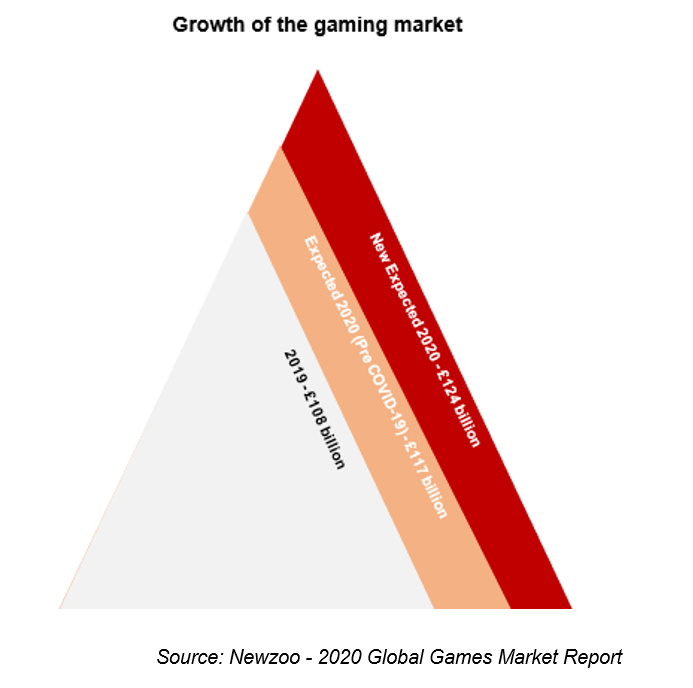
2020 has been an unprecedented and disruptive year, but despite this it has been a year of extraordinary growth. One where total internet searches grew by almost 70 percent, e-commerce by almost 12 percent and online streaming services by 28 percent, the online gaming market has shown exceptional growth with experts at Newzoo estimating that the games market would generate £124 billion in revenue, a 15 percent increase compared to the previous year. This exceeded the original £117 billion estimate.

Chart showing the growth of the gaming market.

In the first and last quarter of the year, platforms like Lichess, Chess.com and Chess24 reported significant spikes in activity leading to multiple server upgrades to cope with this increased demand.

Why is watching Netflix good for chess?

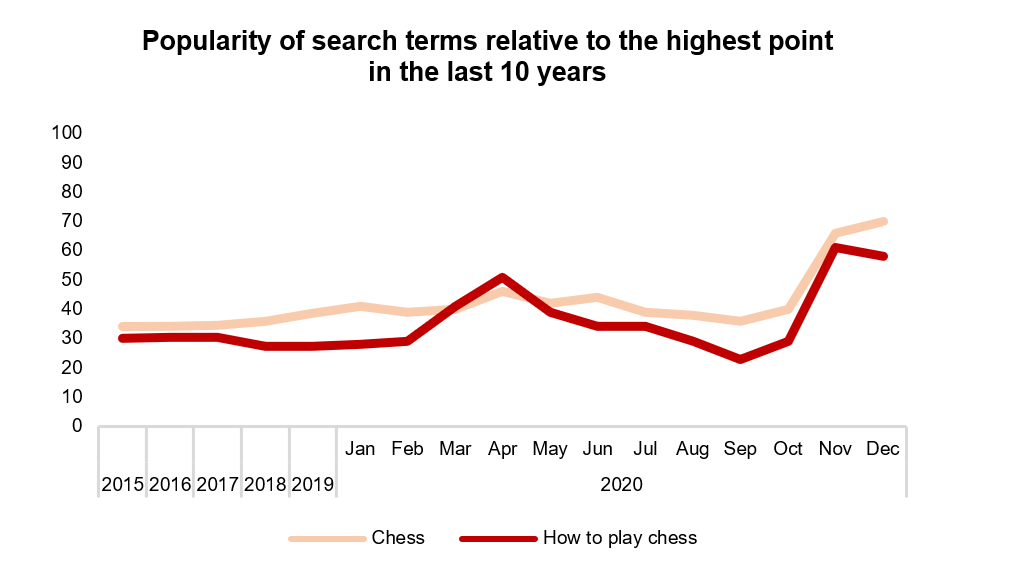
Based on Google Trends search queries for the terms ‘chess’ and ‘How to play chess’ worldwide, there was an increased affinity for the game in March/April and October/November. COVID-19 has fuelled the gaming industry during this period, now that everyone has more time, causing these peaks. A study carried out by Instant Offices found the average commute in London to be 74 minutes a day and 40 minutes elsewhere in the world. This, coupled with the cancellation of numerous shows and sport encouraged extra hours on in-home entertainment.

Chart showing the popularity of Chess search terms.

The second peak in late October was due to the release of Netflix’s record-setting series The Queen’s Gambit. The show, which featured a female protagonist Anya Taylor-Joy playing Beth Harmon, ranked #1 in 63 countries. Magnus Carlsen, the world’s highest-ranked grandmaster, noted that the series “did chess better” than anything Hollywood has made previously, especially since the focus was on Harmon’s talent and not her gender.

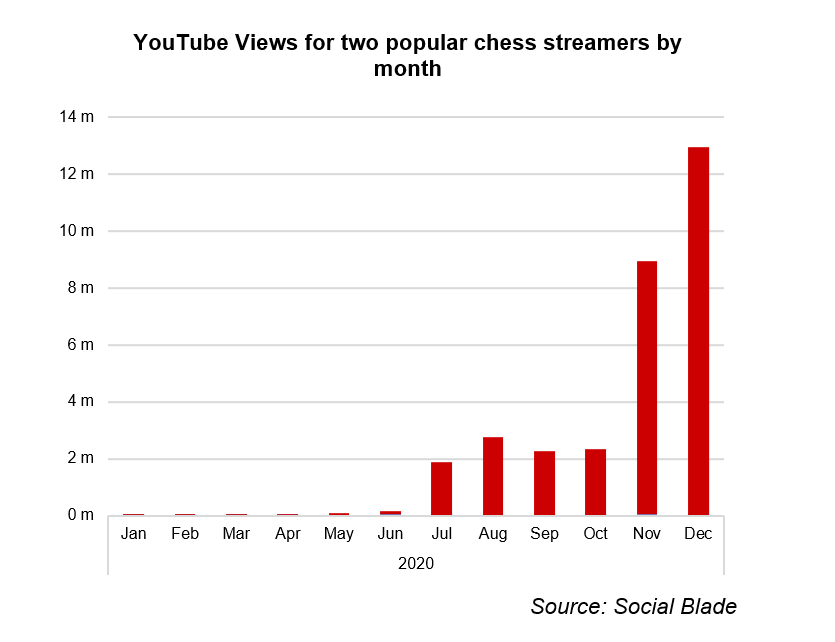
As a result of gaming’s success, e-sports viewing has surged with an estimated revenue of £810 million, which translates to an incredible 16% increase since 2019. Analytical firms such as Social Blade found online chess viewership to have boomed on viewing platforms including Twitch and YouTube. YouTube videos have gained more than 350 million views globally since January 2020 and YouTube gaming reached 100 billion watch time hours.

Chart showing YouTube views for popular chess streamers.

Figures from Social Blade reveal how chess streamers and content creators have peaked this year for the same reasons as the peaks for the search terms’ popularity.

In August, Team SoloMid (TSM) a Los Angeles based e-sports organisation valued at £300 million signed its first professional chess player GM Hikaru Nakamura. This is a milestone for chess since the board game is being adopted by the e-sports industry.

What’s next for chess?

Although 2020 negatively impacted a lot of industries, chess has managed to flourish. In the upcoming years it will be crucial that these platforms manage to retain their new users and continue to grow in order to monetise the gaming community and develop. It will be important for these platforms and content creators to publish engaging content. Inevitably some players will be itching to go back to local clubs so that they can have their ‘battles to the death’ face to face once the world returns to some form of normality.

This blog was contributed by BSc Financial Economics student Sanjiiv Easwarathas and was originally written as an assignment for the module Quantitative Techniques for Applied Economics.

Further Information:

Time to say goodbye: Brexit, employment and the hospitality sector

The UK hospitality sector looks set to be the most affected in terms of economic growth and employment rate after Brexit. BSc Financial Economics student Guglielmo Polizzotto explores where the sector stands now.

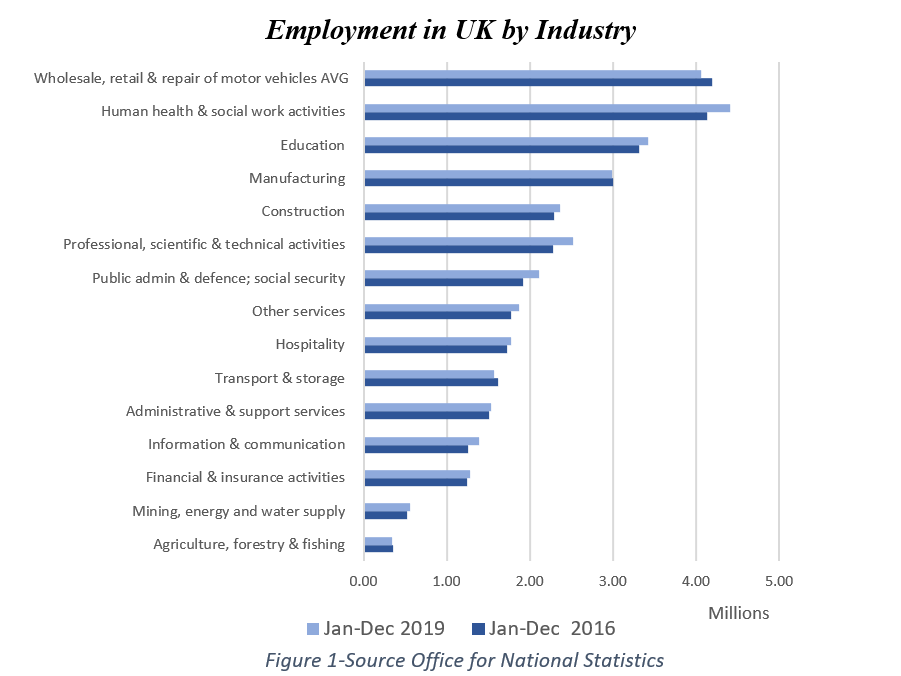
According to the Office for National Statistics (ONS), the number of people in work in the UK is over 30 million, with 5.44% of those in hospitality. Between 2016 and 2019, the number of people in work grew by 3.31%, but in hospitality the proportion of workers shrank by 0.04%. In Figure 1, we can appreciate that the difference between hospitality and other industries has been minimal in terms of numbers of employees. To have a better understanding, a look to the employment vacancies is needed.

Graph showing employment in the UK by industry

A 2017 study by People 1st established that strict government conditions of employment for migrants could be the reason why many restaurants and hotels are struggling to fill their vacancies. The UK government asks for certain prerequisites to grant EU migrants access to employment, such as a pre-existing offer of work from the Home Office and a salary of above £25,600.

An average hospitality worker’s salary stands between £17,000 and £21,000, which makes it difficult for any EU worker who would like to work in the UK. So why could this be an issue for the hospitality industry?

The hospitality sector has the highest vacancy rate compared to other industries in the UK, reaching a peak of four vacancies per 100 people in the past five years. One of the reasons behind these high vacancy rates is that certain positions are considered hard to fill.

Over the last few years, the UK has faced a demographic change, which has seen fewer young people join the labour market and caused a shrink in the pool from which any restaurant or business in the hospitality sector was filling certain positions. Migrants were the solution to this problem; many seasonal or long-term workers are employed to cover those positions which could not be filled by the local workforce.

Graph showing vacancy rate in the UK

EU workers have a great impact on those positions considered hard to fill. Immigrants make up 20% of the hospitality workforce and about 70% of these come from EU countries. In a countrGraph showing percentage of EU employees in the UK hospitality sectory with a population of over 65 million, it feels absurd that a few hundred thousand fewer workers would create such a problem for the UK labour market. In fact, the issue is more localized than it seems.


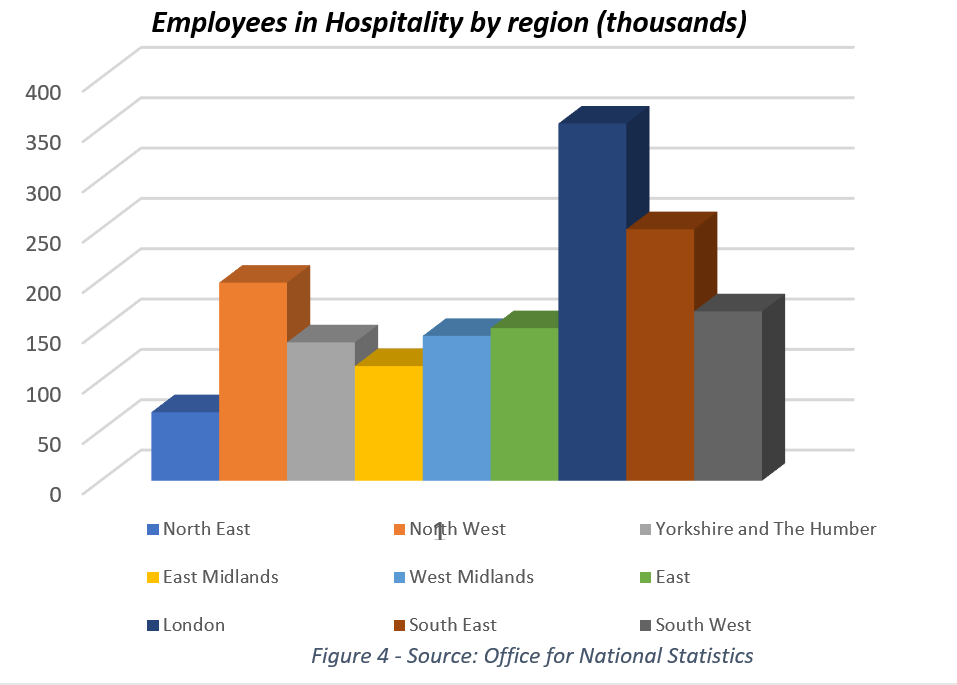
Graph showing UK employees in hospitality by region.London and the East Midlands have the highest number of employees in hospitality and almost half of them come from EU countries. In a situation where the number of vacancies is rising, but the pool from which businesses fill their positions is shrinking, it will become harder to find employees in certain areas of the UK. Businesses (who can afford it) will be forced to increase salaries to make jobs more appetising or share the tasks between fewer people and leave certain positions unfilled, which can cause distress and decrease the quality of the job done.

The time to say goodbye to the EU has come, and while the impact on the workforce looks set to be dramatic, the UK is facing another challenge. With decreasing tourism, and fewer people coming to the UK for work reasons, the labour market is impoverished of its cultural mark that made our beloved country unique.

This blog was originally written as an assignment for the Quantitative Techniques in Applied Economics Module.

Further Information:
The groundbreaking climate action of Sweden’s century-old industry

This blog was contributed by BSc Economics student Linus Kask and was originally written as an assignment for the module Quantitative Techniques for Applied Economics.

In Viking mythology, Thor, the god of lightning, wore iron gloves to manage his famous hammer Mjolnir. Known as the guardian of humankind, Thor used his hammer and gloves to protect the world from giants. Now a new saviour of the world as we know it is lighting up in the land of the Vikings.

For over a thousand years in the northern parts of Sweden, blast furnaces have burnt coal to create iron for steel production. This technique is still standard practice today, thus making the steel industry one of the world’s greatest emitters of carbon dioxide. In a world that lusts for steel to expand economies and an industry sticking to its business-as-usual approach, its emissions are only set to rise. However, a group of businesses from north of the Arctic Circle in Sweden have now formed a vanguard and are looking to turn the industry status quo on its head.

In 2016, the Swedish state-owned mining company LKAB, the state-owned power company Vattenfall and the privately owned steel producer SSAB joined forces to start HYBRIT, Hydrogen Breakthrough Ironmaking Technology, an initiative to create zero-emission steel. In 2026, the first emission-free steel will be on the market and a full-scale operation is expected to be running by 2035. The common goal of all three companies is to be fully carbon neutral by 2045.

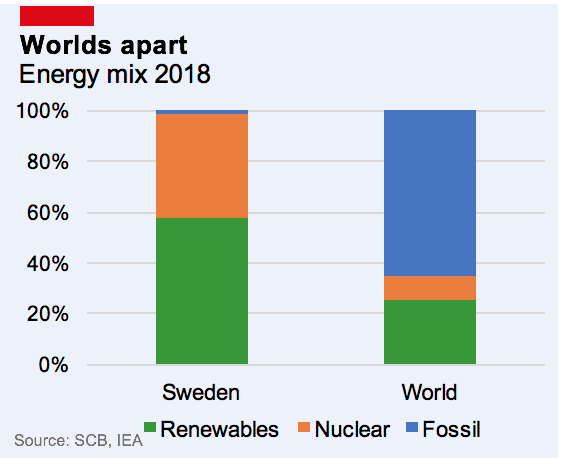
Today, coal is burnt in blast furnaces in order to reduce oxygen from iron ores and extract iron for steel production. HYBRIT aim to replace coal with hydrogen in this process, as when hydrogen reacts with the released oxygen, the only residue product remaining is water instead of carbon dioxide. Hydrogen is the most common element on earth but it is seldom found in its pure form in nature because it is so reactive. This means that it must be extracted from a composition of elements. The most common way is to separate hydrogen from carbon in natural gas, but the residue product then is carbon dioxide. Instead, HYBRIT use water, separating it into oxygen and hydrogen through electrolysis. This is an extremely electricity intense technique and will, when HYBRIT’s technology has reached its full potential, require 10% of Sweden’s current energy consumption. Due to the immense amount of electricity needed in the production of hydrogen, it is paramount that the power is not produced using fossil fuels. This is quite easy to achieve in Sweden, as the country’s energy mix consists of only 1% fossil fuels. In comparison, the rest of the world’s energy mix includes a staggering 65% fossil fuels.

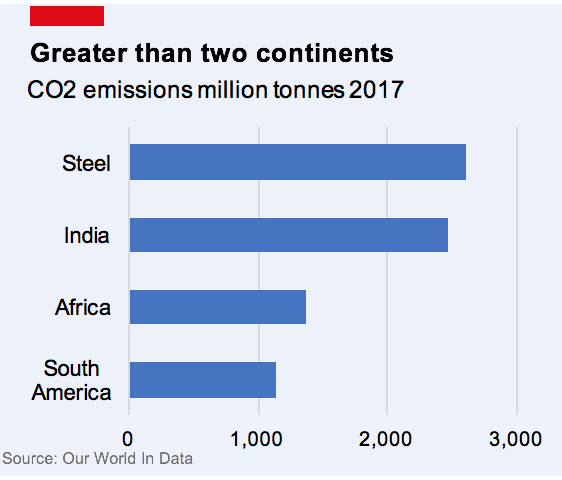
Bar chart showing fossil fuel consumption in Sweden vs the rest of the world.Because of the vast amount of electricity needed to make this groundbreaking shift in the steel industry, the world’s energy mix must contain a greater proportion of renewables. This huge infrastructure investment will be justified by the fact that the steel industry is accountable for 7% of the world’s emissions, releasing more carbon dioxide than India alone, or Africa and South America combined. The development of the technology is not a small investment either, estimated to cost 15 billion Swedish kronas, 1.8 billon US dollars, per annum for the next 20 years. This expenditure is validated because HYBRIT will play a crucial role in reaching the goals set in the Paris Agreement for the whole world. In Sweden, HYBRIT’s new technology will be fundamental in achieving the country’s commitment to net-zero emissions by 2045. The steel industry in Sweden today accounts for 10% of its emissions.

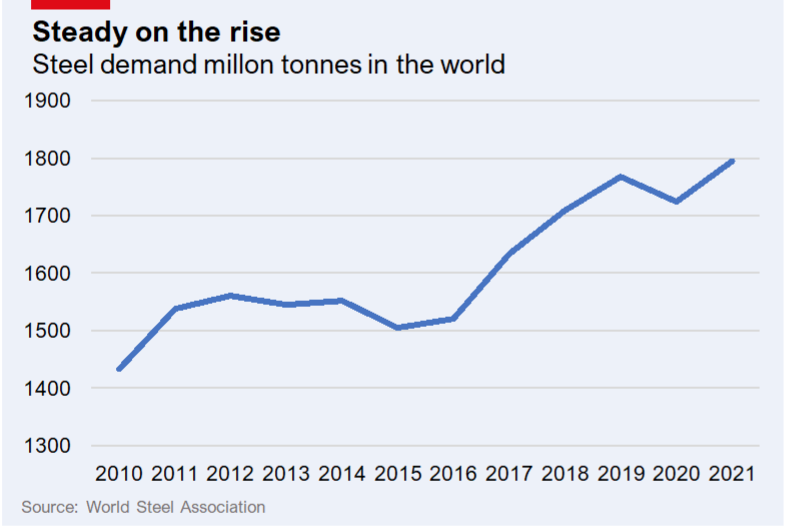
Graph showing the CO2 emissions of the steel industry.Booting the coal in steel production has its economic advantages as well. Carbon prices are set to rise, and McKinsey & Company, a consultancy, estimate that unless they reduce their carbon emissions, steel companies will risk 14% of their value as a result of this increase. With steel demand on a steady rise driven by increasing urbanisation and world population, the industry has a lot to gain by switching to hydrogen.

Line graph showing rising global steel demand.Time is of the essence. If the steel industry does not find an alternative route to production without coal, it could account for 25% of carbon emissions by 2050, thus crushing any possibility of keeping the global temperature within the goal of 1.5 ˚C above pre-industrial levels.

For the first time since the Viking ages, Thor’s iron gloves could be made using sustainable production. HYBRIT’s technology is the best promise available for emission-free steel and if they succeed, a supreme shift has occurred in this ancient practice. North of the Arctic Circle in Sweden, a status quo is about to be turned on its head.

Further Information: