Author Archives: B Merritt

Trump and Brexit: why it’s again NOT the economy, stupid

This post was written by Professor Eric Kaufmann from Birkbeck’s Department of Politics. It was originally published on the LSE British Politics and Policy blog

As the final votes are counted, pundits and pollsters sit stunned as Donald J. Trump gets set to enter the White House. For anyone in Britain, there is a sharp tang of déjà vu in the air: this feels like the morning after the Brexit vote all over again. Eric Kaufmann explains that, as with Brexit, there’s little evidence that the vote had much to do with personal economic circumstances.

For months, commentators have flocked to diagnose the ills that have supposedly propelled Trump’s support, from the Republican primaries until now. As in Britain, many have settled on a ‘left behind’ narrative – that it is the poor, white, working-class losers from globalization that have put Trump over the top. Only a few clairvoyants – Michael Lind, Jonathan Haidt – have seen through the stereotypes.

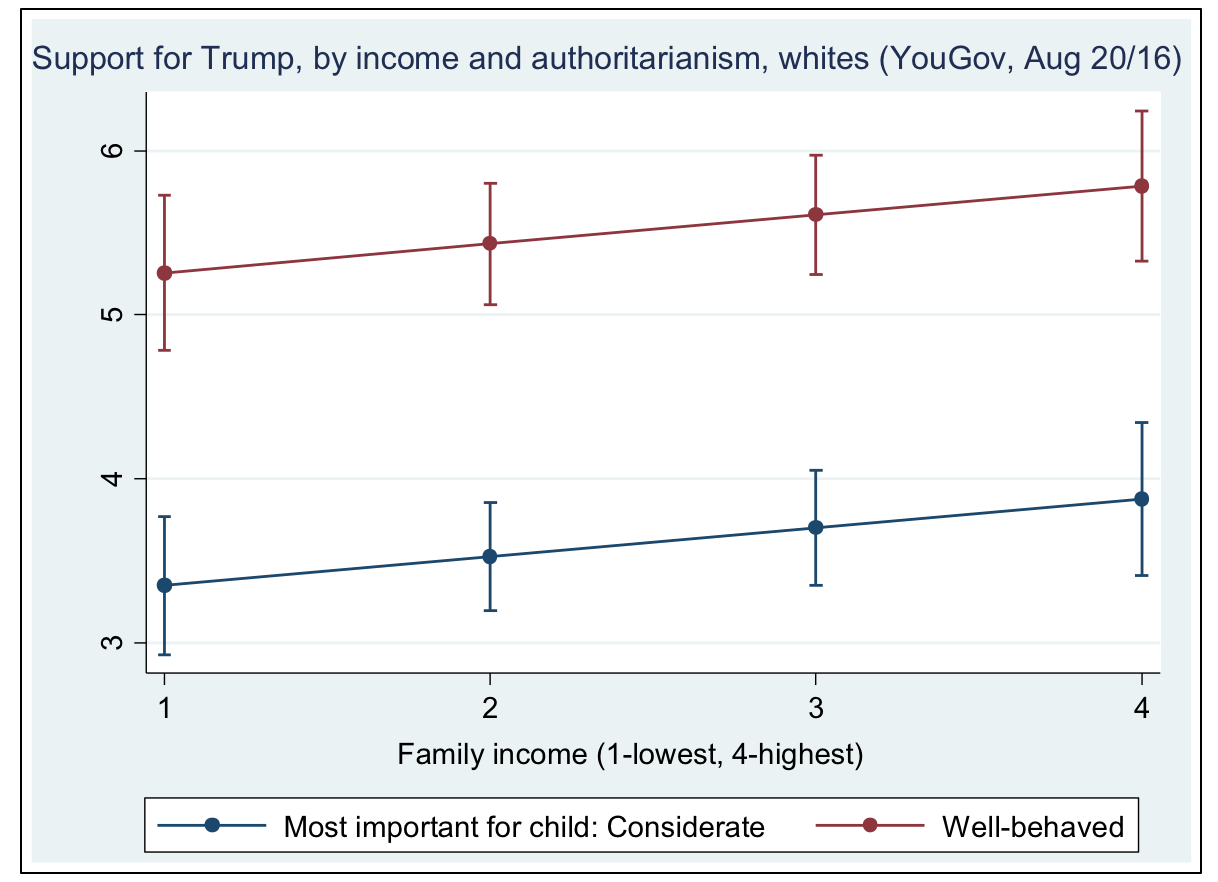
But, as in Britain, there’s precious little evidence this vote had much to do with personal economic circumstances. Let’s look at Trump voting among white Americans from a Birkbeck College/Policy Exchange/YouGov survey I commissioned in late August. Look at the horizontal axis running along the bottom of figure 1. In the graph I have controlled for age, education and gender, with errors clustered on states. The average white American support for Trump on a 0-10 scale in the survey is 4.29.

You can see the two Trump support lines are higher among those at the highest end of the income scale (4) than the lowest (1). This is not, however, statistically significant. What is significant is the gap between the red and blue lines. A full two points in Trump support around a mean of 4.29. This huge spread reflects the difference between two groups of people giving different answers to a highly innocuous question: ‘Is it more important for a child to be considerate or well-mannered?’ The answers sound almost identical, but social psychologists know that ‘considerate’ taps other-directed emotions while ‘well-mannered’ is about respect for authority.

People’s answer to this question matters for Trump support because it taps into a cultural worldview sometimes known as Right-Wing Authoritarianism (RWA). Rather than RWA, which is a loaded term, I would prefer to characterise this as the difference between those who prefer order and those who seek novelty. Social psychologist Karen Stenner presciently wrote that diversity and difference tends to alarm right-wing authoritarians, who seek order and stability. This, and not class, is what cuts the electoral pie in many western countries these days. Income and material circumstances, as a recent review of research on immigration attitudes suggests, is not especially important for understanding right-wing populism.

Figure 1.
1

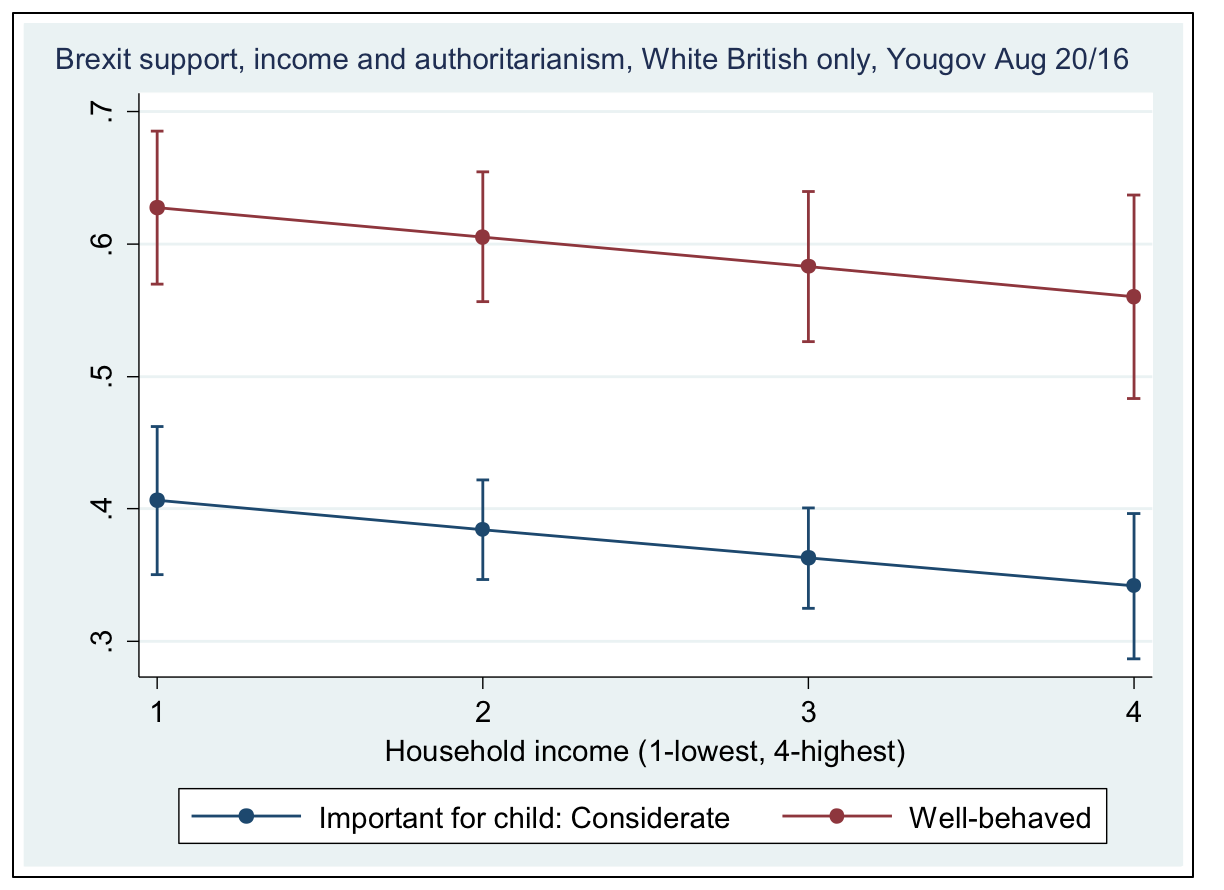
Now look at the same graph in figure 2 with exactly the same questions and controls, fielded on the same day, in Britain. The only difference is that we are substituting people’s reported Brexit vote for Trump support. This time the income slope runs the other way, with poorer White British respondents more likely to be Brexiteers than the wealthy. But income is, once again, not statistically significant. What counts is the same chasm between people who answered that it was important for children to be well-mannered or considerate. In the case of Brexit vote among White Britons, this represents a 25-point difference around a mean of 45.8 per cent (the survey undersamples Brexiteers but this does not affect this kind of analysis). When it comes to Brexit or Trump, think successful plumber, not starving artist or temporary lecturer.

Figure 2.
2

Some might say that even though these populist voters aren’t poor, they really, actually, surely, naturally, are concerned about their economic welfare. Well, let’s take a look at the top concerns of Trump voters in figure 3. I’ve plotted the issues where there are the biggest differences between Trump supporters and detractors on the left-hand side. We can start with inequality. Is this REALLY the driving force behind the Trump vote – all that talk about unemployment, opioid addiction and suicide? Hardly. Nearly 40 per cent of those who gave Trump 0 out of 10 (blue bar) said inequality was the #1 issue facing America. Among folks rating the Donald 10 out of 10, only 4 per cent agreed. That’s a tenfold difference. Now look at immigration: top issue for 25 per cent of white Trump backers but hardly even registering among Trump detractors. Compared to immigration, even the gap between those concerned about terrorism, around 2:1, is not very striking.

Figure 3.
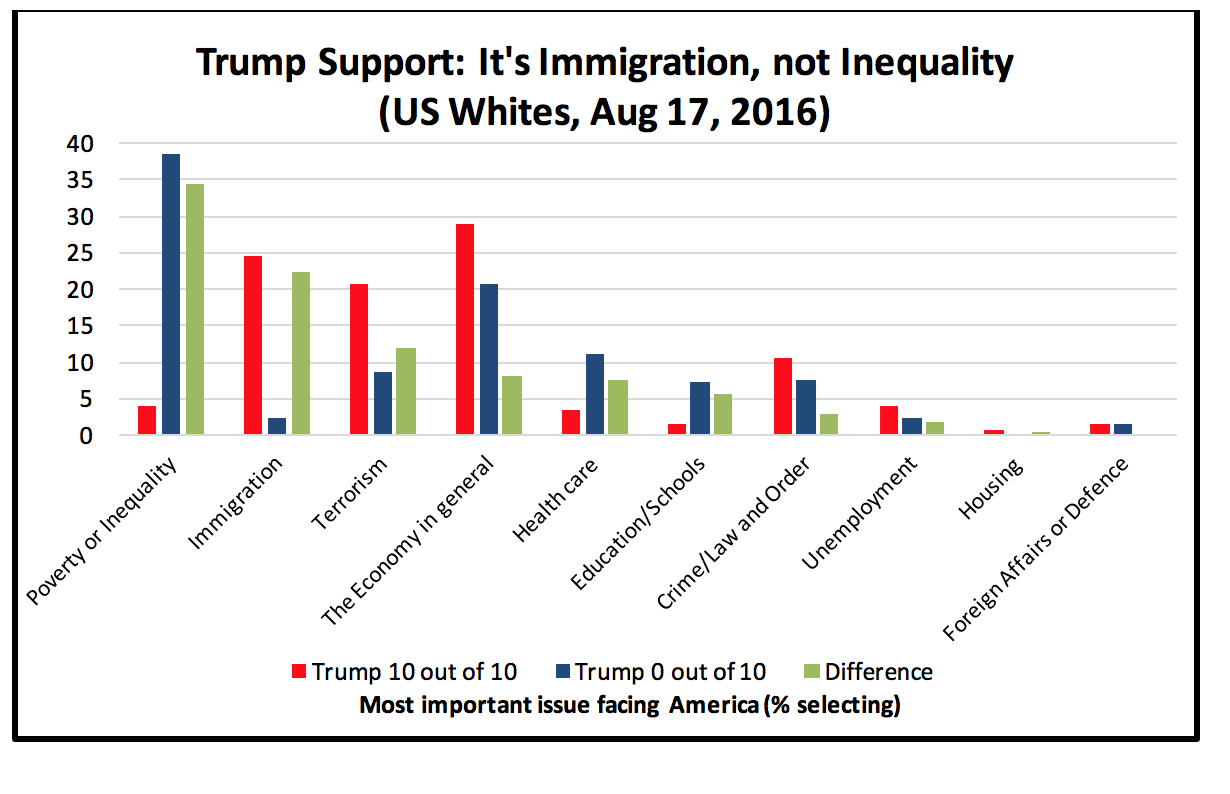
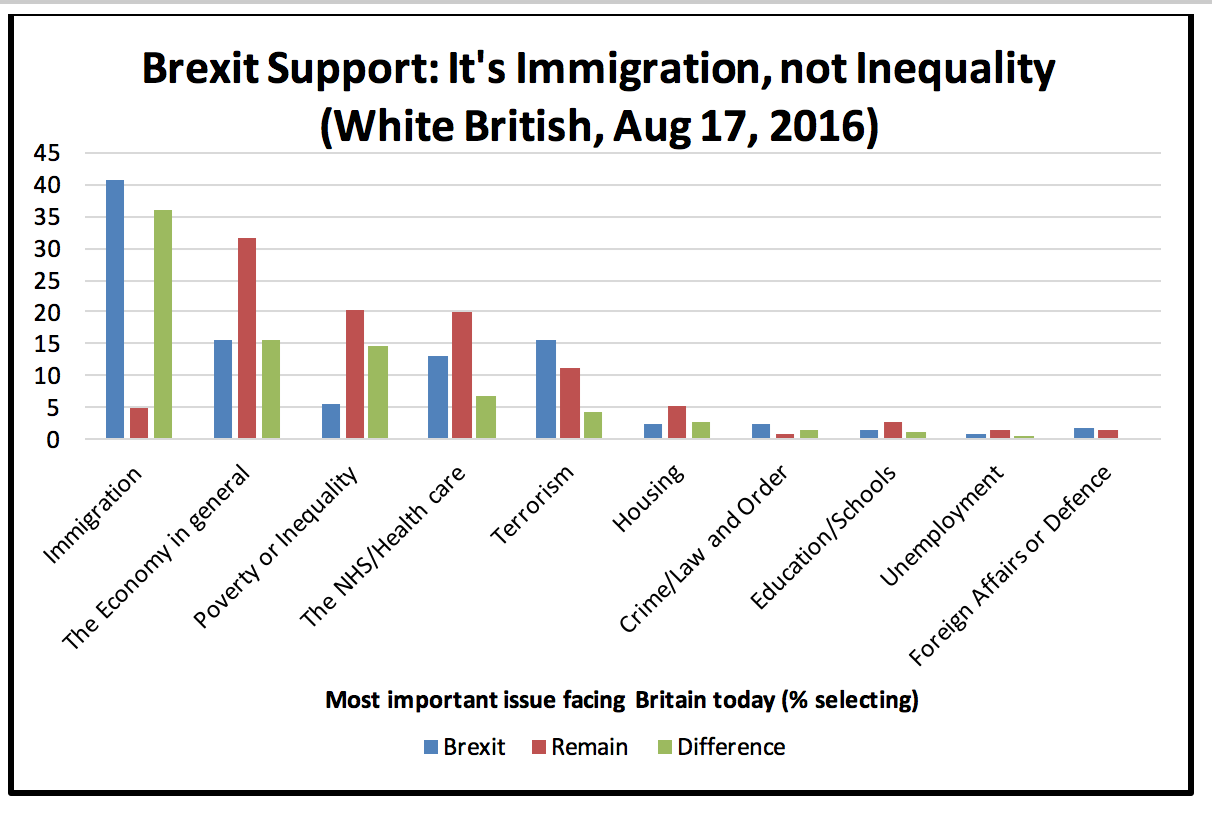
3For Brexit vote, shown in figure 4, the story is much the same, with a few wrinkles. The gap on immigration and inequality is enormous. The one difference is on ‘the economy in general,’ which Trump supporters worry about more than Brexiteers. This could be because in the graph above I am comparing extreme Trump backers with extreme detractors whereas the Brexit-Bremain numbers include all voters. Still, what jumps out is how much more important immigration is for populist voters than inequality.

Figure 4.
4Why is Trump, Brexit, Höfer, Le Pen and Wilders happening now? Immigration and ethnic change. This is unsettling that portion of the white electorate that prefers cultural order over change.

The US was about 90 percent white in 1960, is 63 percent white today and over half of American babies are now from ethnic minorities. Most white Americans already think they are in the minority, and many are beginning to vote in a more ethnopolitical way. The last time the share of foreign born in America reached current levels, immigration restrictionist sentiment was off the charts and the Ku Klux Klan had 6 million members – mainly in northern states concerned about Catholic immigration.

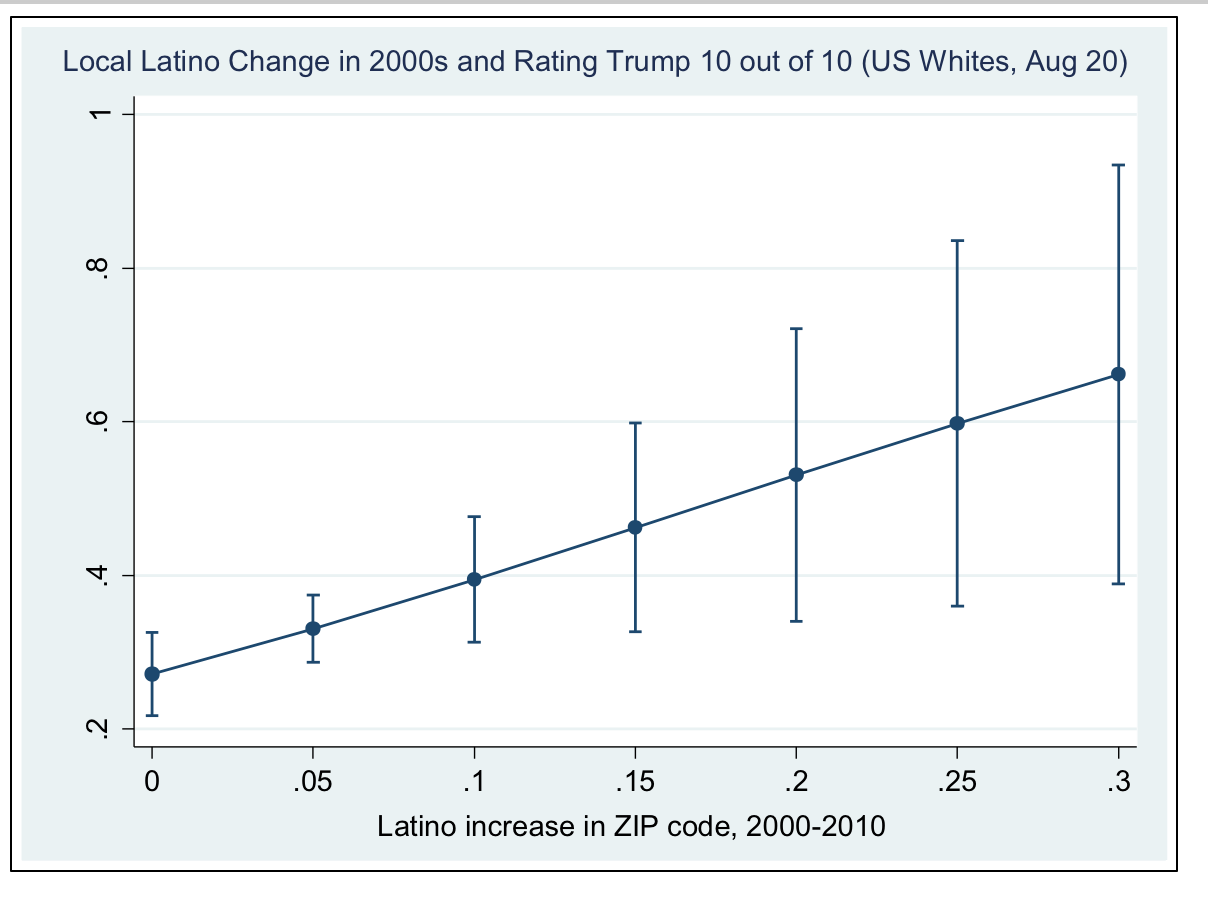
Ethnic change can happen nationally or locally, and it matters in both Britain and America. Figure 5, which includes a series of demographic and area controls, looks at the rate of Latino increase in a white American survey respondent’s ZIP code (average population around 30,000 in this data). The share of white Americans rating Trump 10 out of 10 rises from just over 25 percent in locales with no ethnic change to almost 70 percent in places with a 30-point increase in Latino population.

The town of Arcadia in Wisconsin – fittingly a state that has flipped to Trump – profiled in a recent Wall Street Journal article, shows what can happen. Thomas Vicino has chronicled the phenomenon in other towns, such as Farmer’s Branch, Texas or Carpentersville, Illinois. There are very few ZIP codes that have seen change on this scale, hence the small sample and wide error bars toward the right. Still, this confirms what virtually all the academic research shows: rapid ethnic change leads to an increase in anti-immigration sentiment and populism, even if this subsequently fades. The news also spreads and can shape the wider climate of public opinion, even in places untouched by immigration.

Figure 5.
5Now let’s look in figure 6 at Brexit, and how White British voters in wards with fast East European growth in the 2000s voted. With similar controls, it’s the same story: when we control for the level of minorities in a ward, local ethnic change is linked with a much higher rate of Brexit voting. From under 40 percent in places with no ethnic change to over 60 percent voting Brexit in the fastest changing areas. Think Boston in Lincolnshire, which had the strongest Brexit vote in the country and where the share of East Europeans jumped from essentially zero in 2001 to the highest in the country by 2011.

Figure 6.

6

The Trump and Brexit votes are the opening shots which define a new political era in which the values divide between voters – especially among whites – is the main axis of politics. In a period of rapid ethnic change, this cleavage separates those who prefer cultural continuity and order from novelty-seekers open to diversity. Policymakers and pundits should face this instead of imagining that old remedies – schools, hospitals, jobs – will put the populist genie back in the bottle.

From ‘Go back to China’ to ‘Where are you really from?’: Nationality and ethnicity talk in everyday interactions

This article was contributed by Professor Zhu Hua of Birkbeck’s Department of Applied Linguistics and Communication

perpetual-foreigner-syndromeIn his open letter published in the New York Times on 9 October, Michael Luo, who was born and grew up in the US, told of his encounter with a woman who yelled at him and his family, ‘Go back to China!’, on the Upper East Side of Manhattan when they came out of a church service.  Puzzled by the event, his 7-year-old daughter asked ‘Why did she say, ‘Go back to China?’ We’re not from China.’

What Michael Luo experienced is ‘perpetual foreigner syndrome’, a problem facing many transnational individuals in everyday interactions, especially those who may look or sound different from the local majority.  Back in 2002, Frank Wu, the first Asian American law professor at Howard University Law School, wrote specifically on how perpetual foreigner syndrome is instantiated through recurrent and seemingly innocent questions (which, admittedly, are much milder than what was hurled at Michael Luo):

Where are you from?’ is a question I like answering. ‘Where are you really from?’ is a question I really hate answering… For Asian Americans, the questions frequently come paired like that…. More than anything else that unites us, everyone with an Asian face who lives in America is afflicted by the perpetual foreigner syndrome. We are figuratively and even literally returned to Asia and ejected from America. (Wu 2002)

His point about what these questions can do strikes a chord with me. Having lived and worked in China and Britain and travelled to many parts of the world, I find questions like ‘where you are from?’ really difficult to answer. I never seem get it right and always end it up with the feeling that the self I present in my attempted answers is not real – it is fragmented some times, and rehearsed at others.  If I say that I am from London, I know that the next question will be ‘where are you really from’. I have to look apologetic and confess that I ‘originally’ came from China more than 20 years ago and have lived in Britain longer than I had been in China.  If I take the short-cut and tell people that I am from China, the next comment I am likely to hear is a compliment ‘but your English is so good!’.  For a long time, I thought that this is just me, an applied linguist who is over-interpreting language use in everyday interactions, until I read Rosina Lippi-Green’s work on language, ideology and discrimination (1997/2012) and began to make connections with my observations on these instances of discourse in daily encounters and the existing studies including one of the strands of my work on Interculturality.

I refer to this kind of discourse that evokes or orients to one’s ethnicity or nationality either explicitly or implicitly as Nationality and Ethnicity Talk (NET). It includes questions or comments which, frequently occurring in small talk, aim to establish, ascribe, challenge, deny or resist one’s ethnicity or nationality.  The questions and comments range from direct ones (e.g. ‘Where are your people coming from?’, ‘When are you going back?’, ‘Is it as hot as this where you are from?’, ‘What is it like back home?’ to more subtle ones (e.g. ‘Your English is so good!’). There is nothing inherently wrong with questions like ‘where are you from’. The question can be genuine – people would like to find out more about China, Japan or Korea or any other culture or they are simply interested in you as a person.  But problems occur when those who are asking such questions appear to look for a certain answer and appear confused or disappointed when hearing an unexpected answer and those on the receiving end of such questions might have been asked the same questions 101 times.  And of course, in Michael Luo’s case, it made him and his daughter feel like ‘foreigners’ in their own country

Despite growing acceptance of racial equality in post-industrialised societies, NET of the above kind reflects people’s hidden and flawed folk theories of race, reproduces and reifies cultural essentialism, and can result in exclusion and marginalisation of certain social groups.  Jane Hill (2008) coined the concept of ‘folk theory of race’ to describe everyday assumptions that people have about race and ethnicity. Because the folk models or theories are often taken for granted, people tend to use them to ‘interpret the world without a second thought’. Folk theory of race can be in operation subtly and, on some occasions, it is almost invisible to those who apply it and/or those at the receiving end of it. Markus & Moya (2010) have unpicked the powerful, hidden, and flawed assumptions about the nature and meanings of race and ethnicity beneath the eight common conversations about race amongst American people. These include: ‘We’re beyond race.’ ‘Racial diversity is killing us.’ ‘Everyone’s a little bit racist.’ ‘That’s just identity politics.’ ‘Variety is the spice of life.’ ‘It’s a Black thing—you wouldn’t understand.’ ‘I’m___ and I’m proud.’ and ‘Race is in our DNA’.  They argue that ‘these eight conversations give us the illusion of understanding, but they are narrowly based on limited, flawed, and of course, unstated assumptions … Also like stereotypes, these conversations are pervasive, they are difficult to change and they have powerful consequences for our actions.’

In my recently published article co-authored with Li Wei, we examine the significance of questions such as ‘where are you really from?’ in everyday conversational interactions. We discuss what constitutes NET, how it works through symbolic and indexical cues and strategic emphasis, and why it matters in the wider context of identity, race, intercultural contact and power relations. The discussion draws on social media data including youtube videos and a blog with the title of ‘It may not be racist, but it’s a question I’m tired of hearing’ by Ariane Sherine in the Guardian’s opinion column, Comment is Free. We argue that the question ‘where are you really from’ itself does not per se contest immigrants’ entitlement. However, what makes a difference to the perception of whether one is an ‘outsider’ as Michael Luo did – is the tangled history, memory and expectation imbued and fuelled by power inequality.

There have been reports of the increase in the number of racial insults at people who look and sound different since the EU Referendum. It is important that we pay closer attention to linguistic xenophobic, but it is equally important to be mindful of the significance of the more subtle ways of Othering as exemplified in NET.

Further reading:

  • Hill, Jane H. 2008. The everyday language of white racism. Malden, MA: Wiley-Blackwell.
  • Lippi-Green, Rosina. 1997/2012. English with an Accent. Language, Ideology, and Discrimination in the United States. London: Routledge.
  • Markus, Rose & Paula Moya (eds.). 2010. Doing Race: 21 Essays for the 21st Century. New York: W.W. Norton & Company.
  • Wu, Frank. H. 2002.  Where are you really from? Asian Americans and the Perpetual Foreigner Syndrome.  Civil Rights Journal  Winter 2002. 16-22.
  • Zhu Hua and Li Wei (2016) “Where are you really from?”: Nationality and Ethnicity Talk (NET) in everyday interactions. In Zhu Hua & Claire Kramsch (eds.), Symbolic power and conversational inequality in intercultural communication, a special issue of Applied Linguistics Review 7(4), 449-470.  The article can be accessed here.

Soldiers aren’t being harangued by lawyers – it’s a myth designed to discredit the Human Rights Act

This article was written by Dr Frederick Cowell from Birkbeck’s School of Law. It was originally published on Left Foot Foward

Theresa May’s government is pushing a narrow, meaningless conception of human rights

theresa-may-3

There has been some controversy over the government’s plans to use the emergency powers provisions of the European Convention on Human Rights (ECHR) to exempt British forces from lawsuits.

Despite the bullish selling of the proposals it is worth noting they can’t exempt soldiers from being responsible for torture or allow them to use the death penalty. In these cases the Human Rights Act (HRA) could still be used to bring claims against British forces and they could still be subject to war crimes prosecutions under the International Criminal Court Act.

But it’s the tone of this announcement and the context in which it takes place which makes it worrying for the protection of human rights.

As Dr Marko Milanovic notes, there is little evidence of an ‘industry’ of ‘vexatious litigation’ against the armed forces, which is the stated rational for these proposals.

Yet, it seemed to provide the warm up to the Prime Minister’s speech at the Conservative Party conference where she promised to never again ‘allow left-wing human rights lawyers to harangue… our armed forces.’

Theresa May has been here before; in 2011 when she was Home Sectary she addressed the Conservative Party Conference claiming that there was an illegal migrant ‘who cannot be deported because, and I am not making this up, he had a pet cat.’

Except, she was making it up. Taken alongside the wider drip feed of negative stories about the HRA, many of which are based on misrepresentations of the law, this appears to be part of a process of ‘monstering’ the HRA, designed to create the political conditions for its repeal.

The repeal of the HRA and its replacement with a ‘British Bill of Rights’ has been Conservative Party Policy since 2006. In 2007 the then Leader of the Opposition David Cameron said that a British Bill of Rights could enhance the protection of rights by including rights not included in the ECHR, such as the right to a trial by jury.

Later this was quietly dropped with the emphasis on HRA repeal focusing on criminals using the right to family life to avoid deportation. In 2012 the Commission on a UK Bill of Rights concluded that the HRA shouldn’t be repealed but noted there were ‘perceived problems with the Human Rights Act… largely caused by a lack of public education’.

Ironically the escalation of anti-HRA rhetoric came precisely at the time when the UK Government achieved a major victory on reforming the European Court of Human Rights, with the 2012 Brighton Declaration, which led to a reduction in its backlog of cases. In 2014 the government were able to change immigration rules to make it much harder for criminals to use the right to a family life to resist deportation, again addressing a criticism often levelled at the HRA.

There is a split in the Conservative party between those who think a Bill of Rights should be framed narrowly, to amend the HRA, and those who think it should lead to UK withdraw from the ECHR, in a form of second Brexit. The current Justice Secretary has confirmed that it is still government policy to introduce a British Bill of Rights, although since winning the 2015 General Election this has been subject to a series of delays.

In her Conservative Party leadership campaign in July Theresa May stated that she would not campaign to leave the ECHR as there was no parliamentary majority for such a move. This leaves the door open to withdraw the ECHR at a later date which is considerably easier to do following withdrawal from the EU.

The contents of a British Bill of Rights is as of yet unknown however, the tone of announcements seem to indicate a strong focus on who shouldn’t have rights and where rights shouldn’t be applied.

The 2014 Conservative Party paper ‘Protecting Human Rights in the UK’ contain some indications, such as references to preventing human rights being used in ‘trivial’ cases, that there are moves to distinguish between undeserving and deserving rights holders in a future Bill of Rights.

Repeated criticism by many leading figures in the government of the HRA being used to challenge welfare policy or immigration decisions has been framed in language pointing to an undeserving rights holder. This is also accompanied by claims that certain groups needing to be protected from human rights law, or where human rights law is used by those charged or convicted of a crime that human rights law needs to focus on the victims of crime.

When the recent announcement on the liability of the armed forces is seen in this context, it reads like a trailer to a much narrower, and potentially more meaningless, conception of human rights being pushed by the current government.

Bad Habits? France’s ‘Burkini ban’ in Historical Perspective

This article was written by Dr Carmen Mangion from Birkbeck’s Department of  History, Classics and Archaeology. The article was originally published on the History Workshop Online‘s blog.

The ‘burkini ban’ issued by 30 French beach towns at the end of July 2016 sparked a media frenzy. Town mayors saw the burkini, the full-body swimsuit favoured by some Muslim women as a means of maintaining modesty while enjoying the sea, as a symbol of Islamic extremism and a threat to ‘good morals and secularism’. France’s 1905 constitution separates Church and State, and embraces a laïcité (a secularism in public affairs which prohibits religious expression) meant to limit religion’s influence on its citizens though still allowing freedom of religion. It originated as a means of eliminating the influence of the Catholic Church.Following ministerial criticism, France’s top administrative court investigated the ‘burkini ban’, ruling in late August that it violated basic freedoms.

Nuns at the beach
Nuns at the beach (Facebook/Izzeddin Elzir)

Amidst this furore, Italian Imam Izzedin Elzir’s image of nuns on the beach in their religious habits triggered an international media response. The image, appearing across social media and in outlets as prominent as the New York Times, implied the hypocrisy of a ban targeting Muslims and ignoring Christians. The photos were ironic on two counts:

First, some French mayors were emphatic that nuns in habits were also forbidden on beaches.

Second, and more apposite to this blog post, both the media and ‘ordinary’ citizens seem to be unaware that the ‘nun’ on the streets of Paris (and elsewhere) once sparked a similar outrage.

The historical context was of course different (it always is), but the indignation and the drive to control women’s appearance was just as virulent. Such outrage was not limited to France, but as the ‘burkini ban’ was initiated by the French, it seems appropriate to begin with this bit of French history.

The French revolution of the 1790s, with its cry of liberté, égalité, fraternité was not such a good thing for Catholic nuns. The nun, in her religious habit, became a symbol of the Catholic Church’s role in upholding the inequities and injustices of the ruling classes within France. Catholic nuns, then fully habited, were visible on the streets of Paris as educators, nurses and providers of social welfare, and became targets of anti-clerical outrage. The republican political regime set French nuns ‘free’ from their lifelong vows of poverty, chastity, obedience and their religious habit. It closed convents and confiscated their property. Some members of religious communities weren’t so willing to be set free, however, and were imprisoned. They were told to remove their religious habits (made illegal in 1792) and instead wear secular garb. Nuns including the Carmelites of Compiègne and the Daughters of Charity of Arras were executed for refusing to take the oath of loyalty to the Constitution.

French citizens also made their umbrage against nuns known. One 1791 print representing revolutionary anticlericalism, La Discipline patriotique or le fanatisme corrige (‘The patriotic discipline or fanaticism corrected’), showed the market women of Paris’s les Halles disrobing and thrashing the religious fanaticism out of a group of nuns. Such disciplining of women’s bodies was both salicious and violent.

la_discipline_patriotique_ou_le_-_btv1b69446090

The patriotic discipline or Fanaticism corrected (La Discipline patriotique ou le fanatisme corrigée) (Image: BnF/Gallica)

This urge to control the religious ‘fanaticism’ of women and monitor their clothing choices was not only a French issue; it had earlier incarnations. The dissolution of the monasteries in England in the mid-sixteenth century also ‘freed’ nuns and monks from their vows — and their property. English women’s response to this was to form English convents in exile, many in France and Belgium. In the 1790s English nuns fled, often surreptitiously, back to England. But penal laws restricting Catholic practices were still in effect and English bishops initially discouraged nuns from wearing their religious habit. English citizens too showed their indignation for female religious life by throwing epithets and stones at nuns; the Salford house of the Daughters of Charity of St Vincent de Paul was set alight in 1847. Similar events happened in the United States. Most notoriously the Ursuline convent in Charleston, South Carolina was burned down in the 1830s by anti-nun rioters. In the Netherlands, in Spain, in Belgium, in Germany and more recently in Eastern and Central Europe, nuns were also targeted. Women in religious clothing were (and are) easy targets of vitriol and violence.

So burkinied Muslim women and habited Catholic nuns have far more in common than one might think. The nun’s religious habit, like the burkini, has links to religious identity as counter to cultural norms. Critics say that women in burkinis challenge the French secular way of life. History shows that the habited nun also challenged both a republican version of Frenchness and also an English version of Englishness.

Within this context, the burkini furore illustrates two points.

First, it is yet another disappointing reminder that women’s bodies and appearances remain far too often more relevant (and newsworthy) than women’s intellects and voices. Clothing regulations are an excuse to control women and to divert attention from more substantive issues. They are a means of enforcing a societal version of femininity that doesn’t allow for difference. Women choosing to wear religious dress (or dress associated with religious affiliation) should not be stigmatised.

Second, by focusing on the burkini, we forget the more salient issue of figuring out how diverse people can live together peacefully. It is the social, economic and political factors that need attention: cultural inclusion, high unemployment and participation in civic life. Criminalising what women wear on the beach doesn’t even come close to addressing these issues.

Further Reading:

  • Carmen Mangion, ‘Avoiding “rash and Imprudent measures”: English Nuns in Revolutionary Paris, 1789-1801’ in Communities, Culture and Identity: The English Convents in Exile, 1600-1800 edited by Caroline Bowden and James E. Kelly (Ashgate, 2013), pp. 247-63.
  • Gemma Betros, ‘Liberty, Citizenship and the Suppression of Female Religious Communities in France, 1789-90’, Women’s History Review, 18 (2009), 311–36
  • For a robust comparison of nineteenth-century American nativism to the politics of Islam see José Casanova, ‘The Politics of Nativism Islam in Europe, Catholicism in the United States’, Philosophy & Social Criticism, 38 (2012), 485–95. A short and accessible version of this essay can be found here.

Creating ‘Shake, Rattle and Roll’ with a team of neuroscientists

Theatre Director Sarah Argent finds out why babies giggle and dance, and that she has more in common with the neuroscientists at Birkbeck’s Babylab than she first thoughthome

As someone who dropped all science subjects aged 14 to focus on the arts, I approached the invitation from Pete Glanville (Polka’s Artistic Director) to develop a theatre piece for babies inspired by the work of neuroscientists with a mixture of trepidation and delight (I always like to challenge myself!)

“We all shared a passion for improving the lives of babies but from very different perspectives”

Having identified the Babylab at Birkbeck as one of the most likely places with which to liaise, we were thrilled at the excitement and generosity with which they welcomed our proposal. We met with Mark Johnson, the Director of the BabyLab, and a number of his colleagues who outlined the fascinating work of the lab and we were thrilled to realise that we all shared a passion for improving the lives of babies but from very different perspectives. Having talked about our respective interest in and engagement with babies and how we might work together, Pete and I were taken down to the labs themselves where we were fascinated to see tiny bonnets of electrodes that can ascertain exactly how a baby’s brain is being stimulated; to hear more about the eye-tracking machines that can monitor exactly where a baby is looking; and to see various familiar toys etc that are used in experiments about object permanence and time intervals, etc.

Having agreed with the Babylab that we did, indeed, wish to work together, they arranged for Jo Belloli (Polka’s Associate Producer, Early Years) and me to meet with a range of scientists – undergraduates, PhDs and members of staff – to hear more about their individual and joint areas of research in order to identify which I could most readily see as being the inspiration for the creation of a piece of theatre for babies aged 6-18 months and their parents and carers. Everyone with whom we met did a wonderful job of describing their work in laymen’s terms (neither Jo nor I being a scientist) – although we did still have to ask a few very basic questions! After much discussion and deliberation, we chose three scientists with whom to work: Sinead Rocha, Rosy Edey, and Caspar Addyman (who cut his teeth at Birkbeck and, while there, developed the Baby Laughter project but is now on the teaching staff at the Infant Lab at Goldsmiths).

“You could see the brains of the creative team firing off at the mention of babies’ responses to sound or lights”

We then invited the scientists to visit Polka, to see the Adventure Theatre in which the production will be performed, to meet with Polka staff, and for them to find out more about us and for us to find out more about them. At a wonderfully-attended meeting (Polka staff were so intrigued about and excited by hearing more of the work of the scientists), Caspar, Rosy and Sinead outlined their research areas in more detail. Without the need for bonnets of electrodes, you could see the brains of the creative team firing off at the mention of babies’ responses to sound or lights or what makes them laugh. It was also hugely gratifying to realise that so many of the words and terms we use to describe our creative processes were also used by the scientists – maybe we have even more in common than we thought!

We then spent three wonderfully full and creative days in the Adventure Theatre playing with lights and movement and objects – a mixture of inanimate objects and actor, Maisie!

“The level of scientific clarity took things to a deeper level”

On the second day, we invited a number of babies and their mums to join us to observe how they would respond to our initial ideas. As we suspected, Maisie has a natural affinity with babies with a number of them being mesmerised by her from the moment they first clapped eyes on her. What was so exciting about this project was that, while as makers of baby theatre we are well-versed in close and detailed observation of babies while they are observing rehearsals or performances, the level of scientific clarity with which our scientists could describe the babies’ responses and analyse why the babies’ were responding in a particular way at their particular age took things to a deeper level.

While we’re not asking Maisie to play the character of a baby, we are keen for her movements to mirror or resemble those of a baby – to share some of the characteristics – and so, again, to have the scientists detailing babies’ reasons for moving e.g. the way in which they ‘unlearn’ some of the lessons they’ve learned while crawling or shuffling on their bottoms once they begin toddling on two feet, has played a fascinating role in helping us to develop the movement vocabulary of the piece.

“A wonderful example of science influencing art influencing science”

I have to be honest, the music that Sinead uses in the BabyLab as part of her exploration of rhythm was not music that either myself or Julian Butler (our composer) would have instinctively been drawn to in creating a theatre piece for babies but, in line with the brief of responding to the work of the scientists, we have dutifully explored this – and it has led us to realise that babies respond to much more upbeat and rhythmic music than we had previously imagined! Julian has now created a wonderful track which starts with a heartbeat (evoking the sounds the baby would have heard in the womb) and building to wonderful up-tempo Latin-inspired rhythms – all thanks to Sinead’s research. He has also remixed a track that Sinead had stopped using in her experiments as, while it has the right tempo, it didn’t have a strong enough pulse for the babies to respond to. Sinead is now exploring whether she can use Julian’s remixed track in the BabyLab – a wonderful example of science influencing art influencing science.

Again, confounding our initial instincts, the Adventure Theatre will be transformed into a more aesthetically-pleasing version of the BabyLabs complete with dark curtains and versions of the objects and toys found in the Lab – along with gorgeous carpet and cushions on which the audience can sit.

“Now we have scientists with us who are able to explain WHY the babies’ are responding in this way”

Our scientists will be visiting us regularly throughout rehearsals, observing our material as it develops and observing and commenting on babies’ responses each time they visit. Detailed observation of the moments that make babies’ giggle, the moments that make them move spontaneously be that bouncing or waving their arms, the moments that make their already-large eyes open even more widely is always part of our process, but now we have scientists with us who are able to explain WHY the babies’ are responding in this way.

Further information:

Hard right, soft power: fascist regimes and the battle for hearts and minds

This article was written by Dr David Brydan, a post doctoral researcher in the Department of History, Classics and Archaeology and on Birkbeck’s Reluctant Internationalists project. It was originally published on  The Conversation.

A new global “soft power” ranking recently reported that the democratic states of North America and Western Europe were the most successful at achieving their diplomatic objectives “through attraction and persuasion”.

Countries such as the US, the UK, Germany and Canada, the report claimed, are able to promote their influence through language, education, culture and the media, rather than having to rely on traditional forms of military or diplomatic “hard power”.

The notion of soft power has also returned to prominence in Britain since the Brexit vote, with competing claims that leaving Europe will either damage Britain’s reputation abroad or increase the importance of soft power to British diplomacy.

Although the term “soft power” was popularised by the political scientist Joseph Nye in the 1980s, the practice of states attempting to exert influence through their values and culture goes back much further. Despite what the current soft power list would suggest, it has never been solely the preserve of liberal or democratic states. The Soviet Union, for example, went to great efforts to promote its image to intellectuals and elites abroad through organisations such as VOKS (All-Union Society for Cultural Relations with Foreign Countries).

Perhaps more surprisingly, right-wing authoritarian and fascist states also used soft power strategies to spread their power and influence abroad during the first half of the 20th century. Alongside their aggressive and expansionist foreign policies, Hitler’s Germany, Mussolini’s Italy and other authoritarian states used the arts, science, and culture to further their diplomatic goals.

‘New Europe’

Prior to World War II, these efforts were primarily focused on strengthening ties between the fascist powers. The 1930s, for example, witnessed intensive cultural exchanges between fascist Italy and Nazi Germany. Although these efforts were shaped by the ideology of their respective regimes, they also built on pre-fascist traditions of cultural diplomacy. In the aftermath of World War I, Weimar Germany had become adept at promoting its influence through cultural exchanges in order to counter its diplomatic isolation. After 1933, the Nazi regime was able to shape Weimar-era cultural organisations and relationships to its own purpose.

Leni Riefenstahl, Hitler’s film-maker. Bundesarchiv Bild, CC BY

This authoritarian cultural diplomacy reached its peak during World War II, when Nazi Germany attempted to apply a veneer of legitimacy to its military conquests by promoting the idea of a “New Europe” or “New European Order”. Although Hitler was personally sceptical about such efforts, Joseph Goebbels and others within the Nazi regime saw the “New Europe” as a way to gain support. Nazi propaganda promoted the idea of “European civilization” united against the threat of “Asiatic bolshevism” posed by the Soviet Union and its allies.

As seen in Poland: a BNazi anti-Bolshvik poster

Given the lack of genuine political cooperation within Nazi-occupied Europe, these efforts relied heavily on cultural exchange. The period from the Axis invasion of the Soviet Union in June 1941 until the latter stages of 1943 witnessed an explosion of “European” and “international” events organised under Nazi auspices. They brought together right-wing elites from across the continent – from women’s groups, social policy experts and scientists to singers, dancers and fashion designers.

All of these initiatives, however, faced a common set of problems. Chief among them was the challenge of formulating a model of international cultural collaboration which was distinct from the kind of pre-war liberal internationalism which the fascist states had so violently rejected. The Nazi-dominated European Writers’ Union, for example, attempted to promote a vision of “völkisch” European literature rooted in national, agrarian cultures which it contrasted to the modernist cosmopolitanism of its Parisian-led liberal predecessors. But as a result, complained one Italian participant, the union’s events became “a little world of the literary village, of country poets and provincial writers, a fair for the benefit of obscure men, or a festival of the ‘unknown writer’”.

Deutschland über alles

Despite the language of European cooperation and solidarity which surrounded these organisations, they were ultimately based on Nazi military supremacy. The Nazis’ hierarchical view of European races and cultures prompted resentment even among their closest foreign allies.

Jesse Owens after disproving Nazi race theory at the Berlin Olympics, 1936. Bundesarchiv, Bild, CC BY-SA

These tensions, combined with the practical constraints on wartime travel and the rapid deterioration of Axis military fortunes from 1943 onwards, meant that most of these new organisations were both ineffective and short-lived. But for a brief period they succeeded in bringing together a surprisingly wide range of individuals committed to the idea of a new, authoritarian era of European unity.

Echoes of the cultural “New Europe” lived on after 1945. The Franco regime, for example, relied on cultural diplomacy to overcome the international isolation it faced. The Women’s section of the Spanish fascist party, the Falange, organised “choir and dance” groups which toured the world during the 1940s and 1950s, travelling from Wales to West Africa to promote an unthreatening image of Franco’s Spain through regional folk dances and songs.

But the far-right’s golden age of authoritarian soft power ended with the defeat of the Axis powers. The appeal of fascist culture was fundamentally undermined by post-war revelations about Nazi genocide, death camps and war crimes. At the other end of the political spectrum, continued Soviet efforts to attract support from abroad were hampered by the invasion of Hungary in 1956 and the crushing of the Prague Spring in 1968.

This does not mean that authoritarian soft power has been consigned to history. Both Russia and China made the top 30 of the most recent global ranking, with Russia in particular leading the way in promoting its agenda abroad through both mainstream and social media.

The new wave of populist movements sweeping Europe and the United States often also put the promotion of national cultures at the core of their programmes. France’s Front National, for example, advocates the increased promotion of the French language abroad on the grounds that “language and power go hand-in-hand”. We may well see the emergence of authoritarian soft power re-imagined in the 21st century.

The Conversation

Labour Party pledge to end homelessness

This post was written by Dr Paul Watt from Birkbeck’s Department of Geography, Environment and Development Studies, and was originally published on the letters pages of the Guardian.

london-448552_640Many readers will welcome the letter calling on the Labour party to pledge to end homelessness. But there are two causes of concern. First is the letter’s focus on the most visible aspect of homelessness, rough sleeping. It claims that “under the last Labour government, homelessness fell substantially”. Although true for rough sleepers, it is not true for the numbers in temporary accommodation, which more than doubled in England from 47,000 in 1998 to 100,000 in 2005 before eventually coming down to 50,000 in 2010. A policy focus on the much smaller numbers of rough sleepers will not address the problem of temporary accommodation.

Second, in order for a sustainable reduction in temporary accommodation numbers to occur, there will need to be two policy changes, one of which gets no mention and the second bottom billing. The unmentioned policy change is an improvement in private tenants’ security in order to make them less vulnerable to landlords’ rent increases and evictions – which is now a major cause of homelessness. The second policy change is concerted investment in new social housing, especially public housing – number five in the letter’s list of priorities. Unless a future Labour government gives top priority to new genuinely affordable social rental housing, the danger is that it will simply repeat the lamentable record on this issue of the 1997-2010 New Labour governments.

Was Adele offensive when she swore 33 times at Glastonbury?

This post was contributed by Professor Jean-Marc Dewaele from Birkbeck’s Department of Applied Linguistics and Communication.

I was interviewed on BBC 2 this morning about pop star Adele’s swearing and the public reaction to it.  Here is the gist of it.

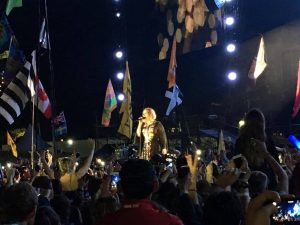
Adele was credited with having won over the Glastonbury festival on 26 June with a generous, celebratory set.  She did create some controversy by swearing 33 times during her performance after admitting that the BBC had warned her about her potty mouth.

How should we judge Adele’s swearing? Was it deliberate? Did she mean to offend?

Adele at Glastonbury 2016. ©Jordan Scammell

Adele at Glastonbury 2016. ©Jordan Scammell

The first important fact is that she used the word “fuck” and “fucking” rather than more offensive words. In other words, she was quite measured (in a way) and certainly didn’t mean to offend her audience.  Being a native speaker of English, Adele has perfect sociolinguistic and pragmatic competence. This means that she knows exactly what effect her words will have depending on the interlocutors and the situation. That skill is part of the reason why she is a great artist. She is able to combine the right words with the right tune and deliver them with such passion that they resonate with her audience. Her swearing is thus not a lack of competence but a different use of her communication skills: her swearwords reflected genuine emotions, she was bonding with the crowd and expressing her solidarity with them. This fits her image of being “the world’s most normal megastar – a bawdy best friend, confiding her deepest secrets to an audience of thousands”.

She did not swear to elicit laughs but to emphasise her authenticity, to boost her credibility, and to remind the audience of her working-class, Tottenham roots.  Although she sings in standard English in a relatively formal register (and there is no swearing in her songs), she speaks in a more informal register with a clear North London accent. The swearing was a way to tell her audience that she belongs to the “in-group”, in this case mostly teenagers and young adults who typically swear more frequently than older generations. She treated her audience like friends – incidentally the people we are most likely to swear with (Dewaele, 2015, 2016a) – and her banter, humour and swearing offered a welcome relief between the sad emotional songs that had her audience in tears.

The star, who famously suffers from stage fright may also have used swearwords for their cathartic effect, to allow her to vent her strong emotions. People who are more anxious and more stressed tend to swear more (Dewaele, 2016b; Jay & Jay, 2015). Another factor linked to frequency of swearing is the environment.  People who hear a lot of swearing, in the home or workplace, typically swear more across contexts and interlocutors. I wonder how much swearing goes on backstage at concerts and in studios.

So to conclude, I am convinced that Adele did not mean to offend when she swore at Glastonbury. Fans who were interviewed after the performance said it had been brilliant and very emotional, but did not mention the swearing. Of course, some curmudgeons who sat listening to the concert at home may have been offended by the swearing because they were not on the same emotional rollercoaster, surrounded by thousands of sweaty crying and yelling fans. And inevitably, the defenders of morality in public speech condemned the use of swearing on the BBC because some children might have picked up the F-words.  What these people ignore is the fact that children need to become aware that some words are taboo or “bad” words and others are non-taboo, “good” or neutral words (Jay & Jay, 2013). Most children already possess the rudiments of adult swearing when they enter school. In other words, swearing does not corrupt them. I’m of course not claiming that parents can freely swear when their kids are around or allow their kids to swear at them – on the contrary. We simply have to accept that kids will pick up this crucial aspect of pragmatic competence at some point in their life.

Another myth to dispel is that people who swear frequently have a limited vocabulary (Jay & Jay, 2015). The authors found that taboo word fluency was correlated with general fluency. Adele serves as an excellent example to counter the simplistic view that swearing is a symptom of language poverty.

References

Dewaele, J.-M. (2015) British ‘Bollocks’ versus American ‘Jerk’: Do native British English speakers swear more –or differently- compared to American English speakers? Applied Linguistic Review 6(3): 309–339. doi 10.1515/applirev-2015-0015

Dewaele, J.-M. (2016a) Thirty shades of offensiveness: L1 and LX English users’ understanding, perception and self-reported use of negative emotion-laden words. Journal of Pragmatics 94, 112-127. doi 10.1016/j.pragma.2016.01.009

Dewaele, J.-M. (2016b) Self-reported frequency of swearing in English: Do situational, psychological and sociobiographical variables have similar effects on first and foreign language users? Journal of Multilingual and Multicultural Development http://dx.doi.org/10.1080/01434632.2016.1201092

Jay, K. L., and T. B. Jay. (2013) A Child’s Garden of Curses: A Gender, Historical, and Age-related Evaluation of the Taboo Lexicon. The American Journal of Psychology 126, 459–475.

Jay, K. L., and T. B. Jay. (2015) Taboo Word Fluency and Knowledge of Slurs and General Pejoratives: Deconstructing the Poverty-of-Vocabulary Myth. Language Sciences 52, 251–259. http://dx.doi.org/10.1016/j.langsci.2014.12.003.

Alligator attack in Disneyworld reminds us of difficulties in managing human-alligator incidents

This post was contributed by Dr Simon Pooley, Lambert Lecturer in Environment (Applied Herpetology) in the Department of Geography, Environment and Development Studies

1024px-AmericanAlligator.JPGAs portrayed in numerous films, including Disney classics like The Rescuers, the American alligator (Alligator Mississippiensis) is an iconic and well known denizen of the State of Florida. It is surely difficult to visit the Sunshine State without being aware of the presence of alligators, which are effectively managed by the Florida Fish and Wildlife Service. However, yesterday’s attack on a two-year old visitor to Disney’s Grand Floridian Resort & Spa in Orlando, Florida, is a sad reminder that coexisting with large and potentially dangerous predators brings risks and responsibilities.

For those visiting Florida’s manicured gardens and golf courses and its theme parks and holiday resorts, it might seem that alligators are denizens of ‘the wild,’ of remote and inaccessible swamps and creeks. As this terrible incident reminds us, in fact alligators are widespread throughout natural and manmade waterways in the State, and it should never be assumed that alligators are not present unless explicit information is available to the contrary. This was highlighted in a widely reported incident just two weeks ago when a very large alligator strolled across a golf course in Palmetto, Florida.

While this attack may be ‘very rare’ (to quote Nick Wiley, executive director of the Florida Fish and Wildlife Conservation Commission), there have been at least 2-4 alligator bites per year reported in the state since record-keeping began in the early 1970s (deaths are much rarer). Being bitten by an alligator is thus always a possibility, though the risk is very small compared to the many other accidents that could occur. Witnesses interviewed after the attack lamented the lack of signs warning of the dangers of alligators, but it is a stretch to expect authorities to signpost every body of water in the State where alligators could turn up. Certainly areas home to stable populations of large alligators and accessible to people should be signposted. In fact, Florida has been a pioneer in the management of human-alligator incidents.

Following federal and state regulations in the 1970s, alligators were effectively protected and swiftly recovered, and complaints about ‘nuisance alligators’ rocketed. A Statewide Nuisance Alligator Program (SNAP) was put in place by the end of the decade, and today alligators are managed through a combination of targeted annual harvests, and incident response programmes outsourced to licensed hunters. Considering that the nearly 20 million inhabitants of the state, along with over 90 million visitors to the State annually, have a good chance of coming across the estimated 1.3 million alligators spread across all of its 67 counties, it is almost miraculous that so few incidents occur.

This incident is still unfolding, and more detail will emerge which may inform our understanding of the particular situation, but at this stage it seems that the incident should be viewed as a terrible accident. There are good educational materials available through the Florida Fish and Wildlife Commission website and public warnings should be issued in the months of peak alligator activity (April to August).

If we want large predators to exist outside of zoos and protected areas, which is necessary for their long-term survival, then we need to educate ourselves about their behaviour and how to behave around such animals. As wolves, bears, mountain lions, alligators and other large predators recover from past persecution and begin to range outside of fenced protected areas, we should learn about how to coexist with them, in the same way that we learn to behave safely around motor vehicles, roads, and also domesticated animals (which are responsible for more deaths and injuries than wild animals). We also need well trained and resourced wildlife management officials to respond swiftly and effectively when tragedies occur.

The Hissène Habré trial: a triumph for victims and civil society

This post was contributed by Marie Gibert, an associate lecturer in Birkbeck’s Department of Geography, Environment and Development Studies. This post was originally published by the South African Institute of International Affairs.

Nearly 26 years after he was forced out of power, former Chadian president Hissène Habré has been found guilty of crimes against humanity, torture (including sexual violence) and crimes of war committed under his rule from 1982 to 1990. He has been condemned to life imprisonment by the judges of theExtraordinary African Chambers (EACs), a court specially created by Senegal upon the request of the African Union (AU). This was the first trial of its kind on the continent and years of lobbying were necessary to convince the AU and Senegal to proceed with it. In pushing Africa to bring Habré to justice, the victims and the international coalition of non-governmental organisations that have supported them have shown that Africa’s relationship to international criminal justice is far more open than the statements of some African leaders might suggest. Africa’s people demand such justice, and will pull all the necessary levers to obtain it.

The years that have passed seem to have reinforced the determination of the surviving victims, the victims’ families and the civil society organisations (CSOs) that have accompanied them – from the Chadian Association of Victims of Crimes and Political Repression (AVCRP) to the Chadian Association for the Promotion and Defence of Human Rights (ATPDH) to the Dakar-based based African Assembly for the Defence of Human Rights (RADDHO) to the international Human Rights Watch (HRW) and International Federation for Human Rights (FIDH). In the absence of a straightforward legal path – it was evident from early on that the Chadian justice system would not request Habré’s extradition from Senegal to prosecute him, and the International Criminal Court’s (ICC) jurisdiction does not cover crimes committed before 2002 – they have, over the years, knocked on all doors. This has included calling on Senegalese justice, of course, but also on the UN Committee against Torture, the UN High Commissioner for Human Rights, Belgium’s universal jurisdiction provisions, and the International Court of Justice, but also defending their case before the Court of Justice of the Economic Community of West African States (ECOWAS), (of which Senegal is a member) that had been seized by Habré’s supporters and lawyers.

The campaign for the Habré trial has also successfully drawn on previous cases, and on the expertise that has now accumulated across the world on cases of mass human rights abuses. Argentinian forensics experts, with similar experience in their own country, were thus called upon to analyse Chad’s mass graves and testify in the trial. The courts’ name also naturally draws on the Extraordinary Chambers in the Courts of Cambodia, set up to try the surviving leaders of the Khmer Rouge regime. It provided an initial legal template when Senegal was asked to create an ad hoc tribunal to try the former Chadian president.

The campaign, however, has not just been a legal one. In the absence of a guarantee that the trial would take place one day, the surviving victims have been keen to publish their testimonies. This has taken many forms, from the more traditional bibliographic account written by Souleymane Guengueng, to video testimonies gathered on HRW’s website or in documentary films such as Klaartje Quirijns’ The Dictator Hunter, Isabel Coixet’s Parler de Rose, or Mahamat-Saleh Haroun’s Hissein Habre: a Chadian Tragedy. There are also written testimonies in civil society publications – in 2013 HRW published The Plain of the Dead, a 714-page account of the Habré repression system in great part based on victims’ testimonies – and interventions in the media. In so doing, the survivors have not only made sure their testimonies would be available beyond their own deaths, but also helped to publicise the Habré affair and gave it a very human face. Some of them have equally been present throughout the trial, delivering most of the witness testimonies in an attempt to represent as best as they could all victims, alive and dead.

Img habre Oueddei peace treay cc Ammagina

Chad’s Government of National Unity, headed by Goukouni Ooueddei (left), was created on 23 March 1979 in an attempt to end the civil war. Hissène Habré (right) was Minister of Defence until his loyalists overthrew the government in 1982, ushering in a military dictatorship that lasted until 1990. Photo (c)Ammagina, CC BY-SA 4.0

As with many such international justice prosecutions, Habré’s trial has taken place many thousands of kilometres away from most of his victims and the places where his secret police’s crimes took place. While some observers note that geographic distance, in some cases, may contribute to greater judicial serenity, most commentators state that it also means that justice remains out of reach for many victims and most of the population, and that the national judiciary is unable to strengthen its legitimacy in the eyes of the people. These are obvious shortcomings in the Habré affair, although the Chadian justice system prosecuted and condemned 20 Habré regime officials in 2015, in an obvious effort to show that justice could also be served in Chad.

Here, too, the steady involvement of the victims and CSOs has had an important effect on reducing the distance. They, and a number of initiatives launched by volunteers and legal professionals, have also made creative use of new technologies to promote the trial, record it and reach out to Chadians.Websites and Twitter have served as platforms to post regular updates on the proceedings whileYouTube has hosted all trial recordings posted by the EACs’ interactive forum. Outreach activities in Chad are on-going and have notably included public screenings of extracts of the trial, and debates and dialogues with local inhabitants throughout the country.

Paradoxically, the victims’ long wait for a trial may well have increased the quality of the evidence presented before the EACs. It has had an obvious impact, first, on the quality of the documentary evidence used in the trial. The EAC investigators were thus able to use documents from the Direction de la documentation et de la sécurité (DDS), Habré’s political police, found by HRW investigators in 2001, as well as the testimonies gathered by CSOs and evidence collected by Belgian Judge Fransen, who investigated the case in 2001-2005 (at a time when it looked like Belgium, rather than Senegal, would prosecute Habré). Moreover, not only has the time elapsed had no adverse effect on the victims’ determination to testify, it may even have given them a greater freedom to do so. The trial thus uncovered a hitherto little-known aspect of Habré’s rule: the extent to which sexual violence was used by its repressive system (a crime now specifically acknowledged in the verdict although the EAC judges had initially refused to add it to the charges). This discovery was only possible thanks to the testimonies of a number of now middle-aged women who testified about the violence and abuses to which they were subjected with an incredible dignity and great clarity, looking Habré in the eye. It is not likely that they would have felt able, and free, to do so publicly twenty years ago, as younger women. The Habré trial has thus successfully overcome one of the main challenges in the prosecution of grave crimes, that of gathering enough high quality evidence and witness statements – something the ICC has been struggling to do, notably with regards to the Kenyan case.

In many ways, the Habré trial before the EACs and the campaign that led to it have underlined the importance of a multi-faceted approach in seeking international criminal justice. The victims and their allies have gone well beyond the obvious legal strategy to lobby the AU, Senegal and their international partners. In seeking the support of international civil society allies, drawing on existing international expertise, knocking on all institutional doors, using a wide range of media outlets, collecting, transcribing and storing evidence, and preparing for the trial and their witness statements, they have not only made sure that, in the words of one of Habré’s victims, Rose Lokissim, ‘Chad would thank [them] and History would remember [them]’, but that the long-awaited justice would be of the highest possible quality.